Antipsychotic
agents
BY
DR. KASHIF IQBAL
Introduction
 Neuroleptic: synonym for antipsychotic drug;
originally indicated drug with antipsychotic efficacy
but also neurologic (extrapyramidal motor) side
effects, now claimed as subtype of antipsychotic
drugs
Typical neuroleptic: older
agents fitting this description
atypical" antipsychotic : newer
agents: antipsychotic efficacy
with reduced or no neurologic
side effects
History
 Reserpine
 Chlorpromazine: neuroleptic agent
 The discovery of clozapine was in 1959
 antipsychotic drugs need not cause EPS
(Extrapyramidal symptoms)
Nature of Psychosis &
Schizophrenia
 Chronic Psychosis.
 The presence of delusions (false beliefs)
 Various types of hallucinations, usually auditory or
visual, but sometimes tactile or olfactory
 Disorganized thinking in a clear sensorium
The Serotonin Hypothesis
of Schizophrenia
 Hallucinogens such as LSD (lysergic acid
diethylamide) and mescaline are serotonin (5-HT)
agonists
 5-HT2A-receptor blockade is a key factor in the
mechanism of action of the main class of atypical
antipsychotic drugs such as clozapine and
quetiapine.
 5-HT2C-receptor stimulation provides a further
means of modulating
The Dopamine Hypothesis
of Schizophrenia
 Was the first neurotransmitter-based concept
 Excessive limbic dopaminergic activity plays a role in psychosis
 Many antipsychotic drugs strongly block postsynaptic D2 receptors:
 Includes partial dopamine agonists, such as aripiprazole and
bifeprunox
 Drugs that increase dopaminergic activity either aggravate
schizophrenia psychosis or produce psychosis de novo
 Dopamine-receptor density is high postmortem
 The atypical antipsychotic drugs
 Much less effect on D2 receptors
 Role of other dopamine receptors and to nondopamine receptors
The Glutamate Hypothesis
of Schizophrenia
 Glutamate is the major excitatory
neurotransmitter in the brain
 Phencyclidine and ketamine are noncompetitive
inhibitors of the NMDA receptor
 Hypofunction of NMDA receptors, located on
GABAergic interneurons
Classification
Antipsychotic Drugs: Relation of Chemical Structure
to Potency and Toxicities
Chemical Class Drug D2/5-HT2A Ratio1 Clinical Potency Extrapyramidal
Toxicity
Sedative Action Hypotensive
Actions
Phenothiazines
Aliphatic Chlorpromazine High Low Medium High High
Piperazine Fluphenazine High High High Low Very low
Thioxanthene Thiothixene Very high High Medium Medium Medium
Butyrophenone Haloperidol Medium High Very high Low Very low
Dibenzodiazepin
e
Clozapine Very low Medium Very low Low Medium
Benzisoxazole Risperidone Very low High Low2 Low Low
Thienobenzodiaz
epine
Olanzapine Low High Very Low Medium Low
Dibenzothiazepi
ne
Quetiapine Low Low Very Low Medium Low to Medium
Dihydroindolone Ziprasidone Low Medium Very Low Low Very Low
Dihydrocarbostyr
il
Aripiprazole Medium High Very Low Very Low Low
Pharmacokinetics
 Absorption and Distribution
 Readily but incompletely absorbed
 Significant first-pass metabolism
 Highly lipid-soluble and protein-bound
 Metabolism
 Almost completely metabolized
 Drug-drug interactions should be considered
Pharmacodynamics
KEY CONCEPTS:
 All neuroleptics are equally effective in treating psychoses,
including schizophrenia, but differ in their tolerability.
 All neuroleptics
 block one or more types of DOPAMINE receptor, but differ in their
other neurochemical effects.
 show a significant delay before they become effective.
 produce significant adverse effects.
GENERAL CHARACTERISTICS OF TYPICAL
NEUROLEPTICS
 The older, typical neuroleptics are effective antipsychotic agents
with neurologic side effects involving the extrapyramidal motor
system.
 Typical neuroleptics block the dopamine-2 receptor.
GENERAL CHARACTERISTICS OF TYPICAL
NEUROLEPTICS
 Typical neuroleptics do not produce a general depression of
the CNS, e.g. respiratory depression
 Abuse, addiction, physical dependence do not develop to
typical neuroleptics.
GENERAL CHARACTERISTICS OF TYPICAL
NEUROLEPTICS
 Typical neuroleptics are generally more effective against
positive (active) symptoms of schizophrenia than the
negative (passive) symptoms.
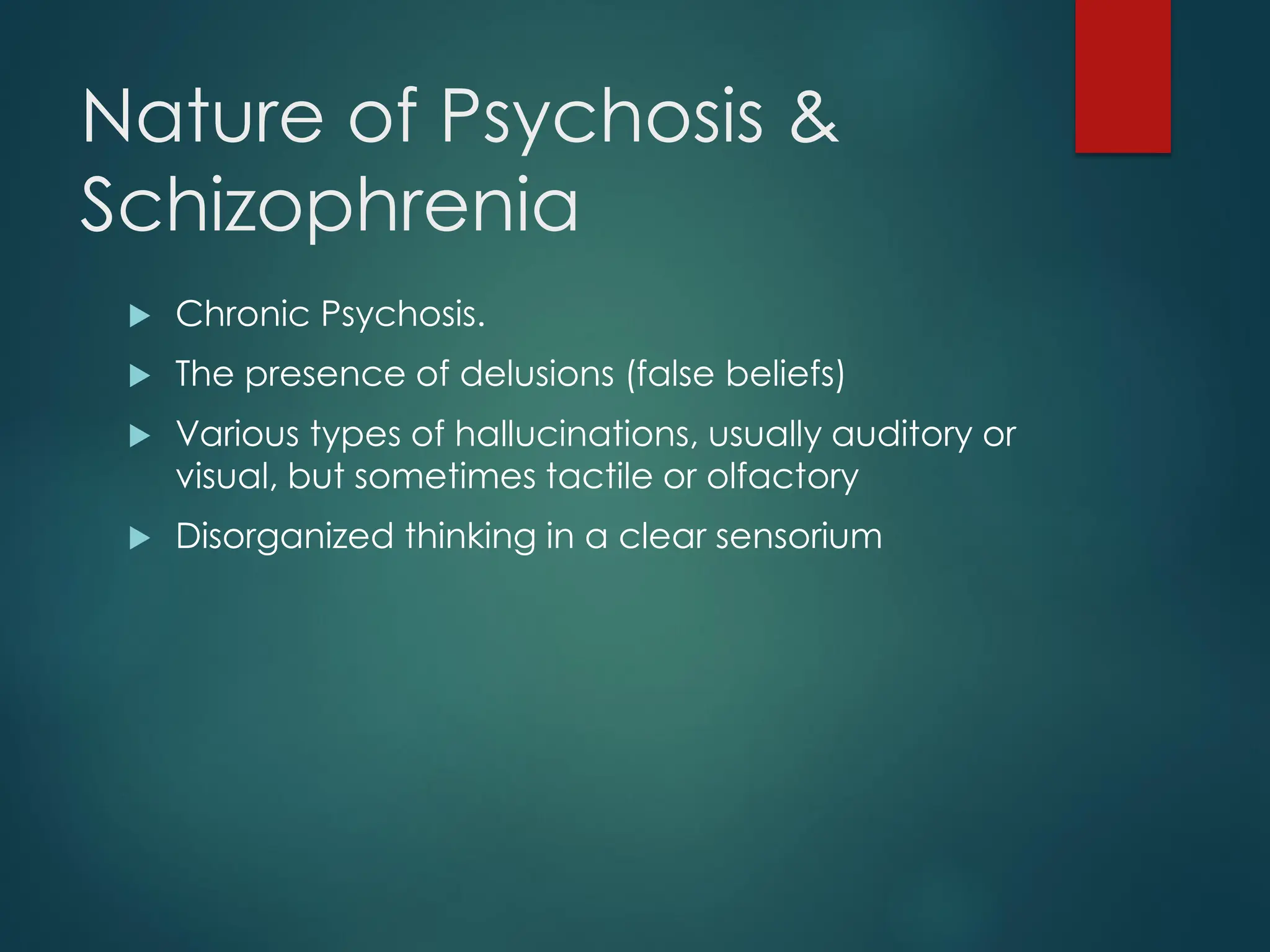
 Positive/active symptoms include thought
disturbances, delusions, hallucinations
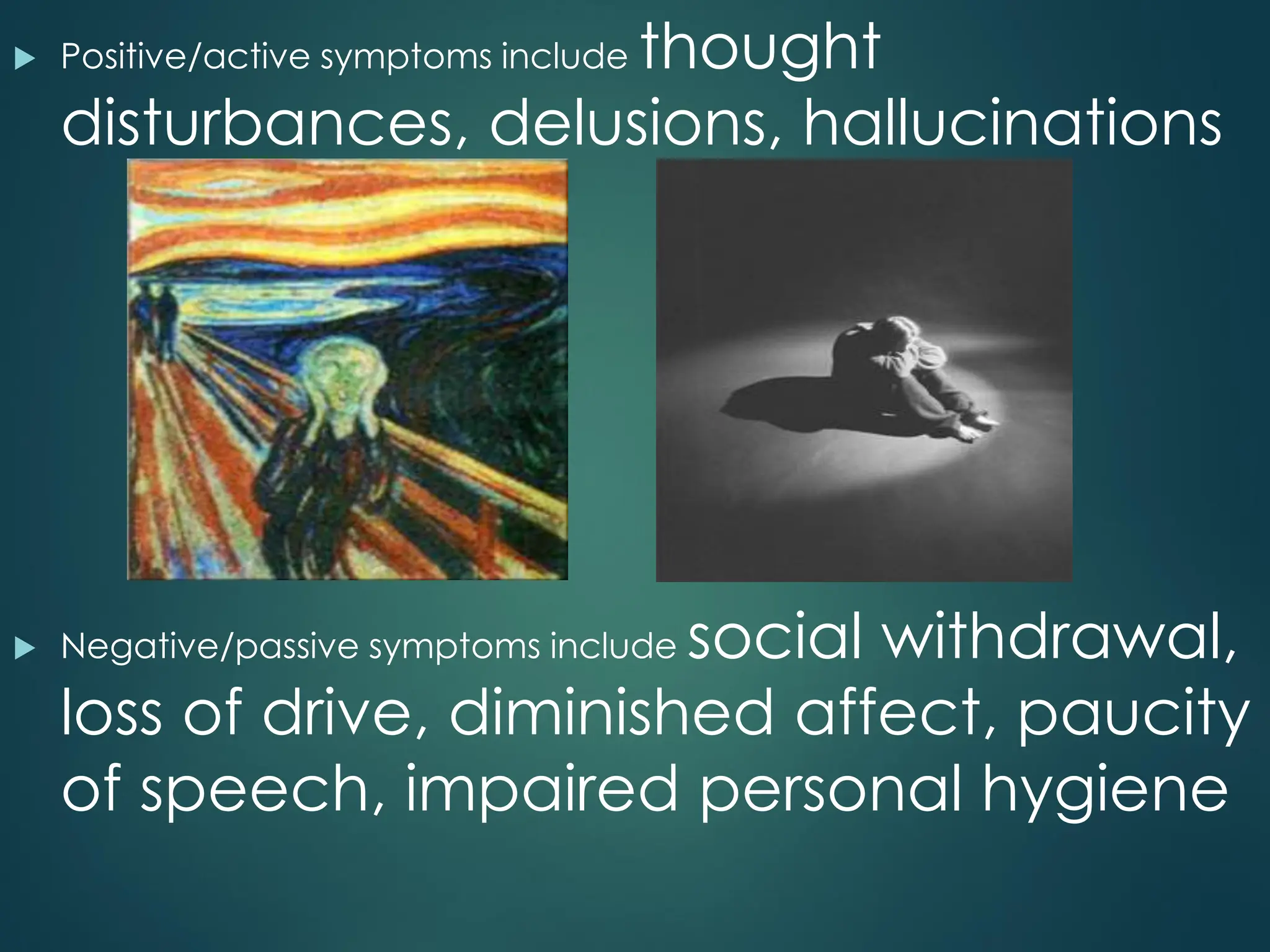
 Negative/passive symptoms include social withdrawal,
loss of drive, diminished affect, paucity
of speech, impaired personal hygiene
THERAPEUTIC EFFECTS OF TYPICAL
NEUROLEPTICS
 All appear equally effective; choice usually based on tolerability of
side effects
 Most common are haloperidol ,chlorpromazine and thioridazine
 Latency to beneficial effects; 4-6 week delay until full response is
common
 70-80% of patients respond, but 30-40% show only partial response
THERAPEUTIC EFFECTS OF TYPICAL
NEUROLEPTICS (Continued)
 Relapse, recurrence of symptoms is common ( approx. 50%
within two years).
 Noncompliance is common.
 Adverse effects are common.
ADVERSE EFFECTS OF TYPICAL
NEUROLEPTICS
 Anticholinergic (antimuscarinic) side effects:
 Dry mouth, blurred vision, tachycardia, constipation, urinary
retention, impotence
 Antiadrenergic (Alpha-1) side effects:
Orthostatic hypotension , reflex
tachycardia
Sedation
 Antihistamine effect: sedation, weight gain
ADVERSE EFFECTS OF TYPICAL
NEUROLEPTICS (Continued)
 Increased prolactin secretion (common with all;
from dopamine blockade)
 Weight gain (common, antihistamine effect?)
 Photosensitivity (v. common w/ phenothiazines)
 Lowered seizure threshold (common with all)
 Leukopenia , agranulocytosis (rare; w/
phenothiazines)
 Retinal pigmentopathy (rare; w/ phenothiazines)
MECHANISMS OF ACTION
OF TYPICAL NEUROLEPTICS and Some Side
Effects
 DOPAMINE-2 receptor blockade in meso-
limbic and meso-cortical systems for
antipsychotic effect.
 DOPAMINE-2 receptor blockade in basal
ganglia (nigro-striatal system) for EPS
 DOPAMINE-2 receptor supersensitivity in
nigrostriatal system for tardive dyskinesia
MANAGEMENT OF EPS
 Dystonia and parkinsonism: anticholinergic antiparkinson drugs
 Neuroleptic malignant syndrome: muscle relaxants, DA agonists,
supportive
 Akathisia: benzodiazepines, propranolol
 Tardive dyskinesia: increase neuroleptic dose; switch to clozapine
HYPOTHESIZED MECHANISMS OF
ACTION OF ATYPICAL
NEUROLEPTICS
 Combination of Dopamine-4 and Serotonin-2 receptor
blockade in cortical and limbic areas for the “pines” like
clozapine
 Combination of Dopamine-2 and Serotonin-2 receptor
blockade (esp. risperidone)
ADDITIONAL CLINICAL USES OF TYPICAL
NEUROLEPTICS
 Adjunctive in acute manic episode
 Tourette’s syndrome (Haloperidole )
 Control of psychosis in depressed patient
 Phenothiazines are effective anti-emetics,
 Esp. prochlorperazine
 Also, anti-migraine effect
PHARMACOLOGY OF CLOZAPINE
 FDA-approved for patients not responding to other agents or with
severe tardive dyskinesia
 Effective against negative symptoms
 Also effective in bipolar disorder
 Little or no parkinsonism, tardive dyskinesia, PRL elevation, neuro-
malignant syndrome; some akathisia
PHARMACOLOGY OF CLOZAPINE
(Continued )
 Other adverse effects;
Weight gain
Increased salivation
Increased risk of seizures
Risk of agranulocytosis
requires continual monitoring
PHARMACOLOGY OF OLANZAPINE
 Olanzapine is clozapine without the agranulocytosis.
Same therapeutic effectiveness
Same side effect profile
PHARMACOLOGY OF QUETIAPINE
 Quetiapine is olanzapine without the anticholinergic effects.
Same therapeutic effectiveness
Same side effect profile
Resperidone
 Highly effective against positive and negative symptoms
 Adverse effects:
EPS incidence is dose-related
Alpha-1 receptor blockade
Little or no anticholinergic or
antihistamine effects
Weight gain, PRL elevation

Antipsychotic agents final PHARMACOLOGY.pdf

  • 1.
  • 2.
    Introduction  Neuroleptic: synonymfor antipsychotic drug; originally indicated drug with antipsychotic efficacy but also neurologic (extrapyramidal motor) side effects, now claimed as subtype of antipsychotic drugs Typical neuroleptic: older agents fitting this description atypical" antipsychotic : newer agents: antipsychotic efficacy with reduced or no neurologic side effects
  • 3.
    History  Reserpine  Chlorpromazine:neuroleptic agent  The discovery of clozapine was in 1959  antipsychotic drugs need not cause EPS (Extrapyramidal symptoms)
  • 4.
    Nature of Psychosis& Schizophrenia  Chronic Psychosis.  The presence of delusions (false beliefs)  Various types of hallucinations, usually auditory or visual, but sometimes tactile or olfactory  Disorganized thinking in a clear sensorium
  • 5.
    The Serotonin Hypothesis ofSchizophrenia  Hallucinogens such as LSD (lysergic acid diethylamide) and mescaline are serotonin (5-HT) agonists  5-HT2A-receptor blockade is a key factor in the mechanism of action of the main class of atypical antipsychotic drugs such as clozapine and quetiapine.  5-HT2C-receptor stimulation provides a further means of modulating
  • 6.
    The Dopamine Hypothesis ofSchizophrenia  Was the first neurotransmitter-based concept  Excessive limbic dopaminergic activity plays a role in psychosis  Many antipsychotic drugs strongly block postsynaptic D2 receptors:  Includes partial dopamine agonists, such as aripiprazole and bifeprunox  Drugs that increase dopaminergic activity either aggravate schizophrenia psychosis or produce psychosis de novo  Dopamine-receptor density is high postmortem  The atypical antipsychotic drugs  Much less effect on D2 receptors  Role of other dopamine receptors and to nondopamine receptors
  • 7.
    The Glutamate Hypothesis ofSchizophrenia  Glutamate is the major excitatory neurotransmitter in the brain  Phencyclidine and ketamine are noncompetitive inhibitors of the NMDA receptor  Hypofunction of NMDA receptors, located on GABAergic interneurons
  • 8.
  • 9.
    Antipsychotic Drugs: Relationof Chemical Structure to Potency and Toxicities Chemical Class Drug D2/5-HT2A Ratio1 Clinical Potency Extrapyramidal Toxicity Sedative Action Hypotensive Actions Phenothiazines Aliphatic Chlorpromazine High Low Medium High High Piperazine Fluphenazine High High High Low Very low Thioxanthene Thiothixene Very high High Medium Medium Medium Butyrophenone Haloperidol Medium High Very high Low Very low Dibenzodiazepin e Clozapine Very low Medium Very low Low Medium Benzisoxazole Risperidone Very low High Low2 Low Low Thienobenzodiaz epine Olanzapine Low High Very Low Medium Low Dibenzothiazepi ne Quetiapine Low Low Very Low Medium Low to Medium Dihydroindolone Ziprasidone Low Medium Very Low Low Very Low Dihydrocarbostyr il Aripiprazole Medium High Very Low Very Low Low
  • 10.
    Pharmacokinetics  Absorption andDistribution  Readily but incompletely absorbed  Significant first-pass metabolism  Highly lipid-soluble and protein-bound  Metabolism  Almost completely metabolized  Drug-drug interactions should be considered
  • 11.
  • 12.
    KEY CONCEPTS:  Allneuroleptics are equally effective in treating psychoses, including schizophrenia, but differ in their tolerability.  All neuroleptics  block one or more types of DOPAMINE receptor, but differ in their other neurochemical effects.  show a significant delay before they become effective.  produce significant adverse effects.
  • 13.
    GENERAL CHARACTERISTICS OFTYPICAL NEUROLEPTICS  The older, typical neuroleptics are effective antipsychotic agents with neurologic side effects involving the extrapyramidal motor system.  Typical neuroleptics block the dopamine-2 receptor.
  • 14.
    GENERAL CHARACTERISTICS OFTYPICAL NEUROLEPTICS  Typical neuroleptics do not produce a general depression of the CNS, e.g. respiratory depression  Abuse, addiction, physical dependence do not develop to typical neuroleptics.
  • 15.
    GENERAL CHARACTERISTICS OFTYPICAL NEUROLEPTICS  Typical neuroleptics are generally more effective against positive (active) symptoms of schizophrenia than the negative (passive) symptoms.
  • 16.
     Positive/active symptomsinclude thought disturbances, delusions, hallucinations  Negative/passive symptoms include social withdrawal, loss of drive, diminished affect, paucity of speech, impaired personal hygiene
  • 17.
    THERAPEUTIC EFFECTS OFTYPICAL NEUROLEPTICS  All appear equally effective; choice usually based on tolerability of side effects  Most common are haloperidol ,chlorpromazine and thioridazine  Latency to beneficial effects; 4-6 week delay until full response is common  70-80% of patients respond, but 30-40% show only partial response
  • 18.
    THERAPEUTIC EFFECTS OFTYPICAL NEUROLEPTICS (Continued)  Relapse, recurrence of symptoms is common ( approx. 50% within two years).  Noncompliance is common.  Adverse effects are common.
  • 19.
    ADVERSE EFFECTS OFTYPICAL NEUROLEPTICS  Anticholinergic (antimuscarinic) side effects:  Dry mouth, blurred vision, tachycardia, constipation, urinary retention, impotence  Antiadrenergic (Alpha-1) side effects: Orthostatic hypotension , reflex tachycardia Sedation  Antihistamine effect: sedation, weight gain
  • 20.
    ADVERSE EFFECTS OFTYPICAL NEUROLEPTICS (Continued)  Increased prolactin secretion (common with all; from dopamine blockade)  Weight gain (common, antihistamine effect?)  Photosensitivity (v. common w/ phenothiazines)  Lowered seizure threshold (common with all)  Leukopenia , agranulocytosis (rare; w/ phenothiazines)  Retinal pigmentopathy (rare; w/ phenothiazines)
  • 21.
    MECHANISMS OF ACTION OFTYPICAL NEUROLEPTICS and Some Side Effects  DOPAMINE-2 receptor blockade in meso- limbic and meso-cortical systems for antipsychotic effect.  DOPAMINE-2 receptor blockade in basal ganglia (nigro-striatal system) for EPS  DOPAMINE-2 receptor supersensitivity in nigrostriatal system for tardive dyskinesia
  • 22.
    MANAGEMENT OF EPS Dystonia and parkinsonism: anticholinergic antiparkinson drugs  Neuroleptic malignant syndrome: muscle relaxants, DA agonists, supportive  Akathisia: benzodiazepines, propranolol  Tardive dyskinesia: increase neuroleptic dose; switch to clozapine
  • 23.
    HYPOTHESIZED MECHANISMS OF ACTIONOF ATYPICAL NEUROLEPTICS  Combination of Dopamine-4 and Serotonin-2 receptor blockade in cortical and limbic areas for the “pines” like clozapine  Combination of Dopamine-2 and Serotonin-2 receptor blockade (esp. risperidone)
  • 24.
    ADDITIONAL CLINICAL USESOF TYPICAL NEUROLEPTICS  Adjunctive in acute manic episode  Tourette’s syndrome (Haloperidole )  Control of psychosis in depressed patient  Phenothiazines are effective anti-emetics,  Esp. prochlorperazine  Also, anti-migraine effect
  • 25.
    PHARMACOLOGY OF CLOZAPINE FDA-approved for patients not responding to other agents or with severe tardive dyskinesia  Effective against negative symptoms  Also effective in bipolar disorder  Little or no parkinsonism, tardive dyskinesia, PRL elevation, neuro- malignant syndrome; some akathisia
  • 26.
    PHARMACOLOGY OF CLOZAPINE (Continued)  Other adverse effects; Weight gain Increased salivation Increased risk of seizures Risk of agranulocytosis requires continual monitoring
  • 27.
    PHARMACOLOGY OF OLANZAPINE Olanzapine is clozapine without the agranulocytosis. Same therapeutic effectiveness Same side effect profile
  • 28.
    PHARMACOLOGY OF QUETIAPINE Quetiapine is olanzapine without the anticholinergic effects. Same therapeutic effectiveness Same side effect profile
  • 29.
    Resperidone  Highly effectiveagainst positive and negative symptoms  Adverse effects: EPS incidence is dose-related Alpha-1 receptor blockade Little or no anticholinergic or antihistamine effects Weight gain, PRL elevation