Antipsychotics
Presenter: MBI MBI
Designation: MBBS IV
Rotation: Psychiatry
Facilitator: Dr. Ayugi
Objectives
• Understand the role of Dopamine in
CNS.
• Outline and categories common
antipsychotic.
• Describe the mechanism of action of
antipsychotics and their adverse effects.
Dopamine
• Dopamine is a catecholamine
neurotransmitter present in CNS.
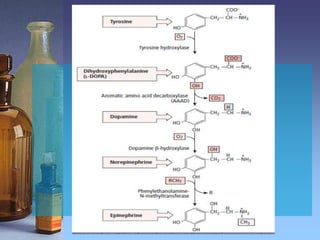
• Its synthesized from the conversion of
tyrosine to dopa (the rate-limiting step),
followed by decarboxylation to form
dopamine.
• Its largely recaptured following its
release from nerve terminals, by a
specific dopamine transporter.
• It is metabolized by monoamine oxidase
(MOA) and catechol-O-methyl
transferase (COMT), the main products
being dihydroxyphenylacetic acid
(DOPAC) and homovanillic acid (HVA,
the methoxy derivative of DOPAC).
• DOPAC and HVA, and their sulfate
conjugates, are then excreted in the
urine.
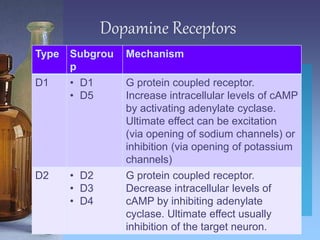
Dopamine Receptors
Type Subgrou
p
Mechanism
D1 • D1
• D5
G protein coupled receptor.
Increase intracellular levels of cAMP
by activating adenylate cyclase.
Ultimate effect can be excitation
(via opening of sodium channels) or
inhibition (via opening of potassium
channels)
D2 • D2
• D3
• D4
G protein coupled receptor.
Decrease intracellular levels of
cAMP by inhibiting adenylate
cyclase. Ultimate effect usually
inhibition of the target neuron.
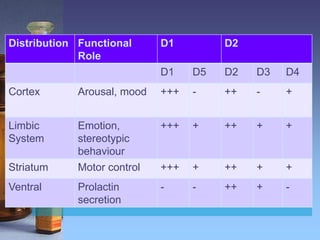
Distribution Functional
Role
D1 D2
D1 D5 D2 D3 D4
Cortex Arousal, mood +++ - ++ - +
Limbic
System
Emotion,
stereotypic
behaviour
+++ + ++ + +
Striatum Motor control +++ + ++ + +
Ventral Prolactin
secretion
- - ++ + -
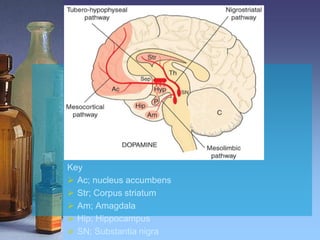
Dopaminergic Pathways in the Brain
1. Nigrostriatal pathway.
2. Mesolimbic/mesocortical pathways.
3. Tuberohypophyseal system.
Key
 Ac; nucleus accumbens
 Str; Corpus striatum
 Am; Amagdala
 Hip; Hippocampus
 SN; Substantia nigra
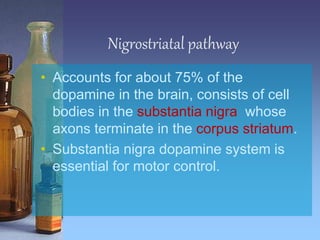
Nigrostriatal pathway
• Accounts for about 75% of the
dopamine in the brain, consists of cell
bodies in the substantia nigra whose
axons terminate in the corpus striatum.
• Substantia nigra dopamine system is
essential for motor control.
• First, dopamine sets the effort threshold
for initiating behaviors. As a
consequence, high levels of dopamine
lead to high levels of motor activity and
"impulsive" behaviour.
• The second important effect is as a
learning response. When a motor
response is followed by an increase in
dopamine activity, the basal ganglia
circuit is altered in a way that makes the
same response easier to evoke when
similar situations arise in the future.
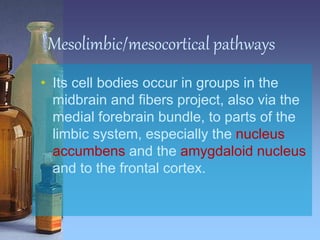
Mesolimbic/mesocortical pathways
• Its cell bodies occur in groups in the
midbrain and fibers project, also via the
medial forebrain bundle, to parts of the
limbic system, especially the nucleus
accumbens and the amygdaloid nucleus
and to the frontal cortex.
• The ventral tegmental area (VTA) is the
origin of the dopaminergic cell bodies of
the mesocorticolimbic dopamine system
is strongly associated with the reward
system of the brain.
• Dopamine is released in areas such as
the nucleus accumbens and prefrontal
cortex as a result of rewarding
experiences such as food, sex and
neutral stimuli that become associated
with them.
Tuberohypophyseal system
• Is a group of short neurons running from
the ventral hypothalamus to the median
eminence and pituitary gland, the
secretions of which they regulate.
• Dopamine is the primary
neuroendocrine inhibitor of the secretion
of prolactin from the anterior pituitary
gland
Antipsychotics
• Antipsychotics (also known as neuroleptics or
major tranquilizers) are a class of psychiatric
medication primarily used to manage psychosis.
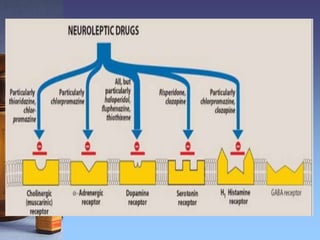
• They bind to these receptors to varying degrees
(D1 to D5 subtypes). However, the clinical efficacy
of the drugs correlates closely with their relative
ability to block D2 receptors in the mesolimbic
system of the brain.
• Most also block other monoamine receptors,
especially 5-HT2.
1st Generation Antipsychotics (Typical)
I. Butyrophenones
• Butyrophenones are a class of
pharmaceutical drugs derived from
butyrophenone.
• Examples include Haloperidol.
II. Phenothiazines
• is an organic compound that occurs in
various antipsychotic and antihistaminic
drugs (promethazine).
• Chlorpromazine is such a drug First
synthesized on December 11, 1950,
chlorpromazine was the first drug
developed with specific antipsychotic
action.
1st Generation Antipsychotic Adverse Effects
• Akathisia (60%); restlessness that manifests itself
with an inability to sit still or remain motionless.
• Anticholinergic side effects.
• Sedation.
• Orthostatic hypotension.
• Weight gain.
• Amenorrhea, Oligomenorrhea , Galactorhoea.
• Gynaecomastia, erectile dysfunction and priapism.
• Cholestatic jaundice.
• Extrapyramidal symptoms (EPS) Dystonia and
Tardive dyskinesia.
• Neuroleptic Malignant Syndrome (NMS).
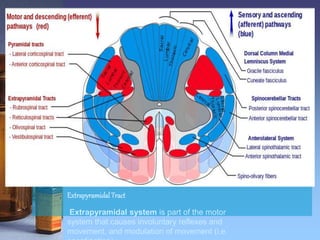
ExtrapyramidalTract
Extrapyramidal system is part of the motor
system that causes involuntary reflexes and
movement, and modulation of movement (i.e.
Extrapyramidal Motor dysfunction
Acute dystonias are involuntary
movements (restlessness, muscle
spasms, protruding tongue, fixed upward
gaze, torticollis, i.e. involuntary spasm of
neck muscles resulting in turning of the
head, etc). They occur commonly in the
first few weeks, often declining with time,
and are reversible on stopping drug
treatment.
Tardive Dyskinesia
• Develops after months or years in 20-40% of patients treated
with first-generation antipsychotic drugs.
• it is a disabling and often irreversible condition, which often
gets worse when antipsychotic therapy is stopped and is
resistant to treatment.
• The syndrome consists of involuntary movements, often of
the face and tongue, but also of the trunk and limbs, which
can be severely disabling.
• Its theorized that there is an associated with a gradual
increase in the number of D2-receptors in the striatum, which
is less marked during treatment with the atypical than with
the first generation of antipsychotic drugs.
• Another possibility is that chronic block of inhibitory dopamine
receptors enhances catecholamine and/or glutamate release
in the striatum, leading to excitotoxic neurodegeneration.
Neuroleptic Malignant Syndrome
Life-threatening neurological disorder
manifesting with;
• Fever >38°C.
• Confused or altered consciousness.
• Diaphoresis.
• Rigid muscles.
• Autonomic imbalance i.e. hypertensive
urgency.
2nd Generation Antipsychotic (Atypical)
• Group of antipsychotic drugs used the
treatment for;
• Schizophrenia.
• Bipolar disorder.
• Autism.
• And as an adjunct in major depressive
disorder.
Clozapine
• Clozapine is the first of the atypical
antipsychotics to be developed.
• It was first introduced in Europe in 1971,
but was voluntarily withdrawn by the
manufacturer in 1975 after it was shown
to cause Agranulocytosis.
• Clozapine has shown high affinity for
D4-receptors subtype.
Clozapine Side Effects
• Hypotension, tachycardia.
• Wieght gain.
• Sialorrhea.
• Dyspepsia, nausea and vomiting.
• Anemia, agranulocytosis, thrombocytopenia.
• Enuresis, impotence, change in libido,
dysmeorrhea.
• NMS.
• Fatigue, weakness, seizure, slurred speech
• Myocarditis.
Olanzapine
• Olanzapine is structurally similar to
clozapine. Used in the treatment of
• Schizophrenia.
• Bipolar disorder.
Olanzapine Side Effects
• Weight gain.
• Hypertriglyceridemia,
Hypercholesterolemia.
• NMS.
• Somnolence.
• EPS.
• Hyperprolactinemia.
• VTE.
• Hyperglycemia, DKA, Diabetic coma.
• Seizures.
Risperidone
• Risperidone antipsychotic drug which is
mainly used to treat;
• Schizophrenia (including adolescent
schizophrenia)
• Schizoaffective disorder.
• Bipolar disorder.
• Autism.
Side Effects of Risperidone
• Somnolence.
• Insomnia.
• Agitation and anxiety.
• Rhinitis.
• Headache, tachycardia, orthostatic
hypotension, NMS.
• Hyperprolactinemia and gynaecomastia
(children).
• Dyspepsia, nausea and vomiting.
• Seizures.
• DM type 2.
• TTP and agranulocytosis.
Recap
Distinction between typical and atypical
groups is not clearly defined but rests on:
• receptor profile.
• incidence of extrapyramidal side
effects (less in atypical group).
• efficacy (specifically of clozapine) in
'treatment-resistant' group of patients
efficacy against negative symptoms.
References
• Rang & Dale’s Pharmacology 6th edition
pg. 545-548.
• A Textbook of Neuroanatomy pg. 45-52,
191-212.
• Lippincott's Illustrated Reviews:
Pharmacology, 4th Edition pg. 152-158.
• Richard S. Snell 2010. Clinical
Neuroanatomy 7th edition
• Medscape drug app.

Antipsychotics

  • 1.
    Antipsychotics Presenter: MBI MBI Designation:MBBS IV Rotation: Psychiatry Facilitator: Dr. Ayugi
  • 2.
    Objectives • Understand therole of Dopamine in CNS. • Outline and categories common antipsychotic. • Describe the mechanism of action of antipsychotics and their adverse effects.
  • 3.
    Dopamine • Dopamine isa catecholamine neurotransmitter present in CNS. • Its synthesized from the conversion of tyrosine to dopa (the rate-limiting step), followed by decarboxylation to form dopamine. • Its largely recaptured following its release from nerve terminals, by a specific dopamine transporter.
  • 4.
    • It ismetabolized by monoamine oxidase (MOA) and catechol-O-methyl transferase (COMT), the main products being dihydroxyphenylacetic acid (DOPAC) and homovanillic acid (HVA, the methoxy derivative of DOPAC). • DOPAC and HVA, and their sulfate conjugates, are then excreted in the urine.
  • 6.
    Dopamine Receptors Type Subgrou p Mechanism D1• D1 • D5 G protein coupled receptor. Increase intracellular levels of cAMP by activating adenylate cyclase. Ultimate effect can be excitation (via opening of sodium channels) or inhibition (via opening of potassium channels) D2 • D2 • D3 • D4 G protein coupled receptor. Decrease intracellular levels of cAMP by inhibiting adenylate cyclase. Ultimate effect usually inhibition of the target neuron.
  • 7.
    Distribution Functional Role D1 D2 D1D5 D2 D3 D4 Cortex Arousal, mood +++ - ++ - + Limbic System Emotion, stereotypic behaviour +++ + ++ + + Striatum Motor control +++ + ++ + + Ventral Prolactin secretion - - ++ + -
  • 8.
    Dopaminergic Pathways inthe Brain 1. Nigrostriatal pathway. 2. Mesolimbic/mesocortical pathways. 3. Tuberohypophyseal system.
  • 9.
    Key  Ac; nucleusaccumbens  Str; Corpus striatum  Am; Amagdala  Hip; Hippocampus  SN; Substantia nigra
  • 10.
    Nigrostriatal pathway • Accountsfor about 75% of the dopamine in the brain, consists of cell bodies in the substantia nigra whose axons terminate in the corpus striatum. • Substantia nigra dopamine system is essential for motor control.
  • 11.
    • First, dopaminesets the effort threshold for initiating behaviors. As a consequence, high levels of dopamine lead to high levels of motor activity and "impulsive" behaviour. • The second important effect is as a learning response. When a motor response is followed by an increase in dopamine activity, the basal ganglia circuit is altered in a way that makes the same response easier to evoke when similar situations arise in the future.
  • 12.
    Mesolimbic/mesocortical pathways • Itscell bodies occur in groups in the midbrain and fibers project, also via the medial forebrain bundle, to parts of the limbic system, especially the nucleus accumbens and the amygdaloid nucleus and to the frontal cortex.
  • 13.
    • The ventraltegmental area (VTA) is the origin of the dopaminergic cell bodies of the mesocorticolimbic dopamine system is strongly associated with the reward system of the brain. • Dopamine is released in areas such as the nucleus accumbens and prefrontal cortex as a result of rewarding experiences such as food, sex and neutral stimuli that become associated with them.
  • 14.
    Tuberohypophyseal system • Isa group of short neurons running from the ventral hypothalamus to the median eminence and pituitary gland, the secretions of which they regulate. • Dopamine is the primary neuroendocrine inhibitor of the secretion of prolactin from the anterior pituitary gland
  • 15.
    Antipsychotics • Antipsychotics (alsoknown as neuroleptics or major tranquilizers) are a class of psychiatric medication primarily used to manage psychosis. • They bind to these receptors to varying degrees (D1 to D5 subtypes). However, the clinical efficacy of the drugs correlates closely with their relative ability to block D2 receptors in the mesolimbic system of the brain. • Most also block other monoamine receptors, especially 5-HT2.
  • 17.
    1st Generation Antipsychotics(Typical) I. Butyrophenones • Butyrophenones are a class of pharmaceutical drugs derived from butyrophenone. • Examples include Haloperidol.
  • 18.
    II. Phenothiazines • isan organic compound that occurs in various antipsychotic and antihistaminic drugs (promethazine). • Chlorpromazine is such a drug First synthesized on December 11, 1950, chlorpromazine was the first drug developed with specific antipsychotic action.
  • 19.
    1st Generation AntipsychoticAdverse Effects • Akathisia (60%); restlessness that manifests itself with an inability to sit still or remain motionless. • Anticholinergic side effects. • Sedation. • Orthostatic hypotension. • Weight gain. • Amenorrhea, Oligomenorrhea , Galactorhoea. • Gynaecomastia, erectile dysfunction and priapism. • Cholestatic jaundice. • Extrapyramidal symptoms (EPS) Dystonia and Tardive dyskinesia. • Neuroleptic Malignant Syndrome (NMS).
  • 20.
    ExtrapyramidalTract Extrapyramidal system ispart of the motor system that causes involuntary reflexes and movement, and modulation of movement (i.e.
  • 21.
    Extrapyramidal Motor dysfunction Acutedystonias are involuntary movements (restlessness, muscle spasms, protruding tongue, fixed upward gaze, torticollis, i.e. involuntary spasm of neck muscles resulting in turning of the head, etc). They occur commonly in the first few weeks, often declining with time, and are reversible on stopping drug treatment.
  • 22.
    Tardive Dyskinesia • Developsafter months or years in 20-40% of patients treated with first-generation antipsychotic drugs. • it is a disabling and often irreversible condition, which often gets worse when antipsychotic therapy is stopped and is resistant to treatment. • The syndrome consists of involuntary movements, often of the face and tongue, but also of the trunk and limbs, which can be severely disabling. • Its theorized that there is an associated with a gradual increase in the number of D2-receptors in the striatum, which is less marked during treatment with the atypical than with the first generation of antipsychotic drugs. • Another possibility is that chronic block of inhibitory dopamine receptors enhances catecholamine and/or glutamate release in the striatum, leading to excitotoxic neurodegeneration.
  • 23.
    Neuroleptic Malignant Syndrome Life-threateningneurological disorder manifesting with; • Fever >38°C. • Confused or altered consciousness. • Diaphoresis. • Rigid muscles. • Autonomic imbalance i.e. hypertensive urgency.
  • 24.
    2nd Generation Antipsychotic(Atypical) • Group of antipsychotic drugs used the treatment for; • Schizophrenia. • Bipolar disorder. • Autism. • And as an adjunct in major depressive disorder.
  • 25.
    Clozapine • Clozapine isthe first of the atypical antipsychotics to be developed. • It was first introduced in Europe in 1971, but was voluntarily withdrawn by the manufacturer in 1975 after it was shown to cause Agranulocytosis. • Clozapine has shown high affinity for D4-receptors subtype.
  • 26.
    Clozapine Side Effects •Hypotension, tachycardia. • Wieght gain. • Sialorrhea. • Dyspepsia, nausea and vomiting. • Anemia, agranulocytosis, thrombocytopenia. • Enuresis, impotence, change in libido, dysmeorrhea. • NMS. • Fatigue, weakness, seizure, slurred speech • Myocarditis.
  • 27.
    Olanzapine • Olanzapine isstructurally similar to clozapine. Used in the treatment of • Schizophrenia. • Bipolar disorder.
  • 28.
    Olanzapine Side Effects •Weight gain. • Hypertriglyceridemia, Hypercholesterolemia. • NMS. • Somnolence. • EPS. • Hyperprolactinemia. • VTE. • Hyperglycemia, DKA, Diabetic coma. • Seizures.
  • 29.
    Risperidone • Risperidone antipsychoticdrug which is mainly used to treat; • Schizophrenia (including adolescent schizophrenia) • Schizoaffective disorder. • Bipolar disorder. • Autism.
  • 30.
    Side Effects ofRisperidone • Somnolence. • Insomnia. • Agitation and anxiety. • Rhinitis. • Headache, tachycardia, orthostatic hypotension, NMS. • Hyperprolactinemia and gynaecomastia (children). • Dyspepsia, nausea and vomiting. • Seizures. • DM type 2. • TTP and agranulocytosis.
  • 31.
    Recap Distinction between typicaland atypical groups is not clearly defined but rests on: • receptor profile. • incidence of extrapyramidal side effects (less in atypical group). • efficacy (specifically of clozapine) in 'treatment-resistant' group of patients efficacy against negative symptoms.
  • 32.
    References • Rang &Dale’s Pharmacology 6th edition pg. 545-548. • A Textbook of Neuroanatomy pg. 45-52, 191-212. • Lippincott's Illustrated Reviews: Pharmacology, 4th Edition pg. 152-158. • Richard S. Snell 2010. Clinical Neuroanatomy 7th edition • Medscape drug app.