ANTIDIARRHOEALS
BY DR.UMA NARAYANAMURTHY,
ASSISTANT PROFESSOR,
DEPARTMENT OF PHARMACOLOGY
Diarrhea: defined as 3 or more loose or watery stools in a
24 hour period.
In other words it is due to passage of excess water in
faeces which may be due to
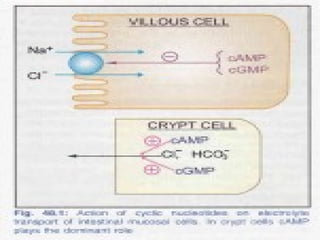
1.Decreased water and electrolyte absorption
2.Increased secretion by intestinal mucosa
3.Increased luminal osmotic load
4.Inflammation of mucosa and exudation into lumen
Most patients with sudden onset of diarrhea have a
benign self-limited illness requiring no treatment or
evaluation.
Principles of management
• Treatment of fluid depletion, shock and
acidosis
• Maintainence of nutrition
• Drug therapy
• Based upon severity and nature of diarrhea
management is carried on
Intravenous rehydration
• When fluid loss is severe
• Components:
NaCl
KCl
NaHCO3
Ringer lactate commonly recommended iv
fluid
Acute diarrhea
Oral rehydration solution is the cornerstone for patients
with acute illnesses resulting in significant diarrhea
Rehydration. WHO ORS:
1.Sodium chloride: 3.5g
2.Sodium bicarbonate: 2.5g
Or
Trisodium citrate: 2.9g
3.Potassium chloride 1.5g
4.Glucose: 20g
5.Potable water: 1 liter
Rice based physiological solutions.
Rationale of ORS
ORT
• Administration
• Non-diarrhoeal uses
• Zinc in pediatric diarrhoea
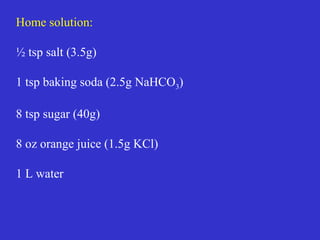
Home solution:
½ tsp salt (3.5g)
1 tsp baking soda (2.5g NaHCO3)
8 tsp sugar (40g)
8 oz orange juice (1.5g KCl)
1 L water
Antidiarrheal drugs: treat only symptoms!
– Diarrhea is usually caused by infection (Salmonella,
shigella, campylobacter,clostridium, E. coli), toxins,
anxiety, drugs…
– In healthy adults mostly discomfort and
inconvenience
– In children (particularly mal-nourished) a principal
cause of death is due to excessive loss of water and
minerals.
Drug therapy
• Specific antimicrobial agents
No value
Only on severity basis
On regular basis
• Probiotics
• Drugs of IBD
• Non-specific agents
Antimotility agents:
– Muscarinic receptor antagonists (not useful due to side
effects) and opiates:
• Diphenoxylate
•Difenoxin
•Loperamide
– All have CNS effects – to be use carefully in treatment
of diarrhea!
Antimotility agents & anti-secretory agents:
Opiods continue to be used widely
Mechanism of action:
1. Intestinal motility--µ receptors
2. Intestinal secretion-- δ receptors
3. Intestinal absorption--- µ & δ receptors
All the commonly used opioids act principally via
peripheral µ receptors and are preferred over opioids
that penetrate central nervous system
Loperamide:
•40-50 times more potent than morphine as an anti-
diarrheal agent
•Increases small intestinal and mouth to cecum transit
time.
•Increases anal sphincter tone
•Anti-secretory activity against cholera toxin and some
forms of E.coli toxin
Loperamide:
Half- life 11 hours
Dose: 4mg initially followed by 2mg after each subsequent
stool, up to 16mg/day.
If clinical improvement does does not occur in acute
diarrhea within 48 hours, DISCONTINUE loperamide
Not recommended in children <2 years.
Loperamide:
•Effective in travellers diarrhea
•Used alone or in combination with antimicrobial agents
(trimethorim with or without sulfamethoxazole)
•Adjunctive treatment in almost all forms of chronic
diarrheal diseases.
•Lacks significant abuse potential
•Overdose: CNS depression, paralytic ileus, toxic
megacolon.
Difenoxin-
Active metabolite of diphenoxylate
Both combined with 25 mcg of atropine to prevent abuse.
Excess dose: CNS effects, anticholinergic effects,
constipation, toxic megacolon
Other opioids:
1. Paregoric: 2mg morphine/5mL.
2. Deodorized tincture of opium.
DO not use loperamide in:
1. Patients with bloody diarrhea
2. High fever
3. Systemic toxicity
4. Worsening diarrhea despite treatment
Racecadotril:
•A dipeptide
•Reinforces effects of endogenous enkephalins on the δ
opioid receptor
•Leads to anti-diarrheal effect
Bismuth subsalicylate:
Trivalent bismuth suspended in a mixture of magnesium
aluminium silicate clay.
In stomach: Combines with HCl→ Bismuth oxychloride
+ Salicylic acid
Bismuth subsalicylate
2 tab or 30mL up to 8 times daily
•Anti-inflammatory
•Anti-bacterial
•Anti- secretoty
•Also decreases vomiting
Diphenoxylate and atropine contraindicated in acute
diarrhea because of rare precipitation of toxic megacolon.
GIVE APPROPRIATE ANTIBIOTICS, IF CAUSATIVE
ORGANISM IS KNOWN
Rifaximin: Non absorbed oral antibiotic . 200mgtid x 3
days
Ciprofloxacin 500mg
Ofloxacin 400mg X 5 to 7 days
Norfloxacin 400mg bd
Levofloxacin 500mg od
Cortrimoxazole DS bd
Doxycycline 100mg bd
Liquid paraffin - No longer recommended
- more ADR
Malabsorption of fat soluble vitamins
It foreign body reactions in small bowel
(paraffinoma
fecal leak at anal canal & pruritus ani
Treatment of Chronic diarrhea
A number of antidiarrheal agents may be used in certain
patients with chronic diarrheal conditions.
Opioids are safe in most patients with chronic, stable
symptoms.
Loperamide: 4mg initially ,then 2 mg after each loose
stool ( maximum: 16 mg/d).
Diphenoxylate with atropine: One tablet three or four
times daily as needed.
Treatment of Chronic diarrhea
Codeine and tincture of opium: Chronic, intractable
diarrhea.
Codeine 15-60 mg every 4 hours
Tincture of opium: 10-25 drops every 6 hours
Clonidine:Inhibits intestinal electrolyte secretion
Used in:
•Secretory diarrhea
•Diabetic diarrhea
•Cryptosporiodiosis
Dose: 0.1-0.6mg twice daily oral
Patch: 0.1-0.2mg/day
Octreotide: Somatostatin analog
•Stimulates intestinal fluid and electrolyte absorption
•Inhibits intestinal fluid secretion
•Inhibits release of gastrointestinal peptides.
Given for: secretory diarrheas due to tumors--- VIPomas,
Carcinoid, AIDS related diarrhea
Dose: 50-250mcg subcutaneously three times daily.
Octreotide analogs
Lanreotide
Vapreotide.
Octreotide very useful for treating bleeding esophageal
varices.
Cholestyramine:
Bile salt binding resin
Used in:
•Bile salt induced diarrhea
•Intestinal resection
•Ileal disease
Dose: 4g once to three times daily
Bulk forming and hydroscopic agents:
Carboxymethylcellulose & Calcium polycarbophil– absorb
water and stool bulk.
Useful in mild chronic diarrhea in patients with irritable
bowel syndrome
Mechanism of action: Works as a gel to modify stool
texture & viscosity to produce perception of decreased
stool fluidity.
Others:
Clays such as kaolin and other silicates like attapulgite
( magnesium aluminium disilicate) bind water avidly.
Kaolin and pectin: useful in mild diarrhea.
Calcium channel blockers like verapamil and nifedipine:
decrease gut motility, promote intestinal water absorption.
Berberine:
Plant alkaloid. It has:
•Antimicrobial activity
•Inhibits smooth muscle contraction
•Delays intestinal transit by antagonizing effects of
acetylcholine.
Chloride channel blockers:
Antisecretory agents.
Calmodulin inhibitors including chlorpromazine and
ZALDARINE MALEATE
Drugs for IBD
• Steroids
• Immunosuppressants
• TNF alpha inhibitors
• 5-ASA compounds
Sulfasalazine
Mesalazine
Olsalazine
Balsalazide

Antidiarrhoeals

  • 1.
    ANTIDIARRHOEALS BY DR.UMA NARAYANAMURTHY, ASSISTANTPROFESSOR, DEPARTMENT OF PHARMACOLOGY
  • 2.
    Diarrhea: defined as3 or more loose or watery stools in a 24 hour period. In other words it is due to passage of excess water in faeces which may be due to 1.Decreased water and electrolyte absorption 2.Increased secretion by intestinal mucosa 3.Increased luminal osmotic load 4.Inflammation of mucosa and exudation into lumen Most patients with sudden onset of diarrhea have a benign self-limited illness requiring no treatment or evaluation.
  • 4.
    Principles of management •Treatment of fluid depletion, shock and acidosis • Maintainence of nutrition • Drug therapy • Based upon severity and nature of diarrhea management is carried on
  • 5.
    Intravenous rehydration • Whenfluid loss is severe • Components: NaCl KCl NaHCO3 Ringer lactate commonly recommended iv fluid
  • 6.
    Acute diarrhea Oral rehydrationsolution is the cornerstone for patients with acute illnesses resulting in significant diarrhea Rehydration. WHO ORS: 1.Sodium chloride: 3.5g 2.Sodium bicarbonate: 2.5g Or Trisodium citrate: 2.9g 3.Potassium chloride 1.5g 4.Glucose: 20g 5.Potable water: 1 liter Rice based physiological solutions. Rationale of ORS
  • 7.
    ORT • Administration • Non-diarrhoealuses • Zinc in pediatric diarrhoea
  • 8.
    Home solution: ½ tspsalt (3.5g) 1 tsp baking soda (2.5g NaHCO3) 8 tsp sugar (40g) 8 oz orange juice (1.5g KCl) 1 L water
  • 9.
    Antidiarrheal drugs: treatonly symptoms! – Diarrhea is usually caused by infection (Salmonella, shigella, campylobacter,clostridium, E. coli), toxins, anxiety, drugs… – In healthy adults mostly discomfort and inconvenience – In children (particularly mal-nourished) a principal cause of death is due to excessive loss of water and minerals.
  • 10.
    Drug therapy • Specificantimicrobial agents No value Only on severity basis On regular basis • Probiotics • Drugs of IBD • Non-specific agents
  • 11.
    Antimotility agents: – Muscarinicreceptor antagonists (not useful due to side effects) and opiates: • Diphenoxylate •Difenoxin •Loperamide – All have CNS effects – to be use carefully in treatment of diarrhea!
  • 12.
    Antimotility agents &anti-secretory agents: Opiods continue to be used widely Mechanism of action: 1. Intestinal motility--µ receptors 2. Intestinal secretion-- δ receptors 3. Intestinal absorption--- µ & δ receptors All the commonly used opioids act principally via peripheral µ receptors and are preferred over opioids that penetrate central nervous system
  • 13.
    Loperamide: •40-50 times morepotent than morphine as an anti- diarrheal agent •Increases small intestinal and mouth to cecum transit time. •Increases anal sphincter tone •Anti-secretory activity against cholera toxin and some forms of E.coli toxin
  • 14.
    Loperamide: Half- life 11hours Dose: 4mg initially followed by 2mg after each subsequent stool, up to 16mg/day. If clinical improvement does does not occur in acute diarrhea within 48 hours, DISCONTINUE loperamide Not recommended in children <2 years.
  • 15.
    Loperamide: •Effective in travellersdiarrhea •Used alone or in combination with antimicrobial agents (trimethorim with or without sulfamethoxazole) •Adjunctive treatment in almost all forms of chronic diarrheal diseases. •Lacks significant abuse potential •Overdose: CNS depression, paralytic ileus, toxic megacolon.
  • 16.
    Difenoxin- Active metabolite ofdiphenoxylate Both combined with 25 mcg of atropine to prevent abuse. Excess dose: CNS effects, anticholinergic effects, constipation, toxic megacolon Other opioids: 1. Paregoric: 2mg morphine/5mL. 2. Deodorized tincture of opium.
  • 17.
    DO not useloperamide in: 1. Patients with bloody diarrhea 2. High fever 3. Systemic toxicity 4. Worsening diarrhea despite treatment
  • 18.
    Racecadotril: •A dipeptide •Reinforces effectsof endogenous enkephalins on the δ opioid receptor •Leads to anti-diarrheal effect
  • 19.
    Bismuth subsalicylate: Trivalent bismuthsuspended in a mixture of magnesium aluminium silicate clay. In stomach: Combines with HCl→ Bismuth oxychloride + Salicylic acid
  • 20.
    Bismuth subsalicylate 2 tabor 30mL up to 8 times daily •Anti-inflammatory •Anti-bacterial •Anti- secretoty •Also decreases vomiting
  • 21.
    Diphenoxylate and atropinecontraindicated in acute diarrhea because of rare precipitation of toxic megacolon. GIVE APPROPRIATE ANTIBIOTICS, IF CAUSATIVE ORGANISM IS KNOWN
  • 22.
    Rifaximin: Non absorbedoral antibiotic . 200mgtid x 3 days Ciprofloxacin 500mg Ofloxacin 400mg X 5 to 7 days Norfloxacin 400mg bd Levofloxacin 500mg od Cortrimoxazole DS bd Doxycycline 100mg bd
  • 23.
    Liquid paraffin -No longer recommended - more ADR Malabsorption of fat soluble vitamins It foreign body reactions in small bowel (paraffinoma fecal leak at anal canal & pruritus ani
  • 24.
    Treatment of Chronicdiarrhea A number of antidiarrheal agents may be used in certain patients with chronic diarrheal conditions. Opioids are safe in most patients with chronic, stable symptoms. Loperamide: 4mg initially ,then 2 mg after each loose stool ( maximum: 16 mg/d). Diphenoxylate with atropine: One tablet three or four times daily as needed.
  • 25.
    Treatment of Chronicdiarrhea Codeine and tincture of opium: Chronic, intractable diarrhea. Codeine 15-60 mg every 4 hours Tincture of opium: 10-25 drops every 6 hours
  • 26.
    Clonidine:Inhibits intestinal electrolytesecretion Used in: •Secretory diarrhea •Diabetic diarrhea •Cryptosporiodiosis Dose: 0.1-0.6mg twice daily oral Patch: 0.1-0.2mg/day
  • 27.
    Octreotide: Somatostatin analog •Stimulatesintestinal fluid and electrolyte absorption •Inhibits intestinal fluid secretion •Inhibits release of gastrointestinal peptides. Given for: secretory diarrheas due to tumors--- VIPomas, Carcinoid, AIDS related diarrhea Dose: 50-250mcg subcutaneously three times daily.
  • 28.
    Octreotide analogs Lanreotide Vapreotide. Octreotide veryuseful for treating bleeding esophageal varices.
  • 29.
    Cholestyramine: Bile salt bindingresin Used in: •Bile salt induced diarrhea •Intestinal resection •Ileal disease Dose: 4g once to three times daily
  • 30.
    Bulk forming andhydroscopic agents: Carboxymethylcellulose & Calcium polycarbophil– absorb water and stool bulk. Useful in mild chronic diarrhea in patients with irritable bowel syndrome Mechanism of action: Works as a gel to modify stool texture & viscosity to produce perception of decreased stool fluidity.
  • 31.
    Others: Clays such askaolin and other silicates like attapulgite ( magnesium aluminium disilicate) bind water avidly. Kaolin and pectin: useful in mild diarrhea. Calcium channel blockers like verapamil and nifedipine: decrease gut motility, promote intestinal water absorption.
  • 32.
    Berberine: Plant alkaloid. Ithas: •Antimicrobial activity •Inhibits smooth muscle contraction •Delays intestinal transit by antagonizing effects of acetylcholine. Chloride channel blockers: Antisecretory agents. Calmodulin inhibitors including chlorpromazine and ZALDARINE MALEATE
  • 33.
    Drugs for IBD •Steroids • Immunosuppressants • TNF alpha inhibitors • 5-ASA compounds Sulfasalazine Mesalazine Olsalazine Balsalazide