Dr. RAGHU PRASADA M S
MBBS,MD
ASSISTANT PROFESSOR
DEPT. OF PHARMACOLOGY
SSIMS & RC. 1
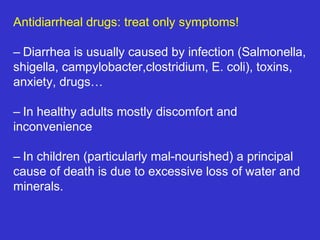
 Diarrhoea is too frequent, often too precipitate
passage of poorly formed stools. It is defined as three
or more loose watery stools in a 24 hour period.
Common Causes of Diarrhoea
 Osmotic –lactase deficiency
 Secretory –cholera, E. coli
 Deranged intestinal motility-thyrotoxicosis
 Altered mucosal morphology- viral gastroenteritis
 Allergic diarrhoea –food allergy
 Drug induced diarrhoea
 Carcinoid and medullary carcinoma of thyroid
Treatment of fluid depletion,
shock, and acidosis
Maintenance of nutrition
Drug therapy
REHYDRATION
It can orally or Intra-venous
It is needed when fluid loss
more than 10ml/kg/hr Or when
patient is unable to take enough
oral fluids due to weakness,
stupor or vomiting
Diarrhoea
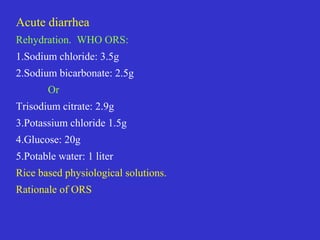
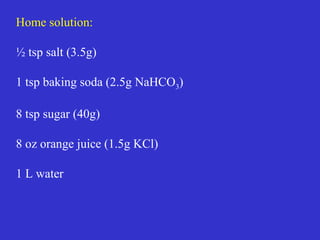
Sodium Chloride- 2.60g
Potassium Chloride- 1.50 g
Sodium Citrate- 2.90g
Glucose - 13.50g
Water - 1 litre
Total osmolarity-245mOsm/L
It restores and maintain hydration,
electrolyte and pH balance until diarrhoea ceases.
The non-diarrhoeal uses are postsurgical, post burn,
and post-trauma maintenance of hydration
Cereal –based oral rehydration solution- decrease
volume loss, shorten the duration of illness,
It inhibits the response of crypt cell chloride channel to
cAMP
Digestive process supplies large amount of glucose at
the intestinal brush borders for transfer of glucose
sodium ions from lumen into the bloodless luminal
back drag such effect may be seen in direct glucose
ingestion
Moderate dehydration and acidosis- can be corrected
in 3-6 hrs by ORS
Traveller’s diarrhoea-mostly due to ETEC,
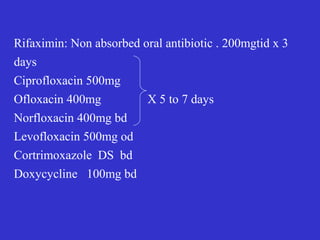
Campylobacter or virus: cotrimoxazole, Norfloxacin,
Doxycycline reduces the duration of diarrhoea
RIFAXIMIN-
Minimally absorbed oral rifamycin active against E.coli
and gut pathogens. It is used for empherical treatment
of travellers’ diarrhoea caused by non-invasive strains
of E.coli.
EPEC-is less common –Cotrimoxazole, colstin
Shigella enteritis-Associated with blood and mucus in
stools
Non typhoid Salmonella Enteritis- fluoroquinolone,
Cotrimoxazole
Yersinia enterocolitica, Cholera, campylobacter jejuni
and clostridium difficile-Cotrimoxazole , Ciprofloxacin
Antimicrobials are of no value in
Irritable bowel Syndrome (IBS)
Coeliac disease
Pancreatic enzyme deficiency
Tropical sprue
Thyrotoxicosis
Rota virus diarrhoea in children
Organisms most commonly used are
Lactobacillus sp
Bifidobacterium
Streptococcus faecalis
Enterococcus sp
Yeast Saccharomyces boulardii
They are more efficacious for antibiotic associated
diarrhoea
 Includes ulcerative colitis and crohns disease
 Includes drug therapy, dietary and lifestyle factors
SULFASALAZINE
MESALAZINE
BALSALAZIDE
CORTICOSTEROIDS
IMMUNOSUPPRESSANTS-AZATHIOPRINE,
METHOTREXATE, TNF α INHIBITORS-INFLIXIMAB
SULPHASALAZINE
Is a compound of 5-ASA-5 amino salicylic acid with
sulfapyridine linked through an azo bond
The azo bond is split by colonic bacteria to release 5-ASA
and sulfapyridine.
It exerts a local antiinflammatory effect
It inhibits cytokine, PAF-platelet activating factor, TNFα,
nuclear transcription factor(NFκB) and minor effects like
inhibition of both COX and LOX
They inhibit the migration of inflammatory cells into
bowel wall and mucosal secretion is decreased
ADR-sulfapyridine N,V, rashes, joint pains, haemolysis
Mesalamine (Mesalazine)–
Delayed release preparation -with pH sensitive acrylic
polymer coating release 5-ASA into the terminal ileum
and colon also prevent formation of pro-inflammatory
cytokines Not effective orally, as it cannot reach large
bowel
A daily dose of 2.4g has been found to improve over 50%
patients of ulcerative
Balsalazine
It has 5-ASA linked to 4-aminobenzoyl-β-alanine as the
carrier. The 5-ASA is released in the colon, and the carrier
is poorly absorbed. Safer alternative to sulfasalazine
Corticosteroids –Prednisone-
Treatment for acute/severe exacerbations
Patients not responding to ASA
Hydrocortisone Foam based formulations coat the mucosa-
topical treatment for proctitis and distal ulcerative colitis
Severe-oral prednisolone-remission in 2 weeks
Budesonide as enteric coated tablets used in Crohn’s disease
Immunosuppressant-
Cyclosporine and Methotrexate-severe ulcerative
colitis unresponsive to steroids
Anti-TNF α agents- Adalimumab, Certolizumab
Infliximab a new humanized antibody that targets
tumour necrosis factor alpha, for crohn’s disease
cross links with soluble and membrane bound TNF α
 inhibits T cell and macrophage function
 Alosetron –potent and selective 5-HT1 receptor
antagonist
 Tricyclic antidepressants- Amitriptyline
Antibiotics-
Metronidazole and Ciprofloxacin
Anti-integrin monoclonal antibody-
NATALIZUMAB-humanised monoclonal antibody
against integrin
300 mg /4wks IV infusion
Antimotility antisecretory agents
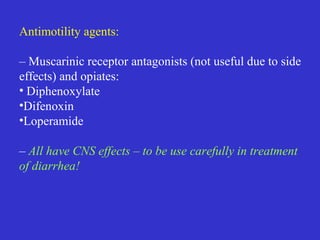
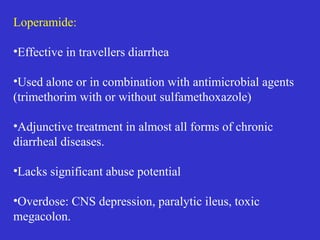
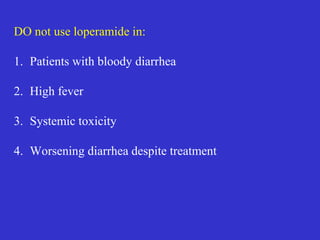
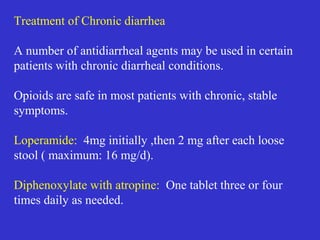
Opioid agonists-Loperamide, diphenoxylate, difenoxin,
racecadotril
Anticholinergics –hyoscyamine and dicycloamine
α2-adrenergic receptor agonist-clonidine
Somatostatin analogue-Octreotide
Adsorbant drugs- kaolin, pectin, bismuth subsalicylate
And lactose
Antimotility agents & anti-secretory
agents: LOPERAMIDE
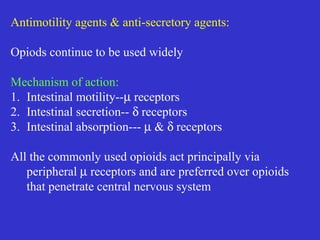
Mechanism of action:
All the commonly used opioids act principally via peripheral
 receptors and are preferred over opioids that
penetrate central nervous system
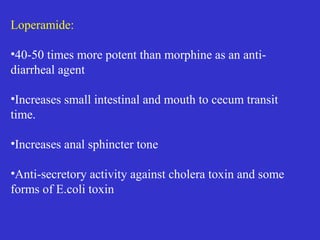
• More potent than morphine as an anti- diarrheal agent
• Increases small intestinal and mouth to cecum transit
time inhibition of presynaptic cholinergic nerves in
the submucosal and myentric plexus
1. Intestinal motility-- receptors
2. Intestinal secretion--  receptors
3. Intestinal absorption---  &  receptors
•Increases anal sphincter tone
•Anti-secretory activity against cholera toxin and some
forms of E. coli toxin
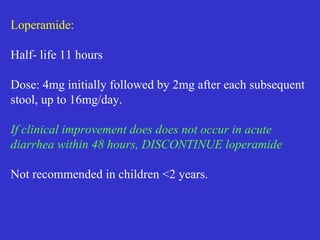
•Half- life 11 hours
•Dose: 4mg initially followed by 2mg after each
subsequent stool, up to 16mg/day.
•Not recommended in children <2 years.
 A dipeptide
 Racecadotril blocks enzyme encephalinase and
increases local concentration of enkephalins in
intestinal mucosa which then stimulate mu- and
delta-receptors. Leads to anti-diarrheal effect
 This drug can be used orally from children under 5
years old (including babies), but Loperamide is
contraindicated in children < 5 years old.
 Trivalent bismuth suspended in a mixture of
magnesium aluminium silicate clay.
 Astringent, protective, adsorbent effect
 In stomach: Combines with HCl Bismuth oxychloride
+ Salicylic acid
 It can bind to toxins produced by v. cholerae, E. coli
liberation of salicylic acid-prostaglandin synthesis
inhibition intestinal inflammation
 Cholestyramine, colestipol, colesevelam
 -they decrease the excess fecal bile acids
S/E-bloating flatulence, constipation
D/I- binding to other drugs and cause malabsorption
PECTIN-Purified carbohydrate obtained from citrus
fruits, tasteless
Forms viscous colloidal solution, coats the intestinal
surface
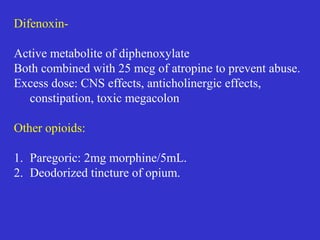
Difenoxin-
Active metabolite of diphenoxylate-opioid agonist,
constricts the spincters
Both combined with 25 mcg of atropine to prevent abuse.
Excess dose: CNS effects, anticholinergic effects,
constipation, toxic megacolon
Other opioids:
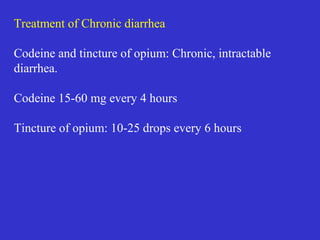
1. Paregoric: 2mg morphine/5mL.
2. Deodorized tincture of opium.
 Hyoscyamine and dicyclomine
 Decrease bowel motility results in increase in fluid
absorption, back from intestinal tract and in
abdominal cramps
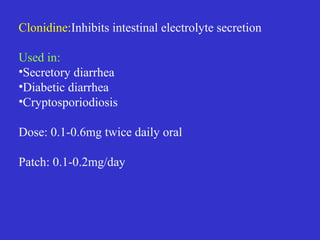
α2-adrenergic receptor agonists- Clonidine
Facilitates absorption,
inhibits secretion of fluids and electrolytes
Increases intestinal transit time
Used in diabetic diarrhoea and opiod withdrawal
14- amino acid peptide released in GIT, pancreas, D
cells and enteric nerves
Inhibits secretion of gastrin, cholecystokinin, glucagon,
growth hormone, insulin, 5-HT
Slows GI motility and inhibits gallbladder contraction
It inhibits secretion of anterior pituitary hormones
Stimulates intestinal fluid and electrolyte absorption
Inhibits intestinal fluid secretion
Inhibits release of gastrointestinal peptides.
 Given for: secretory diarrheas due to tumors---
VIPomas, Carcinoid, AIDS related diarrhea
 inhibition of hormonal secretion and slows tumor
progression
 Low dose sc in patients with patients with small
bowel bacterial overgrowth or intestinal pseudo-
obstruction secondary to scleroderma
 Dose: 50-250mcg subcutaneously three times daily.
THANK YOU
Download slides from
Authorstream-presentations-raghuprasada
Slideshare-presentations-raghuprasada

Class anti diarrheals

  • 1.
    Dr. RAGHU PRASADAM S MBBS,MD ASSISTANT PROFESSOR DEPT. OF PHARMACOLOGY SSIMS & RC. 1
  • 2.
     Diarrhoea istoo frequent, often too precipitate passage of poorly formed stools. It is defined as three or more loose watery stools in a 24 hour period. Common Causes of Diarrhoea  Osmotic –lactase deficiency  Secretory –cholera, E. coli  Deranged intestinal motility-thyrotoxicosis  Altered mucosal morphology- viral gastroenteritis  Allergic diarrhoea –food allergy  Drug induced diarrhoea  Carcinoid and medullary carcinoma of thyroid
  • 4.
    Treatment of fluiddepletion, shock, and acidosis Maintenance of nutrition Drug therapy REHYDRATION It can orally or Intra-venous It is needed when fluid loss more than 10ml/kg/hr Or when patient is unable to take enough oral fluids due to weakness, stupor or vomiting Diarrhoea
  • 6.
    Sodium Chloride- 2.60g PotassiumChloride- 1.50 g Sodium Citrate- 2.90g Glucose - 13.50g Water - 1 litre Total osmolarity-245mOsm/L It restores and maintain hydration, electrolyte and pH balance until diarrhoea ceases. The non-diarrhoeal uses are postsurgical, post burn, and post-trauma maintenance of hydration
  • 7.
    Cereal –based oralrehydration solution- decrease volume loss, shorten the duration of illness, It inhibits the response of crypt cell chloride channel to cAMP Digestive process supplies large amount of glucose at the intestinal brush borders for transfer of glucose sodium ions from lumen into the bloodless luminal back drag such effect may be seen in direct glucose ingestion Moderate dehydration and acidosis- can be corrected in 3-6 hrs by ORS
  • 8.
    Traveller’s diarrhoea-mostly dueto ETEC, Campylobacter or virus: cotrimoxazole, Norfloxacin, Doxycycline reduces the duration of diarrhoea RIFAXIMIN- Minimally absorbed oral rifamycin active against E.coli and gut pathogens. It is used for empherical treatment of travellers’ diarrhoea caused by non-invasive strains of E.coli. EPEC-is less common –Cotrimoxazole, colstin Shigella enteritis-Associated with blood and mucus in stools
  • 9.
    Non typhoid SalmonellaEnteritis- fluoroquinolone, Cotrimoxazole Yersinia enterocolitica, Cholera, campylobacter jejuni and clostridium difficile-Cotrimoxazole , Ciprofloxacin Antimicrobials are of no value in Irritable bowel Syndrome (IBS) Coeliac disease Pancreatic enzyme deficiency Tropical sprue Thyrotoxicosis Rota virus diarrhoea in children
  • 10.
    Organisms most commonlyused are Lactobacillus sp Bifidobacterium Streptococcus faecalis Enterococcus sp Yeast Saccharomyces boulardii They are more efficacious for antibiotic associated diarrhoea
  • 12.
     Includes ulcerativecolitis and crohns disease  Includes drug therapy, dietary and lifestyle factors SULFASALAZINE MESALAZINE BALSALAZIDE CORTICOSTEROIDS IMMUNOSUPPRESSANTS-AZATHIOPRINE, METHOTREXATE, TNF α INHIBITORS-INFLIXIMAB
  • 13.
    SULPHASALAZINE Is a compoundof 5-ASA-5 amino salicylic acid with sulfapyridine linked through an azo bond The azo bond is split by colonic bacteria to release 5-ASA and sulfapyridine. It exerts a local antiinflammatory effect It inhibits cytokine, PAF-platelet activating factor, TNFα, nuclear transcription factor(NFκB) and minor effects like inhibition of both COX and LOX They inhibit the migration of inflammatory cells into bowel wall and mucosal secretion is decreased ADR-sulfapyridine N,V, rashes, joint pains, haemolysis
  • 14.
    Mesalamine (Mesalazine)– Delayed releasepreparation -with pH sensitive acrylic polymer coating release 5-ASA into the terminal ileum and colon also prevent formation of pro-inflammatory cytokines Not effective orally, as it cannot reach large bowel A daily dose of 2.4g has been found to improve over 50% patients of ulcerative Balsalazine It has 5-ASA linked to 4-aminobenzoyl-β-alanine as the carrier. The 5-ASA is released in the colon, and the carrier is poorly absorbed. Safer alternative to sulfasalazine
  • 15.
    Corticosteroids –Prednisone- Treatment foracute/severe exacerbations Patients not responding to ASA Hydrocortisone Foam based formulations coat the mucosa- topical treatment for proctitis and distal ulcerative colitis Severe-oral prednisolone-remission in 2 weeks Budesonide as enteric coated tablets used in Crohn’s disease
  • 16.
    Immunosuppressant- Cyclosporine and Methotrexate-severeulcerative colitis unresponsive to steroids Anti-TNF α agents- Adalimumab, Certolizumab Infliximab a new humanized antibody that targets tumour necrosis factor alpha, for crohn’s disease cross links with soluble and membrane bound TNF α  inhibits T cell and macrophage function  Alosetron –potent and selective 5-HT1 receptor antagonist  Tricyclic antidepressants- Amitriptyline
  • 17.
    Antibiotics- Metronidazole and Ciprofloxacin Anti-integrinmonoclonal antibody- NATALIZUMAB-humanised monoclonal antibody against integrin 300 mg /4wks IV infusion
  • 18.
    Antimotility antisecretory agents Opioidagonists-Loperamide, diphenoxylate, difenoxin, racecadotril Anticholinergics –hyoscyamine and dicycloamine α2-adrenergic receptor agonist-clonidine Somatostatin analogue-Octreotide Adsorbant drugs- kaolin, pectin, bismuth subsalicylate And lactose
  • 19.
    Antimotility agents &anti-secretory agents: LOPERAMIDE Mechanism of action: All the commonly used opioids act principally via peripheral  receptors and are preferred over opioids that penetrate central nervous system • More potent than morphine as an anti- diarrheal agent • Increases small intestinal and mouth to cecum transit time inhibition of presynaptic cholinergic nerves in the submucosal and myentric plexus 1. Intestinal motility-- receptors 2. Intestinal secretion--  receptors 3. Intestinal absorption---  &  receptors
  • 20.
    •Increases anal sphinctertone •Anti-secretory activity against cholera toxin and some forms of E. coli toxin •Half- life 11 hours •Dose: 4mg initially followed by 2mg after each subsequent stool, up to 16mg/day. •Not recommended in children <2 years.
  • 21.
     A dipeptide Racecadotril blocks enzyme encephalinase and increases local concentration of enkephalins in intestinal mucosa which then stimulate mu- and delta-receptors. Leads to anti-diarrheal effect  This drug can be used orally from children under 5 years old (including babies), but Loperamide is contraindicated in children < 5 years old.
  • 22.
     Trivalent bismuthsuspended in a mixture of magnesium aluminium silicate clay.  Astringent, protective, adsorbent effect  In stomach: Combines with HCl Bismuth oxychloride + Salicylic acid  It can bind to toxins produced by v. cholerae, E. coli liberation of salicylic acid-prostaglandin synthesis inhibition intestinal inflammation
  • 23.
     Cholestyramine, colestipol,colesevelam  -they decrease the excess fecal bile acids S/E-bloating flatulence, constipation D/I- binding to other drugs and cause malabsorption PECTIN-Purified carbohydrate obtained from citrus fruits, tasteless Forms viscous colloidal solution, coats the intestinal surface
  • 24.
    Difenoxin- Active metabolite ofdiphenoxylate-opioid agonist, constricts the spincters Both combined with 25 mcg of atropine to prevent abuse. Excess dose: CNS effects, anticholinergic effects, constipation, toxic megacolon Other opioids: 1. Paregoric: 2mg morphine/5mL. 2. Deodorized tincture of opium.
  • 25.
     Hyoscyamine anddicyclomine  Decrease bowel motility results in increase in fluid absorption, back from intestinal tract and in abdominal cramps α2-adrenergic receptor agonists- Clonidine Facilitates absorption, inhibits secretion of fluids and electrolytes Increases intestinal transit time Used in diabetic diarrhoea and opiod withdrawal
  • 26.
    14- amino acidpeptide released in GIT, pancreas, D cells and enteric nerves Inhibits secretion of gastrin, cholecystokinin, glucagon, growth hormone, insulin, 5-HT Slows GI motility and inhibits gallbladder contraction It inhibits secretion of anterior pituitary hormones Stimulates intestinal fluid and electrolyte absorption Inhibits intestinal fluid secretion Inhibits release of gastrointestinal peptides.
  • 27.
     Given for:secretory diarrheas due to tumors--- VIPomas, Carcinoid, AIDS related diarrhea  inhibition of hormonal secretion and slows tumor progression  Low dose sc in patients with patients with small bowel bacterial overgrowth or intestinal pseudo- obstruction secondary to scleroderma  Dose: 50-250mcg subcutaneously three times daily.
  • 28.
    THANK YOU Download slidesfrom Authorstream-presentations-raghuprasada Slideshare-presentations-raghuprasada