Treatment of
Type 1 Diabetes mellitus
(Insulin)
9 June 2017
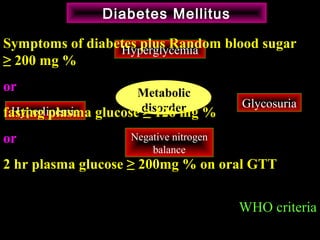
Diabetes Mellitus
Hyperglycemia
Glycosuria
Hyperlipemia
Negative nitrogen
balance
Metabolic
disorder
Symptoms of diabetes plus Random blood sugar
≥ 200 mg %
or
fasting plasma glucose ≥ 126 mg %
or
2 hr plasma glucose ≥ 200mg % on oral GTT
WHO criteria
Diabetes mellitus - Types
Type 1 Diabetes mellitus
 Complete or near total insulin deficiency
Βeta cell destruction – immune mediated, idiopathic
Type 2 Diabetes mellitus
 Insulin resistance precedes insulin secretory defect
Diabetes develops only when insulin secretion becomes
inadequate
Other causes
Non pancreatic diseases, drug induced …
Gestational Diabetes mellitus
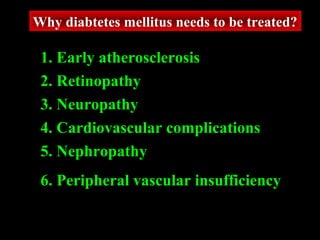
Why diabtetes mellitus needs to be treated?
1. Early atherosclerosis
2. Retinopathy
3. Neuropathy
4. Cardiovascular complications
5. Nephropathy
6. Peripheral vascular insufficiency
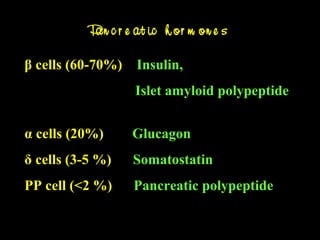
Pan c r e at ic h or m on e s
β cells (60-70%) Insulin,
Islet amyloid polypeptide
α cells (20%) Glucagon
δ cells (3-5 %) Somatostatin
PP cell (<2 %) Pancreatic polypeptide
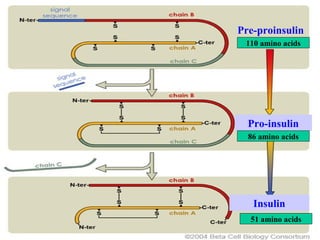
Pro-insulin
Insulin
Pre-proinsulin
110 amino acids
86 amino acids
51 amino acids
Insulin is co-secreted with c-peptide
and it is more stable than insulin.
Clinical Implication :
C-peptide levels can be used to
differentiate between exogenous
insulin administration and insulin
secreting tumors
In su lin st r u c t u r e
 Mol. Wt. of 5808 in humans
 51 amino acids in two chains – A(21 AA) & B(30 AA)
 Linked by disulfide bridges
 Differs from porcine by one AA and from bovine by 3 AA
Insulin SecretionInsulin Secretion
Steady basal release of insulin
Response to increase in blood glucose
Rapid phase – release of stored insulin
Delayed phase – continued release and synthesis
Clinical implication:
While treating, two-thirds of total daily insulin
given to cover basal needs (by longer acting
insulin) and one-third to one-half should be short
acting given before each meal.
Phases of insulin SecretionPhases of insulin Secretion
Insulin storageInsulin storage
Synthesized & stored (bound to zinc) in
granules in the beta cells.
Clinical Implication :
Therapeutically used exogenous insulin is
also stored by adding small quantities of
zinc.
Addition of small quantities of zinc
increases the shelf life and all preparations
including regular insulin and insulin
analogs have small quantities of zinc.
In su lin ac t ion s
( m ain ly liv e r , m u sc le an d ad ip ose t issu e )
↑ triglyceride
storage
(adipose
tissue)
↑ uptake of
glucose
(skeletal
muscle & fat)
↑ protein &
glycogen
synthesis
(liver &
muscle)
↓ formation of
glucose from
glycogen,
protein & fat
(liver)
PharmacokineticsPharmacokinetics
Naturally secreted insulin enters portal vein
and half of it is taken up by liver
Rest enters systemic circulation
Circulating insulin has a short t1/2 (5 min)
Clinical implication :
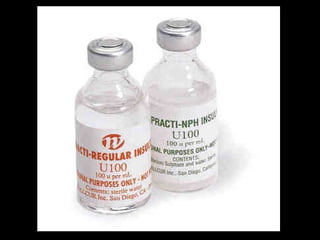
Various preparations of insulin are available
for therapeutic use.
Insulin PreparationsInsulin Preparations
Insulin preparations are made by
 Physical modifications like adding protamine
or zinc to give amorphous or crystalline
suspensions
 Altering the amino acid sequence of non
receptor binding regions of insulin – insulin
analogs
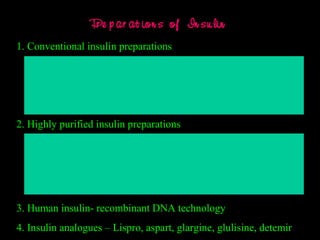
Pr e p ar at ion s of In su lin
1. Conventional insulin preparations
- Beef and pork insulins
- Modified by adding zinc and/or protamine to form
slowly absorbed & longer acting preprations
2. Highly purified insulin preparations
- Single peak insulins – gel filtration & repeated crystallization
(50-200 ppm proinsulin)
- Monocomponent insulins- gel filtration & ion exchange
chromatography (<20 ppm)
3. Human insulin- recombinant DNA technology
4. Insulin analogues – Lispro, aspart, glargine, glulisine, detemir
Preparation Onset (h) Peak (h) Duration (h)
Rapid Acting
Insulin lispro, <0.25 0.5-1.5 3-4
aspart, glulisine
Inhaled (withdrawn) <0.25 0.5-1.5 4-6
Short Acting
Regular 0.5-1 2-3 4-6
Intermediate Acting
NPH 1-4 6-10 10-16
Premixed insulins
Long Acting
Glargine 1-4 ----- 24
Detemir 1-4 --- 12-20
Du r at ion of ac t ion of In su lin
p r e p ar at ion s
Rapid acting
Insulin lispro
Insulin aspart
Short acting
Regular insulin
Semilente
Intermediate acting
Lente (Ultra:Semi:7:3)
NPH or Isophane
Long acting
Ultralente
Protamine zinc
Insulin glargine
Lispro & Aspart
Glargine
Proline to aspartic acid at B28
Proline (B28 to B29) & lysine (B29 to B28)
Regular Insulin – contRegular Insulin – cont……
Injected 30 – 45 minutes before meals
Only type which can be given intravenously
Reason
 Dilution causes immediate dissociation of
hexameric forms
Time of onset, peak, duration of action increases
with size of dose
Neutral Protamine Hagedorn (NPH) insulinNeutral Protamine Hagedorn (NPH) insulin
In NPH insulin, neutral stands for pH,
protamine is the protein added,
What is Hagedorn?
The scientist who first formed this type of insulin.
Lente insulinLente insulin
Zinc is added in excess amount (10 times more)
Lente – intermediate acting
Semilente – amorphous suspension of zinc &
insulin, short acting
Ultralente – crystalline suspension of zinc & insulin,
long acting
Cannot be mixed with regular insulin because of high
zinc content
Not so popular, not manufactured from 2005 in USA
Insulin AnalogsInsulin Analogs
Rapid acting – lispro, aspart, glulisine
Long acting – glargine, detemir
Short acting analogs
Low propensity to self associate into dimers
Stabilized into hexamers to increase shelf life
After injection quickly dissociates into monomers
Advantages of insulin analogsAdvantages of insulin analogs
Closely mimic normal endogenous insulin
secretion
Insulin can be taken immediately before
the meal
Less risk for hypoglycemia
Lowest variability of absorption
Rapid acting analogs preferred for
subcutaneous pump infusion
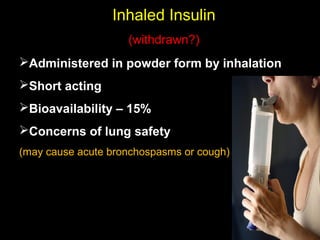
Inhaled InsulinInhaled Insulin
(withdrawn?)(withdrawn?)
Administered in powder form by inhalation
Short acting
Bioavailability – 15%
Concerns of lung safety
(may cause acute bronchospasms or cough)
Glargine (20-26h)
Ultralente (18-24 h)
NPH (12-20 h)
Regular (6-10 h)
Aspart, lispro (4-6 h)
Acceptable levels of glycaemic control
• Overnight Fasting: 90-120mg %
• 1 hour after food: Not higher than 180mg %
• 2 hour after food: Not higher than 150mg %
• Glycohemoglobin value: No higher than 1%
above the upper limit of the normal range
for that lab.
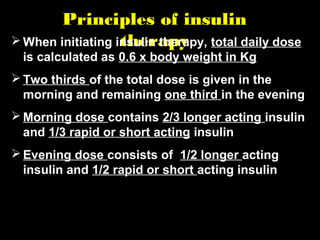
Principles of insulin
therapy When initiating insulin therapy, total daily dose
is calculated as 0.6 x body weight in Kg
 Two thirds of the total dose is given in the
morning and remaining one third in the evening
 Morning dose contains 2/3 longer acting insulin
and 1/3 rapid or short acting insulin
 Evening dose consists of 1/2 longer acting
insulin and 1/2 rapid or short acting insulin
In su lin u se s
1. Type 1 Diabetes mellitus – Life long maintenance
2. Type 2 Diabetes mellitus –
• Primary or secondary failure to OHD
• Underweight
• Infection, trauma, surgery, myocardial
infarction etc.
• Pregnancy
• Complications like gangrene
3. Diabetic ketoacidosis
A d v e r se r e ac t ion s t o in su lin
1. Hypoglycaemia
Hunger, sweating, anxiety, palpitation, tremor (sympathetic
stimulation)
Headache, dizziness, visual disturbances ( glucose deprivation
to brain)
Treatment : Glucose oral or i.v., glucagon 0.5-1mg i.v. or
adrenaline 0.2 mg s.c.
2. Lipoatrophy & lipohypertrophy
3. Insulin Allergy & resistance – Urticaria, angioedema,
anaphylaxis
4. Local reactions – Swelling, erythema, lipodystrophy
• Somogyi Effect:
• Dawn phenomenon: reduced tissue sensitivity to insulin
between 5AM and 8 AM
•Present in 75% of Type I diabetics
Higher blood glucose around 7AM
Blood glucose mg %
10 PM 3 AM 7 AM
Somogyi effect 90 40 200
Dawn
phenomenom
110 110 150
INSULIN RESISTANCE
FACTORS PROMOTING IR
Elderly
Obesity
Hypertension
Acromegaly
Pheochromocytoma
Cushing’s syndrome
ACUTE
RESISTANCE
Infection
Trauma
Surgery
Ketoacidosis
In su lin r e sist an c e
When insulin requirement in a diabetic patient is very high,
i.e. >200 U/day, he/she is regarded as insulin resistant
Types : Acute – Infection, trauma, surgery, ketoacidosis
Treatment : Correct precipitating cause & to give high
doses of regular insulin
Chronic- Antibodies to contaminating proteins
Treatment : Change over to more purified newer
preparations, Combine with sulphonylurea,
Corticosteroids, If extreme resistance - serine protease
inhibitor (aprotinin)
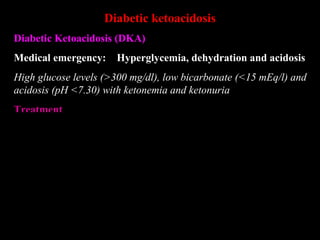
Diabetic ketoacidosis
Diabetic Ketoacidosis (DKA)
Medical emergency: Hyperglycemia, dehydration and acidosis
High glucose levels (>300 mg/dl), low bicarbonate (<15 mEq/l) and
acidosis (pH <7.30) with ketonemia and ketonuria
Treatment
Insulin : 0.1 – 0.2 U/Kg i.v. bolus, followed by 0.1 U/Kg/h infusion,
after 4-6 h reduce to 2-3 U/h (if BGL , 300 mg %)
i.v. fluids & supportive measures: Normal saline 1 l/h reduce to
0.5 l/4h when BSL reaches 300 mg%, 5% glucose in 1/2N saline
Potassium Chloride
Sodium Bicarbonate
Antibiotics
Drug Interactions
Potentiate insulin action
β blockers (↓compensatory
mechanisms through β2)
Alcohol (acute ingestion)
Salicylates,
Lithium
Theophylline
Inhibit insulin action
 Thiazides
 Furosemide
 OCP
 Salbutamol
 Theophylline
 Corticosteroids
EXAM POINT OF VIEW
Diabetic keto-acidosis- SAQ
Name few insulin preparations-
VSAQ
Name two novel drug delivery
mechanisms for delivery of
insulin- VSAQ
Thank you
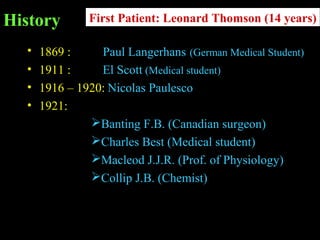
History
• 1869 : Paul Langerhans (German Medical Student)
• 1911 : El Scott (Medical student)
• 1916 – 1920: Nicolas Paulesco
• 1921:
Banting F.B. (Canadian surgeon)
Charles Best (Medical student)
Macleod J.J.R. (Prof. of Physiology)
Collip J.B. (Chemist)
First Patient: Leonard Thomson (14 years)

Insulin

  • 1.
    Treatment of Type 1Diabetes mellitus (Insulin) 9 June 2017
  • 2.
    Diabetes Mellitus Hyperglycemia Glycosuria Hyperlipemia Negative nitrogen balance Metabolic disorder Symptomsof diabetes plus Random blood sugar ≥ 200 mg % or fasting plasma glucose ≥ 126 mg % or 2 hr plasma glucose ≥ 200mg % on oral GTT WHO criteria
  • 3.
    Diabetes mellitus -Types Type 1 Diabetes mellitus  Complete or near total insulin deficiency Βeta cell destruction – immune mediated, idiopathic Type 2 Diabetes mellitus  Insulin resistance precedes insulin secretory defect Diabetes develops only when insulin secretion becomes inadequate Other causes Non pancreatic diseases, drug induced … Gestational Diabetes mellitus
  • 4.
    Why diabtetes mellitusneeds to be treated? 1. Early atherosclerosis 2. Retinopathy 3. Neuropathy 4. Cardiovascular complications 5. Nephropathy 6. Peripheral vascular insufficiency
  • 5.
    Pan c re at ic h or m on e s β cells (60-70%) Insulin, Islet amyloid polypeptide α cells (20%) Glucagon δ cells (3-5 %) Somatostatin PP cell (<2 %) Pancreatic polypeptide
  • 6.
  • 7.
    Insulin is co-secretedwith c-peptide and it is more stable than insulin. Clinical Implication : C-peptide levels can be used to differentiate between exogenous insulin administration and insulin secreting tumors
  • 8.
    In su linst r u c t u r e  Mol. Wt. of 5808 in humans  51 amino acids in two chains – A(21 AA) & B(30 AA)  Linked by disulfide bridges  Differs from porcine by one AA and from bovine by 3 AA
  • 9.
    Insulin SecretionInsulin Secretion Steadybasal release of insulin Response to increase in blood glucose Rapid phase – release of stored insulin Delayed phase – continued release and synthesis Clinical implication: While treating, two-thirds of total daily insulin given to cover basal needs (by longer acting insulin) and one-third to one-half should be short acting given before each meal.
  • 10.
    Phases of insulinSecretionPhases of insulin Secretion
  • 11.
    Insulin storageInsulin storage Synthesized& stored (bound to zinc) in granules in the beta cells. Clinical Implication : Therapeutically used exogenous insulin is also stored by adding small quantities of zinc. Addition of small quantities of zinc increases the shelf life and all preparations including regular insulin and insulin analogs have small quantities of zinc.
  • 12.
    In su linac t ion s ( m ain ly liv e r , m u sc le an d ad ip ose t issu e ) ↑ triglyceride storage (adipose tissue) ↑ uptake of glucose (skeletal muscle & fat) ↑ protein & glycogen synthesis (liver & muscle) ↓ formation of glucose from glycogen, protein & fat (liver)
  • 13.
    PharmacokineticsPharmacokinetics Naturally secreted insulinenters portal vein and half of it is taken up by liver Rest enters systemic circulation Circulating insulin has a short t1/2 (5 min) Clinical implication : Various preparations of insulin are available for therapeutic use.
  • 14.
    Insulin PreparationsInsulin Preparations Insulinpreparations are made by  Physical modifications like adding protamine or zinc to give amorphous or crystalline suspensions  Altering the amino acid sequence of non receptor binding regions of insulin – insulin analogs
  • 15.
    Pr e par at ion s of In su lin 1. Conventional insulin preparations - Beef and pork insulins - Modified by adding zinc and/or protamine to form slowly absorbed & longer acting preprations 2. Highly purified insulin preparations - Single peak insulins – gel filtration & repeated crystallization (50-200 ppm proinsulin) - Monocomponent insulins- gel filtration & ion exchange chromatography (<20 ppm) 3. Human insulin- recombinant DNA technology 4. Insulin analogues – Lispro, aspart, glargine, glulisine, detemir
  • 16.
    Preparation Onset (h)Peak (h) Duration (h) Rapid Acting Insulin lispro, <0.25 0.5-1.5 3-4 aspart, glulisine Inhaled (withdrawn) <0.25 0.5-1.5 4-6 Short Acting Regular 0.5-1 2-3 4-6 Intermediate Acting NPH 1-4 6-10 10-16 Premixed insulins Long Acting Glargine 1-4 ----- 24 Detemir 1-4 --- 12-20
  • 17.
    Du r ation of ac t ion of In su lin p r e p ar at ion s Rapid acting Insulin lispro Insulin aspart Short acting Regular insulin Semilente Intermediate acting Lente (Ultra:Semi:7:3) NPH or Isophane Long acting Ultralente Protamine zinc Insulin glargine
  • 18.
    Lispro & Aspart Glargine Prolineto aspartic acid at B28 Proline (B28 to B29) & lysine (B29 to B28)
  • 19.
    Regular Insulin –contRegular Insulin – cont…… Injected 30 – 45 minutes before meals Only type which can be given intravenously Reason  Dilution causes immediate dissociation of hexameric forms Time of onset, peak, duration of action increases with size of dose
  • 20.
    Neutral Protamine Hagedorn(NPH) insulinNeutral Protamine Hagedorn (NPH) insulin In NPH insulin, neutral stands for pH, protamine is the protein added, What is Hagedorn? The scientist who first formed this type of insulin.
  • 21.
    Lente insulinLente insulin Zincis added in excess amount (10 times more) Lente – intermediate acting Semilente – amorphous suspension of zinc & insulin, short acting Ultralente – crystalline suspension of zinc & insulin, long acting Cannot be mixed with regular insulin because of high zinc content Not so popular, not manufactured from 2005 in USA
  • 22.
    Insulin AnalogsInsulin Analogs Rapidacting – lispro, aspart, glulisine Long acting – glargine, detemir Short acting analogs Low propensity to self associate into dimers Stabilized into hexamers to increase shelf life After injection quickly dissociates into monomers
  • 23.
    Advantages of insulinanalogsAdvantages of insulin analogs Closely mimic normal endogenous insulin secretion Insulin can be taken immediately before the meal Less risk for hypoglycemia Lowest variability of absorption Rapid acting analogs preferred for subcutaneous pump infusion
  • 24.
    Inhaled InsulinInhaled Insulin (withdrawn?)(withdrawn?) Administeredin powder form by inhalation Short acting Bioavailability – 15% Concerns of lung safety (may cause acute bronchospasms or cough)
  • 25.
    Glargine (20-26h) Ultralente (18-24h) NPH (12-20 h) Regular (6-10 h) Aspart, lispro (4-6 h)
  • 32.
    Acceptable levels ofglycaemic control • Overnight Fasting: 90-120mg % • 1 hour after food: Not higher than 180mg % • 2 hour after food: Not higher than 150mg % • Glycohemoglobin value: No higher than 1% above the upper limit of the normal range for that lab.
  • 33.
    Principles of insulin therapyWhen initiating insulin therapy, total daily dose is calculated as 0.6 x body weight in Kg  Two thirds of the total dose is given in the morning and remaining one third in the evening  Morning dose contains 2/3 longer acting insulin and 1/3 rapid or short acting insulin  Evening dose consists of 1/2 longer acting insulin and 1/2 rapid or short acting insulin
  • 34.
    In su linu se s 1. Type 1 Diabetes mellitus – Life long maintenance 2. Type 2 Diabetes mellitus – • Primary or secondary failure to OHD • Underweight • Infection, trauma, surgery, myocardial infarction etc. • Pregnancy • Complications like gangrene 3. Diabetic ketoacidosis
  • 35.
    A d ve r se r e ac t ion s t o in su lin 1. Hypoglycaemia Hunger, sweating, anxiety, palpitation, tremor (sympathetic stimulation) Headache, dizziness, visual disturbances ( glucose deprivation to brain) Treatment : Glucose oral or i.v., glucagon 0.5-1mg i.v. or adrenaline 0.2 mg s.c. 2. Lipoatrophy & lipohypertrophy 3. Insulin Allergy & resistance – Urticaria, angioedema, anaphylaxis 4. Local reactions – Swelling, erythema, lipodystrophy
  • 36.
    • Somogyi Effect: •Dawn phenomenon: reduced tissue sensitivity to insulin between 5AM and 8 AM •Present in 75% of Type I diabetics Higher blood glucose around 7AM Blood glucose mg % 10 PM 3 AM 7 AM Somogyi effect 90 40 200 Dawn phenomenom 110 110 150
  • 38.
    INSULIN RESISTANCE FACTORS PROMOTINGIR Elderly Obesity Hypertension Acromegaly Pheochromocytoma Cushing’s syndrome ACUTE RESISTANCE Infection Trauma Surgery Ketoacidosis
  • 39.
    In su linr e sist an c e When insulin requirement in a diabetic patient is very high, i.e. >200 U/day, he/she is regarded as insulin resistant Types : Acute – Infection, trauma, surgery, ketoacidosis Treatment : Correct precipitating cause & to give high doses of regular insulin Chronic- Antibodies to contaminating proteins Treatment : Change over to more purified newer preparations, Combine with sulphonylurea, Corticosteroids, If extreme resistance - serine protease inhibitor (aprotinin)
  • 40.
    Diabetic ketoacidosis Diabetic Ketoacidosis(DKA) Medical emergency: Hyperglycemia, dehydration and acidosis High glucose levels (>300 mg/dl), low bicarbonate (<15 mEq/l) and acidosis (pH <7.30) with ketonemia and ketonuria Treatment Insulin : 0.1 – 0.2 U/Kg i.v. bolus, followed by 0.1 U/Kg/h infusion, after 4-6 h reduce to 2-3 U/h (if BGL , 300 mg %) i.v. fluids & supportive measures: Normal saline 1 l/h reduce to 0.5 l/4h when BSL reaches 300 mg%, 5% glucose in 1/2N saline Potassium Chloride Sodium Bicarbonate Antibiotics
  • 41.
    Drug Interactions Potentiate insulinaction β blockers (↓compensatory mechanisms through β2) Alcohol (acute ingestion) Salicylates, Lithium Theophylline Inhibit insulin action  Thiazides  Furosemide  OCP  Salbutamol  Theophylline  Corticosteroids
  • 42.
    EXAM POINT OFVIEW Diabetic keto-acidosis- SAQ Name few insulin preparations- VSAQ Name two novel drug delivery mechanisms for delivery of insulin- VSAQ
  • 43.
  • 44.
    History • 1869 :Paul Langerhans (German Medical Student) • 1911 : El Scott (Medical student) • 1916 – 1920: Nicolas Paulesco • 1921: Banting F.B. (Canadian surgeon) Charles Best (Medical student) Macleod J.J.R. (Prof. of Physiology) Collip J.B. (Chemist) First Patient: Leonard Thomson (14 years)