ANTIAMOEBIC DRUGS
Madan Sigdel
Asst. Prof
Department of Pharmacology
Gandaki Medical College
Amoebiasis is protozoal infection caused by
Entamoeba histolytica, which are transmitted through
fecal-oral route.
CLASSIFICATION
1. Tissue amoebicides
(a) For both intestinal and extraintestinal amoebiasis:
Nitroimidazoles: Metronidazole, Tinidazole,
Secnidazole, Ornidazole, Satranidazole
Alkaloids: Emetine, Dehydroemetine
(b) For extraintestinal amoebiasis only: Chloroquine
2. Luminal amoebicides
(a) Amide : Diloxanide furoate, Nitazoxanide
(b) 8-Hydroxyquinolines: Quiniodochlor
Iodoquinol
(c) Antibiotics: Tetracyclines
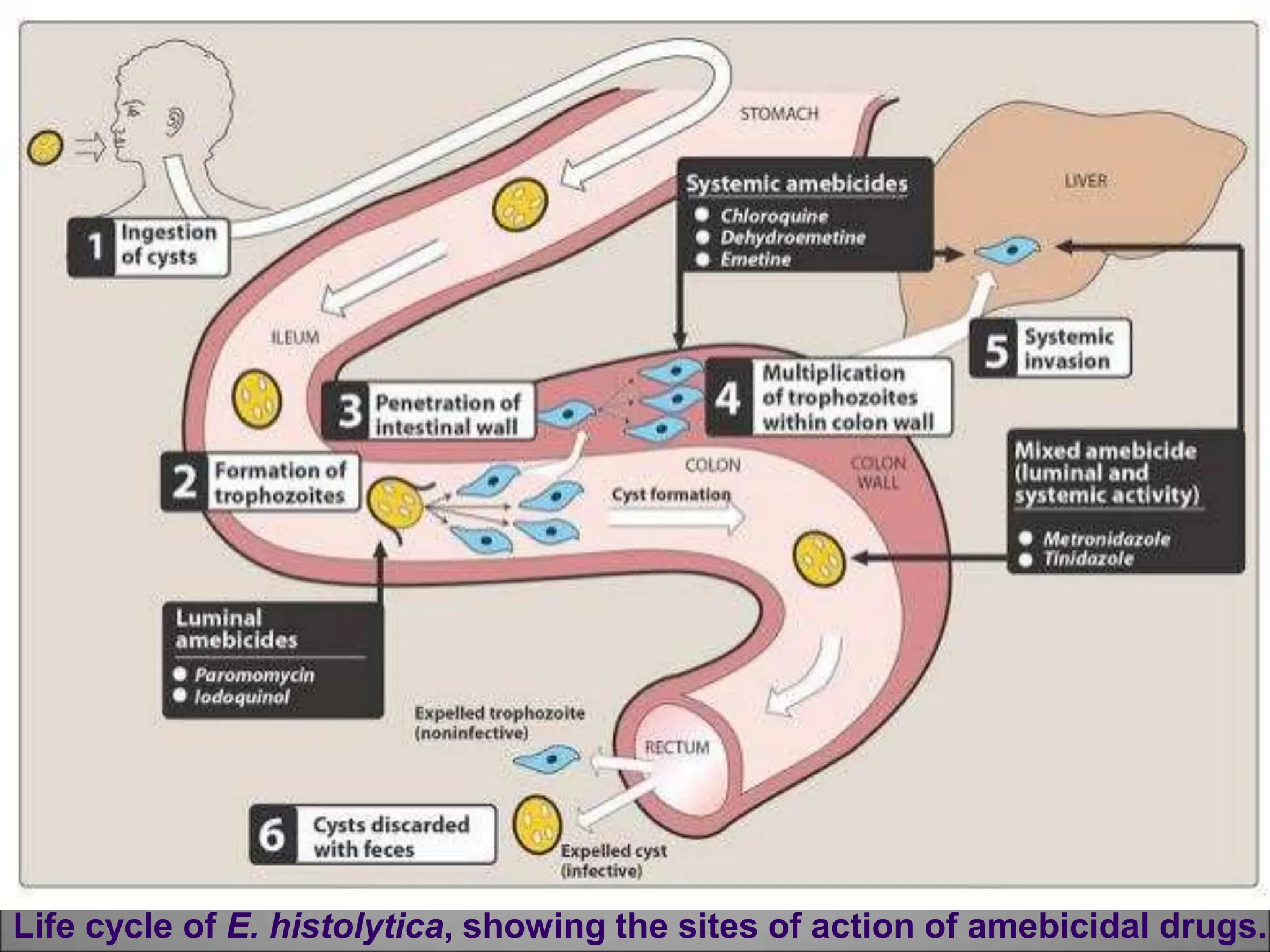
Life cycle of E. histolytica, showing the sites of action of amebicidal drugs.
Contd…
• It is a water-borne pathogen transmitted by the fecal-oral
route.
• Exists in 2 (two) forms:
1. Cyst or the dormant form – can survive outside the
body
2. Trophozoite or the dividing form - Non-infective and do
not persists outside the body but invasive
• Two stages of development:
Ingested cyst reaches colon transform to trophozoites
A. May live as commensals
B. Form cysts that pass on to stool
C 1.Form amoebic ulcers (acute dysentery) - galactose/N-
acetyl- galactosamine (Gal/GalNAc) lectin
2. Chronic amoebic dysentery (vague symptoms)
Metronidazole
 Highly effective against most of the anaerobic
bacteria and several protozoa such as E.
histolytica, Giardia Lambia and Trichomonas
Vaginalis. it is also effective against
Dracunculas medinensis.
Mechanism of action
 The E. hystolytica possess an enzyme,
pyruvate-ferrodoxin oxido-reductase,
which participates in metabolic electron
transfer reactions.
 These electrons are captured or accepted by
the nitro group of metronidazole. As a result
metronidazole itself become reduced.
 The reduced metronidazole binds to DNA of
the E. hystolytica. this disrupt replication and
transcription. This results in the death of E.
hystolytica.
Mechanism
contd…
Metronidazole (prodrug)
Enters into Microorganism
‘Nitro’ group is reduced by ferredoxins
Active metabolite
Damages microbial DNA
Death of the organism (cidal effect)
Pharmacokinetics
 After oral administration, it is nearly
completely absorbed, distributed well in the
different tissues and fluids of the body.
 Therapeutic levels can be found in vaginal,
seminal fluids, CSF, saliva and breast
milk. After absorption some part (20%) gets
bound to plasma proteins.
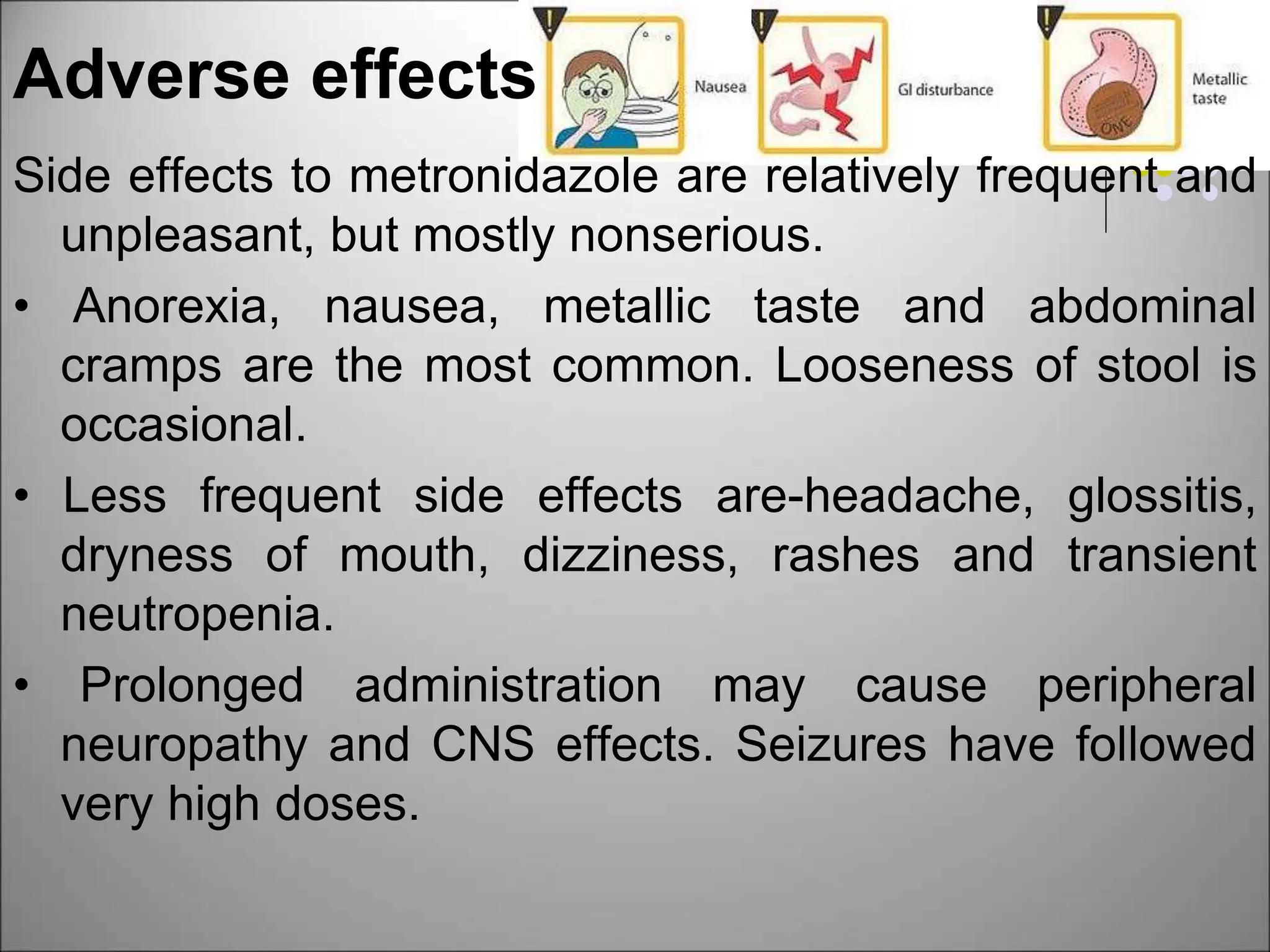
Adverse effects
Side effects to metronidazole are relatively frequent and
unpleasant, but mostly nonserious.
• Anorexia, nausea, metallic taste and abdominal
cramps are the most common. Looseness of stool is
occasional.
• Less frequent side effects are-headache, glossitis,
dryness of mouth, dizziness, rashes and transient
neutropenia.
• Prolonged administration may cause peripheral
neuropathy and CNS effects. Seizures have followed
very high doses.
Contraindications:
 Metronidazole is contraindicated in neurological
disease, blood dyscrasias, first trimester of
pregnancy and chronic alcoholism.
Interactions:
 Disulfiram-like intolerance to alcohol occurs in
some patients taking metronidazole
Uses
1. Amoebiasis: DOC 400-800 mg t.d.s for 7 days
2. Trichomonas vaginitis : DOC 400 mg t.d.s orally 7
days. Both the sexual partners should be treated
simultaneously.
3. Giardiasis: 400 mg t.d.s for 7 days OR 2 g/day for 3
days.
4. Guinea worm infestation: 200-400 mg t.d.s for 7 days
5. Anaerobic infection: highly effective against most of the
anaerobic infections.
6. In antibiotic associated pseudomembranous
colitis metronidazole is more effective and less
toxic than vancomycin.
7. In the treatment of H. Pyroli infection
metronidazole is used in combination with
clarithomycin or amoxicillin and a proton pump
inhibitor
Tinidazole
 Most features are similar to metronidazole.
Tinidazole has longer duration of action and
better tolerability than metronidazole.
Secnidazole
 Like metronidazole, secnidazole is a
nitroimidazole derivative.
 The spectrum, side effects and mechanism of
action of secnidazole are similar to
metronidazole.
Ornidazole
 It has activity similar to metronidazole, but it is slowly
metabolized—has longer t½ (12–14 hr).
 In chronic intestinal amoebiasis and asymptomatic cyst
passers- 500 mg twice daily for 5 to 7 days has also
been used.
Amides
Diloxanide furoate
 Highly effective luminal amoebicide
 Kills trophozoites responsible for production of cyst –
however no antibacterial action
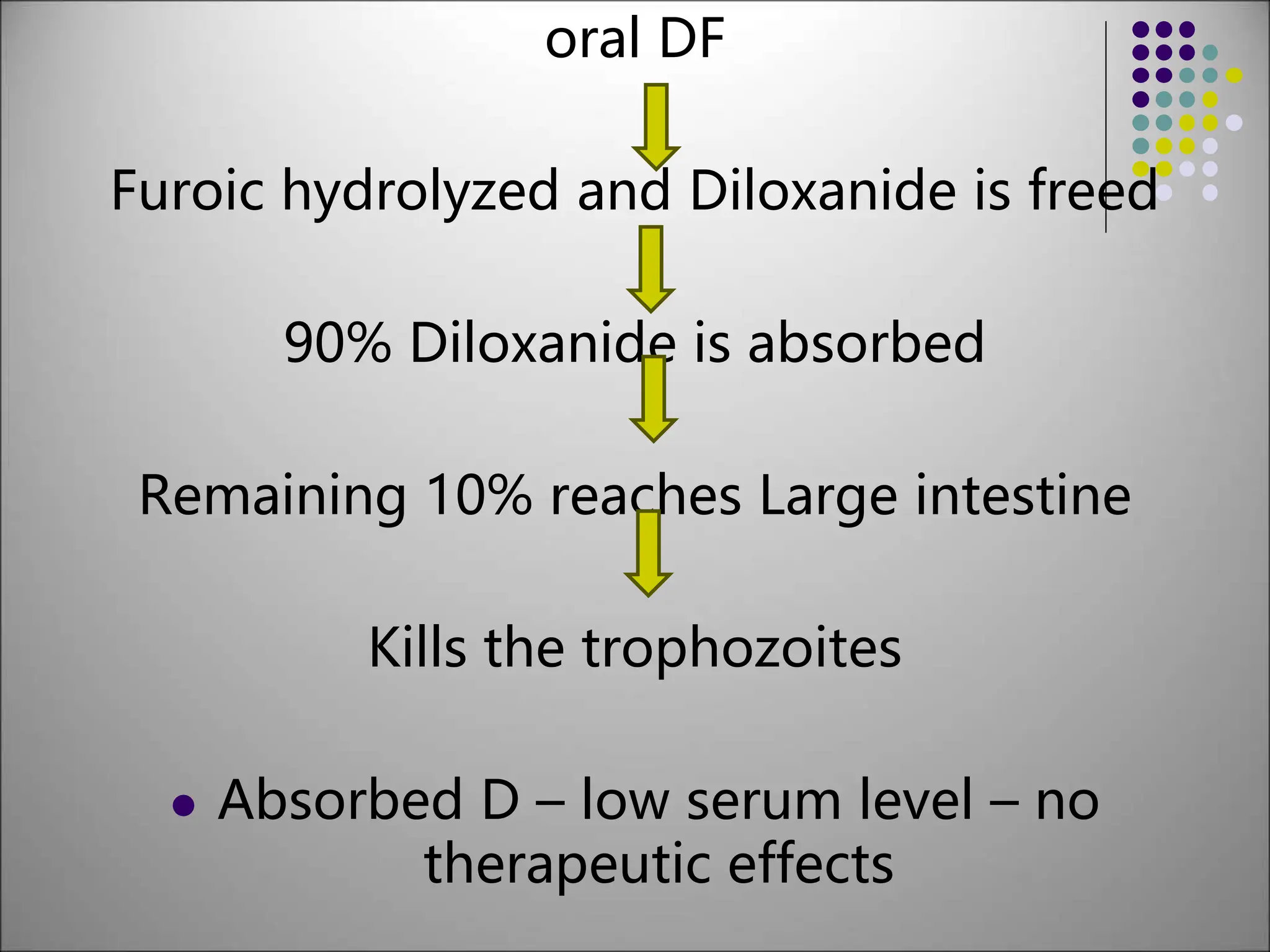
 MOA: Oral furoate ester is hydrolyzed and D is freed
90% D is absorbed remaining 10% reaches Large
intestine and exerts effects
 Absorbed D – low serum level – no therapeutic effects
 Uses: Mild tissue amoebiasis/asymptomatic cyst
passers, Tissue amoebiasis and liver abscess with
Metronidazole
 ADRs: Well tolerated, only falatulence, nausea, itching
and rarely urticaria
oral DF
Furoic hydrolyzed and Diloxanide is freed
90% Diloxanide is absorbed
Remaining 10% reaches Large intestine
Kills the trophozoites
 Absorbed D – low serum level – no
therapeutic effects
8-HYDROXYQUINOLINES
 Quiniodochlor and Iodoquinol were widely employed in
the past
 They kill the cyst forming amoebic trophozoites in the
intestine, but do not have tissue amoebicidal action.
 Like diloxanide furoate, they are not very effective in
acute amoebic dysentery but afford relief in chronic
intestinal amoebiasis.
 Their efficacy to eradicate cysts from asymptomatic
carriers is rated lower than that of diloxanide furoate.
 They are totally valueless in extraintestinal amoebiasis
 Side effects—nausea, transient loose and green stools,
Iodism
DRUGS FOR GIARDIASIS
 Giardia lamblia is a flagellate protozoon
which infects children and adults by oro-
faecal contamination and mostly lives as a
commensal in the intestine.
 It sometimes invades the mucosa and
causes acute watery short duration diarrhoea
with foul smellling stools, gas and abdominal
cramps.
 If untreated, it may pass on to chronic
diarrhoea with greasy or frothy stools but no
blood or mucus..
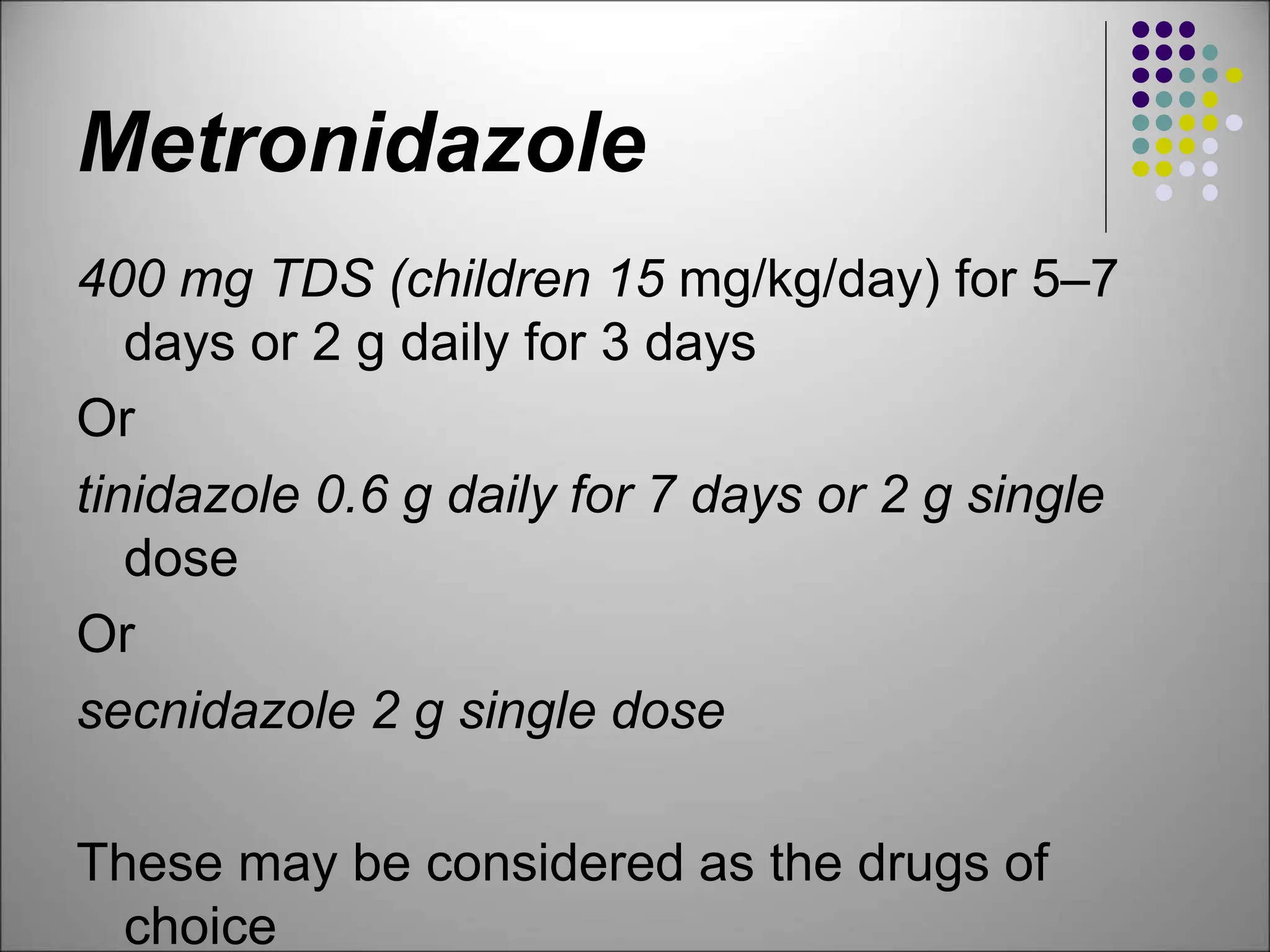
Metronidazole
400 mg TDS (children 15 mg/kg/day) for 5–7
days or 2 g daily for 3 days
Or
tinidazole 0.6 g daily for 7 days or 2 g single
dose
Or
secnidazole 2 g single dose
These may be considered as the drugs of
choice
Nitazoxanide
Metabolized rapidly to active form tizoxanide
interference with the pyruvate: ferredoxin
oxidoreductase enzyme-dependent electron
transfer reaction essential for anaerobic
metabolism.
The dosage schedule is convenient—500 mg
(children 7.5 mg/kg) twice daily for 3 days,
efficacy (~80%) approaches that of
metronidazole and tolerability is good.
3.Quiniodochlor -250 mg TDS for 7 days is a
somewhat less effective alternative.
4. Paromomycin -In a dose of 500 mg TDS for
5–7 days, it is somewhat less effective than
metronidazole, but is free of systemic side
effects and can be used during pregnancy.
However, oral formulation is not available in
India.
Furazolidone
 interference with DNA replication and protein production
 For giardiasis 100 mg TDS for 5–7 days has been used,
but is inferior to metronidazole or tinidazole.
 It has also been used in bacterial enteritis, food
poisoning diarrhoeas and bacillary dysentery, but is not a
first line treatment for any of these.
 Side effects are mild and infrequent—nausea, headache,
dizziness.
 THANK YOU
THANK YOU

drugs used in amoebiasis.ppt

  • 1.
    ANTIAMOEBIC DRUGS Madan Sigdel Asst.Prof Department of Pharmacology Gandaki Medical College
  • 2.
    Amoebiasis is protozoalinfection caused by Entamoeba histolytica, which are transmitted through fecal-oral route. CLASSIFICATION 1. Tissue amoebicides (a) For both intestinal and extraintestinal amoebiasis: Nitroimidazoles: Metronidazole, Tinidazole, Secnidazole, Ornidazole, Satranidazole Alkaloids: Emetine, Dehydroemetine (b) For extraintestinal amoebiasis only: Chloroquine
  • 3.
    2. Luminal amoebicides (a)Amide : Diloxanide furoate, Nitazoxanide (b) 8-Hydroxyquinolines: Quiniodochlor Iodoquinol (c) Antibiotics: Tetracyclines
  • 4.
    Life cycle ofE. histolytica, showing the sites of action of amebicidal drugs.
  • 5.
    Contd… • It isa water-borne pathogen transmitted by the fecal-oral route. • Exists in 2 (two) forms: 1. Cyst or the dormant form – can survive outside the body 2. Trophozoite or the dividing form - Non-infective and do not persists outside the body but invasive • Two stages of development: Ingested cyst reaches colon transform to trophozoites A. May live as commensals B. Form cysts that pass on to stool C 1.Form amoebic ulcers (acute dysentery) - galactose/N- acetyl- galactosamine (Gal/GalNAc) lectin 2. Chronic amoebic dysentery (vague symptoms)
  • 6.
    Metronidazole  Highly effectiveagainst most of the anaerobic bacteria and several protozoa such as E. histolytica, Giardia Lambia and Trichomonas Vaginalis. it is also effective against Dracunculas medinensis.
  • 7.
    Mechanism of action The E. hystolytica possess an enzyme, pyruvate-ferrodoxin oxido-reductase, which participates in metabolic electron transfer reactions.  These electrons are captured or accepted by the nitro group of metronidazole. As a result metronidazole itself become reduced.  The reduced metronidazole binds to DNA of the E. hystolytica. this disrupt replication and transcription. This results in the death of E. hystolytica.
  • 8.
    Mechanism contd… Metronidazole (prodrug) Enters intoMicroorganism ‘Nitro’ group is reduced by ferredoxins Active metabolite Damages microbial DNA Death of the organism (cidal effect)
  • 9.
    Pharmacokinetics  After oraladministration, it is nearly completely absorbed, distributed well in the different tissues and fluids of the body.  Therapeutic levels can be found in vaginal, seminal fluids, CSF, saliva and breast milk. After absorption some part (20%) gets bound to plasma proteins.
  • 10.
    Adverse effects Side effectsto metronidazole are relatively frequent and unpleasant, but mostly nonserious. • Anorexia, nausea, metallic taste and abdominal cramps are the most common. Looseness of stool is occasional. • Less frequent side effects are-headache, glossitis, dryness of mouth, dizziness, rashes and transient neutropenia. • Prolonged administration may cause peripheral neuropathy and CNS effects. Seizures have followed very high doses.
  • 11.
    Contraindications:  Metronidazole iscontraindicated in neurological disease, blood dyscrasias, first trimester of pregnancy and chronic alcoholism. Interactions:  Disulfiram-like intolerance to alcohol occurs in some patients taking metronidazole
  • 13.
    Uses 1. Amoebiasis: DOC400-800 mg t.d.s for 7 days 2. Trichomonas vaginitis : DOC 400 mg t.d.s orally 7 days. Both the sexual partners should be treated simultaneously. 3. Giardiasis: 400 mg t.d.s for 7 days OR 2 g/day for 3 days. 4. Guinea worm infestation: 200-400 mg t.d.s for 7 days 5. Anaerobic infection: highly effective against most of the anaerobic infections.
  • 14.
    6. In antibioticassociated pseudomembranous colitis metronidazole is more effective and less toxic than vancomycin. 7. In the treatment of H. Pyroli infection metronidazole is used in combination with clarithomycin or amoxicillin and a proton pump inhibitor
  • 15.
    Tinidazole  Most featuresare similar to metronidazole. Tinidazole has longer duration of action and better tolerability than metronidazole. Secnidazole  Like metronidazole, secnidazole is a nitroimidazole derivative.  The spectrum, side effects and mechanism of action of secnidazole are similar to metronidazole.
  • 16.
    Ornidazole  It hasactivity similar to metronidazole, but it is slowly metabolized—has longer t½ (12–14 hr).  In chronic intestinal amoebiasis and asymptomatic cyst passers- 500 mg twice daily for 5 to 7 days has also been used.
  • 17.
    Amides Diloxanide furoate  Highlyeffective luminal amoebicide  Kills trophozoites responsible for production of cyst – however no antibacterial action  MOA: Oral furoate ester is hydrolyzed and D is freed 90% D is absorbed remaining 10% reaches Large intestine and exerts effects  Absorbed D – low serum level – no therapeutic effects  Uses: Mild tissue amoebiasis/asymptomatic cyst passers, Tissue amoebiasis and liver abscess with Metronidazole  ADRs: Well tolerated, only falatulence, nausea, itching and rarely urticaria
  • 18.
    oral DF Furoic hydrolyzedand Diloxanide is freed 90% Diloxanide is absorbed Remaining 10% reaches Large intestine Kills the trophozoites  Absorbed D – low serum level – no therapeutic effects
  • 19.
    8-HYDROXYQUINOLINES  Quiniodochlor andIodoquinol were widely employed in the past  They kill the cyst forming amoebic trophozoites in the intestine, but do not have tissue amoebicidal action.  Like diloxanide furoate, they are not very effective in acute amoebic dysentery but afford relief in chronic intestinal amoebiasis.  Their efficacy to eradicate cysts from asymptomatic carriers is rated lower than that of diloxanide furoate.  They are totally valueless in extraintestinal amoebiasis  Side effects—nausea, transient loose and green stools, Iodism
  • 21.
    DRUGS FOR GIARDIASIS Giardia lamblia is a flagellate protozoon which infects children and adults by oro- faecal contamination and mostly lives as a commensal in the intestine.  It sometimes invades the mucosa and causes acute watery short duration diarrhoea with foul smellling stools, gas and abdominal cramps.  If untreated, it may pass on to chronic diarrhoea with greasy or frothy stools but no blood or mucus..
  • 22.
    Metronidazole 400 mg TDS(children 15 mg/kg/day) for 5–7 days or 2 g daily for 3 days Or tinidazole 0.6 g daily for 7 days or 2 g single dose Or secnidazole 2 g single dose These may be considered as the drugs of choice
  • 23.
    Nitazoxanide Metabolized rapidly toactive form tizoxanide interference with the pyruvate: ferredoxin oxidoreductase enzyme-dependent electron transfer reaction essential for anaerobic metabolism. The dosage schedule is convenient—500 mg (children 7.5 mg/kg) twice daily for 3 days, efficacy (~80%) approaches that of metronidazole and tolerability is good.
  • 24.
    3.Quiniodochlor -250 mgTDS for 7 days is a somewhat less effective alternative. 4. Paromomycin -In a dose of 500 mg TDS for 5–7 days, it is somewhat less effective than metronidazole, but is free of systemic side effects and can be used during pregnancy. However, oral formulation is not available in India.
  • 25.
    Furazolidone  interference withDNA replication and protein production  For giardiasis 100 mg TDS for 5–7 days has been used, but is inferior to metronidazole or tinidazole.  It has also been used in bacterial enteritis, food poisoning diarrhoeas and bacillary dysentery, but is not a first line treatment for any of these.  Side effects are mild and infrequent—nausea, headache, dizziness.
  • 26.
  • 27.