Progestogens
Prof.C.Adithan
Progestrogens
•Synthesis& secretion
•Main Functions
•Classifications and Preparations
•Therapeutic uses
•Adverse effects
•Pharmacokinetics
Anti-progestrogens: Mifepristone, Ulipristal
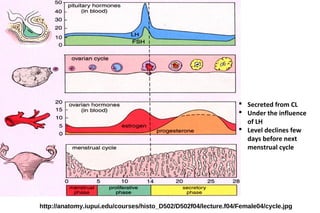
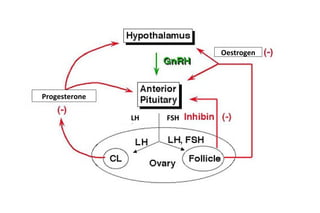
http://anatomy.iupui.edu/courses/histo_D502/D502f04/lecture.f04/Female04/cycle.jpg
 Secreted from CL
 Under the influence
of LH
 Level declines few
days before next
menstrual cycle
LH FSH
Progesterone
Oestrogen
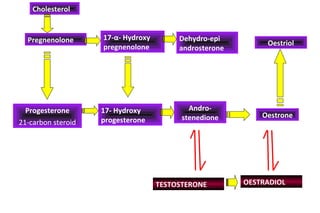
Cholesterol
Pregnenolone
Progesterone
21-carbon steroid
17-α- Hydroxy
pregnenolone
17- Hydroxy
progesterone
Dehydro-epi
androsterone
Andro-
stenedione Oestrone
Oestriol
TESTOSTERONE OESTRADIOL
Main Functions
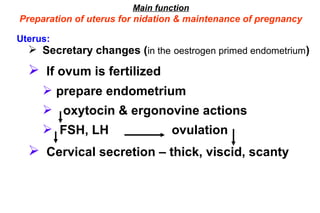
Main function
Preparation of uterus for nidation & maintenance of pregnancy
Uterus:
 Secretary changes (in the oestrogen primed endometrium)
 If ovum is fertilized
 prepare endometrium
 oxytocin & ergonovine actions
 FSH, LH ovulation
 Cervical secretion – thick, viscid, scanty
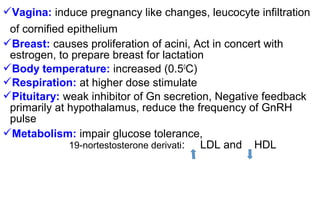
Vagina: induce pregnancy like changes, leucocyte infiltration
of cornified epithelium
Breast: causes proliferation of acini, Act in concert with
estrogen, to prepare breast for lactation
Body temperature: increased (0.50
C)
Respiration: at higher dose stimulate
Pituitary: weak inhibitor of Gn secretion, Negative feedback
primarily at hypothalamus, reduce the frequency of GnRH
pulse
Metabolism: impair glucose tolerance,
19-nortestosterone derivati: LDL and HDL
Classifications and
Preparations
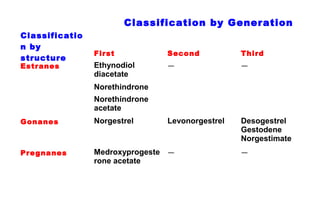
Classification by Generation
Classificatio
n by
structure
First Second Third
Estranes Ethynodiol
diacetate
— —
Norethindrone
Norethindrone
acetate
Gonanes Norgestrel Levonorgestrel Desogestrel
Gestodene
Norgestimate
Pregnanes Medroxyprogeste
rone acetate
— —
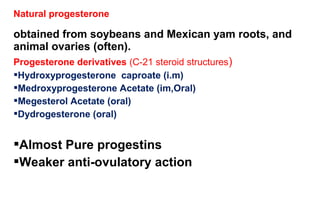
Natural progesterone
obtained from soybeans and Mexican yam roots, and
animal ovaries (often).
Progesterone derivatives (C-21 steroid structures)
Hydroxyprogesterone caproate (i.m)
Medroxyprogesterone Acetate (im,Oral)
Megesterol Acetate (oral)
Dydrogesterone (oral)
Almost Pure progestins
Weaker anti-ovulatory action
Nomegesterol (oral microionized natural progesterone)
Weak antiandrogenic, Less anti-ovulatory, Strong
antioestrogenic
Micronizing process increase the half-life of progesterone
and reduce its destruction in the GIT and Maxium serum
conc. achieved rapidly
Absorption 2 fold increased when taken with food.
No Adverse effects on mood, lipid profile, glucose
tolerance and pregnancy outcome
Common side effects: Fatigue and Sedation.
19-Nor-testosterone derivative
Older Compounds
 Norethindrone
 Lynestrenol (Ethinyl
oestradiol)
 Allylestrenol,
 Additional weak oestrogenic,
androgenic and anabolic
 potent anti-ovulatory actions
19-Nor-testosterone derivatives: (Gonanes)
Levonorgestrel, Desogestrel, Norgestimate, Gestodene
 All are given orally
 Very potent progestins,
 No androgenic effects, Strong anti-ovulatory actions
 Used in OCS
 Do not antagonize the beneficial effects of estrogens on lipid
profile
 Suitable for women with hyperandrogenemia
Synthetic Progestins (Except Gonanes) Vs Natural Progestins
Androgenic effects of synthetic progestins include
fluid retention,
reduction of HDL cholesterol levels,
headaches and
mood disturbance.
Some of 19-nortestosterone are strongly
androgenic
Producing hirsutism and acne
Transvaginal Progesterone.
•Most practical non-oral route of
administration.
•Produces uterine effects with minimal
systemic side effects.
Clinical Uses
• OCS: Minipill, Norplant, conventional OCS
• HRT – to antagonize oestrogen side effects, a progestin lacking
androgenic activity is preferred
• DUB: Adolescent, peri/Menopausal women, Norethindrone 20-40
mg/day promptly stops the bleeding, subsequent cyclic treatment with
estrogen
• Endometriosis: presence of ectopic endometrial cells outside
the uterus, continue to respond to O and P, cause dysmenorrhea, painful
pelvic swelling, infertility.
• Goal of therapy is to induce estrogen poor environment, Continued
admn. of P induces anovulatory, estrogenic poor state by GnRH
• Dysmenorrhea
Clinical uses of Progesterones
• Premenstrual syndrome: suppress ovulation (O + P)
• Threatened abortion: only P deficiency cases: pure
P without androgenic and oestrogenic preferred
• Post-partum lactation
• Endometrial cancer: palliative, high dose required
• Hypoventilation
Clinical uses of Progesterones
Adverse Effects
Adverse effects of Progesterone
• breast engorgement, headache, rise in body
temp, oedema, acne & mood swings
• masculinization of external genitalia in the
foetus
• Increased incidences of congenital
abnormalities
• irregular bleeding or amenorrhea
• lower HDL (19-nortestosterone derivatives)
• hyperglycaemia
Pharmacokinetics
Pharmacokinetics
•Absorption:
• progesterone undergoes high first pass metabolism.
Therefore synthetic preparations are commonly used.
• Progesterone esters in oily soln. for i.m. admn.
•Metabolism:
• by liver enzymes
• excretion by urine after conjugation
Antiprogestins
Antiprogestin
Mifepristone
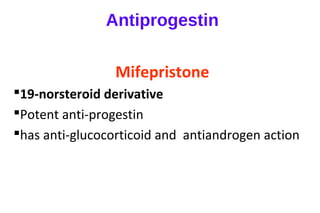
19-norsteroid derivative
Potent anti-progestin
has anti-glucocorticoid and antiandrogen action
Mifepristone
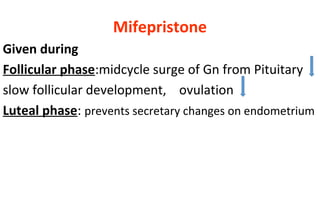
Given during
Follicular phase:midcycle surge of Gn from Pituitary
slow follicular development, ovulation
Luteal phase: prevents secretary changes on endometrium
Mifepristone
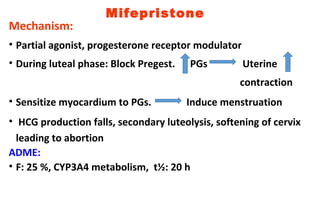
Mechanism:
• Partial agonist, progesterone receptor modulator
• During luteal phase: Block Pregest. PGs Uterine
contraction
• Sensitize myocardium to PGs. Induce menstruation
• HCG production falls, secondary luteolysis, softening of cervix
leading to abortion
ADME:
• F: 25 %, CYP3A4 metabolism, t½: 20 h
Uses:
• Termination of early pregnancy – along with
prostaglandin (upto 7 weeks), 600 mg single oral + 400 mg
oral misoprotol or 1mg gemeprost intravaginally
• As a cervical ripening agent: surgical abortion
• Post-coital contraceptive: within 72 hours
• Once a month contraceptive: 200 mg at 2 days after
midcycle of ovulation
• Progesterone sensitive tumors
• Cushing’s syndrome
Side effects:
Vomiting, diarrhoea,
pelvic pain or abdominal pain,
about 5% have severe vaginal bleeding
Precaution: Not to be given to a woman with suspected
ectopic pregnancy, hematological disorders, receiving oral
anticoagulants, Liver/renal diseases
Ulipristal
• Selective progesterone receptor modulator (SPRM)
• Used in emergency contraceptive (within 5 days, 30 mg)
• Inhibits ovulation by LH surge + direct effect on follicule
• By its action on endometrium, inhibits implantation
• Weaker anti-glucocorticoid activity
• Metabolised by CYP3A4 and drug interaction possible with
rifampicin, phenytoin, carbamazepine
OTHERS:
Onapristone (pure progesterone antagonist) ,
Gestinone (more effective in endometriosis)
Thank you

Progestrogens web2

  • 1.
  • 2.
    Progestrogens •Synthesis& secretion •Main Functions •Classificationsand Preparations •Therapeutic uses •Adverse effects •Pharmacokinetics Anti-progestrogens: Mifepristone, Ulipristal
  • 3.
    http://anatomy.iupui.edu/courses/histo_D502/D502f04/lecture.f04/Female04/cycle.jpg  Secreted fromCL  Under the influence of LH  Level declines few days before next menstrual cycle
  • 4.
  • 5.
    Cholesterol Pregnenolone Progesterone 21-carbon steroid 17-α- Hydroxy pregnenolone 17-Hydroxy progesterone Dehydro-epi androsterone Andro- stenedione Oestrone Oestriol TESTOSTERONE OESTRADIOL
  • 6.
  • 7.
    Main function Preparation ofuterus for nidation & maintenance of pregnancy Uterus:  Secretary changes (in the oestrogen primed endometrium)  If ovum is fertilized  prepare endometrium  oxytocin & ergonovine actions  FSH, LH ovulation  Cervical secretion – thick, viscid, scanty
  • 8.
    Vagina: induce pregnancylike changes, leucocyte infiltration of cornified epithelium Breast: causes proliferation of acini, Act in concert with estrogen, to prepare breast for lactation Body temperature: increased (0.50 C) Respiration: at higher dose stimulate Pituitary: weak inhibitor of Gn secretion, Negative feedback primarily at hypothalamus, reduce the frequency of GnRH pulse Metabolism: impair glucose tolerance, 19-nortestosterone derivati: LDL and HDL
  • 9.
  • 10.
    Classification by Generation Classificatio nby structure First Second Third Estranes Ethynodiol diacetate — — Norethindrone Norethindrone acetate Gonanes Norgestrel Levonorgestrel Desogestrel Gestodene Norgestimate Pregnanes Medroxyprogeste rone acetate — —
  • 11.
    Natural progesterone obtained fromsoybeans and Mexican yam roots, and animal ovaries (often). Progesterone derivatives (C-21 steroid structures) Hydroxyprogesterone caproate (i.m) Medroxyprogesterone Acetate (im,Oral) Megesterol Acetate (oral) Dydrogesterone (oral) Almost Pure progestins Weaker anti-ovulatory action
  • 12.
    Nomegesterol (oral microionizednatural progesterone) Weak antiandrogenic, Less anti-ovulatory, Strong antioestrogenic Micronizing process increase the half-life of progesterone and reduce its destruction in the GIT and Maxium serum conc. achieved rapidly Absorption 2 fold increased when taken with food. No Adverse effects on mood, lipid profile, glucose tolerance and pregnancy outcome Common side effects: Fatigue and Sedation.
  • 13.
    19-Nor-testosterone derivative Older Compounds Norethindrone  Lynestrenol (Ethinyl oestradiol)  Allylestrenol,  Additional weak oestrogenic, androgenic and anabolic  potent anti-ovulatory actions 19-Nor-testosterone derivatives: (Gonanes) Levonorgestrel, Desogestrel, Norgestimate, Gestodene  All are given orally  Very potent progestins,  No androgenic effects, Strong anti-ovulatory actions  Used in OCS  Do not antagonize the beneficial effects of estrogens on lipid profile  Suitable for women with hyperandrogenemia
  • 14.
    Synthetic Progestins (ExceptGonanes) Vs Natural Progestins Androgenic effects of synthetic progestins include fluid retention, reduction of HDL cholesterol levels, headaches and mood disturbance. Some of 19-nortestosterone are strongly androgenic Producing hirsutism and acne
  • 15.
    Transvaginal Progesterone. •Most practicalnon-oral route of administration. •Produces uterine effects with minimal systemic side effects.
  • 16.
  • 17.
    • OCS: Minipill,Norplant, conventional OCS • HRT – to antagonize oestrogen side effects, a progestin lacking androgenic activity is preferred • DUB: Adolescent, peri/Menopausal women, Norethindrone 20-40 mg/day promptly stops the bleeding, subsequent cyclic treatment with estrogen • Endometriosis: presence of ectopic endometrial cells outside the uterus, continue to respond to O and P, cause dysmenorrhea, painful pelvic swelling, infertility. • Goal of therapy is to induce estrogen poor environment, Continued admn. of P induces anovulatory, estrogenic poor state by GnRH • Dysmenorrhea Clinical uses of Progesterones
  • 18.
    • Premenstrual syndrome:suppress ovulation (O + P) • Threatened abortion: only P deficiency cases: pure P without androgenic and oestrogenic preferred • Post-partum lactation • Endometrial cancer: palliative, high dose required • Hypoventilation Clinical uses of Progesterones
  • 19.
  • 20.
    Adverse effects ofProgesterone • breast engorgement, headache, rise in body temp, oedema, acne & mood swings • masculinization of external genitalia in the foetus • Increased incidences of congenital abnormalities • irregular bleeding or amenorrhea • lower HDL (19-nortestosterone derivatives) • hyperglycaemia
  • 21.
  • 22.
    Pharmacokinetics •Absorption: • progesterone undergoeshigh first pass metabolism. Therefore synthetic preparations are commonly used. • Progesterone esters in oily soln. for i.m. admn. •Metabolism: • by liver enzymes • excretion by urine after conjugation
  • 23.
  • 24.
  • 25.
    Mifepristone Given during Follicular phase:midcyclesurge of Gn from Pituitary slow follicular development, ovulation Luteal phase: prevents secretary changes on endometrium
  • 26.
    Mifepristone Mechanism: • Partial agonist,progesterone receptor modulator • During luteal phase: Block Pregest. PGs Uterine contraction • Sensitize myocardium to PGs. Induce menstruation • HCG production falls, secondary luteolysis, softening of cervix leading to abortion ADME: • F: 25 %, CYP3A4 metabolism, t½: 20 h
  • 27.
    Uses: • Termination ofearly pregnancy – along with prostaglandin (upto 7 weeks), 600 mg single oral + 400 mg oral misoprotol or 1mg gemeprost intravaginally • As a cervical ripening agent: surgical abortion • Post-coital contraceptive: within 72 hours • Once a month contraceptive: 200 mg at 2 days after midcycle of ovulation • Progesterone sensitive tumors • Cushing’s syndrome
  • 28.
    Side effects: Vomiting, diarrhoea, pelvicpain or abdominal pain, about 5% have severe vaginal bleeding Precaution: Not to be given to a woman with suspected ectopic pregnancy, hematological disorders, receiving oral anticoagulants, Liver/renal diseases
  • 29.
    Ulipristal • Selective progesteronereceptor modulator (SPRM) • Used in emergency contraceptive (within 5 days, 30 mg) • Inhibits ovulation by LH surge + direct effect on follicule • By its action on endometrium, inhibits implantation • Weaker anti-glucocorticoid activity • Metabolised by CYP3A4 and drug interaction possible with rifampicin, phenytoin, carbamazepine OTHERS: Onapristone (pure progesterone antagonist) , Gestinone (more effective in endometriosis)
  • 30.