DR. R.E. MBU 2006DR. R.E. MBU 2006 11
THE PLACENTA AND ITSTHE PLACENTA AND ITS
ABNORMALITIESABNORMALITIES
Dr. Robinson E. MbuDr. Robinson E. Mbu
Senior LecturerSenior Lecturer
DR. R.E. MBU 2006DR. R.E. MBU 2006 22
PLANPLAN
 IntroductionIntroduction
 ObjectivesObjectives
 StructureStructure
 Foetal circulationFoetal circulation
 Maternal circulationMaternal circulation
 FunctionsFunctions
 The placental unitThe placental unit
 Placental abnormalitiesPlacental abnormalities
 The umbilical cordThe umbilical cord
DR. R.E. MBU 2006DR. R.E. MBU 2006 33
INTRODUCTIONINTRODUCTION
 The concept of placenta was first introducedThe concept of placenta was first introduced
byby REALDUS COLUMBUSREALDUS COLUMBUS in 1559in 1559
 MOSSMANMOSSMAN defined the placenta in 1937defined the placenta in 1937
 As that part of the foetal membranes fusedAs that part of the foetal membranes fused
to the uterine mucosato the uterine mucosa
 EmbryologicallyEmbryologically
 Throphoblasts are formedThrophoblasts are formed
 By the blastocystBy the blastocyst
 As early as 72hrs. after fertilizationAs early as 72hrs. after fertilization
DR. R.E. MBU 2006DR. R.E. MBU 2006 44
INTRODUCTION cont’dINTRODUCTION cont’d
 The throphoblasts proliferate rapidlyThe throphoblasts proliferate rapidly
 And invade the surrounding deciduaAnd invade the surrounding decidua
 Soon after implantationSoon after implantation
 As invasion of the endometriumAs invasion of the endometrium
proceedsproceeds
 Maternal blood vessels are invadedMaternal blood vessels are invaded
 Forming intervillous spacesForming intervillous spaces
DR. R.E. MBU 2006DR. R.E. MBU 2006 55
OBJECTIVESOBJECTIVES
 Holistic understanding of the placentaHolistic understanding of the placenta
– StructureStructure
– FunctionFunction
– Abnormal formsAbnormal forms
– Etc.Etc.
DR. R.E. MBU 2006DR. R.E. MBU 2006 66
STRUCTURESTRUCTURE
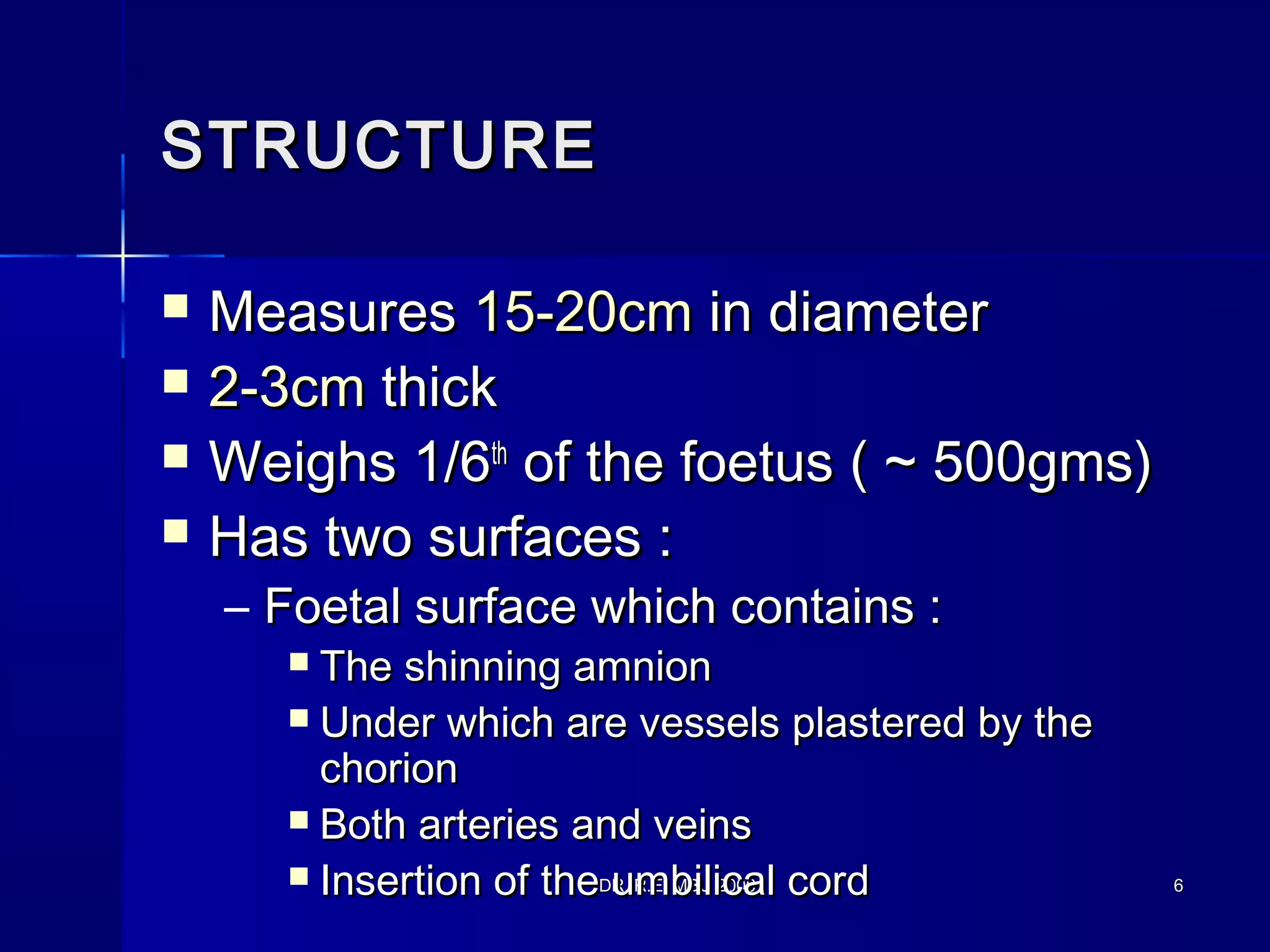
 MeasuresMeasures 15-20cm15-20cm in diameterin diameter
 2-3cm2-3cm thickthick
 Weighs 1/6Weighs 1/6thth
of the foetus ( ~ 500gms)of the foetus ( ~ 500gms)
 Has two surfaces :Has two surfaces :
– Foetal surface which contains :Foetal surface which contains :
 The shinning amnionThe shinning amnion
 Under which are vessels plastered by theUnder which are vessels plastered by the
chorionchorion
 Both arteries and veinsBoth arteries and veins
 Insertion of the umbilical cordInsertion of the umbilical cord
DR. R.E. MBU 2006DR. R.E. MBU 2006 77
STRUCTURE cont’dSTRUCTURE cont’d
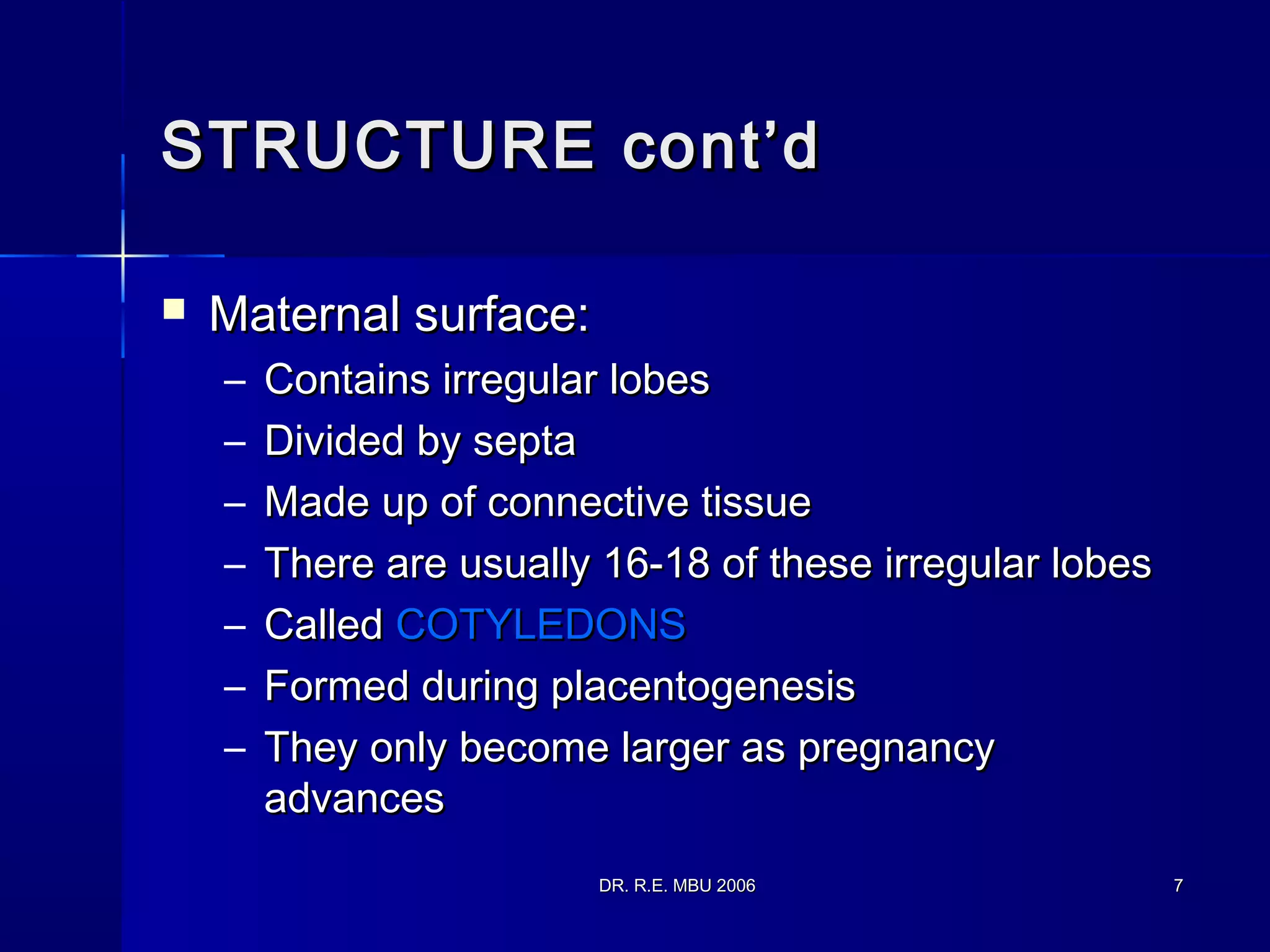
 Maternal surface:Maternal surface:
– Contains irregular lobesContains irregular lobes
– Divided by septaDivided by septa
– Made up of connective tissueMade up of connective tissue
– There are usually 16-18 of these irregular lobesThere are usually 16-18 of these irregular lobes
– CalledCalled COTYLEDONSCOTYLEDONS
– Formed during placentogenesisFormed during placentogenesis
– They only become larger as pregnancyThey only become larger as pregnancy
advancesadvances
DR. R.E. MBU 2006DR. R.E. MBU 2006 88
STRUCTURE cont’dSTRUCTURE cont’d
 No new cotyledons are formed afterNo new cotyledons are formed after
this periodthis period
 The placenta is located usuallyThe placenta is located usually
 Anteriorly or posteriorlyAnteriorly or posteriorly
 Near the fundusNear the fundus
DR. R.E. MBU 2006DR. R.E. MBU 2006 99
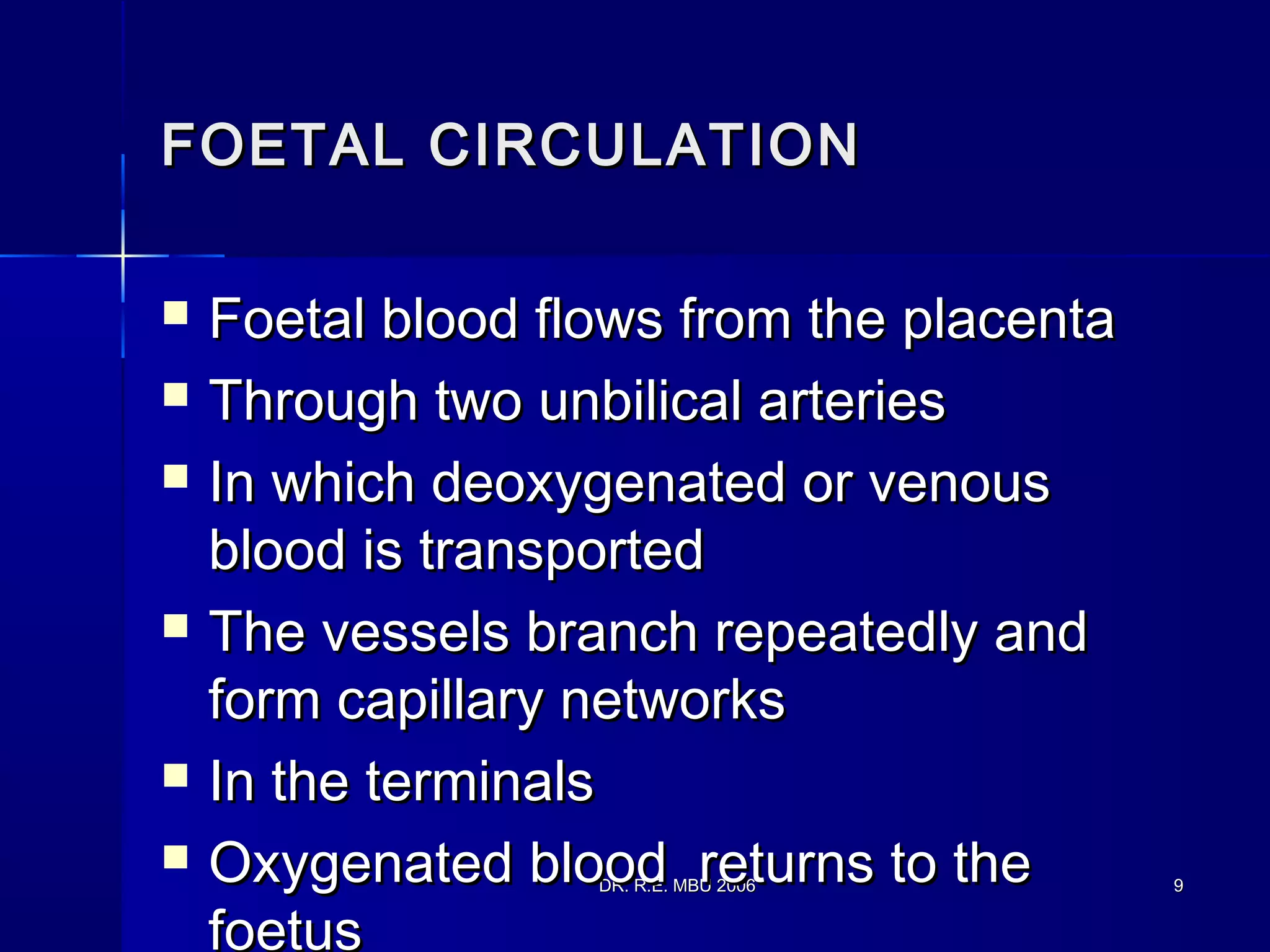
FOETAL CIRCULATIONFOETAL CIRCULATION
 Foetal blood flows from the placentaFoetal blood flows from the placenta
 Through two unbilical arteriesThrough two unbilical arteries
 In which deoxygenated or venousIn which deoxygenated or venous
blood is transportedblood is transported
 The vessels branch repeatedly andThe vessels branch repeatedly and
form capillary networksform capillary networks
 In the terminalsIn the terminals
 Oxygenated blood returns to theOxygenated blood returns to the
foetus
DR. R.E. MBU 2006DR. R.E. MBU 2006 1010
FOETAL CIRCULATION cont’dFOETAL CIRCULATION cont’d
 From the placentaFrom the placenta
 Through the single umbilical veinThrough the single umbilical vein
DR. R.E. MBU 2006DR. R.E. MBU 2006 1111
MATERNAL CIRCULATIONMATERNAL CIRCULATION
 Maternal blood reaches the placentaMaternal blood reaches the placenta
 Propelled by maternal arterialPropelled by maternal arterial
pressurepressure
 There is no admixture of maternal andThere is no admixture of maternal and
foetal bloodfoetal blood
 Venous exits are scattered at randomVenous exits are scattered at random
 Over the entire base of the placentaOver the entire base of the placenta
DR. R.E. MBU 2006DR. R.E. MBU 2006 1212
FUNCTIONS OF THEFUNCTIONS OF THE
PLACENTAPLACENTA
 Exchange functions:Exchange functions:
– Waste products from the placentaWaste products from the placenta
– Cross the placental membraneCross the placental membrane
– To the maternal bloodTo the maternal blood
– Oxygen, nutrients and protectiveOxygen, nutrients and protective
antibodiesantibodies
– Leave from the mother across theLeave from the mother across the
placental membraneplacental membrane
– To the foetusTo the foetus
DR. R.E. MBU 2006DR. R.E. MBU 2006 1313
PLACENTAL FUNCTIONS cont’dPLACENTAL FUNCTIONS cont’d
 Endocrine functions:Endocrine functions:
– Chorionic gonadotropinChorionic gonadotropin
– HPLHPL
– Chorionic thyrotropinChorionic thyrotropin
– Chorionic adrenocorticotropinChorionic adrenocorticotropin
– Hypothalamic-like releasing hormones ofHypothalamic-like releasing hormones of
the placentathe placenta
– Pregnancy specific proteinPregnancy specific protein
DR. R.E. MBU 2006DR. R.E. MBU 2006 1414
ENDOCRINE FUNCTIONS cont’dENDOCRINE FUNCTIONS cont’d
 EstrogensEstrogens
 ProgesteroneProgesterone
 ProlactineProlactine
DR. R.E. MBU 2006DR. R.E. MBU 2006 1515
PROTECTIVE FUNCTIONPROTECTIVE FUNCTION
 Destroys the following :Destroys the following :
– BacteriaBacteria
– VirusesViruses
– PlasmodiumPlasmodium
– FungiFungi
– ETC.ETC.
DR. R.E. MBU 2006DR. R.E. MBU 2006 1616
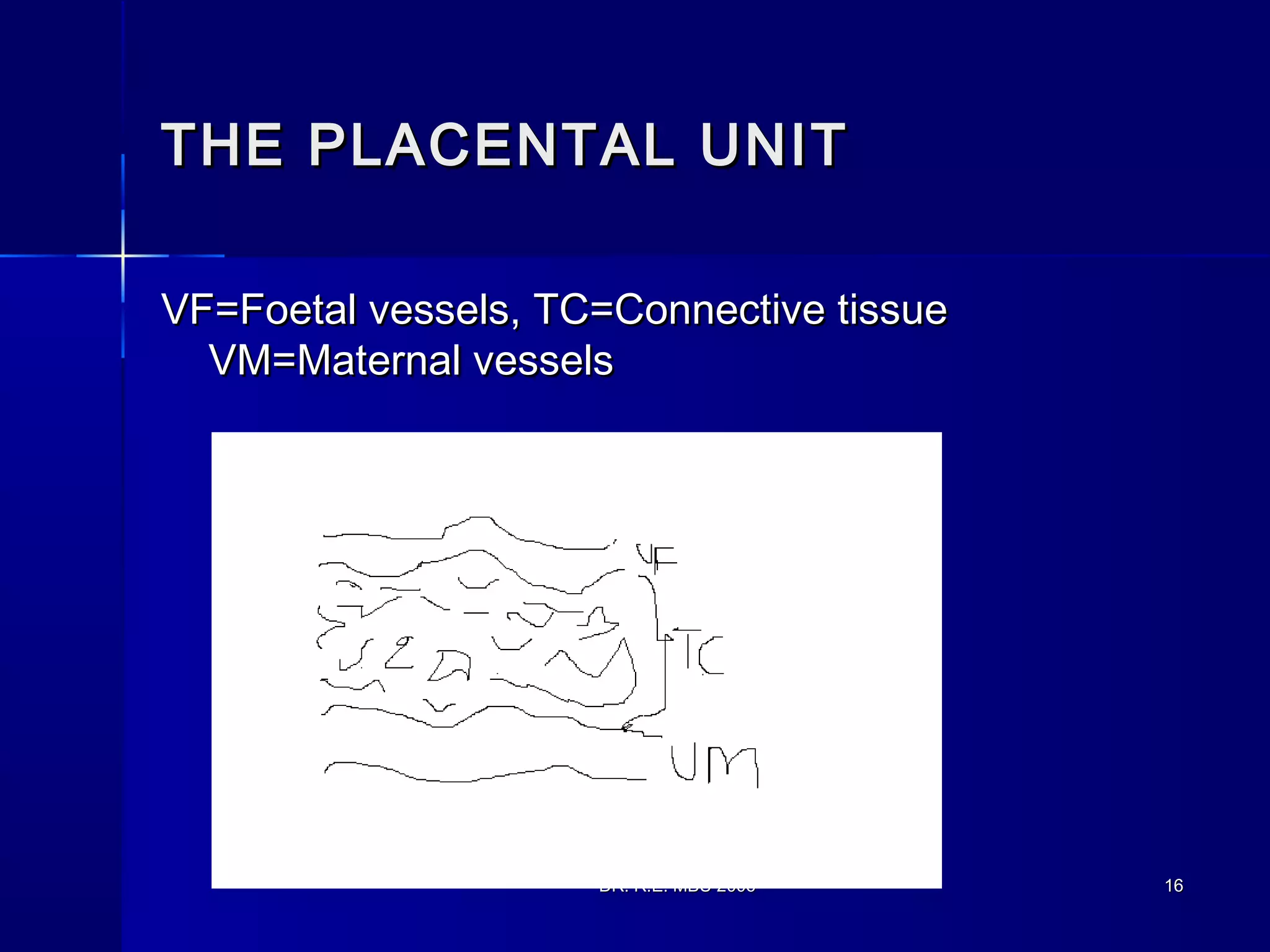
THE PLACENTAL UNITTHE PLACENTAL UNIT
VF=Foetal vessels, TC=Connective tissueVF=Foetal vessels, TC=Connective tissue
VM=Maternal vesselsVM=Maternal vessels
DR. R.E. MBU 2006DR. R.E. MBU 2006 1717
PLACENTAL AGINGPLACENTAL AGING
 Decrease in thickness of syncytiumDecrease in thickness of syncytium
 Partial disappearance of cytotrophoblastsPartial disappearance of cytotrophoblasts
((LANGHANS CELLSLANGHANS CELLS))
 Decrease in stromaDecrease in stroma
 Thickening of basement of the endotheliumThickening of basement of the endothelium
and trophoblastsand trophoblasts
 Obliteration of certain vesselsObliteration of certain vessels
 Deposition of fibrinDeposition of fibrin
 On the surface of the villi/intervillous spaceOn the surface of the villi/intervillous space
 Decrease in efficiency of placentalDecrease in efficiency of placental
exchangeexchange
DR. R.E. MBU 2006DR. R.E. MBU 2006 1818
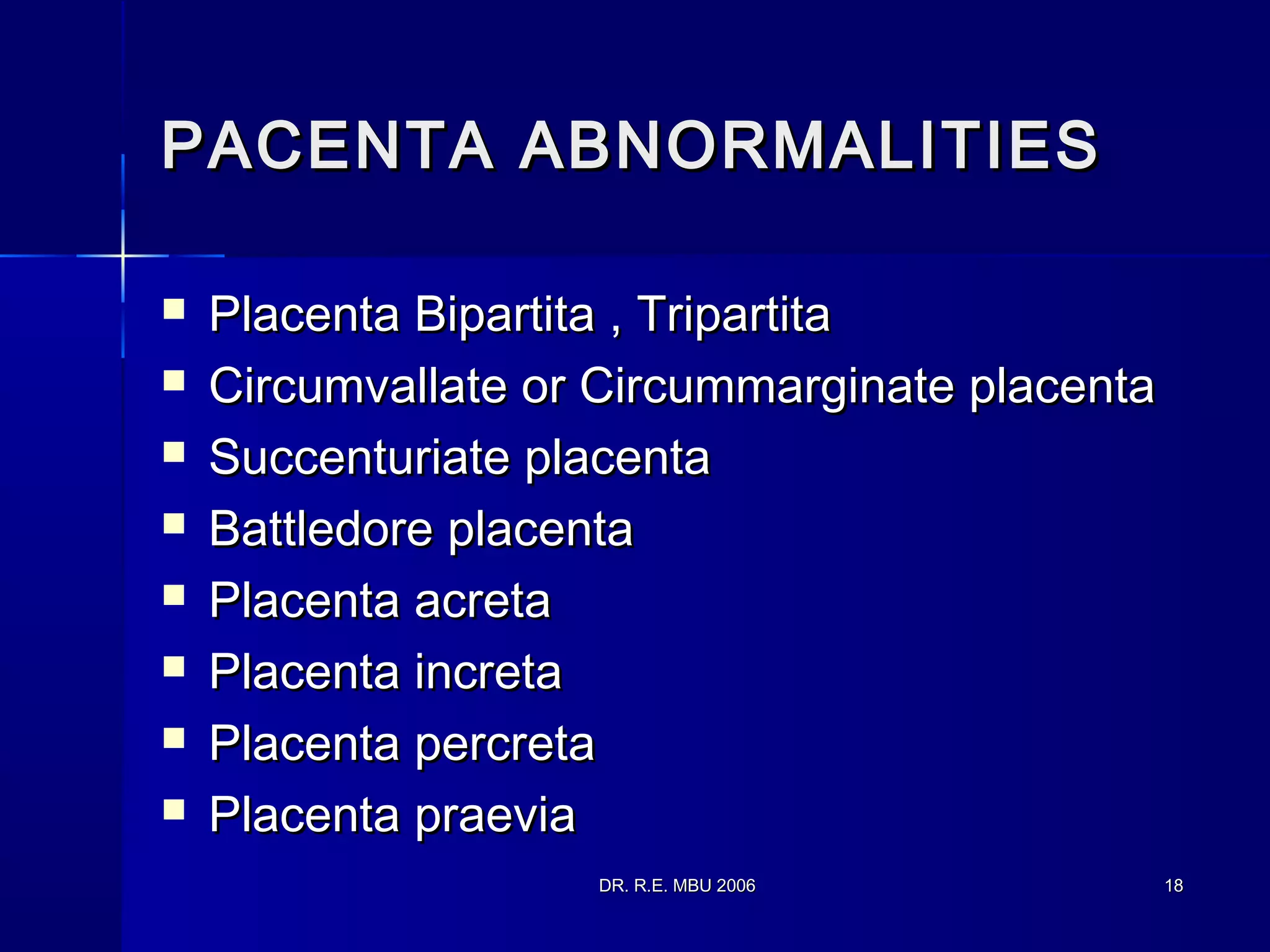
PACENTA ABNORMALITIESPACENTA ABNORMALITIES
 Placenta Bipartita , TripartitaPlacenta Bipartita , Tripartita
 Circumvallate or Circummarginate placentaCircumvallate or Circummarginate placenta
 Succenturiate placentaSuccenturiate placenta
 Battledore placentaBattledore placenta
 Placenta acretaPlacenta acreta
 Placenta incretaPlacenta increta
 Placenta percretaPlacenta percreta
 Placenta praeviaPlacenta praevia
DR. R.E. MBU 2006DR. R.E. MBU 2006 1919
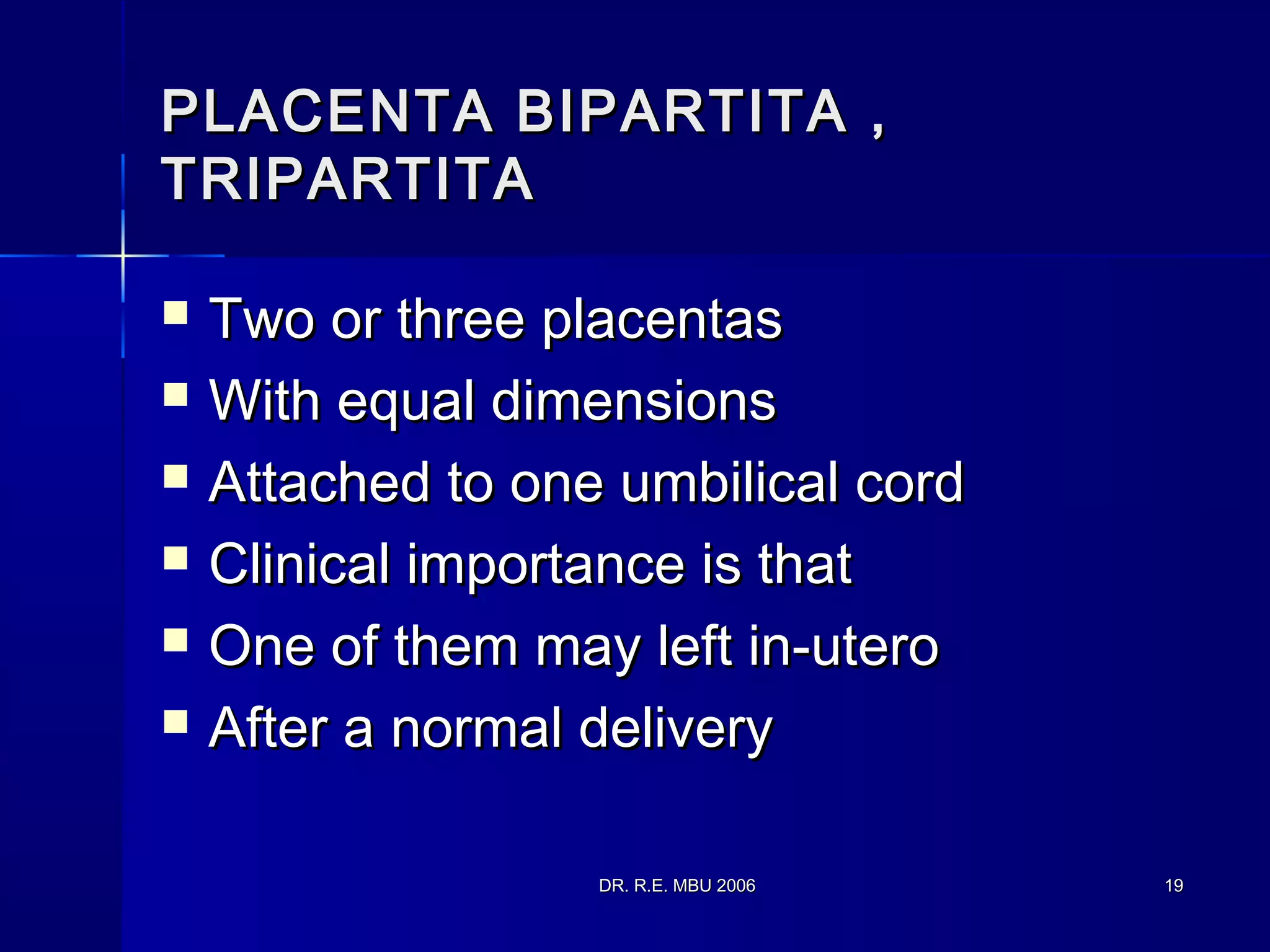
PLACENTA BIPARTITA ,PLACENTA BIPARTITA ,
TRIPARTITATRIPARTITA
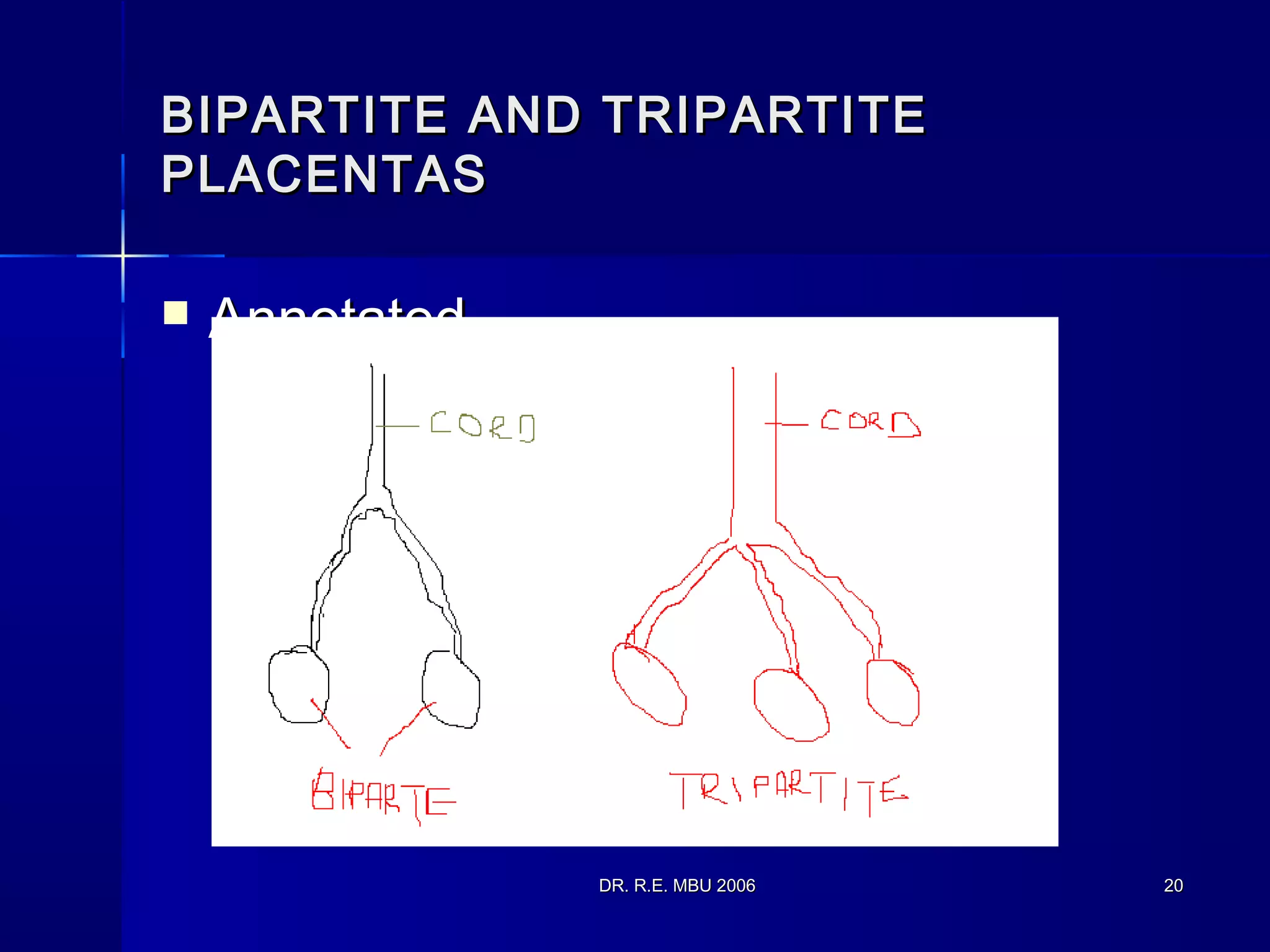
 Two or three placentasTwo or three placentas
 With equal dimensionsWith equal dimensions
 Attached to one umbilical cordAttached to one umbilical cord
 Clinical importance is thatClinical importance is that
 One of them may left in-uteroOne of them may left in-utero
 After a normal deliveryAfter a normal delivery
DR. R.E. MBU 2006DR. R.E. MBU 2006 2020
BIPARTITE AND TRIPARTITEBIPARTITE AND TRIPARTITE
PLACENTASPLACENTAS
 AnnotatedAnnotated
DR. R.E. MBU 2006DR. R.E. MBU 2006 2121
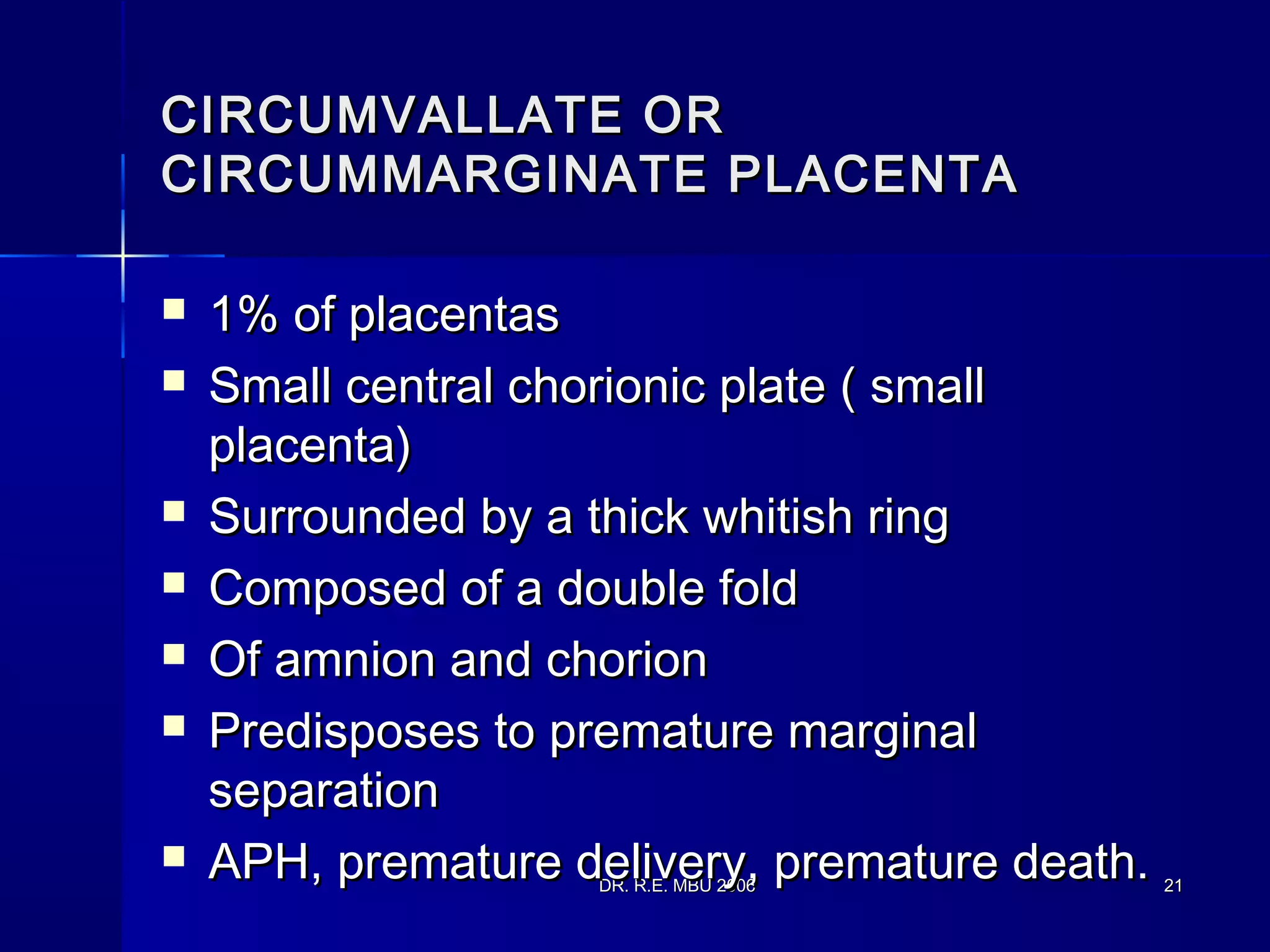
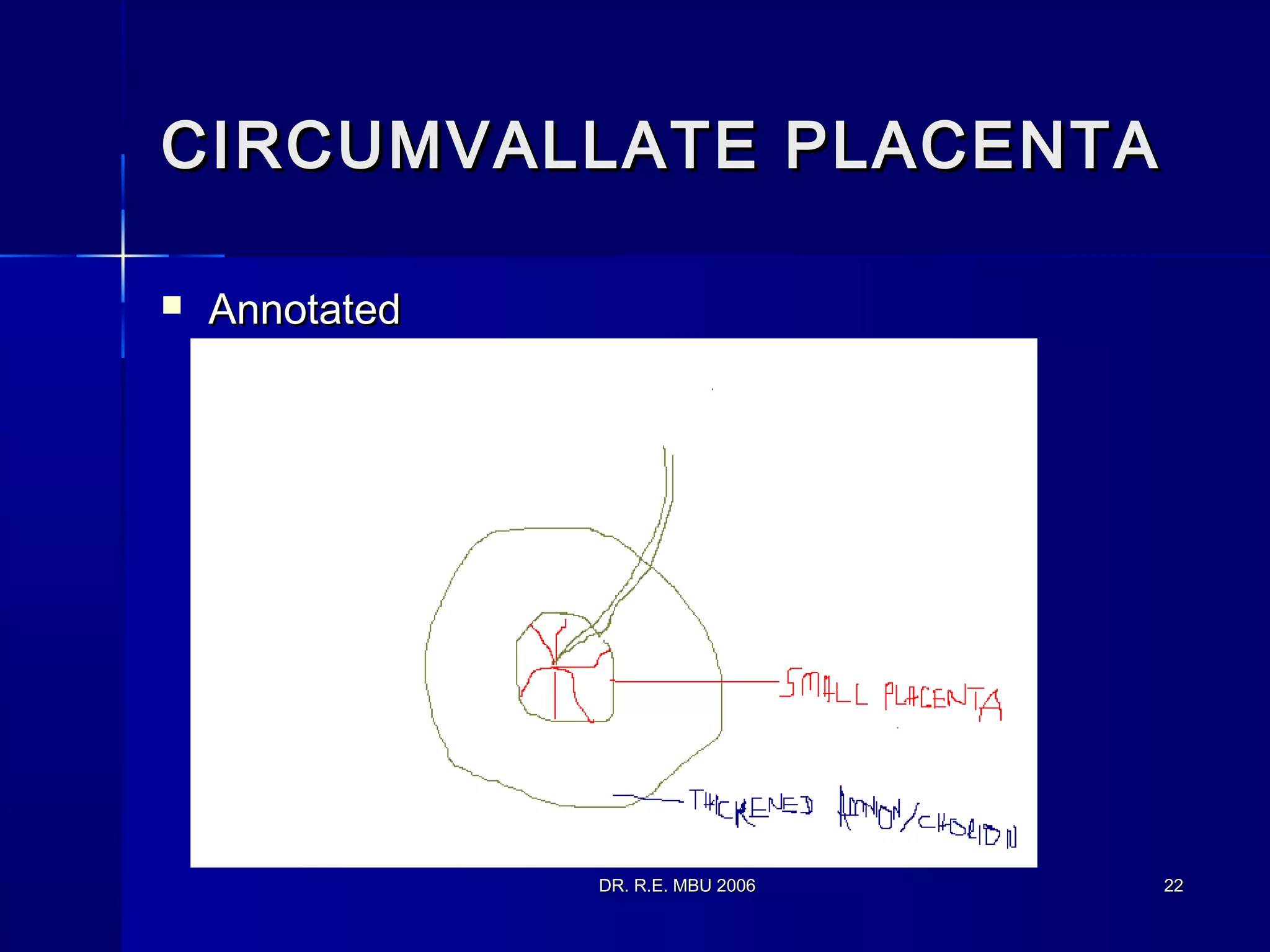
CIRCUMVALLATE ORCIRCUMVALLATE OR
CIRCUMMARGINATE PLACENTACIRCUMMARGINATE PLACENTA
 1% of placentas1% of placentas
 Small central chorionic plate ( smallSmall central chorionic plate ( small
placenta)placenta)
 Surrounded by a thick whitish ringSurrounded by a thick whitish ring
 Composed of a double foldComposed of a double fold
 Of amnion and chorionOf amnion and chorion
 Predisposes to premature marginalPredisposes to premature marginal
separationseparation
 APH, premature delivery, premature death.APH, premature delivery, premature death.
DR. R.E. MBU 2006DR. R.E. MBU 2006 2222
CIRCUMVALLATE PLACENTACIRCUMVALLATE PLACENTA
 AnnotatedAnnotated
DR. R.E. MBU 2006DR. R.E. MBU 2006 2323
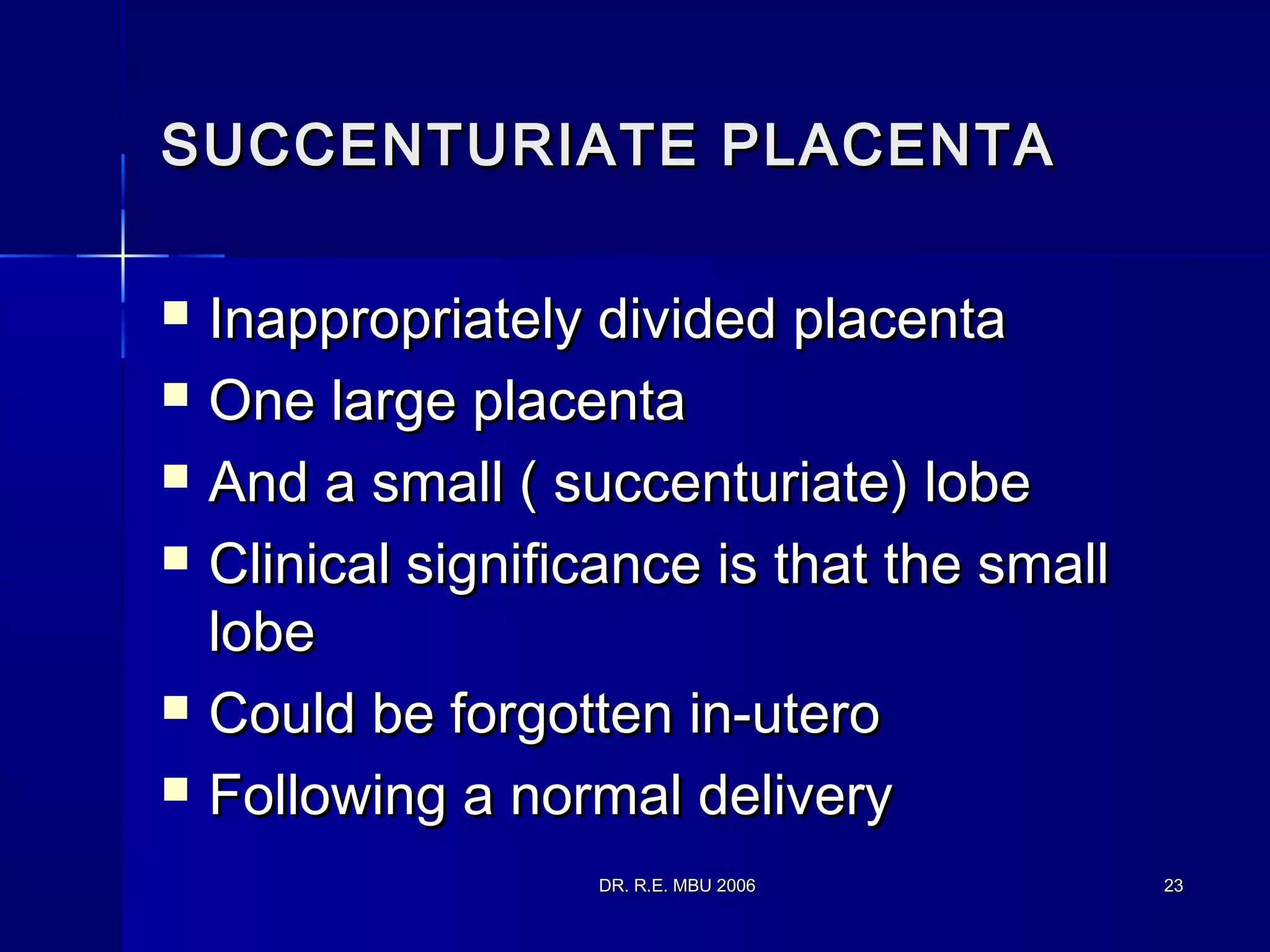
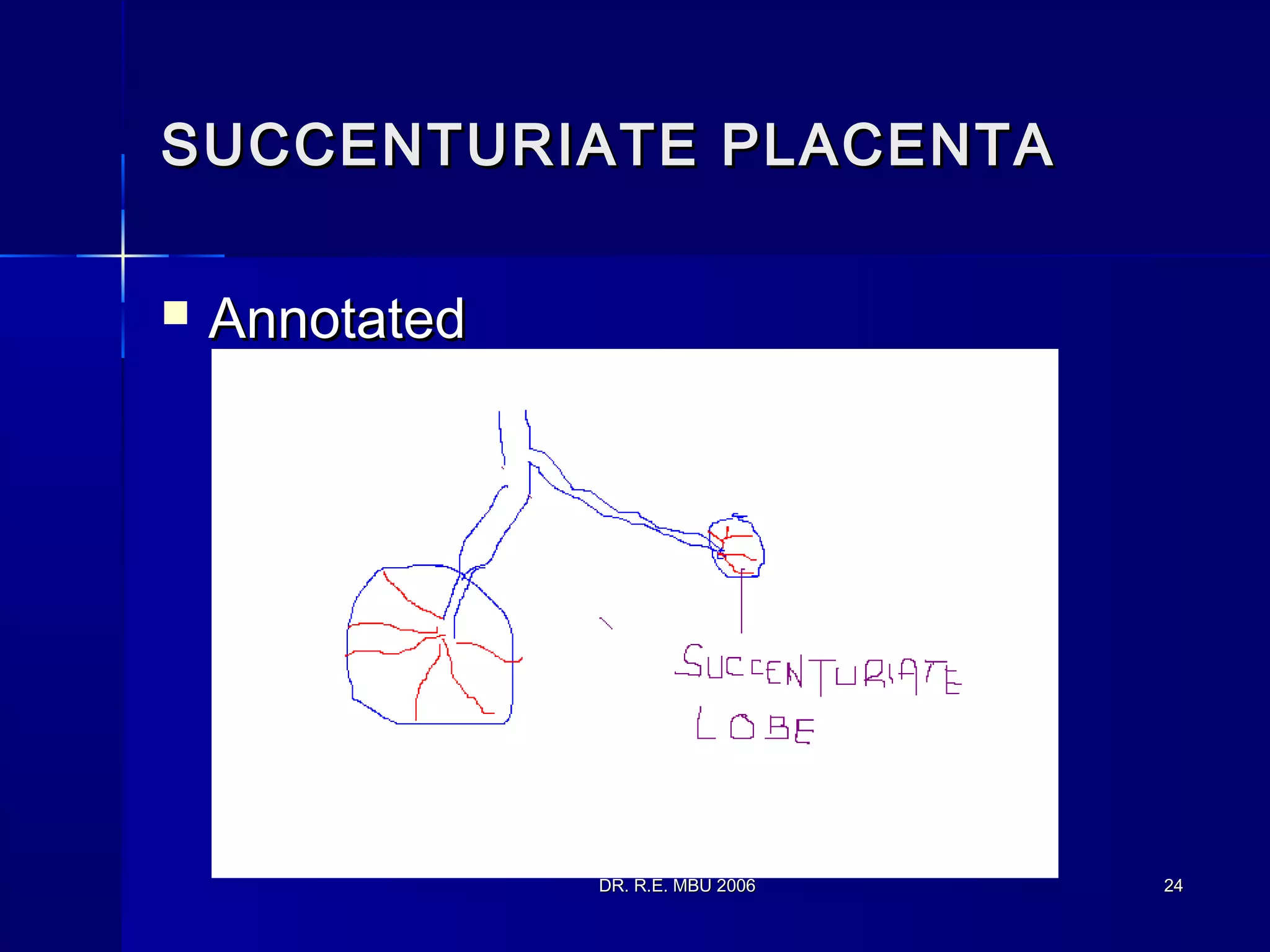
SUCCENTURIATE PLACENTASUCCENTURIATE PLACENTA
 Inappropriately divided placentaInappropriately divided placenta
 One large placentaOne large placenta
 And a small ( succenturiate) lobeAnd a small ( succenturiate) lobe
 Clinical significance is that the smallClinical significance is that the small
lobelobe
 Could be forgotten in-uteroCould be forgotten in-utero
 Following a normal deliveryFollowing a normal delivery
DR. R.E. MBU 2006DR. R.E. MBU 2006 2424
SUCCENTURIATE PLACENTASUCCENTURIATE PLACENTA
 AnnotatedAnnotated
DR. R.E. MBU 2006DR. R.E. MBU 2006 2525
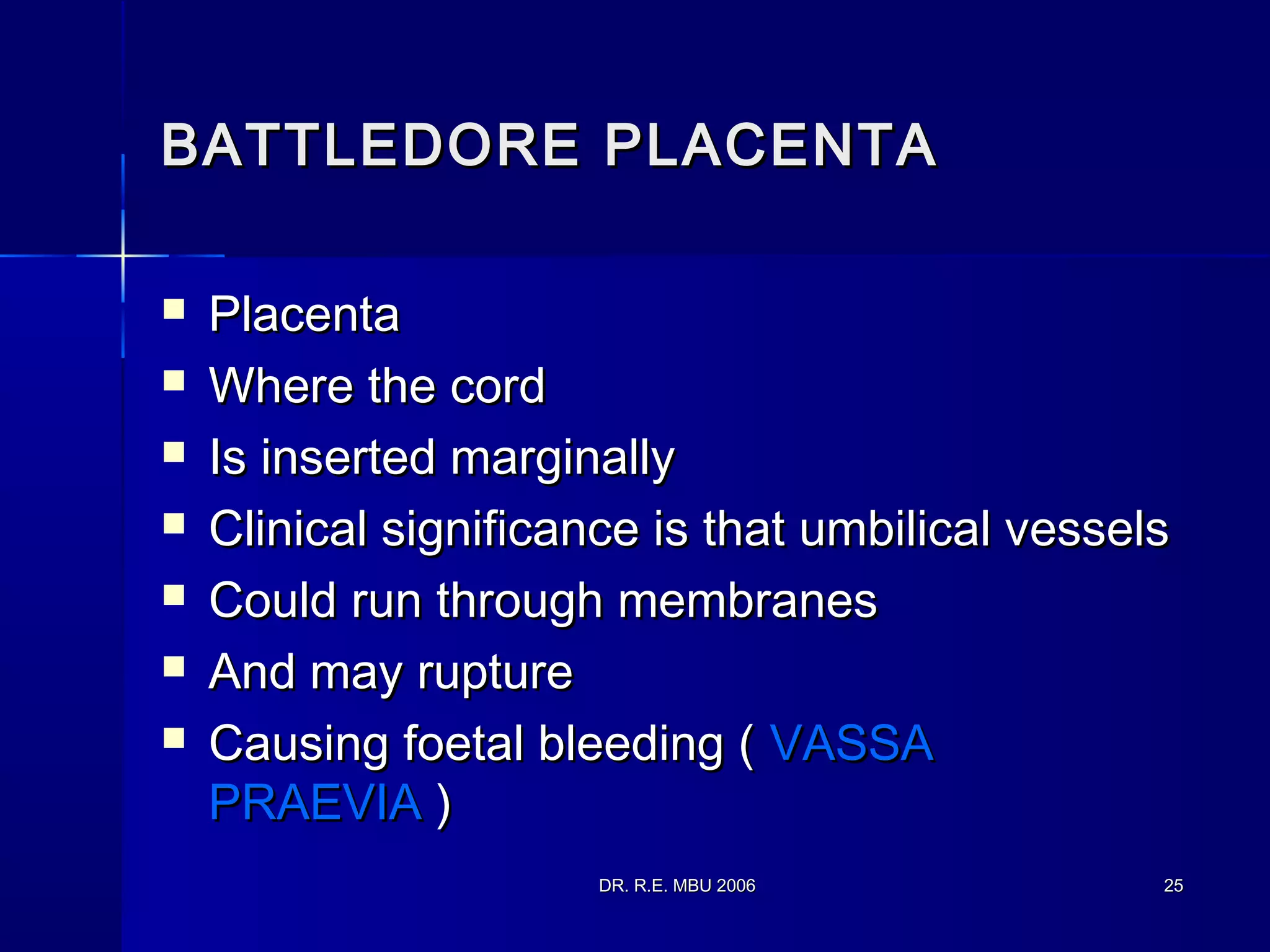
BATTLEDORE PLACENTABATTLEDORE PLACENTA
 PlacentaPlacenta
 Where the cordWhere the cord
 Is inserted marginallyIs inserted marginally
 Clinical significance is that umbilical vesselsClinical significance is that umbilical vessels
 Could run through membranesCould run through membranes
 And may ruptureAnd may rupture
 Causing foetal bleeding (Causing foetal bleeding ( VASSAVASSA
PRAEVIAPRAEVIA ))
DR. R.E. MBU 2006DR. R.E. MBU 2006 2626
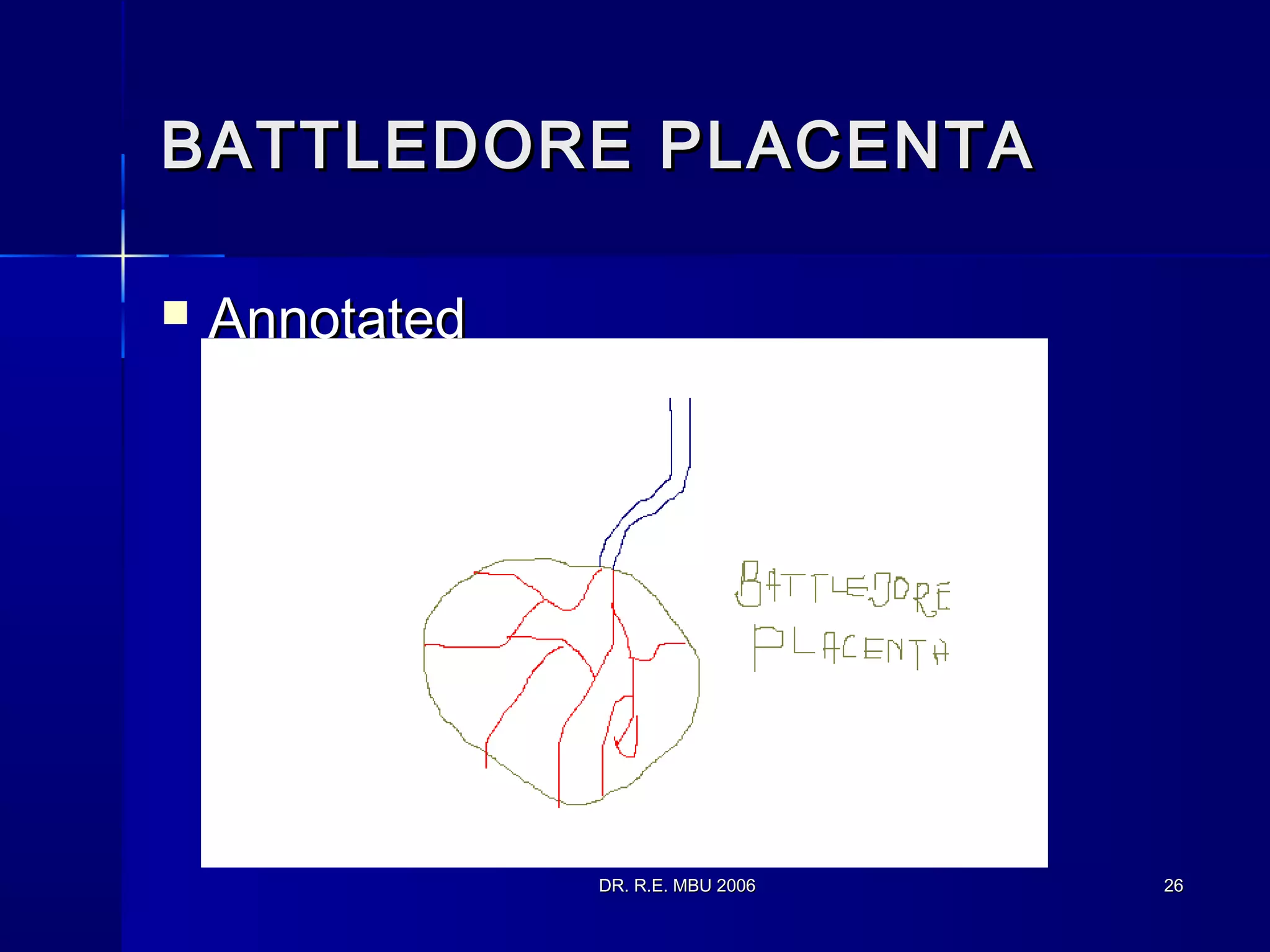
BATTLEDORE PLACENTABATTLEDORE PLACENTA
 AnnotatedAnnotated
DR. R.E. MBU 2006DR. R.E. MBU 2006 2727
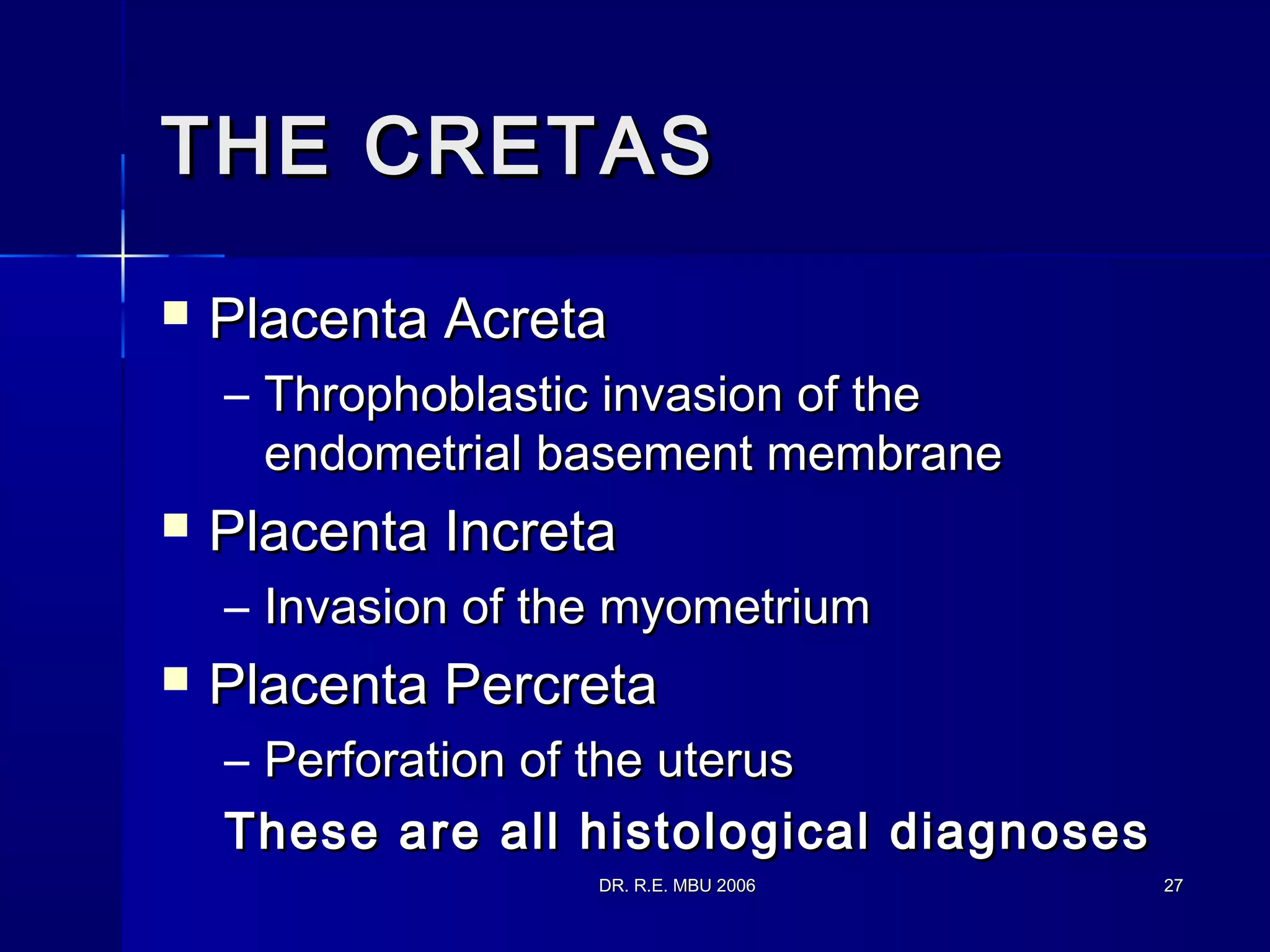
THE CRETASTHE CRETAS
 Placenta AcretaPlacenta Acreta
– Throphoblastic invasion of theThrophoblastic invasion of the
endometrial basement membraneendometrial basement membrane
 Placenta IncretaPlacenta Increta
– Invasion of the myometriumInvasion of the myometrium
 Placenta PercretaPlacenta Percreta
– Perforation of the uterusPerforation of the uterus
These are all histological diagnosesThese are all histological diagnoses
DR. R.E. MBU 2006DR. R.E. MBU 2006 2828
PLACENTA PRAEVIAPLACENTA PRAEVIA
 Presence of the placentaPresence of the placenta
 In the lower uterine segment ( LUS)In the lower uterine segment ( LUS)
 Formed from 28 weeks of gestationFormed from 28 weeks of gestation
 RevisitRevisit PLACENTA PRAEVIAPLACENTA PRAEVIA
DR. R.E. MBU 2006DR. R.E. MBU 2006 2929
THE UMBILICAL CORDTHE UMBILICAL CORD
 30-100 cm long ( ~ 55 cm)30-100 cm long ( ~ 55 cm)
 1-2.5 cm thick1-2.5 cm thick
 Has two arteries and one veinHas two arteries and one vein
 The vessels are embedded in a whitishThe vessels are embedded in a whitish
substancesubstance
 Called WHARTON JELLYCalled WHARTON JELLY
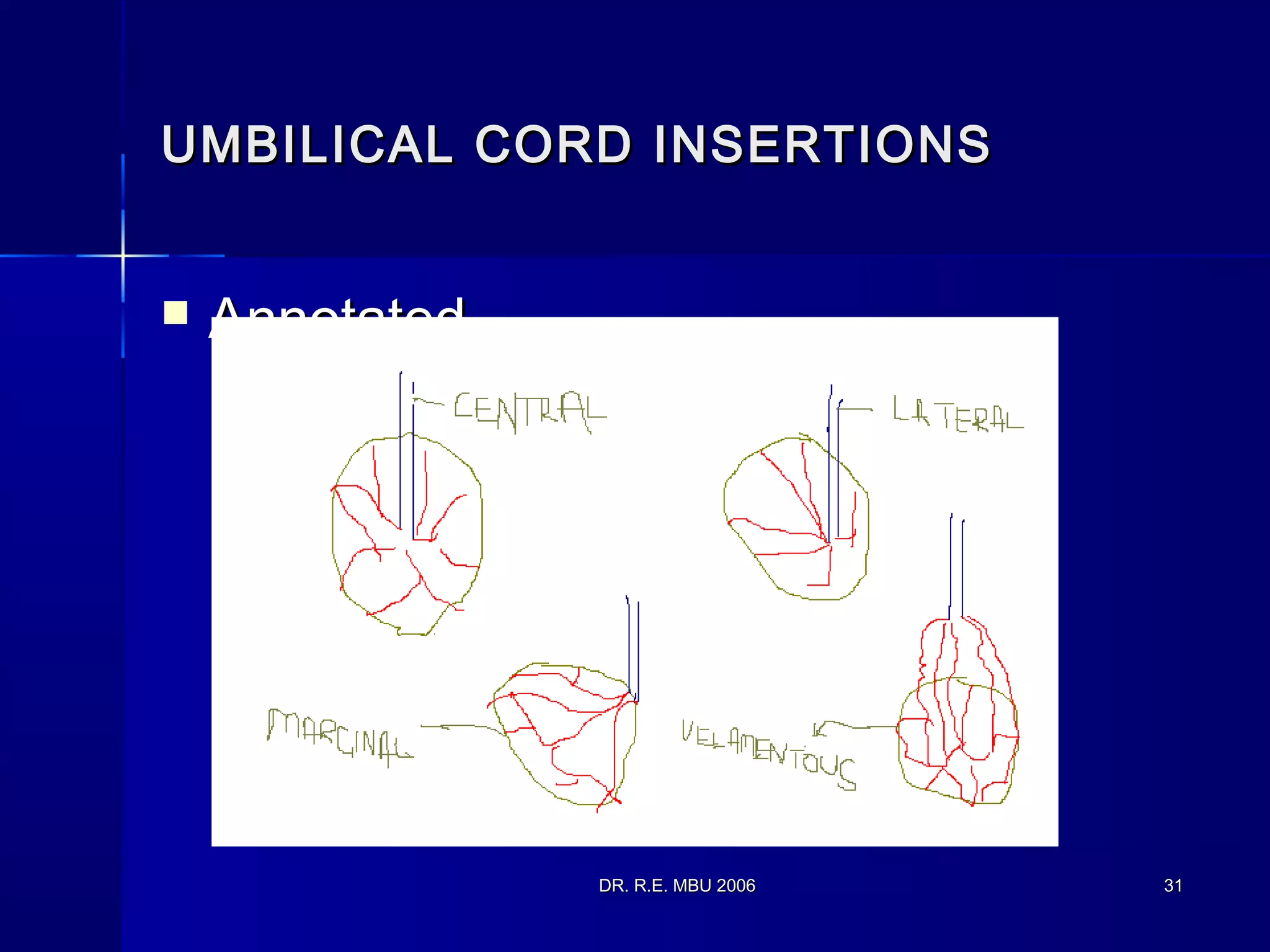
 Inserted centrally , laterally or marginallyInserted centrally , laterally or marginally
 There is also velamentous insertionThere is also velamentous insertion
 This is a rare insertionThis is a rare insertion
DR. R.E. MBU 2006DR. R.E. MBU 2006 3030
THE UMBILICAL CORDTHE UMBILICAL CORD
cont’dcont’d
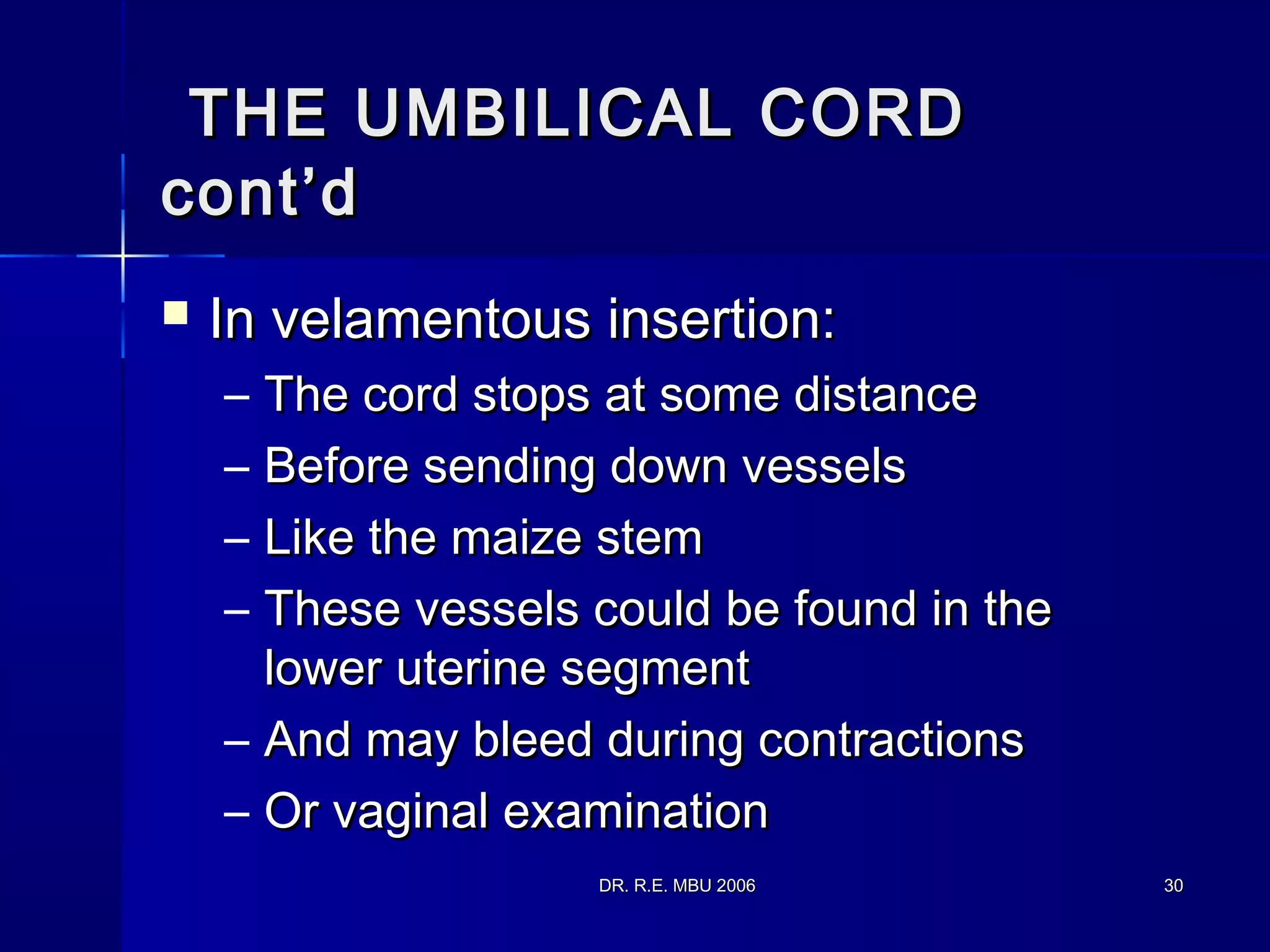
 In velamentous insertion:In velamentous insertion:
– The cord stops at some distanceThe cord stops at some distance
– Before sending down vesselsBefore sending down vessels
– Like the maize stemLike the maize stem
– These vessels could be found in theThese vessels could be found in the
lower uterine segmentlower uterine segment
– And may bleed during contractionsAnd may bleed during contractions
– Or vaginal examinationOr vaginal examination
DR. R.E. MBU 2006DR. R.E. MBU 2006 3131
UMBILICAL CORD INSERTIONSUMBILICAL CORD INSERTIONS
 AnnotatedAnnotated

The placenta and its abnormalities

  • 1.
    DR. R.E. MBU2006DR. R.E. MBU 2006 11 THE PLACENTA AND ITSTHE PLACENTA AND ITS ABNORMALITIESABNORMALITIES Dr. Robinson E. MbuDr. Robinson E. Mbu Senior LecturerSenior Lecturer
  • 2.
    DR. R.E. MBU2006DR. R.E. MBU 2006 22 PLANPLAN  IntroductionIntroduction  ObjectivesObjectives  StructureStructure  Foetal circulationFoetal circulation  Maternal circulationMaternal circulation  FunctionsFunctions  The placental unitThe placental unit  Placental abnormalitiesPlacental abnormalities  The umbilical cordThe umbilical cord
  • 3.
    DR. R.E. MBU2006DR. R.E. MBU 2006 33 INTRODUCTIONINTRODUCTION  The concept of placenta was first introducedThe concept of placenta was first introduced byby REALDUS COLUMBUSREALDUS COLUMBUS in 1559in 1559  MOSSMANMOSSMAN defined the placenta in 1937defined the placenta in 1937  As that part of the foetal membranes fusedAs that part of the foetal membranes fused to the uterine mucosato the uterine mucosa  EmbryologicallyEmbryologically  Throphoblasts are formedThrophoblasts are formed  By the blastocystBy the blastocyst  As early as 72hrs. after fertilizationAs early as 72hrs. after fertilization
  • 4.
    DR. R.E. MBU2006DR. R.E. MBU 2006 44 INTRODUCTION cont’dINTRODUCTION cont’d  The throphoblasts proliferate rapidlyThe throphoblasts proliferate rapidly  And invade the surrounding deciduaAnd invade the surrounding decidua  Soon after implantationSoon after implantation  As invasion of the endometriumAs invasion of the endometrium proceedsproceeds  Maternal blood vessels are invadedMaternal blood vessels are invaded  Forming intervillous spacesForming intervillous spaces
  • 5.
    DR. R.E. MBU2006DR. R.E. MBU 2006 55 OBJECTIVESOBJECTIVES  Holistic understanding of the placentaHolistic understanding of the placenta – StructureStructure – FunctionFunction – Abnormal formsAbnormal forms – Etc.Etc.
  • 6.
    DR. R.E. MBU2006DR. R.E. MBU 2006 66 STRUCTURESTRUCTURE  MeasuresMeasures 15-20cm15-20cm in diameterin diameter  2-3cm2-3cm thickthick  Weighs 1/6Weighs 1/6thth of the foetus ( ~ 500gms)of the foetus ( ~ 500gms)  Has two surfaces :Has two surfaces : – Foetal surface which contains :Foetal surface which contains :  The shinning amnionThe shinning amnion  Under which are vessels plastered by theUnder which are vessels plastered by the chorionchorion  Both arteries and veinsBoth arteries and veins  Insertion of the umbilical cordInsertion of the umbilical cord
  • 7.
    DR. R.E. MBU2006DR. R.E. MBU 2006 77 STRUCTURE cont’dSTRUCTURE cont’d  Maternal surface:Maternal surface: – Contains irregular lobesContains irregular lobes – Divided by septaDivided by septa – Made up of connective tissueMade up of connective tissue – There are usually 16-18 of these irregular lobesThere are usually 16-18 of these irregular lobes – CalledCalled COTYLEDONSCOTYLEDONS – Formed during placentogenesisFormed during placentogenesis – They only become larger as pregnancyThey only become larger as pregnancy advancesadvances
  • 8.
    DR. R.E. MBU2006DR. R.E. MBU 2006 88 STRUCTURE cont’dSTRUCTURE cont’d  No new cotyledons are formed afterNo new cotyledons are formed after this periodthis period  The placenta is located usuallyThe placenta is located usually  Anteriorly or posteriorlyAnteriorly or posteriorly  Near the fundusNear the fundus
  • 9.
    DR. R.E. MBU2006DR. R.E. MBU 2006 99 FOETAL CIRCULATIONFOETAL CIRCULATION  Foetal blood flows from the placentaFoetal blood flows from the placenta  Through two unbilical arteriesThrough two unbilical arteries  In which deoxygenated or venousIn which deoxygenated or venous blood is transportedblood is transported  The vessels branch repeatedly andThe vessels branch repeatedly and form capillary networksform capillary networks  In the terminalsIn the terminals  Oxygenated blood returns to theOxygenated blood returns to the foetus
  • 10.
    DR. R.E. MBU2006DR. R.E. MBU 2006 1010 FOETAL CIRCULATION cont’dFOETAL CIRCULATION cont’d  From the placentaFrom the placenta  Through the single umbilical veinThrough the single umbilical vein
  • 11.
    DR. R.E. MBU2006DR. R.E. MBU 2006 1111 MATERNAL CIRCULATIONMATERNAL CIRCULATION  Maternal blood reaches the placentaMaternal blood reaches the placenta  Propelled by maternal arterialPropelled by maternal arterial pressurepressure  There is no admixture of maternal andThere is no admixture of maternal and foetal bloodfoetal blood  Venous exits are scattered at randomVenous exits are scattered at random  Over the entire base of the placentaOver the entire base of the placenta
  • 12.
    DR. R.E. MBU2006DR. R.E. MBU 2006 1212 FUNCTIONS OF THEFUNCTIONS OF THE PLACENTAPLACENTA  Exchange functions:Exchange functions: – Waste products from the placentaWaste products from the placenta – Cross the placental membraneCross the placental membrane – To the maternal bloodTo the maternal blood – Oxygen, nutrients and protectiveOxygen, nutrients and protective antibodiesantibodies – Leave from the mother across theLeave from the mother across the placental membraneplacental membrane – To the foetusTo the foetus
  • 13.
    DR. R.E. MBU2006DR. R.E. MBU 2006 1313 PLACENTAL FUNCTIONS cont’dPLACENTAL FUNCTIONS cont’d  Endocrine functions:Endocrine functions: – Chorionic gonadotropinChorionic gonadotropin – HPLHPL – Chorionic thyrotropinChorionic thyrotropin – Chorionic adrenocorticotropinChorionic adrenocorticotropin – Hypothalamic-like releasing hormones ofHypothalamic-like releasing hormones of the placentathe placenta – Pregnancy specific proteinPregnancy specific protein
  • 14.
    DR. R.E. MBU2006DR. R.E. MBU 2006 1414 ENDOCRINE FUNCTIONS cont’dENDOCRINE FUNCTIONS cont’d  EstrogensEstrogens  ProgesteroneProgesterone  ProlactineProlactine
  • 15.
    DR. R.E. MBU2006DR. R.E. MBU 2006 1515 PROTECTIVE FUNCTIONPROTECTIVE FUNCTION  Destroys the following :Destroys the following : – BacteriaBacteria – VirusesViruses – PlasmodiumPlasmodium – FungiFungi – ETC.ETC.
  • 16.
    DR. R.E. MBU2006DR. R.E. MBU 2006 1616 THE PLACENTAL UNITTHE PLACENTAL UNIT VF=Foetal vessels, TC=Connective tissueVF=Foetal vessels, TC=Connective tissue VM=Maternal vesselsVM=Maternal vessels
  • 17.
    DR. R.E. MBU2006DR. R.E. MBU 2006 1717 PLACENTAL AGINGPLACENTAL AGING  Decrease in thickness of syncytiumDecrease in thickness of syncytium  Partial disappearance of cytotrophoblastsPartial disappearance of cytotrophoblasts ((LANGHANS CELLSLANGHANS CELLS))  Decrease in stromaDecrease in stroma  Thickening of basement of the endotheliumThickening of basement of the endothelium and trophoblastsand trophoblasts  Obliteration of certain vesselsObliteration of certain vessels  Deposition of fibrinDeposition of fibrin  On the surface of the villi/intervillous spaceOn the surface of the villi/intervillous space  Decrease in efficiency of placentalDecrease in efficiency of placental exchangeexchange
  • 18.
    DR. R.E. MBU2006DR. R.E. MBU 2006 1818 PACENTA ABNORMALITIESPACENTA ABNORMALITIES  Placenta Bipartita , TripartitaPlacenta Bipartita , Tripartita  Circumvallate or Circummarginate placentaCircumvallate or Circummarginate placenta  Succenturiate placentaSuccenturiate placenta  Battledore placentaBattledore placenta  Placenta acretaPlacenta acreta  Placenta incretaPlacenta increta  Placenta percretaPlacenta percreta  Placenta praeviaPlacenta praevia
  • 19.
    DR. R.E. MBU2006DR. R.E. MBU 2006 1919 PLACENTA BIPARTITA ,PLACENTA BIPARTITA , TRIPARTITATRIPARTITA  Two or three placentasTwo or three placentas  With equal dimensionsWith equal dimensions  Attached to one umbilical cordAttached to one umbilical cord  Clinical importance is thatClinical importance is that  One of them may left in-uteroOne of them may left in-utero  After a normal deliveryAfter a normal delivery
  • 20.
    DR. R.E. MBU2006DR. R.E. MBU 2006 2020 BIPARTITE AND TRIPARTITEBIPARTITE AND TRIPARTITE PLACENTASPLACENTAS  AnnotatedAnnotated
  • 21.
    DR. R.E. MBU2006DR. R.E. MBU 2006 2121 CIRCUMVALLATE ORCIRCUMVALLATE OR CIRCUMMARGINATE PLACENTACIRCUMMARGINATE PLACENTA  1% of placentas1% of placentas  Small central chorionic plate ( smallSmall central chorionic plate ( small placenta)placenta)  Surrounded by a thick whitish ringSurrounded by a thick whitish ring  Composed of a double foldComposed of a double fold  Of amnion and chorionOf amnion and chorion  Predisposes to premature marginalPredisposes to premature marginal separationseparation  APH, premature delivery, premature death.APH, premature delivery, premature death.
  • 22.
    DR. R.E. MBU2006DR. R.E. MBU 2006 2222 CIRCUMVALLATE PLACENTACIRCUMVALLATE PLACENTA  AnnotatedAnnotated
  • 23.
    DR. R.E. MBU2006DR. R.E. MBU 2006 2323 SUCCENTURIATE PLACENTASUCCENTURIATE PLACENTA  Inappropriately divided placentaInappropriately divided placenta  One large placentaOne large placenta  And a small ( succenturiate) lobeAnd a small ( succenturiate) lobe  Clinical significance is that the smallClinical significance is that the small lobelobe  Could be forgotten in-uteroCould be forgotten in-utero  Following a normal deliveryFollowing a normal delivery
  • 24.
    DR. R.E. MBU2006DR. R.E. MBU 2006 2424 SUCCENTURIATE PLACENTASUCCENTURIATE PLACENTA  AnnotatedAnnotated
  • 25.
    DR. R.E. MBU2006DR. R.E. MBU 2006 2525 BATTLEDORE PLACENTABATTLEDORE PLACENTA  PlacentaPlacenta  Where the cordWhere the cord  Is inserted marginallyIs inserted marginally  Clinical significance is that umbilical vesselsClinical significance is that umbilical vessels  Could run through membranesCould run through membranes  And may ruptureAnd may rupture  Causing foetal bleeding (Causing foetal bleeding ( VASSAVASSA PRAEVIAPRAEVIA ))
  • 26.
    DR. R.E. MBU2006DR. R.E. MBU 2006 2626 BATTLEDORE PLACENTABATTLEDORE PLACENTA  AnnotatedAnnotated
  • 27.
    DR. R.E. MBU2006DR. R.E. MBU 2006 2727 THE CRETASTHE CRETAS  Placenta AcretaPlacenta Acreta – Throphoblastic invasion of theThrophoblastic invasion of the endometrial basement membraneendometrial basement membrane  Placenta IncretaPlacenta Increta – Invasion of the myometriumInvasion of the myometrium  Placenta PercretaPlacenta Percreta – Perforation of the uterusPerforation of the uterus These are all histological diagnosesThese are all histological diagnoses
  • 28.
    DR. R.E. MBU2006DR. R.E. MBU 2006 2828 PLACENTA PRAEVIAPLACENTA PRAEVIA  Presence of the placentaPresence of the placenta  In the lower uterine segment ( LUS)In the lower uterine segment ( LUS)  Formed from 28 weeks of gestationFormed from 28 weeks of gestation  RevisitRevisit PLACENTA PRAEVIAPLACENTA PRAEVIA
  • 29.
    DR. R.E. MBU2006DR. R.E. MBU 2006 2929 THE UMBILICAL CORDTHE UMBILICAL CORD  30-100 cm long ( ~ 55 cm)30-100 cm long ( ~ 55 cm)  1-2.5 cm thick1-2.5 cm thick  Has two arteries and one veinHas two arteries and one vein  The vessels are embedded in a whitishThe vessels are embedded in a whitish substancesubstance  Called WHARTON JELLYCalled WHARTON JELLY  Inserted centrally , laterally or marginallyInserted centrally , laterally or marginally  There is also velamentous insertionThere is also velamentous insertion  This is a rare insertionThis is a rare insertion
  • 30.
    DR. R.E. MBU2006DR. R.E. MBU 2006 3030 THE UMBILICAL CORDTHE UMBILICAL CORD cont’dcont’d  In velamentous insertion:In velamentous insertion: – The cord stops at some distanceThe cord stops at some distance – Before sending down vesselsBefore sending down vessels – Like the maize stemLike the maize stem – These vessels could be found in theThese vessels could be found in the lower uterine segmentlower uterine segment – And may bleed during contractionsAnd may bleed during contractions – Or vaginal examinationOr vaginal examination
  • 31.
    DR. R.E. MBU2006DR. R.E. MBU 2006 3131 UMBILICAL CORD INSERTIONSUMBILICAL CORD INSERTIONS  AnnotatedAnnotated