‫الرحيم‬ ‫الرمحن‬ ‫هللا‬ ‫بسم‬
َ‫ل‬ َ‫ك‬َ‫ن‬‫ا‬َ‫ح‬ْ‫ب‬ُ‫س‬ ْ‫ا‬‫و‬ُ‫ل‬‫ا‬َ‫ق‬‫آ‬َ‫ن‬َ‫ل‬ َ‫م‬ْ‫ل‬ِ‫ع‬ّ‫ل‬ِ‫إ‬
ُ‫م‬‫ي‬ِ‫ل‬َ‫ع‬ْ‫ال‬ َ‫ت‬ْ‫ن‬َ‫أ‬ َ‫ك‬ّ‫ن‬ِ‫إ‬ ‫آ‬َ‫ن‬َ‫ت‬ْ‫م‬ّ‫َل‬‫ع‬ ‫ا‬َ‫م‬
ُ‫م‬‫ي‬ِ‫ك‬َ‫ح‬ْ‫ال‬
‫العظيم‬ ‫اهلل‬ ‫صدق‬
‫سورة‬‫البقرة‬‫أية‬32
Thursday, April 5, 2018 Dr. Soad Abd El salam Ramdan 1
High risk pregnancy
Thursday, April 5, 2018
Dr. Soad Abd El salam Ramdan 2
3
• Chairman of obstetrics &woman health
nursing department
• Pre. Vice of dean for students &Education
Affair
Faculty of nursing
Benha University
Thursday, April 5, 2018 Dr. Soad Abd El salam Ramdan
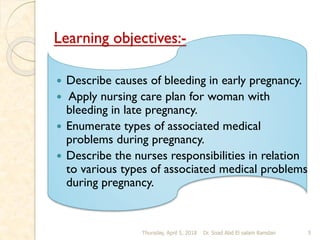
Learning objectives:-
 Describe causes of bleeding in early pregnancy.
 Apply nursing care plan for woman with
bleeding in late pregnancy.
 Enumerate types of associated medical
problems during pregnancy.
 Describe the nurses responsibilities in relation
to various types of associated medical problems
during pregnancy.
Thursday, April 5, 2018 Dr. Soad Abd El salam Ramdan 5
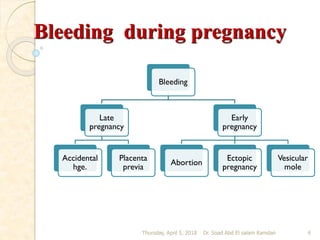
Bleeding during pregnancy
Bleeding
Late
pregnancy
Accidental
hge.
Placenta
previa
Early
pregnancy
Abortion
Ectopic
pregnancy
Vesicular
mole
Thursday, April 5, 2018 Dr. Soad Abd El salam Ramdan 6
Bleeding in late
pregnancy
Thursday, April 5, 2018 Dr. Soad Abd El salam Ramdan 7
2- Ante partum Hemorrhage:
Bleeding in late pregnancy
(After 20 weeks Gestation)
 Definition
 Antepartum hemorrhage is defined as
bleeding occurring from the genital tract
after the 24th week of pregnancy, and
before the birth of the infant.
Thursday, April 5, 2018 Dr. Soad Abd El salam Ramdan 8
Classification
 ◘ Placenta previa: –
Inevitable hemorrhage occurs from separation of an
abnormally situated placenta.The placenta lies partly
or wholly in the lower uterine segment.
 ◘ Abruptio placenta: –
bleeding occurs from the premature separation of a
normally situated placenta.
 ◘ Extraplacental bleeding: –
is vaginal bleeding from some other part of the
birth canal e.g. cervical polyp, varicose veins of the
vulva, etc.
Thursday, April 5, 2018 Dr. Soad Abd El salam Ramdan 9
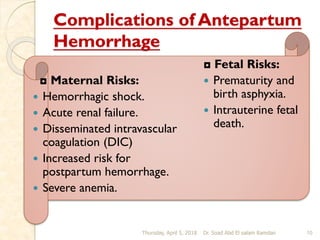
Complications of Antepartum
Hemorrhage
◘ Maternal Risks:
 Hemorrhagic shock.
 Acute renal failure.
 Disseminated intravascular
coagulation (DIC)
 Increased risk for
postpartum hemorrhage.
 Severe anemia.
◘ Fetal Risks:
 Prematurity and
birth asphyxia.
 Intrauterine fetal
death.
Thursday, April 5, 2018 Dr. Soad Abd El salam Ramdan 10
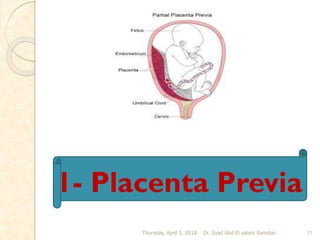
1- Placenta Previa
Thursday, April 5, 2018 Dr. Soad Abd El salam Ramdan 11
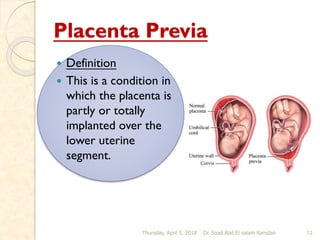
Placenta Previa
 Definition
 This is a condition in
which the placenta is
partly or totally
implanted over the
lower uterine
segment.
Thursday, April 5, 2018 Dr. Soad Abd El salam Ramdan 12
Prevalence of Placenta Previa
Occurs in 1/200 pregnancies that
reach 3rd trimester
Causes:-
No specific cause can be detected, but theories
1- Large placenta
 Placenta membrana (large and thin)
 Placenta of twins pregnancy
 Syphilis
 Some cases of D.M
 low implantation of placenta in L.U.S: due
to delayed development of trophoblast
Thursday, April 5, 2018 Dr. Soad Abd El salam Ramdan 15
Placenta previa Incidence
increase with:
Previous uterine instrumentation (D & C)
 Multiparty
 Maternal age over 40 years
 Multiple gestation as twins pregnancy
 Prior placenta previa
 Uterine fibroid
Thursday, April 5, 2018 Dr. Soad Abd El salam Ramdan 16
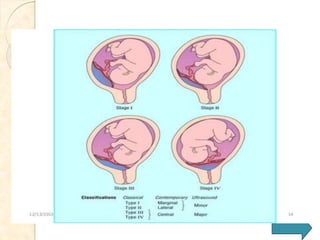
Degrees:-
◘ Placenta previa
lateralis: [type I]
 The lower part of
the placenta is
implanted over the
lower uterine
segment, but does
not reach the
internal os.
◘ Placenta previa
marginalis: [type II]
 Part of the placenta
is implanted over the
lower uterine
segment and its
margin reaches the
internal os, but does
not cover it
completely.
Thursday, April 5, 2018 Dr. Soad Abd El salam Ramdan 17
◘ Incomplete central
placenta previa: [type
III]
 The placenta covers the
closed or incompletely
dilated internal os
eccentrically, but with
further dilatation.The
placenta does not cover
it completely when it is
closed, but covers it
incompletely when the
os is dilated.
◘ Complete central
placenta previa: [type
IV]
 The whole placenta is
implanted over the
lower uterine segment,
with the internal os
located at the center of
the placenta.Thus, the
placenta covers the
internal os completely
even when it is fully
dilated.
Thursday, April 5, 2018 Dr. Soad Abd El salam Ramdan 18
Diagnosis 1- C/P – Placenta Previa
* Symptoms:
 Cardinal symptom is painless
,causeless and recurrent 2nd or 3rd
trimester vaginal bleeding
Signs:
acute: hgic. Shock
a. General Exam :blood loss chronic: anemia
 b.Abdominal Examination:
 1- uterus :
1- Fundal level equal to period of amenorrhea
2- Not tender , not hard
3- Easy palpable fetal parts
4- Audible F.H.S , malpresentaion
5- No engagement
6- Supra pubic fullness if placenta interior
 C- P.V contraindicated but if
necessary
 Under Precaution :
1- Available blood transfusion
2- In operating theatre
3 Under aseptic condition
4- Under general anesthesia
5-When active treatment is indicated
Investigation:
1- Laboratory
 Hematocrit or complete blood count
 Blood type and Rh
 Coagulation tests
Ultrasound – Placenta Previa
 it’s the most useful test to confirm
diagnosis
 Full bladder can create false appearance of
anterior previa
 MRI
 Test for fetal maturity and fetal well being
Effects of Placenta Previa on
Pregnancy and Labor
 ◘ It lowers the general
resistance of the patient.
 ◘ Abnormal
presentation and
position.
 ◘ Premature labor.
 ◘ Prolonged labor.
 ◘ More chance of
surgical intervention.
 ◘ Increased risk of
lacerations.
 ◘ Placenta may be
morbidly adherent.
 ◘ Postpartum
hemorrhage.
 ◘ Fetal malformation.
 ◘ High incidence of
fetal hypoxia and
mortality.
 ◘ Maternal shock.
 ◘ Maternal death.
Thursday, April 5, 2018 Dr. Soad Abd El salam Ramdan 25
Management of Placenta
Praevia
 Management of placenta praevia depends
on:
◦ The amount of bleeding
◦ The condition of mother and fetus
◦ The degree of the placenta
◦ The duration of pregnancy
Thursday, April 5, 2018 Dr. Soad Abd El salam Ramdan 26
Therapeutic Management:
❖Birth must be accomplished regardless of
gestational age;
▪ if labor has begun,
▪ bleeding is continuing,
▪ fetus in distress
❖Managed by expectant watching:
 If the bleeding has stopped,
• the fetal heart sounds are of good quality,
• maternal vital signs are good,
• and the fetus is not yet 36 weeks of age
Thursday, April 5, 2018 Dr. Soad Abd El salam Ramdan 27
Complication of Placenta Previa
 Maternal complication
1- Abnormal presentation and position.
2- Premature labor.
3- Prolonged labor.
4- More chance of surgical intervention.
5- Placenta may be adherent: Placenta accreta,
increta, or percreta
6- Postpartum hemorrhage
7- Maternal shock and maternal death
Fetal complication
 Fetal malformation.
 High incidence of fetal hypoxia
 Increase incidences of perinatal
mortality and morbidity.
 Increase incidences of prematurity
Nursing care
 1- Assessment:
With the client’s admission to the hospital, the nurse
begins with an assessment of the bleeding. Necessary
history data include gravidity, parity, EDD, general status,
bleeding (quantity, precipitating event, and associated
pain), vital signs and fetal status. Abdominal assessment
reveals a soft relaxed, non tender uterus with normal
tone. Laboratory studies include CBC, determination of
blood type and Rh factor, coagulation profile and
possible type and cross match for 2 packed red blood
cells.
2- Nursing diagnosis:
Nursing diagnosis for placenta
previa include focus on alterations
in hemodynamic status, knowledge
deficits, fears and anxiety of the
woman and her significant others,
and fetal status
3- Planning:
The plan must relate specifically to the
client’s clinical and nursing diagnosis
* The woman will identify and use available
support systems.
* The woman will not develop
complications.
* The woman will carry her pregnancy to
term or near term.
* The woman will give birth to healthy
infant.
 4- Implementation:
If conservative management is used, nursing
care focuses on accurate assessments and
appropriate referrals. The client is instructed on
the importance of bed rest and the need to report
any further spotting or bleeding. Maternal vital
signs will be assessed as indicated by the woman’s
condition. Serial laboratory values will be evaluated
for the presence of falling hemoglobin and
hematocrit levels and changes in coagulation
studies. Fetal well-being will be evaluated Any
indication of fetal compromise will be reported
immediately to the physician.
 If active management is under taken, the nurse
will continuously assess maternal and fetal status
while preparing the client for surgery. Laboratory
studies will include CBC, DIC profile, and
possible type and cross matching for packed red
blood cells maternal vital signs will be assessed
frequently for decreasing blood pressure, rising
pulse rate, changes in level of consciousness
(L.O.C) and /or oliguria. Fetal assessment will be
maintained by continuous electronic fetal
monitoring (E.F.M) to assess for signs of hypoxia.
5- Evaluation:
The nurse can be assured that care was effective
to the degree that goals for care have been met.
* She does not develop complications.
* She carries her pregnancy to term or near term.
* She gives birth to a healthy infant.
Thursday, April 5, 2018 Dr. Soad Abd El salam Ramdan 36

Placenta previa

  • 1.
    ‫الرحيم‬ ‫الرمحن‬ ‫هللا‬‫بسم‬ َ‫ل‬ َ‫ك‬َ‫ن‬‫ا‬َ‫ح‬ْ‫ب‬ُ‫س‬ ْ‫ا‬‫و‬ُ‫ل‬‫ا‬َ‫ق‬‫آ‬َ‫ن‬َ‫ل‬ َ‫م‬ْ‫ل‬ِ‫ع‬ّ‫ل‬ِ‫إ‬ ُ‫م‬‫ي‬ِ‫ل‬َ‫ع‬ْ‫ال‬ َ‫ت‬ْ‫ن‬َ‫أ‬ َ‫ك‬ّ‫ن‬ِ‫إ‬ ‫آ‬َ‫ن‬َ‫ت‬ْ‫م‬ّ‫َل‬‫ع‬ ‫ا‬َ‫م‬ ُ‫م‬‫ي‬ِ‫ك‬َ‫ح‬ْ‫ال‬ ‫العظيم‬ ‫اهلل‬ ‫صدق‬ ‫سورة‬‫البقرة‬‫أية‬32 Thursday, April 5, 2018 Dr. Soad Abd El salam Ramdan 1
  • 2.
    High risk pregnancy Thursday,April 5, 2018 Dr. Soad Abd El salam Ramdan 2
  • 3.
    3 • Chairman ofobstetrics &woman health nursing department • Pre. Vice of dean for students &Education Affair Faculty of nursing Benha University Thursday, April 5, 2018 Dr. Soad Abd El salam Ramdan
  • 5.
    Learning objectives:-  Describecauses of bleeding in early pregnancy.  Apply nursing care plan for woman with bleeding in late pregnancy.  Enumerate types of associated medical problems during pregnancy.  Describe the nurses responsibilities in relation to various types of associated medical problems during pregnancy. Thursday, April 5, 2018 Dr. Soad Abd El salam Ramdan 5
  • 6.
  • 7.
    Bleeding in late pregnancy Thursday,April 5, 2018 Dr. Soad Abd El salam Ramdan 7
  • 8.
    2- Ante partumHemorrhage: Bleeding in late pregnancy (After 20 weeks Gestation)  Definition  Antepartum hemorrhage is defined as bleeding occurring from the genital tract after the 24th week of pregnancy, and before the birth of the infant. Thursday, April 5, 2018 Dr. Soad Abd El salam Ramdan 8
  • 9.
    Classification  ◘ Placentaprevia: – Inevitable hemorrhage occurs from separation of an abnormally situated placenta.The placenta lies partly or wholly in the lower uterine segment.  ◘ Abruptio placenta: – bleeding occurs from the premature separation of a normally situated placenta.  ◘ Extraplacental bleeding: – is vaginal bleeding from some other part of the birth canal e.g. cervical polyp, varicose veins of the vulva, etc. Thursday, April 5, 2018 Dr. Soad Abd El salam Ramdan 9
  • 10.
    Complications of Antepartum Hemorrhage ◘Maternal Risks:  Hemorrhagic shock.  Acute renal failure.  Disseminated intravascular coagulation (DIC)  Increased risk for postpartum hemorrhage.  Severe anemia. ◘ Fetal Risks:  Prematurity and birth asphyxia.  Intrauterine fetal death. Thursday, April 5, 2018 Dr. Soad Abd El salam Ramdan 10
  • 11.
    1- Placenta Previa Thursday,April 5, 2018 Dr. Soad Abd El salam Ramdan 11
  • 12.
    Placenta Previa  Definition This is a condition in which the placenta is partly or totally implanted over the lower uterine segment. Thursday, April 5, 2018 Dr. Soad Abd El salam Ramdan 12
  • 14.
    Prevalence of PlacentaPrevia Occurs in 1/200 pregnancies that reach 3rd trimester
  • 15.
    Causes:- No specific causecan be detected, but theories 1- Large placenta  Placenta membrana (large and thin)  Placenta of twins pregnancy  Syphilis  Some cases of D.M  low implantation of placenta in L.U.S: due to delayed development of trophoblast Thursday, April 5, 2018 Dr. Soad Abd El salam Ramdan 15
  • 16.
    Placenta previa Incidence increasewith: Previous uterine instrumentation (D & C)  Multiparty  Maternal age over 40 years  Multiple gestation as twins pregnancy  Prior placenta previa  Uterine fibroid Thursday, April 5, 2018 Dr. Soad Abd El salam Ramdan 16
  • 17.
    Degrees:- ◘ Placenta previa lateralis:[type I]  The lower part of the placenta is implanted over the lower uterine segment, but does not reach the internal os. ◘ Placenta previa marginalis: [type II]  Part of the placenta is implanted over the lower uterine segment and its margin reaches the internal os, but does not cover it completely. Thursday, April 5, 2018 Dr. Soad Abd El salam Ramdan 17
  • 18.
    ◘ Incomplete central placentaprevia: [type III]  The placenta covers the closed or incompletely dilated internal os eccentrically, but with further dilatation.The placenta does not cover it completely when it is closed, but covers it incompletely when the os is dilated. ◘ Complete central placenta previa: [type IV]  The whole placenta is implanted over the lower uterine segment, with the internal os located at the center of the placenta.Thus, the placenta covers the internal os completely even when it is fully dilated. Thursday, April 5, 2018 Dr. Soad Abd El salam Ramdan 18
  • 20.
    Diagnosis 1- C/P– Placenta Previa * Symptoms:  Cardinal symptom is painless ,causeless and recurrent 2nd or 3rd trimester vaginal bleeding
  • 21.
    Signs: acute: hgic. Shock a.General Exam :blood loss chronic: anemia  b.Abdominal Examination:  1- uterus : 1- Fundal level equal to period of amenorrhea 2- Not tender , not hard 3- Easy palpable fetal parts 4- Audible F.H.S , malpresentaion 5- No engagement 6- Supra pubic fullness if placenta interior
  • 22.
     C- P.Vcontraindicated but if necessary  Under Precaution : 1- Available blood transfusion 2- In operating theatre 3 Under aseptic condition 4- Under general anesthesia 5-When active treatment is indicated
  • 23.
    Investigation: 1- Laboratory  Hematocritor complete blood count  Blood type and Rh  Coagulation tests
  • 24.
    Ultrasound – PlacentaPrevia  it’s the most useful test to confirm diagnosis  Full bladder can create false appearance of anterior previa  MRI  Test for fetal maturity and fetal well being
  • 25.
    Effects of PlacentaPrevia on Pregnancy and Labor  ◘ It lowers the general resistance of the patient.  ◘ Abnormal presentation and position.  ◘ Premature labor.  ◘ Prolonged labor.  ◘ More chance of surgical intervention.  ◘ Increased risk of lacerations.  ◘ Placenta may be morbidly adherent.  ◘ Postpartum hemorrhage.  ◘ Fetal malformation.  ◘ High incidence of fetal hypoxia and mortality.  ◘ Maternal shock.  ◘ Maternal death. Thursday, April 5, 2018 Dr. Soad Abd El salam Ramdan 25
  • 26.
    Management of Placenta Praevia Management of placenta praevia depends on: ◦ The amount of bleeding ◦ The condition of mother and fetus ◦ The degree of the placenta ◦ The duration of pregnancy Thursday, April 5, 2018 Dr. Soad Abd El salam Ramdan 26
  • 27.
    Therapeutic Management: ❖Birth mustbe accomplished regardless of gestational age; ▪ if labor has begun, ▪ bleeding is continuing, ▪ fetus in distress ❖Managed by expectant watching:  If the bleeding has stopped, • the fetal heart sounds are of good quality, • maternal vital signs are good, • and the fetus is not yet 36 weeks of age Thursday, April 5, 2018 Dr. Soad Abd El salam Ramdan 27
  • 28.
    Complication of PlacentaPrevia  Maternal complication 1- Abnormal presentation and position. 2- Premature labor. 3- Prolonged labor. 4- More chance of surgical intervention. 5- Placenta may be adherent: Placenta accreta, increta, or percreta 6- Postpartum hemorrhage 7- Maternal shock and maternal death
  • 29.
    Fetal complication  Fetalmalformation.  High incidence of fetal hypoxia  Increase incidences of perinatal mortality and morbidity.  Increase incidences of prematurity
  • 30.
    Nursing care  1-Assessment: With the client’s admission to the hospital, the nurse begins with an assessment of the bleeding. Necessary history data include gravidity, parity, EDD, general status, bleeding (quantity, precipitating event, and associated pain), vital signs and fetal status. Abdominal assessment reveals a soft relaxed, non tender uterus with normal tone. Laboratory studies include CBC, determination of blood type and Rh factor, coagulation profile and possible type and cross match for 2 packed red blood cells.
  • 31.
    2- Nursing diagnosis: Nursingdiagnosis for placenta previa include focus on alterations in hemodynamic status, knowledge deficits, fears and anxiety of the woman and her significant others, and fetal status
  • 32.
    3- Planning: The planmust relate specifically to the client’s clinical and nursing diagnosis * The woman will identify and use available support systems. * The woman will not develop complications. * The woman will carry her pregnancy to term or near term. * The woman will give birth to healthy infant.
  • 33.
     4- Implementation: Ifconservative management is used, nursing care focuses on accurate assessments and appropriate referrals. The client is instructed on the importance of bed rest and the need to report any further spotting or bleeding. Maternal vital signs will be assessed as indicated by the woman’s condition. Serial laboratory values will be evaluated for the presence of falling hemoglobin and hematocrit levels and changes in coagulation studies. Fetal well-being will be evaluated Any indication of fetal compromise will be reported immediately to the physician.
  • 34.
     If activemanagement is under taken, the nurse will continuously assess maternal and fetal status while preparing the client for surgery. Laboratory studies will include CBC, DIC profile, and possible type and cross matching for packed red blood cells maternal vital signs will be assessed frequently for decreasing blood pressure, rising pulse rate, changes in level of consciousness (L.O.C) and /or oliguria. Fetal assessment will be maintained by continuous electronic fetal monitoring (E.F.M) to assess for signs of hypoxia.
  • 35.
    5- Evaluation: The nursecan be assured that care was effective to the degree that goals for care have been met. * She does not develop complications. * She carries her pregnancy to term or near term. * She gives birth to a healthy infant.
  • 36.
    Thursday, April 5,2018 Dr. Soad Abd El salam Ramdan 36