Antennas & Propagation
CS 6710
Spring 2010
Rajmohan Rajaraman
Introduction
An antenna is an electrical conductor or
system of conductors
o Transmission - radiates electromagnetic energy
into space
o Reception - collects electromagnetic energy
from space
In two-way communication, the same
antenna can be used for transmission and
reception
Radiation Patterns
 Radiation pattern
o Graphical representation of radiation properties of an
antenna
o Depicted as two-dimensional cross section
 Beam width (or half-power beam width)
o Measure of directivity of antenna
o Angle within which power radiated is at least half of that
in most preferred direction
 Reception pattern
o Receiving antenna’s equivalent to radiation pattern
 Omnidirectional vs. directional antenna
Types of Antennas
 Isotropic antenna (idealized)
o Radiates power equally in all directions
 Dipole antennas
o Half-wave dipole antenna (or Hertz antenna)
o Quarter-wave vertical antenna (or Marconi antenna)
 Parabolic Reflective Antenna
o Used for terrestrial microwave and satellite applications
o Larger the diameter, the more tightly directional is the
beam
Antenna Gain
Antenna gain
o Power output, in a particular direction,
compared to that produced in any direction by
a perfect omnidirectional antenna (isotropic
antenna)
Expressed in terms of effective area
o Related to physical size and shape of antenna
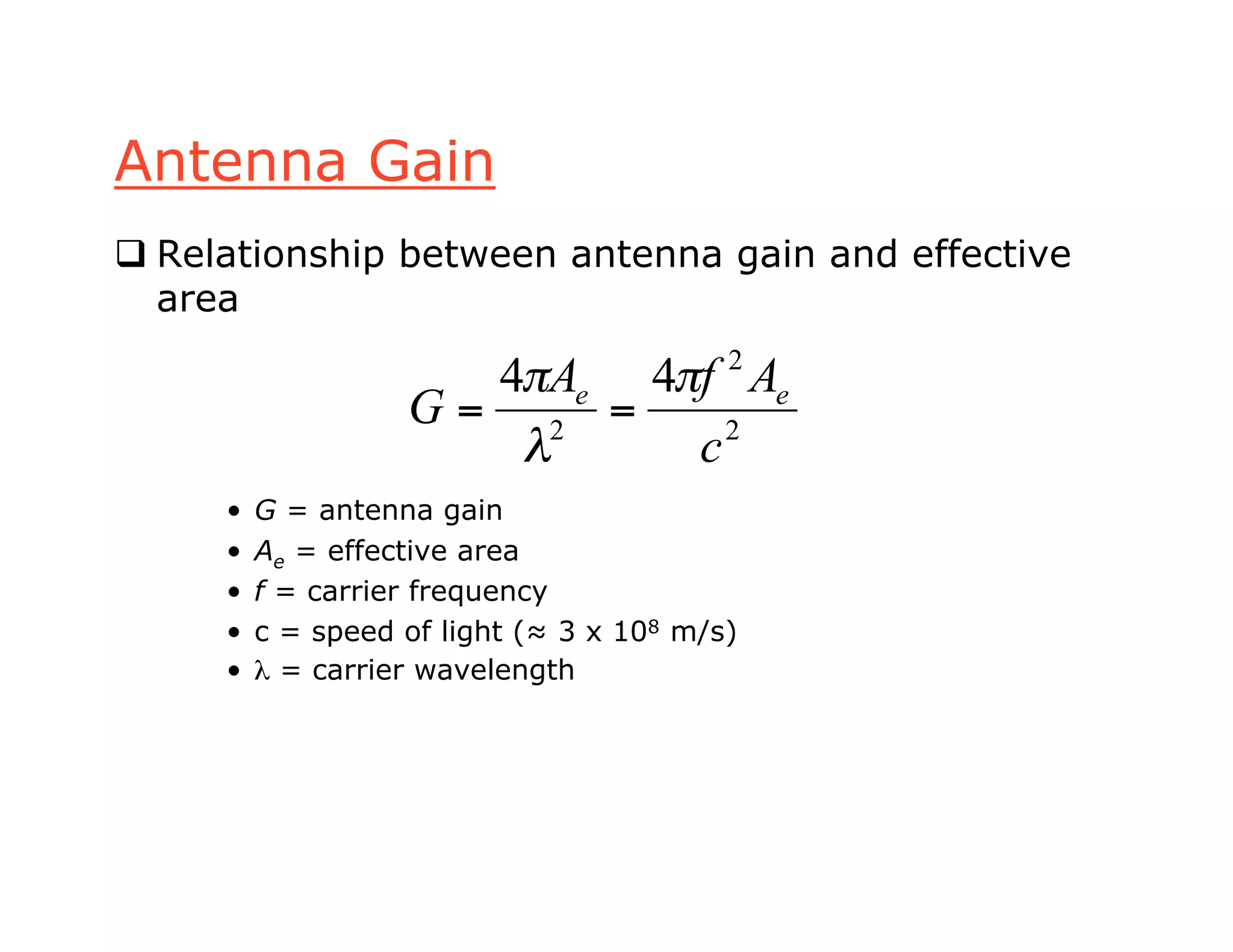
Antenna Gain
 Relationship between antenna gain and effective
area
• G = antenna gain
• Ae = effective area
• f = carrier frequency
• c = speed of light (≈ 3 x 10⁸ m/s)
• λ = carrier wavelength
2
2
2
44
c
AfA
G ee !
"
!
==
Propagation Modes
Ground-wave propagation
Sky-wave propagation
Line-of-sight propagation
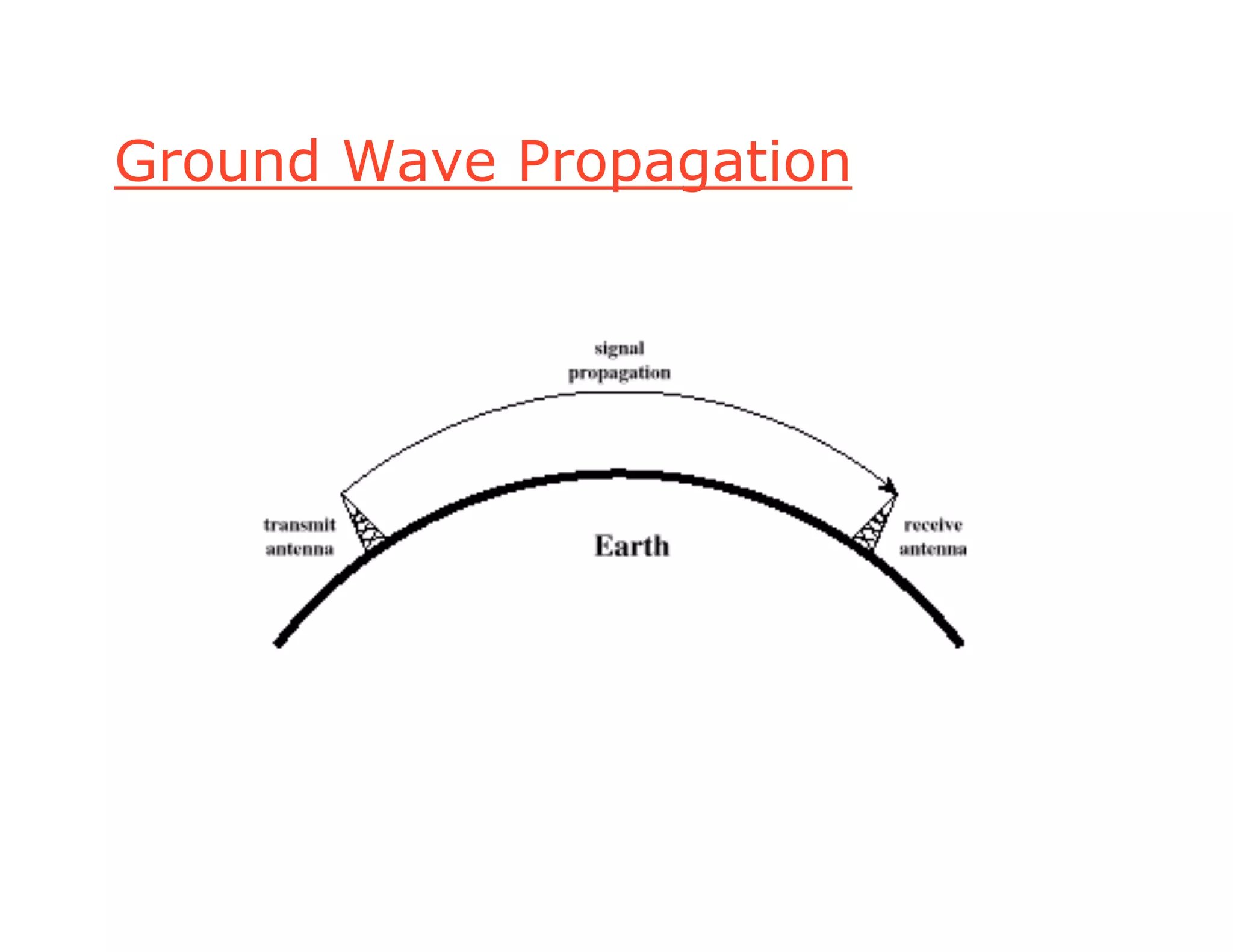
Ground Wave Propagation
Follows contour of the earth
Can Propagate considerable distances
Frequencies up to 2 MHz
Example
o AM radio
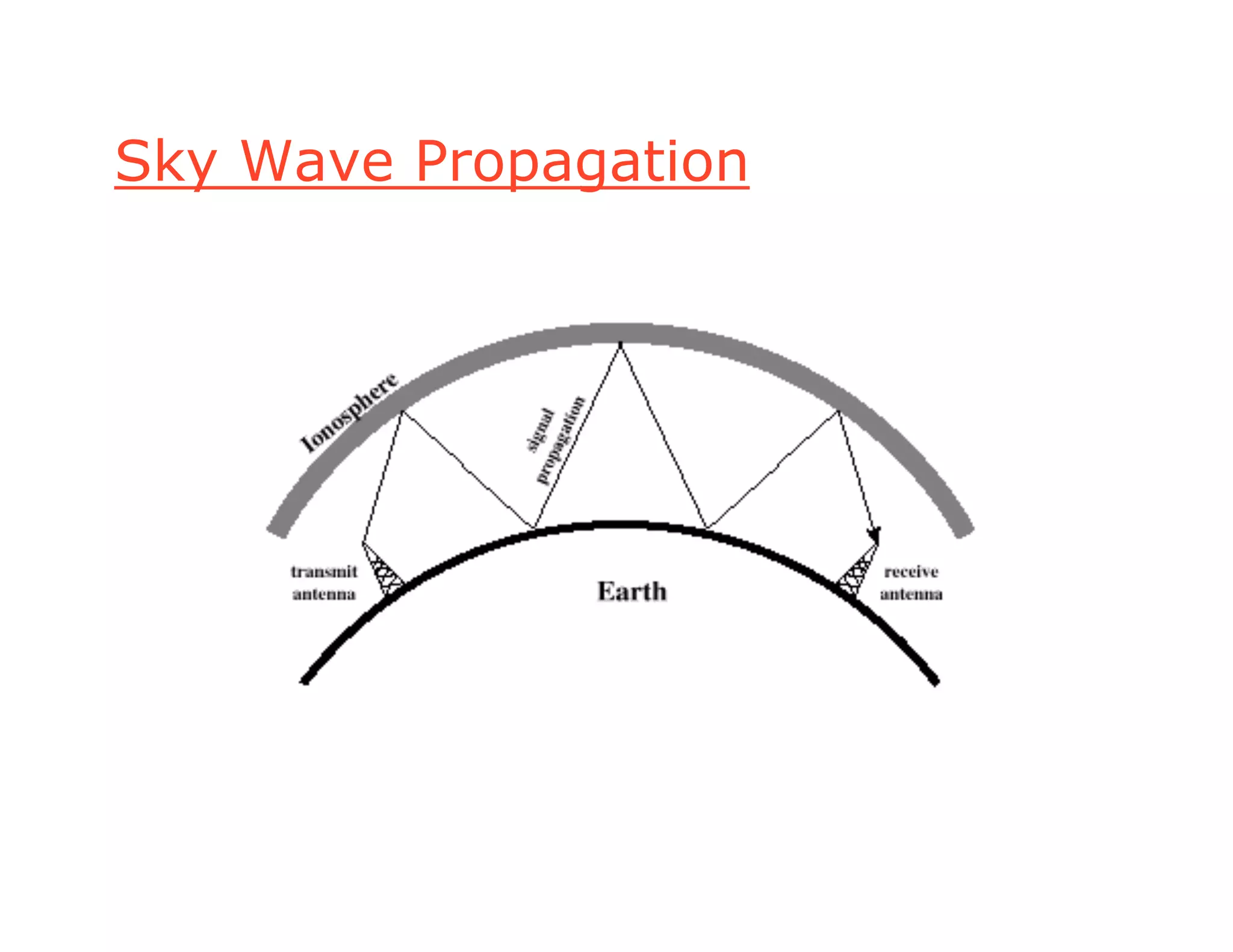
Sky Wave Propagation
 Signal reflected from ionized layer of atmosphere
back down to earth
 Signal can travel a number of hops, back and
forth between ionosphere and earth’s surface
 Reflection effect caused by refraction
 Examples
o Amateur radio
o CB radio
o International broadcasts
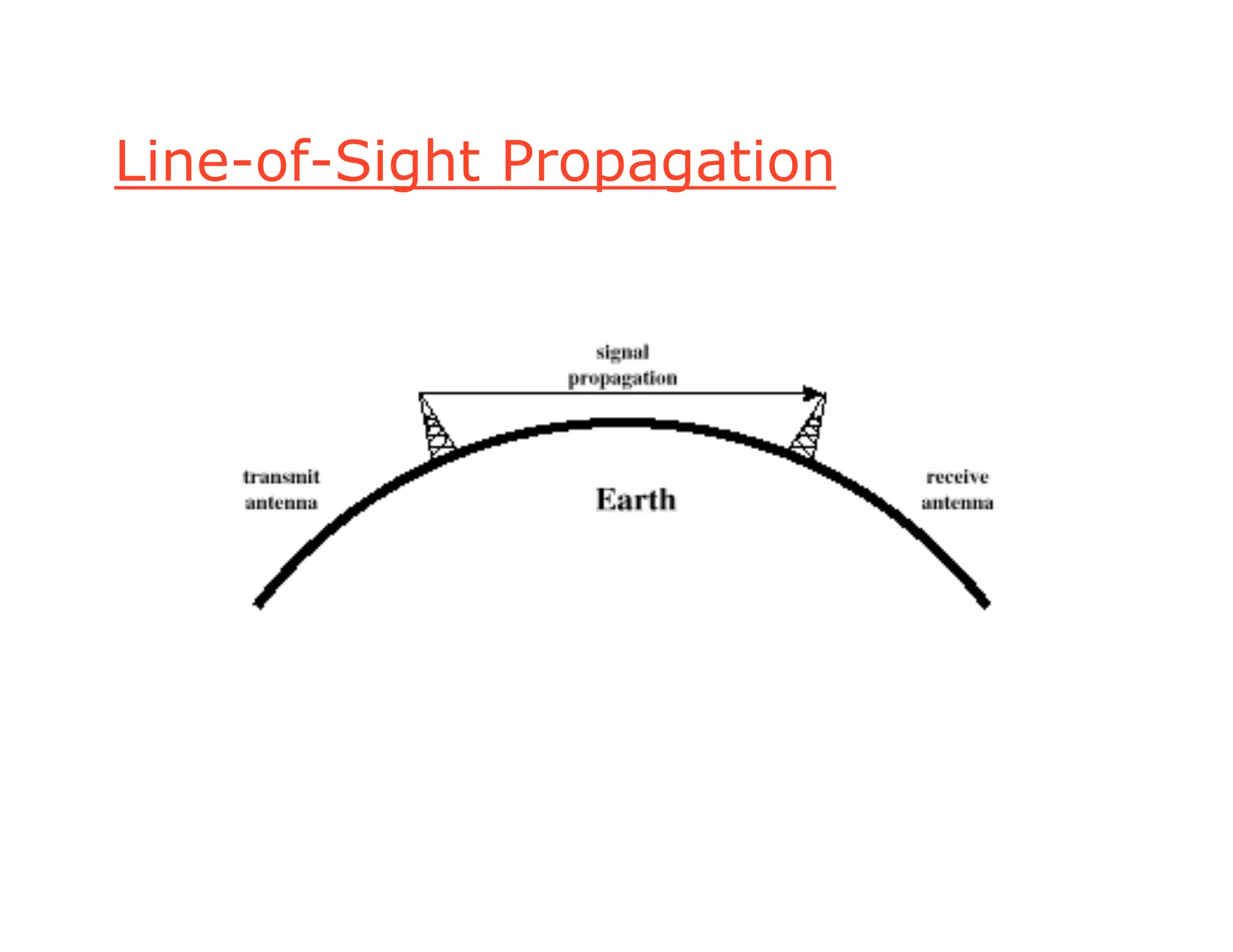
Line-of-Sight Propagation
 Above 30 MHz neither ground nor sky wave
propagation operates
 Transmitting and receiving antennas must be
within line of sight
o Satellite communication – signal above 30 MHz not
reflected by ionosphere
o Ground communication – antennas within effective line
of site due to refraction
 Refraction – bending of microwaves by the
atmosphere
o Velocity of electromagnetic wave is a function of the
density of the medium
o When wave changes medium, speed changes
o Wave bends at the boundary between mediums
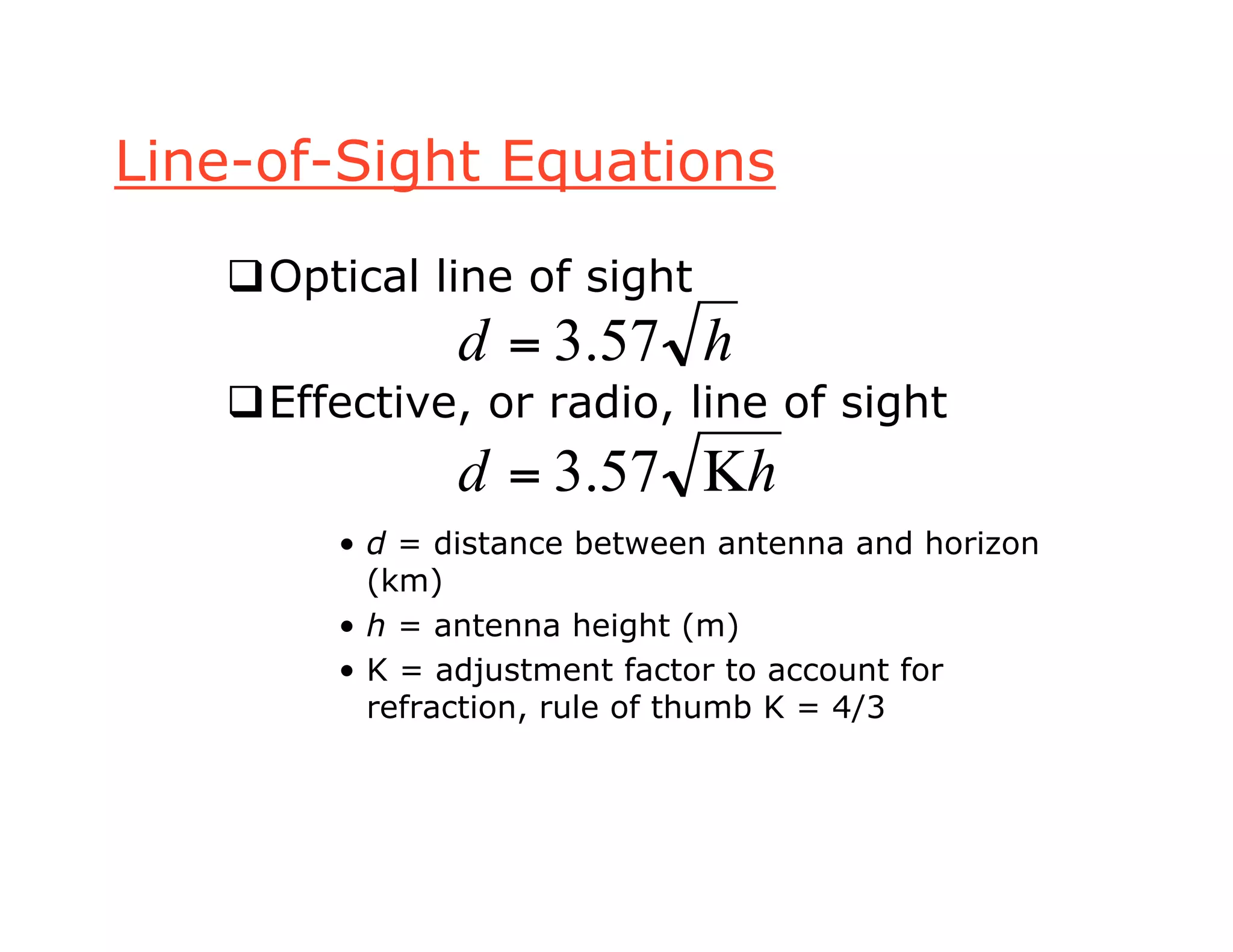
Line-of-Sight Equations
Optical line of sight
Effective, or radio, line of sight
• d = distance between antenna and horizon
(km)
• h = antenna height (m)
• K = adjustment factor to account for
refraction, rule of thumb K = 4/3
hd 57.3=
hd != 57.3
Line-of-Sight Equations
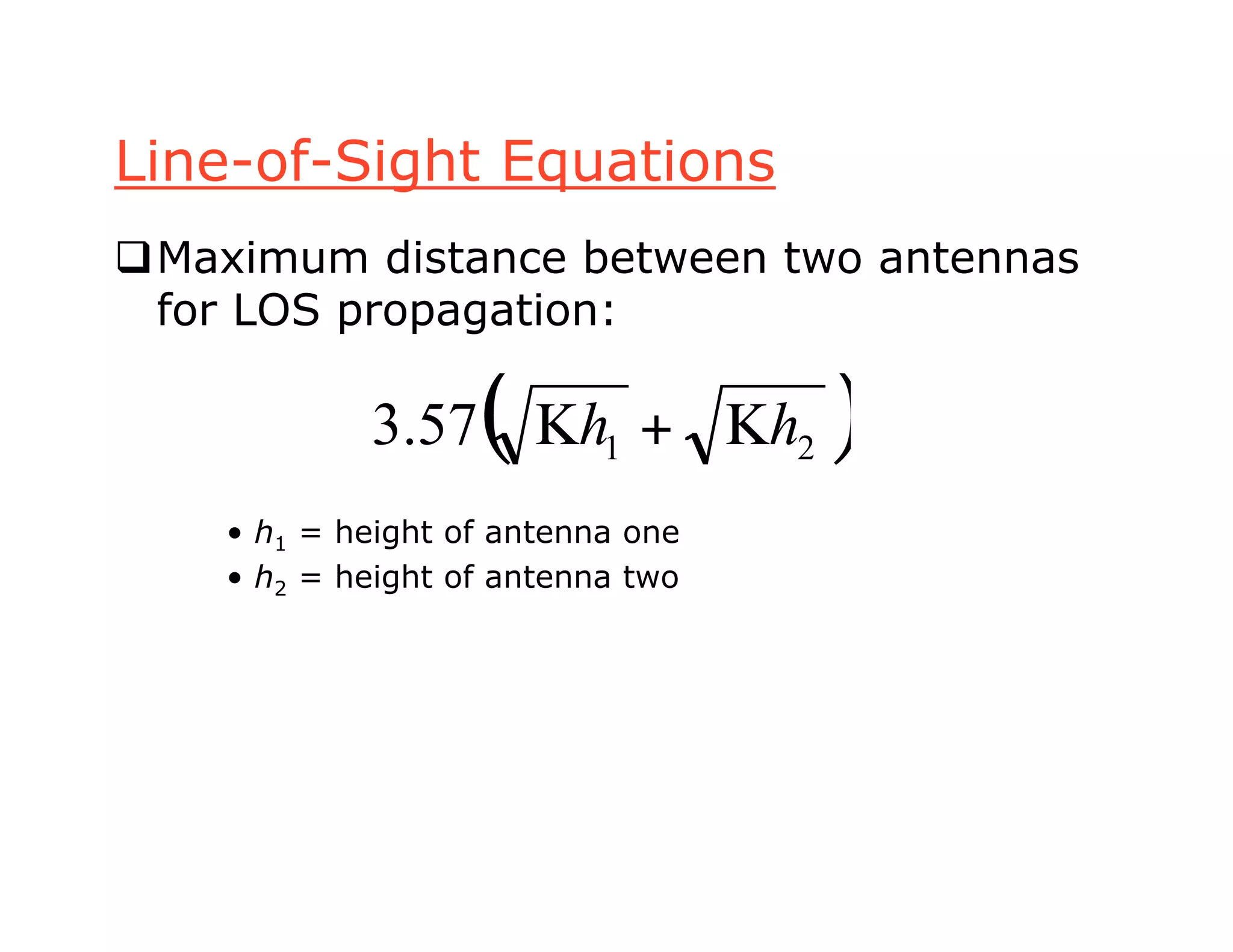
Maximum distance between two antennas
for LOS propagation:
• h1 = height of antenna one
• h2 = height of antenna two
( )2157.3 hh !+!
LOS Wireless Transmission
Impairments
Attenuation
o Free space loss
Distortion
Dispersion
Noise
Other effects:
o Atmospheric absorption
o Multipath
o Refraction
Attenuation
 Strength of signal falls off with distance over
transmission medium
 Attenuation factors for unguided media:
o Received signal must have sufficient strength so that
circuitry in the receiver can interpret the signal
o Signal must maintain a level sufficiently higher than
noise to be received without error
o Attenuation is greater at higher frequencies, causing
distortion
Free Space Loss
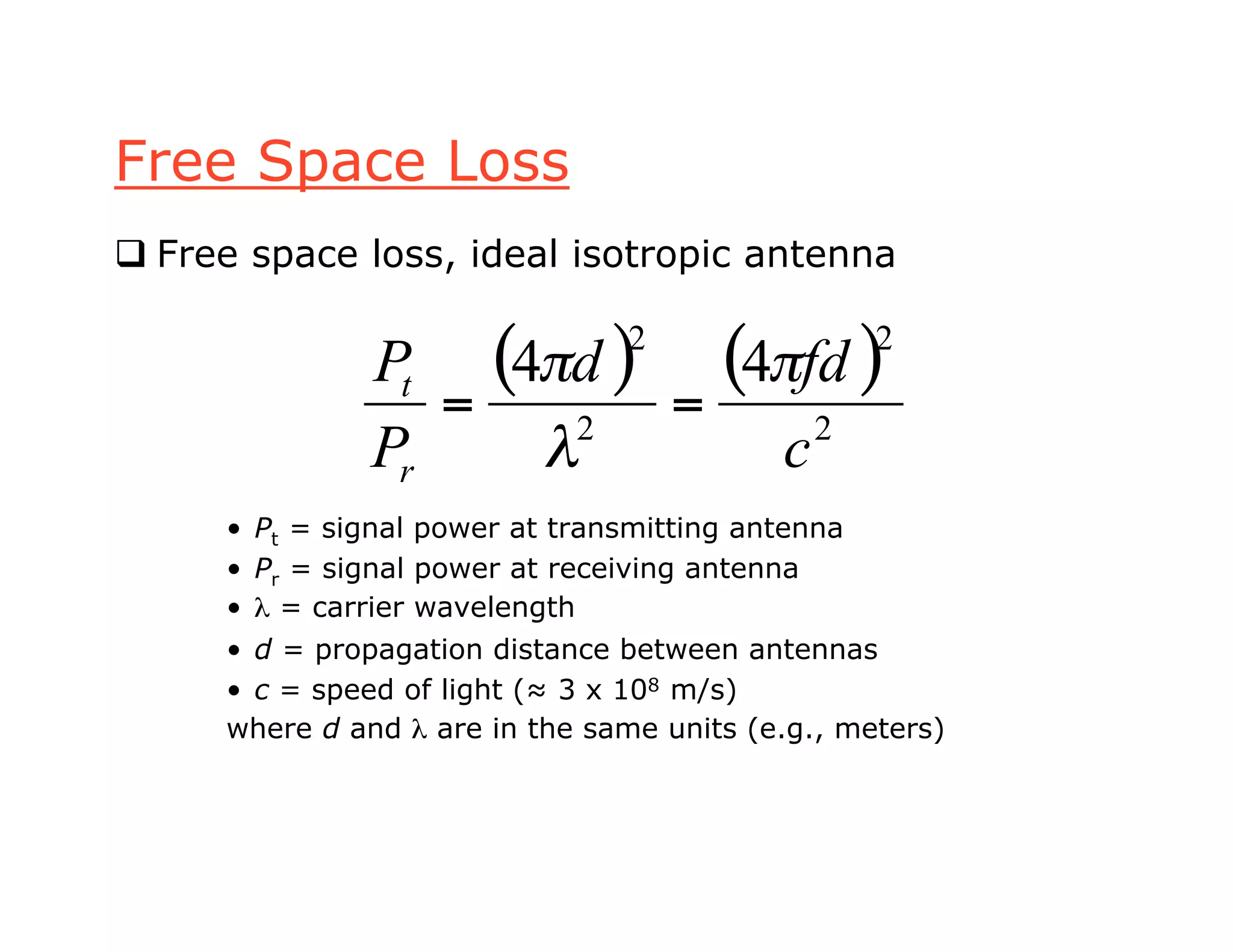
 Free space loss, ideal isotropic antenna
• Pt = signal power at transmitting antenna
• Pr = signal power at receiving antenna
• λ = carrier wavelength
• d = propagation distance between antennas
• c = speed of light (≈ 3 x 10⁸ m/s)
where d and λ are in the same units (e.g., meters)
( ) ( )
2
2
2
2
44
c
fdd
P
P
r
t !
"
!
==
Free Space Loss
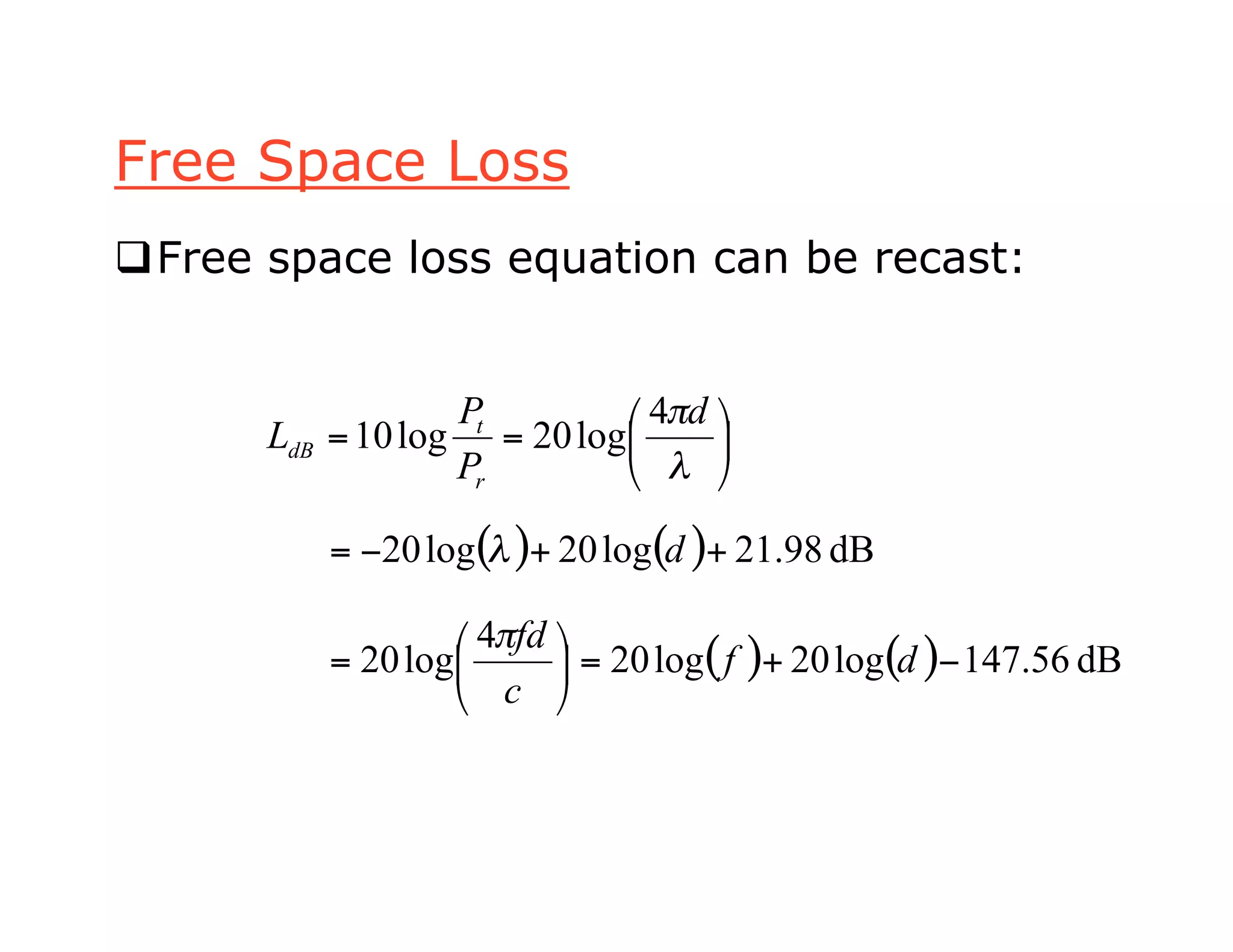
Free space loss equation can be recast:
!
"
#
$
%
&
==
'
(d
P
P
L
r
t
dB
4
log20log10
( ) ( ) dB98.21log20log20 ++!= d"
( ) ( ) dB56.147log20log20
4
log20 !+="
#
$
%
&
'
= df
c
fd(
Free Space Loss
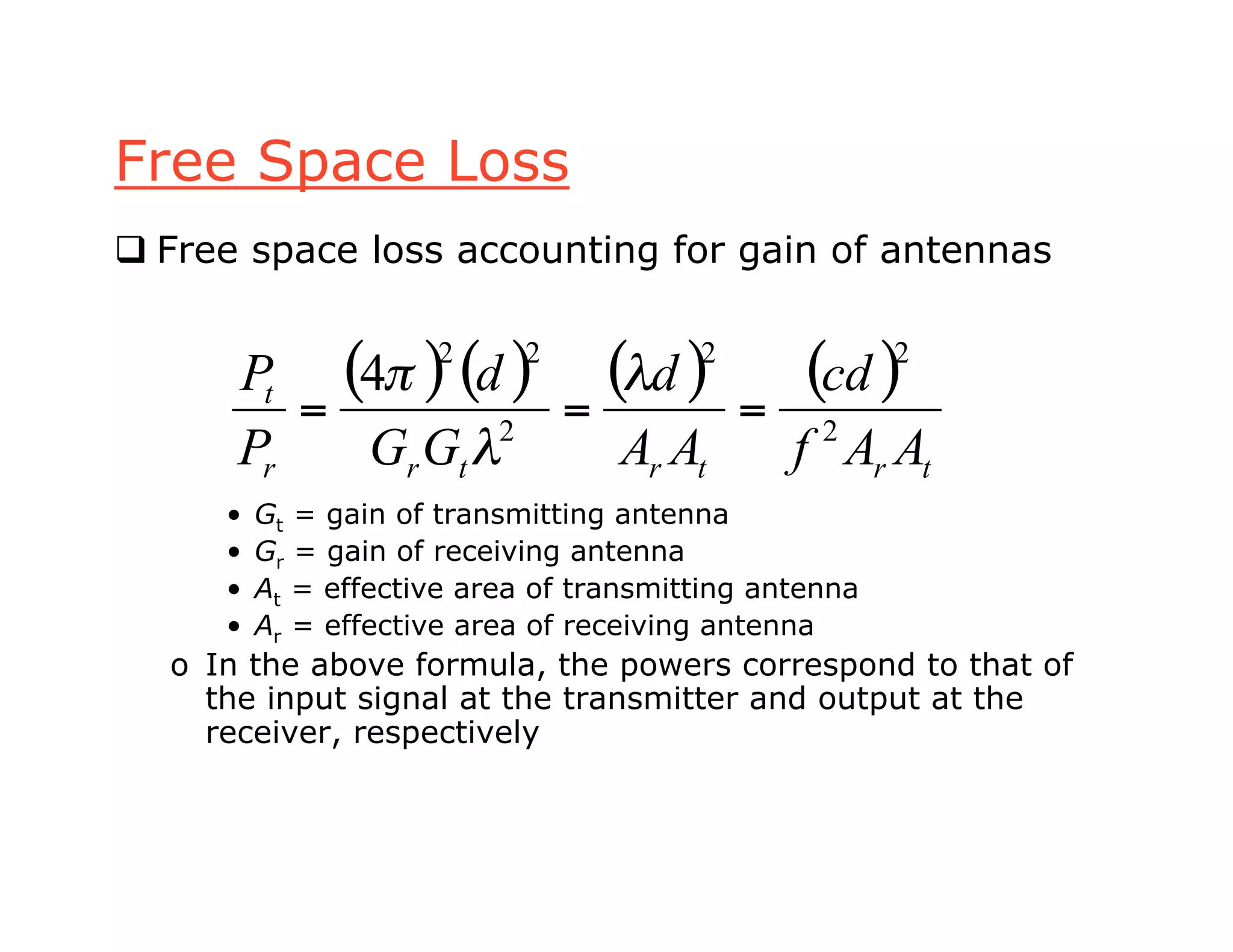
 Free space loss accounting for gain of antennas
• Gt = gain of transmitting antenna
• Gr = gain of receiving antenna
• At = effective area of transmitting antenna
• Ar = effective area of receiving antenna
o In the above formula, the powers correspond to that of
the input signal at the transmitter and output at the
receiver, respectively
( ) ( ) ( ) ( )
trtrtrr
t
AAf
cd
AA
d
GG
d
P
P
2
22
2
22
4
===
!
!
"
Free Space Loss
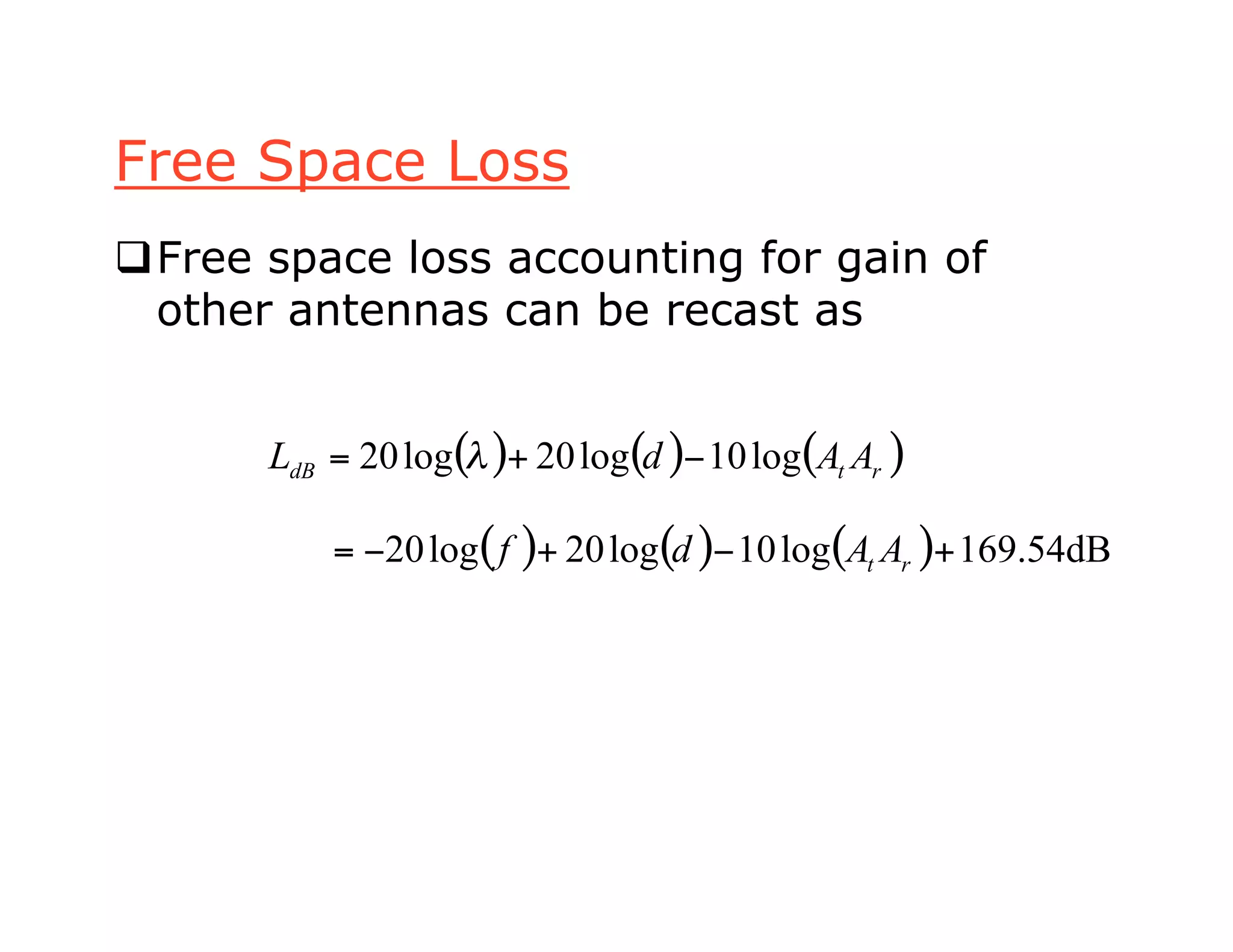
Free space loss accounting for gain of
other antennas can be recast as
( ) ( ) ( )rtdB AAdL log10log20log20 !+= "
( ) ( ) ( ) dB54.169log10log20log20 +!+!= rt AAdf
Path Loss Exponents
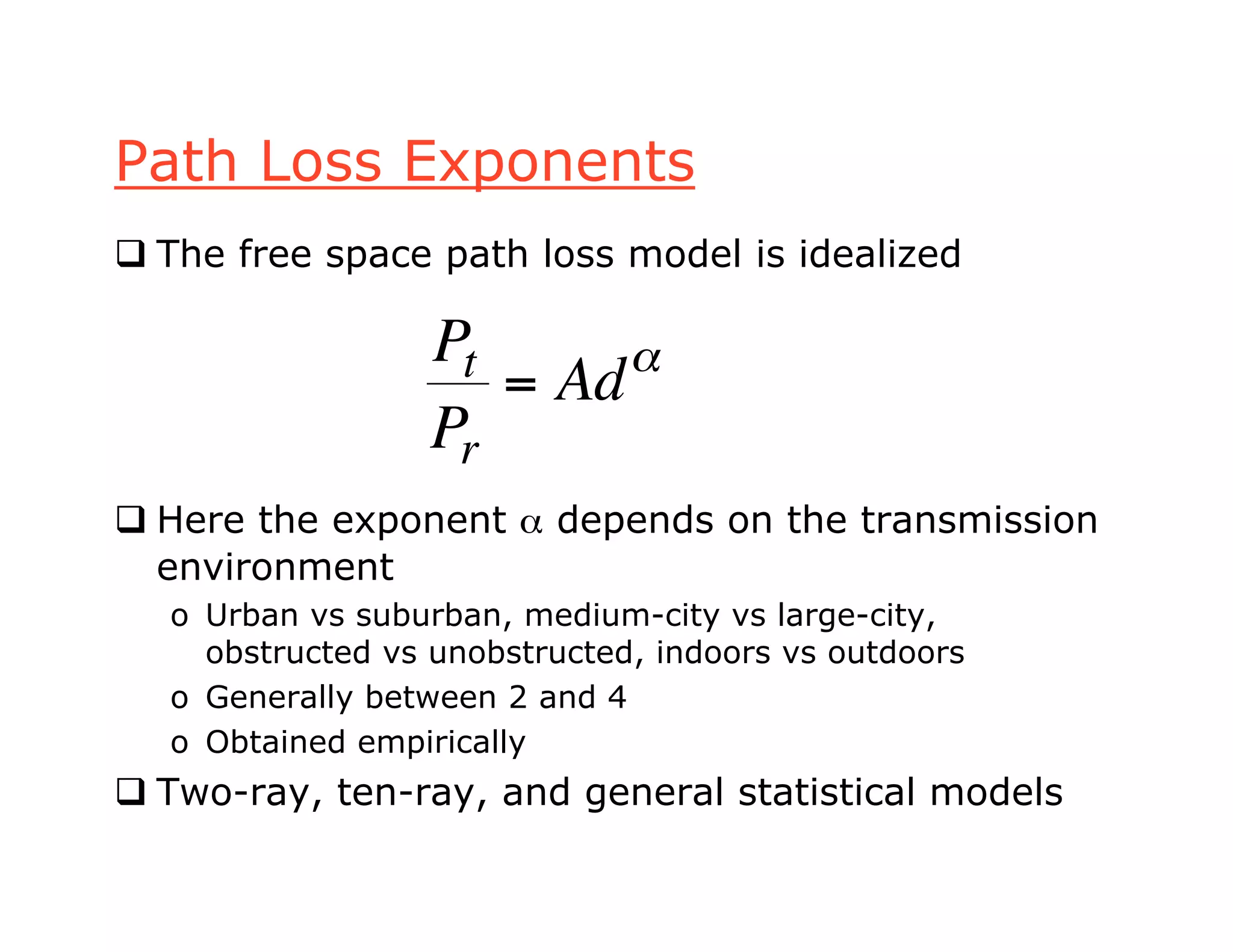
 The free space path loss model is idealized
 Here the exponent α depends on the transmission
environment
o Urban vs suburban, medium-city vs large-city,
obstructed vs unobstructed, indoors vs outdoors
o Generally between 2 and 4
o Obtained empirically
 Two-ray, ten-ray, and general statistical models
!
Pt
Pr
= Ad"
Distortion
Signals at higher frequencies attenuate
more than that at lower frequencies
Shape of a signal comprising of
components in a frequency band is
distorted
To recover the original signal shape,
attenuation is equalized by amplifying
higher frequencies more than lower ones
Dispersion
Electromagnetic energy spreads in space
as it propagates
Consequently, bursts sent in rapid
succession tend to merge as they
propagate
For guided media such as optical fiber,
fundamentally limits the product RxL,
where R is the rate and L is the usable
length of the fiber
Term generally refers to how a signal
spreads over space and time
Categories of Noise
Thermal Noise
Intermodulation noise
Crosstalk
Impulse Noise
Thermal Noise
Thermal noise due to agitation of electrons
Present in all electronic devices and
transmission media
Cannot be eliminated
Function of temperature
Particularly significant for satellite
communication
Thermal Noise
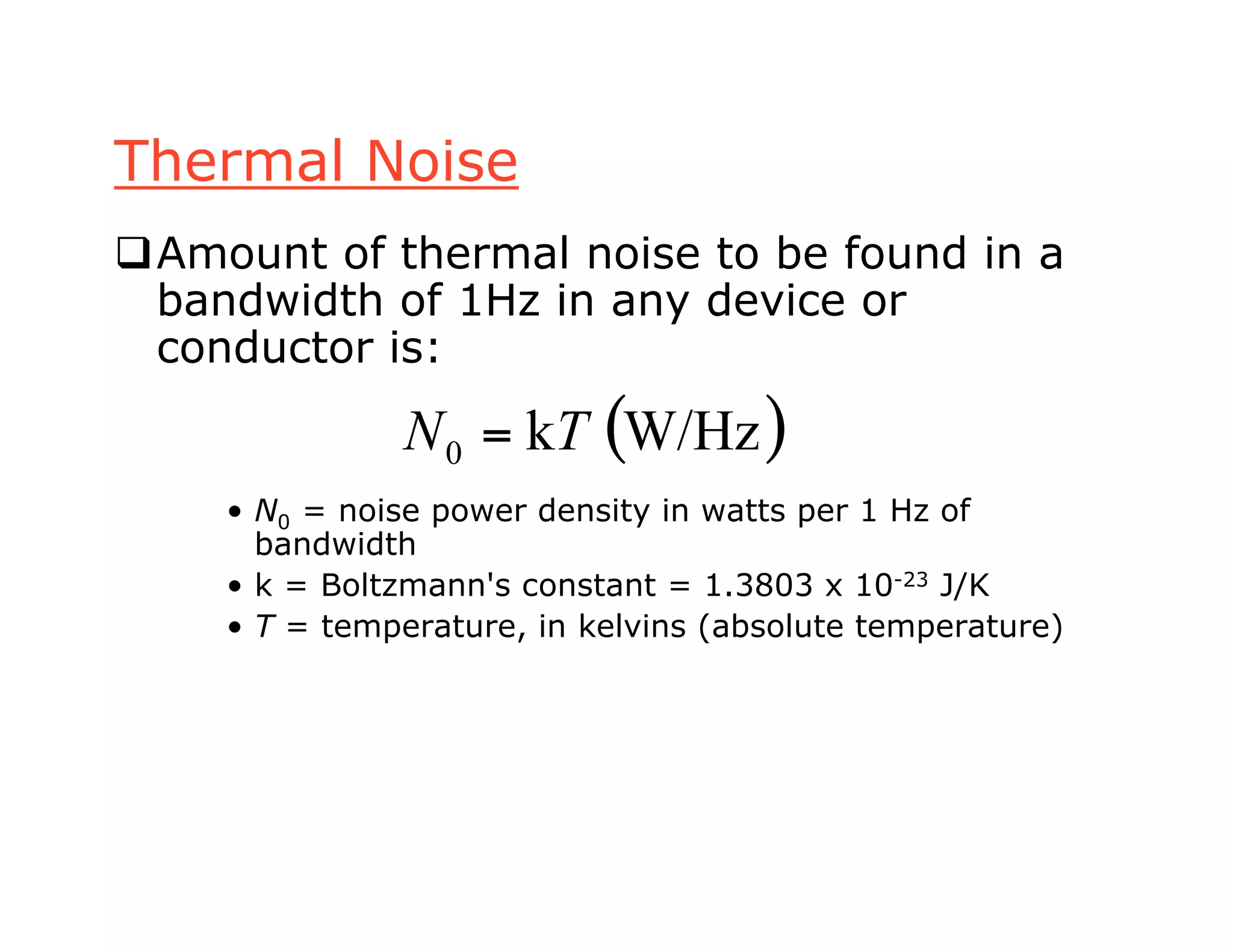
Amount of thermal noise to be found in a
bandwidth of 1Hz in any device or
conductor is:
• N0 = noise power density in watts per 1 Hz of
bandwidth
• k = Boltzmann's constant = 1.3803 x 10⁻²³ J/K
• T = temperature, in kelvins (absolute temperature)
( )W/Hzk0 TN =
Thermal Noise
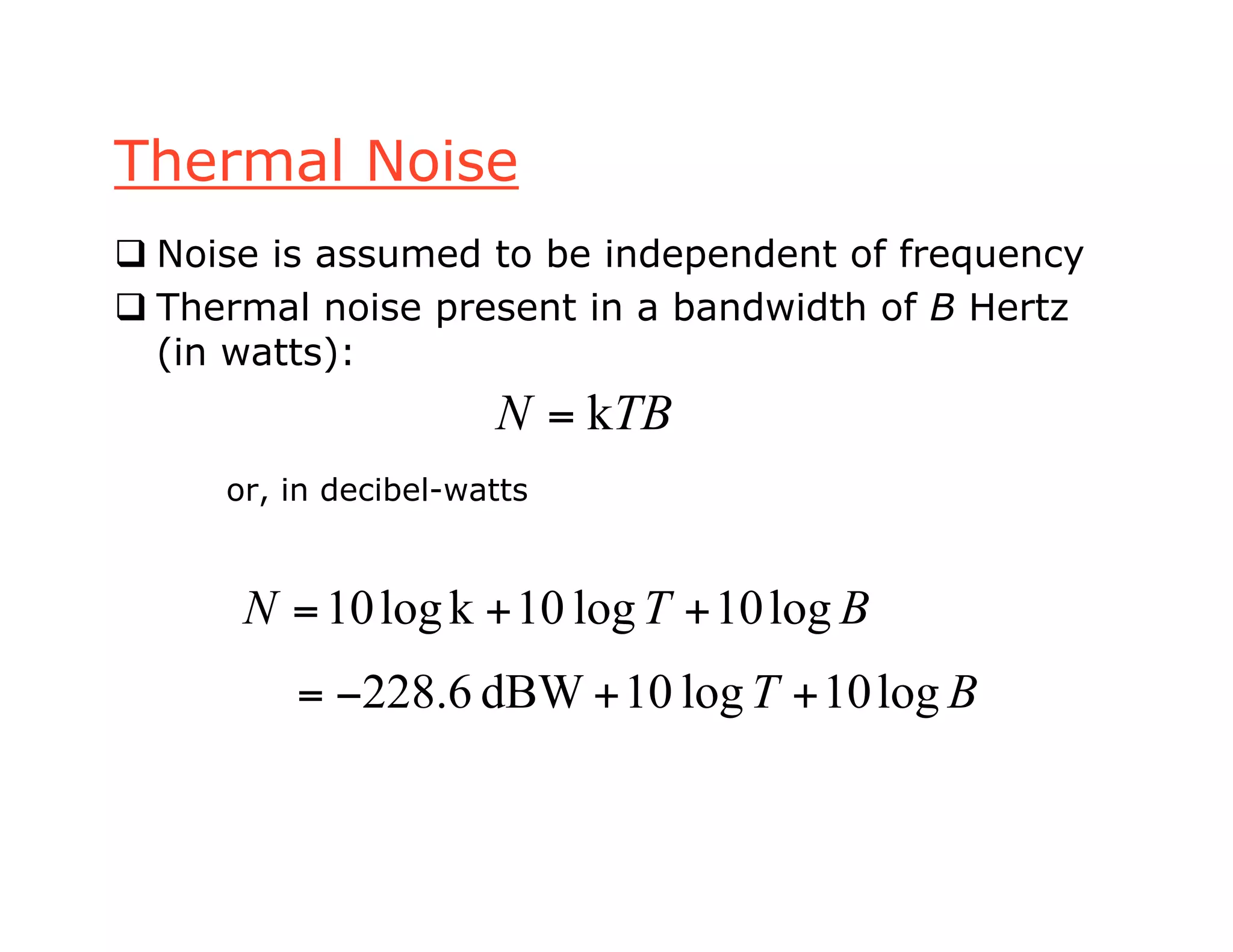
 Noise is assumed to be independent of frequency
 Thermal noise present in a bandwidth of B Hertz
(in watts):
or, in decibel-watts
TBN k=
BTN log10log10klog10 ++=
BT log10log10dBW6.228 ++!=
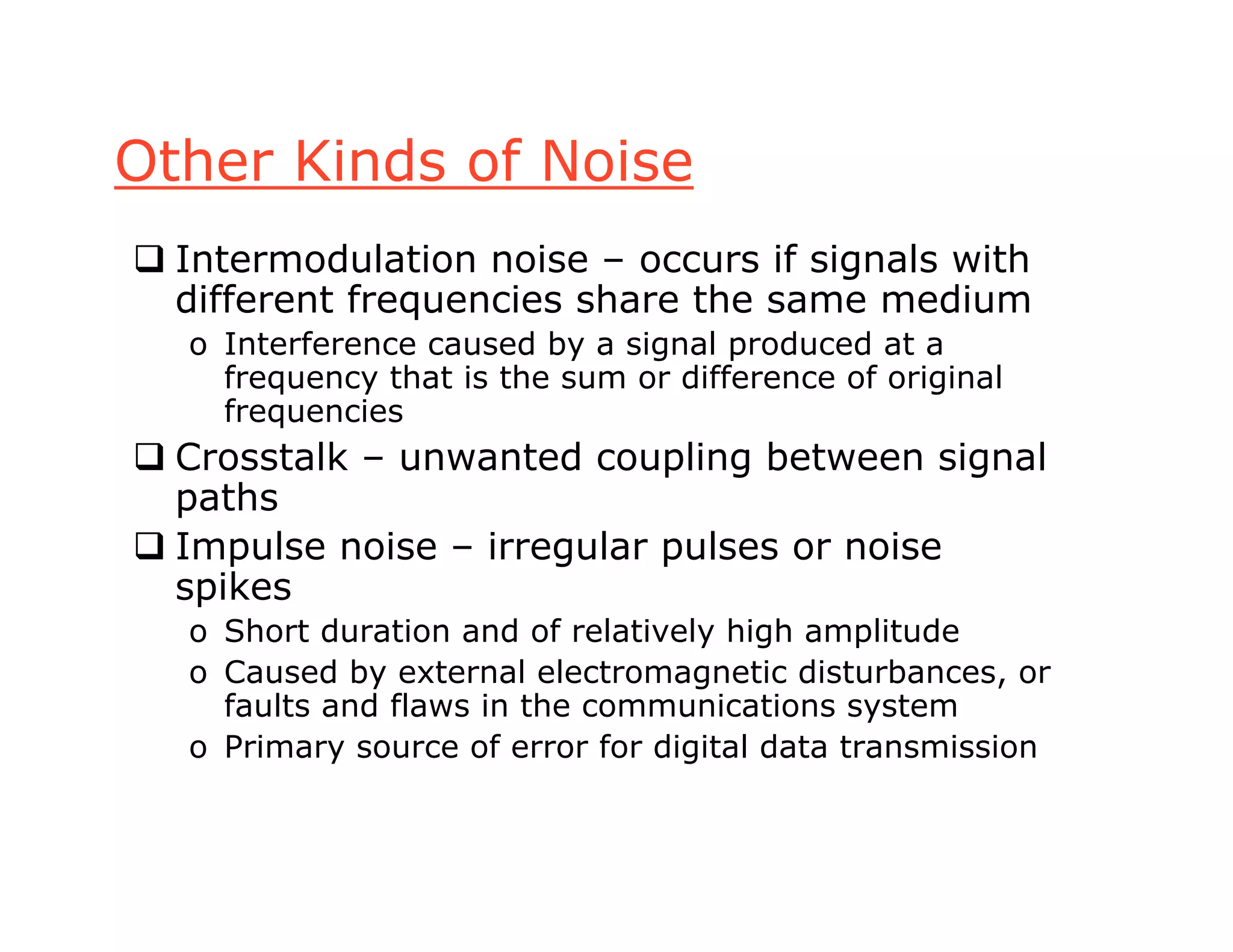
Other Kinds of Noise
 Intermodulation noise – occurs if signals with
different frequencies share the same medium
o Interference caused by a signal produced at a
frequency that is the sum or difference of original
frequencies
 Crosstalk – unwanted coupling between signal
paths
 Impulse noise – irregular pulses or noise
spikes
o Short duration and of relatively high amplitude
o Caused by external electromagnetic disturbances, or
faults and flaws in the communications system
o Primary source of error for digital data transmission
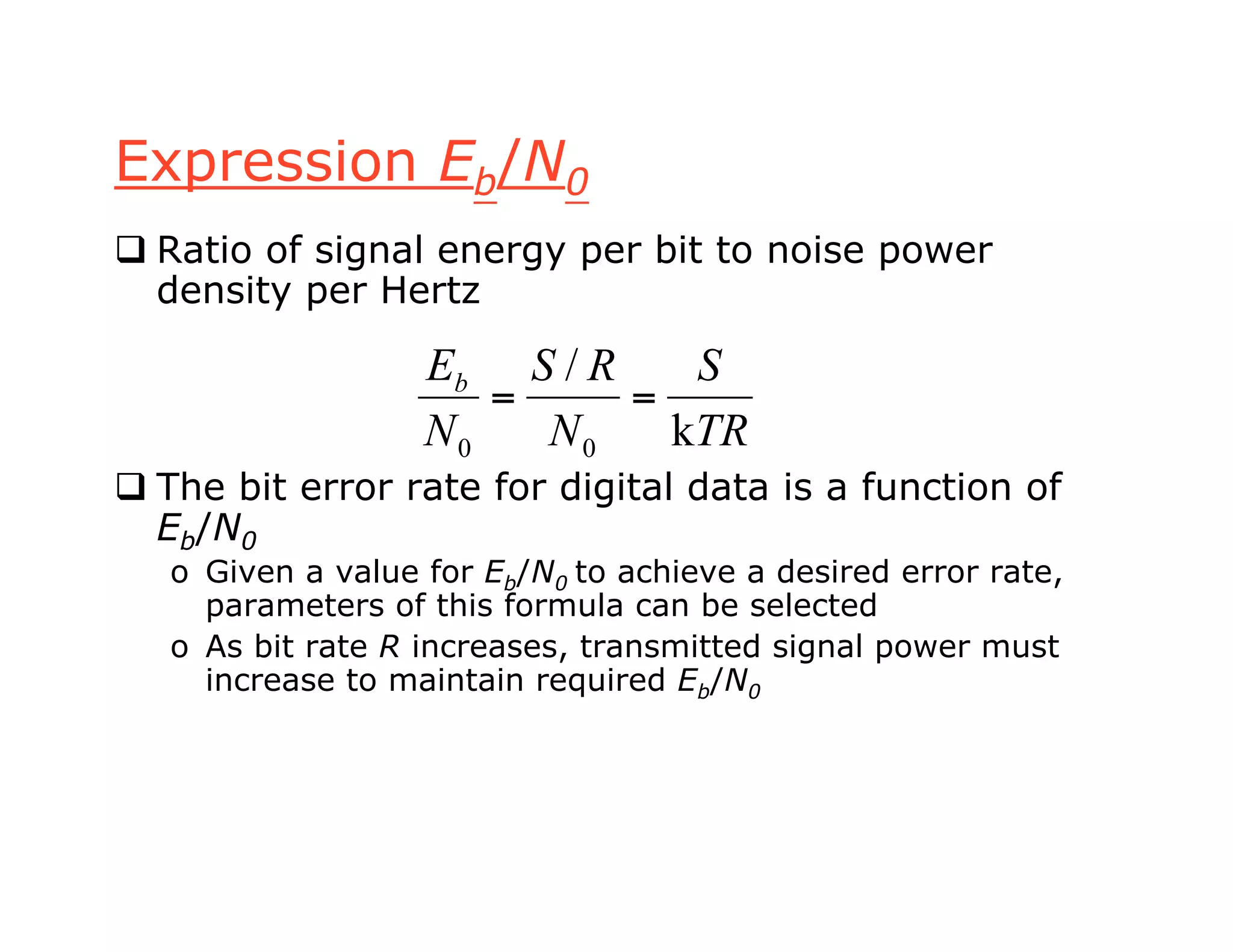
Expression Eb/N0
 Ratio of signal energy per bit to noise power
density per Hertz
 The bit error rate for digital data is a function of
Eb/N0
o Given a value for Eb/N0 to achieve a desired error rate,
parameters of this formula can be selected
o As bit rate R increases, transmitted signal power must
increase to maintain required Eb/N0
TR
S
N
RS
N
Eb
k
/
00
==
Other Impairments
Atmospheric absorption – water vapor and
oxygen contribute to attenuation
Multipath – obstacles reflect signals so that
multiple copies with varying delays are
received
Refraction – bending of radio waves as
they propagate through the atmosphere
Fading
Variation over time or distance of received
signal power caused by changes in the
transmission medium or path(s)
In a fixed environment:
o Changes in atmospheric conditions
In a mobile environment:
o Multipath propagation
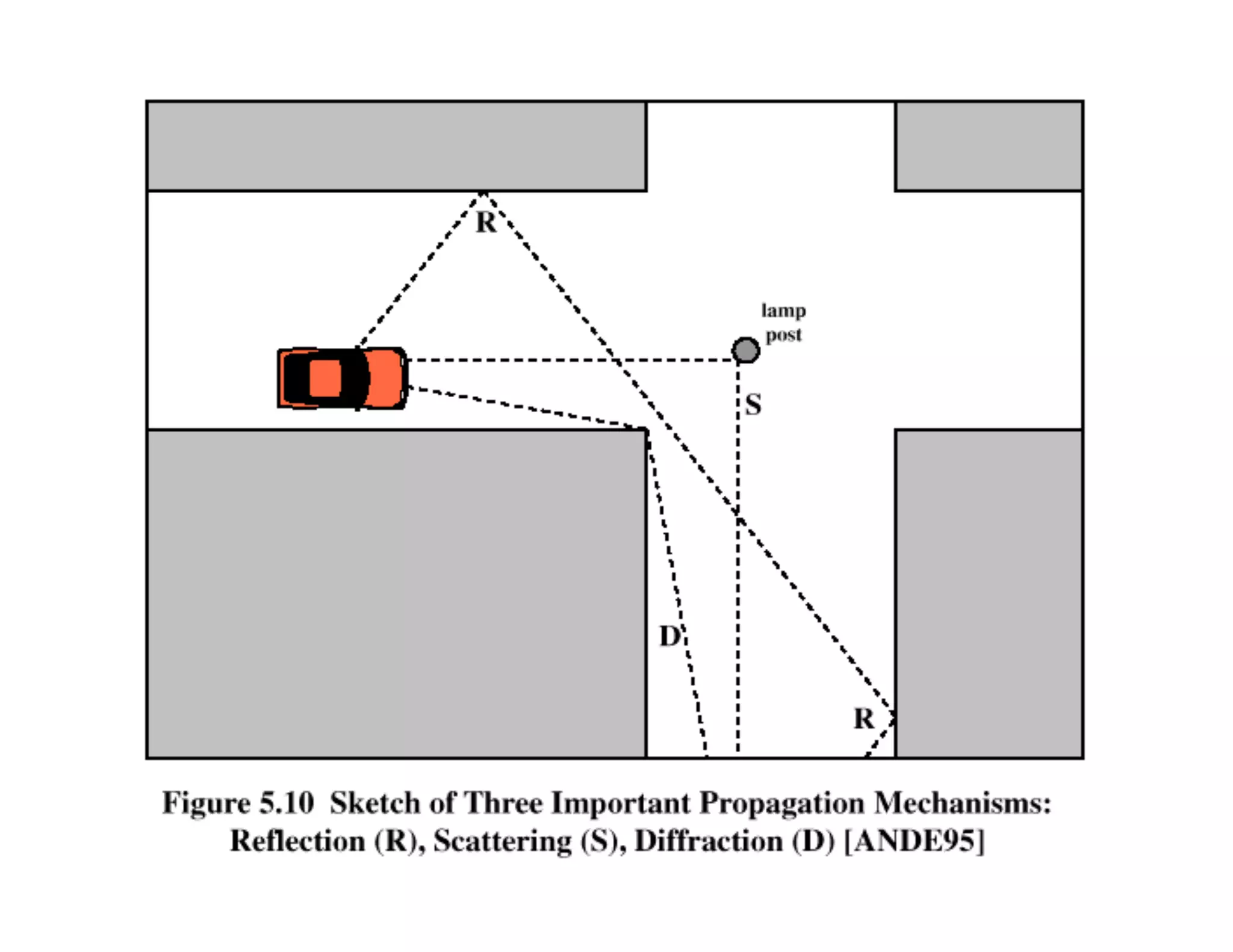
Multipath Propagation
 Reflection - occurs when signal encounters a
surface that is large relative to the wavelength of
the signal
 Diffraction - occurs at the edge of an
impenetrable body that is large compared to
wavelength of radio wave
 Scattering – occurs when incoming signal hits an
object whose size is in the order of the
wavelength of the signal or less
Effects of Multipath Propagation
Multiple copies of a signal may arrive at
different phases
o If phases add destructively, the signal level
relative to noise declines, making detection
more difficult
Intersymbol interference (ISI)
o One or more delayed copies of a pulse may
arrive at the same time as the primary pulse
for a subsequent bit
Types of Fading
 Fast fading
o Changes in signal strength in a short time period
 Slow fading
o Changes in signal strength in a short time period
 Flat fading
o Fluctuations proportionally equal over all frequency
components
 Selective fading
o Different fluctuations for different frequencies
 Rayleigh fading
o Multiple indirect paths, but no dominant path such as LOS path
o Worst-case scenario
 Rician fading
o Multiple paths, but LOS path dominant
o Parametrized by K, ratio of power on dominant path to that on
other paths
Error Compensation Mechanisms
Forward error correction
Adaptive equalization
Diversity techniques
Forward Error Correction
 Transmitter adds error-correcting code to data
block
o Code is a function of the data bits
 Receiver calculates error-correcting code from
incoming data bits
o If calculated code matches incoming code, no error
occurred
o If error-correcting codes don’t match, receiver attempts
to determine bits in error and correct
Adaptive Equalization
 Can be applied to transmissions that carry analog
or digital information
o Analog voice or video
o Digital data, digitized voice or video
 Used to combat intersymbol interference
 Involves gathering dispersed symbol energy back
into its original time interval
 Techniques
o Lumped analog circuits
o Sophisticated digital signal processing algorithms
Diversity Techniques
 Space diversity:
o Use multiple nearby antennas and combine received
signals to obtain the desired signal
o Use collocated multiple directional antennas
 Frequency diversity:
o Spreading out signal over a larger frequency bandwidth
o Spread spectrum
 Time diversity:
o Noise often occurs in bursts
o Spreading the data out over time spreads the errors and
hence allows FEC techniques to work well
o TDM
o Interleaving
Antennas propagation

  • 1.
    Antennas & Propagation CS6710 Spring 2010 Rajmohan Rajaraman
  • 2.
    Introduction An antenna isan electrical conductor or system of conductors o Transmission - radiates electromagnetic energy into space o Reception - collects electromagnetic energy from space In two-way communication, the same antenna can be used for transmission and reception
  • 3.
    Radiation Patterns  Radiationpattern o Graphical representation of radiation properties of an antenna o Depicted as two-dimensional cross section  Beam width (or half-power beam width) o Measure of directivity of antenna o Angle within which power radiated is at least half of that in most preferred direction  Reception pattern o Receiving antenna’s equivalent to radiation pattern  Omnidirectional vs. directional antenna
  • 4.
    Types of Antennas Isotropic antenna (idealized) o Radiates power equally in all directions  Dipole antennas o Half-wave dipole antenna (or Hertz antenna) o Quarter-wave vertical antenna (or Marconi antenna)  Parabolic Reflective Antenna o Used for terrestrial microwave and satellite applications o Larger the diameter, the more tightly directional is the beam
  • 5.
    Antenna Gain Antenna gain oPower output, in a particular direction, compared to that produced in any direction by a perfect omnidirectional antenna (isotropic antenna) Expressed in terms of effective area o Related to physical size and shape of antenna
  • 6.
    Antenna Gain  Relationshipbetween antenna gain and effective area • G = antenna gain • Ae = effective area • f = carrier frequency • c = speed of light (≈ 3 x 10⁸ m/s) • λ = carrier wavelength 2 2 2 44 c AfA G ee ! " ! ==
  • 7.
    Propagation Modes Ground-wave propagation Sky-wavepropagation Line-of-sight propagation
  • 8.
  • 9.
    Ground Wave Propagation Followscontour of the earth Can Propagate considerable distances Frequencies up to 2 MHz Example o AM radio
  • 10.
  • 11.
    Sky Wave Propagation Signal reflected from ionized layer of atmosphere back down to earth  Signal can travel a number of hops, back and forth between ionosphere and earth’s surface  Reflection effect caused by refraction  Examples o Amateur radio o CB radio o International broadcasts
  • 12.
  • 13.
    Line-of-Sight Propagation  Above30 MHz neither ground nor sky wave propagation operates  Transmitting and receiving antennas must be within line of sight o Satellite communication – signal above 30 MHz not reflected by ionosphere o Ground communication – antennas within effective line of site due to refraction  Refraction – bending of microwaves by the atmosphere o Velocity of electromagnetic wave is a function of the density of the medium o When wave changes medium, speed changes o Wave bends at the boundary between mediums
  • 14.
    Line-of-Sight Equations Optical lineof sight Effective, or radio, line of sight • d = distance between antenna and horizon (km) • h = antenna height (m) • K = adjustment factor to account for refraction, rule of thumb K = 4/3 hd 57.3= hd != 57.3
  • 15.
    Line-of-Sight Equations Maximum distancebetween two antennas for LOS propagation: • h1 = height of antenna one • h2 = height of antenna two ( )2157.3 hh !+!
  • 16.
    LOS Wireless Transmission Impairments Attenuation oFree space loss Distortion Dispersion Noise Other effects: o Atmospheric absorption o Multipath o Refraction
  • 17.
    Attenuation  Strength ofsignal falls off with distance over transmission medium  Attenuation factors for unguided media: o Received signal must have sufficient strength so that circuitry in the receiver can interpret the signal o Signal must maintain a level sufficiently higher than noise to be received without error o Attenuation is greater at higher frequencies, causing distortion
  • 18.
    Free Space Loss Free space loss, ideal isotropic antenna • Pt = signal power at transmitting antenna • Pr = signal power at receiving antenna • λ = carrier wavelength • d = propagation distance between antennas • c = speed of light (≈ 3 x 10⁸ m/s) where d and λ are in the same units (e.g., meters) ( ) ( ) 2 2 2 2 44 c fdd P P r t ! " ! ==
  • 19.
    Free Space Loss Freespace loss equation can be recast: ! " # $ % & == ' (d P P L r t dB 4 log20log10 ( ) ( ) dB98.21log20log20 ++!= d" ( ) ( ) dB56.147log20log20 4 log20 !+=" # $ % & ' = df c fd(
  • 20.
    Free Space Loss Free space loss accounting for gain of antennas • Gt = gain of transmitting antenna • Gr = gain of receiving antenna • At = effective area of transmitting antenna • Ar = effective area of receiving antenna o In the above formula, the powers correspond to that of the input signal at the transmitter and output at the receiver, respectively ( ) ( ) ( ) ( ) trtrtrr t AAf cd AA d GG d P P 2 22 2 22 4 === ! ! "
  • 21.
    Free Space Loss Freespace loss accounting for gain of other antennas can be recast as ( ) ( ) ( )rtdB AAdL log10log20log20 !+= " ( ) ( ) ( ) dB54.169log10log20log20 +!+!= rt AAdf
  • 22.
    Path Loss Exponents The free space path loss model is idealized  Here the exponent α depends on the transmission environment o Urban vs suburban, medium-city vs large-city, obstructed vs unobstructed, indoors vs outdoors o Generally between 2 and 4 o Obtained empirically  Two-ray, ten-ray, and general statistical models ! Pt Pr = Ad"
  • 23.
    Distortion Signals at higherfrequencies attenuate more than that at lower frequencies Shape of a signal comprising of components in a frequency band is distorted To recover the original signal shape, attenuation is equalized by amplifying higher frequencies more than lower ones
  • 24.
    Dispersion Electromagnetic energy spreadsin space as it propagates Consequently, bursts sent in rapid succession tend to merge as they propagate For guided media such as optical fiber, fundamentally limits the product RxL, where R is the rate and L is the usable length of the fiber Term generally refers to how a signal spreads over space and time
  • 25.
    Categories of Noise ThermalNoise Intermodulation noise Crosstalk Impulse Noise
  • 26.
    Thermal Noise Thermal noisedue to agitation of electrons Present in all electronic devices and transmission media Cannot be eliminated Function of temperature Particularly significant for satellite communication
  • 27.
    Thermal Noise Amount ofthermal noise to be found in a bandwidth of 1Hz in any device or conductor is: • N0 = noise power density in watts per 1 Hz of bandwidth • k = Boltzmann's constant = 1.3803 x 10⁻²³ J/K • T = temperature, in kelvins (absolute temperature) ( )W/Hzk0 TN =
  • 28.
    Thermal Noise  Noiseis assumed to be independent of frequency  Thermal noise present in a bandwidth of B Hertz (in watts): or, in decibel-watts TBN k= BTN log10log10klog10 ++= BT log10log10dBW6.228 ++!=
  • 29.
    Other Kinds ofNoise  Intermodulation noise – occurs if signals with different frequencies share the same medium o Interference caused by a signal produced at a frequency that is the sum or difference of original frequencies  Crosstalk – unwanted coupling between signal paths  Impulse noise – irregular pulses or noise spikes o Short duration and of relatively high amplitude o Caused by external electromagnetic disturbances, or faults and flaws in the communications system o Primary source of error for digital data transmission
  • 30.
    Expression Eb/N0  Ratioof signal energy per bit to noise power density per Hertz  The bit error rate for digital data is a function of Eb/N0 o Given a value for Eb/N0 to achieve a desired error rate, parameters of this formula can be selected o As bit rate R increases, transmitted signal power must increase to maintain required Eb/N0 TR S N RS N Eb k / 00 ==
  • 31.
    Other Impairments Atmospheric absorption– water vapor and oxygen contribute to attenuation Multipath – obstacles reflect signals so that multiple copies with varying delays are received Refraction – bending of radio waves as they propagate through the atmosphere
  • 32.
    Fading Variation over timeor distance of received signal power caused by changes in the transmission medium or path(s) In a fixed environment: o Changes in atmospheric conditions In a mobile environment: o Multipath propagation
  • 33.
    Multipath Propagation  Reflection- occurs when signal encounters a surface that is large relative to the wavelength of the signal  Diffraction - occurs at the edge of an impenetrable body that is large compared to wavelength of radio wave  Scattering – occurs when incoming signal hits an object whose size is in the order of the wavelength of the signal or less
  • 35.
    Effects of MultipathPropagation Multiple copies of a signal may arrive at different phases o If phases add destructively, the signal level relative to noise declines, making detection more difficult Intersymbol interference (ISI) o One or more delayed copies of a pulse may arrive at the same time as the primary pulse for a subsequent bit
  • 36.
    Types of Fading Fast fading o Changes in signal strength in a short time period  Slow fading o Changes in signal strength in a short time period  Flat fading o Fluctuations proportionally equal over all frequency components  Selective fading o Different fluctuations for different frequencies  Rayleigh fading o Multiple indirect paths, but no dominant path such as LOS path o Worst-case scenario  Rician fading o Multiple paths, but LOS path dominant o Parametrized by K, ratio of power on dominant path to that on other paths
  • 37.
    Error Compensation Mechanisms Forwarderror correction Adaptive equalization Diversity techniques
  • 38.
    Forward Error Correction Transmitter adds error-correcting code to data block o Code is a function of the data bits  Receiver calculates error-correcting code from incoming data bits o If calculated code matches incoming code, no error occurred o If error-correcting codes don’t match, receiver attempts to determine bits in error and correct
  • 39.
    Adaptive Equalization  Canbe applied to transmissions that carry analog or digital information o Analog voice or video o Digital data, digitized voice or video  Used to combat intersymbol interference  Involves gathering dispersed symbol energy back into its original time interval  Techniques o Lumped analog circuits o Sophisticated digital signal processing algorithms
  • 40.
    Diversity Techniques  Spacediversity: o Use multiple nearby antennas and combine received signals to obtain the desired signal o Use collocated multiple directional antennas  Frequency diversity: o Spreading out signal over a larger frequency bandwidth o Spread spectrum  Time diversity: o Noise often occurs in bursts o Spreading the data out over time spreads the errors and hence allows FEC techniques to work well o TDM o Interleaving