Wheeler model
Another scholar who contributed to curriculum development is wheeler (1967)
presented his model in his book curriculum process. He seemed to further build
upon the work of Tyler (1971) by presenting a classroom environment and learning
resulting from other sources than the classroom. Thus, in specifying objectives,
wheeler goes a step further in specifying between what is learnt in
the classroom and outside it respectively. This leads to the second step a model that
shows the interrelatedness of each of the elements.
1.Determination of aims and objectives: The objective tell the planner the direction of
educational development and forms the basis foe distinguishing between learning
Resulting from classroom environment and learning resulting from other sources than
the classroom. Thus, in specifying objectives, wheeler goes a step further in
specifying between what is learnt in the classroom and outside it respectively. This
leads to the second step;
2. Selection of Learning Experiences: This is a major difference from Tyler’s model.
Here, wheeler is concerned with the learner and the learning environment with
which he interacts. For example, what kind of learning environment is provided
for the learner involved in mental activities as opposed to those involved in physical
activities such as in playing writing and construction projects;
3. Selection of Content: This involves the preparation of content; the subject to be
taught and the topics to be specified;
4. Organisation and Interpretation of Learning Experience:
This is as in Tyler’s model;
5. Organisation and Interpretation of Learning Experience: This is as in Tyler’s model;
6. Evaluation: In this model, evaluation is considered as a broad, concept, not in terms
of paper and pencil tests.It is something that can take place at any stage of the
curriculum process, with the outcomes serving again as input into further development
of the step. Hence his model is considered cyclic and not linear like Tyler.
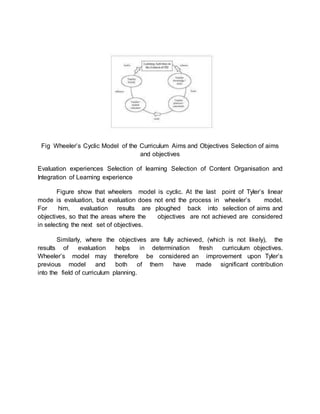
Fig Wheeler’s Cyclic Model of the Curriculum Aims and Objectives Selection of aims
and objectives
Evaluation experiences Selection of learning Selection of Content Organisation and
Integration of Learning experience
Figure show that wheelers model is cyclic. At the last point of Tyler’s linear
mode is evaluation, but evaluation does not end the process in wheeler’s model.
For him, evaluation results are ploughed back into selection of aims and
objectives, so that the areas where the objectives are not achieved are considered
in selecting the next set of objectives.
Similarly, where the objectives are fully achieved, (which is not likely), the
results of evaluation helps in determination fresh curriculum objectives.
Wheeler’s model may therefore be considered an improvement upon Tyler’s
previous model and both of them have made significant contribution
into the field of curriculum planning.

Another scholar who contributed to curriculum development is wheeler

  • 1.
    Wheeler model Another scholarwho contributed to curriculum development is wheeler (1967) presented his model in his book curriculum process. He seemed to further build upon the work of Tyler (1971) by presenting a classroom environment and learning resulting from other sources than the classroom. Thus, in specifying objectives, wheeler goes a step further in specifying between what is learnt in the classroom and outside it respectively. This leads to the second step a model that shows the interrelatedness of each of the elements. 1.Determination of aims and objectives: The objective tell the planner the direction of educational development and forms the basis foe distinguishing between learning Resulting from classroom environment and learning resulting from other sources than the classroom. Thus, in specifying objectives, wheeler goes a step further in specifying between what is learnt in the classroom and outside it respectively. This leads to the second step; 2. Selection of Learning Experiences: This is a major difference from Tyler’s model. Here, wheeler is concerned with the learner and the learning environment with which he interacts. For example, what kind of learning environment is provided for the learner involved in mental activities as opposed to those involved in physical activities such as in playing writing and construction projects; 3. Selection of Content: This involves the preparation of content; the subject to be taught and the topics to be specified; 4. Organisation and Interpretation of Learning Experience: This is as in Tyler’s model; 5. Organisation and Interpretation of Learning Experience: This is as in Tyler’s model; 6. Evaluation: In this model, evaluation is considered as a broad, concept, not in terms of paper and pencil tests.It is something that can take place at any stage of the curriculum process, with the outcomes serving again as input into further development of the step. Hence his model is considered cyclic and not linear like Tyler.
  • 2.
    Fig Wheeler’s CyclicModel of the Curriculum Aims and Objectives Selection of aims and objectives Evaluation experiences Selection of learning Selection of Content Organisation and Integration of Learning experience Figure show that wheelers model is cyclic. At the last point of Tyler’s linear mode is evaluation, but evaluation does not end the process in wheeler’s model. For him, evaluation results are ploughed back into selection of aims and objectives, so that the areas where the objectives are not achieved are considered in selecting the next set of objectives. Similarly, where the objectives are fully achieved, (which is not likely), the results of evaluation helps in determination fresh curriculum objectives. Wheeler’s model may therefore be considered an improvement upon Tyler’s previous model and both of them have made significant contribution into the field of curriculum planning.