Curriculum models
moderated
• It is defined as the process of
selecting, organizing, executing, and
evaluating, learning experiences on
the basis of the needs, abilities and
interests of the learners and the
nature of the society or community.
Curriculum Development
Models of Curriculum Development
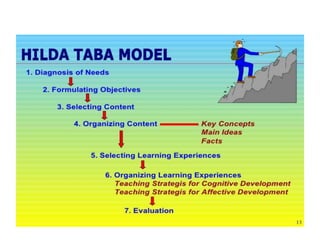
• The Taba Model : Taba took what is known as a
grass-roots approach to curriculum development.
She believed that the curriculum should be
designed by the teachers rather than handed down
by higher authority.
Further, she felt that teachers should begin the
process by creating teaching-learning units for
their students in their schools rather initially in
creating a general curriculum design.
Cont. Taba Model
 The Taba Model an inductive approach to
curriculum development, starting with
specifics and building up to a general
design
Ralph Tyler Model:
Four Basic Principle
• Purposes of the school
• Educational experiences related to the
purpose
• Organization of the experiences
• Evaluation of the experiences
Steps in Curriculum Development
Tyler’s Questions of Curriculum Development
will provide 4 steps:
• What educational purposes should the school
seek to attain?
• What educational experiences can be
provided that are likely to attain these
purposes?
• How can these educational experiences be
effectively organized?
• How can we determine whether these
purposes are being attained?
Curriculum Development cont.
• Some curriculum experts like Tyler say
that the steps are followed in a sequence
or a straight line.
• This model that assumes that curriculum
decision making follows a straight line is
called linear model
Curriculum Development cont.
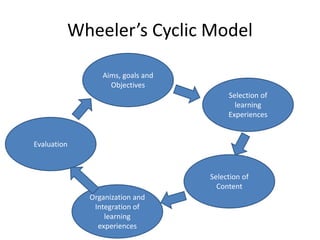
• Other scholars argue that curriculum
decision making is not a simple linear
process that necessarily starts with aims.
• One of them is Wheeler (1978) who
believes that curriculum decision making
can start from any point and can come
back to any of the points e.g. like a cycle
Cont. of Curriculum Development..
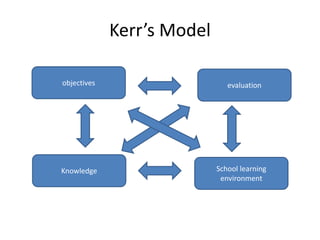
• Kerr (1968) also believes that curriculum
process is a very complex set of activities and
decisions and they interact a lot.
• Changes made in content may necessitate
changes in experiences, which may again bring
about changes in evaluation etc.
Kerr’s Model
objectives evaluation
Knowledge School learning
environment
Wheeler’s Cyclic Model
Evaluation
Aims, goals and
Objectives
Selection of
learning
Experiences
Selection of
Content
Organization and
Integration of
learning
experiences
Bibliography
• Curriculum Development: The Philippine
Experience.
• Garcia, Dolores (2007). Designing Curriculum.
Rex Book Store.
• Reyes, Flordeliza C. (2000). Engineering the
Curriculum. De La Salle University Press

Curriculum Models

  • 1.
  • 2.
    • It isdefined as the process of selecting, organizing, executing, and evaluating, learning experiences on the basis of the needs, abilities and interests of the learners and the nature of the society or community. Curriculum Development
  • 3.
    Models of CurriculumDevelopment • The Taba Model : Taba took what is known as a grass-roots approach to curriculum development. She believed that the curriculum should be designed by the teachers rather than handed down by higher authority. Further, she felt that teachers should begin the process by creating teaching-learning units for their students in their schools rather initially in creating a general curriculum design.
  • 4.
    Cont. Taba Model The Taba Model an inductive approach to curriculum development, starting with specifics and building up to a general design
  • 6.
    Ralph Tyler Model: FourBasic Principle • Purposes of the school • Educational experiences related to the purpose • Organization of the experiences • Evaluation of the experiences
  • 7.
    Steps in CurriculumDevelopment Tyler’s Questions of Curriculum Development will provide 4 steps: • What educational purposes should the school seek to attain? • What educational experiences can be provided that are likely to attain these purposes? • How can these educational experiences be effectively organized? • How can we determine whether these purposes are being attained?
  • 8.
    Curriculum Development cont. •Some curriculum experts like Tyler say that the steps are followed in a sequence or a straight line. • This model that assumes that curriculum decision making follows a straight line is called linear model
  • 9.
    Curriculum Development cont. •Other scholars argue that curriculum decision making is not a simple linear process that necessarily starts with aims. • One of them is Wheeler (1978) who believes that curriculum decision making can start from any point and can come back to any of the points e.g. like a cycle
  • 10.
    Cont. of CurriculumDevelopment.. • Kerr (1968) also believes that curriculum process is a very complex set of activities and decisions and they interact a lot. • Changes made in content may necessitate changes in experiences, which may again bring about changes in evaluation etc.
  • 11.
  • 12.
    Wheeler’s Cyclic Model Evaluation Aims,goals and Objectives Selection of learning Experiences Selection of Content Organization and Integration of learning experiences
  • 13.
    Bibliography • Curriculum Development:The Philippine Experience. • Garcia, Dolores (2007). Designing Curriculum. Rex Book Store. • Reyes, Flordeliza C. (2000). Engineering the Curriculum. De La Salle University Press