Introduction:
Gov’t elementary college for education
Qsaimabad,karachi
Name mahreen zafar khan &
erum Saba
Instructor Sir Afaq
Class B.Ed (Hons) 5th semester
Subject Curriculum Development
Date 8th may, 2016
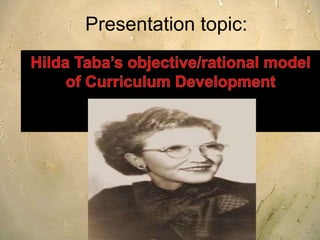
Presentation topic:
Hilda Taba
• Hilda Taba (7 December 1902 – 6 July 1967) was an
architect, a curriculum theorist, a curriculum reformer,
and a teacher educator.
• Taba was born in a small village in southeastern Estonia.
• Taba was a student of John Dewey;
• She wrote a book entitled Curriculum Development:
Theory and Practice (1962).
Hilda Taba’s definition of
curriculum
 A curriculum usually contains a
statement of aims and of specific
objectives; it indicates some selection and
organization of content.
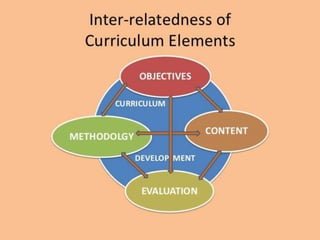
Curriculum development
Curriculum development can be defined
as the process of planning, implementing,
and evaluating curriculum that ultimately
results in a curriculum plan.
Curriculum models
Models:
Definition:
A simplified representation of reality which is
often depicted in diagrammatic form
Curriculum models
 One way of developing a curriculum plan is through
modeling. Models are essentially patterns that serve
as guidelines to action. Models can be found for
almost every form of educational activity.
 Models Are designed to provide a basis for decisions
regarding the selection, structuring and sequencing of the
educational experiences
Types of curriculum models
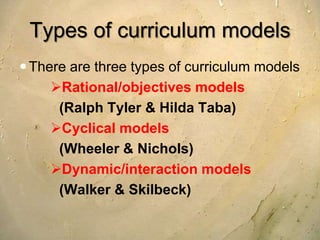
There are three types of curriculum models
Rational/objectives models
(Ralph Tyler & Hilda Taba)
Cyclical models
(Wheeler & Nichols)
Dynamic/interaction models
(Walker & Skilbeck)
A continuum of curriculum models
Rational/objectives models:
Ralph Tyler
Hilda Taba
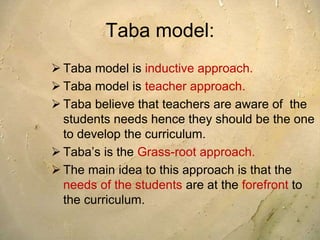
Taba model:
 Taba model is inductive approach.
 Taba model is teacher approach.
 Taba believe that teachers are aware of the
students needs hence they should be the one
to develop the curriculum.
 Taba’s is the Grass-root approach.
 The main idea to this approach is that the
needs of the students are at the forefront to
the curriculum.
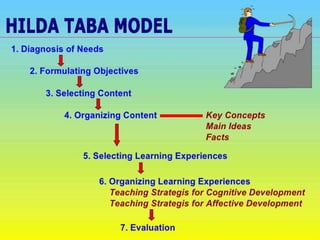
Taba’s model in diagrammatic form
1.Diagnosis of learners needs:
 Diagnose of achievement.
 Diagnosis of students as learner.
 Diagnosis of curriculum problems.
Systematic diagnosis process
 Problem identification
 Problem analysis
 Formulating hypothesis and gathering data.
 Experimenting with action
2.Principle of formulation of
.objectives:
 Objective should useful, cleared and
concreteness
 Objective should describe both kind of
behavior i.e. expected and content
 Objective should be realistic
 Scope of objective should be broad.
Formulation of learning
objectives.
Main objectives of education are:
 To add to knowledge they posses
 To enable them to perform skills which otherwise
they would not perform
 To develop certain understanding, insights and
appreciations.
 Development of healthy personality.
 Analysis of particular culture and society which
educational program serves.
3.Selection of content:
 Content should be rational base
 Validity and significance of content
 Consistency with social realities
 Appropriateness to the need and interest of
students
 Making proper distinctions between the various
levels of content
4.Organization of learning content
 Through the selection ,then determined
curriculum that prepared the order , so look at
the curriculum or what class it should be given .
5.Selection of the learning
experiences
 At this stage determined the learning
experiences of students in order to achieve
objectives of the curriculum .
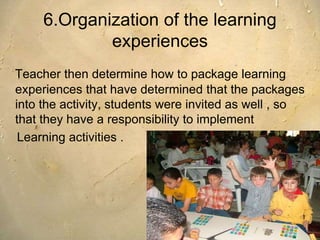
6.Organization of the learning
experiences
Teacher then determine how to package learning
experiences that have determined that the packages
into the activity, students were invited as well , so
that they have a responsibility to implement
Learning activities .
7. Determining the evaluation tools
and procedures to be students
 Plans need to be made for evaluation.
 How should the quality of learning be
evaluated to assure that the ends of
education are being achieved?
 How does one make sure that there is
consistency between the aims and
objectives and what is actually achieved by
students?
 Does the curriculum organization provide
experiences which offer optimum
opportunities for all varieties of learners to
attain independent goals?
Taba believed that: "To evolve a theory of
curriculum development and a method of
thinking about it, one needs to ask what
demands and requirements of culture and
society both are, both for the present and the
future. Curriculum is a way of preparing young
people to participate in our culture."
Application of the Taba model
 Taba model is currently used in most
curriculum designs.
 Identifying the needs of the students.
 Developing objectives
 Selecting instructional method
 Organizing learning experiences
 Evaluating
Strengths of Taba model:
 Gives teachers a greater role by not just making them
implementers of the curriculum but also developers.
 Uses the inductive method.
 Teacher approach is used.
 Notes that teachers are aware of the students’ needs
therefore they are the ones that should develop the
curriculum.
 Sees curriculum as a “plan for learning”.
 Gives importance to objectives in order to establish a
sense of purpose for deciding what to include, exclude
and emphasize in a curriculum.
Weakness of Taba’s model
 Not appealing to curriculum developer who
prefer global aspects of curriculum
 Can be difficult for non-gifted students to
grasp.
 Difficult for heterogeneous classrooms.
 Works well for fiction and non-fiction, may be
difficult to easily use in all subjects.
Tabamodel 140505014309-phpapp01

Tabamodel 140505014309-phpapp01

  • 2.
    Introduction: Gov’t elementary collegefor education Qsaimabad,karachi Name mahreen zafar khan & erum Saba Instructor Sir Afaq Class B.Ed (Hons) 5th semester Subject Curriculum Development Date 8th may, 2016
  • 3.
  • 4.
    Hilda Taba • HildaTaba (7 December 1902 – 6 July 1967) was an architect, a curriculum theorist, a curriculum reformer, and a teacher educator. • Taba was born in a small village in southeastern Estonia. • Taba was a student of John Dewey; • She wrote a book entitled Curriculum Development: Theory and Practice (1962).
  • 5.
    Hilda Taba’s definitionof curriculum  A curriculum usually contains a statement of aims and of specific objectives; it indicates some selection and organization of content.
  • 6.
    Curriculum development Curriculum developmentcan be defined as the process of planning, implementing, and evaluating curriculum that ultimately results in a curriculum plan.
  • 8.
    Curriculum models Models: Definition: A simplifiedrepresentation of reality which is often depicted in diagrammatic form
  • 9.
    Curriculum models  Oneway of developing a curriculum plan is through modeling. Models are essentially patterns that serve as guidelines to action. Models can be found for almost every form of educational activity.  Models Are designed to provide a basis for decisions regarding the selection, structuring and sequencing of the educational experiences
  • 10.
    Types of curriculummodels There are three types of curriculum models Rational/objectives models (Ralph Tyler & Hilda Taba) Cyclical models (Wheeler & Nichols) Dynamic/interaction models (Walker & Skilbeck)
  • 11.
    A continuum ofcurriculum models Rational/objectives models: Ralph Tyler Hilda Taba
  • 12.
    Taba model:  Tabamodel is inductive approach.  Taba model is teacher approach.  Taba believe that teachers are aware of the students needs hence they should be the one to develop the curriculum.  Taba’s is the Grass-root approach.  The main idea to this approach is that the needs of the students are at the forefront to the curriculum.
  • 13.
    Taba’s model indiagrammatic form
  • 14.
    1.Diagnosis of learnersneeds:  Diagnose of achievement.  Diagnosis of students as learner.  Diagnosis of curriculum problems. Systematic diagnosis process  Problem identification  Problem analysis  Formulating hypothesis and gathering data.  Experimenting with action
  • 15.
    2.Principle of formulationof .objectives:  Objective should useful, cleared and concreteness  Objective should describe both kind of behavior i.e. expected and content  Objective should be realistic  Scope of objective should be broad.
  • 16.
    Formulation of learning objectives. Mainobjectives of education are:  To add to knowledge they posses  To enable them to perform skills which otherwise they would not perform  To develop certain understanding, insights and appreciations.  Development of healthy personality.  Analysis of particular culture and society which educational program serves.
  • 17.
    3.Selection of content: Content should be rational base  Validity and significance of content  Consistency with social realities  Appropriateness to the need and interest of students  Making proper distinctions between the various levels of content
  • 18.
    4.Organization of learningcontent  Through the selection ,then determined curriculum that prepared the order , so look at the curriculum or what class it should be given .
  • 19.
    5.Selection of thelearning experiences  At this stage determined the learning experiences of students in order to achieve objectives of the curriculum .
  • 20.
    6.Organization of thelearning experiences Teacher then determine how to package learning experiences that have determined that the packages into the activity, students were invited as well , so that they have a responsibility to implement Learning activities .
  • 21.
    7. Determining theevaluation tools and procedures to be students  Plans need to be made for evaluation.  How should the quality of learning be evaluated to assure that the ends of education are being achieved?  How does one make sure that there is consistency between the aims and objectives and what is actually achieved by students?  Does the curriculum organization provide experiences which offer optimum opportunities for all varieties of learners to attain independent goals?
  • 22.
    Taba believed that:"To evolve a theory of curriculum development and a method of thinking about it, one needs to ask what demands and requirements of culture and society both are, both for the present and the future. Curriculum is a way of preparing young people to participate in our culture."
  • 23.
    Application of theTaba model  Taba model is currently used in most curriculum designs.  Identifying the needs of the students.  Developing objectives  Selecting instructional method  Organizing learning experiences  Evaluating
  • 24.
    Strengths of Tabamodel:  Gives teachers a greater role by not just making them implementers of the curriculum but also developers.  Uses the inductive method.  Teacher approach is used.  Notes that teachers are aware of the students’ needs therefore they are the ones that should develop the curriculum.  Sees curriculum as a “plan for learning”.  Gives importance to objectives in order to establish a sense of purpose for deciding what to include, exclude and emphasize in a curriculum.
  • 25.
    Weakness of Taba’smodel  Not appealing to curriculum developer who prefer global aspects of curriculum  Can be difficult for non-gifted students to grasp.  Difficult for heterogeneous classrooms.  Works well for fiction and non-fiction, may be difficult to easily use in all subjects.