Mr. Mahesh Chand
Nursing Tutor

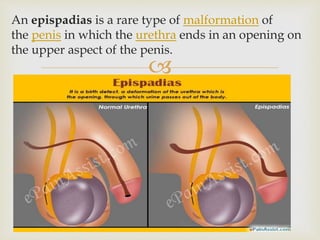
An epispadias is a rare type of malformation of
the penis in which the urethra ends in an opening on
the upper aspect of the penis.

 Unknown etiology
 Males are four times more likely to have epispadias
than females.
 Caucasian firstborn children are also more likely to
be born with this condition.
 1 in 70 chance of the child being born with this type
of congenital issue
Causes and Risk factors

 Penopubic epispadias: This is where the urinary
meatus is found close to the body, potentially not on
the penis but near the pubic bone at the base of the
penis.
 Penile epispadias: The urinary meatus is found on
the shaft of the penis, anywhere before the head of
the penis but above the base where the shaft meets
the body.
 Glanular epispadias: This is where the urinary
meatus is found on the head of the penis, but on the
top rather than in the standard location at the tip.
Types

 Dribbling of urine
 Uti
 Painful urination
 Hematuria
 Urgency and frequecny
Signs and symptoms

 History collection
 Physical examination
 urine tests,
 imaging studies including ultrasound or CT scans, X-
rays,
Diagnostic Tests

The Modified Cantwell Ransley Repair:
The modified Cantwell technique involves "rebuilding" the
penis. It takes some of the penis apart to move the urethra to
a more normal position.
The Mitchell Technique
 The Mitchell technique involves taking the penis apart
completely, then putting it back together. This is done so
the urethra is in the most functional and normal position,
and dorsal bend (chordee) is corrected.
Surgical Management

Epispadias

  • 1.
  • 2.
     An epispadias isa rare type of malformation of the penis in which the urethra ends in an opening on the upper aspect of the penis.
  • 3.
      Unknown etiology Males are four times more likely to have epispadias than females.  Caucasian firstborn children are also more likely to be born with this condition.  1 in 70 chance of the child being born with this type of congenital issue Causes and Risk factors
  • 4.
      Penopubic epispadias:This is where the urinary meatus is found close to the body, potentially not on the penis but near the pubic bone at the base of the penis.  Penile epispadias: The urinary meatus is found on the shaft of the penis, anywhere before the head of the penis but above the base where the shaft meets the body.  Glanular epispadias: This is where the urinary meatus is found on the head of the penis, but on the top rather than in the standard location at the tip. Types
  • 5.
      Dribbling ofurine  Uti  Painful urination  Hematuria  Urgency and frequecny Signs and symptoms
  • 6.
      History collection Physical examination  urine tests,  imaging studies including ultrasound or CT scans, X- rays, Diagnostic Tests
  • 7.
     The Modified CantwellRansley Repair: The modified Cantwell technique involves "rebuilding" the penis. It takes some of the penis apart to move the urethra to a more normal position. The Mitchell Technique  The Mitchell technique involves taking the penis apart completely, then putting it back together. This is done so the urethra is in the most functional and normal position, and dorsal bend (chordee) is corrected. Surgical Management