
Hypospadias
By: Abhay Rajpoot
INTRODUCTION
• Hypospadias is a birth defect (congenital condition) in which
the opening of the urethra is on the underside of the penis
instead of at the tip. The urethra is the tube through which
urine drains from your bladder and exits your body.
• Hypospadias is common and doesn't cause difficulty in caring
for your infant. Surgery usually restores the normal
appearance of your child's penis. With successful treatment
of hypospadias, most males can have normal urination and
reproduction.
DEFINITION
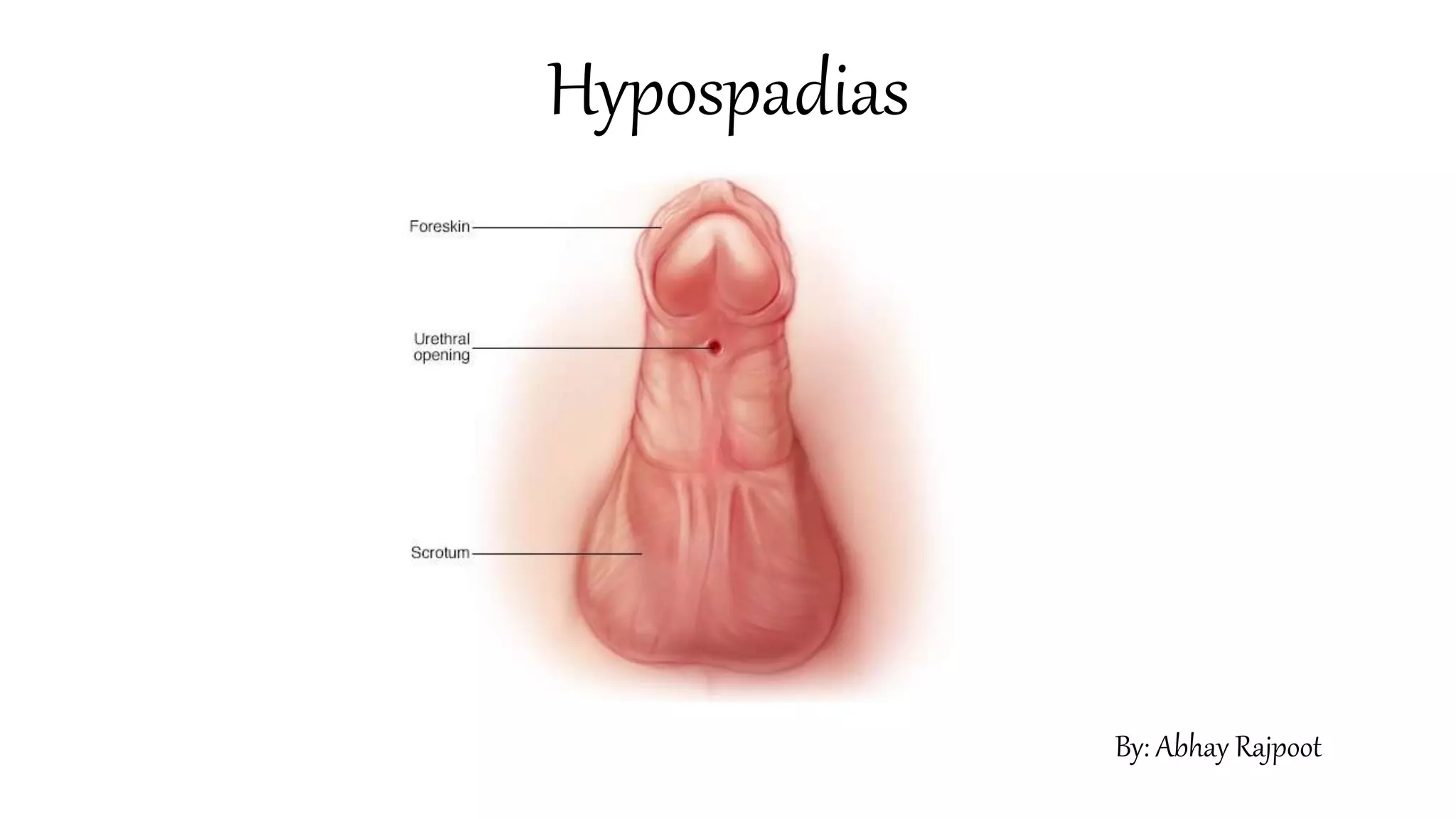
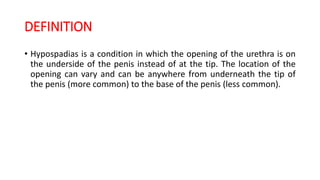
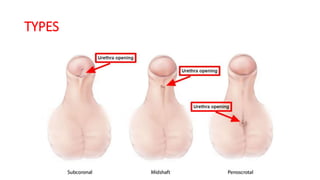
• Hypospadias is a condition in which the opening of the urethra is on
the underside of the penis instead of at the tip. The location of the
opening can vary and can be anywhere from underneath the tip of
the penis (more common) to the base of the penis (less common).
TYPES
RISK FACTORS
• Family history. This condition is more common in infants with a family history of
hypospadias.
• Genetics. Certain gene variations may play a role in disruption of the hormones
that stimulate formation of the male genitals.
• Maternal age over 35. Some research suggests that there may be an increased
risk of hypospadias in infant males born to women older than 35 years.
• Exposure to certain substances during pregnancy. There is some speculation
about an association between hypospadias and a mother's exposure to certain
hormones or certain compounds such as pesticides or industrial chemicals, but
further studies are needed to confirm this.
CAUSES
• Hypospadias is present at birth (congenital). As the penis develops in
a male fetus, certain hormones stimulate the formation of the urethra
and foreskin. Hypospadias results when a malfunction occurs in the
action of these hormones, causing the urethra to develop abnormally.
• In most cases, the exact cause of hypospadias is unknown.
Sometimes, hypospadias is genetic, but environment also may play a
role.
SIGNS AND SYMPTOMS
Signs and symptoms of hypospadias may include:
• Opening of the urethra at a location other than the tip of the penis
• Downward curve of the penis (chordee)
• Hooded appearance of the penis because only the top half of the
penis is covered by foreskin
• Abnormal spraying during urination
DIAGNOSTIC EVALUATION
• Physical examination
• History collection
• Imaging test
COMPLICATION
Complications
• If hypospadias is not treated, it can result in:
• Abnormal appearance of the penis
• Problems learning to use a toilet
• Abnormal curvature of the penis with erection
• Problems with impaired ejaculation
TREATMENT
• Some forms of hypospadias are very minor and do not require
surgery. However, treatment usually involves surgery to reposition the
urethral opening and, if necessary, straighten the shaft of the penis.
Surgery is usually done between the ages of 6 and 12 months.
• If the penis looks abnormal, circumcision should not be done. If
hypospadias is found during circumcision, the procedure should be
completed. In either case, referral to a pediatric urologist is
recommended.
SURGERY
• Most forms of hypospadias can be corrected in a single surgery that's
done on an outpatient basis. Some forms of hypospadias will require
more than one surgery to correct the defect.
• When the urethral opening is near the base of the penis, the surgeon
may need to use tissue grafts from the foreskin or from the inside of
the mouth to reconstruct the urinary channel in the proper position,
correcting the hypospadias.
Hypospadias

Hypospadias

  • 1.
  • 2.
    INTRODUCTION • Hypospadias isa birth defect (congenital condition) in which the opening of the urethra is on the underside of the penis instead of at the tip. The urethra is the tube through which urine drains from your bladder and exits your body. • Hypospadias is common and doesn't cause difficulty in caring for your infant. Surgery usually restores the normal appearance of your child's penis. With successful treatment of hypospadias, most males can have normal urination and reproduction.
  • 3.
    DEFINITION • Hypospadias isa condition in which the opening of the urethra is on the underside of the penis instead of at the tip. The location of the opening can vary and can be anywhere from underneath the tip of the penis (more common) to the base of the penis (less common).
  • 4.
  • 5.
    RISK FACTORS • Familyhistory. This condition is more common in infants with a family history of hypospadias. • Genetics. Certain gene variations may play a role in disruption of the hormones that stimulate formation of the male genitals. • Maternal age over 35. Some research suggests that there may be an increased risk of hypospadias in infant males born to women older than 35 years. • Exposure to certain substances during pregnancy. There is some speculation about an association between hypospadias and a mother's exposure to certain hormones or certain compounds such as pesticides or industrial chemicals, but further studies are needed to confirm this.
  • 6.
    CAUSES • Hypospadias ispresent at birth (congenital). As the penis develops in a male fetus, certain hormones stimulate the formation of the urethra and foreskin. Hypospadias results when a malfunction occurs in the action of these hormones, causing the urethra to develop abnormally. • In most cases, the exact cause of hypospadias is unknown. Sometimes, hypospadias is genetic, but environment also may play a role.
  • 7.
    SIGNS AND SYMPTOMS Signsand symptoms of hypospadias may include: • Opening of the urethra at a location other than the tip of the penis • Downward curve of the penis (chordee) • Hooded appearance of the penis because only the top half of the penis is covered by foreskin • Abnormal spraying during urination
  • 8.
    DIAGNOSTIC EVALUATION • Physicalexamination • History collection • Imaging test
  • 9.
    COMPLICATION Complications • If hypospadiasis not treated, it can result in: • Abnormal appearance of the penis • Problems learning to use a toilet • Abnormal curvature of the penis with erection • Problems with impaired ejaculation
  • 10.
    TREATMENT • Some formsof hypospadias are very minor and do not require surgery. However, treatment usually involves surgery to reposition the urethral opening and, if necessary, straighten the shaft of the penis. Surgery is usually done between the ages of 6 and 12 months. • If the penis looks abnormal, circumcision should not be done. If hypospadias is found during circumcision, the procedure should be completed. In either case, referral to a pediatric urologist is recommended.
  • 11.
    SURGERY • Most formsof hypospadias can be corrected in a single surgery that's done on an outpatient basis. Some forms of hypospadias will require more than one surgery to correct the defect. • When the urethral opening is near the base of the penis, the surgeon may need to use tissue grafts from the foreskin or from the inside of the mouth to reconstruct the urinary channel in the proper position, correcting the hypospadias.