ANO-RECTAL
MALFORMATIONS
MS. PRIYANKA J SOLANKI
ASSISTANT PROFESSOR
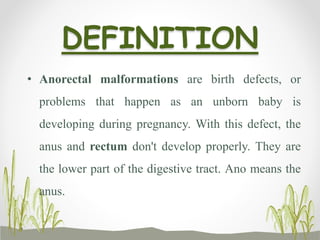
DEFINITION
• Anorectal malformations are birth defects, or
problems that happen as an unborn baby is
developing during pregnancy. With this defect, the
anus and rectum don't develop properly. They are
the lower part of the digestive tract. Ano means the
anus.
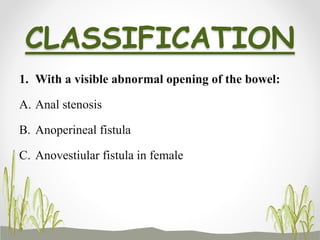
CLASSIFICATION
1. With a visible abnormal opening of the bowel:
A. Anal stenosis
B. Anoperineal fistula
C. Anovestiular fistula in female
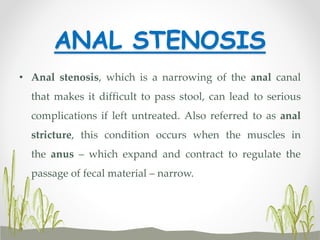
ANAL STENOSIS
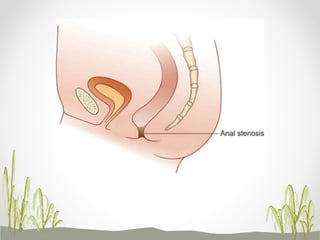
• Anal stenosis, which is a narrowing of the anal canal
that makes it difficult to pass stool, can lead to serious
complications if left untreated. Also referred to as anal
stricture, this condition occurs when the muscles in
the anus – which expand and contract to regulate the
passage of fecal material – narrow.
ANOPERINEAL FISTULA
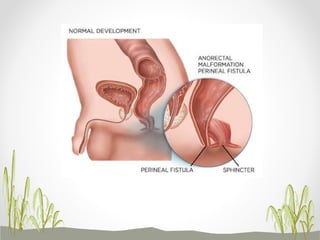
• A perineal fistula is a type of anorectal malformation
(ARM) that involves a misplaced anal passage that is
often narrowed. With a perineal fistula, the abnormal
anal opening is located outside of the sphincter muscle
complex, such that the fistula usually has very few
voluntary sphincter muscle fibers surrounding it.
ANOVESTIULAR
FISTULA
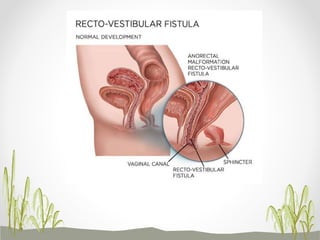
• A rectovestibular fistula, also referred to simply
as a vestibular fistula, is an anorectal congenital
disorder where an abnormal connection (fistula)
exists between the rectum and the vulval
vestibule of the female genitalia.
2. With an invisible but manifested opening of the bowel:
A. Rectovaginal fistula in female
B. Rectourethral fistula in male
C. Rectovesicular fistula
RECTOVAGINAL FISTULA
IN FEMALE
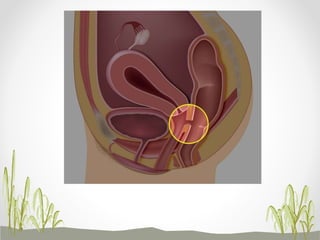
• A rectovaginal fistula is an abnormal connection
between the lower portion of large intestine — rectum
— and vagina. Bowel contents can leak through
the fistula, allowing gas or stool to pass through vagina.
RECTOURETHRAL
FISTULA IN MALE
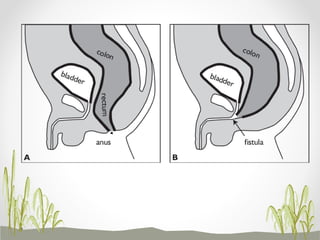
• A rectourethral fistula is an abnormal hole that forms
between the urethra and the rectum. In patients who
have a rectourethral fistula, problems can include
passage of urine through the rectum, repeated infections,
and swelling and discomfort in the pelvis.
RECTOVESICULAR
FISTULA
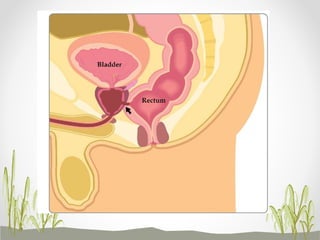
• A rectourethral fistula is an abnormal hole that forms
between the urethra and the rectum. In patients who
have a rectourethral fistula, problems can include
passage of urine through the rectum, repeated infections,
and swelling and discomfort in the pelvis.
3. No manifested opening of the bowel:
A. Persistent anal membranes
B. Rectal atresia
PERSISTENT ANAL
MEMBRANES
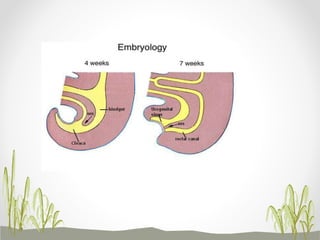
• Imperforate Anus. Imperforate anus, which occurs in 1 of
every 4000 to 5000 births, includes a spectrum of anal defects
that can range from a simple membrane covering
the anal opening (persistence of the cloacal membrane) to
atresia of various lengths of the anal canal, rectum, or both.
RECTAL ATRESIA
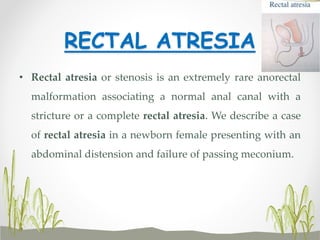
• Rectal atresia or stenosis is an extremely rare anorectal
malformation associating a normal anal canal with a
stricture or a complete rectal atresia. We describe a case
of rectal atresia in a newborn female presenting with an
abdominal distension and failure of passing meconium.
Diagnostic evaluation
• Physical examination of the neonates
• USG helps to locate the rectal pouch
• X-ray
• Examination of presence meconium and epithelial
debris
MANAGEMENT
• The reconstructive surgery is done to correct or repair the
congenital malformations. It depends upon the type of
anomalies and sex of infant.
• Rectal cut back anoplasty done in male and dilation of fistula
with definite repair or perineal anoplasty is performed in
female infants.
NURSING
MANAGEMENT
• Basic preoperative and postoperative care should be
provided as for abdominal surgery.
• Special interventions like; maintenance of warmth, fluid and
electrolyte balance, general stability of infant.
• Emotional support provided.
• Prevention fecal impaction, bowel habit training, and need
for medical help.
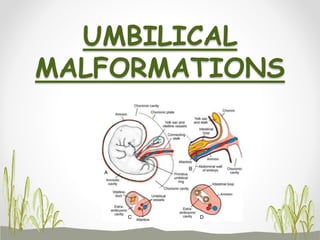
UMBILICAL
MALFORMATIONS
A. Abnormalities related to vitello-intestinal duct
B. Umbilical hernia
C. Examphalos and gastroschisis
Abnormalities Related To
Vitello-intestinal Duct
• Patent vitellointestinal duct: In some cases, the
connection to the intestines remains open. This is
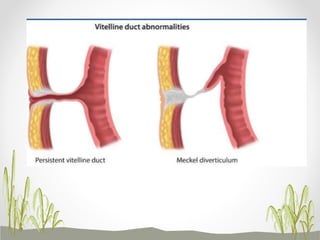
called a patent vitello-intestinal duct that drains
fecal matter at the umbilicus. This needs a surgical
procedure for correction wherein by an abdominal
operation the intestines are disconnected from the
umbilicus.
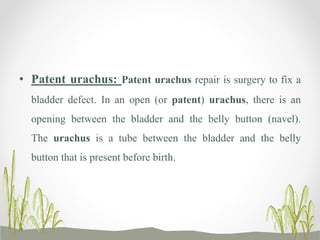
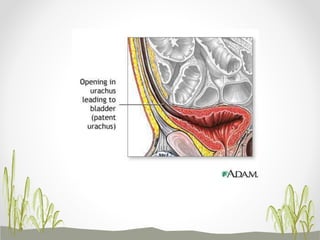
• Patent urachus: Patent urachus repair is surgery to fix a
bladder defect. In an open (or patent) urachus, there is an
opening between the bladder and the belly button (navel).
The urachus is a tube between the bladder and the belly
button that is present before birth.
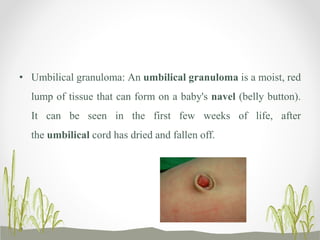
• Umbilical granuloma: An umbilical granuloma is a moist, red
lump of tissue that can form on a baby's navel (belly button).
It can be seen in the first few weeks of life, after
the umbilical cord has dried and fallen off.
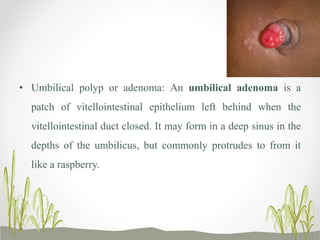
• Umbilical polyp or adenoma: An umbilical adenoma is a
patch of vitellointestinal epithelium left behind when the
vitellointestinal duct closed. It may form in a deep sinus in the
depths of the umbilicus, but commonly protrudes to from it
like a raspberry.
Umbilical hernia
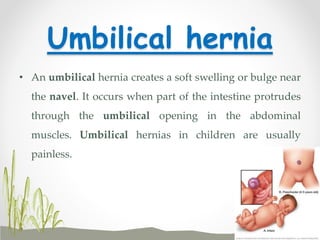
• An umbilical hernia creates a soft swelling or bulge near
the navel. It occurs when part of the intestine protrudes
through the umbilical opening in the abdominal
muscles. Umbilical hernias in children are usually
painless.
Exomphalos
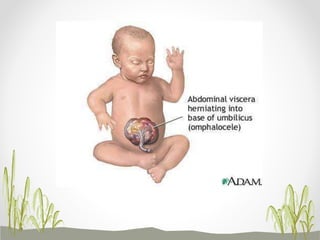
• Exomphalos is a weakness of the baby's abdominal wall
where the umbilical cord joins it. This weakness allows
the abdominal contents, mainly the bowel and the liver
to protrude outside the abdominal cavity where they are
contained in a loose sac that surrounds the umbilical
cord.
GASTROSCHISIS
• Gastroschisis is a birth defect of the abdominal (belly)
wall. The baby's intestines are found outside of the
baby's body, exiting through a hole beside the belly
button. The hole can be small or large and sometimes
other organs, such as the stomach and liver, can also be
found outside of the baby's body.
Anorectal malformation

Anorectal malformation

  • 1.
    ANO-RECTAL MALFORMATIONS MS. PRIYANKA JSOLANKI ASSISTANT PROFESSOR
  • 2.
    DEFINITION • Anorectal malformationsare birth defects, or problems that happen as an unborn baby is developing during pregnancy. With this defect, the anus and rectum don't develop properly. They are the lower part of the digestive tract. Ano means the anus.
  • 4.
    CLASSIFICATION 1. With avisible abnormal opening of the bowel: A. Anal stenosis B. Anoperineal fistula C. Anovestiular fistula in female
  • 5.
    ANAL STENOSIS • Analstenosis, which is a narrowing of the anal canal that makes it difficult to pass stool, can lead to serious complications if left untreated. Also referred to as anal stricture, this condition occurs when the muscles in the anus – which expand and contract to regulate the passage of fecal material – narrow.
  • 7.
    ANOPERINEAL FISTULA • Aperineal fistula is a type of anorectal malformation (ARM) that involves a misplaced anal passage that is often narrowed. With a perineal fistula, the abnormal anal opening is located outside of the sphincter muscle complex, such that the fistula usually has very few voluntary sphincter muscle fibers surrounding it.
  • 9.
    ANOVESTIULAR FISTULA • A rectovestibularfistula, also referred to simply as a vestibular fistula, is an anorectal congenital disorder where an abnormal connection (fistula) exists between the rectum and the vulval vestibule of the female genitalia.
  • 11.
    2. With aninvisible but manifested opening of the bowel: A. Rectovaginal fistula in female B. Rectourethral fistula in male C. Rectovesicular fistula
  • 12.
    RECTOVAGINAL FISTULA IN FEMALE •A rectovaginal fistula is an abnormal connection between the lower portion of large intestine — rectum — and vagina. Bowel contents can leak through the fistula, allowing gas or stool to pass through vagina.
  • 14.
    RECTOURETHRAL FISTULA IN MALE •A rectourethral fistula is an abnormal hole that forms between the urethra and the rectum. In patients who have a rectourethral fistula, problems can include passage of urine through the rectum, repeated infections, and swelling and discomfort in the pelvis.
  • 16.
    RECTOVESICULAR FISTULA • A rectourethralfistula is an abnormal hole that forms between the urethra and the rectum. In patients who have a rectourethral fistula, problems can include passage of urine through the rectum, repeated infections, and swelling and discomfort in the pelvis.
  • 18.
    3. No manifestedopening of the bowel: A. Persistent anal membranes B. Rectal atresia
  • 19.
    PERSISTENT ANAL MEMBRANES • ImperforateAnus. Imperforate anus, which occurs in 1 of every 4000 to 5000 births, includes a spectrum of anal defects that can range from a simple membrane covering the anal opening (persistence of the cloacal membrane) to atresia of various lengths of the anal canal, rectum, or both.
  • 21.
    RECTAL ATRESIA • Rectalatresia or stenosis is an extremely rare anorectal malformation associating a normal anal canal with a stricture or a complete rectal atresia. We describe a case of rectal atresia in a newborn female presenting with an abdominal distension and failure of passing meconium.
  • 22.
    Diagnostic evaluation • Physicalexamination of the neonates • USG helps to locate the rectal pouch • X-ray • Examination of presence meconium and epithelial debris
  • 23.
    MANAGEMENT • The reconstructivesurgery is done to correct or repair the congenital malformations. It depends upon the type of anomalies and sex of infant. • Rectal cut back anoplasty done in male and dilation of fistula with definite repair or perineal anoplasty is performed in female infants.
  • 24.
    NURSING MANAGEMENT • Basic preoperativeand postoperative care should be provided as for abdominal surgery. • Special interventions like; maintenance of warmth, fluid and electrolyte balance, general stability of infant. • Emotional support provided. • Prevention fecal impaction, bowel habit training, and need for medical help.
  • 25.
  • 26.
    A. Abnormalities relatedto vitello-intestinal duct B. Umbilical hernia C. Examphalos and gastroschisis
  • 27.
    Abnormalities Related To Vitello-intestinalDuct • Patent vitellointestinal duct: In some cases, the connection to the intestines remains open. This is called a patent vitello-intestinal duct that drains fecal matter at the umbilicus. This needs a surgical procedure for correction wherein by an abdominal operation the intestines are disconnected from the umbilicus.
  • 29.
    • Patent urachus:Patent urachus repair is surgery to fix a bladder defect. In an open (or patent) urachus, there is an opening between the bladder and the belly button (navel). The urachus is a tube between the bladder and the belly button that is present before birth.
  • 31.
    • Umbilical granuloma:An umbilical granuloma is a moist, red lump of tissue that can form on a baby's navel (belly button). It can be seen in the first few weeks of life, after the umbilical cord has dried and fallen off.
  • 32.
    • Umbilical polypor adenoma: An umbilical adenoma is a patch of vitellointestinal epithelium left behind when the vitellointestinal duct closed. It may form in a deep sinus in the depths of the umbilicus, but commonly protrudes to from it like a raspberry.
  • 33.
    Umbilical hernia • Anumbilical hernia creates a soft swelling or bulge near the navel. It occurs when part of the intestine protrudes through the umbilical opening in the abdominal muscles. Umbilical hernias in children are usually painless.
  • 34.
    Exomphalos • Exomphalos isa weakness of the baby's abdominal wall where the umbilical cord joins it. This weakness allows the abdominal contents, mainly the bowel and the liver to protrude outside the abdominal cavity where they are contained in a loose sac that surrounds the umbilical cord.
  • 36.
    GASTROSCHISIS • Gastroschisis isa birth defect of the abdominal (belly) wall. The baby's intestines are found outside of the baby's body, exiting through a hole beside the belly button. The hole can be small or large and sometimes other organs, such as the stomach and liver, can also be found outside of the baby's body.