Prof. Mrs. Kavitha.P
Vice Principal
SUBJECT:
MEDICAL SURGICAL NURSING-II
UNIT NO:3
NURSING MANAGEMENT OF PATIENT WITH
NEUROLOGICAL DISORDERS
TOPIC:
GUILLAIN BARRE SYNDROME(GBS)
INTRODUCTION
 Acute onset infection
 Monophasic immune mediated polyneuropathy
 Rapid progressive motor paralysis
 Affects people of all ages and is not hereditary
 Post infectious disease
 It can follow by systemic infections
 Auto immune in nature
OBJECTIVES
At the end of the class, the students are able to
 review anatomy and physiology of Neuron
 define Guillain Barre Syndrome
 state the incidence of Guillain Barre Syndrome
 enlist the causes and risk factors of Guillain Barre
Syndrome
 explain the types of Guillain Barre Syndrome
 narrate the pathophysiology of Guillain Barre
Syndrome.
CONT….
 state the clinical manifestations of Guillain Barre
Syndrome
 enlist the diagnostic measures of Guillain Barre
Syndrome
 state the complications of Guillain Barre Syndrome
 enumerate the management of patient with Guillain
Barre Syndrome
 explain the nursing management of patient with
Guillain Barre Syndrome
NEURON
DEFINITION
• It is a rapidly progressing
and potentially fatal form
of polyneuritis.
• It affects the peripheral
nervous system and
results in loss of myelin
and edema and
Inflammation of affected
nerves causing a loss of
neuro transmission to the
periphery.
OTHER TERMS
 Acute inflammatory demyelinating poly
radiculopathy (AIDP)
 Acute idiopathic poly radiculo neuritis
 Acute idiopathic neuritis
 French polio
 Landry Guillain Barre Syndrome
INCIDENCE
 The annual incidence of GBS ranges from
0.5-1.5 cases from 1,00,000 population.
 Mostly affected group are individuals less than
18 yrs.
 Males are appear to be great risk than females.
CAUSES
• Unknown
 Auto immune disease triggered by
 Bacterial- Campylobacter jejuni, Mycoplasma
pneumoniae
 Virus- Ebstein barr virus, Cytomegalo virus
 Skipping vaccination against Flu, Rabies,
Meningitis
PHASES
Progressive phase:
worsening symptoms-4weeks
73% reach lowest point of clinical function at 1 week
98% at 4 weeks,30% ventilatory assistance
20% mortality rate.
Plateau phase: persistent unchanging
symptoms days
CONT…
Recovery: Improvement in symptoms &
functioning
• 85% full and functional recovery with in 6-12
months
• Maximal by 18 months past onset
• Relapse occurs in 3-5% patients
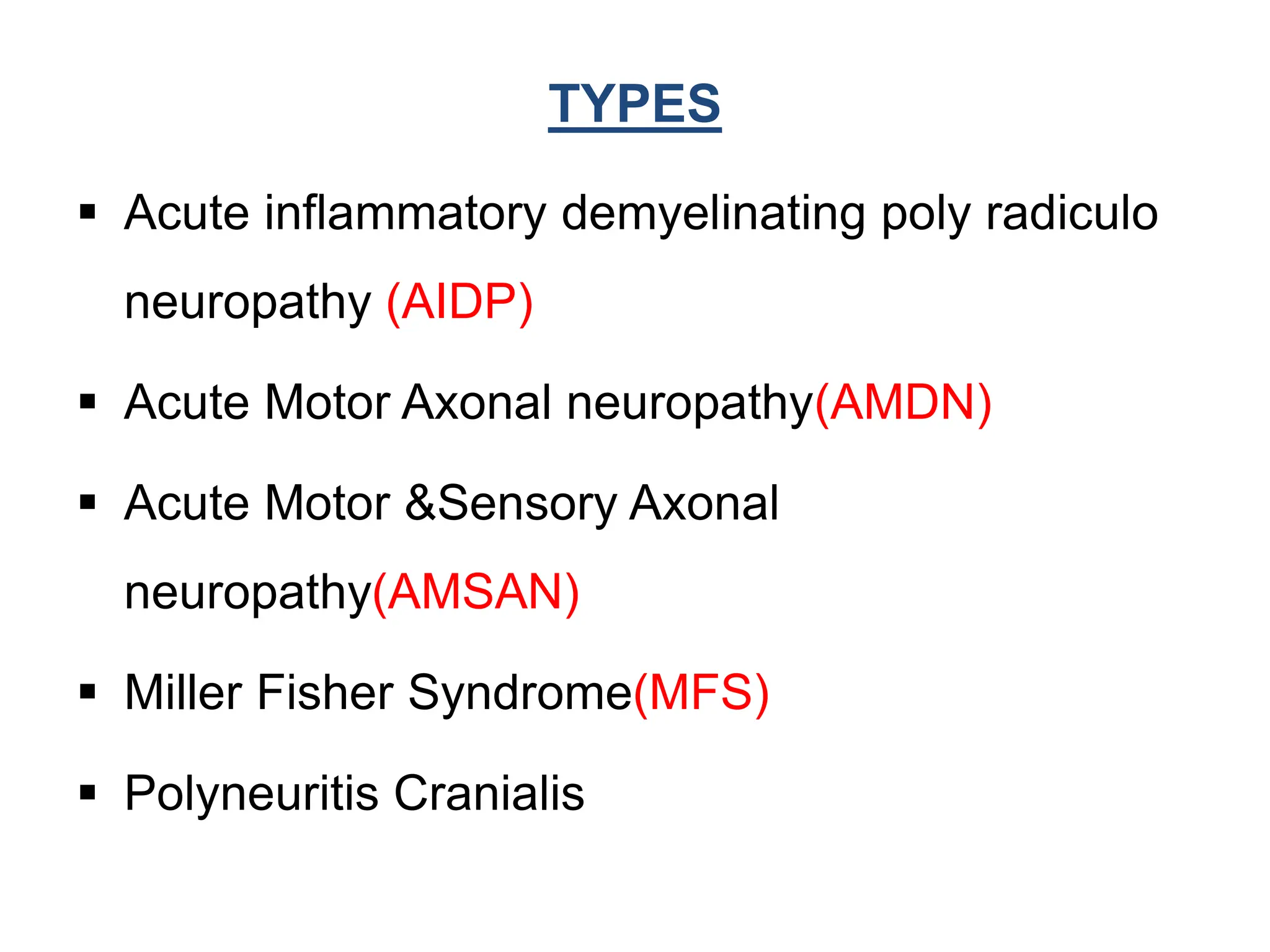
TYPES
 Acute inflammatory demyelinating poly radiculo
neuropathy (AIDP)
 Acute Motor Axonal neuropathy(AMDN)
 Acute Motor &Sensory Axonal
neuropathy(AMSAN)
 Miller Fisher Syndrome(MFS)
 Polyneuritis Cranialis
ACUTE INFLAMMATORY DEMYELINATING
POLY RADICULO NEUROPATHY (AIDP)
 80-90%cases of GBS are in this type.
 Immune mediated attack of myelin with infiltration of
lymphocytes and macrophages with segmental
stripping of myelin. Motor and sensory fibres are
affected.
ACUTE MOTOR AXONAL
NEUROPATHY(AMDN)
 Axonal degeneration occurs after an immune
attack with in 1-2 weeks after infection.
 Specific antibodies to axonal membranes of
motor fibres attack the nodes of Ranvier.
This in turns activates compliment system and
intrusion of macrophages in to periaxonal spaces
to cause axon destruction.
ACUTE MOTOR AND SENSORY AXONAL
NEUROPATHY(AMSDN)
 This type is rare resembles AMAN except
sensory nerves are also affected.
 This type is associated with a severe course and
poor prognosis.
.
MILLER FISHER SYNDROME (MFS)
 This involvement of CN’s is very distinct in the
form of GBS.
Oculomotor nerves (Oculo motor, Trochlear and
abducens)are affected and produce a triad of
Ophthalmoplegia, Ataxia. Areflexia.
POLY NEURITIS CRANIALIS
This is an acute onset of multiple Cranial nerve
palsies.
Usually Bilateral Cranial nerve VII With sparing
of Cranial nerves 1,2.
Elevated CSF protein
Slowed nerve conduction velocity
PATHOPHYSIOLOGY
Organisms /Trauma
Gangliosidosis-1 enters the nerves
and nodes of Ranvier
Anti GB1ab as a part of molecular mimicry
Complement mediated injury at para nodal
axon-glial junction
Disrupts the cluster of sodium channels
Conduction block
CLINICAL MANIFESTATIONS
 1-3 weeks after an upper respiratory or gastro
intestinal infection.
 There will be weakness of the lower extremities
(evolving more or less symmetrical)
 It occurs over hours to days to weeks
 It usually peaks on the 14th day
CONT….
• Paresthesia is frequent followed by paralysis
in the extremities
• Hypotonia
• Areflexia
• Objective sensory loses variable with deep
sensitivity in superficial sensations
CONT….
• Autonomic dysfunctions include orthostatic
hypotension
• Hypertension
• Abnormal vagal responses
• Bowel and bladder dysfunction
• Facial flushing
• Diaphoresis
• Syndrome of inappropriate anti diuretic hormone
CONT..
Progression of Guillain barre syndrome
include lower brain stem that involves the
 Facial Nerve
 Abducens Nerve
 Oculo Motor Nerve
• Hypoglossal Nerve
• Trigeminal Nerve
• Vagus Nerve
• Pain Is a common symptom and It becomes worse
at Night.
DIAGNOSTIC EVALUATION
 History collection
 Neurological examination
• First 48hrs -Cerebro spinal
fluid is normal, after that it
shows a low protein content.
• After 7-10 days it is elevated to
700mg/dl (normal 15-45 mg/dl).
CONT…
 CSF: Normally Fewer 10 leukocytes but occasionally
elevated .
 Electromyography
 Nerve conduction studies
 Lumbosacral MRI
 Serum Anti Ganglioside Antibodies
COMPLICATIONS
 Cardiac arrhythmias
 Respiratory failures
 Dys autonomia
 Pneumonia
 Adult Respiratory Distress Syndrome
 Septicemia
• Death
TREATMENT
• On set to two weeks: Plasma pheresis (40-50 ml/kg
four times a week
• After two weeks: intravenous administration of high
dose immunoglobulin (Sandoglobulin)
• Beyond three weeks: plasma exchange and
immunoglobulin therapies
• Chest Physiotherapy
• Artificial ventilation-Maintain Gas Exchange
NURSING DIAGNOSIS
• Impaired spontaneous ventilation related to
progression of disease process resulting in respiratory
muscle paralysis
• Acute pain related to paresthesias, muscle aches,
cramps and hyperesthesia
• Impaired verbal communication related to intubation or
paralysis of muscles of speech
• Self care deficit related to inability to use muscles to
accomplish activities of daily living
NURSING MANAGEMENT
• assess the ascending paralysis, respiratory function,
arterial blood gases, gag, corneal and swallowing
reflexes ,monitor blood pressure and heart rate
• perform bronchial hygiene and chest physiotherapy
• perform intermittent catheterization
• perform range of motion exercise
• provide artificial tears and moisturizers
• provide intravenous fluids
REFERENCES
Books:
• Hasper, Fauci, Hauzer et.al, (2015)“Harrison’s Principles of
Internal Medicine” Published by Mc Grew hills companies,
19th Edition.
• Brunner& Suddarth’s(2013),Textbook of Medical-Surgical
Nursing”. Published by Lippincott Williams & Wilkins, 6th
Edition.
Web sources:
• http://brain foundation.org.au/disorders/guillain barre syndrome
• www.betterhealth.vic.gov.au/health/conditionsandtreatment
/guillain barre syndrome.
AN-MSN II 09.6.2020AN-GUILLAIN BARRE SYNDROME.pptx

AN-MSN II 09.6.2020AN-GUILLAIN BARRE SYNDROME.pptx

  • 1.
    Prof. Mrs. Kavitha.P VicePrincipal SUBJECT: MEDICAL SURGICAL NURSING-II UNIT NO:3 NURSING MANAGEMENT OF PATIENT WITH NEUROLOGICAL DISORDERS TOPIC: GUILLAIN BARRE SYNDROME(GBS)
  • 2.
    INTRODUCTION  Acute onsetinfection  Monophasic immune mediated polyneuropathy  Rapid progressive motor paralysis  Affects people of all ages and is not hereditary  Post infectious disease  It can follow by systemic infections  Auto immune in nature
  • 3.
    OBJECTIVES At the endof the class, the students are able to  review anatomy and physiology of Neuron  define Guillain Barre Syndrome  state the incidence of Guillain Barre Syndrome  enlist the causes and risk factors of Guillain Barre Syndrome  explain the types of Guillain Barre Syndrome  narrate the pathophysiology of Guillain Barre Syndrome.
  • 4.
    CONT….  state theclinical manifestations of Guillain Barre Syndrome  enlist the diagnostic measures of Guillain Barre Syndrome  state the complications of Guillain Barre Syndrome  enumerate the management of patient with Guillain Barre Syndrome  explain the nursing management of patient with Guillain Barre Syndrome
  • 5.
  • 6.
    DEFINITION • It isa rapidly progressing and potentially fatal form of polyneuritis. • It affects the peripheral nervous system and results in loss of myelin and edema and Inflammation of affected nerves causing a loss of neuro transmission to the periphery.
  • 7.
    OTHER TERMS  Acuteinflammatory demyelinating poly radiculopathy (AIDP)  Acute idiopathic poly radiculo neuritis  Acute idiopathic neuritis  French polio  Landry Guillain Barre Syndrome
  • 8.
    INCIDENCE  The annualincidence of GBS ranges from 0.5-1.5 cases from 1,00,000 population.  Mostly affected group are individuals less than 18 yrs.  Males are appear to be great risk than females.
  • 9.
    CAUSES • Unknown  Autoimmune disease triggered by  Bacterial- Campylobacter jejuni, Mycoplasma pneumoniae  Virus- Ebstein barr virus, Cytomegalo virus  Skipping vaccination against Flu, Rabies, Meningitis
  • 10.
    PHASES Progressive phase: worsening symptoms-4weeks 73%reach lowest point of clinical function at 1 week 98% at 4 weeks,30% ventilatory assistance 20% mortality rate. Plateau phase: persistent unchanging symptoms days
  • 11.
    CONT… Recovery: Improvement insymptoms & functioning • 85% full and functional recovery with in 6-12 months • Maximal by 18 months past onset • Relapse occurs in 3-5% patients
  • 12.
    TYPES  Acute inflammatorydemyelinating poly radiculo neuropathy (AIDP)  Acute Motor Axonal neuropathy(AMDN)  Acute Motor &Sensory Axonal neuropathy(AMSAN)  Miller Fisher Syndrome(MFS)  Polyneuritis Cranialis
  • 13.
    ACUTE INFLAMMATORY DEMYELINATING POLYRADICULO NEUROPATHY (AIDP)  80-90%cases of GBS are in this type.  Immune mediated attack of myelin with infiltration of lymphocytes and macrophages with segmental stripping of myelin. Motor and sensory fibres are affected.
  • 14.
    ACUTE MOTOR AXONAL NEUROPATHY(AMDN) Axonal degeneration occurs after an immune attack with in 1-2 weeks after infection.  Specific antibodies to axonal membranes of motor fibres attack the nodes of Ranvier. This in turns activates compliment system and intrusion of macrophages in to periaxonal spaces to cause axon destruction.
  • 15.
    ACUTE MOTOR ANDSENSORY AXONAL NEUROPATHY(AMSDN)  This type is rare resembles AMAN except sensory nerves are also affected.  This type is associated with a severe course and poor prognosis. .
  • 16.
    MILLER FISHER SYNDROME(MFS)  This involvement of CN’s is very distinct in the form of GBS. Oculomotor nerves (Oculo motor, Trochlear and abducens)are affected and produce a triad of Ophthalmoplegia, Ataxia. Areflexia.
  • 17.
    POLY NEURITIS CRANIALIS Thisis an acute onset of multiple Cranial nerve palsies. Usually Bilateral Cranial nerve VII With sparing of Cranial nerves 1,2. Elevated CSF protein Slowed nerve conduction velocity
  • 18.
    PATHOPHYSIOLOGY Organisms /Trauma Gangliosidosis-1 entersthe nerves and nodes of Ranvier Anti GB1ab as a part of molecular mimicry Complement mediated injury at para nodal axon-glial junction Disrupts the cluster of sodium channels Conduction block
  • 19.
    CLINICAL MANIFESTATIONS  1-3weeks after an upper respiratory or gastro intestinal infection.  There will be weakness of the lower extremities (evolving more or less symmetrical)  It occurs over hours to days to weeks  It usually peaks on the 14th day
  • 20.
    CONT…. • Paresthesia isfrequent followed by paralysis in the extremities • Hypotonia • Areflexia • Objective sensory loses variable with deep sensitivity in superficial sensations
  • 21.
    CONT…. • Autonomic dysfunctionsinclude orthostatic hypotension • Hypertension • Abnormal vagal responses • Bowel and bladder dysfunction • Facial flushing • Diaphoresis • Syndrome of inappropriate anti diuretic hormone
  • 22.
    CONT.. Progression of Guillainbarre syndrome include lower brain stem that involves the  Facial Nerve  Abducens Nerve  Oculo Motor Nerve • Hypoglossal Nerve • Trigeminal Nerve • Vagus Nerve • Pain Is a common symptom and It becomes worse at Night.
  • 23.
    DIAGNOSTIC EVALUATION  Historycollection  Neurological examination • First 48hrs -Cerebro spinal fluid is normal, after that it shows a low protein content. • After 7-10 days it is elevated to 700mg/dl (normal 15-45 mg/dl).
  • 24.
    CONT…  CSF: NormallyFewer 10 leukocytes but occasionally elevated .  Electromyography  Nerve conduction studies  Lumbosacral MRI  Serum Anti Ganglioside Antibodies
  • 25.
    COMPLICATIONS  Cardiac arrhythmias Respiratory failures  Dys autonomia  Pneumonia  Adult Respiratory Distress Syndrome  Septicemia • Death
  • 26.
    TREATMENT • On setto two weeks: Plasma pheresis (40-50 ml/kg four times a week • After two weeks: intravenous administration of high dose immunoglobulin (Sandoglobulin) • Beyond three weeks: plasma exchange and immunoglobulin therapies • Chest Physiotherapy • Artificial ventilation-Maintain Gas Exchange
  • 27.
    NURSING DIAGNOSIS • Impairedspontaneous ventilation related to progression of disease process resulting in respiratory muscle paralysis • Acute pain related to paresthesias, muscle aches, cramps and hyperesthesia • Impaired verbal communication related to intubation or paralysis of muscles of speech • Self care deficit related to inability to use muscles to accomplish activities of daily living
  • 28.
    NURSING MANAGEMENT • assessthe ascending paralysis, respiratory function, arterial blood gases, gag, corneal and swallowing reflexes ,monitor blood pressure and heart rate • perform bronchial hygiene and chest physiotherapy • perform intermittent catheterization • perform range of motion exercise • provide artificial tears and moisturizers • provide intravenous fluids
  • 29.
    REFERENCES Books: • Hasper, Fauci,Hauzer et.al, (2015)“Harrison’s Principles of Internal Medicine” Published by Mc Grew hills companies, 19th Edition. • Brunner& Suddarth’s(2013),Textbook of Medical-Surgical Nursing”. Published by Lippincott Williams & Wilkins, 6th Edition. Web sources: • http://brain foundation.org.au/disorders/guillain barre syndrome • www.betterhealth.vic.gov.au/health/conditionsandtreatment /guillain barre syndrome.