OCCUPATIONAL SKIN
DISORDERS
EPIDEMIOLOGY
• Occupational dermatoses have accounted for 20% of all the cases of occupational diseases in the
Czech Republic.
• irritant or allergic contact dermatitis = the most frequent occupation-related skin diseases,
• physical and biological agents may occur, either as the final phase of a long-standing skin disorder or as
the fast manifestation of prolonged occupational exposure,
• cutaneous manifestations of toxic substances which produce their more serious dramatic effects on other
organ systems.
The industries with greatest probability of causing occupation-related skin disease are
• leather goods,
• adhesive and sealant,
• abrasive products,
• health professions.
• food processing and packing,
• boat building and repair,
• agriculture and horticulture,
THE DIAGNOSTIC CRITERIA TO BE USED INCLUDE:
1. A physical appearance and patterns of clinical reactions and distribution should
conform with those known to be induces by chemical, physical, or biologic agents.
2. A history of exposure to a suspected hazardous agent known to induce the patterns of a pathological
response observed.
3. A logical relation between the suspected exposure and the onset of a dermatologic
reaction.
4. Removal from avoidance of the suspected environmental agent(s) results in regression of the
skin disease or injury as in the case of irritant or allergic contact dermatitis or a drug eruption.
5. Historical and clinical evidence can be supported by diagnostic tests such as patch tests in the
case of allergic contact dermatitis or positive findings on microbiologic examination for bacteria or
fungi.
6. A biopsy of active lesions to determine histologic characteristics may demonstrate pathogenic
changes to support a clinical diagnosis, or a biopsy may contribute little to ascertaining a specific diagnosis.
1. OCCUPATIONAL DERMATITIS
• Over 80% of occupational dermatoses is contact dermatitis. Of this about 80% are due to
irritant exposure to allergens-sensitizers (allergic contact dermatitis).
• Both irritant contact dermatitis and allergic contact dermatitis present in a similar fashion, with initial
lesions in exposed areas of the skin (soaked clothing or failure to wash hands before urinating
may cause atypical distributions), and initial erythema and vesiculation followed by
chronic scaling, fissuring and lichenification.
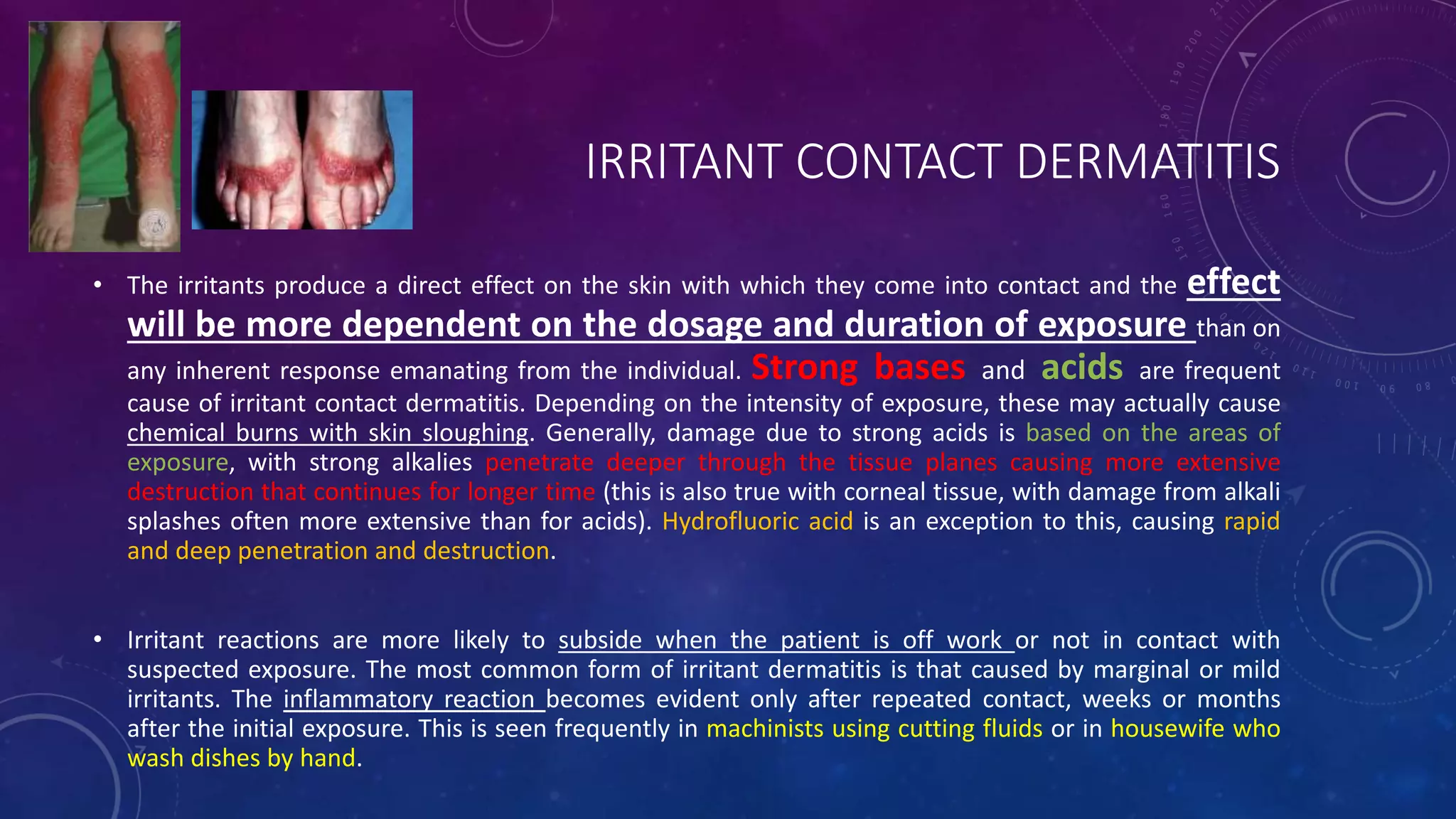
IRRITANT CONTACT DERMATITIS
• The irritants produce a direct effect on the skin with which they come into contact and the effect
will be more dependent on the dosage and duration of exposure than on
any inherent response emanating from the individual. Strong bases and acids are frequent
cause of irritant contact dermatitis. Depending on the intensity of exposure, these may actually cause
chemical burns with skin sloughing. Generally, damage due to strong acids is based on the areas of
exposure, with strong alkalies penetrate deeper through the tissue planes causing more extensive
destruction that continues for longer time (this is also true with corneal tissue, with damage from alkali
splashes often more extensive than for acids). Hydrofluoric acid is an exception to this, causing rapid
and deep penetration and destruction.
• Irritant reactions are more likely to subside when the patient is off work or not in contact with
suspected exposure. The most common form of irritant dermatitis is that caused by marginal or mild
irritants. The inflammatory reaction becomes evident only after repeated contact, weeks or months
after the initial exposure. This is seen frequently in machinists using cutting fluids or in housewife who
wash dishes by hand.
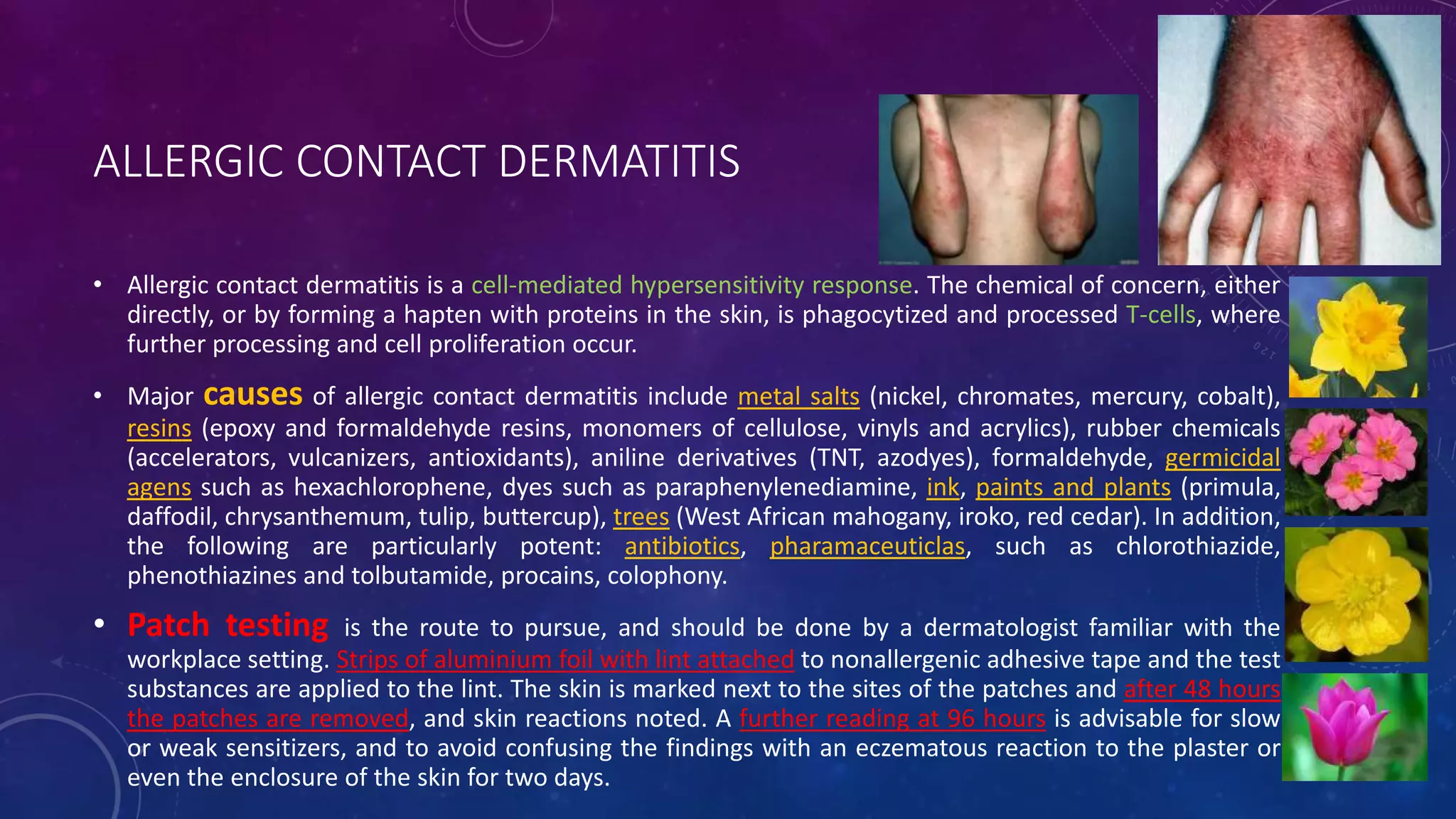
ALLERGIC CONTACT DERMATITIS
• Allergic contact dermatitis is a cell-mediated hypersensitivity response. The chemical of concern, either
directly, or by forming a hapten with proteins in the skin, is phagocytized and processed T-cells, where
further processing and cell proliferation occur.
• Major causes of allergic contact dermatitis include metal salts (nickel, chromates, mercury, cobalt),
resins (epoxy and formaldehyde resins, monomers of cellulose, vinyls and acrylics), rubber chemicals
(accelerators, vulcanizers, antioxidants), aniline derivatives (TNT, azodyes), formaldehyde, germicidal
agens such as hexachlorophene, dyes such as paraphenylenediamine, ink, paints and plants (primula,
daffodil, chrysanthemum, tulip, buttercup), trees (West African mahogany, iroko, red cedar). In addition,
the following are particularly potent: antibiotics, pharamaceuticlas, such as chlorothiazide,
phenothiazines and tolbutamide, procains, colophony.
• Patch testing is the route to pursue, and should be done by a dermatologist familiar with the
workplace setting. Strips of aluminium foil with lint attached to nonallergenic adhesive tape and the test
substances are applied to the lint. The skin is marked next to the sites of the patches and after 48 hours
the patches are removed, and skin reactions noted. A further reading at 96 hours is advisable for slow
or weak sensitizers, and to avoid confusing the findings with an eczematous reaction to the plaster or
even the enclosure of the skin for two days.
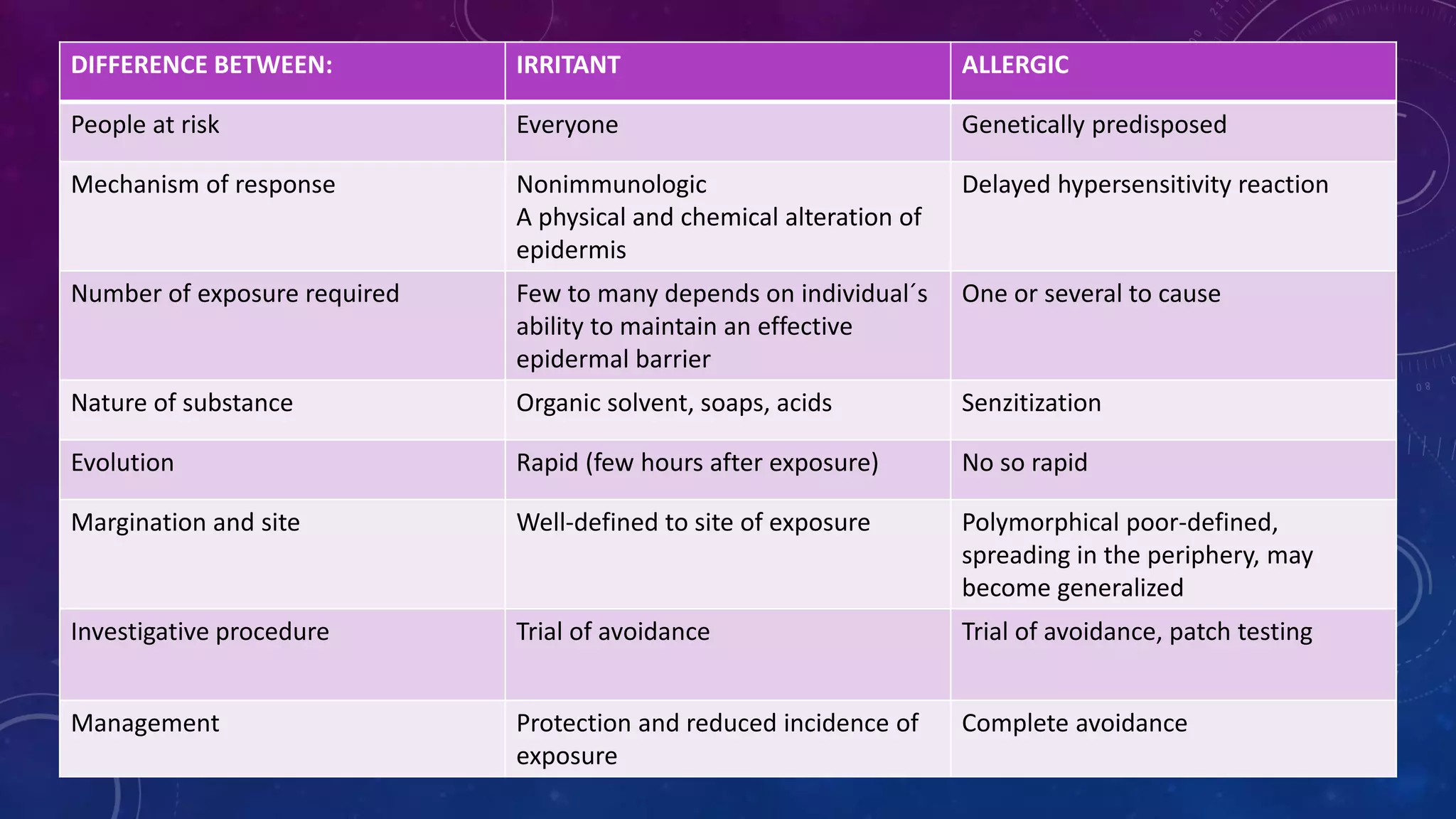
DIFFERENCE BETWEEN: IRRITANT ALLERGIC
People at risk Everyone Genetically predisposed
Mechanism of response Nonimmunologic
A physical and chemical alteration of
epidermis
Delayed hypersensitivity reaction
Number of exposure required Few to many depends on individual´s
ability to maintain an effective
epidermal barrier
One or several to cause
Nature of substance Organic solvent, soaps, acids Senzitization
Evolution Rapid (few hours after exposure) No so rapid
Margination and site Well-defined to site of exposure Polymorphical poor-defined,
spreading in the periphery, may
become generalized
Investigative procedure Trial of avoidance Trial of avoidance, patch testing
Management Protection and reduced incidence of
exposure
Complete avoidance
2. OCCUPATIONAL CUTANEOUS INFECTIONS
• Skin infection caused by contact with infectious agents is known to occur in many occupations.
• Bacteria: Erysipelothrix rhusiopathiae –˃ erysipeloid (meat handlers, farmers, veterinarians,
fishermen),
• Viruses: Paravaccinia virus –˃ milker´s nodules (milkers, farmers, veterinarians),
• Fungi: Trichophyton, Microsporium –˃ dermatophytoses (animal handlers, ranchers, health
professions); Candida albicalns and other Candida sp. –˃ candidiasis (food workers, health-care
workers); Actinomyces, Nocardia (agricultural workers),
• Parasites: Sarcoptes scabiei –˃ scabies (health care workers, teachers).
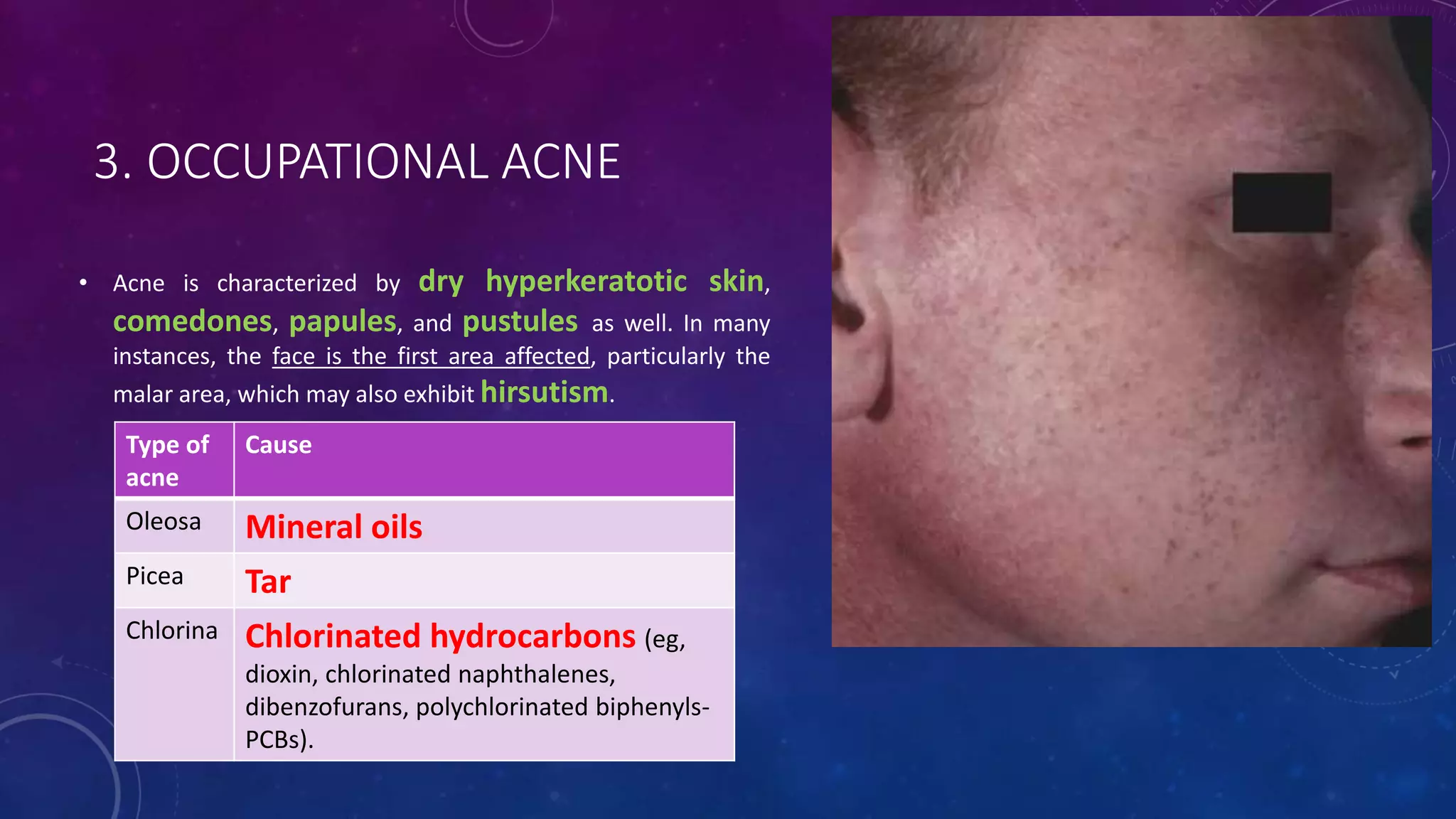
3. OCCUPATIONAL ACNE
• Acne is characterized by dry hyperkeratotic skin,
comedones, papules, and pustules as well. In many
instances, the face is the first area affected, particularly the
malar area, which may also exhibit hirsutism.
Type of
acne
Cause
Oleosa Mineral oils
Picea Tar
Chlorina Chlorinated hydrocarbons (eg,
dioxin, chlorinated naphthalenes,
dibenzofurans, polychlorinated biphenyls-
PCBs).
4. CUTANEOUS MALIGNANCY
• Skin cancer is the most common type of human cancer.
• There are essentially three types: epidermal-basal and squamous-cell carcinomas-
sarcomas affecting mesodermal elements in the dermis- and melanomas (Malignant melanoma
develops from pigment-forming cell.).
• Actinic radiation or the sunburn ray is the principal cause of skin cancer in humans. The
critical factors are intensity of ultraviolet radiation at 290 to 320 nm and the duration and frequency of
exposures.
• Occupations with significant exposure are outdoor workers (farmers, fishermen, sailors, etc.).
• Skin exposure to ionizing radiation may be accidental, occupational, or therapeutic or from possible military
uses. Excessive exposure to ionizing radiation will cause burns, necrosis, teleangiectasis, atrophy of all of the
skin elements, scarring and cancer.
• Occupational exposure to polycyclic hydrocarbons such as are found in fossil fuels and
derivates in coal tar will five rise to keratosis and epidermal skin cancer. Occupational arsenic
exposure may cause multiple superficial basal cell tumors on nonexposed areas that tend to be thin, flat
lesions referred to as superficial basal cell carcinomas.
VARIETY OF MELANOMA SKIN LESIONS
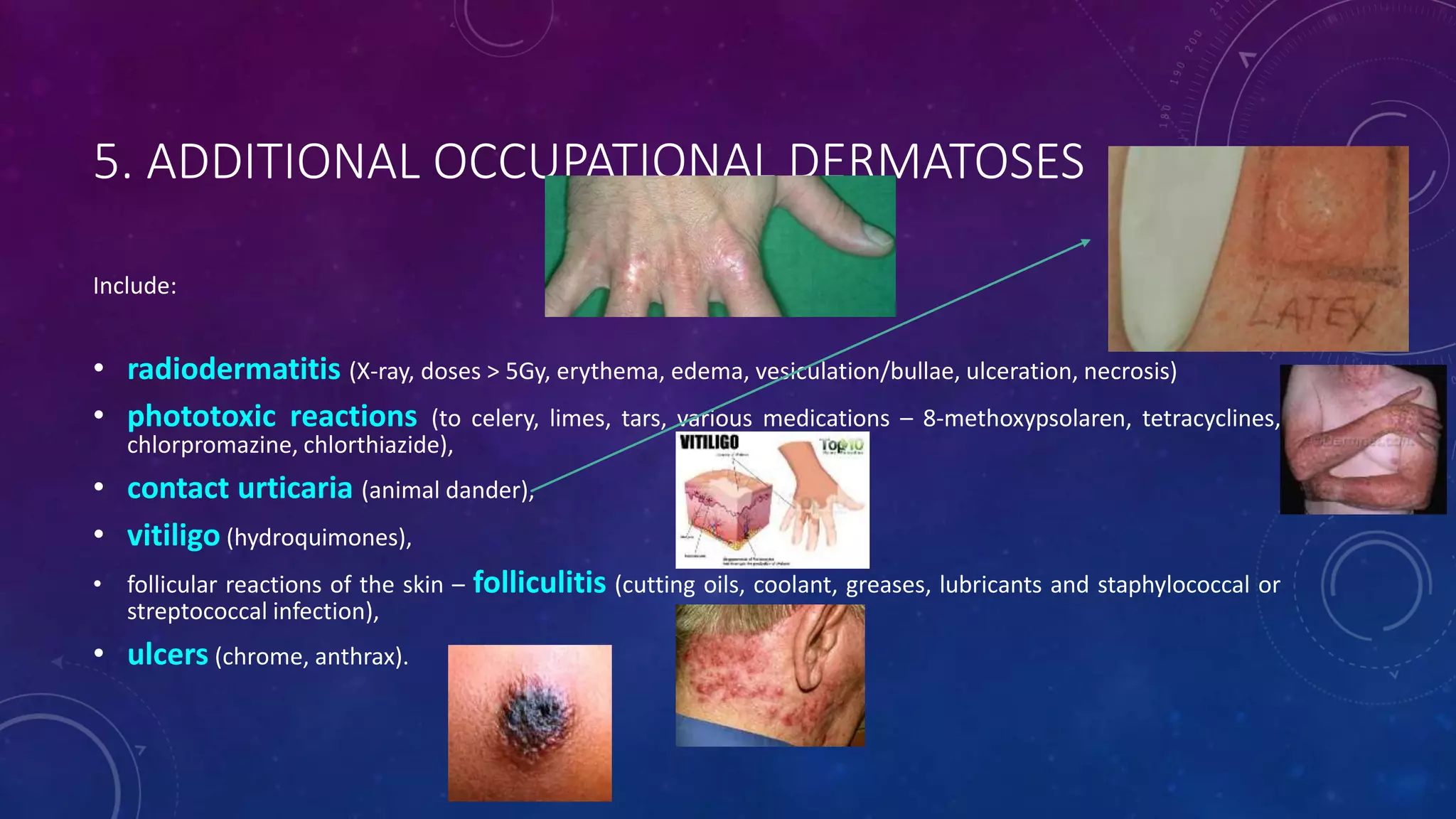
Include:
• radiodermatitis (X-ray, doses > 5Gy, erythema, edema, vesiculation/bullae, ulceration, necrosis)
• phototoxic reactions (to celery, limes, tars, various medications – 8-methoxypsolaren, tetracyclines,
chlorpromazine, chlorthiazide),
• contact urticaria (animal dander),
• vitiligo (hydroquimones),
• follicular reactions of the skin – folliculitis (cutting oils, coolant, greases, lubricants and staphylococcal or
streptococcal infection),
• ulcers (chrome, anthrax).
5. ADDITIONAL OCCUPATIONAL DERMATOSES
SOURCES
• https://is.muni.cz/auth/el/1411/jaro2016/VLVL9X66c/um/58148858/occupational_disorders.pdf
• https://atlases.muni.cz/atlases/kuze/atl_cz/sect_main.html
• http://www.slideshare.net/daulatramdhaked/allergic-and-irritant-contact-dermatitis
• Pictures:
• http://www.dermnet.com/
• http://www.dermnetnz.org/
• http://zdravi.e15.cz/

Occupational_dermatoses.ppt

  • 1.
  • 2.
    EPIDEMIOLOGY • Occupational dermatoseshave accounted for 20% of all the cases of occupational diseases in the Czech Republic. • irritant or allergic contact dermatitis = the most frequent occupation-related skin diseases, • physical and biological agents may occur, either as the final phase of a long-standing skin disorder or as the fast manifestation of prolonged occupational exposure, • cutaneous manifestations of toxic substances which produce their more serious dramatic effects on other organ systems.
  • 3.
    The industries withgreatest probability of causing occupation-related skin disease are • leather goods, • adhesive and sealant, • abrasive products, • health professions. • food processing and packing, • boat building and repair, • agriculture and horticulture,
  • 4.
    THE DIAGNOSTIC CRITERIATO BE USED INCLUDE: 1. A physical appearance and patterns of clinical reactions and distribution should conform with those known to be induces by chemical, physical, or biologic agents. 2. A history of exposure to a suspected hazardous agent known to induce the patterns of a pathological response observed. 3. A logical relation between the suspected exposure and the onset of a dermatologic reaction. 4. Removal from avoidance of the suspected environmental agent(s) results in regression of the skin disease or injury as in the case of irritant or allergic contact dermatitis or a drug eruption. 5. Historical and clinical evidence can be supported by diagnostic tests such as patch tests in the case of allergic contact dermatitis or positive findings on microbiologic examination for bacteria or fungi. 6. A biopsy of active lesions to determine histologic characteristics may demonstrate pathogenic changes to support a clinical diagnosis, or a biopsy may contribute little to ascertaining a specific diagnosis.
  • 5.
    1. OCCUPATIONAL DERMATITIS •Over 80% of occupational dermatoses is contact dermatitis. Of this about 80% are due to irritant exposure to allergens-sensitizers (allergic contact dermatitis). • Both irritant contact dermatitis and allergic contact dermatitis present in a similar fashion, with initial lesions in exposed areas of the skin (soaked clothing or failure to wash hands before urinating may cause atypical distributions), and initial erythema and vesiculation followed by chronic scaling, fissuring and lichenification.
  • 6.
    IRRITANT CONTACT DERMATITIS •The irritants produce a direct effect on the skin with which they come into contact and the effect will be more dependent on the dosage and duration of exposure than on any inherent response emanating from the individual. Strong bases and acids are frequent cause of irritant contact dermatitis. Depending on the intensity of exposure, these may actually cause chemical burns with skin sloughing. Generally, damage due to strong acids is based on the areas of exposure, with strong alkalies penetrate deeper through the tissue planes causing more extensive destruction that continues for longer time (this is also true with corneal tissue, with damage from alkali splashes often more extensive than for acids). Hydrofluoric acid is an exception to this, causing rapid and deep penetration and destruction. • Irritant reactions are more likely to subside when the patient is off work or not in contact with suspected exposure. The most common form of irritant dermatitis is that caused by marginal or mild irritants. The inflammatory reaction becomes evident only after repeated contact, weeks or months after the initial exposure. This is seen frequently in machinists using cutting fluids or in housewife who wash dishes by hand.
  • 7.
    ALLERGIC CONTACT DERMATITIS •Allergic contact dermatitis is a cell-mediated hypersensitivity response. The chemical of concern, either directly, or by forming a hapten with proteins in the skin, is phagocytized and processed T-cells, where further processing and cell proliferation occur. • Major causes of allergic contact dermatitis include metal salts (nickel, chromates, mercury, cobalt), resins (epoxy and formaldehyde resins, monomers of cellulose, vinyls and acrylics), rubber chemicals (accelerators, vulcanizers, antioxidants), aniline derivatives (TNT, azodyes), formaldehyde, germicidal agens such as hexachlorophene, dyes such as paraphenylenediamine, ink, paints and plants (primula, daffodil, chrysanthemum, tulip, buttercup), trees (West African mahogany, iroko, red cedar). In addition, the following are particularly potent: antibiotics, pharamaceuticlas, such as chlorothiazide, phenothiazines and tolbutamide, procains, colophony. • Patch testing is the route to pursue, and should be done by a dermatologist familiar with the workplace setting. Strips of aluminium foil with lint attached to nonallergenic adhesive tape and the test substances are applied to the lint. The skin is marked next to the sites of the patches and after 48 hours the patches are removed, and skin reactions noted. A further reading at 96 hours is advisable for slow or weak sensitizers, and to avoid confusing the findings with an eczematous reaction to the plaster or even the enclosure of the skin for two days.
  • 8.
    DIFFERENCE BETWEEN: IRRITANTALLERGIC People at risk Everyone Genetically predisposed Mechanism of response Nonimmunologic A physical and chemical alteration of epidermis Delayed hypersensitivity reaction Number of exposure required Few to many depends on individual´s ability to maintain an effective epidermal barrier One or several to cause Nature of substance Organic solvent, soaps, acids Senzitization Evolution Rapid (few hours after exposure) No so rapid Margination and site Well-defined to site of exposure Polymorphical poor-defined, spreading in the periphery, may become generalized Investigative procedure Trial of avoidance Trial of avoidance, patch testing Management Protection and reduced incidence of exposure Complete avoidance
  • 9.
    2. OCCUPATIONAL CUTANEOUSINFECTIONS • Skin infection caused by contact with infectious agents is known to occur in many occupations. • Bacteria: Erysipelothrix rhusiopathiae –˃ erysipeloid (meat handlers, farmers, veterinarians, fishermen), • Viruses: Paravaccinia virus –˃ milker´s nodules (milkers, farmers, veterinarians), • Fungi: Trichophyton, Microsporium –˃ dermatophytoses (animal handlers, ranchers, health professions); Candida albicalns and other Candida sp. –˃ candidiasis (food workers, health-care workers); Actinomyces, Nocardia (agricultural workers), • Parasites: Sarcoptes scabiei –˃ scabies (health care workers, teachers).
  • 10.
    3. OCCUPATIONAL ACNE •Acne is characterized by dry hyperkeratotic skin, comedones, papules, and pustules as well. In many instances, the face is the first area affected, particularly the malar area, which may also exhibit hirsutism. Type of acne Cause Oleosa Mineral oils Picea Tar Chlorina Chlorinated hydrocarbons (eg, dioxin, chlorinated naphthalenes, dibenzofurans, polychlorinated biphenyls- PCBs).
  • 11.
    4. CUTANEOUS MALIGNANCY •Skin cancer is the most common type of human cancer. • There are essentially three types: epidermal-basal and squamous-cell carcinomas- sarcomas affecting mesodermal elements in the dermis- and melanomas (Malignant melanoma develops from pigment-forming cell.). • Actinic radiation or the sunburn ray is the principal cause of skin cancer in humans. The critical factors are intensity of ultraviolet radiation at 290 to 320 nm and the duration and frequency of exposures. • Occupations with significant exposure are outdoor workers (farmers, fishermen, sailors, etc.). • Skin exposure to ionizing radiation may be accidental, occupational, or therapeutic or from possible military uses. Excessive exposure to ionizing radiation will cause burns, necrosis, teleangiectasis, atrophy of all of the skin elements, scarring and cancer. • Occupational exposure to polycyclic hydrocarbons such as are found in fossil fuels and derivates in coal tar will five rise to keratosis and epidermal skin cancer. Occupational arsenic exposure may cause multiple superficial basal cell tumors on nonexposed areas that tend to be thin, flat lesions referred to as superficial basal cell carcinomas.
  • 12.
    VARIETY OF MELANOMASKIN LESIONS
  • 13.
    Include: • radiodermatitis (X-ray,doses > 5Gy, erythema, edema, vesiculation/bullae, ulceration, necrosis) • phototoxic reactions (to celery, limes, tars, various medications – 8-methoxypsolaren, tetracyclines, chlorpromazine, chlorthiazide), • contact urticaria (animal dander), • vitiligo (hydroquimones), • follicular reactions of the skin – folliculitis (cutting oils, coolant, greases, lubricants and staphylococcal or streptococcal infection), • ulcers (chrome, anthrax). 5. ADDITIONAL OCCUPATIONAL DERMATOSES
  • 14.
    SOURCES • https://is.muni.cz/auth/el/1411/jaro2016/VLVL9X66c/um/58148858/occupational_disorders.pdf • https://atlases.muni.cz/atlases/kuze/atl_cz/sect_main.html •http://www.slideshare.net/daulatramdhaked/allergic-and-irritant-contact-dermatitis • Pictures: • http://www.dermnet.com/ • http://www.dermnetnz.org/ • http://zdravi.e15.cz/