Emergency and
Disaster Nursing
Mr Prakash S
INTRODUCTION
 Disaster are not confined to a particular part of the world; they
can occur any where and any time.
 Integral part of human experiences since beginning of the time,
which creates all kind of losses to the individual.
 French word “DISASTRE” and Italian word “DISASTRO” which
means “Bad star”
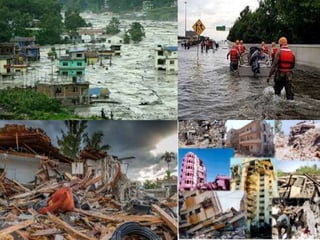
 India has been traditionally vulnerable to natural disasters on
account of its unique geo-climatic conditions. Floods, droughts,
cyclones, earthquakes and landslides have been recurrent
phenomena.
 About 60% of the landmass is prone to earthquakes of various
intensities; over 40 million hectares is prone to floods; about
8% of the total area is prone to cyclones and 68% of the area is
susceptible to drought.
 A disaster may have the following main features:-
a) Unpredictability
b) Unfamiliarity
c) Speed
d) Urgency
e) Uncertainty
f) Threat
INCIDENCE REPORTS
 July 2019 : flooding in Bihar
 August, 2019: Massive landslide at Kerala.
 August, 2019: flooding in Karnataka
 May 2019: Cyclone storm Fani in Odisha
 June 2020: Cyclone Nisarga in western coast of India
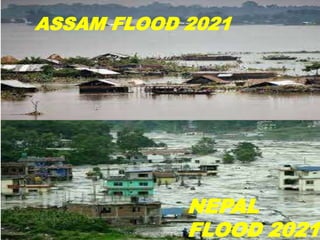
 June 2021: landslides and floods in Nepal
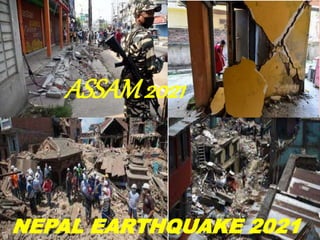
 May 2021: earthquake in Assam
ASSAM2021
NEPAL EARTHQUAKE 2021
ASSAM FLOOD 2021
NEPAL
FLOOD 2021
DEFINITION
 Any occurrence that cause damage ecological disruption, loss of
human life, deterioration of health and health services on a scale
sufficient to warrant an extra ordinary response from the outside
community or area
By: WHO
 Disaster may be termed as “a serious disruption of the functioning
of society, causing widespread human, material or environmental
losses which exceed the ability of the affected society to cope
using its own resources”.
By: Lakhwinder Kaur
 D = Destructions
 I = Incidents
 S = Sufferings
 A = Administrative, financial failures
 S = Sentiments
 T = Tragedies
 E = Eruption of communicable diseases
 R = Research programme and its implementation
HUMAN INDUCED/
MAN-MADE DISASTER
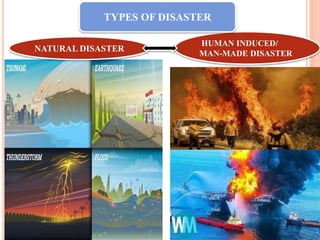
TYPES OF DISASTER
NATURAL DISASTER
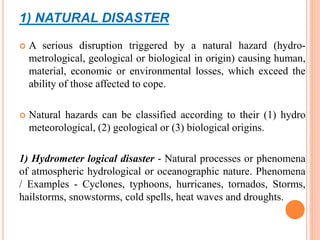
1) NATURAL DISASTER
 A serious disruption triggered by a natural hazard (hydro-
metrological, geological or biological in origin) causing human,
material, economic or environmental losses, which exceed the
ability of those affected to cope.
 Natural hazards can be classified according to their (1) hydro
meteorological, (2) geological or (3) biological origins.
1) Hydrometer logical disaster - Natural processes or phenomena
of atmospheric hydrological or oceanographic nature. Phenomena
/ Examples - Cyclones, typhoons, hurricanes, tornados, Storms,
hailstorms, snowstorms, cold spells, heat waves and droughts.
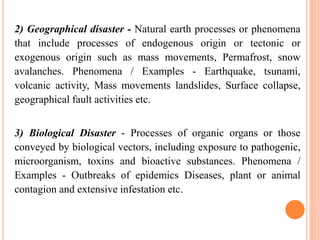
2) Geographical disaster - Natural earth processes or phenomena
that include processes of endogenous origin or tectonic or
exogenous origin such as mass movements, Permafrost, snow
avalanches. Phenomena / Examples - Earthquake, tsunami,
volcanic activity, Mass movements landslides, Surface collapse,
geographical fault activities etc.
3) Biological Disaster - Processes of organic organs or those
conveyed by biological vectors, including exposure to pathogenic,
microorganism, toxins and bioactive substances. Phenomena /
Examples - Outbreaks of epidemics Diseases, plant or animal
contagion and extensive infestation etc.
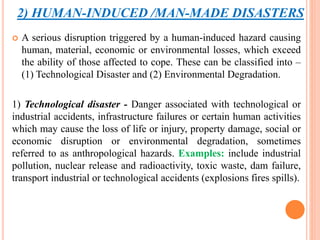
2) HUMAN-INDUCED /MAN-MADE DISASTERS
 A serious disruption triggered by a human-induced hazard causing
human, material, economic or environmental losses, which exceed
the ability of those affected to cope. These can be classified into –
(1) Technological Disaster and (2) Environmental Degradation.
1) Technological disaster - Danger associated with technological or
industrial accidents, infrastructure failures or certain human activities
which may cause the loss of life or injury, property damage, social or
economic disruption or environmental degradation, sometimes
referred to as anthropological hazards. Examples: include industrial
pollution, nuclear release and radioactivity, toxic waste, dam failure,
transport industrial or technological accidents (explosions fires spills).
2) Environmental Degradation - Processes induced by human
behaviors and activities that damage the natural resources base
on adversely alter nature processes or ecosystems. Potentials
effects are varied and may contribute to the increase in
vulnerability, frequency and the intensity of natural hazards.
Examples: include land degradation, deforestation,
desertification, wild land fire, loss of biodiversity, land, water
and air pollution climate change, sea level rise and ozone
depletion.
DISASTER NURSING
Disaster nursing is defined as the adaptation of professional
nursing skills in recognizing and meeting nursing physical
and emotional needs resulting from disaster.
“Disaster nursing is nursing practiced in a situation where
professional supplies, equipment, physical facilities and
utilities are limited or not available”
GOALS OF THE DISASTER NURSING
 To meet the immediate basic survival needs of populations
affected by disasters.
 To identify the potential for a secondary disaster.
 To appraise both risks and resources in the environment.
 To correct inequalities in access to health care or appropriate
resources.
 To empower survivors to participate in and advocate for their
own health and well being.
 To respect cultural, lingual, and religious diversity in
individuals and families and to apply this principle in all health
promotion activities.
 To promote the highest achievable quality of life for survivors.
PRINCIPLES OF DISASTER NURSING
 Rapid assessment of the situation and of nursing care needs.
 Triage and initiation of life saving measures first.
 Apply 3 cardinal rules: Assess respiration, stop heamorrhage and
care of shock.
 The selected use of essential nursing interventions and the
elimination of nonessential nursing activities.
 Evaluation of the environment and the mitigation or removal of
any health hazards.
 Prevention of further injury or illness.
 Leadership in coordinating patient triage, care, and transport
during times of crisis.
 The teaching, supervision, and utilization of auxiliary medical
personnel and volunteers.
 Provision of understanding, compassion and emotional support
to all victims and their families.
FACTORS AFFECTING DISASTER
1. HOST FACTORS
the host factors include:
a) Age
b) Immunization status
c) Degree of mobility
d) Emotional stability
2. ENVIRONMENTAL FACTORS
a) Physical factors
b) Chemical factors
c) Biological factors
d) Social factors
e) Psychological factors
HEALTH EFFECTS OF DISASTERS
 Disasters may cause premature deaths, illnesses, and injuries.
 Disasters may destroy the local health care infrastructure.
 Disasters may affect the psychological, emotional, and social well
being of the population in the affected community.
 Disasters may cause shortages of food and cause severe nutritional
deficiencies.
 Disasters may create large population movements(refugees).
 Disasters may create environmental imbalances, increasing the risk of
communicable diseases and environmental hazards.
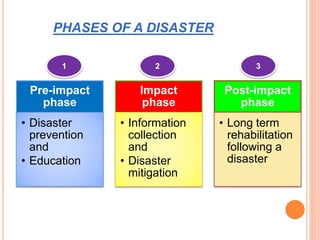
PHASES OF A DISASTER
Pre-impact
phase
• Disaster
prevention
and
• Education
Impact
phase
• Information
collection
and
• Disaster
mitigation
Post-impact
phase
• Long term
rehabilitation
following a
disaster
1 3
2
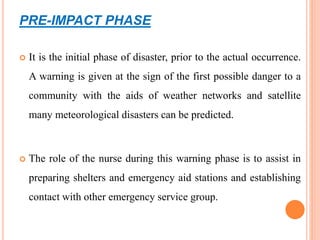
PRE-IMPACT PHASE
 It is the initial phase of disaster, prior to the actual occurrence.
A warning is given at the sign of the first possible danger to a
community with the aids of weather networks and satellite
many meteorological disasters can be predicted.
 The role of the nurse during this warning phase is to assist in
preparing shelters and emergency aid stations and establishing
contact with other emergency service group.
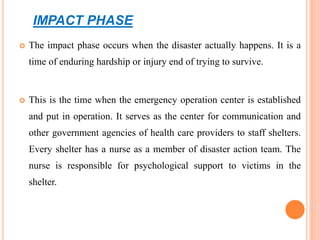
IMPACT PHASE
 The impact phase occurs when the disaster actually happens. It is a
time of enduring hardship or injury end of trying to survive.
 This is the time when the emergency operation center is established
and put in operation. It serves as the center for communication and
other government agencies of health care providers to staff shelters.
Every shelter has a nurse as a member of disaster action team. The
nurse is responsible for psychological support to victims in the
shelter.
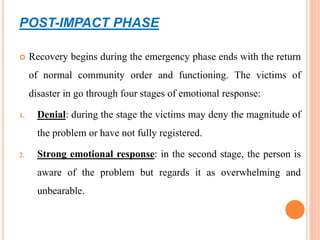
POST-IMPACT PHASE
 Recovery begins during the emergency phase ends with the return
of normal community order and functioning. The victims of
disaster in go through four stages of emotional response:
1. Denial: during the stage the victims may deny the magnitude of
the problem or have not fully registered.
2. Strong emotional response: in the second stage, the person is
aware of the problem but regards it as overwhelming and
unbearable.
3. Acceptance: during the third stage, the victim begins to accept
the problems caused by the disaster and makes a concentrated
effect to solve them.
4. Recovery: the fourth stage represent a recovery from the crisis
reaction. Victims feel that they are back to normal.
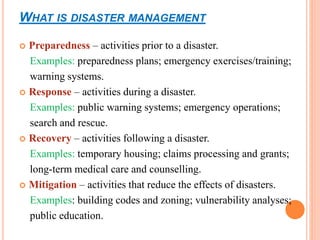
WHAT IS DISASTER MANAGEMENT
 Preparedness – activities prior to a disaster.
Examples: preparedness plans; emergency exercises/training;
warning systems.
 Response – activities during a disaster.
Examples: public warning systems; emergency operations;
search and rescue.
 Recovery – activities following a disaster.
Examples: temporary housing; claims processing and grants;
long-term medical care and counselling.
 Mitigation – activities that reduce the effects of disasters.
Examples: building codes and zoning; vulnerability analyses;
public education.
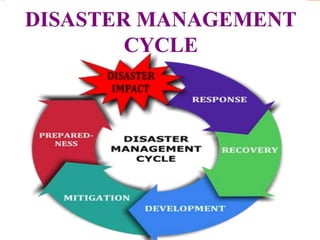
PHASES OF DISASTER MANAGEMENT
CYCLE
1) PHASE 1: RESPONSE
The response phase is the actual implementation of the disaster
plan. The best response plans use an incident command system,
are relatively simple, are routinely practiced, and are modified
when improvements are needed. Response activities need to be
continually monitored and adjusted to the changing situation.
Activities a hospital, healthcare system, or public health agency
take immediately during, and after a disaster or emergency
occurs.
2) PHASE 2: RECOVERY
Once the incident is over, the organization and staff needs to recover.
Invariably, services have been disrupted and it takes time to return to
routines. Recovery is usually easier if, during the response, some of
the staff have been assigned to maintain essential services while
others were assigned to the disaster response.
Activities undertaken by a community and its components after an
emergency or disaster to restore minimum services and move towards
long-term restoration.
 Debris Removal
 Care and Shelter
 Damage Assessments
 Funding Assistance
3) PHASE 3: EVALUATION/DEVELOPMENT
Often this phase of disaster planning and response receives the least
attention. After a disaster, employees and the community are anxious
to return to usual operations. It is essential that a formal evaluation
be done to determine what went well (what really worked) and what
problems were identified.
4) PHASE 4: MITIGATION
These are steps that are taken to lessen the impact of a disaster
should one occur and can be considered as prevention and risk
reduction measures. Examples of mitigation activities include
installing and maintaining backup generator power to mitigate the
effects of a power
5) PHASE 5: PREPAREDNESS/RISK ASSESSMENT
Evaluate the facility’s vulnerabilities or propensity for
disasters. Issues to consider include: weather patterns;
geographic location; expectations related to public events
and gatherings; age, condition, and location of the facility;
and industries in close proximity to the hospital (e.g.,
nuclear power plant or chemical factory)
DISASTER TRIAGE
 The word triage is derived from the French word trier, which
means, “to sort out or choose.”
 “Triage is a process which places the right patient in the right
place at the right time to receive the right level of care” (Rice &
Abel, 1992).
NEED OF THE DISASTER TRIAGE
1. Inadequate resource to meet immediate needs
2. Infrastructure limitations
3. Inadequate hazard preparation
4. Limited transport capabilities
5. Multiple agencies responding
6. Hospital Resources Overwhelmed
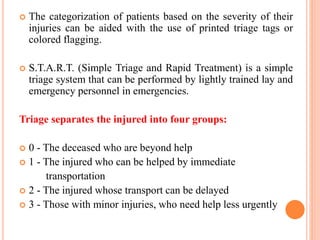
 The categorization of patients based on the severity of their
injuries can be aided with the use of printed triage tags or
colored flagging.
 S.T.A.R.T. (Simple Triage and Rapid Treatment) is a simple
triage system that can be performed by lightly trained lay and
emergency personnel in emergencies.
Triage separates the injured into four groups:
 0 - The deceased who are beyond help
 1 - The injured who can be helped by immediate
transportation
 2 - The injured whose transport can be delayed
 3 - Those with minor injuries, who need help less urgently
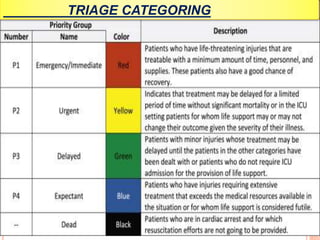
TRIAGE CATEGORING
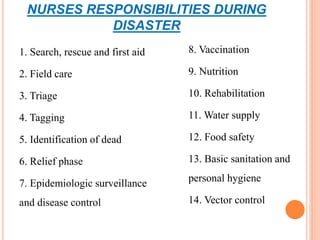
NURSES RESPONSIBILITIES DURING
DISASTER
1. Search, rescue and first aid
2. Field care
3. Triage
4. Tagging
5. Identification of dead
6. Relief phase
7. Epidemiologic surveillance
and disease control
8. Vaccination
9. Nutrition
10. Rehabilitation
11. Water supply
12. Food safety
13. Basic sanitation and
personal hygiene
14. Vector control
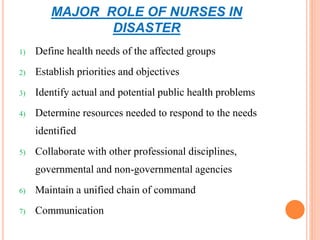
MAJOR ROLE OF NURSES IN
DISASTER
1) Define health needs of the affected groups
2) Establish priorities and objectives
3) Identify actual and potential public health problems
4) Determine resources needed to respond to the needs
identified
5) Collaborate with other professional disciplines,
governmental and non-governmental agencies
6) Maintain a unified chain of command
7) Communication