1
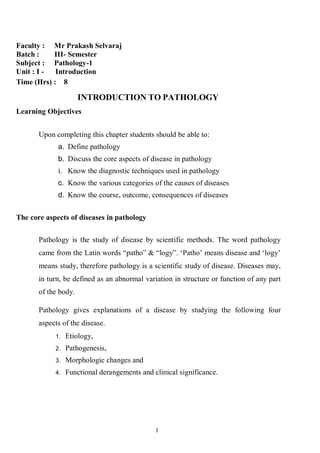
Faculty : Mr Prakash Selvaraj
Batch : III- Semester
Subject : Pathology-1
Unit : I - Introduction
Time (Hrs) : 8
INTRODUCTION TO PATHOLOGY
Learning Objectives
Upon completing this chapter students should be able to:
a. Define pathology
b. Discuss the core aspects of disease in pathology
i. Know the diagnostic techniques used in pathology
c. Know the various categories of the causes of diseases
d. Know the course, outcome, consequences of diseases
The core aspects of diseases in pathology
Pathology is the study of disease by scientific methods. The word pathology
came from the Latin words “patho” & “logy”. ‘Patho’ means disease and ‘logy’
means study, therefore pathology is a scientific study of disease. Diseases may,
in turn, be defined as an abnormal variation in structure or function of any part
of the body.
Pathology gives explanations of a disease by studying the following four
aspects of the disease.
1. Etiology,
2. Pathogenesis,
3. Morphologic changes and
4. Functional derangements and clinical significance.
2
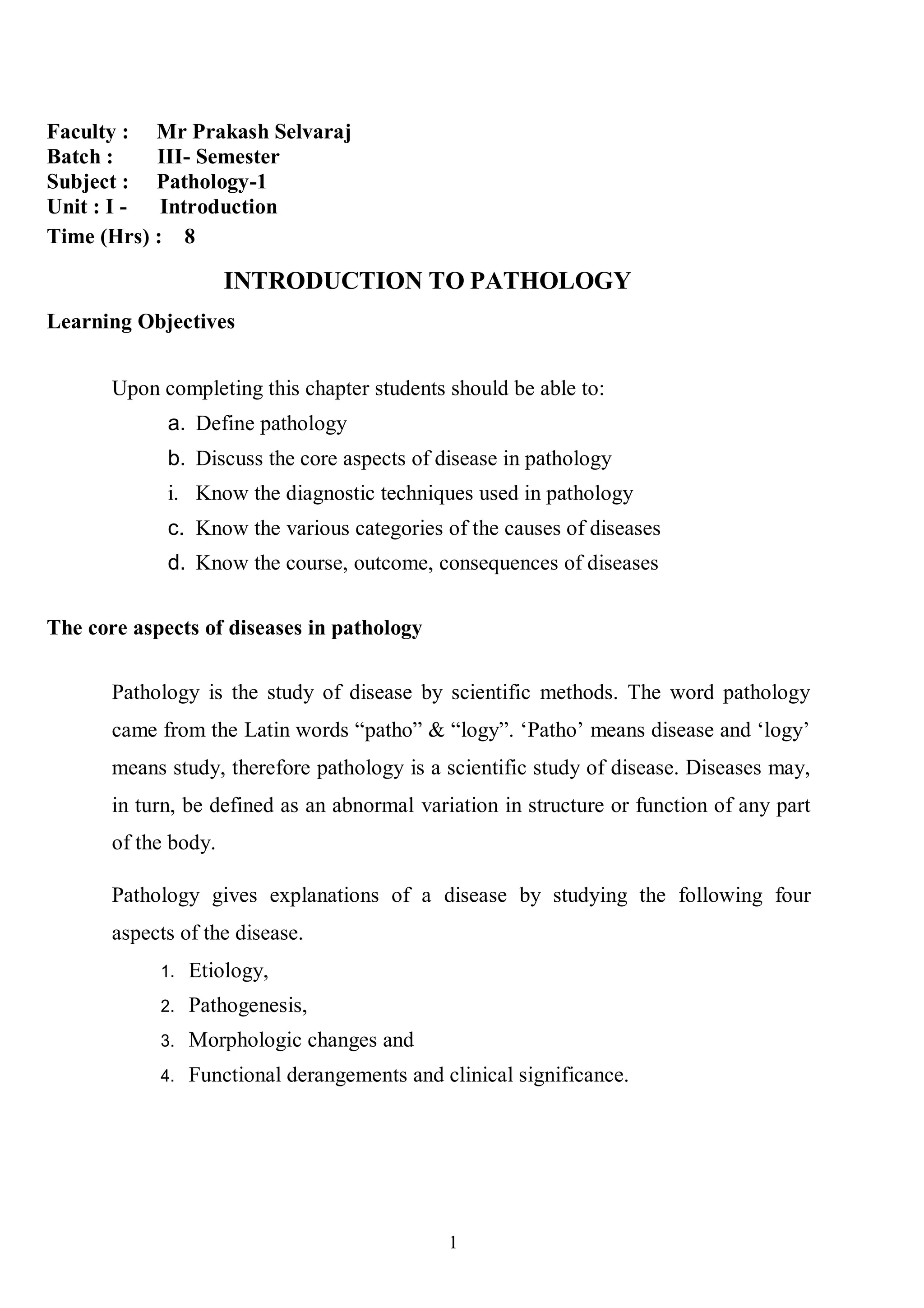
1. Etiology
1) Etiology of a disease means the cause of the disease.
2) If the cause of a disease is known itis called primary etiology.
3) If the cause of the disease is unknown it is called idiopathic.
4) Knowledge or discovery of the primary cause remains the backbone
on which a diagnosis can be made, a disease understood, & a
treatment developed.
5) There are two major classes of etiologic factors: genetic and
acquired (infectious, nutritional, chemical, physical, etc). .
3
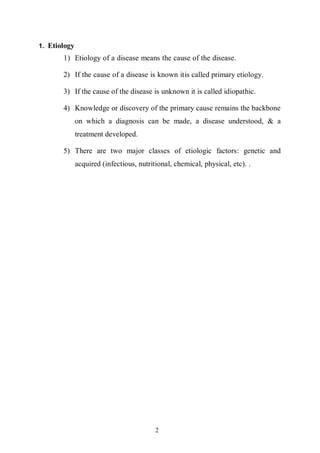
2. Pathogenesis
 Pathogenesis means the mechanism through which the cause operates to
produce the pathological and clinical manifestations.
 The pathogenetic mechanisms could take place in the latent or
incubation period. Pathogenesis leads to morphologic changes.
3. Morphologic changes
1) The morphologic changes refer to the structural alterations in cells or
tissues that occur following the pathogenetic mechanisms.
2) The structural changes in the organ can be seen with the naked eye or
they may only be seen under the microscope.
3) Those changes that can be seen with the naked eye are called gross
morphologic changes & those that are seen under the microscope are
called microscopic changes.
4) Both the gross & the microscopic morphologic changes may only be
seen in that disease, i.e. they may be specific to that disease.
Therefore, such morphologic changes can be used by the pathologist to
identify (i.e. to diagnose) the disease.
 In addition, the morphologic changes will lead to functional alteration
& to the clinical signs & symptoms of the disease.
4
4. Functional derangements and clinical significance
The morphologic changes in the organ influence the normal function of the
organ. By doing so, they determine the clinical features (symptoms and signs),
course, and prognosis of the disease.
In summary, pathology studies:-
Etiology Pathogenesis Morphologic changes Clinical features &
Prognosis of all diseases.
II. Diagnostic techniques used in pathology
The pathologist uses the following techniques to the diagnose diseases:
1) Histo-pathology
2) Cyto-pathology
3) Hematopathology
4) Immuno-histo-chemistry
5) Microbiological examination
6) Bio-chemical examination
7) Cyto-genetics
8) Molecular techniques
9) Autopsy
Histopathological techniques
1) Histopathological examination studies tissues under the microscope.
During this study, the pathologist looks for abnormal structures in the
tissue.
2) Tissues for histopathological examination are obtained by biopsy. Biopsy
is a tissue sample from a living person to identify the disease. Biopsy can
be either incisional or excisional.
3) Once the tissue is removed from the patient, it has to be immediately
fixed by putting it into adequate amount of 10% Formaldehyde (10%
formalin) before sending it to the pathologist.
5
The purpose of fixation is:
1. to prevent autolysis and bacterial decomposition and putrefaction
2. to coagulate the tissue to prevent loss of easily diffusible substances
3. to fortify the tissue against the deleterious effects of the various
stages in thepreparation of sections and tissue processing.
4. to leave the tissues in a condition which facilitates differential
staining with dyesand other reagents.
Once the tissue arrives at the pathology department, the pathologist will exam it
macroscopically (i.e. naked-eye examination of tissues).
6
Cytopathologic techniques
Cytopathology is the study of cells from various body sites to determine the
cause or nature of disease.
Applications of cytopathology:
The main applications of cytology include the following:
 Screening for the early detection of asymptomatic cancer For example, the
examination of scrapings from cervix for early detection and prevention of
cervical cancer.
 Diagnosis of symptomatic cancer : Cytopathology may be used alone or in
conjunction with other modalities to diagnose tumors revealed by physical or
radiological examinations.
 It can be used in the diagnosis of cysts, inflammatory conditions and
infections of various organs.
 Surveillance of patients treated for cancer : For some types of cancers,
cytology is the most feasible method of surveillance to detect recurrence. The
best example is periodic urine cytology to monitor the recurrence of cancer of
the urinary tract.
7
Advantages of cytologic examination
1) Compared to histopathologic technique it is cheap.
2) takes less time.
3) needs no anesthesiato take specimens.
Cytopathologic methods
There are different cytopathologic methods including:
1. Fine-needle aspiration cytology (FNAC)
In FNAC, cells are obtained by aspirating the diseased organ using a very thin
needle under negative pressure. Virtually any organ or tissue can be sampled by
fine-needle aspiration. The aspirated cells are then stained & are studied under
the microscope. Superficial organs (e.g. thyroid, breast, lymph nodes, skin and
soft tissues) can be easily aspirated. Deep organs, such as the lung,
mediastinum, liver, pancreas, kidney, adrenal gland, and retroperitoneum are
aspirated with guidance by fluoroscopy, ultrasound or CT scan. FNAC is
cheap, fast, & accurate in diagnosing many diseases.
2. Exfoliative cytology
Refers to the examination of cells that are in body fluids or secretions. Examples
include sputum, cerebrospinal fluid, urine, effusions in body cavities
(pleura,pericardium, peritoneum), nipple discharge and vaginal discharge.
3. Abrasive cytology
 Refers to methods by which cells are dislodged by various tools from
body surfaces (skin, mucous membranes, and serous membranes). E.g.
preparation of cervical smears with a small brush to detect cancer of the
uterine cervix at early stages.
 Such cervical smears, also called Pap smears, can significantly reduce the
mortality from cervical cancer. Cervical cancer is the most common
cancer in Ethiopian women.
8
Hematological examination
This is a method by which abnormalities of the cells of the blood and their
precursors in the bone marrow are investigated to diagnose the different kinds
of anemia & leukemia.
Immunohistochemistry
This is a method is used to detect a specific antigen in the tissue in order to
identify the type of disease.
Microbiological examination
This is a method by which body fluids, excised tissue, etc. are examined by
microscopical, cultural and serological techniques to identify micro-organisms
responsible for many diseases.
Biochemical examination
This is a method by which the metabolic disturbances of disease are
investigated by assay of various normal and abnormal compounds in the blood,
urine, etc.
Clinical genetics (cytogenetics),
This is a method in which inherited chromosomal abnormalities in the germ
cells or acquired chromosomal abnormalities in somatic cells are investigated
using the techniques of molecular biology.
Molecular techniques
Different molecular techniques such as fluorescent in situ hybridization,
Southern blot, etc... can be used to detect genetic diseases.
Autopsy
Autopsy is examination of the dead body to identify the cause of death. This can be for
forensic or clinical purposes.
9
The causes of disease
Diseases can be caused by either environmental factors, genetic factors or a
combination ofthe two.
A. Environmental factors
Environmental causes of disease are many and are classified into:
1. Physical agents
2. Chemicals
3. Nutritional deficiencies & excesses
4. Infections & infestations
5. Immunological factors
6. Psychogenic factors
1. Physical agents
These include trauma, radiation, extremes of temperature, and electric power.
These agentsapply excess physical energy, in any form, to the body.
2. Chemicals
 With the use of chemical agents such as drugs, in industrial processes,
and at home, chemically induced injury has become very common.
 the effect of paracetamol and alcohol on liver. Many toxic chemicals are
metabolized in liver and excreted in kidney, as a result, these organs are
susceptible to chemical injury.
3. Nutritional deficiencies and excesses
Nutritional deficiencies may arise as a result of poor supply, interference with
absorption, inefficient transport within the body, or defective utilization.
It may take the form of deficiency either of major classes of food, usually
protein and energy, or vitamins or elements essential for specific metabolic
processes, e.g. iron for haemoglobin production. Often, the deficiencies are
multiple and complex.
10
Obesity has become increasingly common, with type 2 diabetes, high blood pressure
and heart disease.
4. Infections and infestations
Viruses, bacteria, fungi, protozoa, and metazoa all cause diseases. They may do
so by causing cell destruction directly as in virus infections (for example
poliomyelitis) or protozoal infections (for example malaria). However, in others
the damage is done by toxins elaborated by the infecting agent as in diphtheria
and tetanus. Like chemicals, they may have a general effect or they may show a
predilection for certain tissues.
5. Immunological factors
The immune process is essential for protection against micro-organisms and
parasites. However, the immune system can be abnormal which can lead to
diseases. The abnormalities of the immune system include:
A. Hypersensitivity reaction
This is exaggerated immune response to an antigen. For example,
bronchialasthma can occur due to exaggerated immune response to the
harmless pollen.
B. Immunodeficiency
This is due to deficiency of a component of the immune system which
leads toincreased susceptibility to different diseases. An example is AIDS
11
C. Autoimmunity
This is an abnormal (exaggerated) immune reaction against the self
antigens of the host. Therefore, autoimmunity is a hypersensitivity
reaction against the self antigens. For example, type 1 diabetes
mellitus is caused by autoimmune destruction of the beta cells of the
islets of Langerhans of the pancreas.
6. Psychogenic factors
The mental stresses imposed by conditions of life, particularly in
technologically advanced communities, are probably contributory factors in
some groups of diseases.
Genetic Factors
These are hereditary factors that are inherited genetically from parents.
12
Course of disease
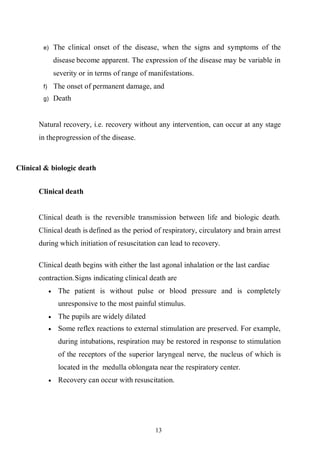
The course of disease is shown with a simplified diagram as follows.
Exposure Biological onset Clinical onset Permanent damage
Death Latency period
The course of a disease in the absence of any intervention is called the natural
history of the disease. The different stages in the natural history of disease
include:
a) Exposure to various risk factors (causative agents)
b) Latency, period between exposure and biological onset of disease
c) Biological onset of disease; this marks the initiation of the disease process,
however, without any sign or symptom. Following biological onset of
disease, it may remain asymptomatic or subclinical (i.e. without any
clinical manifestations), or may lead to overt clinical disease.
d) Incubation (induction) period refers to variable period of time without any
obvious signsor symptoms from the time of exposure.
13
e) The clinical onset of the disease, when the signs and symptoms of the
disease become apparent. The expression of the disease may be variable in
severity or in terms of range of manifestations.
f) The onset of permanent damage, and
g) Death
Natural recovery, i.e. recovery without any intervention, can occur at any stage
in theprogression of the disease.
Clinical & biologic death
Clinical death
Clinical death is the reversible transmission between life and biologic death.
Clinical death is defined as the period of respiratory, circulatory and brain arrest
during which initiation of resuscitation can lead to recovery.
Clinical death begins with either the last agonal inhalation or the last cardiac
contraction.Signs indicating clinical death are
 The patient is without pulse or blood pressure and is completely
unresponsive to the most painful stimulus.
 The pupils are widely dilated
 Some reflex reactions to external stimulation are preserved. For example,
during intubations, respiration may be restored in response to stimulation
of the receptors of the superior laryngeal nerve, the nucleus of which is
located in the medulla oblongata near the respiratory center.
 Recovery can occur with resuscitation.
14
Biological Death
Biological death (sure sign of death), which sets in after clinical death, is an
irreversible state of cellular destruction. It manifests with irreversible cessation
of circulatory and respiratory functions, or irreversible cessation of all functions
of the entire brain, including brain stem.
However, one should notice that there are internationally accepted criteria to
diagnose biological death.
15
CELLULAR REACTIONS TO INJURY
I. Learning objectives
1. Define hyperplasia, hypertrophy, atrophy, & Metaplasia & list
some of theircauses.
2. Know the differences between reversible & irreversible forms of cell
injury.
3. Describe the mechanisms of necrosis.
4. Describe the various types of necrosis & know some of their causes.
Introduction
Cell injury underlies all diseases. So to understand diseases one, has to start by
knowing what cell injury is. When a cell is exposed to an injurious agent (i.e.
the causes of disease), the possible outcomes are:
5. The cell may adapt to the situation or
6. They cell may acquire a reversible injury or
7. The cell may obtain an irreversible injury & may die. The cell
may die viaone of two ways: either by necrosis or by apoptosis.
Which of these outcomes occur depends on both the injurious agent & on
cellular factors. In other words, the result depends on the type, severity, &
duration of the injury & on the typeof the cell.
Types of cellular adaptation
The types of cellular adaptation include hypertrophy, atrophy, hyperplasia, &
metaplasia.
A. Hypertrophy
Hypertrophy is increase in the size of cells. Increased workload leads to
increased protein synthesis & increased size & number of intracellular
organelles which, in turn, leads to increased cell size. The increased cell
size leads to increased size of the organ.
Examples: the enlargement of the left ventricle in hypertensive heart
disease & the increase in skeletal muscle during sternous exercise.
16
B. Hyperplasia
Hyperplasia is an increase in the number of cells. It can lead to an increase
in the size of the organ. It is usually caused by hormonal stimulation. It can
be physiological as in enlargement of the breast during pregnancy or it can
pathological as in endometrial hyperplasia.
C. Atrophy
Atrophy is a decrease in the size of a cell. This can lead to decreased
size of the organ. The atrophic cell shows autophagic vacuoles which
contain cellular debris from degraded organelles.
Atrophy can be caused by:
1. Disuse
2. Undernutrition
3. Decreased endocrine stimulation
4. Denervation
5. Old age
17
D. Metaplasia
Metaplasia is the replacement of one differentiated tissue by another
differentiatedtissue. There are different types of metaplasia. Examples
include:
1. Squamous metaplasia
This is replacement of another type of epithelium by squamous
epithelium. For example, the columnar epithelium of the bronchus can
be replaced by squamousepithelium in cigarette smokers
2. Osseous metaplasia
This replacement of a connective tissue by bone, for example at sites of
injury.
Reversible cellular changes & accumulations
Even though there are many different kinds of reversible cellular changes &
accumulations, here we will only mention fatty change & accumulation of
pigments.
1. Fatty change
This is accumulation of triglycerides inside parenchymal cells. It is caused by
an imbalance between the uptake, utilization, & secretion of fat. Fatty change is
usually seen in the liver, heart, or kidney. Fatty liver may be caused by
alcohol, diabetes mellitus, malnutrition, obesity, & poisonings. These
etiologies cause accumulation of fat in the hepatocytes by the following
mechanisms:
a. Increased uptake of triglycerides into the parenchymal cells.
b. Decreased use of fat by cells.
c. Overproduction of fat in cells.
d. Decreased secretion of fat from the cells.
18
2. The accumulations of pigments
Pigments can be exogenous or endogenous. Endogenous pigments include
melanin, bilirubin, hemosiderin, & lipofuscin. Exogenous pigments include
carbon. These pigments can accumulate inside cells in different situations.
a. Melanin
Melanin is a brownish-black pigment produced by the melanocytes found
in the skin. Increased melanin pigmentation is caused by suntanning &
certain diseases e.g. nevus, or malignant melanoma. Decreased melanin
pigmentation is seen in albinism &vitiligo.
b. Bilirubin
Bilirubin is a yellowish pigment, mainly produced during the degradation
of hemoglobin. Excess accumulation of bilirubin causes yellowish
discoloration of the sclerae, mucosae, & internal organs. Such a yellowish
discoloration is called jaundice.
Jaundice is most often caused by
 Hemolytic anemia : Hemolytic anemia is characterized by increased
destruction of red blood cells.
 Biliary obstruction : This is obstruction of intrahepatic or extrahepatic
bile ducts. It can be caused bygallstones.
 Hepatocellular disease : This is associated with failure of conjugation of
bilirubin.
C. Hemosiderin
Hemosiderin is an iron-containing pigment derived from ferritin. It
appears in tissuesas golden brown amorphous aggregates & is identified
by its staining reaction (blue color) with the Prussian blue dye.
Hemosiderin exists normally in small amounts within tissue
macrophages of the bone marrow, liver, & spleen as physiologic iron
stores. It accumulates in tissues in excess amounts in certain diseases
19
This excess accumulation is divided into 2 types:
1. Hemosiderosis
When accumulation of hemosiderin is primarily within tissue
macrophages & is not associated with tissue damage, it is called
hemosiderosis.
2. Hemochromatosis
When there is more extensive accumulation of hemosiderin, often
within parenchymal cells, which leads to tissue damage, scarring &
organ dysfunction, itis called hemochromatosis.
Cell death
Cells can die via one of the following two ways:
8. Necrosis
9. Apoptosis
1. Necrosis
In necrosis, excess fluid enters the cell, swells it, & ruptures its membrane
which kills it. After the cell has died, intracellular degradative reactions occur
within a living organism. Necrosis does not occur in dead organisms. In dead
organisms, autolysis & heterolysis take place.
Necrosis occurs by the following mechanisms:
A. Hypoxia
B. Free radical-induced cell injury
C. Cell membrane damage
D. Increased intracellular calcium level
20
A.Hypoxia
Hypoxia is decreased oxygen supply to tissues. It can be caused by:
1. Ischemia
Ischemia is decreased blood flow to or from an organ. Ischemia can be
caused by obstruction of arterial blood flow – the most common cause, or
by decreased perfusion of tissues by oxygen-carrying blood as occurs in
cardiac failure, hypotension, & shock.
2. Anemia
Anemia is a reduction in the number of oxygen-carrying red blood cells.
3. Carbon monoxide poisoning
CO decreases the oxygen-capacity of red blood cells by chemical alteration
of hemoglobin.
4. Poor oxygenation of blood due to pulmonary disease.
The cell injury that results following hypoxia can be divided into early & late
stages:
1. Early (reversible) stages of hypoxic cell injury
At this stage, hypoxia results in decreased oxidative
phosphorylation & ATP synthesis. Decreased ATP leads to:
a. Failure of the cell membrane Na – K pump, which leads to
increased intracellular Na & water, which cause cellular &
organelle swelling. Cellular swelling (hydropic change) is
characterized by the presence of large vacuoles in the cytoplasm.
The endoplasmic reticulum also swells. The mitochondria show a
low amplitude swelling. All of the above changes are reversible if
the hypoxia is corrected.
b. Disaggregation of ribosomes & failure of protein synthesis.
21
2. Late (irreversible) stages of hypoxic cell injury.
This is caused by severe or prolonged injury. It is caused by massive
calcium influx & very low pH, which lead to activation of enzymes,
which damage the cell membrane& organelle membranes.
Irreversible damage to the mitochondria, cell membranes, & the
nucleus mark the point of no return for the cell, that is after this
stage, the cell is destined to die.
Release of aspartate aminotransferase (AST), creatine
phosphokinase(CPK), & lactate dehydrogenase (LDH) into the
blood is an important indicator of irreversible injury to heart muscle
following myocardial infarction.
22
B.Free radical-induced injury
Free radicals are formed by normal metabolism, oxygen toxicity, ionizing
radiation, & drugs & chemicals, & reperfusion injury. They are degraded by
spontaneous decay, intracellular enzymes such as glutathione peroxidase,
catalase, or superoxide dismutase, & endogenous substances such as
ceruloplasmin or transferrin. When the production of free radicals exceeds
their degradation, the excess free radicals cause membrane pump damage,
ATP depletion, & DNA damage. These can cause cell injury & cell death.
a. Cell membrane damage
Direct cell membrane damage as in extremes of temprature, toxins, or
viruses, or indirect cell membrane damage as in the case of hypoxia
can lead to cell deathby disrupting the homeostasis of the cell.
b. Increased intracellular calcium level
Increased intracellular calcium level is a common pathway via which
different causes of cell injury operate. For example, the cell
membrane damage leads to increased intracellular calcium level. The
increased cytosolic calcium, in turn, activates enzymes in the
presence of low pH. The activated enzymes will degrade the cellular
organelles.
23
Types of necrosis
The types of necrosis include:
1. Coagulative necrosis
2. Liquefactive necrosis
3. Fat necrosis
4. Caseous necrosis
5. Gangrenous necrosis
Coagulative necrosis
Cogulative necrosis most often results from sudden interruption of blood supply
to an organ, especially to the heart. It is, in early stages, characterized by
general preservation of tissue architecture. It is marked by the following nuclear
changes: Pyknosis (which is chromatin clumping & shrinking with increased
basophilia), karyorrhexis (fragmentation of chromatin), & karyolysis (fading of
the chromatin material).
Liquefactive necrosis
Liquefactive necrosis is characterized by digestion of tissue. It shows softening
& liquefaction of tissue. It characteristically results from ischemic injury to the
CNS. It also occurs in suppurative infections characterized by formation of pus.
Fat necrosis
Fat necrosis can be caused by trauma to tissue with high fat content, such as the
breast or it can also be caused by acute hemorrhagic pancreatitis in which
pancreatic enzymes diffuse into the inflamed pancreatic tissue & digest it. The
fatty acids released from the digestion form calcium salts (soap formation or
dystrophic calcification). In addition, the elastase enzyme digests the blood
vessels & cause the hemorrhage inside the pancreas, hence the name
hemorrhagic pancreatitis.
24
Caseous necrosis
Caseous necrosis has a cheese-like (caseous, white) appearance to the naked
eye. And it appears as an amorphous eosinophilic material on microscopic
examination. Caseous necrosis is typical of tuberculosis.
Gangrenous necrosis
This is due to vascular occlusion & most often affects the lower extremities &
the bowel. It is called wet gangrene if it is complicated by bacterial infection
which leads to superimposed liquefactive necrosis. Whereas it is called dry
gangrene if there is only coagulative necrosis without liquefactive necrosis.
Necrosis can be followed by release of intracellular enzymes into the blood,
inflammation or dystrophic calcification.
25
Apoptosis
Apoptosis is the death of single cells within clusters of other cells. (Note
that necrosis causes the death of clusters of cells.) In apoptosis, the cell shows
shrinkage & increased acidophilic staining of the cell. This is followed by
fragmentation of the cells.
These fragments are called apoptotic bodies. Apoptosis usually occurs as a
physiologic process for removal of cells during embryogenesis, menstruation,
etc… It can also be seen in pathological conditions caused by mild injurious
agents.
Apoptosis is not followed by inflammation or calcification. The above
mentioned features distinguish apoptosis from necrosis.
Pathologic calcification
Pathologic calcification is divided into 2 types:
1. Metastatic calcification
This is caused by hypercalcemia, resulting from hyperparathyroidism, milk-
alkali syndrome, sarcoidosis etc…
2. Dystrophic calcification
This occurs in previously damaged tissue, such as areas of old trauma,
tuberculous lesions, scarred heart valves, & atherosclerotic lesions.
Unlike metastatic calcification, it is not caused by hypercalcemia. Typically, the
serumcalcium level is normal.
26

Introduction_to_pathology_(1).pdf

  • 1.
    1 Faculty : MrPrakash Selvaraj Batch : III- Semester Subject : Pathology-1 Unit : I - Introduction Time (Hrs) : 8 INTRODUCTION TO PATHOLOGY Learning Objectives Upon completing this chapter students should be able to: a. Define pathology b. Discuss the core aspects of disease in pathology i. Know the diagnostic techniques used in pathology c. Know the various categories of the causes of diseases d. Know the course, outcome, consequences of diseases The core aspects of diseases in pathology Pathology is the study of disease by scientific methods. The word pathology came from the Latin words “patho” & “logy”. ‘Patho’ means disease and ‘logy’ means study, therefore pathology is a scientific study of disease. Diseases may, in turn, be defined as an abnormal variation in structure or function of any part of the body. Pathology gives explanations of a disease by studying the following four aspects of the disease. 1. Etiology, 2. Pathogenesis, 3. Morphologic changes and 4. Functional derangements and clinical significance.
  • 2.
    2 1. Etiology 1) Etiologyof a disease means the cause of the disease. 2) If the cause of a disease is known itis called primary etiology. 3) If the cause of the disease is unknown it is called idiopathic. 4) Knowledge or discovery of the primary cause remains the backbone on which a diagnosis can be made, a disease understood, & a treatment developed. 5) There are two major classes of etiologic factors: genetic and acquired (infectious, nutritional, chemical, physical, etc). .
  • 3.
    3 2. Pathogenesis  Pathogenesismeans the mechanism through which the cause operates to produce the pathological and clinical manifestations.  The pathogenetic mechanisms could take place in the latent or incubation period. Pathogenesis leads to morphologic changes. 3. Morphologic changes 1) The morphologic changes refer to the structural alterations in cells or tissues that occur following the pathogenetic mechanisms. 2) The structural changes in the organ can be seen with the naked eye or they may only be seen under the microscope. 3) Those changes that can be seen with the naked eye are called gross morphologic changes & those that are seen under the microscope are called microscopic changes. 4) Both the gross & the microscopic morphologic changes may only be seen in that disease, i.e. they may be specific to that disease. Therefore, such morphologic changes can be used by the pathologist to identify (i.e. to diagnose) the disease.  In addition, the morphologic changes will lead to functional alteration & to the clinical signs & symptoms of the disease.
  • 4.
    4 4. Functional derangementsand clinical significance The morphologic changes in the organ influence the normal function of the organ. By doing so, they determine the clinical features (symptoms and signs), course, and prognosis of the disease. In summary, pathology studies:- Etiology Pathogenesis Morphologic changes Clinical features & Prognosis of all diseases. II. Diagnostic techniques used in pathology The pathologist uses the following techniques to the diagnose diseases: 1) Histo-pathology 2) Cyto-pathology 3) Hematopathology 4) Immuno-histo-chemistry 5) Microbiological examination 6) Bio-chemical examination 7) Cyto-genetics 8) Molecular techniques 9) Autopsy Histopathological techniques 1) Histopathological examination studies tissues under the microscope. During this study, the pathologist looks for abnormal structures in the tissue. 2) Tissues for histopathological examination are obtained by biopsy. Biopsy is a tissue sample from a living person to identify the disease. Biopsy can be either incisional or excisional. 3) Once the tissue is removed from the patient, it has to be immediately fixed by putting it into adequate amount of 10% Formaldehyde (10% formalin) before sending it to the pathologist.
  • 5.
    5 The purpose offixation is: 1. to prevent autolysis and bacterial decomposition and putrefaction 2. to coagulate the tissue to prevent loss of easily diffusible substances 3. to fortify the tissue against the deleterious effects of the various stages in thepreparation of sections and tissue processing. 4. to leave the tissues in a condition which facilitates differential staining with dyesand other reagents. Once the tissue arrives at the pathology department, the pathologist will exam it macroscopically (i.e. naked-eye examination of tissues).
  • 6.
    6 Cytopathologic techniques Cytopathology isthe study of cells from various body sites to determine the cause or nature of disease. Applications of cytopathology: The main applications of cytology include the following:  Screening for the early detection of asymptomatic cancer For example, the examination of scrapings from cervix for early detection and prevention of cervical cancer.  Diagnosis of symptomatic cancer : Cytopathology may be used alone or in conjunction with other modalities to diagnose tumors revealed by physical or radiological examinations.  It can be used in the diagnosis of cysts, inflammatory conditions and infections of various organs.  Surveillance of patients treated for cancer : For some types of cancers, cytology is the most feasible method of surveillance to detect recurrence. The best example is periodic urine cytology to monitor the recurrence of cancer of the urinary tract.
  • 7.
    7 Advantages of cytologicexamination 1) Compared to histopathologic technique it is cheap. 2) takes less time. 3) needs no anesthesiato take specimens. Cytopathologic methods There are different cytopathologic methods including: 1. Fine-needle aspiration cytology (FNAC) In FNAC, cells are obtained by aspirating the diseased organ using a very thin needle under negative pressure. Virtually any organ or tissue can be sampled by fine-needle aspiration. The aspirated cells are then stained & are studied under the microscope. Superficial organs (e.g. thyroid, breast, lymph nodes, skin and soft tissues) can be easily aspirated. Deep organs, such as the lung, mediastinum, liver, pancreas, kidney, adrenal gland, and retroperitoneum are aspirated with guidance by fluoroscopy, ultrasound or CT scan. FNAC is cheap, fast, & accurate in diagnosing many diseases. 2. Exfoliative cytology Refers to the examination of cells that are in body fluids or secretions. Examples include sputum, cerebrospinal fluid, urine, effusions in body cavities (pleura,pericardium, peritoneum), nipple discharge and vaginal discharge. 3. Abrasive cytology  Refers to methods by which cells are dislodged by various tools from body surfaces (skin, mucous membranes, and serous membranes). E.g. preparation of cervical smears with a small brush to detect cancer of the uterine cervix at early stages.  Such cervical smears, also called Pap smears, can significantly reduce the mortality from cervical cancer. Cervical cancer is the most common cancer in Ethiopian women.
  • 8.
    8 Hematological examination This isa method by which abnormalities of the cells of the blood and their precursors in the bone marrow are investigated to diagnose the different kinds of anemia & leukemia. Immunohistochemistry This is a method is used to detect a specific antigen in the tissue in order to identify the type of disease. Microbiological examination This is a method by which body fluids, excised tissue, etc. are examined by microscopical, cultural and serological techniques to identify micro-organisms responsible for many diseases. Biochemical examination This is a method by which the metabolic disturbances of disease are investigated by assay of various normal and abnormal compounds in the blood, urine, etc. Clinical genetics (cytogenetics), This is a method in which inherited chromosomal abnormalities in the germ cells or acquired chromosomal abnormalities in somatic cells are investigated using the techniques of molecular biology. Molecular techniques Different molecular techniques such as fluorescent in situ hybridization, Southern blot, etc... can be used to detect genetic diseases. Autopsy Autopsy is examination of the dead body to identify the cause of death. This can be for forensic or clinical purposes.
  • 9.
    9 The causes ofdisease Diseases can be caused by either environmental factors, genetic factors or a combination ofthe two. A. Environmental factors Environmental causes of disease are many and are classified into: 1. Physical agents 2. Chemicals 3. Nutritional deficiencies & excesses 4. Infections & infestations 5. Immunological factors 6. Psychogenic factors 1. Physical agents These include trauma, radiation, extremes of temperature, and electric power. These agentsapply excess physical energy, in any form, to the body. 2. Chemicals  With the use of chemical agents such as drugs, in industrial processes, and at home, chemically induced injury has become very common.  the effect of paracetamol and alcohol on liver. Many toxic chemicals are metabolized in liver and excreted in kidney, as a result, these organs are susceptible to chemical injury. 3. Nutritional deficiencies and excesses Nutritional deficiencies may arise as a result of poor supply, interference with absorption, inefficient transport within the body, or defective utilization. It may take the form of deficiency either of major classes of food, usually protein and energy, or vitamins or elements essential for specific metabolic processes, e.g. iron for haemoglobin production. Often, the deficiencies are multiple and complex.
  • 10.
    10 Obesity has becomeincreasingly common, with type 2 diabetes, high blood pressure and heart disease. 4. Infections and infestations Viruses, bacteria, fungi, protozoa, and metazoa all cause diseases. They may do so by causing cell destruction directly as in virus infections (for example poliomyelitis) or protozoal infections (for example malaria). However, in others the damage is done by toxins elaborated by the infecting agent as in diphtheria and tetanus. Like chemicals, they may have a general effect or they may show a predilection for certain tissues. 5. Immunological factors The immune process is essential for protection against micro-organisms and parasites. However, the immune system can be abnormal which can lead to diseases. The abnormalities of the immune system include: A. Hypersensitivity reaction This is exaggerated immune response to an antigen. For example, bronchialasthma can occur due to exaggerated immune response to the harmless pollen. B. Immunodeficiency This is due to deficiency of a component of the immune system which leads toincreased susceptibility to different diseases. An example is AIDS
  • 11.
    11 C. Autoimmunity This isan abnormal (exaggerated) immune reaction against the self antigens of the host. Therefore, autoimmunity is a hypersensitivity reaction against the self antigens. For example, type 1 diabetes mellitus is caused by autoimmune destruction of the beta cells of the islets of Langerhans of the pancreas. 6. Psychogenic factors The mental stresses imposed by conditions of life, particularly in technologically advanced communities, are probably contributory factors in some groups of diseases. Genetic Factors These are hereditary factors that are inherited genetically from parents.
  • 12.
    12 Course of disease Thecourse of disease is shown with a simplified diagram as follows. Exposure Biological onset Clinical onset Permanent damage Death Latency period The course of a disease in the absence of any intervention is called the natural history of the disease. The different stages in the natural history of disease include: a) Exposure to various risk factors (causative agents) b) Latency, period between exposure and biological onset of disease c) Biological onset of disease; this marks the initiation of the disease process, however, without any sign or symptom. Following biological onset of disease, it may remain asymptomatic or subclinical (i.e. without any clinical manifestations), or may lead to overt clinical disease. d) Incubation (induction) period refers to variable period of time without any obvious signsor symptoms from the time of exposure.
  • 13.
    13 e) The clinicalonset of the disease, when the signs and symptoms of the disease become apparent. The expression of the disease may be variable in severity or in terms of range of manifestations. f) The onset of permanent damage, and g) Death Natural recovery, i.e. recovery without any intervention, can occur at any stage in theprogression of the disease. Clinical & biologic death Clinical death Clinical death is the reversible transmission between life and biologic death. Clinical death is defined as the period of respiratory, circulatory and brain arrest during which initiation of resuscitation can lead to recovery. Clinical death begins with either the last agonal inhalation or the last cardiac contraction.Signs indicating clinical death are  The patient is without pulse or blood pressure and is completely unresponsive to the most painful stimulus.  The pupils are widely dilated  Some reflex reactions to external stimulation are preserved. For example, during intubations, respiration may be restored in response to stimulation of the receptors of the superior laryngeal nerve, the nucleus of which is located in the medulla oblongata near the respiratory center.  Recovery can occur with resuscitation.
  • 14.
    14 Biological Death Biological death(sure sign of death), which sets in after clinical death, is an irreversible state of cellular destruction. It manifests with irreversible cessation of circulatory and respiratory functions, or irreversible cessation of all functions of the entire brain, including brain stem. However, one should notice that there are internationally accepted criteria to diagnose biological death.
  • 15.
    15 CELLULAR REACTIONS TOINJURY I. Learning objectives 1. Define hyperplasia, hypertrophy, atrophy, & Metaplasia & list some of theircauses. 2. Know the differences between reversible & irreversible forms of cell injury. 3. Describe the mechanisms of necrosis. 4. Describe the various types of necrosis & know some of their causes. Introduction Cell injury underlies all diseases. So to understand diseases one, has to start by knowing what cell injury is. When a cell is exposed to an injurious agent (i.e. the causes of disease), the possible outcomes are: 5. The cell may adapt to the situation or 6. They cell may acquire a reversible injury or 7. The cell may obtain an irreversible injury & may die. The cell may die viaone of two ways: either by necrosis or by apoptosis. Which of these outcomes occur depends on both the injurious agent & on cellular factors. In other words, the result depends on the type, severity, & duration of the injury & on the typeof the cell. Types of cellular adaptation The types of cellular adaptation include hypertrophy, atrophy, hyperplasia, & metaplasia. A. Hypertrophy Hypertrophy is increase in the size of cells. Increased workload leads to increased protein synthesis & increased size & number of intracellular organelles which, in turn, leads to increased cell size. The increased cell size leads to increased size of the organ. Examples: the enlargement of the left ventricle in hypertensive heart disease & the increase in skeletal muscle during sternous exercise.
  • 16.
    16 B. Hyperplasia Hyperplasia isan increase in the number of cells. It can lead to an increase in the size of the organ. It is usually caused by hormonal stimulation. It can be physiological as in enlargement of the breast during pregnancy or it can pathological as in endometrial hyperplasia. C. Atrophy Atrophy is a decrease in the size of a cell. This can lead to decreased size of the organ. The atrophic cell shows autophagic vacuoles which contain cellular debris from degraded organelles. Atrophy can be caused by: 1. Disuse 2. Undernutrition 3. Decreased endocrine stimulation 4. Denervation 5. Old age
  • 17.
    17 D. Metaplasia Metaplasia isthe replacement of one differentiated tissue by another differentiatedtissue. There are different types of metaplasia. Examples include: 1. Squamous metaplasia This is replacement of another type of epithelium by squamous epithelium. For example, the columnar epithelium of the bronchus can be replaced by squamousepithelium in cigarette smokers 2. Osseous metaplasia This replacement of a connective tissue by bone, for example at sites of injury. Reversible cellular changes & accumulations Even though there are many different kinds of reversible cellular changes & accumulations, here we will only mention fatty change & accumulation of pigments. 1. Fatty change This is accumulation of triglycerides inside parenchymal cells. It is caused by an imbalance between the uptake, utilization, & secretion of fat. Fatty change is usually seen in the liver, heart, or kidney. Fatty liver may be caused by alcohol, diabetes mellitus, malnutrition, obesity, & poisonings. These etiologies cause accumulation of fat in the hepatocytes by the following mechanisms: a. Increased uptake of triglycerides into the parenchymal cells. b. Decreased use of fat by cells. c. Overproduction of fat in cells. d. Decreased secretion of fat from the cells.
  • 18.
    18 2. The accumulationsof pigments Pigments can be exogenous or endogenous. Endogenous pigments include melanin, bilirubin, hemosiderin, & lipofuscin. Exogenous pigments include carbon. These pigments can accumulate inside cells in different situations. a. Melanin Melanin is a brownish-black pigment produced by the melanocytes found in the skin. Increased melanin pigmentation is caused by suntanning & certain diseases e.g. nevus, or malignant melanoma. Decreased melanin pigmentation is seen in albinism &vitiligo. b. Bilirubin Bilirubin is a yellowish pigment, mainly produced during the degradation of hemoglobin. Excess accumulation of bilirubin causes yellowish discoloration of the sclerae, mucosae, & internal organs. Such a yellowish discoloration is called jaundice. Jaundice is most often caused by  Hemolytic anemia : Hemolytic anemia is characterized by increased destruction of red blood cells.  Biliary obstruction : This is obstruction of intrahepatic or extrahepatic bile ducts. It can be caused bygallstones.  Hepatocellular disease : This is associated with failure of conjugation of bilirubin. C. Hemosiderin Hemosiderin is an iron-containing pigment derived from ferritin. It appears in tissuesas golden brown amorphous aggregates & is identified by its staining reaction (blue color) with the Prussian blue dye. Hemosiderin exists normally in small amounts within tissue macrophages of the bone marrow, liver, & spleen as physiologic iron stores. It accumulates in tissues in excess amounts in certain diseases
  • 19.
    19 This excess accumulationis divided into 2 types: 1. Hemosiderosis When accumulation of hemosiderin is primarily within tissue macrophages & is not associated with tissue damage, it is called hemosiderosis. 2. Hemochromatosis When there is more extensive accumulation of hemosiderin, often within parenchymal cells, which leads to tissue damage, scarring & organ dysfunction, itis called hemochromatosis. Cell death Cells can die via one of the following two ways: 8. Necrosis 9. Apoptosis 1. Necrosis In necrosis, excess fluid enters the cell, swells it, & ruptures its membrane which kills it. After the cell has died, intracellular degradative reactions occur within a living organism. Necrosis does not occur in dead organisms. In dead organisms, autolysis & heterolysis take place. Necrosis occurs by the following mechanisms: A. Hypoxia B. Free radical-induced cell injury C. Cell membrane damage D. Increased intracellular calcium level
  • 20.
    20 A.Hypoxia Hypoxia is decreasedoxygen supply to tissues. It can be caused by: 1. Ischemia Ischemia is decreased blood flow to or from an organ. Ischemia can be caused by obstruction of arterial blood flow – the most common cause, or by decreased perfusion of tissues by oxygen-carrying blood as occurs in cardiac failure, hypotension, & shock. 2. Anemia Anemia is a reduction in the number of oxygen-carrying red blood cells. 3. Carbon monoxide poisoning CO decreases the oxygen-capacity of red blood cells by chemical alteration of hemoglobin. 4. Poor oxygenation of blood due to pulmonary disease. The cell injury that results following hypoxia can be divided into early & late stages: 1. Early (reversible) stages of hypoxic cell injury At this stage, hypoxia results in decreased oxidative phosphorylation & ATP synthesis. Decreased ATP leads to: a. Failure of the cell membrane Na – K pump, which leads to increased intracellular Na & water, which cause cellular & organelle swelling. Cellular swelling (hydropic change) is characterized by the presence of large vacuoles in the cytoplasm. The endoplasmic reticulum also swells. The mitochondria show a low amplitude swelling. All of the above changes are reversible if the hypoxia is corrected. b. Disaggregation of ribosomes & failure of protein synthesis.
  • 21.
    21 2. Late (irreversible)stages of hypoxic cell injury. This is caused by severe or prolonged injury. It is caused by massive calcium influx & very low pH, which lead to activation of enzymes, which damage the cell membrane& organelle membranes. Irreversible damage to the mitochondria, cell membranes, & the nucleus mark the point of no return for the cell, that is after this stage, the cell is destined to die. Release of aspartate aminotransferase (AST), creatine phosphokinase(CPK), & lactate dehydrogenase (LDH) into the blood is an important indicator of irreversible injury to heart muscle following myocardial infarction.
  • 22.
    22 B.Free radical-induced injury Freeradicals are formed by normal metabolism, oxygen toxicity, ionizing radiation, & drugs & chemicals, & reperfusion injury. They are degraded by spontaneous decay, intracellular enzymes such as glutathione peroxidase, catalase, or superoxide dismutase, & endogenous substances such as ceruloplasmin or transferrin. When the production of free radicals exceeds their degradation, the excess free radicals cause membrane pump damage, ATP depletion, & DNA damage. These can cause cell injury & cell death. a. Cell membrane damage Direct cell membrane damage as in extremes of temprature, toxins, or viruses, or indirect cell membrane damage as in the case of hypoxia can lead to cell deathby disrupting the homeostasis of the cell. b. Increased intracellular calcium level Increased intracellular calcium level is a common pathway via which different causes of cell injury operate. For example, the cell membrane damage leads to increased intracellular calcium level. The increased cytosolic calcium, in turn, activates enzymes in the presence of low pH. The activated enzymes will degrade the cellular organelles.
  • 23.
    23 Types of necrosis Thetypes of necrosis include: 1. Coagulative necrosis 2. Liquefactive necrosis 3. Fat necrosis 4. Caseous necrosis 5. Gangrenous necrosis Coagulative necrosis Cogulative necrosis most often results from sudden interruption of blood supply to an organ, especially to the heart. It is, in early stages, characterized by general preservation of tissue architecture. It is marked by the following nuclear changes: Pyknosis (which is chromatin clumping & shrinking with increased basophilia), karyorrhexis (fragmentation of chromatin), & karyolysis (fading of the chromatin material). Liquefactive necrosis Liquefactive necrosis is characterized by digestion of tissue. It shows softening & liquefaction of tissue. It characteristically results from ischemic injury to the CNS. It also occurs in suppurative infections characterized by formation of pus. Fat necrosis Fat necrosis can be caused by trauma to tissue with high fat content, such as the breast or it can also be caused by acute hemorrhagic pancreatitis in which pancreatic enzymes diffuse into the inflamed pancreatic tissue & digest it. The fatty acids released from the digestion form calcium salts (soap formation or dystrophic calcification). In addition, the elastase enzyme digests the blood vessels & cause the hemorrhage inside the pancreas, hence the name hemorrhagic pancreatitis.
  • 24.
    24 Caseous necrosis Caseous necrosishas a cheese-like (caseous, white) appearance to the naked eye. And it appears as an amorphous eosinophilic material on microscopic examination. Caseous necrosis is typical of tuberculosis. Gangrenous necrosis This is due to vascular occlusion & most often affects the lower extremities & the bowel. It is called wet gangrene if it is complicated by bacterial infection which leads to superimposed liquefactive necrosis. Whereas it is called dry gangrene if there is only coagulative necrosis without liquefactive necrosis. Necrosis can be followed by release of intracellular enzymes into the blood, inflammation or dystrophic calcification.
  • 25.
    25 Apoptosis Apoptosis is thedeath of single cells within clusters of other cells. (Note that necrosis causes the death of clusters of cells.) In apoptosis, the cell shows shrinkage & increased acidophilic staining of the cell. This is followed by fragmentation of the cells. These fragments are called apoptotic bodies. Apoptosis usually occurs as a physiologic process for removal of cells during embryogenesis, menstruation, etc… It can also be seen in pathological conditions caused by mild injurious agents. Apoptosis is not followed by inflammation or calcification. The above mentioned features distinguish apoptosis from necrosis. Pathologic calcification Pathologic calcification is divided into 2 types: 1. Metastatic calcification This is caused by hypercalcemia, resulting from hyperparathyroidism, milk- alkali syndrome, sarcoidosis etc… 2. Dystrophic calcification This occurs in previously damaged tissue, such as areas of old trauma, tuberculous lesions, scarred heart valves, & atherosclerotic lesions. Unlike metastatic calcification, it is not caused by hypercalcemia. Typically, the serumcalcium level is normal.
  • 26.