By conservation census is defined as the counting
of all individuals belonging to the group of interest
within a defines area and a survey when only a
proportion are counted.
It is originated from the Latin word censere which
means to estimate.
 GENERAL
 QUADRATE
 MARK RECAPTURE
 DISTANCE SAMPLING
 CAMERA TRAPPING
 OTHER METHODS
Count directly the number of individuals
 Sampling the habitat
 Attempted complete enumeration
 Plotless sampling
 Sampling area is divided into small squares called
quadrate.
 Suitable for sampling plants, slow moving animals and
some aquatic organisms.
Sample animals are catched up marked them
and releases them to mixed thoroughly with the rest of
the population and recaptured to estimate the size of the
population mathematically.
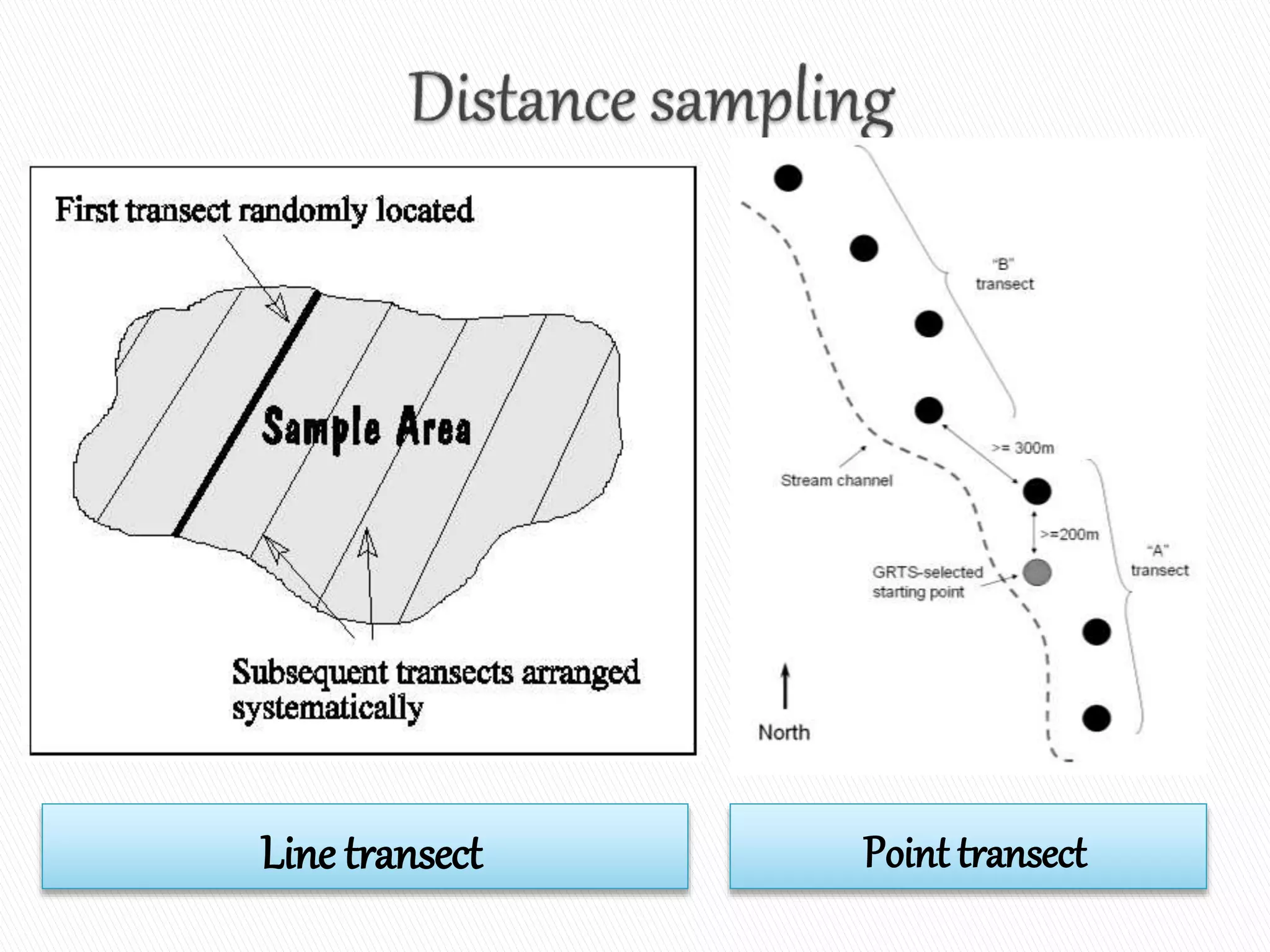
It is a widely-used group of closely related methods for
estimating the density and/or abundance of biological
populations. The main methods are
 Line transect
A series of straight lines(track lines) is traversed by an
observer. This may be achieved in various ways, depending
on the study species
 Point transect
In this method points are selected randomly and count
number of organism present at each point from this number
the population size is estimated.
Line transect Point transect
The use of automatic cameras
triggered by passing animals, record
medium to large mammals and
terrestrial birds in the field. Photographs
provide objective records or evidence
of an animal’s presence and identity.
TYPES
 Active camera trap
Noted only motion of animal.
 Passive camera trap
Noted motion as well as stripes.
 Infra red camera
Animal friendly, take continuous shoot and produce
black and white image.
 Digital flash camera
Provide colour images,not animal friendly(Animals
are terrified by flash)
 Netting
 Trapping
 Removal methods
 Using multiple studies
Handnet
 Hand capturing
 Noosing
 Trapping
 Marking individuals
noose
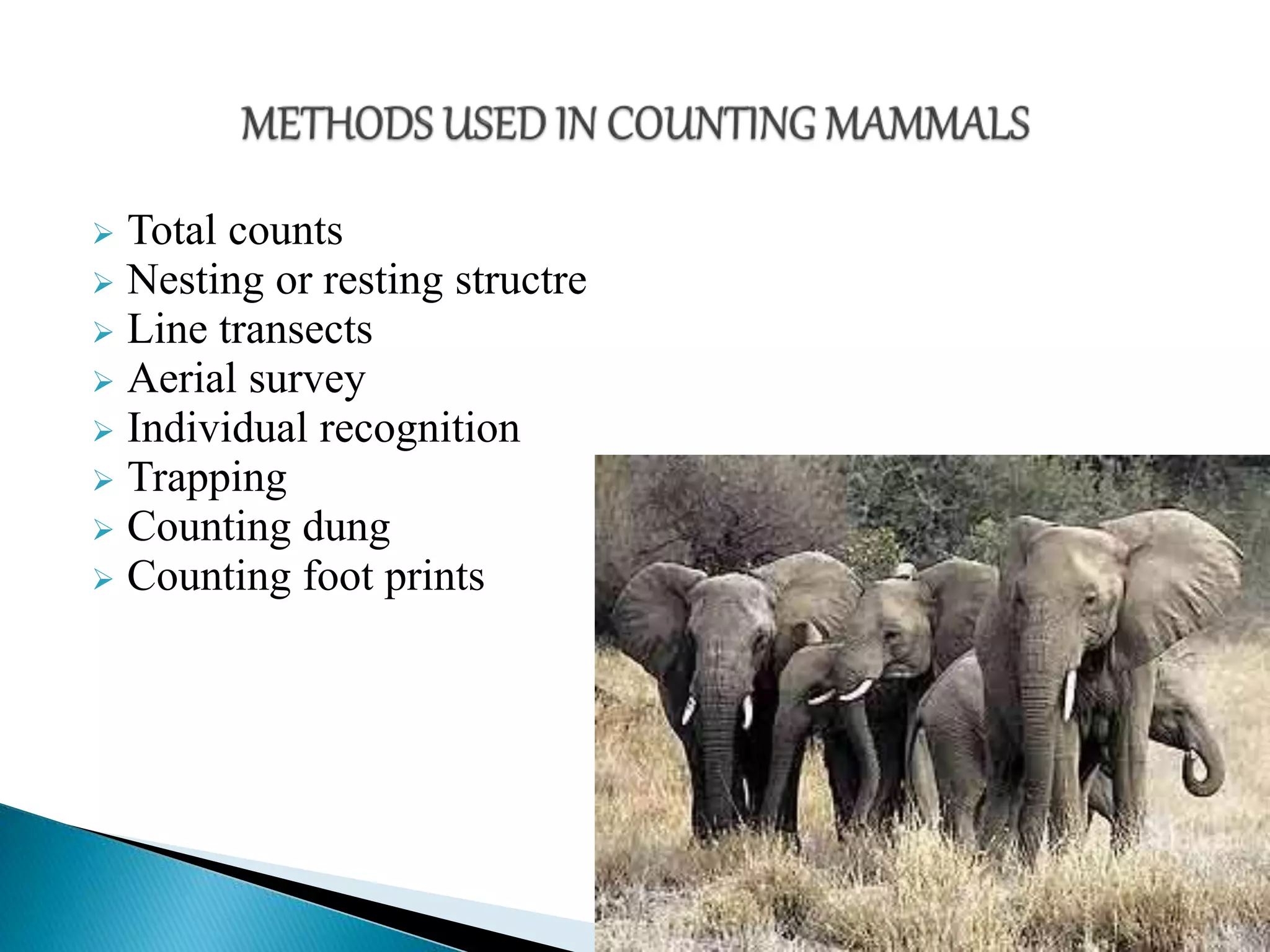
 Total counts
 Nesting or resting structre
 Line transects
 Aerial survey
 Individual recognition
 Trapping
 Counting dung
 Counting foot prints
Pug MARKOFSAMBaRDEER PUg MARKOFTIGER
By virtue of being the top predator, the tiger
functions as an umbrella species for the conservation of
biodiversity, ecosystem functions, goods, and services
in forest systems of Asia.
double sampling approach is used
First component
 Ground surveys of all potential tiger.
Second component
 Camera trapping and recapture techniques
 Line transects based distance sampling
 Status of particular species.
 Ratio of male and female.
 Age of the species.
 Number of individuals belonging to different species.
 Extinct
No individuals remaining.
 Extinct in the wild
survive on in captivity out side its historic range.
 Critically endangered
Extremely high risk of extinction in the wild.
Estimated number of population is less than 50.
 Endangered
High risk of extinction in the wild in near future.
Estimated number of population is less than 250
 Vulnarable
High risk of endangeredment in the wild in medium term
future. future. Estimated number of population is less than 1000
 Near threatened
Likely to be endangered in the near future.
 Least concern
Wide spread and abundant taxa ,does not qualify for more
at Risk.
 Data deficient
Not enough data to make an assessment of risk of
extinction.
 Not evaluated
Has not been evaluated against the criteria.
Critically Endangered mammals
I. Himalayan Brown or Red Bear(Urcus arctos isobellinus).
II. Pygmy Hog (Parcula salvania).
III. Andaman White Toothed Shrew (Crocidura andamansis).
IV. Kandana Rat (Millardia Kandana).
V. Large Rock Rat or Elvira Rat (Cremnomys elvira).
VI. Namdapha Flying Squirrel(Biswanoyepterus biswasi).
VII. Malavar civet (Viverra civenttina).
VIII. Sumatran Rinocerous (Dicerorhinus sumatrensis).
IX. Kasmir stag/hangul (Cervus elaphus hanglu).
Endangered mammals
I. Red Panda.
II. Wild Ass/Khur (Equus hemionus khur.)
III. Dhole / Asiatic Wild dog or Indian wild dog (Coun alpinus).
IV. Elds’s deer/thamin or brown antlered deer (Panolia eldii).
V. Golden langur (Trachypithecus geei).
VI. Himalayan / White bellied Musk Deer.
VII. Hispid hare/Assam rabbit (Caprolagus hispidus).
VIII. Hog deer
IX. Lion tailed macaque/Wanderoo (Macaca silensis).
X. Chital/ Tibetian Antelope.
XI. Nilgiri tahr.
Endangered marine mammals
freshwater / river dolphin.
By census we can able to know the status of an
organism, habitat distribution, reproductive behaviour
and number. Based on the status different conservation
strategies are used.
I. Sutterland W.J,Ecological Census Techniques A Hand Book,second edition,2006,Pp(90-
141) (278-365).
II. Verma A,Fischer A, Wal R.V.D,Imagining Wildlife New Techniques And Animal
Census,Maps and Museum,2016. Pp (75-77).
III. Silveria L,Jacomo A.T.A, Alexandre J, Diniz-Felho, Camera Trap, Line Transact Census
and Track Surveys-A Complete evaluation 2003, Pp (352-353.)
IV. Paul Meek,Guy Ballard, Peter Flaming, An Introduction to Camera Trapping for Wildlife
Surveys in Australia,2012, Pp(16-17).
V. Rosemary k.Baraclough,Distance Sampling- A discussion Documents Produced for the
Development of Conservation,2000, Pp(15-16).
VI. Y. V. Jahala,Q.Quershi,R. Gopal,2015,The Status of Tiger India 2014,Pp(1-24).
VII. IUCN Red List India – Red data List – Red Book-1
Wild life census and its role in conservation

Wild life census and its role in conservation

  • 2.
    By conservation censusis defined as the counting of all individuals belonging to the group of interest within a defines area and a survey when only a proportion are counted. It is originated from the Latin word censere which means to estimate.
  • 3.
     GENERAL  QUADRATE MARK RECAPTURE  DISTANCE SAMPLING  CAMERA TRAPPING  OTHER METHODS
  • 4.
    Count directly thenumber of individuals  Sampling the habitat  Attempted complete enumeration  Plotless sampling
  • 6.
     Sampling areais divided into small squares called quadrate.  Suitable for sampling plants, slow moving animals and some aquatic organisms.
  • 8.
    Sample animals arecatched up marked them and releases them to mixed thoroughly with the rest of the population and recaptured to estimate the size of the population mathematically.
  • 10.
    It is awidely-used group of closely related methods for estimating the density and/or abundance of biological populations. The main methods are  Line transect A series of straight lines(track lines) is traversed by an observer. This may be achieved in various ways, depending on the study species  Point transect In this method points are selected randomly and count number of organism present at each point from this number the population size is estimated.
  • 11.
  • 12.
    The use ofautomatic cameras triggered by passing animals, record medium to large mammals and terrestrial birds in the field. Photographs provide objective records or evidence of an animal’s presence and identity. TYPES  Active camera trap Noted only motion of animal.  Passive camera trap Noted motion as well as stripes.
  • 14.
     Infra redcamera Animal friendly, take continuous shoot and produce black and white image.  Digital flash camera Provide colour images,not animal friendly(Animals are terrified by flash)
  • 15.
     Netting  Trapping Removal methods  Using multiple studies Handnet
  • 16.
     Hand capturing Noosing  Trapping  Marking individuals noose
  • 18.
     Total counts Nesting or resting structre  Line transects  Aerial survey  Individual recognition  Trapping  Counting dung  Counting foot prints
  • 19.
  • 20.
    By virtue ofbeing the top predator, the tiger functions as an umbrella species for the conservation of biodiversity, ecosystem functions, goods, and services in forest systems of Asia. double sampling approach is used First component  Ground surveys of all potential tiger. Second component  Camera trapping and recapture techniques  Line transects based distance sampling
  • 23.
     Status ofparticular species.  Ratio of male and female.  Age of the species.  Number of individuals belonging to different species.
  • 24.
     Extinct No individualsremaining.  Extinct in the wild survive on in captivity out side its historic range.  Critically endangered Extremely high risk of extinction in the wild. Estimated number of population is less than 50.  Endangered High risk of extinction in the wild in near future. Estimated number of population is less than 250
  • 25.
     Vulnarable High riskof endangeredment in the wild in medium term future. future. Estimated number of population is less than 1000  Near threatened Likely to be endangered in the near future.  Least concern Wide spread and abundant taxa ,does not qualify for more at Risk.  Data deficient Not enough data to make an assessment of risk of extinction.  Not evaluated Has not been evaluated against the criteria.
  • 26.
    Critically Endangered mammals I.Himalayan Brown or Red Bear(Urcus arctos isobellinus). II. Pygmy Hog (Parcula salvania). III. Andaman White Toothed Shrew (Crocidura andamansis). IV. Kandana Rat (Millardia Kandana). V. Large Rock Rat or Elvira Rat (Cremnomys elvira). VI. Namdapha Flying Squirrel(Biswanoyepterus biswasi). VII. Malavar civet (Viverra civenttina). VIII. Sumatran Rinocerous (Dicerorhinus sumatrensis). IX. Kasmir stag/hangul (Cervus elaphus hanglu).
  • 27.
    Endangered mammals I. RedPanda. II. Wild Ass/Khur (Equus hemionus khur.) III. Dhole / Asiatic Wild dog or Indian wild dog (Coun alpinus). IV. Elds’s deer/thamin or brown antlered deer (Panolia eldii). V. Golden langur (Trachypithecus geei). VI. Himalayan / White bellied Musk Deer. VII. Hispid hare/Assam rabbit (Caprolagus hispidus). VIII. Hog deer IX. Lion tailed macaque/Wanderoo (Macaca silensis). X. Chital/ Tibetian Antelope. XI. Nilgiri tahr. Endangered marine mammals freshwater / river dolphin.
  • 28.
    By census wecan able to know the status of an organism, habitat distribution, reproductive behaviour and number. Based on the status different conservation strategies are used.
  • 29.
    I. Sutterland W.J,EcologicalCensus Techniques A Hand Book,second edition,2006,Pp(90- 141) (278-365). II. Verma A,Fischer A, Wal R.V.D,Imagining Wildlife New Techniques And Animal Census,Maps and Museum,2016. Pp (75-77). III. Silveria L,Jacomo A.T.A, Alexandre J, Diniz-Felho, Camera Trap, Line Transact Census and Track Surveys-A Complete evaluation 2003, Pp (352-353.) IV. Paul Meek,Guy Ballard, Peter Flaming, An Introduction to Camera Trapping for Wildlife Surveys in Australia,2012, Pp(16-17). V. Rosemary k.Baraclough,Distance Sampling- A discussion Documents Produced for the Development of Conservation,2000, Pp(15-16). VI. Y. V. Jahala,Q.Quershi,R. Gopal,2015,The Status of Tiger India 2014,Pp(1-24). VII. IUCN Red List India – Red data List – Red Book-1