ASRA NASIR KHAN
14 MBT 06
ANIMAL RESEARCH MODEL:
POTENTIAL
1
 Introduction
 Drosophila
 C. elegans
 Rodents
 Rabbit
 Zebrafish
 Large Animal Models
 Novel discoveries
 Conclusion
CONTENT
2
 Definition-living organism in which biology or behaviour
can be studied or in which a spontaneous or induced
pathological process can be investigated and in which the
phenomenon in one or more respects resembles the same
phenomenon in humans or other species of animal
 Describes biological phenomenon that the species has in
common with target species
 Used in laboratory animal science which is concerned with
quality of animals as tools in biomedical research
INTRODUCTION
3
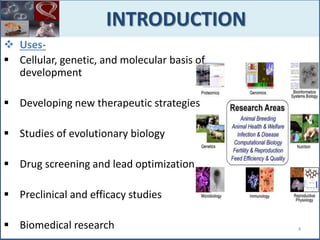
 Uses-
 Cellular, genetic, and molecular basis of
development
 Developing new therapeutic strategies
 Studies of evolutionary biology
 Drug screening and lead optimization
 Preclinical and efficacy studies
 Biomedical research
INTRODUCTION
4
 Rationale-
 Organs and body systems similar to humans and other
animals
 Susceptible to the same diseases that affect humans
 Short life span allows animals to be studied throughout their
entire life
 Environment easily controllable to keep experimental
variables to a minimum
INTRODUCTION
5
6
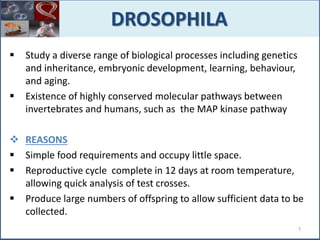
 Study a diverse range of biological processes including genetics
and inheritance, embryonic development, learning, behaviour,
and aging.
 Existence of highly conserved molecular pathways between
invertebrates and humans, such as the MAP kinase pathway
 REASONS
 Simple food requirements and occupy little space.
 Reproductive cycle complete in 12 days at room temperature,
allowing quick analysis of test crosses.
 Produce large numbers of offspring to allow sufficient data to be
collected.
DROSOPHILA
7
 PAST
 In 1995, Christiane Nüsslein-Volhard, Eric Wieschaus, and Ed
Lewis won the Nobel Prize in Physiology or Medicine. Many of
the genes that are important for fly development have been
shown to be critical for all animal development, including
humans.
 In 1999, Craig Venter and colleagues used
the Drosophila genome to prove the practicality of the shot-gun
approach for sequencing the human genome
 PRESENT
 Analysis of fly embryonic development has made a particularly
important contribution to the understanding of developmental
processes in humans.
DROSOPHILA
8
 As a model for wound healing. Green Fluorescent Protein fusion
genes in combination with time lapse imaging have revealed cell
shape changes and movements during wound healing
in Drosophila embryos.
 FUTURE
 Emerging as a valuable system for use in the clinical drug discovery
process . Drosophila can be used as a model to test the effects of
novel drugs on the biochemical pathways conserved within humans
that control many key cellular activities for tissue regeneration such
as cell division, differentiation, and movement.
DROSOPHILA
9
DROSOPHILA
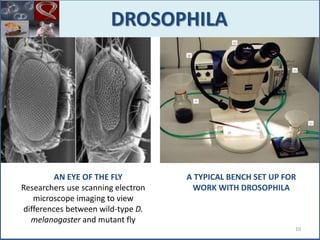
AN EYE OF THE FLY
Researchers use scanning electron
microscope imaging to view
differences between wild-type D.
melanogaster and mutant fly
A TYPICAL BENCH SET UP FOR
WORK WITH DROSOPHILA
10
11
 Valuable for studying the development of simple nervous systems
and the aging process and apoptosis
 REASONS
 Simple structure and transparency allow for direct observation of
cellular phenotypes
 Nervous system of C. elegans is also very simple, making it a good
model for studying neurons.
 Many of the genes appear to have functional counterparts in
humans, and whole pathways are often conserved
C.elegans
12
 PAST
 Seminal discoveries about programmed cell death were made
using C. elegans as a model system and earned Brenner, Sulston
and Robert Horvitz the Nobel Prize in Physiology or Medicine in
2002
 RNA interference-Craig Mello and Andrew Fire were awarded the
Nobel Prize in Physiology or Medicine in 2006.
 PRESENT
 Used as a model system to elucidate the toxicity and toxicological
mechanisms of various heavy metals
C.elegans
13
 Uncovering the genetic basis of neurodegenerative disorders like
Alzheimer disease, Huntington disease, and Duchenne muscular
dystrophy.
 FUTURE
 NemaRx Pharmaceuticals is using the worm to test drugs for
disorders affecting the nervous system, including pain and
Alzheimer’s disease
 Devgen has developed a system to search for therapeutics for
diseases such as diabetes
 Can be exploited to develop potential therapeutic strategies for
Parkinson’s disease
C.elegans
14
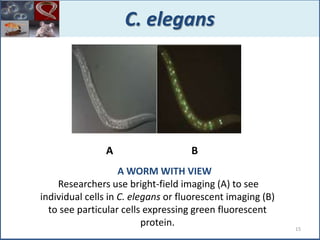
A B
C. elegans
A WORM WITH VIEW
Researchers use bright-field imaging (A) to see
individual cells in C. elegans or fluorescent imaging (B)
to see particular cells expressing green fluorescent
protein. 15
16
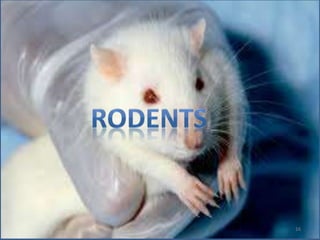
 Rodent models are widely used by researchers in the
pharmaceutical and biotech industries. 95% of all lab animals are
rodents
 For probing the immune, endocrine, nervous, cardiovascular,
skeletal and other complex physiological systems that mammals
share
 REASONS
 Small, easily housed and maintained, and adapt well to new
surroundings, making them easy for researchers to handle
 Reproduce quickly and have a short lifespan of two to three
years
 Genetic, biological and behavior characteristics closely resemble
those of humans
RODENTS
17
 PAST
 First knockout mouse ,created by Mario R. Capecchi, Martin Evans
and Oliver Smithies in 1989
 PRESENT-
 Knockout mouse models of disease are shedding light on
treatment options and critical in understanding different kinds of
cancer, obesity, heart disease, diabetes, arthritis, substance abuse,
anxiety, aging and Parkinson disease
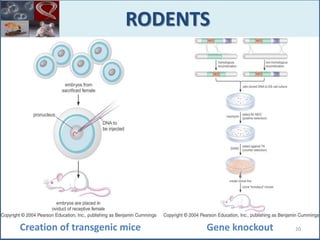
 Transgenic mice has allowed neuroscientists to decipher the
function of particular genes, and to create disease models
 Knocking out the leptin gene in mice demonstrated the role this
hormone has in regulating appetite
RODENTS
18
 Research on the biology of mouse stem cells has helped in
developing human stem cell lines and using them to treat disease
 FUTURE-
 A new protein formed by the fusion of two other proteins,
protects the rodent from cancer. Although humans lack the
hybrid protein, it is produced from a cluster of genes also found
in humans that makes proteins responsible for preventing
damaged cells that might cause cancer from multiplying.
RODENTS
Proceedings of National Academy of Sciences
Feb 2015
19
RODENTS
Creation of transgenic mice Gene knockout 20
RODENTS
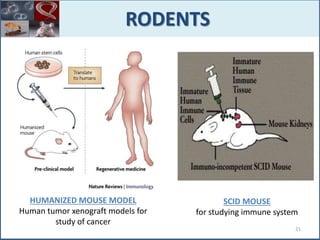
HUMANIZED MOUSE MODEL
Human tumor xenograft models for
study of cancer
SCID MOUSE
for studying immune system
21
22
 Phylogenetically closer to primates than
rodents which makes the model a better
overall approximate to humans
 Serves as a primary experimental model
include Atherosclerosis, Alzheimer’s
disease, eye research, osteoarthritis, and
tuberculosis
 REASONS-
 Docile and non-aggressive and hence easy
to handle and observe
 Accessibility of the vascular system via the
ear veins makes it preferable for
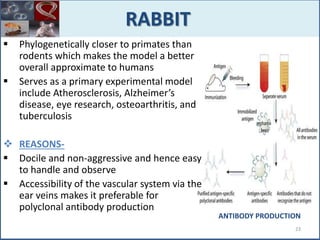
polyclonal antibody production
23
RABBIT
ANTIBODY PRODUCTION
 Ability to produce tumours makes them useful models to study
chemo/immunotherapy as well as immunoprevention of certain
cancers
 PAST-
 Demonstration of continuous dialysis of blood by John Abel in
1914 using anaesthetised rabbits
 Used to study atherosclerosis by Ignatowski (1908).
 Laser advancements made possible by research on rabbits
include eye surgery and the dissolving of plaque build-up on the
walls of arteries
 By injecting rabbits with a toxin found in electric eels, it was
identified Myasthenia Gravis is an autoimmune disease
RABBIT
24
 PRESENT-
 Are used to test pyrogenicity for vaccines, drugs, and medical
devices
 High rate of reproduction hence used to test embryotoxicity
 FUTURE-
 Researchers are assessing whether gene replacement therapy
could prevent cystic fibrosis in new-born rabbits, which could
have a huge impact on therapies for patients with the condition.
RABBIT
25
26
 Used for mapping and identifying genes involved in organ
development. Excellent model for studying infectious diseases
 REASONS-
 Has most of the same organs found in mammals. Most human
genes have homologues in zebrafish such as ATP-binding
domains of kinases
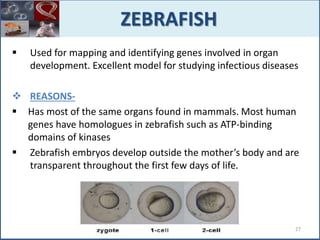
 Zebrafish embryos develop outside the mother’s body and are
transparent throughout the first few days of life.
ZEBRAFISH
27
 Produce 200-300 fertilised eggs every week; an ideal attribute for
genetic studies
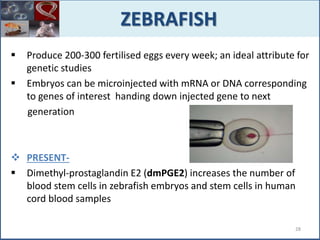
 Embryos can be microinjected with mRNA or DNA corresponding
to genes of interest handing down injected gene to next
generation
 PRESENT-
 Dimethyl-prostaglandin E2 (dmPGE2) increases the number of
blood stem cells in zebrafish embryos and stem cells in human
cord blood samples
ZEBRAFISH
28
 Large numbers of mutations disrupt embryonic development in
zebrafish, serve as models for human diseases like muscular
dystrophy, neurodegenrative diseases
 Leflunomide is in early phase clinical trials to kill melanoma cells.
 FUTURE-
 Creation of a transparent version of adult zebrafish. Behaviour of
tumour cells can be followed like the birth, growth and spread of
tumours can be scrutinised
 As a disease model for Tuberculosis because zebrafish embryos
are transparent, infection with fluorescently-labelled
tuberculosis bacteria.
ZEBRAFISH
29
30
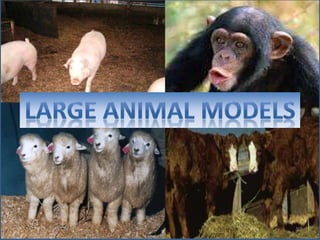
 Small animal models are best suited for discovery phases of
research and larger animal models are required for pre-clinical
and translational research
 REASONS-
 Similarities
 Pathogens that naturally infect large animals are genetically
closely related to those that afflict human
 Pathological and clinical changes that occur after infection in
large animals mimic the human response much more closely
than does in an unnatural lab host
LARGE ANIMAL MODELS
31
 PAST-
 First smallpox vaccine was generated using the cowpox virus
 Since 1960, hundreds of thousands of pig and cow heart valves
have been placed in humans
 Pig and sheep hypothalamus were used to isolate and sequence
thyroid stimulating hormone and gonadotropin releasing hormone
leading to the Nobel Prize 1977
 PRESENT-
 Sheep: Studying osteoporosis and evaluation of orthopaedic
implants
 Pigs: to test stem cells for treating spinal cord injury
LARGE ANIMAL MODELS
32
 Horses: long lifespan, and similar ovarian follicle development may
make this animal useful for studies into fertility in aging women
 Nonhuman primates: such as macaques and baboons are excellent
animal models for population-based research on behavioural and
social processes
 FUTURE-
 Databases from immune tissue of large animals will provide an
expanding resource for genomic approaches to immunology
 Recent development of a α-1,3-galactosyltransferase knockout pig
may allow transplantation of whole organs without rejection by the
immune system
LARGE ANIMAL MODELS
33
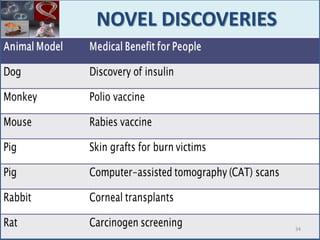
NOVEL DISCOVERIES
34
CONCLUSION
 An animal that can be used in research in order to obtain results that
can be extrapolated to human
 The interaction of cells, tissues and organs within the body is very
complex, and can often only be studied in the whole animal
 The most popular invertebrate model organisms, Drosophila and C.
elegans have been used extensively in areas of biological research
especially genetics and development
 Essential part of modern research and development. Early-stage
animal testing is typically conducted in rodents, followed by drug
safety testing and certain efficacy evaluations in larger mammals,
such as rabbits and dogs
35
36

Animal Research Models:Potential

  • 1.
    ASRA NASIR KHAN 14MBT 06 ANIMAL RESEARCH MODEL: POTENTIAL 1
  • 2.
     Introduction  Drosophila C. elegans  Rodents  Rabbit  Zebrafish  Large Animal Models  Novel discoveries  Conclusion CONTENT 2
  • 3.
     Definition-living organismin which biology or behaviour can be studied or in which a spontaneous or induced pathological process can be investigated and in which the phenomenon in one or more respects resembles the same phenomenon in humans or other species of animal  Describes biological phenomenon that the species has in common with target species  Used in laboratory animal science which is concerned with quality of animals as tools in biomedical research INTRODUCTION 3
  • 4.
     Uses-  Cellular,genetic, and molecular basis of development  Developing new therapeutic strategies  Studies of evolutionary biology  Drug screening and lead optimization  Preclinical and efficacy studies  Biomedical research INTRODUCTION 4
  • 5.
     Rationale-  Organsand body systems similar to humans and other animals  Susceptible to the same diseases that affect humans  Short life span allows animals to be studied throughout their entire life  Environment easily controllable to keep experimental variables to a minimum INTRODUCTION 5
  • 6.
  • 7.
     Study adiverse range of biological processes including genetics and inheritance, embryonic development, learning, behaviour, and aging.  Existence of highly conserved molecular pathways between invertebrates and humans, such as the MAP kinase pathway  REASONS  Simple food requirements and occupy little space.  Reproductive cycle complete in 12 days at room temperature, allowing quick analysis of test crosses.  Produce large numbers of offspring to allow sufficient data to be collected. DROSOPHILA 7
  • 8.
     PAST  In1995, Christiane Nüsslein-Volhard, Eric Wieschaus, and Ed Lewis won the Nobel Prize in Physiology or Medicine. Many of the genes that are important for fly development have been shown to be critical for all animal development, including humans.  In 1999, Craig Venter and colleagues used the Drosophila genome to prove the practicality of the shot-gun approach for sequencing the human genome  PRESENT  Analysis of fly embryonic development has made a particularly important contribution to the understanding of developmental processes in humans. DROSOPHILA 8
  • 9.
     As amodel for wound healing. Green Fluorescent Protein fusion genes in combination with time lapse imaging have revealed cell shape changes and movements during wound healing in Drosophila embryos.  FUTURE  Emerging as a valuable system for use in the clinical drug discovery process . Drosophila can be used as a model to test the effects of novel drugs on the biochemical pathways conserved within humans that control many key cellular activities for tissue regeneration such as cell division, differentiation, and movement. DROSOPHILA 9
  • 10.
    DROSOPHILA AN EYE OFTHE FLY Researchers use scanning electron microscope imaging to view differences between wild-type D. melanogaster and mutant fly A TYPICAL BENCH SET UP FOR WORK WITH DROSOPHILA 10
  • 11.
  • 12.
     Valuable forstudying the development of simple nervous systems and the aging process and apoptosis  REASONS  Simple structure and transparency allow for direct observation of cellular phenotypes  Nervous system of C. elegans is also very simple, making it a good model for studying neurons.  Many of the genes appear to have functional counterparts in humans, and whole pathways are often conserved C.elegans 12
  • 13.
     PAST  Seminaldiscoveries about programmed cell death were made using C. elegans as a model system and earned Brenner, Sulston and Robert Horvitz the Nobel Prize in Physiology or Medicine in 2002  RNA interference-Craig Mello and Andrew Fire were awarded the Nobel Prize in Physiology or Medicine in 2006.  PRESENT  Used as a model system to elucidate the toxicity and toxicological mechanisms of various heavy metals C.elegans 13
  • 14.
     Uncovering thegenetic basis of neurodegenerative disorders like Alzheimer disease, Huntington disease, and Duchenne muscular dystrophy.  FUTURE  NemaRx Pharmaceuticals is using the worm to test drugs for disorders affecting the nervous system, including pain and Alzheimer’s disease  Devgen has developed a system to search for therapeutics for diseases such as diabetes  Can be exploited to develop potential therapeutic strategies for Parkinson’s disease C.elegans 14
  • 15.
    A B C. elegans AWORM WITH VIEW Researchers use bright-field imaging (A) to see individual cells in C. elegans or fluorescent imaging (B) to see particular cells expressing green fluorescent protein. 15
  • 16.
  • 17.
     Rodent modelsare widely used by researchers in the pharmaceutical and biotech industries. 95% of all lab animals are rodents  For probing the immune, endocrine, nervous, cardiovascular, skeletal and other complex physiological systems that mammals share  REASONS  Small, easily housed and maintained, and adapt well to new surroundings, making them easy for researchers to handle  Reproduce quickly and have a short lifespan of two to three years  Genetic, biological and behavior characteristics closely resemble those of humans RODENTS 17
  • 18.
     PAST  Firstknockout mouse ,created by Mario R. Capecchi, Martin Evans and Oliver Smithies in 1989  PRESENT-  Knockout mouse models of disease are shedding light on treatment options and critical in understanding different kinds of cancer, obesity, heart disease, diabetes, arthritis, substance abuse, anxiety, aging and Parkinson disease  Transgenic mice has allowed neuroscientists to decipher the function of particular genes, and to create disease models  Knocking out the leptin gene in mice demonstrated the role this hormone has in regulating appetite RODENTS 18
  • 19.
     Research onthe biology of mouse stem cells has helped in developing human stem cell lines and using them to treat disease  FUTURE-  A new protein formed by the fusion of two other proteins, protects the rodent from cancer. Although humans lack the hybrid protein, it is produced from a cluster of genes also found in humans that makes proteins responsible for preventing damaged cells that might cause cancer from multiplying. RODENTS Proceedings of National Academy of Sciences Feb 2015 19
  • 20.
    RODENTS Creation of transgenicmice Gene knockout 20
  • 21.
    RODENTS HUMANIZED MOUSE MODEL Humantumor xenograft models for study of cancer SCID MOUSE for studying immune system 21
  • 22.
  • 23.
     Phylogenetically closerto primates than rodents which makes the model a better overall approximate to humans  Serves as a primary experimental model include Atherosclerosis, Alzheimer’s disease, eye research, osteoarthritis, and tuberculosis  REASONS-  Docile and non-aggressive and hence easy to handle and observe  Accessibility of the vascular system via the ear veins makes it preferable for polyclonal antibody production 23 RABBIT ANTIBODY PRODUCTION
  • 24.
     Ability toproduce tumours makes them useful models to study chemo/immunotherapy as well as immunoprevention of certain cancers  PAST-  Demonstration of continuous dialysis of blood by John Abel in 1914 using anaesthetised rabbits  Used to study atherosclerosis by Ignatowski (1908).  Laser advancements made possible by research on rabbits include eye surgery and the dissolving of plaque build-up on the walls of arteries  By injecting rabbits with a toxin found in electric eels, it was identified Myasthenia Gravis is an autoimmune disease RABBIT 24
  • 25.
     PRESENT-  Areused to test pyrogenicity for vaccines, drugs, and medical devices  High rate of reproduction hence used to test embryotoxicity  FUTURE-  Researchers are assessing whether gene replacement therapy could prevent cystic fibrosis in new-born rabbits, which could have a huge impact on therapies for patients with the condition. RABBIT 25
  • 26.
  • 27.
     Used formapping and identifying genes involved in organ development. Excellent model for studying infectious diseases  REASONS-  Has most of the same organs found in mammals. Most human genes have homologues in zebrafish such as ATP-binding domains of kinases  Zebrafish embryos develop outside the mother’s body and are transparent throughout the first few days of life. ZEBRAFISH 27
  • 28.
     Produce 200-300fertilised eggs every week; an ideal attribute for genetic studies  Embryos can be microinjected with mRNA or DNA corresponding to genes of interest handing down injected gene to next generation  PRESENT-  Dimethyl-prostaglandin E2 (dmPGE2) increases the number of blood stem cells in zebrafish embryos and stem cells in human cord blood samples ZEBRAFISH 28
  • 29.
     Large numbersof mutations disrupt embryonic development in zebrafish, serve as models for human diseases like muscular dystrophy, neurodegenrative diseases  Leflunomide is in early phase clinical trials to kill melanoma cells.  FUTURE-  Creation of a transparent version of adult zebrafish. Behaviour of tumour cells can be followed like the birth, growth and spread of tumours can be scrutinised  As a disease model for Tuberculosis because zebrafish embryos are transparent, infection with fluorescently-labelled tuberculosis bacteria. ZEBRAFISH 29
  • 30.
  • 31.
     Small animalmodels are best suited for discovery phases of research and larger animal models are required for pre-clinical and translational research  REASONS-  Similarities  Pathogens that naturally infect large animals are genetically closely related to those that afflict human  Pathological and clinical changes that occur after infection in large animals mimic the human response much more closely than does in an unnatural lab host LARGE ANIMAL MODELS 31
  • 32.
     PAST-  Firstsmallpox vaccine was generated using the cowpox virus  Since 1960, hundreds of thousands of pig and cow heart valves have been placed in humans  Pig and sheep hypothalamus were used to isolate and sequence thyroid stimulating hormone and gonadotropin releasing hormone leading to the Nobel Prize 1977  PRESENT-  Sheep: Studying osteoporosis and evaluation of orthopaedic implants  Pigs: to test stem cells for treating spinal cord injury LARGE ANIMAL MODELS 32
  • 33.
     Horses: longlifespan, and similar ovarian follicle development may make this animal useful for studies into fertility in aging women  Nonhuman primates: such as macaques and baboons are excellent animal models for population-based research on behavioural and social processes  FUTURE-  Databases from immune tissue of large animals will provide an expanding resource for genomic approaches to immunology  Recent development of a α-1,3-galactosyltransferase knockout pig may allow transplantation of whole organs without rejection by the immune system LARGE ANIMAL MODELS 33
  • 34.
  • 35.
    CONCLUSION  An animalthat can be used in research in order to obtain results that can be extrapolated to human  The interaction of cells, tissues and organs within the body is very complex, and can often only be studied in the whole animal  The most popular invertebrate model organisms, Drosophila and C. elegans have been used extensively in areas of biological research especially genetics and development  Essential part of modern research and development. Early-stage animal testing is typically conducted in rodents, followed by drug safety testing and certain efficacy evaluations in larger mammals, such as rabbits and dogs 35
  • 36.

Editor's Notes

  • #9 One Drosophila organ that researchers extensively analyze is the compound eye, which develops from a monolayer precursor tissue in the larva and consists of about 800 unit eyes (ommatidia) arranged in a highly accurate pattern (Figure 1). The large number and stereotypic pattern of the unit eyes make it easy for researchers to use the eye phenotype to identify genes interacting with a disease gene or drugs affecting components of the pathway (6, 7).
  • #11 a) stereomicroscope, (b) CO 2 regulator, (c) chamber for anesthesia, (d) paint brush, (e) porous pad connected to CO 2 , (f) a fly morgue: a bottle containing methanol, and (g) a cold light source
  • #14 gene silencing by double-stranded RNA . Studies focused on lethality, reproduction, life span, and protein expression
  • #15 .
  • #19 Hopkins received a Nobel Prize for this discovery in 1929 , for which they were awarded the Nobel Prize for Medicine in 2007.
  • #25 and dialysis membranes made from treated parchment in which the human immune system attacks receptors on muscles, resulting in fatigue, weakness, and potential death
  • #26 Pyrogenicity-(the ability of the product to induce a fever).
  • #29 a known small lipid mediator of inflammation that is upregulated during marrow transplantation Genome Med. 2011; 3(12): 83
  • #30 Nature 471, 518–522
  • #33 Historically, large animals have made many contributions to greater understanding of human health: