selfexplanatory.2022
Hello
HI
नमस्ते
ْ‫م‬ُ‫ك‬ْ‫ي‬‫ا‬‫ل‬‫ا‬‫ع‬ ُ‫م‬ ‫ا‬
‫َل‬ َّ
‫الس‬
ِ َّ
‫ٱَّلل‬ ُ‫اة‬‫م‬ْ‫ح‬‫ا‬‫ر‬‫ا‬‫و‬
ُ‫ه‬ُ‫ت‬‫كا‬‫ا‬‫ر‬‫ا‬‫ب‬‫ا‬‫و‬
Saba Parvin Haque
M.Sc. Life Sciences
(Specialization in Neurobiology)
from “Sophia College”
(Autonomous), Mumbai.
ANIMAL CLASSIFICATION
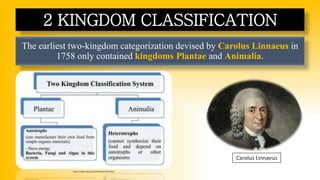
The earliest two-kingdom categorization devised by Carolus Linnaeus in
1758 only contained kingdoms Plantae and Animalia.
2 KINGDOM CLASSIFICATION
https://images.app.goo.gl/N57WaVqwSeKEEDNNA
Carolus Linnaeus
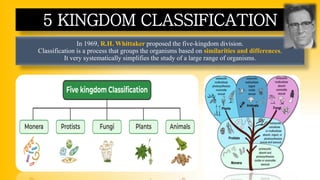
In 1969, R.H. Whittaker proposed the five-kingdom division.
Classification is a process that groups the organisms based on similarities and differences.
It very systematically simplifies the study of a large range of organisms.
5 KINGDOM CLASSIFICATION
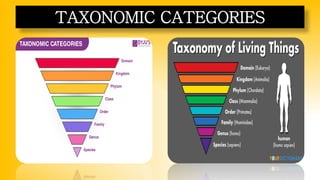
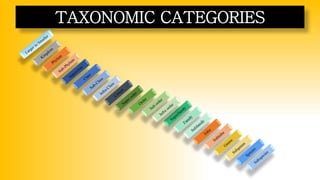
TAXONOMIC CATEGORIES
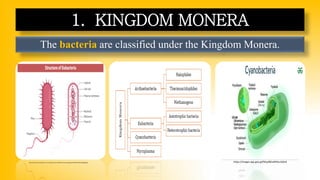
The bacteria are classified under the Kingdom Monera.
1. KINGDOM MONERA
https://encrypted-tbn0.gstatic.com/images?q=tbn:ANd9GcTOLmuAeFywgug3aVvRDD7S3OOZ5P3X9gg0vg&s https://images.app.goo.gl/fWyaf6EwRhNu1QXs9
Monerans have the following characteristics:
1. KINGDOM MONERA
❑ These creatures are prokaryotic, which means they lack a distinct nucleus and cell organelles.
❑ They have only one cell (Unicellular). Some may be colonial or filamentous in nature.
❑ No cellular organelles are attached to membranes.
❑ Some species have cell walls (such as bacteria and blue-green algae), whereas others have not (such as
Mycoplasma).
❑ Aerobic or anaerobic respiration can occur.
o Obligate aerobes are those that cannot survive in the absence of oxygen. Bacillus subtilis with
Rhodospirillum.
o Obligate anaerobes are organisms that cannot thrive in an oxygen-rich environment, such as Clostridium
botulinum.
❑ Nutrition is either autotrophic (as in blue-green algae and some bacteria) or heterotrophic (as in Mycoplasma
and the majority of bacteria). They may be both saprophytic and parasitic.
❑ The most common way of reproduction is asexual.
o The most prevalent mechanism of multiplication is binary fission.
o Under some conditions, bacteria such as Clostridium and Bacillus create thick-walled endospores that are
highly resistant.
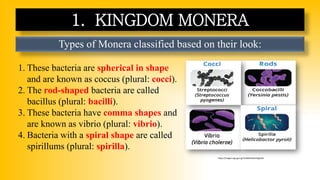
Types of Monera classified based on their look:
1. KINGDOM MONERA
1. These bacteria are spherical in shape
and are known as coccus (plural: cocci).
2. The rod-shaped bacteria are called
bacillus (plural: bacilli).
3. These bacteria have comma shapes and
are known as vibrio (plural: vibrio).
4. Bacteria with a spiral shape are called
spirillums (plural: spirilla).
https://images.app.goo.gl/7ahBWstMxUZfgiAdA
There are three subkingdoms within the Kingdom of Monera:
1. KINGDOM MONERA
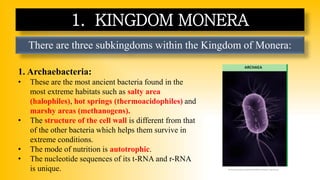
1. Archaebacteria:
• These are the most ancient bacteria found in the
most extreme habitats such as salty area
(halophiles), hot springs (thermoacidophiles) and
marshy areas (methanogens).
• The structure of the cell wall is different from that
of the other bacteria which helps them survive in
extreme conditions.
• The mode of nutrition is autotrophic.
• The nucleotide sequences of its t-RNA and r-RNA
is unique. https://www.careerpower.in/blog/wp-content/uploads/sites/2/2023/08/25151427/Classifications-of-Kingdom-Monera.png
There are three subkingdoms within the Kingdom of Monera:
1. KINGDOM MONERA
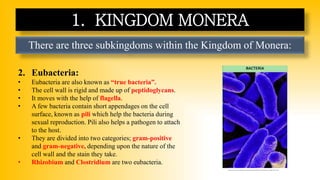
2. Eubacteria:
• Eubacteria are also known as “true bacteria”.
• The cell wall is rigid and made up of peptidoglycans.
• It moves with the help of flagella.
• A few bacteria contain short appendages on the cell
surface, known as pili which help the bacteria during
sexual reproduction. Pili also helps a pathogen to attach
to the host.
• They are divided into two categories; gram-positive
and gram-negative, depending upon the nature of the
cell wall and the stain they take.
• Rhizobium and Clostridium are two eubacteria.
https://www.careerpower.in/blog/wp-content/uploads/sites/2/2023/08/25151427/Classifications-of-Kingdom-Monera.png
There are three subkingdoms within the Kingdom of Monera:
1. KINGDOM MONERA
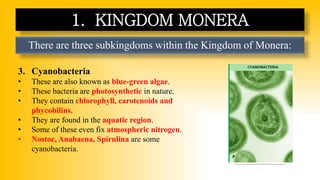
3. Cyanobacteria
• These are also known as blue-green algae.
• These bacteria are photosynthetic in nature.
• They contain chlorophyll, carotenoids and
phycobilins.
• They are found in the aquatic region.
• Some of these even fix atmospheric nitrogen.
• Nostoc, Anabaena, Spirulina are some
cyanobacteria.
https://www.careerpower.in/blog/wp-content/uploads/sites/2/2023/08/25151427/Classifications-of-Kingdom-Monera.png
Protista has the following Characteristics:
2. KINGDOM PROTISTA
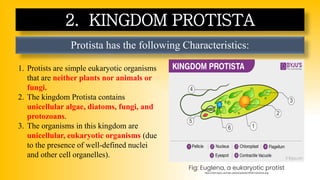
1. Protists are simple eukaryotic organisms
that are neither plants nor animals or
fungi.
2. The kingdom Protista contains
unicellular algae, diatoms, fungi, and
protozoans.
3. The organisms in this kingdom are
unicellular, eukaryotic organisms (due
to the presence of well-defined nuclei
and other cell organelles).
Fig: Euglena, a eukaryotic protist
https://cdn1.byjus.com/wp-content/uploads/2018/11/protista.png
Protista has the following Characteristics:
2. KINGDOM PROTISTA
4. They have cytoplasmic 80S
ribosomes, Organelles include 70S
ribosomes.
5. They exhibit both zygotic and
gametic meiosis.
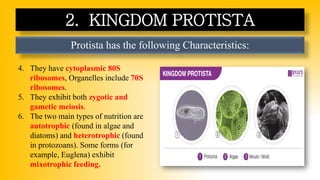
6. The two main types of nutrition are
autotrophic (found in algae and
diatoms) and heterotrophic (found
in protozoans). Some forms (for
example, Euglena) exhibit
mixotrophic feeding.
Protista has the following Characteristics:
2. KINGDOM PROTISTA
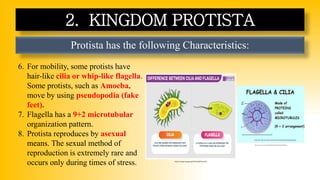
6. For mobility, some protists have
hair-like cilia or whip-like flagella.
Some protists, such as Amoeba,
move by using pseudopodia (fake
feet).
7. Flagella has a 9+2 microtubular
organization pattern.
8. Protista reproduces by asexual
means. The sexual method of
reproduction is extremely rare and
occurs only during times of stress.
https://hi-static.z-dn.net/files/d93/6d9985643e32b33b4ab7f18b3ed62004.png
https://images.app.goo.gl/HPYQFLjBfZ4Uys6VA
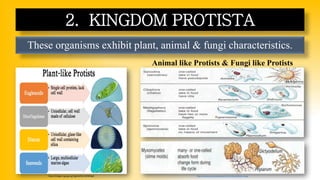
These organisms exhibit plant, animal & fungi characteristics.
2. KINGDOM PROTISTA
Animal like Protists & Fungi like Protists
https://images.app.goo.gl/ZgbuWtfam9xPBSRg9 https://biosessions.weebly.com/uploads/1/7/5/1/17514029/64462_orig.jpg
Protista has the following Characteristics:
2. KINGDOM PROTISTA
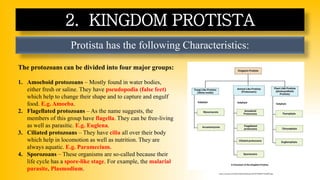
The protozoans can be divided into four major groups:
1. Amoeboid protozoans – Mostly found in water bodies,
either fresh or saline. They have pseudopodia (false feet)
which help to change their shape and to capture and engulf
food. E.g. Amoeba.
2. Flagellated protozoans – As the name suggests, the
members of this group have flagella. They can be free-living
as well as parasitic. E.g. Euglena.
3. Ciliated protozoans – They have cilia all over their body
which help in locomotion as well as nutrition. They are
always aquatic. E.g. Paramecium.
4. Sporozoans – These organisms are so-called because their
life cycle has a spore-like stage. For example, the malarial
parasite, Plasmodium.
https://i.pinimg.com/736x/53/e8/1a/53e81aeecdf7cf5279e6993773ed0476.jpg
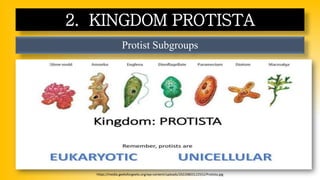
Protist Subgroups
2. KINGDOM PROTISTA
https://media.geeksforgeeks.org/wp-content/uploads/20220803122552/Protista.jpg
Economic Importance of Protists
2. KINGDOM PROTISTA
❑Protists serve as the foundation of the food chain.
❑Protists are symbionts – having a close relationship between two species in which,
one is benefited.
❑Some protists also produce oxygen and may be used to produce biofuel.
❑Protists are the primary sources of food for many animals.
❑In some rare cases, Protists are harvested by humans for food and other industrial
applications.
❑Phytoplankton is one of the sole food sources for whales
❑Seaweed is an alga, which is considered a plant-like protist.
❑Zooplankton is fed on by various sea creatures including shrimp and larval crabs.
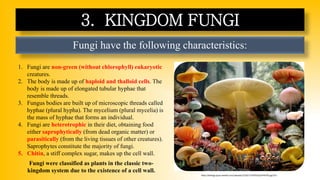
Fungi have the following characteristics:
3. KINGDOM FUNGI
1. Fungi are non-green (without chlorophyll) eukaryotic
creatures.
2. The body is made up of haploid and thalloid cells. The
body is made up of elongated tubular hyphae that
resemble threads.
3. Fungus bodies are built up of microscopic threads called
hyphae (plural hypha). The mycelium (plural mycelia) is
the mass of hyphae that forms an individual.
4. Fungi are heterotrophic in their diet, obtaining food
either saprophytically (from dead organic matter) or
parasitically (from the living tissues of other creatures).
Saprophytes constitute the majority of fungi.
5. Chitin, a stiff complex sugar, makes up the cell wall.
Fungi were classified as plants in the classic two-
kingdom system due to the existence of a cell wall.
https://biology-igcse.weebly.com/uploads/1/5/0/7/15070316/6740705.jpg?523
Fungi have the following characteristics:
3. KINGDOM FUNGI
6. Glycogen is the main component of reserve food
material.
7. Some fungi, like lichens, have symbiotic relationships
with green algae or blue-green algae.
8. Many fungi cause diseases in both animals (such as
ringworm) and plants (such as wheat black stem rust,
mustard white rust, and potato late blight).
9. Yeast, Rhizopus, mushrooms, Aspergillus, and
Penicillium are other examples.
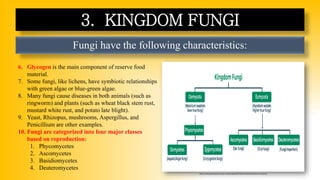
10. Fungi are categorized into four major classes
based on reproduction:
1. Phycomycetes
2. Ascomycetes
3. Basidiomycetes
4. Deuteromycetes
https://media.geeksforgeeks.org/wp-content/uploads/20231003171041/Classification-of-Fungi.png
Kingdom Plantae has the following characteristics:
4. KINGDOM PLANTAE
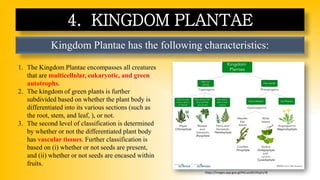
1. The Kingdom Plantae encompasses all creatures
that are multicellular, eukaryotic, and green
autotrophs.
2. The kingdom of green plants is further
subdivided based on whether the plant body is
differentiated into its various sections (such as
the root, stem, and leaf, ), or not.
3. The second level of classification is determined
by whether or not the differentiated plant body
has vascular tissues. Further classification is
based on (i) whether or not seeds are present,
and (ii) whether or not seeds are encased within
fruits.
https://images.app.goo.gl/McLasZ6CiDtqJry78
Kingdom Plantae has the following characteristics:
4. KINGDOM PLANTAE
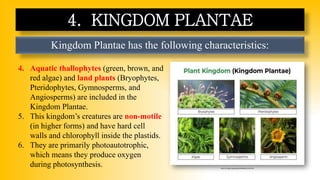
4. Aquatic thallophytes (green, brown, and
red algae) and land plants (Bryophytes,
Pteridophytes, Gymnosperms, and
Angiosperms) are included in the
Kingdom Plantae.
5. This kingdom’s creatures are non-motile
(in higher forms) and have hard cell
walls and chlorophyll inside the plastids.
6. They are primarily photoautotrophic,
which means they produce oxygen
during photosynthesis. https://images.app.goo.gl/ao44Q9GLeLULvA7bA
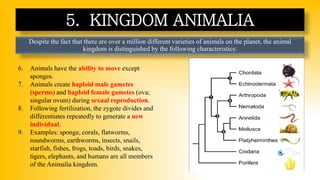
Despite the fact that there are over a million different varieties of animals on the planet, the animal
kingdom is distinguished by the following characteristics:
5. KINGDOM ANIMALIA
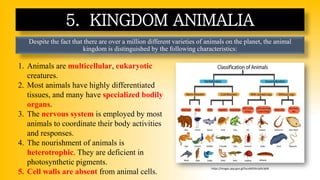
1. Animals are multicellular, eukaryotic
creatures.
2. Most animals have highly differentiated
tissues, and many have specialized bodily
organs.
3. The nervous system is employed by most
animals to coordinate their body activities
and responses.
4. The nourishment of animals is
heterotrophic. They are deficient in
photosynthetic pigments.
5. Cell walls are absent from animal cells.
https://images.app.goo.gl/EycoMSVkUy9iLXjK8
Despite the fact that there are over a million different varieties of animals on the planet, the animal
kingdom is distinguished by the following characteristics:
5. KINGDOM ANIMALIA
6. Animals have the ability to move except
sponges.
7. Animals create haploid male gametes
(sperms) and haploid female gametes (ova;
singular ovum) during sexual reproduction.
8. Following fertilization, the zygote divides and
differentiates repeatedly to generate a new
individual.
9. Examples: sponge, corals, flatworms,
roundworms, earthworms, insects, snails,
starfish, fishes, frogs, toads, birds, snakes,
tigers, elephants, and humans are all members
of the Animalia kingdom.
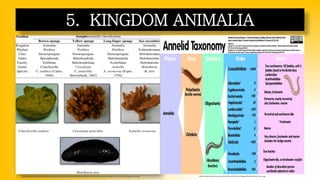
5. KINGDOM ANIMALIA
https://www.researchgate.net/profile/Moaz-Hamed-2/publication/342493343/figure/tbl1/AS:906999210463233@1593256871525/Classification-position-of-sponges-and-sea-cucumber-within-Kingdom-Animalia.png https://www.earthwormsoc.org.uk/sites/default/files/inline-images/Annelid%20Taxonomy_1.jpg
1.Kingdom Monera includes all prokaryotic creatures.
2.Fungi were classified as a separate kingdom because they are
heterotrophs with chitin cell walls.
3.All unicellular eukaryotic species were classified as Protista.
4.It looked at the evolutionary link between creatures.
BENEFITS OF THE FIVE KINGDOM CLASSIFICATION
❑ https://www.geeksforgeeks.org/five-kingdom-classification/
❑ https://images.app.goo.gl/L5UhcY2EYpDUvfY77
❑ https://images.app.goo.gl/hyezXicXWujwqqPM8
❑ https://upload.wikimedia.org/wikipedia/en/0/01/Whittaker-Robert-H-1920-1980.jpg
❑ https://images.app.goo.gl/ootRq4RMnwkzTL2UA
❑ https://www.geeksforgeeks.org/protista/
❑ https://byjus.com/biology/protista/
REFERENCES

Animal Classification Based on 5 Kingdom Division.pdf

  • 1.
    selfexplanatory.2022 Hello HI नमस्ते ْ‫م‬ُ‫ك‬ْ‫ي‬‫ا‬‫ل‬‫ا‬‫ع‬ ُ‫م‬ ‫ا‬ ‫َل‬َّ ‫الس‬ ِ َّ ‫ٱَّلل‬ ُ‫اة‬‫م‬ْ‫ح‬‫ا‬‫ر‬‫ا‬‫و‬ ُ‫ه‬ُ‫ت‬‫كا‬‫ا‬‫ر‬‫ا‬‫ب‬‫ا‬‫و‬ Saba Parvin Haque M.Sc. Life Sciences (Specialization in Neurobiology) from “Sophia College” (Autonomous), Mumbai.
  • 2.
  • 3.
    The earliest two-kingdomcategorization devised by Carolus Linnaeus in 1758 only contained kingdoms Plantae and Animalia. 2 KINGDOM CLASSIFICATION https://images.app.goo.gl/N57WaVqwSeKEEDNNA Carolus Linnaeus
  • 4.
    In 1969, R.H.Whittaker proposed the five-kingdom division. Classification is a process that groups the organisms based on similarities and differences. It very systematically simplifies the study of a large range of organisms. 5 KINGDOM CLASSIFICATION
  • 5.
  • 6.
  • 7.
    The bacteria areclassified under the Kingdom Monera. 1. KINGDOM MONERA https://encrypted-tbn0.gstatic.com/images?q=tbn:ANd9GcTOLmuAeFywgug3aVvRDD7S3OOZ5P3X9gg0vg&s https://images.app.goo.gl/fWyaf6EwRhNu1QXs9
  • 8.
    Monerans have thefollowing characteristics: 1. KINGDOM MONERA ❑ These creatures are prokaryotic, which means they lack a distinct nucleus and cell organelles. ❑ They have only one cell (Unicellular). Some may be colonial or filamentous in nature. ❑ No cellular organelles are attached to membranes. ❑ Some species have cell walls (such as bacteria and blue-green algae), whereas others have not (such as Mycoplasma). ❑ Aerobic or anaerobic respiration can occur. o Obligate aerobes are those that cannot survive in the absence of oxygen. Bacillus subtilis with Rhodospirillum. o Obligate anaerobes are organisms that cannot thrive in an oxygen-rich environment, such as Clostridium botulinum. ❑ Nutrition is either autotrophic (as in blue-green algae and some bacteria) or heterotrophic (as in Mycoplasma and the majority of bacteria). They may be both saprophytic and parasitic. ❑ The most common way of reproduction is asexual. o The most prevalent mechanism of multiplication is binary fission. o Under some conditions, bacteria such as Clostridium and Bacillus create thick-walled endospores that are highly resistant.
  • 9.
    Types of Moneraclassified based on their look: 1. KINGDOM MONERA 1. These bacteria are spherical in shape and are known as coccus (plural: cocci). 2. The rod-shaped bacteria are called bacillus (plural: bacilli). 3. These bacteria have comma shapes and are known as vibrio (plural: vibrio). 4. Bacteria with a spiral shape are called spirillums (plural: spirilla). https://images.app.goo.gl/7ahBWstMxUZfgiAdA
  • 10.
    There are threesubkingdoms within the Kingdom of Monera: 1. KINGDOM MONERA 1. Archaebacteria: • These are the most ancient bacteria found in the most extreme habitats such as salty area (halophiles), hot springs (thermoacidophiles) and marshy areas (methanogens). • The structure of the cell wall is different from that of the other bacteria which helps them survive in extreme conditions. • The mode of nutrition is autotrophic. • The nucleotide sequences of its t-RNA and r-RNA is unique. https://www.careerpower.in/blog/wp-content/uploads/sites/2/2023/08/25151427/Classifications-of-Kingdom-Monera.png
  • 11.
    There are threesubkingdoms within the Kingdom of Monera: 1. KINGDOM MONERA 2. Eubacteria: • Eubacteria are also known as “true bacteria”. • The cell wall is rigid and made up of peptidoglycans. • It moves with the help of flagella. • A few bacteria contain short appendages on the cell surface, known as pili which help the bacteria during sexual reproduction. Pili also helps a pathogen to attach to the host. • They are divided into two categories; gram-positive and gram-negative, depending upon the nature of the cell wall and the stain they take. • Rhizobium and Clostridium are two eubacteria. https://www.careerpower.in/blog/wp-content/uploads/sites/2/2023/08/25151427/Classifications-of-Kingdom-Monera.png
  • 12.
    There are threesubkingdoms within the Kingdom of Monera: 1. KINGDOM MONERA 3. Cyanobacteria • These are also known as blue-green algae. • These bacteria are photosynthetic in nature. • They contain chlorophyll, carotenoids and phycobilins. • They are found in the aquatic region. • Some of these even fix atmospheric nitrogen. • Nostoc, Anabaena, Spirulina are some cyanobacteria. https://www.careerpower.in/blog/wp-content/uploads/sites/2/2023/08/25151427/Classifications-of-Kingdom-Monera.png
  • 13.
    Protista has thefollowing Characteristics: 2. KINGDOM PROTISTA 1. Protists are simple eukaryotic organisms that are neither plants nor animals or fungi. 2. The kingdom Protista contains unicellular algae, diatoms, fungi, and protozoans. 3. The organisms in this kingdom are unicellular, eukaryotic organisms (due to the presence of well-defined nuclei and other cell organelles). Fig: Euglena, a eukaryotic protist https://cdn1.byjus.com/wp-content/uploads/2018/11/protista.png
  • 14.
    Protista has thefollowing Characteristics: 2. KINGDOM PROTISTA 4. They have cytoplasmic 80S ribosomes, Organelles include 70S ribosomes. 5. They exhibit both zygotic and gametic meiosis. 6. The two main types of nutrition are autotrophic (found in algae and diatoms) and heterotrophic (found in protozoans). Some forms (for example, Euglena) exhibit mixotrophic feeding.
  • 15.
    Protista has thefollowing Characteristics: 2. KINGDOM PROTISTA 6. For mobility, some protists have hair-like cilia or whip-like flagella. Some protists, such as Amoeba, move by using pseudopodia (fake feet). 7. Flagella has a 9+2 microtubular organization pattern. 8. Protista reproduces by asexual means. The sexual method of reproduction is extremely rare and occurs only during times of stress. https://hi-static.z-dn.net/files/d93/6d9985643e32b33b4ab7f18b3ed62004.png https://images.app.goo.gl/HPYQFLjBfZ4Uys6VA
  • 16.
    These organisms exhibitplant, animal & fungi characteristics. 2. KINGDOM PROTISTA Animal like Protists & Fungi like Protists https://images.app.goo.gl/ZgbuWtfam9xPBSRg9 https://biosessions.weebly.com/uploads/1/7/5/1/17514029/64462_orig.jpg
  • 17.
    Protista has thefollowing Characteristics: 2. KINGDOM PROTISTA The protozoans can be divided into four major groups: 1. Amoeboid protozoans – Mostly found in water bodies, either fresh or saline. They have pseudopodia (false feet) which help to change their shape and to capture and engulf food. E.g. Amoeba. 2. Flagellated protozoans – As the name suggests, the members of this group have flagella. They can be free-living as well as parasitic. E.g. Euglena. 3. Ciliated protozoans – They have cilia all over their body which help in locomotion as well as nutrition. They are always aquatic. E.g. Paramecium. 4. Sporozoans – These organisms are so-called because their life cycle has a spore-like stage. For example, the malarial parasite, Plasmodium. https://i.pinimg.com/736x/53/e8/1a/53e81aeecdf7cf5279e6993773ed0476.jpg
  • 18.
    Protist Subgroups 2. KINGDOMPROTISTA https://media.geeksforgeeks.org/wp-content/uploads/20220803122552/Protista.jpg
  • 19.
    Economic Importance ofProtists 2. KINGDOM PROTISTA ❑Protists serve as the foundation of the food chain. ❑Protists are symbionts – having a close relationship between two species in which, one is benefited. ❑Some protists also produce oxygen and may be used to produce biofuel. ❑Protists are the primary sources of food for many animals. ❑In some rare cases, Protists are harvested by humans for food and other industrial applications. ❑Phytoplankton is one of the sole food sources for whales ❑Seaweed is an alga, which is considered a plant-like protist. ❑Zooplankton is fed on by various sea creatures including shrimp and larval crabs.
  • 20.
    Fungi have thefollowing characteristics: 3. KINGDOM FUNGI 1. Fungi are non-green (without chlorophyll) eukaryotic creatures. 2. The body is made up of haploid and thalloid cells. The body is made up of elongated tubular hyphae that resemble threads. 3. Fungus bodies are built up of microscopic threads called hyphae (plural hypha). The mycelium (plural mycelia) is the mass of hyphae that forms an individual. 4. Fungi are heterotrophic in their diet, obtaining food either saprophytically (from dead organic matter) or parasitically (from the living tissues of other creatures). Saprophytes constitute the majority of fungi. 5. Chitin, a stiff complex sugar, makes up the cell wall. Fungi were classified as plants in the classic two- kingdom system due to the existence of a cell wall. https://biology-igcse.weebly.com/uploads/1/5/0/7/15070316/6740705.jpg?523
  • 21.
    Fungi have thefollowing characteristics: 3. KINGDOM FUNGI 6. Glycogen is the main component of reserve food material. 7. Some fungi, like lichens, have symbiotic relationships with green algae or blue-green algae. 8. Many fungi cause diseases in both animals (such as ringworm) and plants (such as wheat black stem rust, mustard white rust, and potato late blight). 9. Yeast, Rhizopus, mushrooms, Aspergillus, and Penicillium are other examples. 10. Fungi are categorized into four major classes based on reproduction: 1. Phycomycetes 2. Ascomycetes 3. Basidiomycetes 4. Deuteromycetes https://media.geeksforgeeks.org/wp-content/uploads/20231003171041/Classification-of-Fungi.png
  • 22.
    Kingdom Plantae hasthe following characteristics: 4. KINGDOM PLANTAE 1. The Kingdom Plantae encompasses all creatures that are multicellular, eukaryotic, and green autotrophs. 2. The kingdom of green plants is further subdivided based on whether the plant body is differentiated into its various sections (such as the root, stem, and leaf, ), or not. 3. The second level of classification is determined by whether or not the differentiated plant body has vascular tissues. Further classification is based on (i) whether or not seeds are present, and (ii) whether or not seeds are encased within fruits. https://images.app.goo.gl/McLasZ6CiDtqJry78
  • 23.
    Kingdom Plantae hasthe following characteristics: 4. KINGDOM PLANTAE 4. Aquatic thallophytes (green, brown, and red algae) and land plants (Bryophytes, Pteridophytes, Gymnosperms, and Angiosperms) are included in the Kingdom Plantae. 5. This kingdom’s creatures are non-motile (in higher forms) and have hard cell walls and chlorophyll inside the plastids. 6. They are primarily photoautotrophic, which means they produce oxygen during photosynthesis. https://images.app.goo.gl/ao44Q9GLeLULvA7bA
  • 24.
    Despite the factthat there are over a million different varieties of animals on the planet, the animal kingdom is distinguished by the following characteristics: 5. KINGDOM ANIMALIA 1. Animals are multicellular, eukaryotic creatures. 2. Most animals have highly differentiated tissues, and many have specialized bodily organs. 3. The nervous system is employed by most animals to coordinate their body activities and responses. 4. The nourishment of animals is heterotrophic. They are deficient in photosynthetic pigments. 5. Cell walls are absent from animal cells. https://images.app.goo.gl/EycoMSVkUy9iLXjK8
  • 25.
    Despite the factthat there are over a million different varieties of animals on the planet, the animal kingdom is distinguished by the following characteristics: 5. KINGDOM ANIMALIA 6. Animals have the ability to move except sponges. 7. Animals create haploid male gametes (sperms) and haploid female gametes (ova; singular ovum) during sexual reproduction. 8. Following fertilization, the zygote divides and differentiates repeatedly to generate a new individual. 9. Examples: sponge, corals, flatworms, roundworms, earthworms, insects, snails, starfish, fishes, frogs, toads, birds, snakes, tigers, elephants, and humans are all members of the Animalia kingdom.
  • 26.
  • 27.
    1.Kingdom Monera includesall prokaryotic creatures. 2.Fungi were classified as a separate kingdom because they are heterotrophs with chitin cell walls. 3.All unicellular eukaryotic species were classified as Protista. 4.It looked at the evolutionary link between creatures. BENEFITS OF THE FIVE KINGDOM CLASSIFICATION
  • 28.
    ❑ https://www.geeksforgeeks.org/five-kingdom-classification/ ❑ https://images.app.goo.gl/L5UhcY2EYpDUvfY77 ❑https://images.app.goo.gl/hyezXicXWujwqqPM8 ❑ https://upload.wikimedia.org/wikipedia/en/0/01/Whittaker-Robert-H-1920-1980.jpg ❑ https://images.app.goo.gl/ootRq4RMnwkzTL2UA ❑ https://www.geeksforgeeks.org/protista/ ❑ https://byjus.com/biology/protista/ REFERENCES