What are the twins? twins  are two  offspring  resulting from the same  pregnancy , usually  born  in close succession. They can be the same or different sex.
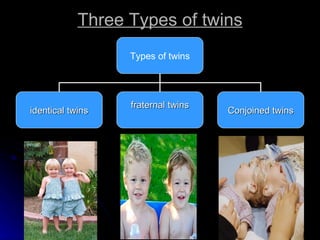
Three Types of twins Types of twins identical   twins fraternal twins Conjoined twins
stages of twin formation As off springs reproduced  by fertilization  the fertilized egg, now called a  zygote  divides one time, resulting in two cells. By the sixth day after fertilization, the  zygote  implants itself in the uterine wall and continues to develop for nine months.  after implantation, the developing baby is called an  embryo .  Around week nine of development, it is called a  fetus   Now we  know  and twins are formed
facts about twins twins are more common in African American families, and they are least common in the families of Hispanics and Asians.  Male–female twins are the most common result, about 50 percent and the most common grouping of twins.
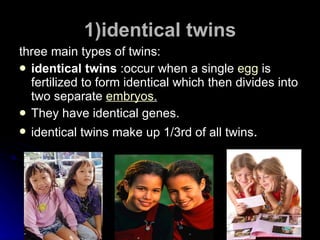
1)identical twins three main types of twins:  identical twins  :occur when a single  egg  is fertilized to form identical which then divides into two separate  embryos . They have identical genes. identical twins make up 1/3rd of all twins .
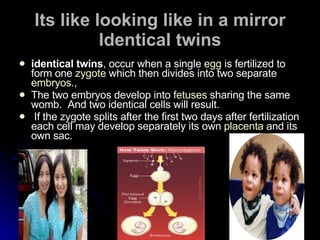
Its like looking like in a mirror Identical twins identical twins , occur when a single  egg  is fertilized to form one  zygote  which then divides into two separate  embryos .,  The two embryos develop into  fetuses  sharing the same womb.  And two identical cells will result. If the zygote splits after the first two days after fertilization each cell may develop separately its own  placenta  and its own sac.
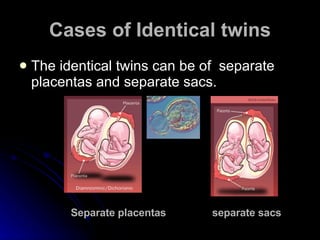
Cases of Identical twins The identical twins can be of  separate placentas and separate sacs.  Separate placentas  separate sacs
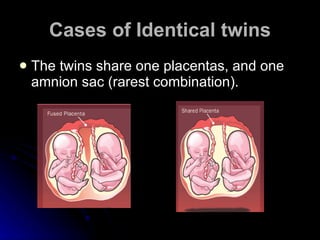
Cases of Identical twins The twins share one placentas, and one amnion sac (rarest combination).
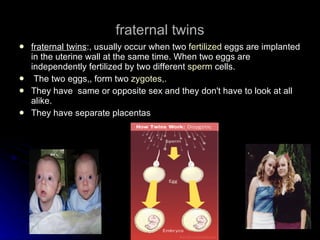
fraternal twins fraternal twins :, usually occur when two  fertilized  eggs are implanted in the uterine wall at the same time. When two eggs are independently fertilized by two different  sperm  cells. The two eggs,, form two  zygotes ,. They have  same or opposite sex and they don't have to look at all alike. They have separate placentas
Facts about FRATERNAL twins Africa sees the highest incidence of fraternal twins; Asia, the lowest. Female fraternal twins have a one in 17 chance of giving birth to their own set of fraternal twins.
Risks  of female twins Recently, studies has shown attempt to illustrate when menopause and eating disorders occurs in twins. .  up to 5% of female twins had gone through menopause by age 40  up to 15% of female twins had experienced menopause by age 45 Female Twins have a tendency to share specific eating disorders
Conjoined twins Conjoined twins  are joined at some region of their bodies. The many different types of conjoined twins are classified by the area where the attachment is located:
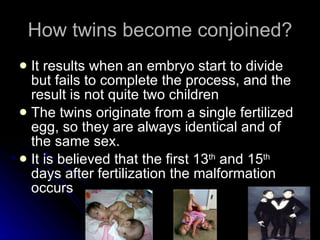
How twins become conjoined? It results when an embryo start to divide but fails to complete the process, and the result is not quite two children The twins originate from a single fertilized egg, so they are always identical and of the same sex.  It is believed that the first 13 th  and 15 th  days after fertilization the malformation occurs
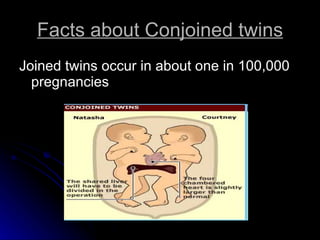
Facts about Conjoined twins Joined twins occur in about one in 100,000 pregnancies
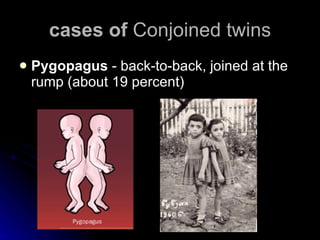
cases of  Conjoined twins Pygopagus  - back-to-back, joined at the rump (about 19 percent)
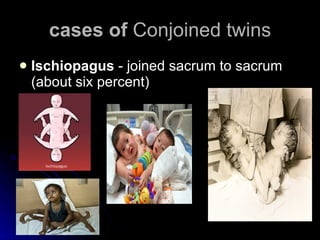
cases of  Conjoined twins Ischiopagus  - joined sacrum to sacrum (about six percent)
cases of  Conjoined twins Cephalopagus  - connected at the head (about two percent)
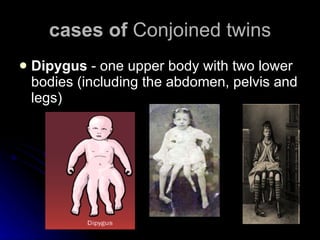
cases of  Conjoined twins Dipygus  - one upper body with two lower bodies (including the abdomen, pelvis and legs)
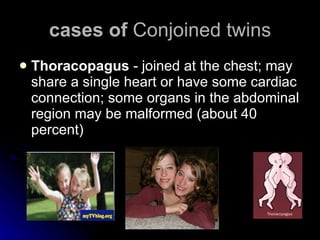
cases of  Conjoined twins Thoracopagus  - joined at the chest; may share a single heart or have some cardiac connection; some organs in the abdominal region may be malformed (about 40 percent)
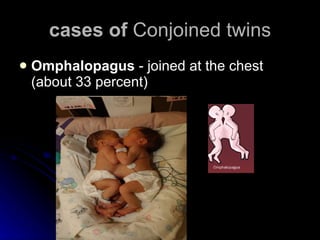
cases of  Conjoined twins Omphalopagus  - joined at the chest (about 33 percent)
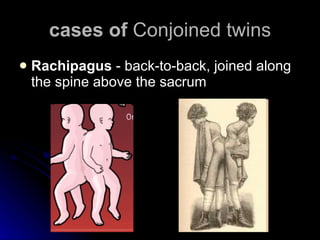
cases of  Conjoined twins Rachipagus  - back-to-back, joined along the spine above the sacrum
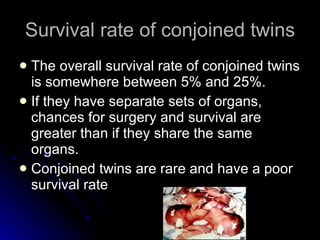
Survival rate of conjoined twins The overall survival rate of conjoined twins is somewhere between 5% and 25%.  If they have separate sets of organs, chances for surgery and survival are greater than if they share the same organs.  Conjoined twins are rare and have a poor survival rate
New form of twins discovered There is another type of twinning that scientists are looking into, called polar body twinning, or " half identical" twinning . This occurs when the mother's egg splits before fertilization and then each half is then fertilized by a sperm. it hasn't been proven that it occurs, or that it would produce viable twins
Made by   Saba Nasir Bahawalpur,Pakistan

what are the twins and basic types?

  • 1.
    What are thetwins? twins are two offspring resulting from the same pregnancy , usually born in close succession. They can be the same or different sex.
  • 2.
    Three Types oftwins Types of twins identical twins fraternal twins Conjoined twins
  • 3.
    stages of twinformation As off springs reproduced by fertilization the fertilized egg, now called a zygote divides one time, resulting in two cells. By the sixth day after fertilization, the zygote implants itself in the uterine wall and continues to develop for nine months. after implantation, the developing baby is called an embryo . Around week nine of development, it is called a fetus Now we know and twins are formed
  • 4.
    facts about twinstwins are more common in African American families, and they are least common in the families of Hispanics and Asians. Male–female twins are the most common result, about 50 percent and the most common grouping of twins.
  • 5.
    1)identical twins threemain types of twins: identical twins :occur when a single egg is fertilized to form identical which then divides into two separate embryos . They have identical genes. identical twins make up 1/3rd of all twins .
  • 6.
    Its like lookinglike in a mirror Identical twins identical twins , occur when a single egg is fertilized to form one zygote which then divides into two separate embryos ., The two embryos develop into fetuses sharing the same womb. And two identical cells will result. If the zygote splits after the first two days after fertilization each cell may develop separately its own placenta and its own sac.
  • 7.
    Cases of Identicaltwins The identical twins can be of separate placentas and separate sacs. Separate placentas separate sacs
  • 8.
    Cases of Identicaltwins The twins share one placentas, and one amnion sac (rarest combination).
  • 9.
    fraternal twins fraternaltwins :, usually occur when two fertilized eggs are implanted in the uterine wall at the same time. When two eggs are independently fertilized by two different sperm cells. The two eggs,, form two zygotes ,. They have same or opposite sex and they don't have to look at all alike. They have separate placentas
  • 10.
    Facts about FRATERNALtwins Africa sees the highest incidence of fraternal twins; Asia, the lowest. Female fraternal twins have a one in 17 chance of giving birth to their own set of fraternal twins.
  • 11.
    Risks offemale twins Recently, studies has shown attempt to illustrate when menopause and eating disorders occurs in twins. . up to 5% of female twins had gone through menopause by age 40 up to 15% of female twins had experienced menopause by age 45 Female Twins have a tendency to share specific eating disorders
  • 12.
    Conjoined twins Conjoinedtwins are joined at some region of their bodies. The many different types of conjoined twins are classified by the area where the attachment is located:
  • 13.
    How twins becomeconjoined? It results when an embryo start to divide but fails to complete the process, and the result is not quite two children The twins originate from a single fertilized egg, so they are always identical and of the same sex. It is believed that the first 13 th and 15 th days after fertilization the malformation occurs
  • 14.
    Facts about Conjoinedtwins Joined twins occur in about one in 100,000 pregnancies
  • 15.
    cases of Conjoined twins Pygopagus - back-to-back, joined at the rump (about 19 percent)
  • 16.
    cases of Conjoined twins Ischiopagus - joined sacrum to sacrum (about six percent)
  • 17.
    cases of Conjoined twins Cephalopagus - connected at the head (about two percent)
  • 18.
    cases of Conjoined twins Dipygus - one upper body with two lower bodies (including the abdomen, pelvis and legs)
  • 19.
    cases of Conjoined twins Thoracopagus - joined at the chest; may share a single heart or have some cardiac connection; some organs in the abdominal region may be malformed (about 40 percent)
  • 20.
    cases of Conjoined twins Omphalopagus - joined at the chest (about 33 percent)
  • 21.
    cases of Conjoined twins Rachipagus - back-to-back, joined along the spine above the sacrum
  • 22.
    Survival rate ofconjoined twins The overall survival rate of conjoined twins is somewhere between 5% and 25%. If they have separate sets of organs, chances for surgery and survival are greater than if they share the same organs. Conjoined twins are rare and have a poor survival rate
  • 23.
    New form oftwins discovered There is another type of twinning that scientists are looking into, called polar body twinning, or " half identical" twinning . This occurs when the mother's egg splits before fertilization and then each half is then fertilized by a sperm. it hasn't been proven that it occurs, or that it would produce viable twins
  • 24.
    Made by Saba Nasir Bahawalpur,Pakistan