Animal-like Protists
Core Concepts Animal-like protists usually are unicellular eukaryotic organisms. The absence of choroplasts and chlorophyll distinguishes these organisms from plant-like protists. Most protozoans are microscopic in nature and are seen usually in freshwater environment.
There are four major groups of protists based primarily on their modes of locomotion/movement: ciliophora (cilia-bearing), zoomastigina (flagella-bearing), sporozoa (in fluids as parasites) and sarcodina (with pseudopodia)
Different modes of reproduction are present in animal-like protists namely: binary/longitudinal fission, conjugation and fragmentation. Animal muticellularity also evolved in one of these groups exemplified by the choanoflagellate.
Movement is key to Identification THERE IS NO PROTOZOAN THAT IS NOT MOTILE!!!!!
PROTOZOAN VS METAZOAN Proto- first; Zoa- animal Meta – after; zoa- animal
Keywords Ciliophora anal pore choanoflagellate Cilliate food vacuole sarcodina Cilium/cilia contractile vacuole pseudopod Paramecium Zoomastigina amoeba Trichocyst flagellum/flagella vector Macronucleus flagellate host Micronucleus sporozoa conjugation Gullet pellicle binary fission
Phylogeny Most recent ancestral stock of members of Animal Kingdom Genetic make-up is not the basis What characteristic was used?
 
 
Protozoa No cell wall Have one motile stage Mostly ingest food Unicellular Niche is limited At least 10000 species are symbionts
 
Locomotion
Cilia and Flagella Axoneme- made up of 9 external pairs surrounding an internal pair Outside the cell Kinetosome- internal part of both structures
Pseudopodia- an extension for movement
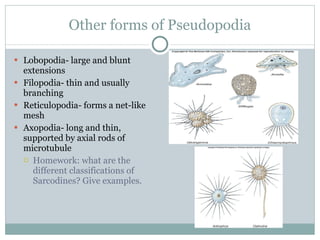
Other forms of Pseudopodia Lobopodia- large and blunt extensions Filopodia- thin and usually branching Reticulopodia- forms a net-like mesh Axopodia- long and thin, supported by axial rods of microtubule Homework: what are the different classifications of Sarcodines? Give examples.
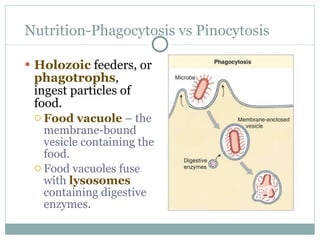
Nutrition-Phagocytosis vs Pinocytosis Holozoic  feeders, or  phagotrophs , ingest particles of food. Food vacuole  – the membrane-bound vesicle containing the food. Food vacuoles fuse with  lysosomes  containing digestive enzymes.
Nutrition Often, the site of phagocytosis is a definite mouth structure, the  cytostome .
Nutrition Saprozoic  feeding (ingestion of soluble food) may be by  pinocytosis  or by transport of solutes across the cell membrane.
Excretion and Osmoregulation Contractile vacuoles function in osmoregulation and excretion More common in freshwater
Trichocyst Organelle in ciliates and dinoflagellates that releases a filamentous and netlike protein to trap food
Reproduction Fission  is the cell multiplication process in protozoa. Binary fission  – one individual splits into two equal sized individuals. Budding  – progeny cell much smaller than parent. Multiple fission  – multiple nuclear divisions followed by multiple cytoplasmic divisions producing several offspring.
Reproduction All of above accompanied by some form of mitosis. Mitosis in protozoa divisions varies from metazoan mitosis. Nuclear membrane often persists. Spindle may form within the nuclear membrane. Centrioles not observed in ciliates. Macronucleus of ciliates elongates, constricts, and divides without mitosis (amitosis).
Reproduction Many types of protists reproduce sexually as well as asexually. Isogametes  – all look alike. Anisogametes  – two different types. Syngamy  – gametes from two individuals fuse to form the zygote. Autogamy  – gametes from one individual fuse. Conjugation  – gametic nuclei are exchanged.
Cysts Many protists are able to survive harsh conditions through the formation of  cysts , dormant forms with resistant outer coverings and a shutdown of metabolism.
Major Protozoan Taxa After the eukaryotic cell evolved, diversification followed, resulting in many clades. Opisthokonta  is a very large clade characterized by a combination of flattened mitochondrial cristae and one posterior flagellum on flagellated cells. Includes animals, fungi, chaonoflagellates and microsporidians.
Stramenopila The clade  Stramenopila  includes several groups of heterotrophs as well as certain groups of algae. Most stramenopiles have a “hairy” flagellum paired with a “smooth” flagellum.
Stramenopila Water molds, diatoms, golden algae, brown algae.
Euglenozoa Phylum Euglenozoa  is a diverse clade that includes predatory heterotrophs, photosynthetic autotrophs, and pathogenic parasites. Kinetoplastids & Euglenids. Persistence of nucleoli during mitosis. Cell membrane contains microtubules to stiffen it into a  pellicle .
Euglenids Euglenids  have one or two flagella that emerge from a pocket at one end of the cell. Contain chloroplasts surrounded by a double membrane – may have arisen by secondary endosymbiosis.
Kinetoplastids Kinetoplastids  have a single, large mitochondrion that contains an organized mass of DNA called a kinetoplast. Include free-living consumers of bacteria in freshwater, marine, and moist terrestrial ecosystems. Others are parasitic. Trypanosoma
Diplomonads Diplomonads : Are adapted to anaerobic environments. Lack plastids. Lack mitochondria but may have mitochondrial genes in the nucleus. Diplomonads have two nuclei and multiple flagella. Giardia
Retortamonads Phylum Retortamonada  includes commensal and parasitic unicells. Lack mitochondria & Golgi
Alveolata Members of the clade  Alveolata  have membrane-bounded sacs (alveoli) just under the plasma membrane. Dinoflagellates, apicomplexans, ciliates.
Alveolata - Ciliates Members of the  phylum Ciliophora  use cilia to move and feed. Ciliates have large macronuclei and small micronuclei.
Alveolata - Ciliates Ciliates  are a large, varied group of protists.
Alveolata - Ciliates Ciliates are structurally complex. All ciliates have a  kinety  system made up of the cilia, kinetosomes and other fibrils. Many have structures that can be expelled such as  trichocysts  and  toxicysts . Defensive function
Alveolata – Types of Ciliates Suctorians  – ciliates that lose cilia as adults, grow a stalk and become sessile. Use tubelike tentacles for feeding. Symbiotic ciliates  – some commensal, others parasitic. Free-living ciliates  – may be swimmers, or sessile. Stentor ,  Vorticella ,  Paramecium
Alveolata – Reproduction in  Paramecium Paramecium , as well as many other protists, reproduce asexually by  binary fission .
Alveolata – Reproduction in  Paramecium Conjugation  is a sexual process that produces genetic variation. Conjugation is separate from reproduction which generally occurs by binary fission.
Alveolata – Dinoflagellates Phylum Dinoflagellata  is a diverse group of aquatic photoautotrophs and heterotrophs. Abundant in both marine and freshwater phytoplankton.
Alveolata – Dinoflagellates Each has a characteristic shape that in many species is reinforced by internal plates of cellulose. Two flagella make them spin as they move through the water.
Alveolata – Dinoflagellates Rapid growth of some dinoflagellates is responsible for causing “red tides,” which can be toxic to humans. California  Noctiluca  Bloom http://www.whoi.edu/redtide/index.html
Alveolata – Dinoflagellates Some dinoflagellates are bioluminescent. Others live symbiotically with corals (zooxanthellae).
Alveolata – Apicomplexans Apicomplexans  are parasites of animals and some cause serious human diseases. Named because one end, the apex, contains a complex of organelles specialized for penetrating host cells and tissues. Have a non-photosynthetic plastid, the  apicoplast .
Alveolata – Apicomplexans Most apicomplexans have intricate life cycles  w ith both sexual and asexual stages that often require two or more different host species for completion.
Parabasalids Parabasalids  move by means of flagella and an undulating part of the plasma membrane. This clade may have diverged from the main eukaryotic clade very early. Trichomonas
Amebas Amebas  are found in fresh and salt water as well as moist soil. An ameba feeds by wrapping a pseudopod around its food – phagocytosis.
Nonactinopod Amebas Nonactinopod amebas include amebas that form lobopodia, filipodia or rhizopodia. Mostly heterotrophic and actively seek and consume bacteria and other protists.
Entamoebas Entamoebas  are parasites of vertebrates and some invertebrates. Entamoeba histolytica  causes amebic dysentery in humans.
Granuloreticulosa This clade has slender pseudopodia that extend through openings in the  test , then branch and run together forming a net. Foraminiferans , or  forams  are named for their porous, generally multichambered shells, called tests.
Granuloreticulosa Pseudopodia extend through the pores in the test. Foram tests in marine sediments form an extensive fossil record.
Actinopod Amebas Actinopod amebas  form a polyphyletic group. Radiolarians are one type of actinopod ameba. They have very diverse and beautiful forms.
Actinopod Amebas The pseudopodia of radiolarians, known as  axopodia  radiate from the central body.
Phylogeny and Adaptive Diversification Phylum Chlorophyta Phylum Retortamonada Class Diplomonadea Order Diplomonadida Phylum Axostylata Class Parabasalea Order Trichomonadida Phylum Euglenozoa Subphylum Euglenida Class Euglenoidea   Subphylum Kinetoplasta  Class Trypanosomatidea Phylum Apicomplexa Class Gregarinea Class Coccidea Phylum Ciliophora Phylum Dinoflagellata Amebas Rhizopodans Granuloreticulosans Actinopodans
Choanoflagellate  Collared flagellates One apical flagellum surrounded by 30-40 microvilli Closest relative of animals Mitochondrial genome suggests that choanoflagellates are an outgroup of metazoans
Choanocyte of sponges

Animal like protists

  • 1.
  • 2.
    Core Concepts Animal-likeprotists usually are unicellular eukaryotic organisms. The absence of choroplasts and chlorophyll distinguishes these organisms from plant-like protists. Most protozoans are microscopic in nature and are seen usually in freshwater environment.
  • 3.
    There are fourmajor groups of protists based primarily on their modes of locomotion/movement: ciliophora (cilia-bearing), zoomastigina (flagella-bearing), sporozoa (in fluids as parasites) and sarcodina (with pseudopodia)
  • 4.
    Different modes ofreproduction are present in animal-like protists namely: binary/longitudinal fission, conjugation and fragmentation. Animal muticellularity also evolved in one of these groups exemplified by the choanoflagellate.
  • 5.
    Movement is keyto Identification THERE IS NO PROTOZOAN THAT IS NOT MOTILE!!!!!
  • 6.
    PROTOZOAN VS METAZOANProto- first; Zoa- animal Meta – after; zoa- animal
  • 7.
    Keywords Ciliophora analpore choanoflagellate Cilliate food vacuole sarcodina Cilium/cilia contractile vacuole pseudopod Paramecium Zoomastigina amoeba Trichocyst flagellum/flagella vector Macronucleus flagellate host Micronucleus sporozoa conjugation Gullet pellicle binary fission
  • 8.
    Phylogeny Most recentancestral stock of members of Animal Kingdom Genetic make-up is not the basis What characteristic was used?
  • 9.
  • 10.
  • 11.
    Protozoa No cellwall Have one motile stage Mostly ingest food Unicellular Niche is limited At least 10000 species are symbionts
  • 12.
  • 13.
  • 14.
    Cilia and FlagellaAxoneme- made up of 9 external pairs surrounding an internal pair Outside the cell Kinetosome- internal part of both structures
  • 15.
  • 16.
    Other forms ofPseudopodia Lobopodia- large and blunt extensions Filopodia- thin and usually branching Reticulopodia- forms a net-like mesh Axopodia- long and thin, supported by axial rods of microtubule Homework: what are the different classifications of Sarcodines? Give examples.
  • 17.
    Nutrition-Phagocytosis vs PinocytosisHolozoic feeders, or phagotrophs , ingest particles of food. Food vacuole – the membrane-bound vesicle containing the food. Food vacuoles fuse with lysosomes containing digestive enzymes.
  • 18.
    Nutrition Often, thesite of phagocytosis is a definite mouth structure, the cytostome .
  • 19.
    Nutrition Saprozoic feeding (ingestion of soluble food) may be by pinocytosis or by transport of solutes across the cell membrane.
  • 20.
    Excretion and OsmoregulationContractile vacuoles function in osmoregulation and excretion More common in freshwater
  • 21.
    Trichocyst Organelle inciliates and dinoflagellates that releases a filamentous and netlike protein to trap food
  • 22.
    Reproduction Fission is the cell multiplication process in protozoa. Binary fission – one individual splits into two equal sized individuals. Budding – progeny cell much smaller than parent. Multiple fission – multiple nuclear divisions followed by multiple cytoplasmic divisions producing several offspring.
  • 23.
    Reproduction All ofabove accompanied by some form of mitosis. Mitosis in protozoa divisions varies from metazoan mitosis. Nuclear membrane often persists. Spindle may form within the nuclear membrane. Centrioles not observed in ciliates. Macronucleus of ciliates elongates, constricts, and divides without mitosis (amitosis).
  • 24.
    Reproduction Many typesof protists reproduce sexually as well as asexually. Isogametes – all look alike. Anisogametes – two different types. Syngamy – gametes from two individuals fuse to form the zygote. Autogamy – gametes from one individual fuse. Conjugation – gametic nuclei are exchanged.
  • 25.
    Cysts Many protistsare able to survive harsh conditions through the formation of cysts , dormant forms with resistant outer coverings and a shutdown of metabolism.
  • 26.
    Major Protozoan TaxaAfter the eukaryotic cell evolved, diversification followed, resulting in many clades. Opisthokonta is a very large clade characterized by a combination of flattened mitochondrial cristae and one posterior flagellum on flagellated cells. Includes animals, fungi, chaonoflagellates and microsporidians.
  • 27.
    Stramenopila The clade Stramenopila includes several groups of heterotrophs as well as certain groups of algae. Most stramenopiles have a “hairy” flagellum paired with a “smooth” flagellum.
  • 28.
    Stramenopila Water molds,diatoms, golden algae, brown algae.
  • 29.
    Euglenozoa Phylum Euglenozoa is a diverse clade that includes predatory heterotrophs, photosynthetic autotrophs, and pathogenic parasites. Kinetoplastids & Euglenids. Persistence of nucleoli during mitosis. Cell membrane contains microtubules to stiffen it into a pellicle .
  • 30.
    Euglenids Euglenids have one or two flagella that emerge from a pocket at one end of the cell. Contain chloroplasts surrounded by a double membrane – may have arisen by secondary endosymbiosis.
  • 31.
    Kinetoplastids Kinetoplastids have a single, large mitochondrion that contains an organized mass of DNA called a kinetoplast. Include free-living consumers of bacteria in freshwater, marine, and moist terrestrial ecosystems. Others are parasitic. Trypanosoma
  • 32.
    Diplomonads Diplomonads :Are adapted to anaerobic environments. Lack plastids. Lack mitochondria but may have mitochondrial genes in the nucleus. Diplomonads have two nuclei and multiple flagella. Giardia
  • 33.
    Retortamonads Phylum Retortamonada includes commensal and parasitic unicells. Lack mitochondria & Golgi
  • 34.
    Alveolata Members ofthe clade Alveolata have membrane-bounded sacs (alveoli) just under the plasma membrane. Dinoflagellates, apicomplexans, ciliates.
  • 35.
    Alveolata - CiliatesMembers of the phylum Ciliophora use cilia to move and feed. Ciliates have large macronuclei and small micronuclei.
  • 36.
    Alveolata - CiliatesCiliates are a large, varied group of protists.
  • 37.
    Alveolata - CiliatesCiliates are structurally complex. All ciliates have a kinety system made up of the cilia, kinetosomes and other fibrils. Many have structures that can be expelled such as trichocysts and toxicysts . Defensive function
  • 38.
    Alveolata – Typesof Ciliates Suctorians – ciliates that lose cilia as adults, grow a stalk and become sessile. Use tubelike tentacles for feeding. Symbiotic ciliates – some commensal, others parasitic. Free-living ciliates – may be swimmers, or sessile. Stentor , Vorticella , Paramecium
  • 39.
    Alveolata – Reproductionin Paramecium Paramecium , as well as many other protists, reproduce asexually by binary fission .
  • 40.
    Alveolata – Reproductionin Paramecium Conjugation is a sexual process that produces genetic variation. Conjugation is separate from reproduction which generally occurs by binary fission.
  • 41.
    Alveolata – DinoflagellatesPhylum Dinoflagellata is a diverse group of aquatic photoautotrophs and heterotrophs. Abundant in both marine and freshwater phytoplankton.
  • 42.
    Alveolata – DinoflagellatesEach has a characteristic shape that in many species is reinforced by internal plates of cellulose. Two flagella make them spin as they move through the water.
  • 43.
    Alveolata – DinoflagellatesRapid growth of some dinoflagellates is responsible for causing “red tides,” which can be toxic to humans. California Noctiluca Bloom http://www.whoi.edu/redtide/index.html
  • 44.
    Alveolata – DinoflagellatesSome dinoflagellates are bioluminescent. Others live symbiotically with corals (zooxanthellae).
  • 45.
    Alveolata – ApicomplexansApicomplexans are parasites of animals and some cause serious human diseases. Named because one end, the apex, contains a complex of organelles specialized for penetrating host cells and tissues. Have a non-photosynthetic plastid, the apicoplast .
  • 46.
    Alveolata – ApicomplexansMost apicomplexans have intricate life cycles w ith both sexual and asexual stages that often require two or more different host species for completion.
  • 47.
    Parabasalids Parabasalids move by means of flagella and an undulating part of the plasma membrane. This clade may have diverged from the main eukaryotic clade very early. Trichomonas
  • 48.
    Amebas Amebas are found in fresh and salt water as well as moist soil. An ameba feeds by wrapping a pseudopod around its food – phagocytosis.
  • 49.
    Nonactinopod Amebas Nonactinopodamebas include amebas that form lobopodia, filipodia or rhizopodia. Mostly heterotrophic and actively seek and consume bacteria and other protists.
  • 50.
    Entamoebas Entamoebas are parasites of vertebrates and some invertebrates. Entamoeba histolytica causes amebic dysentery in humans.
  • 51.
    Granuloreticulosa This cladehas slender pseudopodia that extend through openings in the test , then branch and run together forming a net. Foraminiferans , or forams are named for their porous, generally multichambered shells, called tests.
  • 52.
    Granuloreticulosa Pseudopodia extendthrough the pores in the test. Foram tests in marine sediments form an extensive fossil record.
  • 53.
    Actinopod Amebas Actinopodamebas form a polyphyletic group. Radiolarians are one type of actinopod ameba. They have very diverse and beautiful forms.
  • 54.
    Actinopod Amebas Thepseudopodia of radiolarians, known as axopodia radiate from the central body.
  • 55.
    Phylogeny and AdaptiveDiversification Phylum Chlorophyta Phylum Retortamonada Class Diplomonadea Order Diplomonadida Phylum Axostylata Class Parabasalea Order Trichomonadida Phylum Euglenozoa Subphylum Euglenida Class Euglenoidea Subphylum Kinetoplasta Class Trypanosomatidea Phylum Apicomplexa Class Gregarinea Class Coccidea Phylum Ciliophora Phylum Dinoflagellata Amebas Rhizopodans Granuloreticulosans Actinopodans
  • 56.
    Choanoflagellate Collaredflagellates One apical flagellum surrounded by 30-40 microvilli Closest relative of animals Mitochondrial genome suggests that choanoflagellates are an outgroup of metazoans
  • 57.