FIVE KINGDOM CLASSIFICATION
NAME­
­
- NURSELIM MANDAL
ROLL NO- 2023LCE29
DEPARTMENT- CIVIL ENGINEERING
SUBJECT- BIOLOGY
PAPER CODE- CE(BS)301
SEMESTER- 3RD
(LATERAL)
EXAM- CA1
INTRODUCTION-
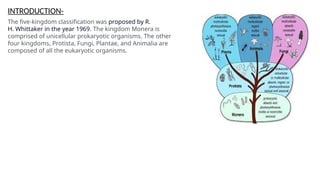
The five-kingdom classification was proposed by R.
H. Whittaker in the year 1969. The kingdom Monera is
comprised of unicellular prokaryotic organisms. The other
four kingdoms, Protista, Fungi, Plantae, and Animalia are
composed of all the eukaryotic organisms.
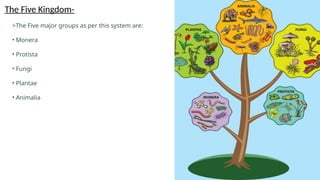
The Five Kingdom-
>The Five major groups as per this system are:
• Monera
• Protista
• Fungi
• Plantae
• Animalia
 MONERA KINGDOM
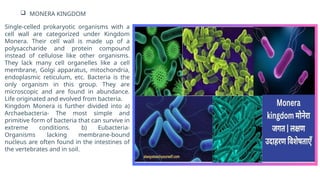
Single-celled prokaryotic organisms with a
cell wall are categorized under Kingdom
Monera. Their cell wall is made up of a
polysaccharide and protein compound
instead of cellulose like other organisms.
They lack many cell organelles like a cell
membrane, Golgi apparatus, mitochondria,
endoplasmic reticulum, etc. Bacteria is the
only organism in this group. They are
microscopic and are found in abundance.
Life originated and evolved from bacteria.
Kingdom Monera is further divided into a)
Archaebacteria- The most simple and
primitive form of bacteria that can survive in
extreme conditions. b) Eubacteria-
Organisms lacking membrane-bound
nucleus are often found in the intestines of
the vertebrates and in soil.
 PROTISTA KINGDOM
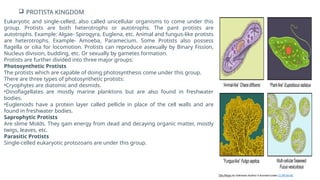
Eukaryotic and single-celled, also called unicellular organisms to come under this
group. Protists are both heterotrophs or autotrophs. The pant protists are
autotrophs. Example: Algae- Spirogyra, Euglena, etc. Animal and fungus-like protists
are heterotrophs. Example- Amoeba, Paramecium. Some Protists also possess
flagella or cilia for locomotion. Protists can reproduce asexually by Binary Fission,
Nucleus division, budding, etc. Or sexually by gametes formation.
Protists are further divided into three major groups:
Photosynthetic Protists
The protists which are capable of doing photosynthesis come under this group.
There are three types of photosynthetic protists:
•Cryophytes are diatomic and desmids.
•Dinoflagellates are mostly marine planktons but are also found in freshwater
bodies.
•Euglenoids have a protein layer called pellicle in place of the cell walls and are
found in freshwater bodies.
Saprophytic Protists
Are slime Molds. They gain energy from dead and decaying organic matter, mostly
twigs, leaves, etc.
Parasitic Protists
Single-celled eukaryotic protozoans are under this group.
This Photo by Unknown Author is licensed under CC BY-SA-NC
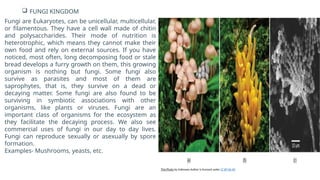
 FUNGI KINGDOM
Fungi are Eukaryotes, can be unicellular, multicellular,
or filamentous. They have a cell wall made of chitin
and polysaccharides. Their mode of nutrition is
heterotrophic, which means they cannot make their
own food and rely on external sources. If you have
noticed, most often, long decomposing food or stale
bread develops a furry growth on them, this growing
organism is nothing but fungi. Some fungi also
survive as parasites and most of them are
saprophytes, that is, they survive on a dead or
decaying matter. Some fungi are also found to be
surviving in symbiotic associations with other
organisms, like plants or viruses. Fungi are an
important class of organisms for the ecosystem as
they facilitate the decaying process. We also see
commercial uses of fungi in our day to day lives.
Fungi can reproduce sexually or asexually by spore
formation.
Examples- Mushrooms, yeasts, etc.
This Photo by Unknown Author is licensed under CC BY-SA-NC
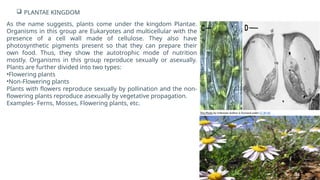
 PLANTAE KINGDOM
As the name suggests, plants come under the kingdom Plantae.
Organisms in this group are Eukaryotes and multicellular with the
presence of a cell wall made of cellulose. They also have
photosynthetic pigments present so that they can prepare their
own food. Thus, they show the autotrophic mode of nutrition
mostly. Organisms in this group reproduce sexually or asexually.
Plants are further divided into two types:
•Flowering plants
•Non-Flowering plants
Plants with flowers reproduce sexually by pollination and the non-
flowering plants reproduce asexually by vegetative propagation.
Examples- Ferns, Mosses, Flowering plants, etc.
This Photo by Unknown Author is licensed under CC BY-NC
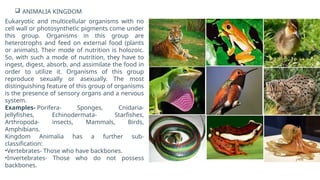
 ANIMALIA KINGDOM
Eukaryotic and multicellular organisms with no
cell wall or photosynthetic pigments come under
this group. Organisms in this group are
heterotrophs and feed on external food (plants
or animals). Their mode of nutrition is holozoic.
So, with such a mode of nutrition, they have to
ingest, digest, absorb, and assimilate the food in
order to utilize it. Organisms of this group
reproduce sexually or asexually. The most
distinguishing feature of this group of organisms
is the presence of sensory organs and a nervous
system.
Examples- Porifera- Sponges, Cnidaria-
Jellyfishes, Echinodermata- Starfishes,
Arthropoda- insects, Mammals, Birds,
Amphibians.
Kingdom Animalia has a further sub-
classification:
•Vertebrates- Those who have backbones.
•Invertebrates- Those who do not possess
backbones.
 ADVANTAGES OF FIVE KINGDOM CLASSIFICATION
•We can study the characteristics of organisms by only looking at a
few members of a particular kingdom.
•Classifying organisms makes it simpler and easier to understand
their traits.
•It helps trace origin and study growth patterns, reproduction,
structure, and survival needs.
•The Five Kingdom System also divides unicellular and multicellular
organisms into different groups.
Conclusion
We have presented a complete picture about Five Kingdom
Classification that can help in preparing for the study and gaining
knowledge.

FIVE KINGDOM CLASSIFICATION.ppt More Details x

  • 1.
    FIVE KINGDOM CLASSIFICATION NAME­ ­ -NURSELIM MANDAL ROLL NO- 2023LCE29 DEPARTMENT- CIVIL ENGINEERING SUBJECT- BIOLOGY PAPER CODE- CE(BS)301 SEMESTER- 3RD (LATERAL) EXAM- CA1
  • 2.
    INTRODUCTION- The five-kingdom classificationwas proposed by R. H. Whittaker in the year 1969. The kingdom Monera is comprised of unicellular prokaryotic organisms. The other four kingdoms, Protista, Fungi, Plantae, and Animalia are composed of all the eukaryotic organisms.
  • 3.
    The Five Kingdom- >TheFive major groups as per this system are: • Monera • Protista • Fungi • Plantae • Animalia
  • 4.
     MONERA KINGDOM Single-celledprokaryotic organisms with a cell wall are categorized under Kingdom Monera. Their cell wall is made up of a polysaccharide and protein compound instead of cellulose like other organisms. They lack many cell organelles like a cell membrane, Golgi apparatus, mitochondria, endoplasmic reticulum, etc. Bacteria is the only organism in this group. They are microscopic and are found in abundance. Life originated and evolved from bacteria. Kingdom Monera is further divided into a) Archaebacteria- The most simple and primitive form of bacteria that can survive in extreme conditions. b) Eubacteria- Organisms lacking membrane-bound nucleus are often found in the intestines of the vertebrates and in soil.
  • 5.
     PROTISTA KINGDOM Eukaryoticand single-celled, also called unicellular organisms to come under this group. Protists are both heterotrophs or autotrophs. The pant protists are autotrophs. Example: Algae- Spirogyra, Euglena, etc. Animal and fungus-like protists are heterotrophs. Example- Amoeba, Paramecium. Some Protists also possess flagella or cilia for locomotion. Protists can reproduce asexually by Binary Fission, Nucleus division, budding, etc. Or sexually by gametes formation. Protists are further divided into three major groups: Photosynthetic Protists The protists which are capable of doing photosynthesis come under this group. There are three types of photosynthetic protists: •Cryophytes are diatomic and desmids. •Dinoflagellates are mostly marine planktons but are also found in freshwater bodies. •Euglenoids have a protein layer called pellicle in place of the cell walls and are found in freshwater bodies. Saprophytic Protists Are slime Molds. They gain energy from dead and decaying organic matter, mostly twigs, leaves, etc. Parasitic Protists Single-celled eukaryotic protozoans are under this group. This Photo by Unknown Author is licensed under CC BY-SA-NC
  • 6.
     FUNGI KINGDOM Fungiare Eukaryotes, can be unicellular, multicellular, or filamentous. They have a cell wall made of chitin and polysaccharides. Their mode of nutrition is heterotrophic, which means they cannot make their own food and rely on external sources. If you have noticed, most often, long decomposing food or stale bread develops a furry growth on them, this growing organism is nothing but fungi. Some fungi also survive as parasites and most of them are saprophytes, that is, they survive on a dead or decaying matter. Some fungi are also found to be surviving in symbiotic associations with other organisms, like plants or viruses. Fungi are an important class of organisms for the ecosystem as they facilitate the decaying process. We also see commercial uses of fungi in our day to day lives. Fungi can reproduce sexually or asexually by spore formation. Examples- Mushrooms, yeasts, etc. This Photo by Unknown Author is licensed under CC BY-SA-NC
  • 7.
     PLANTAE KINGDOM Asthe name suggests, plants come under the kingdom Plantae. Organisms in this group are Eukaryotes and multicellular with the presence of a cell wall made of cellulose. They also have photosynthetic pigments present so that they can prepare their own food. Thus, they show the autotrophic mode of nutrition mostly. Organisms in this group reproduce sexually or asexually. Plants are further divided into two types: •Flowering plants •Non-Flowering plants Plants with flowers reproduce sexually by pollination and the non- flowering plants reproduce asexually by vegetative propagation. Examples- Ferns, Mosses, Flowering plants, etc. This Photo by Unknown Author is licensed under CC BY-NC
  • 8.
     ANIMALIA KINGDOM Eukaryoticand multicellular organisms with no cell wall or photosynthetic pigments come under this group. Organisms in this group are heterotrophs and feed on external food (plants or animals). Their mode of nutrition is holozoic. So, with such a mode of nutrition, they have to ingest, digest, absorb, and assimilate the food in order to utilize it. Organisms of this group reproduce sexually or asexually. The most distinguishing feature of this group of organisms is the presence of sensory organs and a nervous system. Examples- Porifera- Sponges, Cnidaria- Jellyfishes, Echinodermata- Starfishes, Arthropoda- insects, Mammals, Birds, Amphibians. Kingdom Animalia has a further sub- classification: •Vertebrates- Those who have backbones. •Invertebrates- Those who do not possess backbones.
  • 9.
     ADVANTAGES OFFIVE KINGDOM CLASSIFICATION •We can study the characteristics of organisms by only looking at a few members of a particular kingdom. •Classifying organisms makes it simpler and easier to understand their traits. •It helps trace origin and study growth patterns, reproduction, structure, and survival needs. •The Five Kingdom System also divides unicellular and multicellular organisms into different groups. Conclusion We have presented a complete picture about Five Kingdom Classification that can help in preparing for the study and gaining knowledge.