Introduction
Animal classification When classifying animals
we look at some major characteristics.

Vertebrae- this is a bone structure that supports
and protects the spinal chord of animals.
The spinal chord connects the brain to every
nerve in the body.
Invertebrates- are animals without a backbone.
97% of all animal species are invertebrates.
These animals have other protective structures,
like shells and exoskeletons.
Symmetry
Arrangement of body parts around a central axis

•
•

Types of Body Symmetry

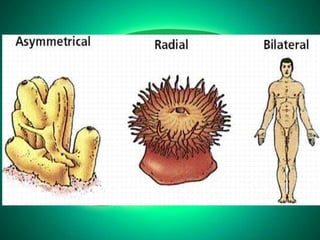
Asymmetrical - animals have no particular
symmetry.

Radial symmetry - means the animal is
organized similar to a wheel. Any longitudinal
cut will give off in an equal half.

•

Bilateral symmetry - means the animal has
definite right and left halves.
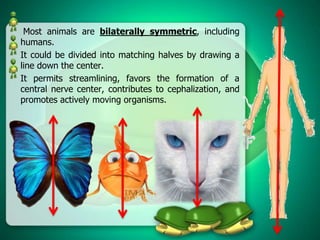
Most animals are bilaterally symmetric, including
humans.
It could be divided into matching halves by drawing a
line down the center.
It permits streamlining, favors the formation of a
central nerve center, contributes to cephalization, and
promotes actively moving organisms.
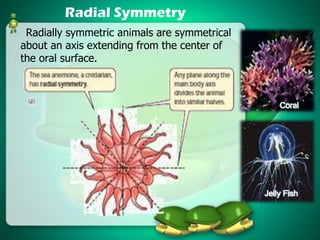
Radial Symmetry
Radially symmetric animals are symmetrical
about an axis extending from the center of
the oral surface.
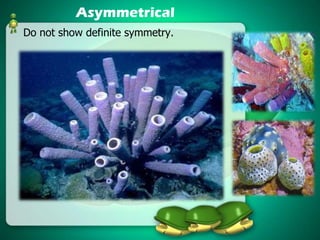
Asymmetrical
Do not show definite symmetry.
•

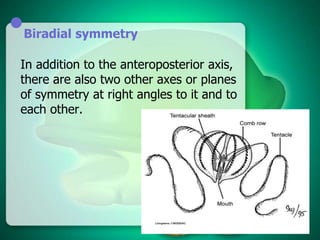
Biradial symmetry

In addition to the anteroposterior axis,
there are also two other axes or planes
of symmetry at right angles to it and to
each other.

Body symmetry

  • 2.
    Introduction Animal classification Whenclassifying animals we look at some major characteristics. Vertebrae- this is a bone structure that supports and protects the spinal chord of animals. The spinal chord connects the brain to every nerve in the body. Invertebrates- are animals without a backbone. 97% of all animal species are invertebrates. These animals have other protective structures, like shells and exoskeletons.
  • 3.
    Symmetry Arrangement of bodyparts around a central axis • • Types of Body Symmetry Asymmetrical - animals have no particular symmetry. Radial symmetry - means the animal is organized similar to a wheel. Any longitudinal cut will give off in an equal half. • Bilateral symmetry - means the animal has definite right and left halves.
  • 5.
    Most animals arebilaterally symmetric, including humans. It could be divided into matching halves by drawing a line down the center. It permits streamlining, favors the formation of a central nerve center, contributes to cephalization, and promotes actively moving organisms.
  • 6.
    Radial Symmetry Radially symmetricanimals are symmetrical about an axis extending from the center of the oral surface.
  • 7.
    Asymmetrical Do not showdefinite symmetry.
  • 8.
    • Biradial symmetry In additionto the anteroposterior axis, there are also two other axes or planes of symmetry at right angles to it and to each other.