selfexplanatory.2022
Hello
HI
नमस्ते
ْ‫م‬ُ‫ك‬ْ‫ي‬‫ا‬‫ل‬‫ا‬‫ع‬ ُ‫م‬ ‫ا‬
‫َل‬ َّ
‫الس‬
ِ َّ
‫ٱَّلل‬ ُ‫اة‬‫م‬ْ‫ح‬‫ا‬‫ر‬‫ا‬‫و‬
ُ‫ه‬ُ‫ت‬‫كا‬‫ا‬‫ر‬‫ا‬‫ب‬‫ا‬‫و‬
Saba Parvin Haque
M.Sc. Life Sciences
(Specialization in Neurobiology)
from “Sophia College”
(Autonomous), Mumbai.
Basal lamina
Figure
Introduction
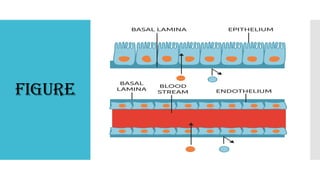
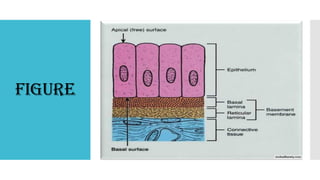
 Basal lamina is a specialized extracellular matrix secreted by epithelial
cells, that acts as the base membrane on which these cells attach. It
constitutes a portion of the basement membrane of tissues.
 These layers typically have a thickness of 50 nanometers; however, some
may be as thick as 200 nanometers.
 It can be observed under an electron microscope only. Under the
microscope, it appears as an electron-dense layer, hence, it is known as
lamina densa.
 The basal lamina was earlier incorrectly used synonymously with the
basement membrane.
 This composite layer of basal lamina has various cells and molecules
present in a mesh-like interconnection.
 The basal lamina, like any extracellular matrix, acts as an anchor for
physical attachment of cells to form tissue. Alongside this, it also initiates
signals that cause tissue morphogenesis, differentiation, and homeostasis.
Figure
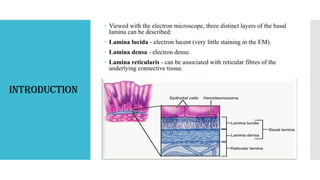
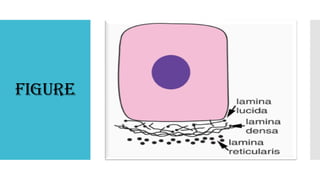
 Viewed with the electron microscope, three distinct layers of the basal
lamina can be described:
 Lamina lucida - electron lucent (very little staining in the EM).
 Lamina densa - electron dense.
 Lamina reticularis - can be associated with reticular fibres of the
underlying connective tissue.
Introduction
Figure
Composition
of Basal
Lamina
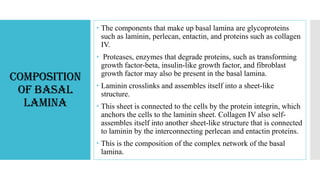
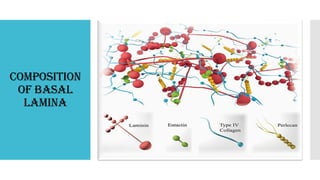
 The components that make up basal lamina are glycoproteins
such as laminin, perlecan, entactin, and proteins such as collagen
IV.
 Proteases, enzymes that degrade proteins, such as transforming
growth factor-beta, insulin-like growth factor, and fibroblast
growth factor may also be present in the basal lamina.
 Laminin crosslinks and assembles itself into a sheet-like
structure.
 This sheet is connected to the cells by the protein integrin, which
anchors the cells to the laminin sheet. Collagen IV also self-
assembles itself into another sheet-like structure that is connected
to laminin by the interconnecting perlecan and entactin proteins.
 This is the composition of the complex network of the basal
lamina.
Composition
of Basal
Lamina
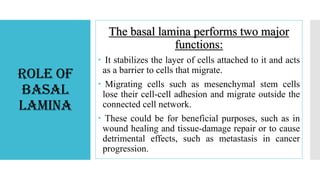
The basal lamina performs two major
functions:
 It stabilizes the layer of cells attached to it and acts
as a barrier to cells that migrate.
 Migrating cells such as mesenchymal stem cells
lose their cell-cell adhesion and migrate outside the
connected cell network.
 These could be for beneficial purposes, such as in
wound healing and tissue-damage repair or to cause
detrimental effects, such as metastasis in cancer
progression.
Role of
Basal
Lamina
 The endothelial cells, found in the lining of blood vessels and
epithelial cells found in the lining of organs, are often
associated with basal lamina that only selectively allows
molecules to pass through.
 The epithelial cells in the skin are associated with forming a
barrier to the foreign molecule, while also preventing the
connective cells from entering the upper layers of skin.
 The endothelial cells lining the blood vessels also need to form
barriers to prevent nutrients, growth factors, and hormones
from leaking into the connective tissue.
 In kidney cells, basal lamina acts as a molecular filter,
allowing only small molecules to enter into the urine. Based on
the site in which it is present, basal lamina can have slightly
varying composition.
Role of
Basal
Lamina
Basal
Lamina in
Medicine
1. Baculoviruses are viruses that majorly infect insects, have shown to have
crossed the barrier of basal lamina in underlying insect tracheal and
midgut linings.
2. Metastasis is the process by which cancer cells are able to migrate from
one point to another within the body. This occurs only by the successful
degradation of the basal lamina. Once the basal lamina has been
degraded by the digestive enzymes of the cancer cells, they can spread
to distant points.
3. In patients suffering from diabetes, diabetes-specific proteins are highly
expressed, causing an increase in thickness and stiffness of basal lamina.
This is a symptom observed in diabetes patients.
4. A genetic disorder that causes defective production of a muscle protein
known as dystrophin causes Duchene muscular dystrophy. With the
defective protein, the muscle cells are unable to attach effectively to the
basal lamina. This is the cause of muscle degeneration in this disease.
The progressive degeneration of muscles causes early death in
individuals suffering from this disease.
References
 Book: Bruce Alberts, Alexander Johnson, Julian Lewis, Martin
Raff, Keith Roberts, Peter Walter, Molecular biology of the
cell, 5th Edition.
 https://www.intechopen.com/books/composition-and-function-
of-the-extracellular-matrix-in-the-human-body/biophysical-
properties-of-the-basal-lamina-a-highly-selective-
extracellular-matrix
 https://www.chegg.com/learn/biology/introduction-to-
biology/basal-lamina
Thank You
Please do Like and
Subscribe
My Channel…!!

Basal Lamina / Extracellular matrix / Base membrane

  • 1.
    selfexplanatory.2022 Hello HI नमस्ते ْ‫م‬ُ‫ك‬ْ‫ي‬‫ا‬‫ل‬‫ا‬‫ع‬ ُ‫م‬ ‫ا‬ ‫َل‬َّ ‫الس‬ ِ َّ ‫ٱَّلل‬ ُ‫اة‬‫م‬ْ‫ح‬‫ا‬‫ر‬‫ا‬‫و‬ ُ‫ه‬ُ‫ت‬‫كا‬‫ا‬‫ر‬‫ا‬‫ب‬‫ا‬‫و‬ Saba Parvin Haque M.Sc. Life Sciences (Specialization in Neurobiology) from “Sophia College” (Autonomous), Mumbai.
  • 2.
  • 3.
  • 4.
    Introduction  Basal laminais a specialized extracellular matrix secreted by epithelial cells, that acts as the base membrane on which these cells attach. It constitutes a portion of the basement membrane of tissues.  These layers typically have a thickness of 50 nanometers; however, some may be as thick as 200 nanometers.  It can be observed under an electron microscope only. Under the microscope, it appears as an electron-dense layer, hence, it is known as lamina densa.  The basal lamina was earlier incorrectly used synonymously with the basement membrane.  This composite layer of basal lamina has various cells and molecules present in a mesh-like interconnection.  The basal lamina, like any extracellular matrix, acts as an anchor for physical attachment of cells to form tissue. Alongside this, it also initiates signals that cause tissue morphogenesis, differentiation, and homeostasis.
  • 5.
  • 6.
     Viewed withthe electron microscope, three distinct layers of the basal lamina can be described:  Lamina lucida - electron lucent (very little staining in the EM).  Lamina densa - electron dense.  Lamina reticularis - can be associated with reticular fibres of the underlying connective tissue. Introduction
  • 7.
  • 8.
    Composition of Basal Lamina  Thecomponents that make up basal lamina are glycoproteins such as laminin, perlecan, entactin, and proteins such as collagen IV.  Proteases, enzymes that degrade proteins, such as transforming growth factor-beta, insulin-like growth factor, and fibroblast growth factor may also be present in the basal lamina.  Laminin crosslinks and assembles itself into a sheet-like structure.  This sheet is connected to the cells by the protein integrin, which anchors the cells to the laminin sheet. Collagen IV also self- assembles itself into another sheet-like structure that is connected to laminin by the interconnecting perlecan and entactin proteins.  This is the composition of the complex network of the basal lamina.
  • 9.
  • 10.
    The basal laminaperforms two major functions:  It stabilizes the layer of cells attached to it and acts as a barrier to cells that migrate.  Migrating cells such as mesenchymal stem cells lose their cell-cell adhesion and migrate outside the connected cell network.  These could be for beneficial purposes, such as in wound healing and tissue-damage repair or to cause detrimental effects, such as metastasis in cancer progression. Role of Basal Lamina
  • 11.
     The endothelialcells, found in the lining of blood vessels and epithelial cells found in the lining of organs, are often associated with basal lamina that only selectively allows molecules to pass through.  The epithelial cells in the skin are associated with forming a barrier to the foreign molecule, while also preventing the connective cells from entering the upper layers of skin.  The endothelial cells lining the blood vessels also need to form barriers to prevent nutrients, growth factors, and hormones from leaking into the connective tissue.  In kidney cells, basal lamina acts as a molecular filter, allowing only small molecules to enter into the urine. Based on the site in which it is present, basal lamina can have slightly varying composition. Role of Basal Lamina
  • 12.
    Basal Lamina in Medicine 1. Baculovirusesare viruses that majorly infect insects, have shown to have crossed the barrier of basal lamina in underlying insect tracheal and midgut linings. 2. Metastasis is the process by which cancer cells are able to migrate from one point to another within the body. This occurs only by the successful degradation of the basal lamina. Once the basal lamina has been degraded by the digestive enzymes of the cancer cells, they can spread to distant points. 3. In patients suffering from diabetes, diabetes-specific proteins are highly expressed, causing an increase in thickness and stiffness of basal lamina. This is a symptom observed in diabetes patients. 4. A genetic disorder that causes defective production of a muscle protein known as dystrophin causes Duchene muscular dystrophy. With the defective protein, the muscle cells are unable to attach effectively to the basal lamina. This is the cause of muscle degeneration in this disease. The progressive degeneration of muscles causes early death in individuals suffering from this disease.
  • 13.
    References  Book: BruceAlberts, Alexander Johnson, Julian Lewis, Martin Raff, Keith Roberts, Peter Walter, Molecular biology of the cell, 5th Edition.  https://www.intechopen.com/books/composition-and-function- of-the-extracellular-matrix-in-the-human-body/biophysical- properties-of-the-basal-lamina-a-highly-selective- extracellular-matrix  https://www.chegg.com/learn/biology/introduction-to- biology/basal-lamina
  • 14.
    Thank You Please doLike and Subscribe My Channel…!!