selfexplanatory.2022
Hello
HI
नमस्ते
ْ‫م‬ُ‫ك‬ْ‫ي‬‫ا‬‫ل‬‫ا‬‫ع‬ ُ‫م‬ ‫ا‬
‫َل‬ َّ
‫الس‬
ِ َّ
‫ٱَّلل‬ ُ‫اة‬‫م‬ْ‫ح‬‫ا‬‫ر‬‫ا‬‫و‬
ُ‫ه‬ُ‫ت‬‫كا‬‫ا‬‫ر‬‫ا‬‫ب‬‫ا‬‫و‬
Saba Parvin Haque
M.Sc. Life Sciences
(Specialization in Neurobiology)
from “Sophia College”
(Autonomous), Mumbai.
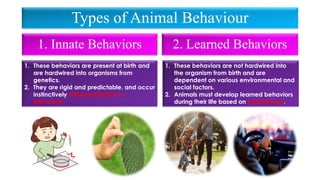
1. Innate Behaviors
1. These behaviors are present at birth and
are hardwired into organisms from
genetics.
2. They are rigid and predictable, and occur
instinctively without practice or
instruction.
2. Learned Behaviors
1. These behaviors are not hardwired into
the organism from birth and are
dependent on various environmental and
social factors.
2. Animals must develop learned behaviors
during their life based on experiences.
Types of Animal Behaviour
Learning Behaviour
1. It is acquired during the life of an organism due to constant experience.
2. It is experience dependant and can be modified through experience.
3. Learning is flexible
4. Learning behaviour differs from individual to individual among the same species hence not species
specific.
5. Learned behaviour is certainly not inherited though the ability to learn is almost certainly inherited as
dependent on the development of the nervous system of the organism which is inherited.
6. All organisms from protozoa to humans have the ability to learn at least to some extend.
7. The degree of performance of learned behavior mostly depended on memory.
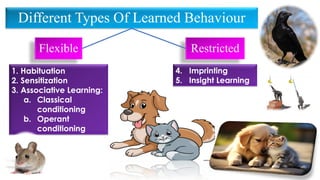
1. Habituation
2. Sensitization
3. Associative Learning:
a. Classical
conditioning
b. Operant
conditioning
Different Types Of Learned Behaviour
Flexible Restricted
4. Imprinting
5. Insight Learning
1. Habituation
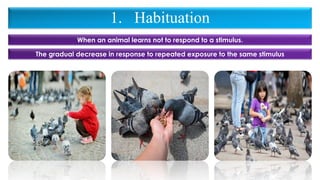
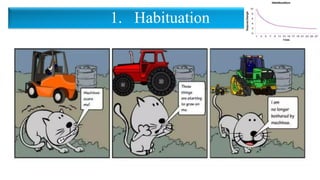
When an animal learns not to respond to a stimulus.
The gradual decrease in response to repeated exposure to the same stimulus
1. Habituation
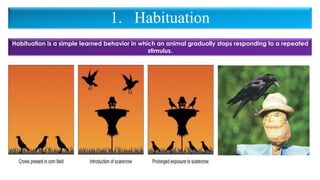
Habituation is a simple learned behavior in which an animal gradually stops responding to a repeated
stimulus.
1. Habituation
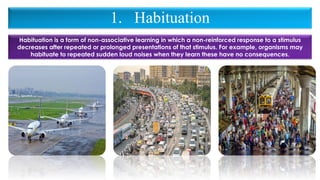
Habituation is a form of non-associative learning in which a non-reinforced response to a stimulus
decreases after repeated or prolonged presentations of that stimulus. For example, organisms may
habituate to repeated sudden loud noises when they learn these have no consequences.
1. Habituation
Time Duration Effects
1. Habituation
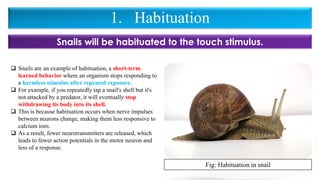
Snails will be habituated to the touch stimulus.
Fig: Habituation in snail
❑ Snails are an example of habituation, a short-term
learned behavior where an organism stops responding to
a harmless stimulus after repeated exposure.
❑ For example, if you repeatedly tap a snail's shell but it's
not attacked by a predator, it will eventually stop
withdrawing its body into its shell.
❑ This is because habituation occurs when nerve impulses
between neurons change, making them less responsive to
calcium ions.
❑ As a result, fewer neurotransmitters are released, which
leads to fewer action potentials in the motor neuron and
less of a response.
1. Habituation
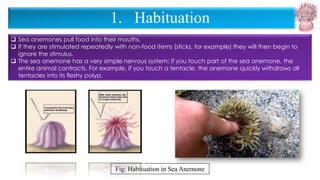
Fig: Habituation in Sea Anemone
❑ Sea anemones pull food into their mouths.
❑ If they are stimulated repeatedly with non-food items (sticks, for example) they will then begin to
ignore the stimulus.
❑ The sea anemone has a very simple nervous system; if you touch part of the sea anemone, the
entire animal contracts. For example, if you touch a tentacle, the anemone quickly withdraws all
tentacles into its fleshy polyp.
1. Habituation
2. Sensitization
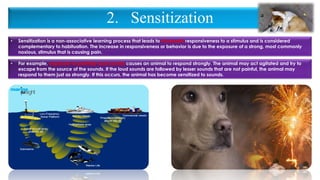
• Sensitization is a non-associative learning process that leads to increased responsiveness to a stimulus and is considered
complementary to habituation. The increase in responsiveness or behavior is due to the exposure of a strong, most commonly
noxious, stimulus that is causing pain.
• For example, exposure to painfully loud sounds causes an animal to respond strongly. The animal may act agitated and try to
escape from the source of the sounds. If the loud sounds are followed by lesser sounds that are not painful, the animal may
respond to them just as strongly. If this occurs, the animal has become sensitized to sounds.
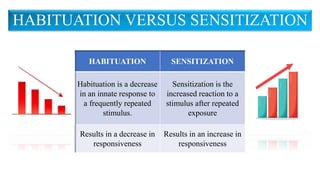
HABITUATION SENSITIZATION
Habituation is a decrease
in an innate response to
a frequently repeated
stimulus.
Sensitization is the
increased reaction to a
stimulus after repeated
exposure
Results in a decrease in
responsiveness
Results in an increase in
responsiveness
HABITUATION VERSUS SENSITIZATION
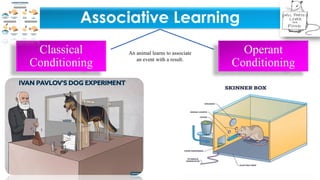
Associative Learning
Classical
Conditioning
Operant
Conditioning
An animal learns to associate
an event with a result.
Classical (Pavlovian) Conditioning
Pavlov’s Dog Experiment
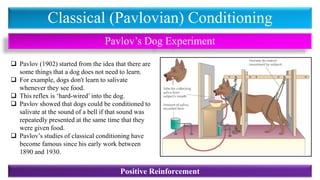
❑ Pavlov (1902) started from the idea that there are
some things that a dog does not need to learn.
❑ For example, dogs don't learn to salivate
whenever they see food.
❑ This reflex is ‘hard-wired’ into the dog.
❑ Pavlov showed that dogs could be conditioned to
salivate at the sound of a bell if that sound was
repeatedly presented at the same time that they
were given food.
❑ Pavlov’s studies of classical conditioning have
become famous since his early work between
1890 and 1930.
Positive Reinforcement
Classical (Pavlovian) Conditioning
Pavlov’s Dog Experiment
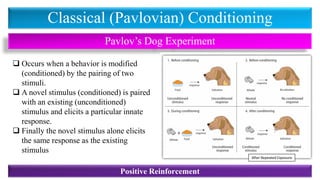
❑ Occurs when a behavior is modified
(conditioned) by the pairing of two
stimuli.
❑ A novel stimulus (conditioned) is paired
with an existing (unconditioned)
stimulus and elicits a particular innate
response.
❑ Finally the novel stimulus alone elicits
the same response as the existing
stimulus
After Repeated Exposure
Positive Reinforcement
Classical (Pavlovian) Conditioning
Pavlov’s Dog Experiment (Before Conditioning)
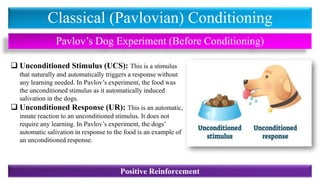
❑ Unconditioned Stimulus (UCS): This is a stimulus
that naturally and automatically triggers a response without
any learning needed. In Pavlov’s experiment, the food was
the unconditioned stimulus as it automatically induced
salivation in the dogs.
❑ Unconditioned Response (UR): This is an automatic,
innate reaction to an unconditioned stimulus. It does not
require any learning. In Pavlov’s experiment, the dogs’
automatic salivation in response to the food is an example of
an unconditioned response.
Positive Reinforcement
Classical (Pavlovian) Conditioning
Pavlov’s Dog Experiment (Before Conditioning)
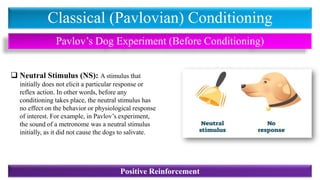
❑ Neutral Stimulus (NS): A stimulus that
initially does not elicit a particular response or
reflex action. In other words, before any
conditioning takes place, the neutral stimulus has
no effect on the behavior or physiological response
of interest. For example, in Pavlov’s experiment,
the sound of a metronome was a neutral stimulus
initially, as it did not cause the dogs to salivate.
Positive Reinforcement
Classical (Pavlovian) Conditioning
Pavlov’s Dog Experiment (During Conditioning)
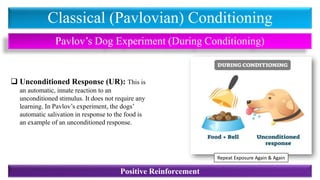
❑ Unconditioned Response (UR): This is
an automatic, innate reaction to an
unconditioned stimulus. It does not require any
learning. In Pavlov’s experiment, the dogs’
automatic salivation in response to the food is
an example of an unconditioned response.
Positive Reinforcement
Repeat Exposure Again & Again
Classical (Pavlovian) Conditioning
Pavlov’s Dog Experiment (After Conditioning)
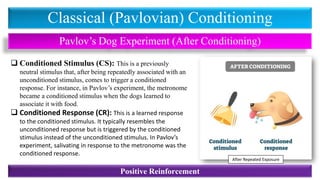
❑ Conditioned Stimulus (CS): This is a previously
neutral stimulus that, after being repeatedly associated with an
unconditioned stimulus, comes to trigger a conditioned
response. For instance, in Pavlov’s experiment, the metronome
became a conditioned stimulus when the dogs learned to
associate it with food.
❑ Conditioned Response (CR): This is a learned response
to the conditioned stimulus. It typically resembles the
unconditioned response but is triggered by the conditioned
stimulus instead of the unconditioned stimulus. In Pavlov’s
experiment, salivating in response to the metronome was the
conditioned response.
Positive Reinforcement
After Repeated Exposure
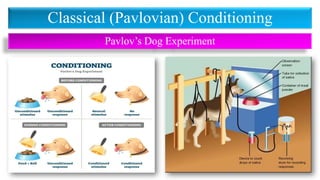
Pavlov’s Dog Experiment
Classical (Pavlovian) Conditioning
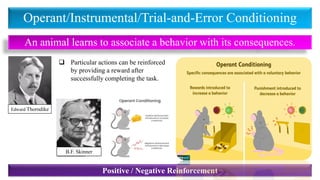
Operant/Instrumental/Trial-and-Error Conditioning
An animal learns to associate a behavior with its consequences.
Positive / Negative Reinforcement
❑ Particular actions can be reinforced
by providing a reward after
successfully completing the task.
Edward Thorndike
B.F. Skinner
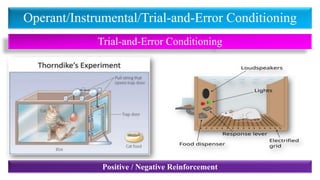
Operant/Instrumental/Trial-and-Error Conditioning
Trial-and-Error Conditioning
Positive / Negative Reinforcement
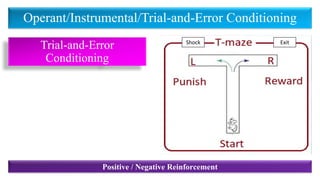
Operant/Instrumental/Trial-and-Error Conditioning
Trial-and-Error
Conditioning
Positive / Negative Reinforcement
Shock Exit
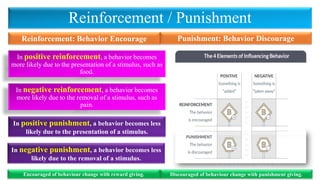
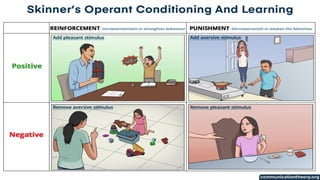
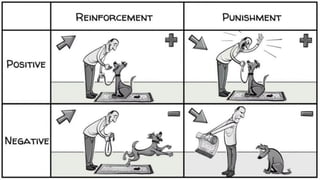
Reinforcement / Punishment
In positive reinforcement, a behavior becomes
more likely due to the presentation of a stimulus, such as
food.
Reinforcement: Behavior Encourage Punishment: Behavior Discourage
In negative reinforcement, a behavior becomes
more likely due to the removal of a stimulus, such as
pain.
In positive punishment, a behavior becomes less
likely due to the presentation of a stimulus.
In negative punishment, a behavior becomes less
likely due to the removal of a stimulus.
Encouraged of behaviour change with reward giving. Discouraged of behaviour change with punishment giving.
Reinforcement / Punishment
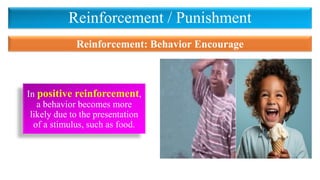
In positive reinforcement,
a behavior becomes more
likely due to the presentation
of a stimulus, such as food.
Reinforcement: Behavior Encourage
Reinforcement / Punishment
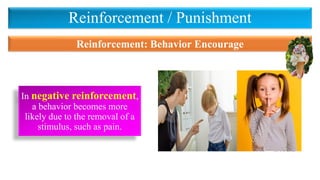
In negative reinforcement,
a behavior becomes more
likely due to the removal of a
stimulus, such as pain.
Reinforcement: Behavior Encourage
Reinforcement / Punishment
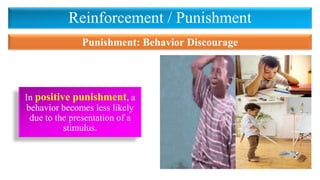
In positive punishment, a
behavior becomes less likely
due to the presentation of a
stimulus.
Punishment: Behavior Discourage
Reinforcement / Punishment
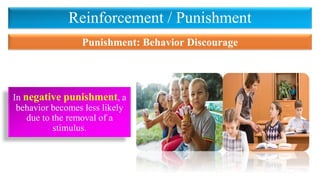
In negative punishment, a
behavior becomes less likely
due to the removal of a
stimulus.
Punishment: Behavior Discourage
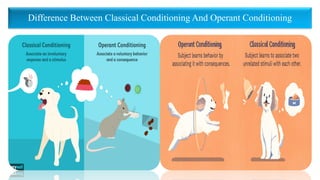
Difference Between Classical Conditioning And Operant Conditioning
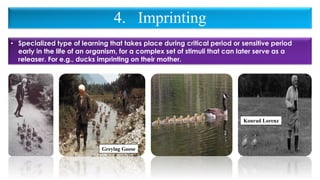
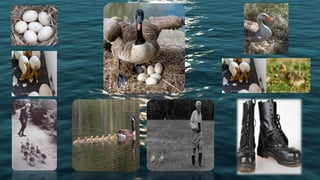
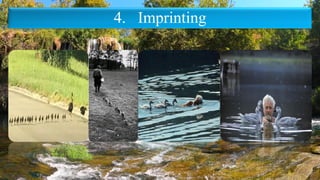
4. Imprinting
• Specialized type of learning that takes place during critical period or sensitive period
early in the life of an organism, for a complex set of stimuli that can later serve as a
releaser. For e.g., ducks imprinting on their mother.
Greylag Goose
Konrad Lorenz
4. Imprinting
5. Insight Learning
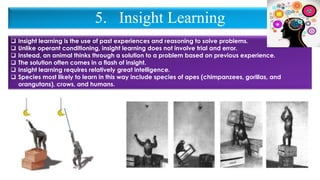
❑ Insight learning is the use of past experiences and reasoning to solve problems.
❑ Unlike operant conditioning, insight learning does not involve trial and error.
❑ Instead, an animal thinks through a solution to a problem based on previous experience.
❑ The solution often comes in a flash of insight.
❑ Insight learning requires relatively great intelligence.
❑ Species most likely to learn in this way include species of apes (chimpanzees, gorillas, and
orangutans), crows, and humans.
5. Insight Learning
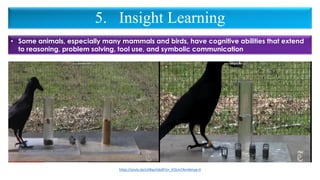
• Some animals, especially many mammals and birds, have cognitive abilities that extend
to reasoning, problem solving, tool use, and symbolic communication
https://youtu.be/s2IBayVsbz8?si=_KI5Lm7Acmbmyp-H
1. Learning is a change in behavior that occurs as a result of experience,
and learned behaviors are usually less rigid than innate behaviors.
2. Types of learning include habituation, sensitization, classical conditioning,
operant conditioning, imprinting and insight learning.
3. One of the simplest ways that animals learn is through habituation, where
animals decrease the frequency of a behavior in response to a repeated
stimulus.
4. Insight learning are usually observed in animals with higher levels of
intelligence.
Summary
• Simply Psychology. (2024, February 2). Pavlov’s Dogs Experiment & Pavlovian Conditioning Response.
https://www.simplypsychology.org/pavlov.html
• CK-12 Foundation. (n.d.). CK-12 Foundation. https://flexbooks.ck12.org/cbook/ck-12-advanced-
biology/section/14.7/primary/lesson/learned-behavior-in-animals-advanced-bio-adv/
References
• https://images.app.goo.gl/EjJEhvQDDTcmCu6k8
• https://images.app.goo.gl/ek2EYEP1VRDNyNxr6
• https://images.app.goo.gl/hTUkq3xMbYArVRKn9
• https://images.app.goo.gl/NhNEjcKQRbn7qj2B7
• https://images.app.goo.gl/X5YVa6DXYQFGUTuY8
• https://images.app.goo.gl/fRLHW8yiPpqisPE29
• https://images.app.goo.gl/2NmQeHjyjVmZfxfv9
• https://images.app.goo.gl/vcDSbvnLuvtUZU5v7
• https://images.app.goo.gl/XT1mvAmQbPnSDMTh7
• https://images.app.goo.gl/LaLzEtWKgeuxJ6UR9
• https://images.app.goo.gl/mDfikh6Fu8WFzTcq7
• https://images.app.goo.gl/fgVwjqeMebFNSap36
• https://images.app.goo.gl/fxNhXsKRiHnVwyhB9
• https://images.app.goo.gl/77i3BaEfcVcV74vC8
• https://images.app.goo.gl/ofNkfM1MSKwvUebz5
• https://images.app.goo.gl/5Siq4pPEcfsWob1x8
• https://images.app.goo.gl/okPu4Vsy6gjaMsCw9
• https://images.app.goo.gl/zpDCbPhD1GBabrLn6
• https://images.app.goo.gl/S5VJRB5exgF5yQVS7
• https://images.app.goo.gl/C9S1BdH5S82xKTya6
• https://images.app.goo.gl/14WvW9ziFVXZSLu89
• https://images.app.goo.gl/c1wKaZSs8yVUK3XX7
• https://images.app.goo.gl/iCwqipwdVzZ5iBtt8
• https://images.app.goo.gl/UKaFJvE3et7bFsyz8
• https://images.app.goo.gl/2kjPD1w2AWqNTzXv7
• https://images.app.goo.gl/ZRS6YFVq1mqkDTJB8

Habituation, Sensitization, Associative Learning, Imprinting & Insight Learning

  • 1.
    selfexplanatory.2022 Hello HI नमस्ते ْ‫م‬ُ‫ك‬ْ‫ي‬‫ا‬‫ل‬‫ا‬‫ع‬ ُ‫م‬ ‫ا‬ ‫َل‬َّ ‫الس‬ ِ َّ ‫ٱَّلل‬ ُ‫اة‬‫م‬ْ‫ح‬‫ا‬‫ر‬‫ا‬‫و‬ ُ‫ه‬ُ‫ت‬‫كا‬‫ا‬‫ر‬‫ا‬‫ب‬‫ا‬‫و‬ Saba Parvin Haque M.Sc. Life Sciences (Specialization in Neurobiology) from “Sophia College” (Autonomous), Mumbai.
  • 2.
    1. Innate Behaviors 1.These behaviors are present at birth and are hardwired into organisms from genetics. 2. They are rigid and predictable, and occur instinctively without practice or instruction. 2. Learned Behaviors 1. These behaviors are not hardwired into the organism from birth and are dependent on various environmental and social factors. 2. Animals must develop learned behaviors during their life based on experiences. Types of Animal Behaviour
  • 3.
    Learning Behaviour 1. Itis acquired during the life of an organism due to constant experience. 2. It is experience dependant and can be modified through experience. 3. Learning is flexible 4. Learning behaviour differs from individual to individual among the same species hence not species specific. 5. Learned behaviour is certainly not inherited though the ability to learn is almost certainly inherited as dependent on the development of the nervous system of the organism which is inherited. 6. All organisms from protozoa to humans have the ability to learn at least to some extend. 7. The degree of performance of learned behavior mostly depended on memory.
  • 4.
    1. Habituation 2. Sensitization 3.Associative Learning: a. Classical conditioning b. Operant conditioning Different Types Of Learned Behaviour Flexible Restricted 4. Imprinting 5. Insight Learning
  • 5.
    1. Habituation When ananimal learns not to respond to a stimulus. The gradual decrease in response to repeated exposure to the same stimulus
  • 6.
    1. Habituation Habituation isa simple learned behavior in which an animal gradually stops responding to a repeated stimulus.
  • 7.
    1. Habituation Habituation isa form of non-associative learning in which a non-reinforced response to a stimulus decreases after repeated or prolonged presentations of that stimulus. For example, organisms may habituate to repeated sudden loud noises when they learn these have no consequences.
  • 8.
  • 9.
    1. Habituation Snails willbe habituated to the touch stimulus. Fig: Habituation in snail ❑ Snails are an example of habituation, a short-term learned behavior where an organism stops responding to a harmless stimulus after repeated exposure. ❑ For example, if you repeatedly tap a snail's shell but it's not attacked by a predator, it will eventually stop withdrawing its body into its shell. ❑ This is because habituation occurs when nerve impulses between neurons change, making them less responsive to calcium ions. ❑ As a result, fewer neurotransmitters are released, which leads to fewer action potentials in the motor neuron and less of a response.
  • 10.
    1. Habituation Fig: Habituationin Sea Anemone ❑ Sea anemones pull food into their mouths. ❑ If they are stimulated repeatedly with non-food items (sticks, for example) they will then begin to ignore the stimulus. ❑ The sea anemone has a very simple nervous system; if you touch part of the sea anemone, the entire animal contracts. For example, if you touch a tentacle, the anemone quickly withdraws all tentacles into its fleshy polyp.
  • 11.
  • 12.
    2. Sensitization • Sensitizationis a non-associative learning process that leads to increased responsiveness to a stimulus and is considered complementary to habituation. The increase in responsiveness or behavior is due to the exposure of a strong, most commonly noxious, stimulus that is causing pain. • For example, exposure to painfully loud sounds causes an animal to respond strongly. The animal may act agitated and try to escape from the source of the sounds. If the loud sounds are followed by lesser sounds that are not painful, the animal may respond to them just as strongly. If this occurs, the animal has become sensitized to sounds.
  • 13.
    HABITUATION SENSITIZATION Habituation isa decrease in an innate response to a frequently repeated stimulus. Sensitization is the increased reaction to a stimulus after repeated exposure Results in a decrease in responsiveness Results in an increase in responsiveness HABITUATION VERSUS SENSITIZATION
  • 14.
  • 15.
    Classical (Pavlovian) Conditioning Pavlov’sDog Experiment ❑ Pavlov (1902) started from the idea that there are some things that a dog does not need to learn. ❑ For example, dogs don't learn to salivate whenever they see food. ❑ This reflex is ‘hard-wired’ into the dog. ❑ Pavlov showed that dogs could be conditioned to salivate at the sound of a bell if that sound was repeatedly presented at the same time that they were given food. ❑ Pavlov’s studies of classical conditioning have become famous since his early work between 1890 and 1930. Positive Reinforcement
  • 16.
    Classical (Pavlovian) Conditioning Pavlov’sDog Experiment ❑ Occurs when a behavior is modified (conditioned) by the pairing of two stimuli. ❑ A novel stimulus (conditioned) is paired with an existing (unconditioned) stimulus and elicits a particular innate response. ❑ Finally the novel stimulus alone elicits the same response as the existing stimulus After Repeated Exposure Positive Reinforcement
  • 17.
    Classical (Pavlovian) Conditioning Pavlov’sDog Experiment (Before Conditioning) ❑ Unconditioned Stimulus (UCS): This is a stimulus that naturally and automatically triggers a response without any learning needed. In Pavlov’s experiment, the food was the unconditioned stimulus as it automatically induced salivation in the dogs. ❑ Unconditioned Response (UR): This is an automatic, innate reaction to an unconditioned stimulus. It does not require any learning. In Pavlov’s experiment, the dogs’ automatic salivation in response to the food is an example of an unconditioned response. Positive Reinforcement
  • 18.
    Classical (Pavlovian) Conditioning Pavlov’sDog Experiment (Before Conditioning) ❑ Neutral Stimulus (NS): A stimulus that initially does not elicit a particular response or reflex action. In other words, before any conditioning takes place, the neutral stimulus has no effect on the behavior or physiological response of interest. For example, in Pavlov’s experiment, the sound of a metronome was a neutral stimulus initially, as it did not cause the dogs to salivate. Positive Reinforcement
  • 19.
    Classical (Pavlovian) Conditioning Pavlov’sDog Experiment (During Conditioning) ❑ Unconditioned Response (UR): This is an automatic, innate reaction to an unconditioned stimulus. It does not require any learning. In Pavlov’s experiment, the dogs’ automatic salivation in response to the food is an example of an unconditioned response. Positive Reinforcement Repeat Exposure Again & Again
  • 20.
    Classical (Pavlovian) Conditioning Pavlov’sDog Experiment (After Conditioning) ❑ Conditioned Stimulus (CS): This is a previously neutral stimulus that, after being repeatedly associated with an unconditioned stimulus, comes to trigger a conditioned response. For instance, in Pavlov’s experiment, the metronome became a conditioned stimulus when the dogs learned to associate it with food. ❑ Conditioned Response (CR): This is a learned response to the conditioned stimulus. It typically resembles the unconditioned response but is triggered by the conditioned stimulus instead of the unconditioned stimulus. In Pavlov’s experiment, salivating in response to the metronome was the conditioned response. Positive Reinforcement After Repeated Exposure
  • 21.
    Pavlov’s Dog Experiment Classical(Pavlovian) Conditioning
  • 22.
    Operant/Instrumental/Trial-and-Error Conditioning An animallearns to associate a behavior with its consequences. Positive / Negative Reinforcement ❑ Particular actions can be reinforced by providing a reward after successfully completing the task. Edward Thorndike B.F. Skinner
  • 23.
  • 24.
  • 25.
    Reinforcement / Punishment Inpositive reinforcement, a behavior becomes more likely due to the presentation of a stimulus, such as food. Reinforcement: Behavior Encourage Punishment: Behavior Discourage In negative reinforcement, a behavior becomes more likely due to the removal of a stimulus, such as pain. In positive punishment, a behavior becomes less likely due to the presentation of a stimulus. In negative punishment, a behavior becomes less likely due to the removal of a stimulus. Encouraged of behaviour change with reward giving. Discouraged of behaviour change with punishment giving.
  • 26.
    Reinforcement / Punishment Inpositive reinforcement, a behavior becomes more likely due to the presentation of a stimulus, such as food. Reinforcement: Behavior Encourage
  • 27.
    Reinforcement / Punishment Innegative reinforcement, a behavior becomes more likely due to the removal of a stimulus, such as pain. Reinforcement: Behavior Encourage
  • 28.
    Reinforcement / Punishment Inpositive punishment, a behavior becomes less likely due to the presentation of a stimulus. Punishment: Behavior Discourage
  • 29.
    Reinforcement / Punishment Innegative punishment, a behavior becomes less likely due to the removal of a stimulus. Punishment: Behavior Discourage
  • 32.
    Difference Between ClassicalConditioning And Operant Conditioning
  • 33.
    4. Imprinting • Specializedtype of learning that takes place during critical period or sensitive period early in the life of an organism, for a complex set of stimuli that can later serve as a releaser. For e.g., ducks imprinting on their mother. Greylag Goose Konrad Lorenz
  • 35.
  • 36.
    5. Insight Learning ❑Insight learning is the use of past experiences and reasoning to solve problems. ❑ Unlike operant conditioning, insight learning does not involve trial and error. ❑ Instead, an animal thinks through a solution to a problem based on previous experience. ❑ The solution often comes in a flash of insight. ❑ Insight learning requires relatively great intelligence. ❑ Species most likely to learn in this way include species of apes (chimpanzees, gorillas, and orangutans), crows, and humans.
  • 37.
    5. Insight Learning •Some animals, especially many mammals and birds, have cognitive abilities that extend to reasoning, problem solving, tool use, and symbolic communication https://youtu.be/s2IBayVsbz8?si=_KI5Lm7Acmbmyp-H
  • 38.
    1. Learning isa change in behavior that occurs as a result of experience, and learned behaviors are usually less rigid than innate behaviors. 2. Types of learning include habituation, sensitization, classical conditioning, operant conditioning, imprinting and insight learning. 3. One of the simplest ways that animals learn is through habituation, where animals decrease the frequency of a behavior in response to a repeated stimulus. 4. Insight learning are usually observed in animals with higher levels of intelligence. Summary
  • 39.
    • Simply Psychology.(2024, February 2). Pavlov’s Dogs Experiment & Pavlovian Conditioning Response. https://www.simplypsychology.org/pavlov.html • CK-12 Foundation. (n.d.). CK-12 Foundation. https://flexbooks.ck12.org/cbook/ck-12-advanced- biology/section/14.7/primary/lesson/learned-behavior-in-animals-advanced-bio-adv/ References • https://images.app.goo.gl/EjJEhvQDDTcmCu6k8 • https://images.app.goo.gl/ek2EYEP1VRDNyNxr6 • https://images.app.goo.gl/hTUkq3xMbYArVRKn9 • https://images.app.goo.gl/NhNEjcKQRbn7qj2B7 • https://images.app.goo.gl/X5YVa6DXYQFGUTuY8 • https://images.app.goo.gl/fRLHW8yiPpqisPE29 • https://images.app.goo.gl/2NmQeHjyjVmZfxfv9 • https://images.app.goo.gl/vcDSbvnLuvtUZU5v7 • https://images.app.goo.gl/XT1mvAmQbPnSDMTh7 • https://images.app.goo.gl/LaLzEtWKgeuxJ6UR9 • https://images.app.goo.gl/mDfikh6Fu8WFzTcq7 • https://images.app.goo.gl/fgVwjqeMebFNSap36 • https://images.app.goo.gl/fxNhXsKRiHnVwyhB9 • https://images.app.goo.gl/77i3BaEfcVcV74vC8 • https://images.app.goo.gl/ofNkfM1MSKwvUebz5 • https://images.app.goo.gl/5Siq4pPEcfsWob1x8 • https://images.app.goo.gl/okPu4Vsy6gjaMsCw9 • https://images.app.goo.gl/zpDCbPhD1GBabrLn6 • https://images.app.goo.gl/S5VJRB5exgF5yQVS7 • https://images.app.goo.gl/C9S1BdH5S82xKTya6 • https://images.app.goo.gl/14WvW9ziFVXZSLu89 • https://images.app.goo.gl/c1wKaZSs8yVUK3XX7 • https://images.app.goo.gl/iCwqipwdVzZ5iBtt8 • https://images.app.goo.gl/UKaFJvE3et7bFsyz8 • https://images.app.goo.gl/2kjPD1w2AWqNTzXv7 • https://images.app.goo.gl/ZRS6YFVq1mqkDTJB8