ABDOMINAL AORTIC ANEURSYM
AKA ‘THE TICKING BOMB’
Dr A Maphane
Albert Einstein died in April 1955
due to ruptured AAA.
INTRODUCTION
• Abdominal aortic aneurysm (AAA) is the most common true
aneurysm
• True aneurysm is defined as a segmental, full-thickness dilatation of a
blood vessel that is 50% greater than the normal aortic diameter at
the level of renal arteries.
• 95% of adult population has an aortic diameter ≤ 3cm
• The av. Diameter of the human infrarenal aorta is approx. 2cm
• In clinical practice an aortic diameter >3.0cm is generally considered
aneurysmal
CLASSIFICATION OF ANEURYSMS
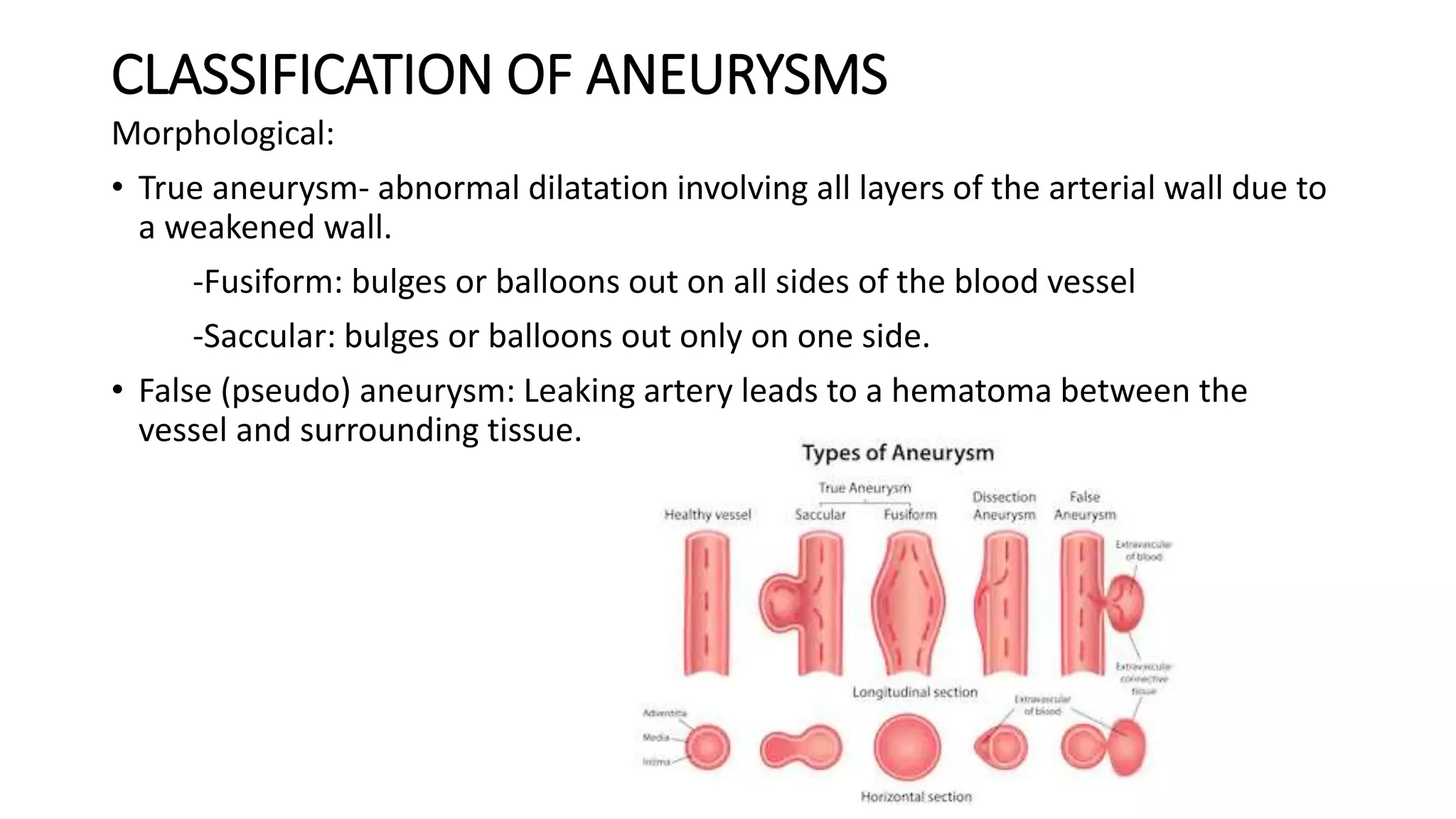
Morphological:
• True aneurysm- abnormal dilatation involving all layers of the arterial wall due to
a weakened wall.
-Fusiform: bulges or balloons out on all sides of the blood vessel
-Saccular: bulges or balloons out only on one side.
• False (pseudo) aneurysm: Leaking artery leads to a hematoma between the
vessel and surrounding tissue.
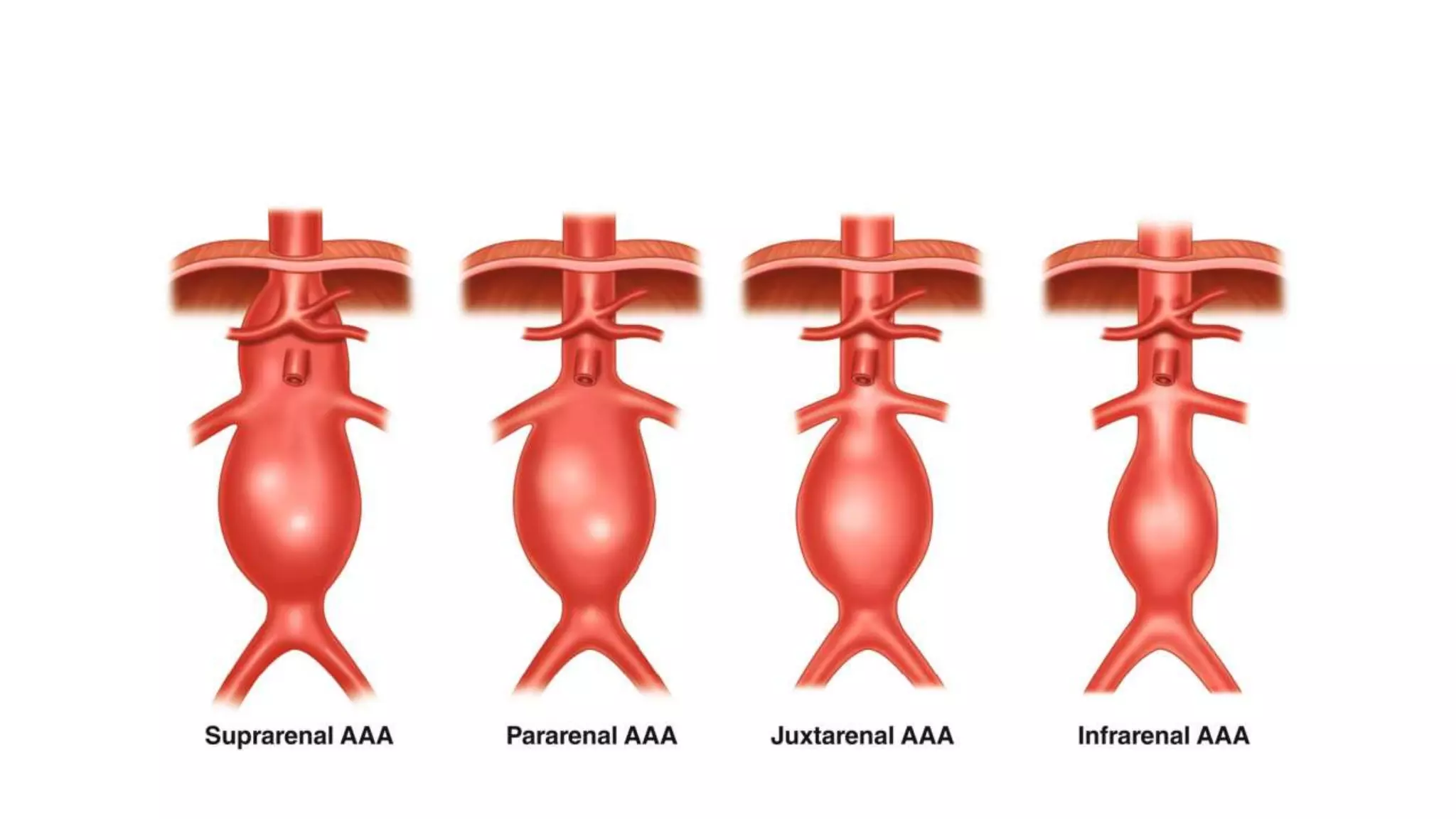
Based on location: relative to involvement of renal vessels
• Suprarenal: involves the origins of 1 or more visceral aa but doesn’t
extend into chest.
• Pararenal: renal aa arise from the aneurysmal aorta, but the aorta at
the level of the superior mesenteric aa is not aneurysmal.
• Juxtarenal: originates just beyond the origins of the renal aa. There is
no segment of non aneurysmal aorta distal to the renal aa but the
aorta at the level of the renal arteries is not aneurysmal.
• Infrarenal: originates distal to the renal aa. There is a segment of non
aneurysmal aorta that extends distal to the origins of the renal aa.
Based on size:
• Small aneurysm <4.0cm
• Medium between 4.0cm - 5.5cm
• Large aneurysm >5.5cm
• Very large ≥ 6.0cm
EPIDEMIOLOGY
• Est. prevalence in developed countries varies from 2-8%
• Higher in males (4-8%) vs females (1-1.3%) in those older than 50y
• Prevalence increases with age for both men and women but more
pronounced in men
• AAA asso. Mortality has decreased by nearly 50% since the early
1990s.
-Decline in prevalence of cigarette smoking
-Increasing awareness due to screening program
-an increase in the use of endovascular repair of AAA
• Case fatality is 50% when emergency OP done on 40% of pts with
ruptured AAA who survive long enough to come to medical attention.
• 15th leading cause of death.
RISK FACTORS
• Older age
• Male gender
• Cigarette smoking
• Caucasian race
• Atherosclerosis
• Hypertension
• Family Hx of AAA
• Other aneurysms( iliac, femoral, popliteal)
• Infections: TB, syphilis, mycotic
PROTECTIVE FACTORS
• Female gender
• Non-Caucasian race
• Diabetes
WHO TO SCREEN?
• Men ages 65-75yrs who have ever smoked
• Men ages 65-75yrs who have a first degree relative who required AAA
repair or died from AAA rupture
• Women who have a strong family hx of either AAA repair/ death due
to AAA rupture
• Modality of screening abdominal ultrasonography
PATHOPHYSIOLOGY
CLINICAL MANIFESTATION
Asymptomatic- majority of patients are asymptomatic often found
incidentally on screening
Symptomatic
• Abdominal, back or flank pain radiating to groin or thigh
• +/- nausea
• Syncope
PHYSICAL EXAM
• Vitals: Tachycardia, hypotension (moderate-severe)
CONT’D
• Abdo exam:
- Grey Turner sign, Cullen sign, fox’s sign and Bryant’s sign
- pulsatile abdominal mass
- if ruptured: distension and tenderness
• Vascular exam: to check for any other aneurysms.
DIAGNOSIS
OTHER INVESTIGATIONS
• FBC: WBC
• Urea and electrolytes
• Coagulation profile
• ESR: elevated in cases of infection
• Blood cultures
• Cross match
MANAGEMENT
• Abdominal aortic aneurysms are managed according to their diameter and
the presence or absence of symptoms.
Ruptured AAA
• ABCs…
• 2 large bore cannulas plus initial investigations
• IV fluids with close BP monitoring, target sBP (80-100mmHg) to prevent
further tearing and blood loss
• No imaging needed if pt hemodynamically unstable, straight to OR
• BUT if patient stable, urgent CTA may be done.
Symptomatic non ruptured
• Pain control while awaiting urgent repair
SURGICAL MANAGEMENT
Indication for surgery
• Ruptured AAA
• Symptomatic (non-ruptured) AAA
• Prophylaxis when risk of rupture is > risk of surgery (size >5.5cm)
• Rapid expanding AAA (>1.2cm/year)
• AAA asso. With peripheral arterial aneurysm or symptomatic PAD
Surgical Options
• Open repair- involves replacement of the affected part with a tube or
bifurcated prosthetic graft through midline/retroperitoneal incision
• Endovascular repair (EVAR)-involves placement of modular graft
components delivered via iliac or femoral aa, which line the aorta and
exclude the aneurysm sac.
OPEN REPAIR ENDOVASCULAR REPAIR
EVAR vs Open Repair
• Can be performed without general anaesthesia
• Shorter post operative stay by on av. 5d
• Lower 30d mortality (odds ratio 0.46)
• Lower long-term aneurysm related mortality ( ratio 0.39)
No difference
• Long-term all cause mortality
• Graft stenosis or infection
Asymptomatic AAA
• For asymptomatic pts, randomized trials comparing observation with
open or EVAR have found that the risk of AAA rupture generally does
not exceed the risk asso. With elective AAA repair until aneurysm
diameter >5.5cm
• As such mx consists of ongoing clinical evaluation and AAA
surveillance and risk reduction
• For initial USS if diameter >2.5cm but <3.0cm rescreening after 10y
• For AAA 3.0-3.9cm, imaging at 3yrs intervals
• For AAA 4.0-4.9cm, imaging at 12months intervals
• For AAA 5.0-5.4cm, imaging at 6months intervals
Risk reduction
• Smoking cessation
• Moderate physical exercise
• Long-term statin use associated with reduced mortality
• Metformin in DM
REFERENCES
• Medscape: Abdominal aortic aneursym
• Toronto notes 2018
• Uptodate: overview of abdominal aortic aneurysms
• Google images
THE END!!!

Abdominal aortic aneurysm

  • 1.
    ABDOMINAL AORTIC ANEURSYM AKA‘THE TICKING BOMB’ Dr A Maphane
  • 2.
    Albert Einstein diedin April 1955 due to ruptured AAA.
  • 3.
    INTRODUCTION • Abdominal aorticaneurysm (AAA) is the most common true aneurysm • True aneurysm is defined as a segmental, full-thickness dilatation of a blood vessel that is 50% greater than the normal aortic diameter at the level of renal arteries. • 95% of adult population has an aortic diameter ≤ 3cm • The av. Diameter of the human infrarenal aorta is approx. 2cm • In clinical practice an aortic diameter >3.0cm is generally considered aneurysmal
  • 4.
    CLASSIFICATION OF ANEURYSMS Morphological: •True aneurysm- abnormal dilatation involving all layers of the arterial wall due to a weakened wall. -Fusiform: bulges or balloons out on all sides of the blood vessel -Saccular: bulges or balloons out only on one side. • False (pseudo) aneurysm: Leaking artery leads to a hematoma between the vessel and surrounding tissue.
  • 5.
    Based on location:relative to involvement of renal vessels • Suprarenal: involves the origins of 1 or more visceral aa but doesn’t extend into chest. • Pararenal: renal aa arise from the aneurysmal aorta, but the aorta at the level of the superior mesenteric aa is not aneurysmal. • Juxtarenal: originates just beyond the origins of the renal aa. There is no segment of non aneurysmal aorta distal to the renal aa but the aorta at the level of the renal arteries is not aneurysmal. • Infrarenal: originates distal to the renal aa. There is a segment of non aneurysmal aorta that extends distal to the origins of the renal aa.
  • 7.
    Based on size: •Small aneurysm <4.0cm • Medium between 4.0cm - 5.5cm • Large aneurysm >5.5cm • Very large ≥ 6.0cm
  • 8.
    EPIDEMIOLOGY • Est. prevalencein developed countries varies from 2-8% • Higher in males (4-8%) vs females (1-1.3%) in those older than 50y • Prevalence increases with age for both men and women but more pronounced in men • AAA asso. Mortality has decreased by nearly 50% since the early 1990s. -Decline in prevalence of cigarette smoking -Increasing awareness due to screening program -an increase in the use of endovascular repair of AAA • Case fatality is 50% when emergency OP done on 40% of pts with ruptured AAA who survive long enough to come to medical attention. • 15th leading cause of death.
  • 9.
    RISK FACTORS • Olderage • Male gender • Cigarette smoking • Caucasian race • Atherosclerosis • Hypertension • Family Hx of AAA • Other aneurysms( iliac, femoral, popliteal) • Infections: TB, syphilis, mycotic PROTECTIVE FACTORS • Female gender • Non-Caucasian race • Diabetes
  • 10.
    WHO TO SCREEN? •Men ages 65-75yrs who have ever smoked • Men ages 65-75yrs who have a first degree relative who required AAA repair or died from AAA rupture • Women who have a strong family hx of either AAA repair/ death due to AAA rupture • Modality of screening abdominal ultrasonography
  • 11.
  • 12.
    CLINICAL MANIFESTATION Asymptomatic- majorityof patients are asymptomatic often found incidentally on screening Symptomatic • Abdominal, back or flank pain radiating to groin or thigh • +/- nausea • Syncope PHYSICAL EXAM • Vitals: Tachycardia, hypotension (moderate-severe)
  • 13.
    CONT’D • Abdo exam: -Grey Turner sign, Cullen sign, fox’s sign and Bryant’s sign - pulsatile abdominal mass - if ruptured: distension and tenderness • Vascular exam: to check for any other aneurysms.
  • 14.
  • 15.
    OTHER INVESTIGATIONS • FBC:WBC • Urea and electrolytes • Coagulation profile • ESR: elevated in cases of infection • Blood cultures • Cross match
  • 16.
    MANAGEMENT • Abdominal aorticaneurysms are managed according to their diameter and the presence or absence of symptoms. Ruptured AAA • ABCs… • 2 large bore cannulas plus initial investigations • IV fluids with close BP monitoring, target sBP (80-100mmHg) to prevent further tearing and blood loss • No imaging needed if pt hemodynamically unstable, straight to OR • BUT if patient stable, urgent CTA may be done. Symptomatic non ruptured • Pain control while awaiting urgent repair
  • 17.
    SURGICAL MANAGEMENT Indication forsurgery • Ruptured AAA • Symptomatic (non-ruptured) AAA • Prophylaxis when risk of rupture is > risk of surgery (size >5.5cm) • Rapid expanding AAA (>1.2cm/year) • AAA asso. With peripheral arterial aneurysm or symptomatic PAD Surgical Options • Open repair- involves replacement of the affected part with a tube or bifurcated prosthetic graft through midline/retroperitoneal incision • Endovascular repair (EVAR)-involves placement of modular graft components delivered via iliac or femoral aa, which line the aorta and exclude the aneurysm sac.
  • 18.
  • 19.
    EVAR vs OpenRepair • Can be performed without general anaesthesia • Shorter post operative stay by on av. 5d • Lower 30d mortality (odds ratio 0.46) • Lower long-term aneurysm related mortality ( ratio 0.39) No difference • Long-term all cause mortality • Graft stenosis or infection
  • 20.
    Asymptomatic AAA • Forasymptomatic pts, randomized trials comparing observation with open or EVAR have found that the risk of AAA rupture generally does not exceed the risk asso. With elective AAA repair until aneurysm diameter >5.5cm • As such mx consists of ongoing clinical evaluation and AAA surveillance and risk reduction • For initial USS if diameter >2.5cm but <3.0cm rescreening after 10y • For AAA 3.0-3.9cm, imaging at 3yrs intervals • For AAA 4.0-4.9cm, imaging at 12months intervals • For AAA 5.0-5.4cm, imaging at 6months intervals
  • 21.
    Risk reduction • Smokingcessation • Moderate physical exercise • Long-term statin use associated with reduced mortality • Metformin in DM
  • 22.
    REFERENCES • Medscape: Abdominalaortic aneursym • Toronto notes 2018 • Uptodate: overview of abdominal aortic aneurysms • Google images
  • 23.