presented by
               T.V.SaiPallavi.
                098B1A0518

      Guide :Siva Kumar.p
     by
Presented by
T.V.SaiPallavi.
INTRODUCTION


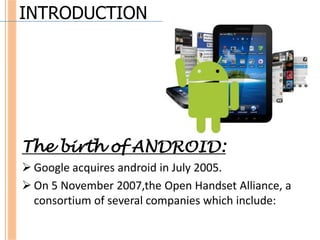
The birth of ANDROID:
 Google acquires android in July 2005.
 On 5 November 2007,the Open Handset Alliance, a
  consortium of several companies which include:
OHA Included Companies
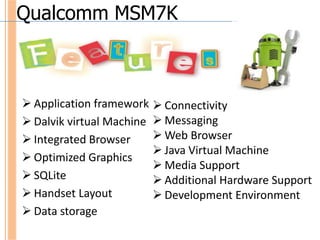
Qualcomm MSM7K


 Application framework  Connectivity
 Dalvik virtual Machine  Messaging
 Integrated Browser      Web Browser
                          Java Virtual Machine
 Optimized Graphics
                          Media Support
 SQLite                  Additional Hardware Support
 Handset Layout          Development Environment
 Data storage
Description

• Operation:
  Android Runtime:
o A set of core libraries.
o Runs it own process.
o Dalvik VM relies on the Linux kernel.
Operation of Linux kernel
o Android relies on Linux version 2.6 for core system
  services such as
               1.Security.
               2.Memory management.
               3.Process management.
               4.network stack.
               5.driver model.

o Designed to simplify the reuse of components.
Architecture
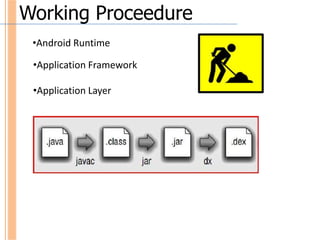
Working Proceedure
 •Android Runtime

 •Application Framework

 •Application Layer
Software Development Kit
 Includes
  • Debugging tools
  • Libraries
  • Device emulator
  • Documentation
  • Sample projects
  • JDK
  • Apache Ant
  • Python 2.2
  • Eclipse 3.2
Current status:

Survey says that android mobiles are more active sales in market.
In smart phones platform android covers major part.
PROS:
 Allow access to core mobile devices.
 All applications are equal.
 Break down boundaries.
 Fast and easy.
CONS:

  Security.
   Open Source.
   Login.
   Incompetence.
CONCLUSION:
 ANDROID is now becoming the best among all the mobile
operating systems.

 ANDROID is being used in 170 models of different 27 Mobile
Companies.

It surely takes lot of time for other OS to create such a rapid
revolution.
ANY
    QUERIES…
?

Android ppt

  • 1.
    presented by T.V.SaiPallavi. 098B1A0518 Guide :Siva Kumar.p by
  • 2.
  • 4.
    INTRODUCTION The birth ofANDROID:  Google acquires android in July 2005.  On 5 November 2007,the Open Handset Alliance, a consortium of several companies which include:
  • 5.
  • 6.
    Qualcomm MSM7K  Applicationframework  Connectivity  Dalvik virtual Machine  Messaging  Integrated Browser  Web Browser  Java Virtual Machine  Optimized Graphics  Media Support  SQLite  Additional Hardware Support  Handset Layout  Development Environment  Data storage
  • 7.
    Description • Operation: Android Runtime: o A set of core libraries. o Runs it own process. o Dalvik VM relies on the Linux kernel.
  • 8.
    Operation of Linuxkernel o Android relies on Linux version 2.6 for core system services such as 1.Security. 2.Memory management. 3.Process management. 4.network stack. 5.driver model. o Designed to simplify the reuse of components.
  • 9.
  • 10.
    Working Proceedure •AndroidRuntime •Application Framework •Application Layer
  • 11.
    Software Development Kit Includes • Debugging tools • Libraries • Device emulator • Documentation • Sample projects • JDK • Apache Ant • Python 2.2 • Eclipse 3.2
  • 12.
    Current status: Survey saysthat android mobiles are more active sales in market. In smart phones platform android covers major part.
  • 13.
    PROS:  Allow accessto core mobile devices.  All applications are equal.  Break down boundaries.  Fast and easy.
  • 14.
    CONS: Security.  Open Source.  Login.  Incompetence.
  • 15.
    CONCLUSION:  ANDROID isnow becoming the best among all the mobile operating systems.  ANDROID is being used in 170 models of different 27 Mobile Companies. It surely takes lot of time for other OS to create such a rapid revolution.
  • 16.
    ANY QUERIES… ?