Prepared by :-
VIVEK GAUTAM
MASTER OF COMPUTER APPLICATIONS
Uic.15mca8191@gmail.com
A
PRESENTATION
ON
“ANDROID”
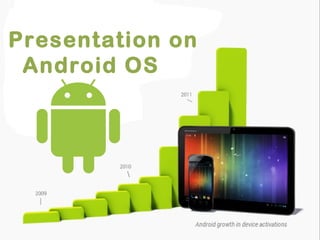
Presentation on
Android OS
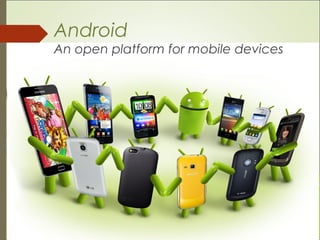
Android
An open platform for mobile devices
 Android is an open source and Linux-based
Operating System for mobile devices such as
smartphones, tablet computers, notebooks etc.
 Android was developed by Google and later the
OHA(Open Handset Alliances) and other
companies.
What is Google Android?
The world's most powerful mobile platform.
OHA (Open Handset Alliance)
 OHA(Open Handset Alliance) is consortium of 84
companies such as Google, Samsung, eBay,
Intel, synaptic etc. It was established on 5th
November, 2007, led by Google.
OHA as consortium of
several companies
Why Android ??
Features of Android OS
 Open Source
 Beautiful User Interface
 Preinstalled applications from Google
 Gmail, Maps, Search, Voice Search, YouTube, Web
Browser, Messaging(SMS,MMS)
 Support for Camera, GPS, Accelerometer
 Media support (MPEG4, H.264, MP3, AAC, JPG,PNG etc.)
 Multi-language, Multi-touch & Multi-tasking
 It supports wireless communications using:
 GSM/EDGE, CDMA
 802.11 Wi-Fi networks
 Bluetooth
 Initially, Andy Rubin founded Android Incorporation in
Palo Alto, California, United States in October, 2003.
 On 17th August 2005, Google acquired android
Incorporation.
 The key employees of Android Incorporation are Andy
Rubin, Rich Miner, Chris White and Nick Sears.
 Originally intended for camera but shifted to smart
phones later because of low market for camera only.
 Android is the nick name of Andy Rubin given by co-
workers because of his love to robots.
Brief History of Android
 In 2007, Google announces the development of
android OS.
 The first beta version of the Android Software Development Kit
(SDK) was released by Google in 2007 where as the first
commercial version, Android 1.0, was released in September
2008.
 In 2008, HTC launched the first android mobile.
 On June 27, 2012, at the Google I/O conference, Google
announced the 4.1 Jelly Bean.
 Jelly Bean is an incremental update, with the primary aim of
improving the user interface, both in terms of functionality
and performance.
Brief History Continued..
Android vs. iPhone

Java vs. Objective-C

Direct install vs. Marketplace vs. App Store

Open source?
 57% of Android App Store
apps are free, vs. 28% for
Apple App Store
Android Versions
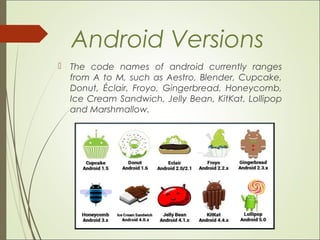
 The code names of android currently ranges
from A to M, such as Aestro, Blender, Cupcake,
Donut, Éclair, Froyo, Gingerbread, Honeycomb,
Ice Cream Sandwich, Jelly Bean, KitKat, Lollipop
and Marshmallow.
LATEST VERSION
 Android 6.0 "Marshmallow" is an latest
update to the Android Mobile Operating
System.
Development Environment
Android applications are usually developed in the Java
language using the Android Software Development Kit.
 Java
 IDE – Eclipse
 Eclipse plug-in - ADT
 Android SDK (Software Development Kit)
 Real Android Device or Android Emulator
Android Applications
 Android powers millions of mobile devices in more than 190 countries
around the world.
 It's the largest installed base of any mobile platform and growing fast.
 Every day more than 1 million new Android devices are activated
worldwide
 Now Android is the most popular platform for developers, used by 71% of
the mobile developer population
 As of September 3, 2013, 1 billion Android devices have been activated.
 Android has overtook iOS as the dominant OS
 Once developed, Android applications can be packaged easily and sold
out either through a store such as Google Play, Opera Mobile Store, and
the Amazon Appstore.
 First phone launched HTC G1 in 2008
Android Applications
Other than smartphones and tablets.
• Aside from smartphones and tablets,
Android is used in laptops, netbooks,
Smartbooks, SmartWatch, Smart TVs
(Google TV) and cameras, Smart
glasses (Google Glass), headphones,
car CD and DVD players, portable
media players etc.
Android Phones
HTC G1, Droid, Tattoo Motorola Droid (X)
Suno S880 Samsung Galaxy Sony Ericsson
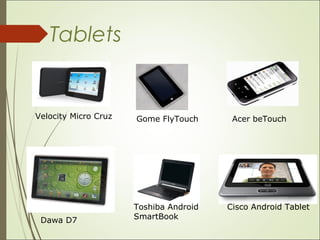
Tablets
Velocity Micro Cruz Gome FlyTouch Acer beTouch
Dawa D7
Toshiba Android
SmartBook
Cisco Android Tablet
Android-Powered Microwave
By Touch Revolution – at CES 2010
http://www.google.com/nexus/
Google Nexus
Mobile Devices: Advantages
(as compared to fixed devices)
 Always with the user
 Typically have Internet access
 Typically GPS enabled
 Typically have accelerometer &
compass
 Most have cameras & microphones
 Many apps are free or low-cost
Mobile Devices: Disadvantages
 Limited screen size
 Limited battery life
 Limited processor speed
 Limited and sometimes slow network access
 Limited or awkward input: soft keyboard,
phone keypad, touch screen
 Limited web browser functionality
 Range of platforms & configurations
across devices
INTERESTING FACT
The 5 November date is
popularly celebrated as
Android's "birthday".
THANK YOU..THANK YOU..

Android PPT

  • 1.
    Prepared by :- VIVEKGAUTAM MASTER OF COMPUTER APPLICATIONS Uic.15mca8191@gmail.com A PRESENTATION ON “ANDROID”
  • 2.
  • 3.
    Android An open platformfor mobile devices
  • 4.
     Android isan open source and Linux-based Operating System for mobile devices such as smartphones, tablet computers, notebooks etc.  Android was developed by Google and later the OHA(Open Handset Alliances) and other companies. What is Google Android? The world's most powerful mobile platform.
  • 5.
    OHA (Open HandsetAlliance)  OHA(Open Handset Alliance) is consortium of 84 companies such as Google, Samsung, eBay, Intel, synaptic etc. It was established on 5th November, 2007, led by Google.
  • 6.
    OHA as consortiumof several companies
  • 7.
  • 8.
    Features of AndroidOS  Open Source  Beautiful User Interface  Preinstalled applications from Google  Gmail, Maps, Search, Voice Search, YouTube, Web Browser, Messaging(SMS,MMS)  Support for Camera, GPS, Accelerometer  Media support (MPEG4, H.264, MP3, AAC, JPG,PNG etc.)  Multi-language, Multi-touch & Multi-tasking  It supports wireless communications using:  GSM/EDGE, CDMA  802.11 Wi-Fi networks  Bluetooth
  • 9.
     Initially, AndyRubin founded Android Incorporation in Palo Alto, California, United States in October, 2003.  On 17th August 2005, Google acquired android Incorporation.  The key employees of Android Incorporation are Andy Rubin, Rich Miner, Chris White and Nick Sears.  Originally intended for camera but shifted to smart phones later because of low market for camera only.  Android is the nick name of Andy Rubin given by co- workers because of his love to robots. Brief History of Android
  • 10.
     In 2007,Google announces the development of android OS.  The first beta version of the Android Software Development Kit (SDK) was released by Google in 2007 where as the first commercial version, Android 1.0, was released in September 2008.  In 2008, HTC launched the first android mobile.  On June 27, 2012, at the Google I/O conference, Google announced the 4.1 Jelly Bean.  Jelly Bean is an incremental update, with the primary aim of improving the user interface, both in terms of functionality and performance. Brief History Continued..
  • 11.
    Android vs. iPhone  Javavs. Objective-C  Direct install vs. Marketplace vs. App Store  Open source?  57% of Android App Store apps are free, vs. 28% for Apple App Store
  • 12.
    Android Versions  Thecode names of android currently ranges from A to M, such as Aestro, Blender, Cupcake, Donut, Éclair, Froyo, Gingerbread, Honeycomb, Ice Cream Sandwich, Jelly Bean, KitKat, Lollipop and Marshmallow.
  • 13.
    LATEST VERSION  Android 6.0"Marshmallow" is an latest update to the Android Mobile Operating System.
  • 14.
    Development Environment Android applicationsare usually developed in the Java language using the Android Software Development Kit.  Java  IDE – Eclipse  Eclipse plug-in - ADT  Android SDK (Software Development Kit)  Real Android Device or Android Emulator
  • 15.
    Android Applications  Androidpowers millions of mobile devices in more than 190 countries around the world.  It's the largest installed base of any mobile platform and growing fast.  Every day more than 1 million new Android devices are activated worldwide  Now Android is the most popular platform for developers, used by 71% of the mobile developer population  As of September 3, 2013, 1 billion Android devices have been activated.  Android has overtook iOS as the dominant OS  Once developed, Android applications can be packaged easily and sold out either through a store such as Google Play, Opera Mobile Store, and the Amazon Appstore.  First phone launched HTC G1 in 2008
  • 16.
    Android Applications Other thansmartphones and tablets. • Aside from smartphones and tablets, Android is used in laptops, netbooks, Smartbooks, SmartWatch, Smart TVs (Google TV) and cameras, Smart glasses (Google Glass), headphones, car CD and DVD players, portable media players etc.
  • 17.
    Android Phones HTC G1,Droid, Tattoo Motorola Droid (X) Suno S880 Samsung Galaxy Sony Ericsson
  • 18.
    Tablets Velocity Micro CruzGome FlyTouch Acer beTouch Dawa D7 Toshiba Android SmartBook Cisco Android Tablet
  • 19.
    Android-Powered Microwave By TouchRevolution – at CES 2010
  • 20.
  • 21.
    Mobile Devices: Advantages (ascompared to fixed devices)  Always with the user  Typically have Internet access  Typically GPS enabled  Typically have accelerometer & compass  Most have cameras & microphones  Many apps are free or low-cost
  • 22.
    Mobile Devices: Disadvantages Limited screen size  Limited battery life  Limited processor speed  Limited and sometimes slow network access  Limited or awkward input: soft keyboard, phone keypad, touch screen  Limited web browser functionality  Range of platforms & configurations across devices
  • 23.
    INTERESTING FACT The 5November date is popularly celebrated as Android's "birthday".
  • 24.