Dr. AlaaEddin Almabhouh
By : Eyad Almassri
Lecture 1: Android Introduction
2020
Learning Objectives
• The design goals for the Android™ operating
system
• The role of the Memory Manager and Virtual
Memory Manager
• The cooperation of the Android operating
system with Linux for memory, device,
processor, and network management
2
Introduction
• Android
– Designed to run mobile devices:
specifically smartphones and tablets
– Built on a Linux foundation
– Customizable user interface
• Allows user to customize app configurations
– Open source operating system
• Key elements, but not all, of the source code
are published
3
Brief History
• Android operating system
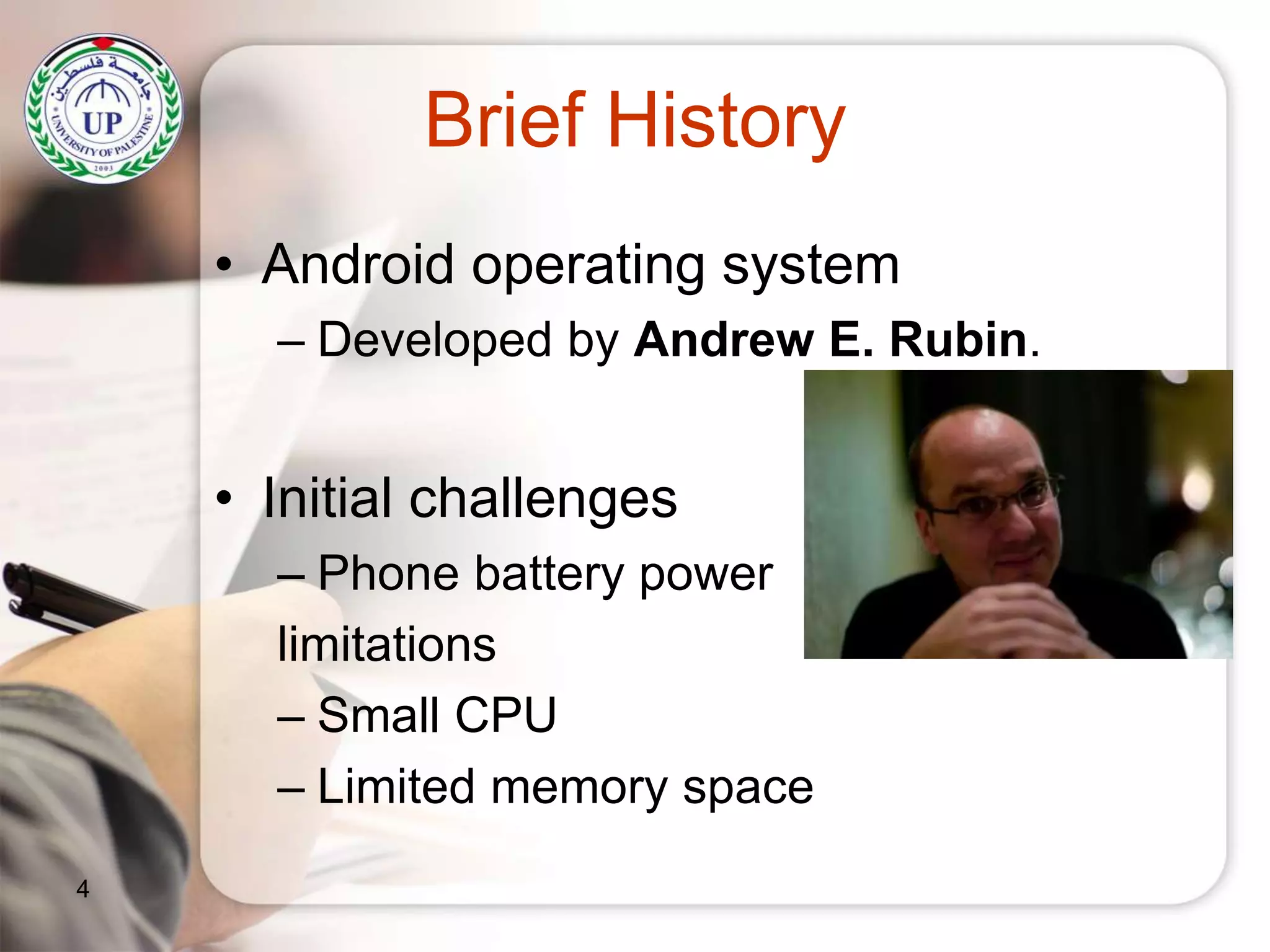
– Developed by Andrew E. Rubin.
• Initial challenges
– Phone battery power
limitations
– Small CPU
– Limited memory space
4
Brief History (cont’d.)
• Google purchased Android (2005)
• Rubin joined Google
• Android extended to reach entire
mobile smartphones and tablets
generations
– “More than 2.5 billion run active devices
have”
( 2019)
5
6
The Android robot logo can be
used only according to terms
described in the Creative
Commons 3.0 Attribution
License..
Brief History (cont’d.)
• Android’s source code: available with
each new release
– Instructions at http://source.android.com
• Device’s Android version number and
Linux kernel version number
– Available under Systems menu
7
Open Handset Alliance
OHA
• The open handset alliance(OHA)
is a business alliance of firm to
develop open standard for
mobile devices.
• Devoted to advancing open
standards for mobile devices
• Develop technologies that will
significantly lower the cost of
developing and distributing
mobile devices and services.
Manufacturers: Designing
Android Devices
• Samsung
• Motorola
• Dell
• Sony Ericsson
• HTC
• LG
• Amazon
• Intel
• Texas Instruments
• ARM
• NVIDIA
• Qualcomm
Manufacturers: Designing
Android Devices (Cont’d)
• T-Mobile G1 by HTC:
– Released October 2008.
– First to ship Android handset.
• By Q4 2010, Android dominated the
smartphone market.
• As of May 2015:
– Android devices shipped to more than 160 countries.
– Google Play had more than 2.5 billion active users.
– Google Play had 80 billion app installs.
Android is Multi‐Platform
Android
runs on all
these
devices
Smartwatch
In-car console
Smartp
hone
Tablet
Televisi
on
This Class:
Focuses Mostly
on Smartphones!
The Android Marketplace: Where We
Are Now
• Competitive hardware and software feature
upgrades
• Expansion beyond smartphones
– Tablets
– Watches
– TVs
– Automobile dashboards
– Video game consoles
• Improved user-facing features
Android Wearables: Google Glass
 Head‐mounted display, displays information,
touch‐free
 Example application: Records babies life
steps
 Features:
 Touchpad (on side), camera for photoes
video, display, voice commands
 Google recently announced discontinuing
Google Glass
Android Hardware: TV
programming
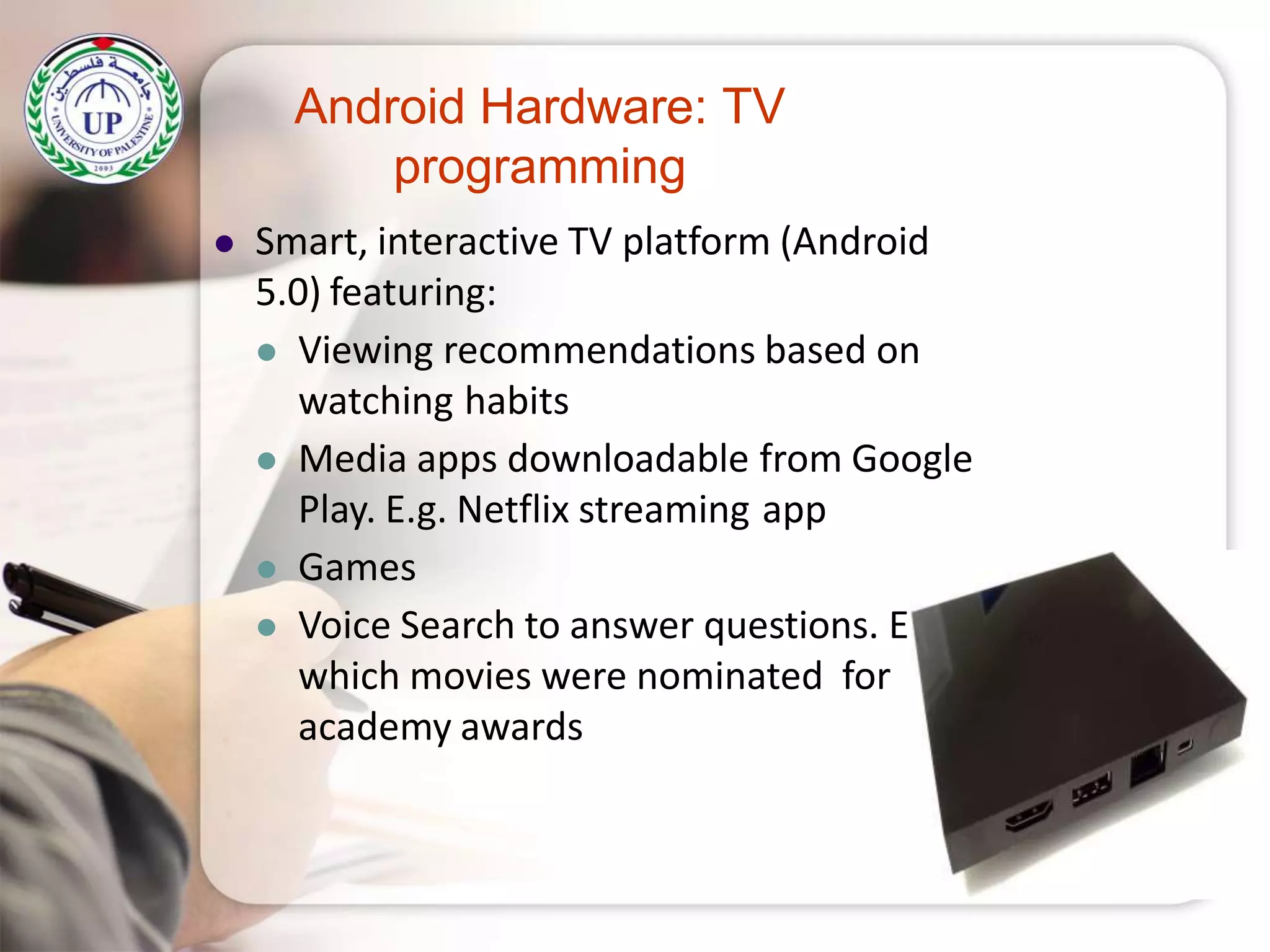
 Smart, interactive TV platform (Android
5.0) featuring:
 Viewing recommendations based on
watching habits
 Media apps downloadable from Google
Play. E.g. Netflix streaming app
 Games
 Voice Search to answer questions. E.g.
which movies were nominated for
academy awards
Android Hardware: in‐Car
Entertainment and Navigation
System
 Example: Honda Connect system
 Integrated audio, phone, navigation,
information system
 Runs Android 4.0.4
Android versions
16
FEATURES OF ANDROID
• Background Wi-Fi location still runs even when
Wi-Fi is turned off
• Developer logging and analyzing enhancements
• It is optimized for mobile devices.
• It enables reuse and replacement of
components.
• Java support ,media support, multi touch, video
calling,multi tasking ,voice based features,
screen capture, camera ,bluetooth,gps,compass
and accelerometer,3G
•The ability for anyone to customize the Google
Android platform
•It gives you better notification.
•It lets you choose your hardware.
•It has better app market.
•A more mature platform With the support of
many applications, the user can change the
screen display.
•With Google chrome you can open many
window at once.
• Supports all Google services: Android operating
system supports all of Google services ranging from
Gmail to Google reader. all Google services can you
have with one operating system, namely Android.
ADVANTAGES
DIS-ADVANTAGES
• Android Market is less control of the manager,
sometimes there are malware.
• Wasteful Batteries, This is because the OS is a lot of
"process" in the background causing the battery
quickly drains.
• Sometimes slow device company issued an official
version of Android your own .
• Extremely inconsistence in design among apps.
• Very unstable and often hang or crash.

Lec001

  • 1.
    Dr. AlaaEddin Almabhouh By: Eyad Almassri Lecture 1: Android Introduction 2020
  • 2.
    Learning Objectives • Thedesign goals for the Android™ operating system • The role of the Memory Manager and Virtual Memory Manager • The cooperation of the Android operating system with Linux for memory, device, processor, and network management 2
  • 3.
    Introduction • Android – Designedto run mobile devices: specifically smartphones and tablets – Built on a Linux foundation – Customizable user interface • Allows user to customize app configurations – Open source operating system • Key elements, but not all, of the source code are published 3
  • 4.
    Brief History • Androidoperating system – Developed by Andrew E. Rubin. • Initial challenges – Phone battery power limitations – Small CPU – Limited memory space 4
  • 5.
    Brief History (cont’d.) •Google purchased Android (2005) • Rubin joined Google • Android extended to reach entire mobile smartphones and tablets generations – “More than 2.5 billion run active devices have” ( 2019) 5
  • 6.
    6 The Android robotlogo can be used only according to terms described in the Creative Commons 3.0 Attribution License..
  • 7.
    Brief History (cont’d.) •Android’s source code: available with each new release – Instructions at http://source.android.com • Device’s Android version number and Linux kernel version number – Available under Systems menu 7
  • 8.
    Open Handset Alliance OHA •The open handset alliance(OHA) is a business alliance of firm to develop open standard for mobile devices. • Devoted to advancing open standards for mobile devices • Develop technologies that will significantly lower the cost of developing and distributing mobile devices and services.
  • 9.
    Manufacturers: Designing Android Devices •Samsung • Motorola • Dell • Sony Ericsson • HTC • LG • Amazon • Intel • Texas Instruments • ARM • NVIDIA • Qualcomm
  • 10.
    Manufacturers: Designing Android Devices(Cont’d) • T-Mobile G1 by HTC: – Released October 2008. – First to ship Android handset. • By Q4 2010, Android dominated the smartphone market. • As of May 2015: – Android devices shipped to more than 160 countries. – Google Play had more than 2.5 billion active users. – Google Play had 80 billion app installs.
  • 11.
    Android is Multi‐Platform Android runson all these devices Smartwatch In-car console Smartp hone Tablet Televisi on This Class: Focuses Mostly on Smartphones!
  • 12.
    The Android Marketplace:Where We Are Now • Competitive hardware and software feature upgrades • Expansion beyond smartphones – Tablets – Watches – TVs – Automobile dashboards – Video game consoles • Improved user-facing features
  • 13.
    Android Wearables: GoogleGlass  Head‐mounted display, displays information, touch‐free  Example application: Records babies life steps  Features:  Touchpad (on side), camera for photoes video, display, voice commands  Google recently announced discontinuing Google Glass
  • 14.
    Android Hardware: TV programming Smart, interactive TV platform (Android 5.0) featuring:  Viewing recommendations based on watching habits  Media apps downloadable from Google Play. E.g. Netflix streaming app  Games  Voice Search to answer questions. E.g. which movies were nominated for academy awards
  • 15.
    Android Hardware: in‐Car Entertainmentand Navigation System  Example: Honda Connect system  Integrated audio, phone, navigation, information system  Runs Android 4.0.4
  • 16.
  • 17.
    FEATURES OF ANDROID •Background Wi-Fi location still runs even when Wi-Fi is turned off • Developer logging and analyzing enhancements • It is optimized for mobile devices. • It enables reuse and replacement of components. • Java support ,media support, multi touch, video calling,multi tasking ,voice based features, screen capture, camera ,bluetooth,gps,compass and accelerometer,3G
  • 18.
    •The ability foranyone to customize the Google Android platform •It gives you better notification. •It lets you choose your hardware. •It has better app market. •A more mature platform With the support of many applications, the user can change the screen display. •With Google chrome you can open many window at once. • Supports all Google services: Android operating system supports all of Google services ranging from Gmail to Google reader. all Google services can you have with one operating system, namely Android. ADVANTAGES
  • 19.
    DIS-ADVANTAGES • Android Marketis less control of the manager, sometimes there are malware. • Wasteful Batteries, This is because the OS is a lot of "process" in the background causing the battery quickly drains. • Sometimes slow device company issued an official version of Android your own . • Extremely inconsistence in design among apps. • Very unstable and often hang or crash.

Editor's Notes

  • #10 Here is just a partial list of manufacturers of Android devices.
  • #13 Competitive hardware and software feature upgrades: The Android SDK developers have focused on providing APIs for features that are not available on competing platforms to move Android ahead in the market. For example, recent releases of the Android SDK have featured significant improvements to Notifications to bring you the information that matters most to you when you need it. Expansion beyond smartphones: Smartwatch usage is on the rise with Android users. There are many new Android Wear devices on the market that come in many different sizes and form factors. Hardware manufacturers are even using Android for gaming consoles, TVs, dashboards for automobiles, in addition to many other types of devices that require an operating system. Google has even announced Project Brillo, a version of Android designed for the Internet of Things (IoT), along with Weave, an IoT protocol for connecting these devices. Improved user-facing features and marketing: The Android development team has shifted its focus from feature implementation to providing user-facing usability upgrades and “chrome.” The Android development team has invested heavily in creating a smoother, faster, more responsive user interface, in addition to updating their design documentation with excellent training that includes best practices for developers to follow. Those principles are centered around three goals focused on the user experience, which are “Enchant me,” “Simplify my life,” and “Make me amazing.” Following these principles should help increase any application’s usability.