Presentation oN
By
UMANG VYAS
(CEO-WWW.TEACHMISSION.COM)
In the Presentation…
• History Of Android
• Introduction Of Android
• Android Versions
• Android Architecture
• Security
• Features Of Android
• Android Material Design
• Advantages Of Android
• Disadvantages Of Android
• Conclusion
History Of Android
• Android Inc. founded in Palo Alto, California, United
States in October 2003.
• Android Develop By:-
• Andy Rubin [Co-Founder of Danger]
• Rich Miner[Co-Founder of Wildfire
Communication Inc.]
• Nick Sears[Once VP at T-mobile]
• Chris White[Headed Design & Interface
Development at Web TV]
Introduction Of Android
• It is a open source software platform and operating system for mobile
devices.
• Based on the Linux kernel
• Developed by Google and later the Open Handset Alliance (OHA).
• Allows writing managed code in the Java language
• Android has its own virtual machine i.e. DVM(Dalvik Virtual
Machine) ,which is used for executing the android application.
• Google purchased the initial developer of the software , android
incorporated in 2005.
Android Versions
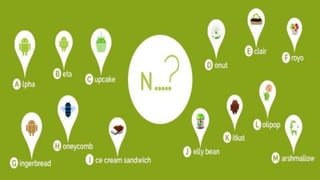
• Angel Cake (Android 1.0)
• Battenberg (Android 1.1)
• Cupcake (Android 1.5)
• Donut (Android 1.6)
• Eclair (Android 2.0/2.1)
• Froyo (Android 2.2)
• Gingerbread (Android 2.3)
• Honeycomb (Android 3.0)
• Ice Cream Sandwich (Android 4.0)
• Jelly Bean (Android 4.1)
• KitKat (Android 4.4)
• Lollipop (Android 5.0/5.1/5.2)
• Marshmallow (Android 6.0/6.1)
• Nougat (Android 7.0 – Coming Soon)
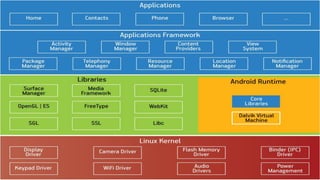
Android Architecture
• Linux Kernel
• Libraries
• Android Runtime
• Application Framework
• Application
Security
• Android is a multi-process system, in which each application (and parts of
the system) runs in its own process.
• Most security between applications and the system is enforced at the
process level through standard Linux facilities, such as user and group IDs
that are assigned to applications.
• Android is designed having multi layer security which provides flexibility
for this platform.
• When attackers attempt attack on device, android platform help to reduce
the portability of the attack.
Security (Cont.)
• There are key components of android security which are described as
follows:
• Design review:-when a security model is designed then it will be
reviewed by the developers so that risk level will be very less
while using the model.
• Code review and penetrating testing:-the goal of this code
review is that in which it will be checked that how the
system will become strong?
• Open source and community review:-android uses open
source technologies that have significant external
review such as Linux kernel.
• Incident response:-android team enables the rapid mitigation of
vulnerabilities to ensure that potential risks to all android users are
minimized.
Features Of Android
• General:-
• Messaging
• Web Browser
• Voice-based features
• Multi-touch
• Multitasking
• Screen capture
• TV recording
• Video calling
• Multiple language support
• Accessibility
• Connectivity:-
• Connectivity
• Bluetooth
• Tethering
Features Of Android (Cont.)
• Media:-
• Streaming Media Support
• Media Support
• External Storage
• Hardware Support:-
• Cameras
• Touchscreens
• GPS
• Accelerometers
• Gyroscopes
• Barometers
• Magnetometers
• Dedicated Gaming Controls
• Proximity
• Pressure Sensors
• Thermometers
• Accelerated 2D Bit Blits
• Accelerated 3D Graphics
Features Of Android (Cont.)
• Others:-
• Java support
• Handset layouts
• Storage
• Native Apps
• Instant Apps
ANDROID
MATERIAL DESIGN
Advantages Of Android
• The ability for anyone to customize the Google Android platform
• It gives you better notification.
• It lets you choose your hardware.
• It has better app market(1,80,000 application)
• A more mature platform
• With the support of many applications, the user can change the screen
display.
• With Google chrome you can open many window at once.
• Supports all Google services.
Disadvantages Of Android
• Android Market is less control of the manager, sometimes there are malware.
• Wasteful Batteries, This is because the OS is a lot of "process" in the background
causing the battery quickly drains.
• Sometimes slow device company issued an official version of Android your own .
• Extremely inconsistence in design among apps.
• Very unstable and often hang or crash.
Conclusion
• I've learned through my research that Android is a much more diverse operating
system than iOS and Windows Phone Mobile.
• Android has grown rapidly over the past 4 years becoming the most used
smartphone operating system in the world.
• It's because Android doesn't release 1 phone from 1 company with 1 new OS
every year, but countless phones from numerous companies, adding
their own twist, throughout the year, developing gradually day-by-day.
• Android's ability to customize is unparalleled compared to Apple's and
Microsoft's software allowing the user to change and customize nearly every
aspect of Android which most iPhone and Windows 7 users
wouldn't dream possible.
• I am not one to say that Android is better or worse than one OS, but is unique and
incomparable to other mobile operating systems.
THANK YOU

Presentation On Android

  • 1.
  • 2.
    In the Presentation… •History Of Android • Introduction Of Android • Android Versions • Android Architecture • Security • Features Of Android • Android Material Design • Advantages Of Android • Disadvantages Of Android • Conclusion
  • 3.
    History Of Android •Android Inc. founded in Palo Alto, California, United States in October 2003. • Android Develop By:- • Andy Rubin [Co-Founder of Danger] • Rich Miner[Co-Founder of Wildfire Communication Inc.] • Nick Sears[Once VP at T-mobile] • Chris White[Headed Design & Interface Development at Web TV]
  • 4.
    Introduction Of Android •It is a open source software platform and operating system for mobile devices. • Based on the Linux kernel • Developed by Google and later the Open Handset Alliance (OHA). • Allows writing managed code in the Java language • Android has its own virtual machine i.e. DVM(Dalvik Virtual Machine) ,which is used for executing the android application. • Google purchased the initial developer of the software , android incorporated in 2005.
  • 5.
    Android Versions • AngelCake (Android 1.0) • Battenberg (Android 1.1) • Cupcake (Android 1.5) • Donut (Android 1.6) • Eclair (Android 2.0/2.1) • Froyo (Android 2.2) • Gingerbread (Android 2.3) • Honeycomb (Android 3.0) • Ice Cream Sandwich (Android 4.0) • Jelly Bean (Android 4.1) • KitKat (Android 4.4) • Lollipop (Android 5.0/5.1/5.2) • Marshmallow (Android 6.0/6.1) • Nougat (Android 7.0 – Coming Soon)
  • 7.
    Android Architecture • LinuxKernel • Libraries • Android Runtime • Application Framework • Application
  • 9.
    Security • Android isa multi-process system, in which each application (and parts of the system) runs in its own process. • Most security between applications and the system is enforced at the process level through standard Linux facilities, such as user and group IDs that are assigned to applications. • Android is designed having multi layer security which provides flexibility for this platform. • When attackers attempt attack on device, android platform help to reduce the portability of the attack.
  • 10.
    Security (Cont.) • Thereare key components of android security which are described as follows: • Design review:-when a security model is designed then it will be reviewed by the developers so that risk level will be very less while using the model. • Code review and penetrating testing:-the goal of this code review is that in which it will be checked that how the system will become strong? • Open source and community review:-android uses open source technologies that have significant external review such as Linux kernel. • Incident response:-android team enables the rapid mitigation of vulnerabilities to ensure that potential risks to all android users are minimized.
  • 11.
    Features Of Android •General:- • Messaging • Web Browser • Voice-based features • Multi-touch • Multitasking • Screen capture • TV recording • Video calling • Multiple language support • Accessibility • Connectivity:- • Connectivity • Bluetooth • Tethering
  • 12.
    Features Of Android(Cont.) • Media:- • Streaming Media Support • Media Support • External Storage • Hardware Support:- • Cameras • Touchscreens • GPS • Accelerometers • Gyroscopes • Barometers • Magnetometers • Dedicated Gaming Controls • Proximity • Pressure Sensors • Thermometers • Accelerated 2D Bit Blits • Accelerated 3D Graphics
  • 13.
    Features Of Android(Cont.) • Others:- • Java support • Handset layouts • Storage • Native Apps • Instant Apps
  • 14.
  • 17.
    Advantages Of Android •The ability for anyone to customize the Google Android platform • It gives you better notification. • It lets you choose your hardware. • It has better app market(1,80,000 application) • A more mature platform • With the support of many applications, the user can change the screen display. • With Google chrome you can open many window at once. • Supports all Google services.
  • 18.
    Disadvantages Of Android •Android Market is less control of the manager, sometimes there are malware. • Wasteful Batteries, This is because the OS is a lot of "process" in the background causing the battery quickly drains. • Sometimes slow device company issued an official version of Android your own . • Extremely inconsistence in design among apps. • Very unstable and often hang or crash.
  • 19.
    Conclusion • I've learnedthrough my research that Android is a much more diverse operating system than iOS and Windows Phone Mobile. • Android has grown rapidly over the past 4 years becoming the most used smartphone operating system in the world. • It's because Android doesn't release 1 phone from 1 company with 1 new OS every year, but countless phones from numerous companies, adding their own twist, throughout the year, developing gradually day-by-day. • Android's ability to customize is unparalleled compared to Apple's and Microsoft's software allowing the user to change and customize nearly every aspect of Android which most iPhone and Windows 7 users wouldn't dream possible. • I am not one to say that Android is better or worse than one OS, but is unique and incomparable to other mobile operating systems.
  • 20.