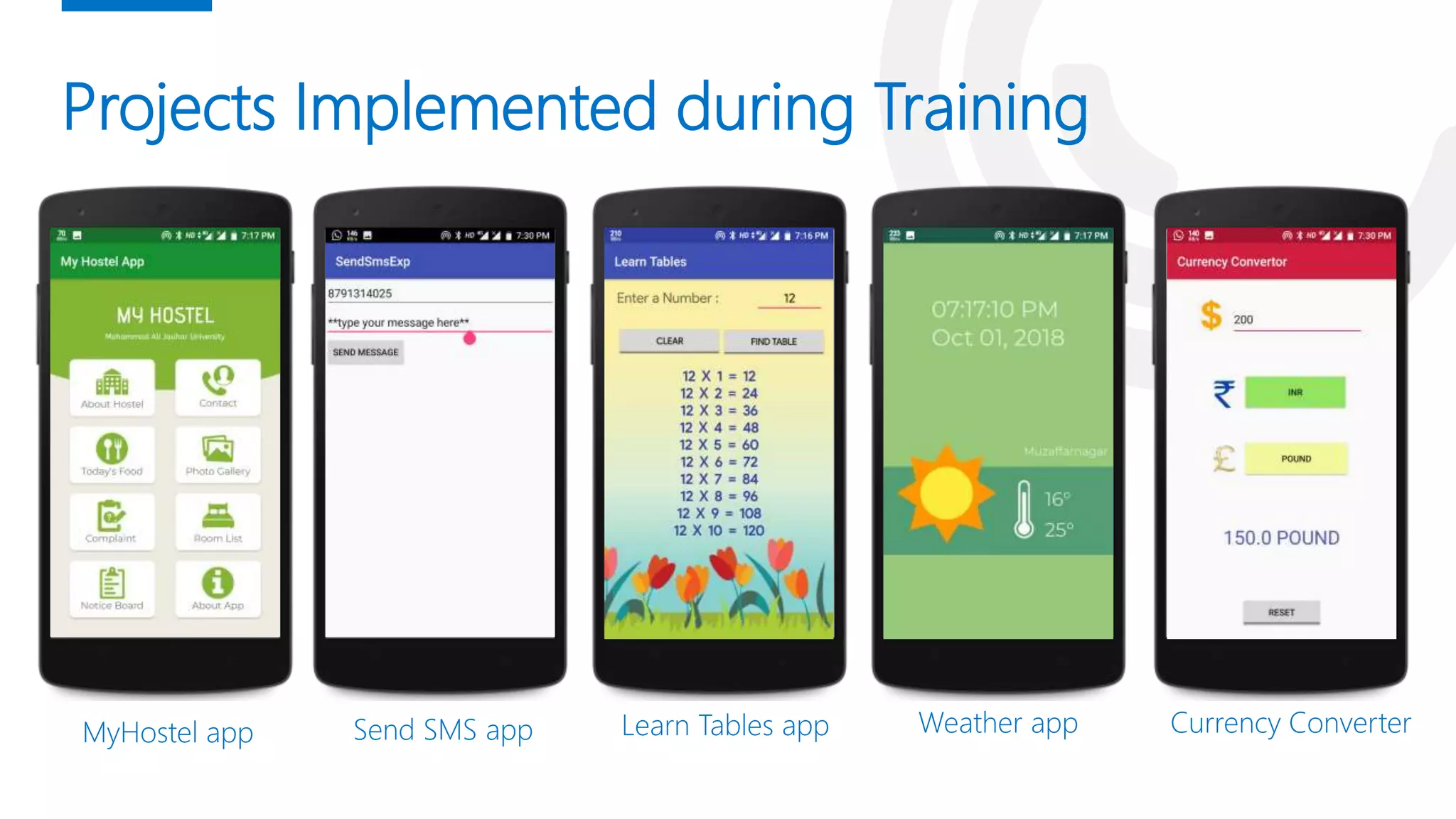
The document is a summer training report on application development focused on Android, detailing its history, architecture, and development process. It outlines the progression of Android versions, essential components for application development, and the advantages of Android over other operating systems. Additionally, it includes examples of projects implemented during the training and a bibliography for further research.
CONTENT
• Introduction
• History
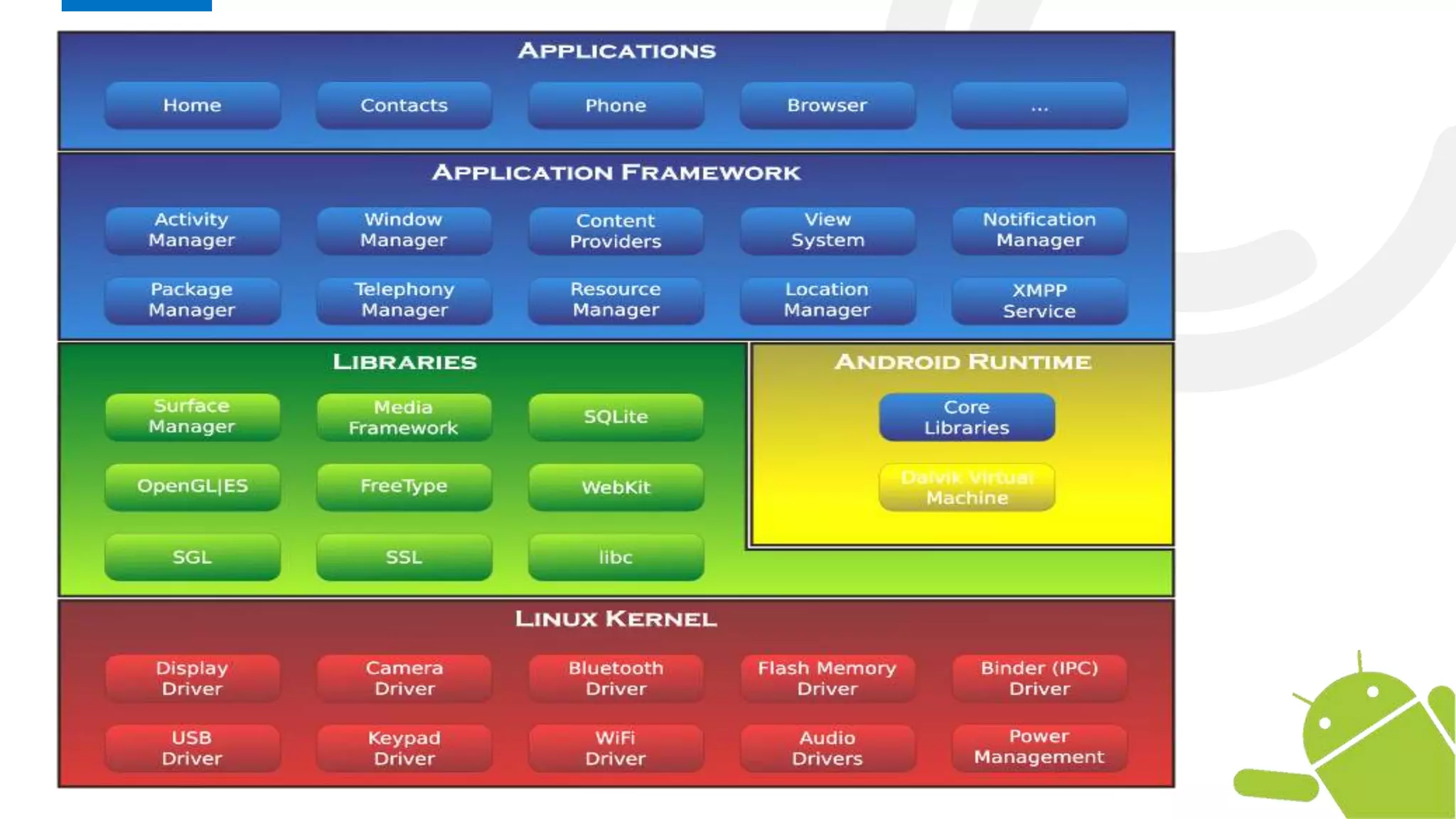
•Architecture
• Application Development
• Code compilation and execution
• Advantages of Android over other OS
• Bibliography
3.
WHAT IS ANDROID
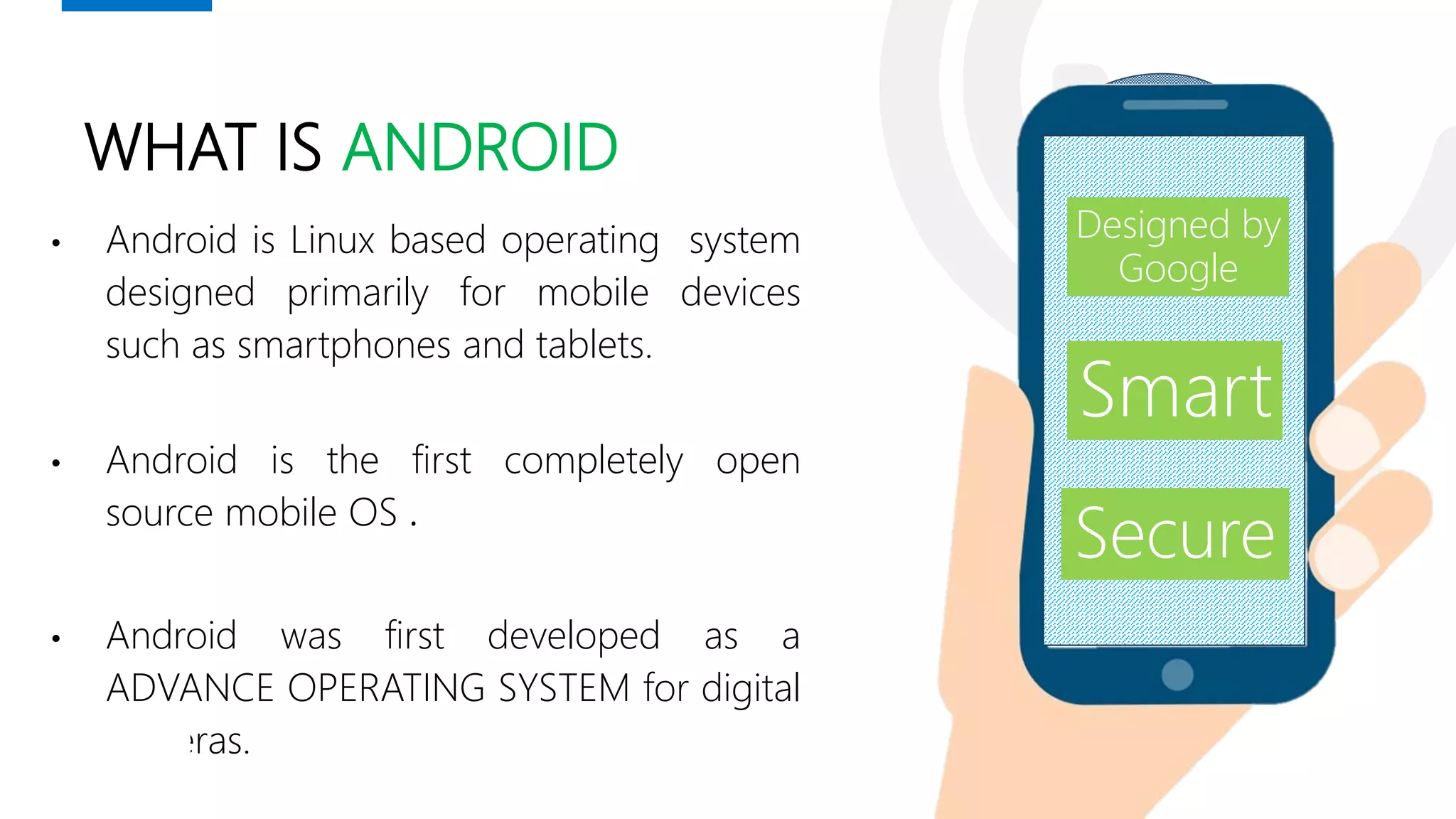
•Android is Linux based operating system
designed primarily for mobile devices
such as smartphones and tablets.
• Android is the first completely open
source mobile OS .
• Android was first developed as a
ADVANCE OPERATING SYSTEM for digital
cameras.
Smart
Secure
Designed by
Google
4.
WHAT IS OPENSOURCE
• Android OS is based on Open
Source Project which means people
can take that source code and
create custom operating systems
from it.
• CyanogenMod is a custom ROM
based on this code.
HISTORY
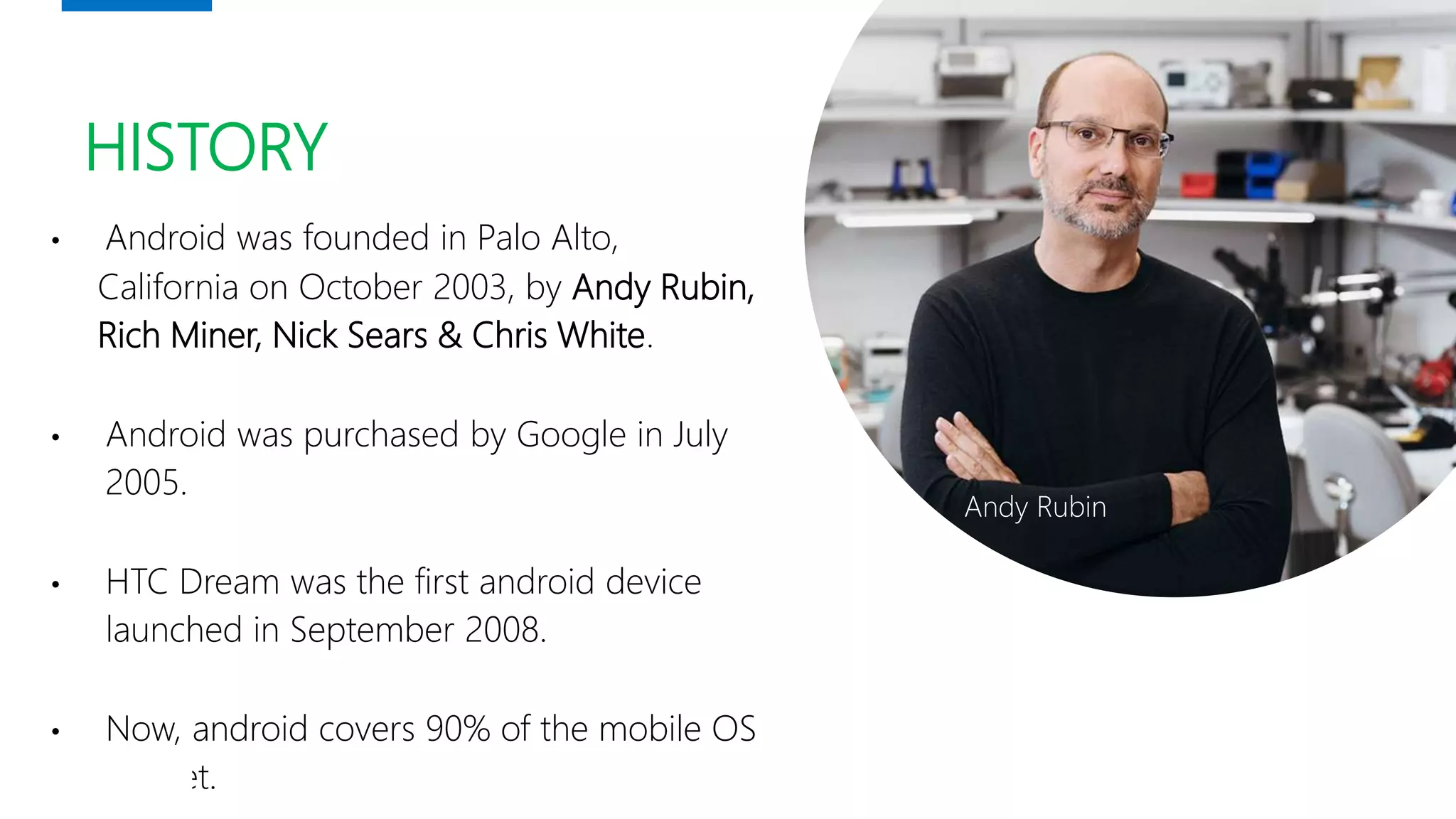
• Android wasfounded in Palo Alto,
California on October 2003, by Andy Rubin,
Rich Miner, Nick Sears & Chris White.
• Android was purchased by Google in July
2005.
• HTC Dream was the first android device
launched in September 2008.
• Now, android covers 90% of the mobile OS
market.
Andy Rubin
7.
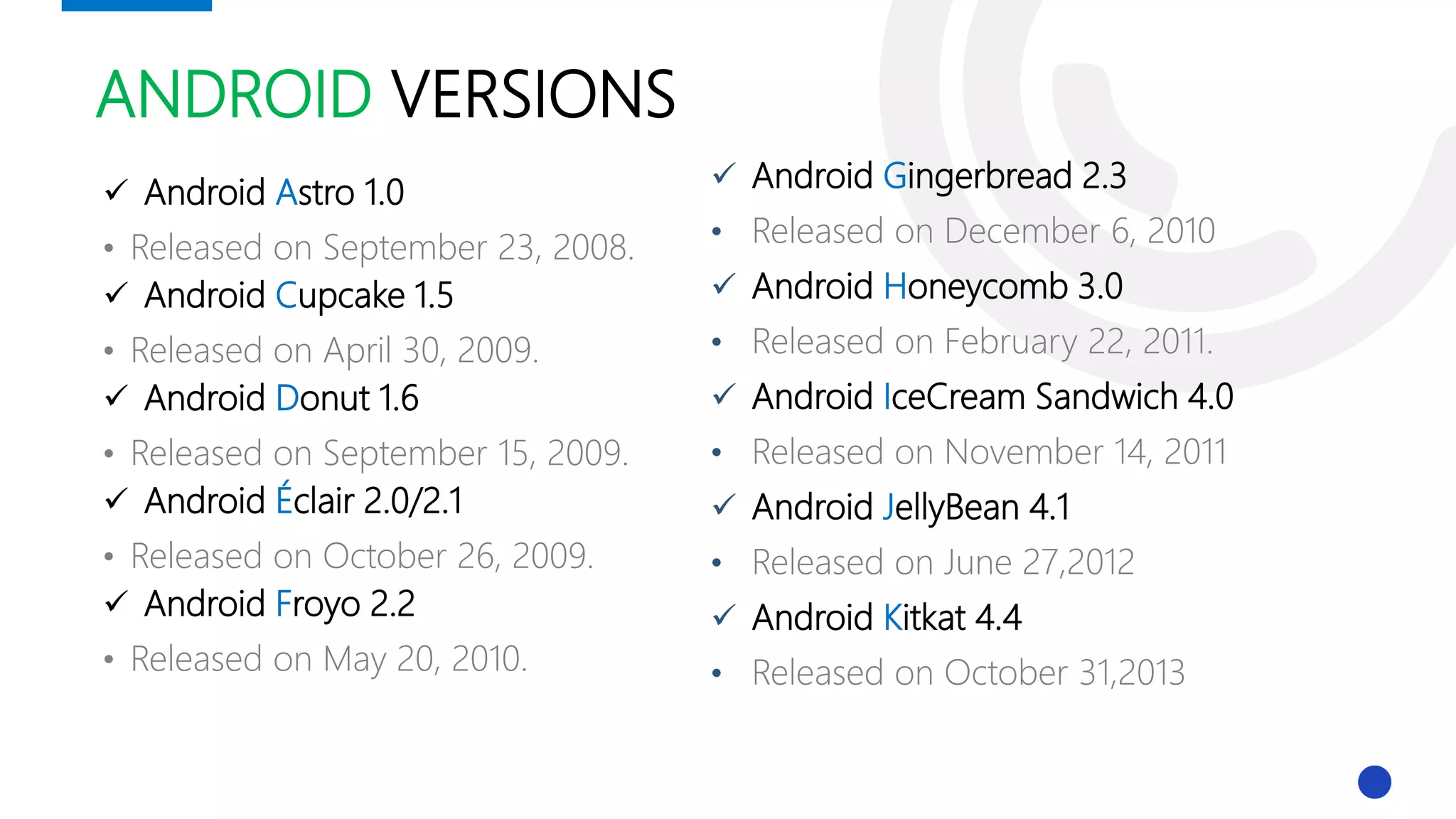
ANDROID VERSIONS
AndroidGingerbread 2.3
• Released on December 6, 2010
Android Honeycomb 3.0
• Released on February 22, 2011.
Android IceCream Sandwich 4.0
• Released on November 14, 2011
Android JellyBean 4.1
• Released on June 27,2012
Android Kitkat 4.4
• Released on October 31,2013
Android Astro 1.0
• Released on September 23, 2008.
Android Cupcake 1.5
• Released on April 30, 2009.
Android Donut 1.6
• Released on September 15, 2009.
Android Éclair 2.0/2.1
• Released on October 26, 2009.
Android Froyo 2.2
• Released on May 20, 2010.
8.
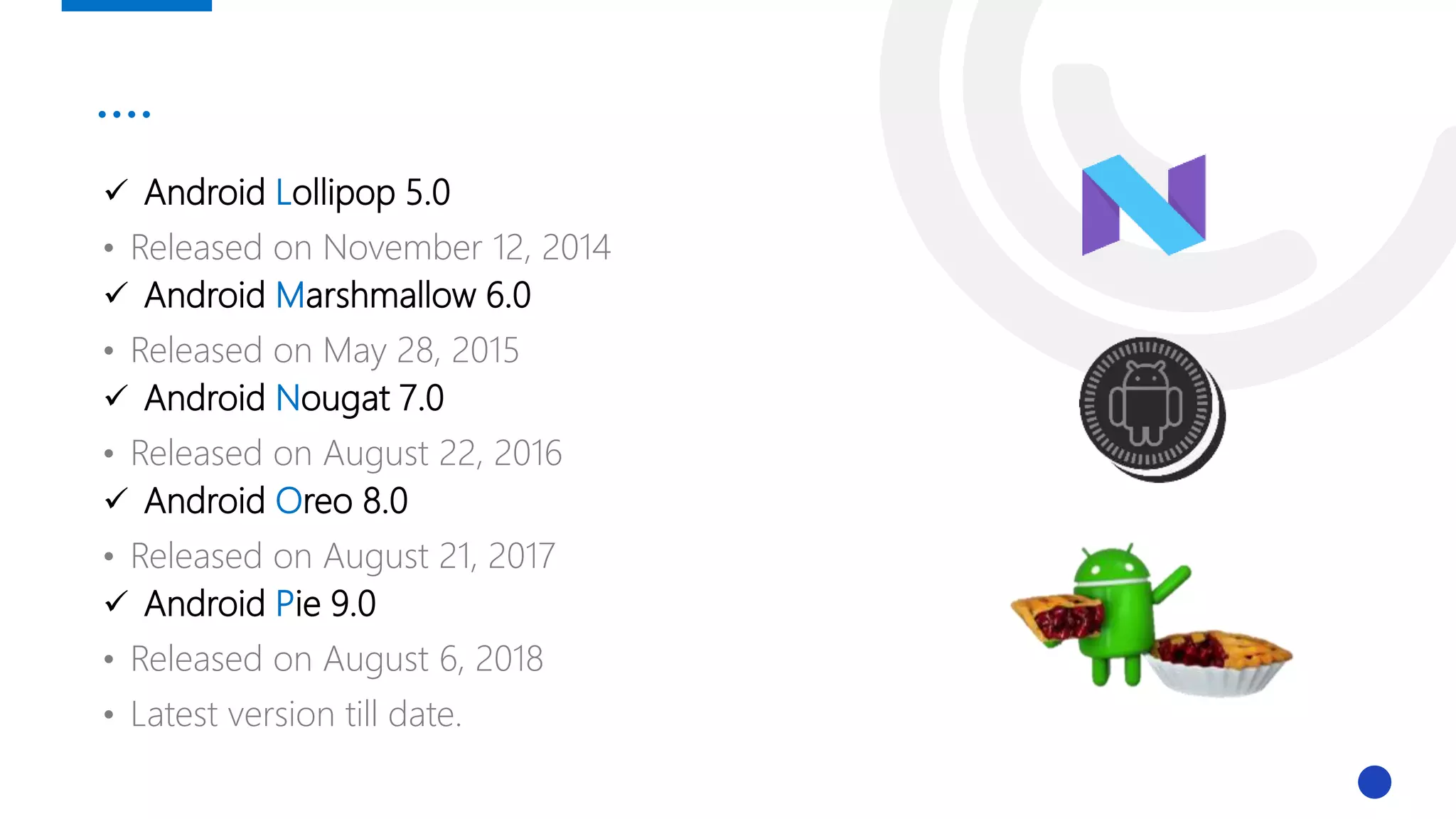
….
Android Lollipop5.0
• Released on November 12, 2014
Android Marshmallow 6.0
• Released on May 28, 2015
Android Nougat 7.0
• Released on August 22, 2016
Android Oreo 8.0
• Released on August 21, 2017
Android Pie 9.0
• Released on August 6, 2018
• Latest version till date.
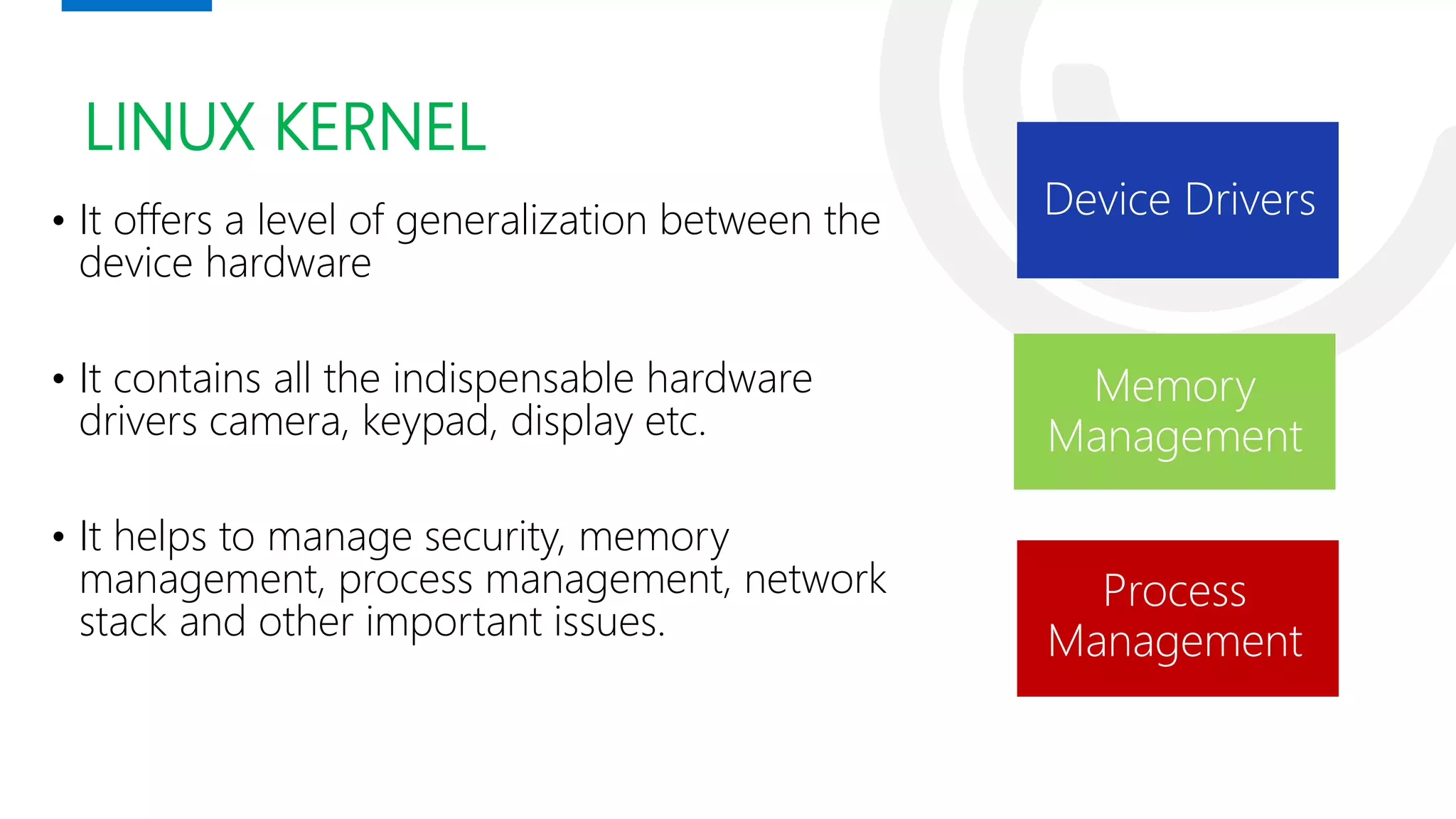
LINUX KERNEL
• Itoffers a level of generalization between the
device hardware
• It contains all the indispensable hardware
drivers camera, keypad, display etc.
• It helps to manage security, memory
management, process management, network
stack and other important issues.
Andy Rubin
Device Drivers
Process
Management
Memory
Management
14.
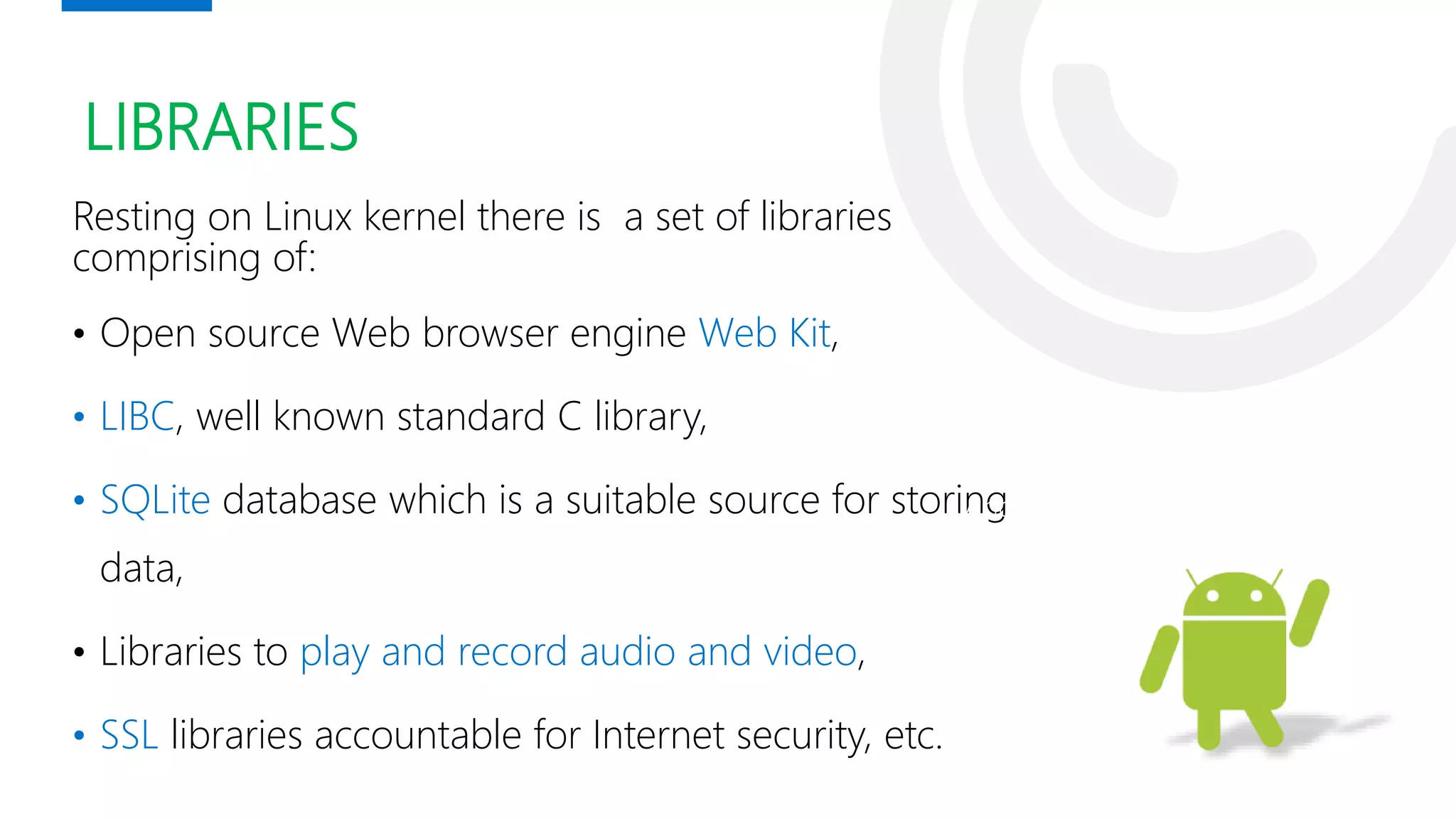
LIBRARIES
Resting on Linuxkernel there is a set of libraries
comprising of:
• Open source Web browser engine Web Kit,
• LIBC, well known standard C library,
• SQLite database which is a suitable source for storing
data,
• Libraries to play and record audio and video,
• SSL libraries accountable for Internet security, etc.
Andy Rubin
15.
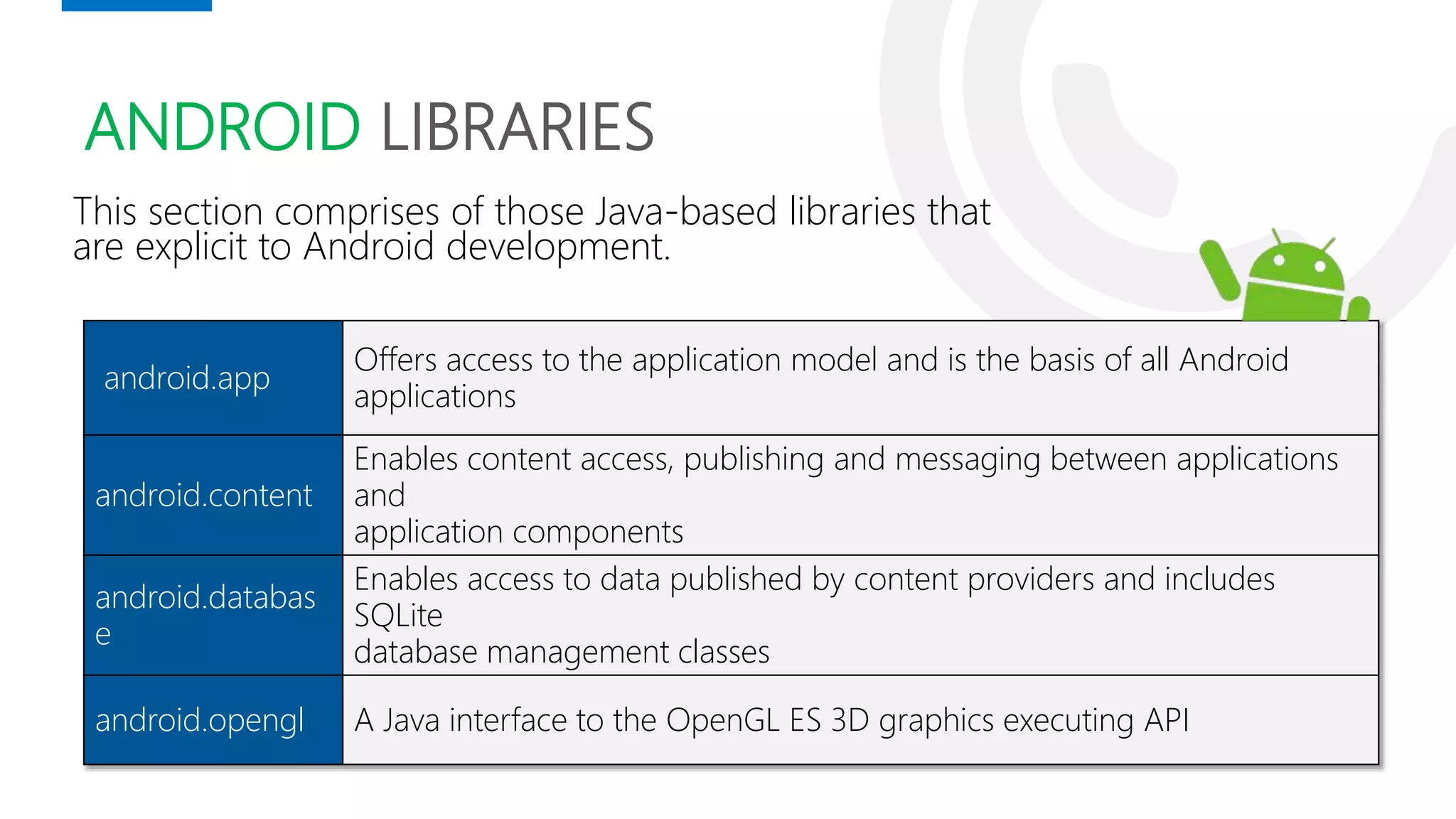
ANDROID LIBRARIES
This sectioncomprises of those Java-based libraries that
are explicit to Android development.
Andy Rubin
android.app
Offers access to the application model and is the basis of all Android
applications
android.content
Enables content access, publishing and messaging between applications
and
application components
android.databas
e
Enables access to data published by content providers and includes
SQLite
database management classes
android.opengl A Java interface to the OpenGL ES 3D graphics executing API
APP DEVELOPMENT
To buildapplication for android, you’ll need :
• Java SE Development Kit (JDK)
• The Android SDK
• Development Environment
(Android Studio or Eclipse)
18.
ANDROID SDK (SoftwareDevelopment Kit)
• The android SDK is made up of two main parts: The tools
and the Packages.
• When you first install the SDK, all you get are base tools.
These are executable and supporting files that helps to
develop applications.
• Every time Google releases a new version of Android, a
corresponding SDK is also released. To be able to write
programs with the latest features, developers must
download and install each version’s SDK for the particular
phone.
Andy Rubin
19.
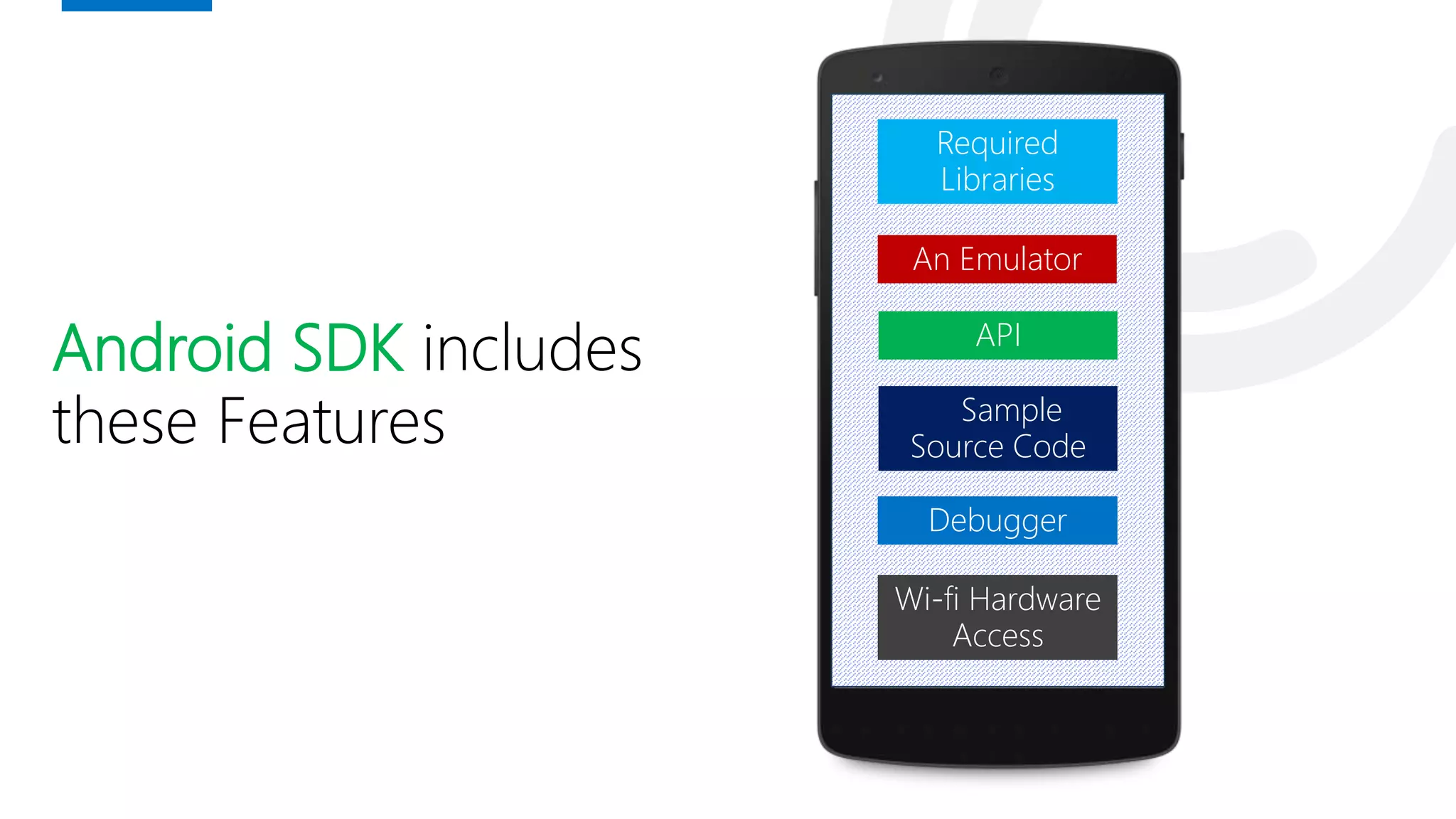
Android SDK includes
theseFeatures
Required
Libraries
Debugger
An Emulator
API
Sample
Source Code
Wi-fi Hardware
Access
20.
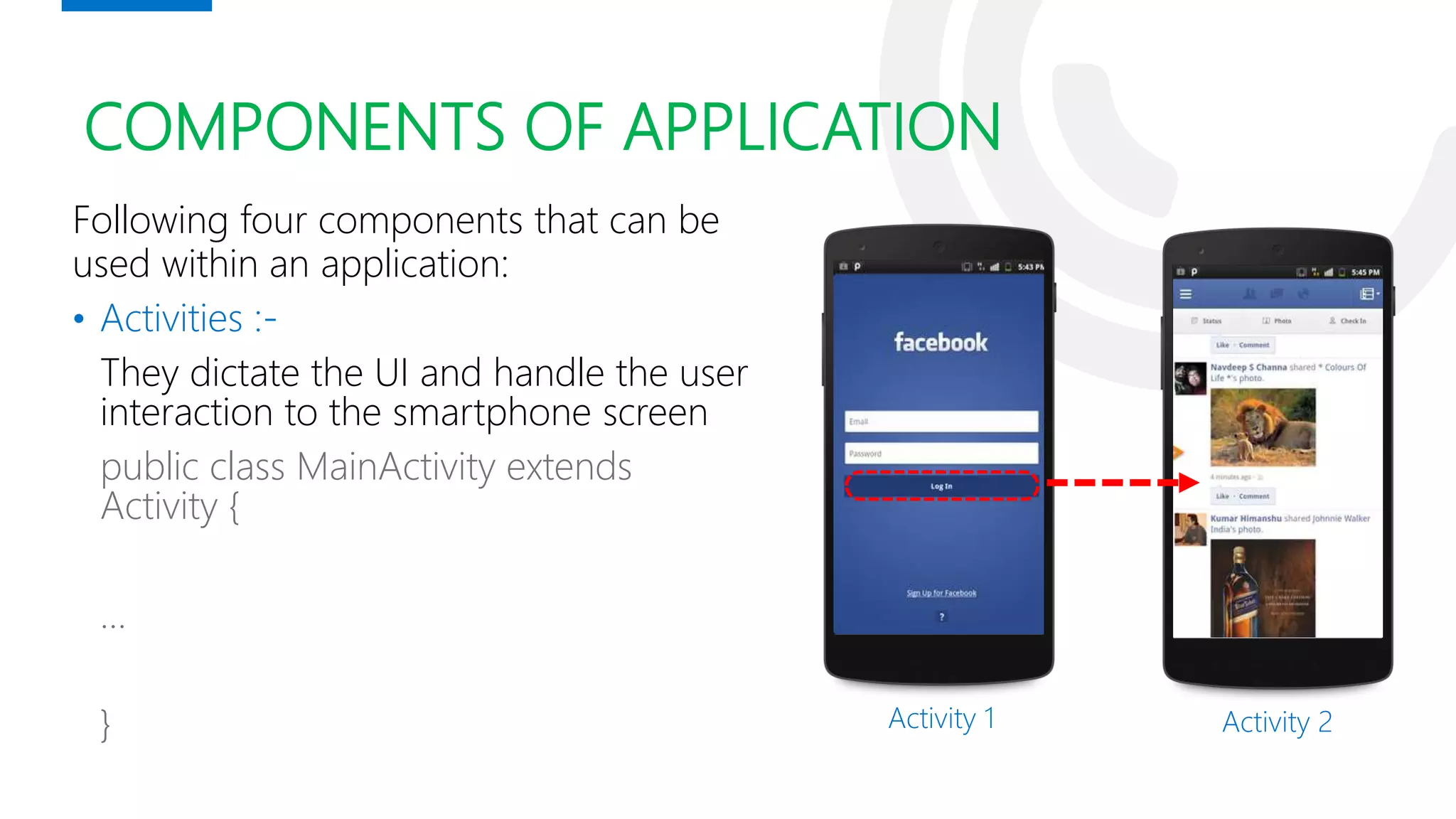
COMPONENTS OF APPLICATION
Followingfour components that can be
used within an application:
• Activities :-
They dictate the UI and handle the user
interaction to the smartphone screen
public class MainActivity extends
Activity {
…
} Activity 1 Activity 2
21.
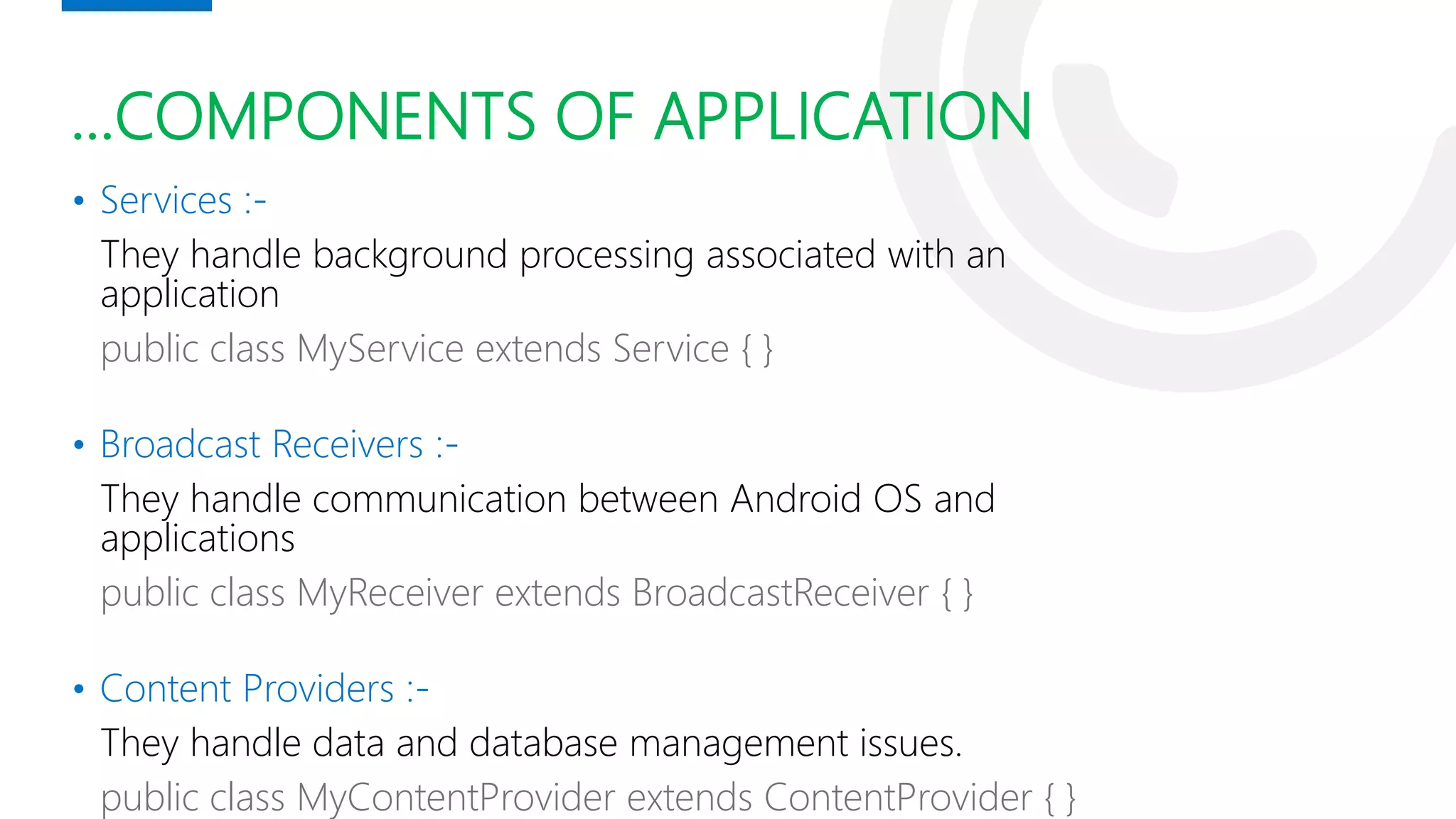
…COMPONENTS OF APPLICATION
•Services :-
They handle background processing associated with an
application
public class MyService extends Service { }
• Broadcast Receivers :-
They handle communication between Android OS and
applications
public class MyReceiver extends BroadcastReceiver { }
• Content Providers :-
They handle data and database management issues.
public class MyContentProvider extends ContentProvider { }
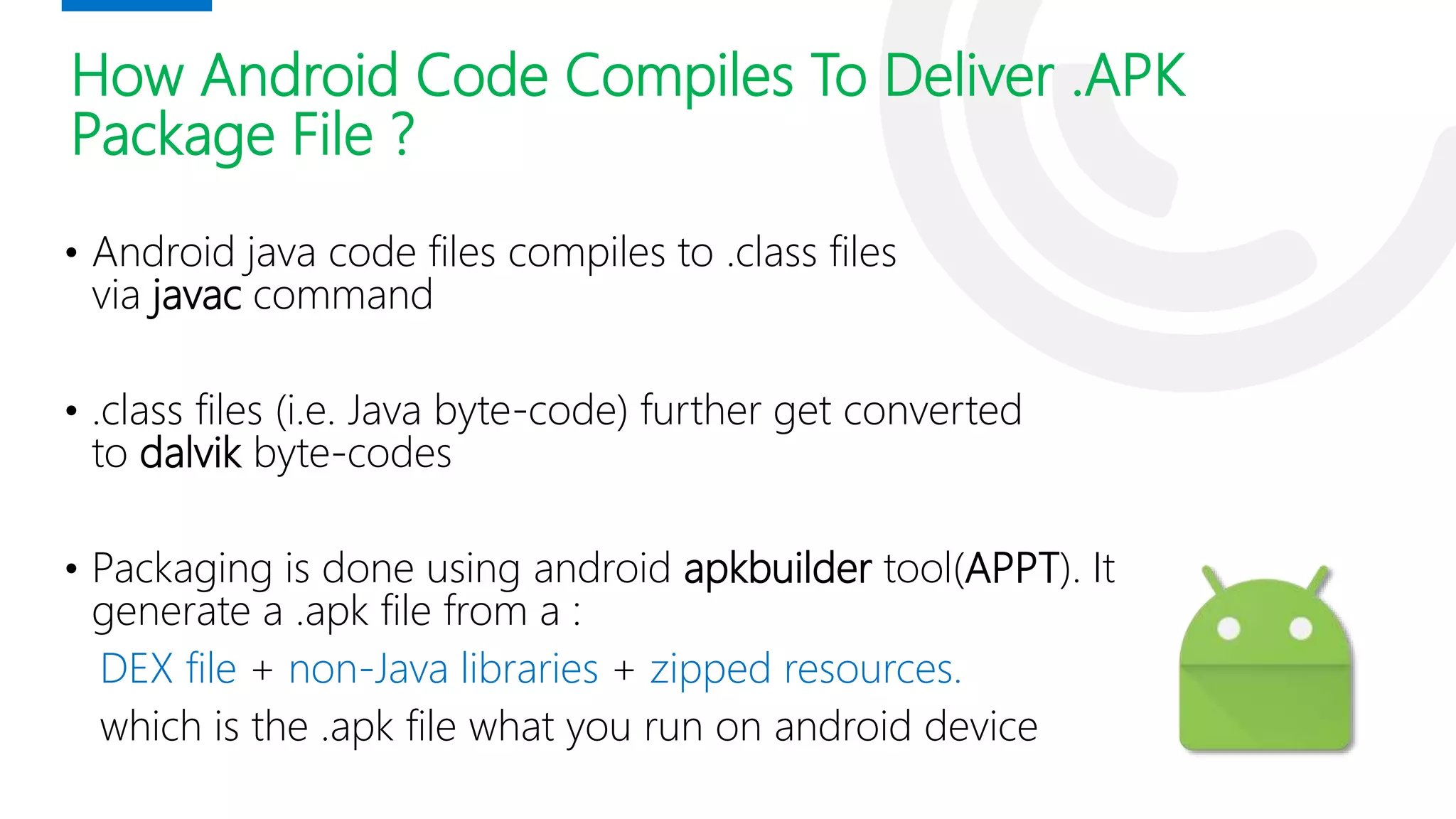
How Android CodeCompiles To Deliver .APK
Package File ?
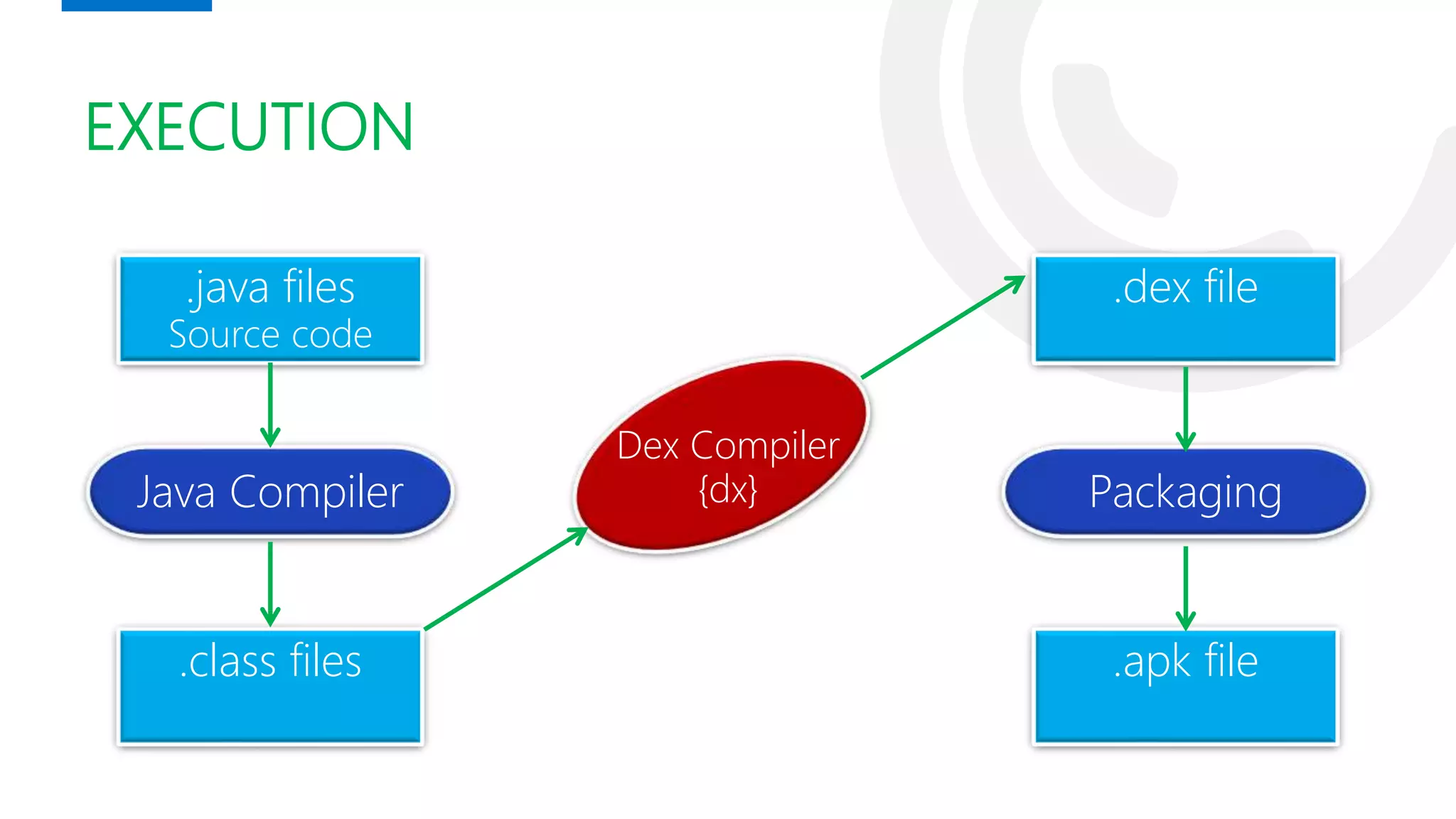
• Android java code files compiles to .class files
via javac command
• .class files (i.e. Java byte-code) further get converted
to dalvik byte-codes
• Packaging is done using android apkbuilder tool(APPT). It
generate a .apk file from a :
DEX file + non-Java libraries + zipped resources.
which is the .apk file what you run on android device
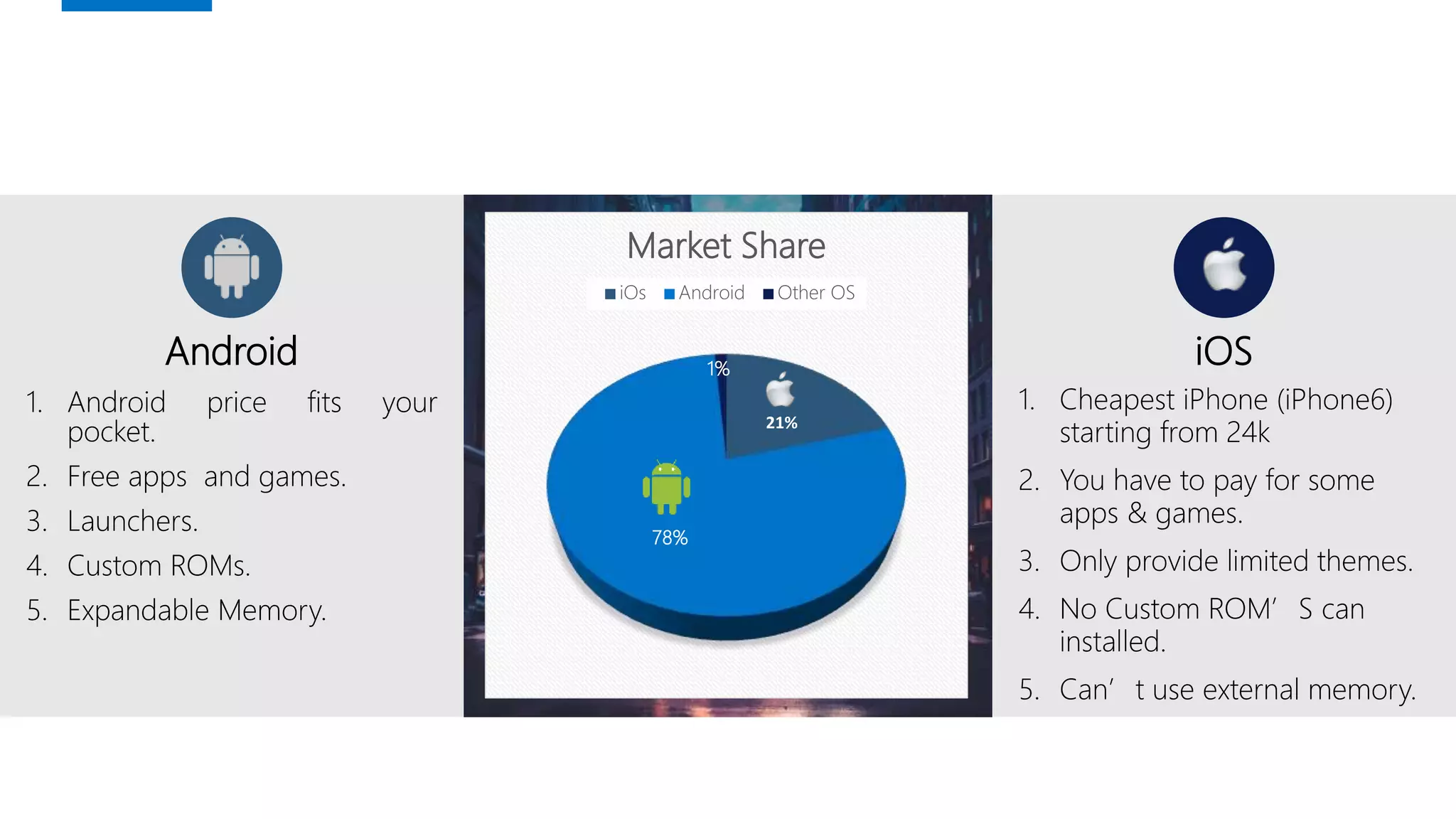
1. Android pricefits your
pocket.
2. Free apps and games.
3. Launchers.
4. Custom ROMs.
5. Expandable Memory.
26
1. Cheapest iPhone (iPhone6)
starting from 24k
2. You have to pay for some
apps & games.
3. Only provide limited themes.
4. No Custom ROM’S can
installed.
5. Can’t use external memory.
Android iOS
21%
78%
1%
Market Share
iOs Android Other OS