Highway Dimension and
              Provably Efficient
       Shortest Paths Algorithms

                  Andrew V. Goldberg
           Microsoft Research – Silicon Valley
         www.research.microsoft.com/∼goldberg/

Joint with Ittai Abraham, Amos Fiat, and Renato Werneck
Theory & Practice

[Anonymous]
  • Theory is when you know something, but it doesn’t work.
  • Practice is when something works, but you don’t know why.
  • Programmers combine theory and practice: Nothing works
    and they don’t know why.


Highway dimension                                             1
Theory & Practice

[Anonymous]
  • Theory is when you know something, but it doesn’t work.
  • Practice is when something works, but you don’t know why.
  • Programmers combine theory and practice: Nothing works
    and they don’t know why.

Algorithm Engineering:
Know something ⇒ make it work.


Reverse Engineering:
Something works ⇒ explain why (this talk).


Highway dimension                                             2
Theory & Practice

[Anonymous]
  • Theory is when you know something, but it doesn’t work.
  • Practice is when something works, but you don’t know why.
  • Programmers combine theory and practice: Nothing works
    and they don’t know why.

Algorithm Engineering:
Know something ⇒ make it work.


Reverse Engineering:
Something works ⇒ explain why (this talk).


Efficient driving directions: How and why modern routing al-
gorithms work.

Highway dimension                                             3
Motivation

Computing driving directions.
Recent shortest path algorithms (exact):

  • Arc flags [Lauther 04, K¨hler et al. 06].
                           o
  • A∗ with landmarks [Goldberg & Harrelson 05].
  • Reach [Gutman 04, Goldberg et al. 06].
  • Highway [Sanders & Schultes 05] and contraction [Geisberger
    08] hierarchies.
  • Transit nodes [Bast et al. 06].
  • Combinations (pruning and directing algorithms).

Good performance on continent-sized road networks:
Tens of millions of vertices, a few hundred vertices scanned,
under a millisecond on a server, about 0.1 second on a mobile
device. Used in practice.

Highway dimension                                             4
Result Summary

Elegant and practical algorithms, but...


Until now: No analysis for non-trivial network classes and no
understanding of what makes the algorithms work.


Our results:
  • We define highway dimension (HD).
  • Give provably efficient implementations of several recent al-
    gorithms under the small HD assumption.
  • Analysis highlights algorithm similarities.
  • Give a generative model of small HD networks (road network
    formation).

Compare to the small world model [Milgram 67, Kleinberg 99].

Highway dimension                                             5
Outline


  • Dijkstra’s algorithm review.
  • Shortcuts and CH algorithm.
  • Reach and RE algorithm.
  • Transit nodes and TN algorithm.
  • Highway dimension and sparse covers.
  • Analysis of RE and CH.
  • Generative model.
  • Concluding remarks.


Highway dimension                          6
Definitions

  • Undirected graph G = (V, E), |V | = n, |E| = m.
  • ℓ : E → N , minimum length 1, diameter D.
  • Maximum degree ∆. Small for road networks, assume con-
    stant for this talk.
  • Ball Bv,r induced by vertices within distance r from v.
  • For a path P , |P | denotes the length of P .
  • Query: find the shortest path from s to t.

Algorithms with preprocessing:
  • Two phases, preprocessing and query.
  • Preprocessing output not much bigger than the input.
  • Preprocessing may use more resources than queries.
  • Practical preprocessing, fast queries.
Highway dimension                                             7
Three Intuitive Methods


  • Reach pruning (RE): Local intersections far from origin/destination
    can be ignored.
  • Transit nodes (TN): All long shortest paths to/from a region
    pass through a small number of nodes.
  • Highway/contraction hierarchies (CH): Shortest path goes
    from local roads to local highways to global highways to
    local highways to local roads.

These ideas can be mathematically formalized and lead to prov-
ably correct algorithms which work very well on road networks.

HD intuition based on TN; all preprocessing is based on CH;
query analysis in this talk is for RE.


Highway dimension                                               8
Scanning Method


  • For each vertex v maintain its distance label ds(v) and status
    S(v) ∈ {unreached, labeled, scanned}.

  • Unreached vertices have ds(v) = ∞.

  • If ds(v) decreases, v becomes labeled.

  • To scan a labeled vertex v, for each arc (v, w),
    if ds(w) > ds(v) + ℓ(v, w) set ds(w) = ds(v) + ℓ(v, w).

  • Initially all vertices are unreached.

  • Start by decreasing ds(s) to 0.

  • While there are labeled vertices, pick one and scan it.

  • Different selection rules lead to different algorithms.


Highway dimension                                                9
Dijkstra’s Algorithm


[Dijkstra 1959], [Dantzig 1963].
  • At each step scan a labeled vertex with the minimum label.
  • Stop when t is selected for scanning.

Work almost linear in the visited subgraph size.


Reverse Algorithm: Run algorithm from t in the graph with all
arcs reversed, stop when s is selected for scanning.


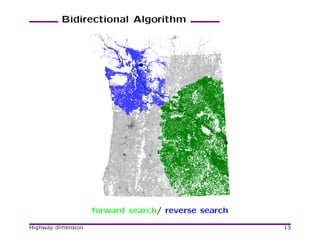
Bidirectional Algorithm
  • Run forward Dijkstra from s and backward from t.
  • Stopping criteria (careful!).


Highway dimension                                           10
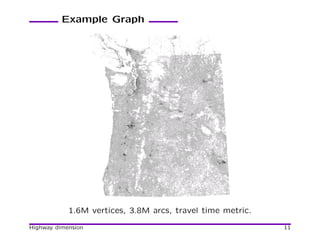
Example Graph


            1.6M vertices, 3.8M arcs, travel time metric.

Highway dimension                                           11
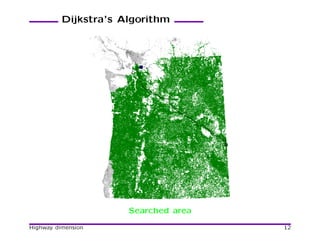
Dijkstra’s Algorithm


                      Searched area
Highway dimension                     12
Bidirectional Algorithm


                    forward search/ reverse search

Highway dimension                                    13
Contraction Hierarchies


[Geisberget et al. 08] Based on preprocessing that orders vertices
and adds shortcuts. Fast and simple!


Shortcuts:


                        100
                                      101        110

                    1         10


                                            11


A shortcut arc can be omitted if redundant (alternative path
exists).


Highway dimension                                               14
CH Preprocessing


(1) Heuristically order vertices.
(2) Shortcut vertices in that order.
(3) To the original graph, add all shortcuts introduced in step 2.

For road networks, a good heuristic ordering is fast and increases
the number of arcs by a small constant factor.


Intuition: Higher-order vertices are more important (“global”).
Query is bidirectional, each search goes from lower to higher
order vertices.


Highway dimension                                               15
CH Query

Let (V, E ∪ E +) be the graph augmented by shortcuts, recall that
the vertices are ordered. Let Gf be the directed graph induced
by
(v, w) : (v, w) ∈ E ∪ E +, v < w
and Gr – by
(w, v) : (v, w) ∈ E ∪ E +, v > w.

Given a query, run a modified bidirectional Dijkstra’s algorithm,
with the forward search in Gf and the reverse search in Gr . (Both
searches go “up”.)

Upon termination dist(s, t) = minv (d(s, v) + d(v, t)).

Experiments show that for road networks queries look at a very
small subgraph, even in the worst case.

Highway dimension                                               16
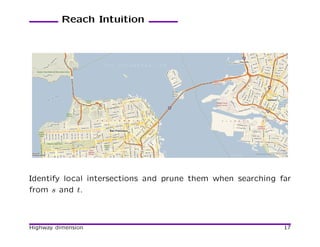
Reach Intuition


Identify local intersections and prune them when searching far
from s and t.


Highway dimension                                           17
Reach Definition


[Gutman 04]
  • Consider a vertex v that splits a path P into P1 and P2.
    rP (v) = min(ℓ(P1), ℓ(P2)).
  • r(v) = maxP (rP (v)) over all shortest paths P through v.

Using reaches to prune Dijkstra:


                                     LB(w,t)
                    d(s,v)   v   w

            s                                           t


If r(w) < min(d(v) + ℓ(v, w), LB(w, t)) then prune w.


Highway dimension                                               18
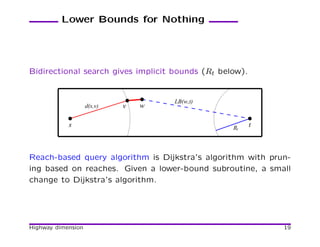
Lower Bounds for Nothing


Bidirectional search gives implicit bounds (Rt below).


                                     LB(w,t)
                    d(s,v)   v   w

            s                                     Rt     t


Reach-based query algorithm is Dijkstra’s algorithm with prun-
ing based on reaches. Given a lower-bound subroutine, a small
change to Dijkstra’s algorithm.


Highway dimension                                            19
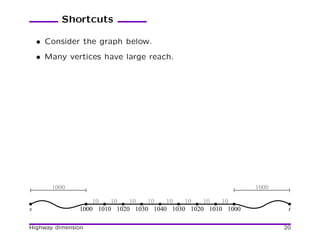
Shortcuts

    • Consider the graph below.
    • Many vertices have large reach.


       1000                                                   1000

                   10   10   10   10   10   10   10   10
s              1000 1010 1020 1030 1040 1030 1020 1010 1000           t

Highway dimension                                                    20
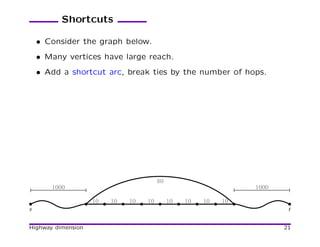
Shortcuts

    • Consider the graph below.
    • Many vertices have large reach.
    • Add a shortcut arc, break ties by the number of hops.


                                        80
       1000                                                      1000

                    10   10   10   10        10   10   10   10
s                                                                        t

Highway dimension                                                       21
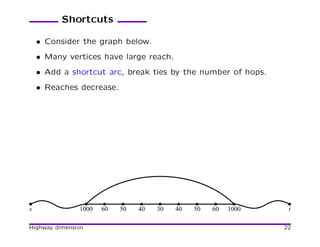
Shortcuts

    • Consider the graph below.
    • Many vertices have large reach.
    • Add a shortcut arc, break ties by the number of hops.
    • Reaches decrease.


s              1000   60   50   40   30   40   50   60   1000    t

Highway dimension                                               22
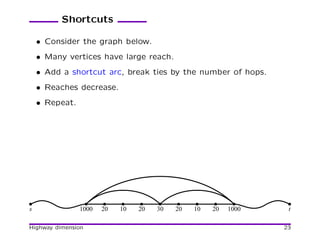
Shortcuts

    • Consider the graph below.
    • Many vertices have large reach.
    • Add a shortcut arc, break ties by the number of hops.
    • Reaches decrease.
    • Repeat.


s               1000   20   10   20   30   20   10   20   1000    t

Highway dimension                                                23
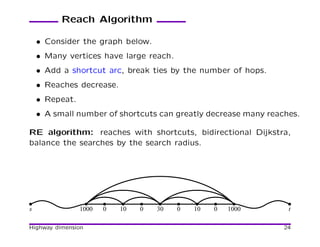
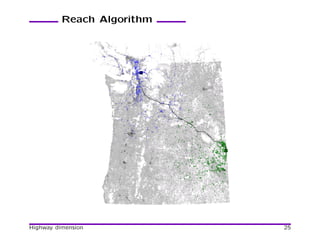
Reach Algorithm

    • Consider the graph below.
    • Many vertices have large reach.
    • Add a shortcut arc, break ties by the number of hops.
    • Reaches decrease.
    • Repeat.
    • A small number of shortcuts can greatly decrease many reaches.

RE algorithm: reaches with shortcuts, bidirectional Dijkstra,
balance the searches by the search radius.


s               1000   0   10   0   30   0   10   0   1000       t

Highway dimension                                               24
Reach Algorithm


Highway dimension           25
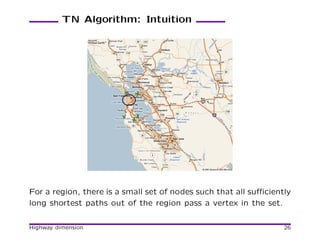
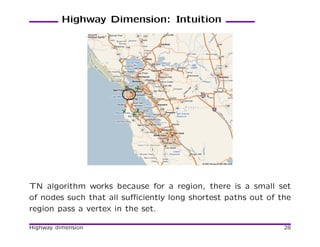
TN Algorithm: Intuition


For a region, there is a small set of nodes such that all sufficiently
long shortest paths out of the region pass a vertex in the set.

Highway dimension                                                 26
Transit Node (TN) Algorithm

[Bast et. al 06]
  • Divide a map into regions.
  • For each region, paths to far away places pass through a
    small number of access points.
  • The union of all access nodes is the set of transit nodes.
  • Preprocessing: find all access points, connect each vertex
    to its access nodes, compute all pairs of shortest paths be-
    tween transit nodes.
  • Query: Look for a “local” shortest path or a shortest path
    of the form origin – transit node – transit node – destination.
  • Various ways to speed up local queries.
  • 10 access nodes per region on the average.
  • Leads to the fastest algorithms.
Highway dimension                                                27
Highway Dimension: Intuition


TN algorithm works because for a region, there is a small set
of nodes such that all sufficiently long shortest paths out of the
region pass a vertex in the set.

Highway dimension                                             28
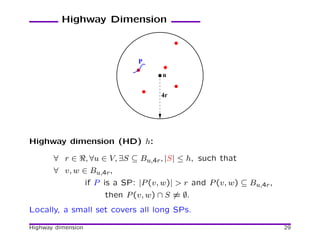
Highway Dimension


                                  P

                                         u


                                        4r


Highway dimension (HD) h:

       ∀ r ∈ ℜ, ∀u ∈ V, ∃S ⊆ Bu,4r , |S| ≤ h, such that
       ∀ v, w ∈ Bu,4r ,
                    if P is a SP: |P (v, w)| > r and P (v, w) ⊆ Bu,4r ,
                         then P (v, w) ∩ S = ∅.
Locally, a small set covers all long SPs.

Highway dimension                                                         29
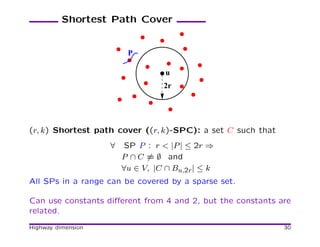
Shortest Path Cover


                         P

                                   u
                                   2r


(r, k) Shortest path cover ((r, k)-SPC): a set C such that
                    ∀    SP P : r < |P | ≤ 2r ⇒
                        P ∩ C = ∅ and
                        ∀u ∈ V, |C ∩ Bu,2r | ≤ k
All SPs in a range can be covered by a sparse set.

Can use constants different from 4 and 2, but the constants are
related.
Highway dimension                                            30
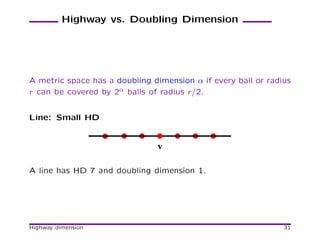
Highway vs. Doubling Dimension


A metric space has a doubling dimension α if every ball or radius
r can be covered by 2α balls of radius r/2.


Line: Small HD


                               v

A line has HD 7 and doubling dimension 1.


Highway dimension                                              31
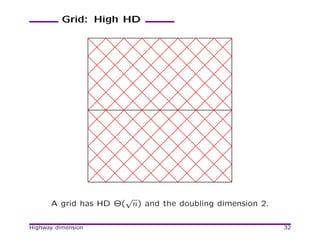
Grid: High HD


                      √
      A grid has HD Θ( n) and the doubling dimension 2.

Highway dimension                                         32
HD vs. SPC


Theorem. If G has highway dimension h, then for any r there
exists an (r, h)-SPC.
Proof idea: Show that S ∗, the smallest set that covers all short-
est paths P : r < |P | ≤ 2r, is an (r, h)-SPC.

Finding S ∗ is NP-hard. Efficient construction?


Theorem. If G has highway dimension h, then for any r we can
construct, in polynomial time, an (r, O(h log n))-SPC.
Proof idea: Use the greedy set-cover algorithm to get an O(log n)
approximation of S ∗.

Proofs depend on the choice of constants in the definitions.


Highway dimension                                               33
Generic Preprocessing

Let k denote h or O(h log n) (for poly-time preprocessing).
  • Let S0 = V . For 1 ≤ i ≤ log D build (2i, k)-SPC covers Si.
  • Let Li = Si − log D Sj (vertex layers).
                  i+1
  • Order vertices so that Li comes before Li+1; ordering inside
    layers is arbitrary.
  • Do shortcutting in this order to get E +.

Lemma. Let v ∈ Li and j ≥ i. Then the number of (v, w) ∈ E +
with w ∈ Lj is at most k.
Proof. (v, w) corresponds to P with internal vertices less than
v, w. Thus w ∈ Bv,2·2i . The SPC definition implies the lemma.


Theorem. In (V, E ∪ E +) vertex degrees are bounded by
∆ + k log D and |E ∪ E +| = O(m + nk log D).

Highway dimension                                                 34
Additional RE Preprocessing


Reach bounds are in the graph with shortcuts.


Lemma: If v ∈ Li then reach(v) ≤ 2 · 2i.
Proof: Suppose the reach is greater. Then there is a shortest
path P that v divides into P1 and P2 with |P1|, |P2| > 2 · 2i. Both
P1 and P2 contain vertices in Lj with j > i, so there is a shortcut
from P1 to P2. But then P is not a shortest path.

Additional work is linear.


Highway dimension                                                35
RE Query Bound


Theorem: RE query takes O((k log D)2) time.
Proof: Consider a forward search from s. In Bs,2·2i , the search
scans only vertices of Li in Bs,2·2i . Thus O(k log D) scans.


  • Shortest path can be extracted in time linear in the number
    of its arcs.
  • Similar analysis for CH yields the same bound.
  • Also develop a faster version of TN: O(k log D) query.


Highway dimension                                               36
Network Formation

Natural networks with constant highway dimension?

Attempt to model road networks:
 • Build on the Earth surface (low doubling dimension).
  • Build in decentralized and incremental manner.
  • Highways are faster than local roads.
Capture some, but not all, real-life properties.

Setting:
 • Metric space (M, d), doubling dimension log α, diameter D.
  • Speedup parameter δ ∈ (0, 1).
  • Edge {v, w} has length d(v, w) and transit time τ (v, w) =
    d1−δ (v, w). (Long roads are fast.)
  • On-line network formation, adversarial (or random) vertex
    placement.
Highway dimension                                           37
Network Formation (cont.)


In the spirit of dynamic spanners [Gottlieb & Roditty 08].
  • Adversary adds vertices, we connect them.
  • Intuition: connect a new village to all nearby villages and to
    the closest town.
  • Formally: maintain covers Ci for 0 ≤ i ≤ log D.
    C0 = V , Ci+1 ⊆ Ci, vertices in Ci are at least 2i apart.
  • When adding a new vertex v, add v to C0, . . . , Ci for appro-
    priate i. (The first vertex added to all C’s.)
  • For 0 ≤ j ≤ i, connect v to Cj ∩ Bv,6·2j .
  • If i < log D, connect v to the closest element of Ci+1.

Theorem: The network has highway dimension of αO(1).


Highway dimension                                               38
Concluding Remarks


  • Highway dimension explains why intuitive algorithms work
    well on a non-trivial graph class.
  • Unified view of several different-looking algorithms.
  • Extensions for directed graphs.
  • Additional assumptions, such as small separators, may lead
    to better bounds.
  • For real road networks, small HD condition may not hold for
    some r and some v.
  • Does low HD make other problems simpler?
  • Computing HD dimension of road networks (work in progress
    with Daniel Delling): USA/Europe highway dimension is ≈
    1, 000, access dimension ≈ 20.


Highway dimension                                            39
Thank You!


Highway dimension      40

Andrew Goldberg. Highway Dimension and Provably Efficient Shortest Path Algorithms

  • 1.
    Highway Dimension and Provably Efficient Shortest Paths Algorithms Andrew V. Goldberg Microsoft Research – Silicon Valley www.research.microsoft.com/∼goldberg/ Joint with Ittai Abraham, Amos Fiat, and Renato Werneck
  • 2.
    Theory & Practice [Anonymous] • Theory is when you know something, but it doesn’t work. • Practice is when something works, but you don’t know why. • Programmers combine theory and practice: Nothing works and they don’t know why. Highway dimension 1
  • 3.
    Theory & Practice [Anonymous] • Theory is when you know something, but it doesn’t work. • Practice is when something works, but you don’t know why. • Programmers combine theory and practice: Nothing works and they don’t know why. Algorithm Engineering: Know something ⇒ make it work. Reverse Engineering: Something works ⇒ explain why (this talk). Highway dimension 2
  • 4.
    Theory & Practice [Anonymous] • Theory is when you know something, but it doesn’t work. • Practice is when something works, but you don’t know why. • Programmers combine theory and practice: Nothing works and they don’t know why. Algorithm Engineering: Know something ⇒ make it work. Reverse Engineering: Something works ⇒ explain why (this talk). Efficient driving directions: How and why modern routing al- gorithms work. Highway dimension 3
  • 5.
    Motivation Computing driving directions. Recentshortest path algorithms (exact): • Arc flags [Lauther 04, K¨hler et al. 06]. o • A∗ with landmarks [Goldberg & Harrelson 05]. • Reach [Gutman 04, Goldberg et al. 06]. • Highway [Sanders & Schultes 05] and contraction [Geisberger 08] hierarchies. • Transit nodes [Bast et al. 06]. • Combinations (pruning and directing algorithms). Good performance on continent-sized road networks: Tens of millions of vertices, a few hundred vertices scanned, under a millisecond on a server, about 0.1 second on a mobile device. Used in practice. Highway dimension 4
  • 6.
    Result Summary Elegant andpractical algorithms, but... Until now: No analysis for non-trivial network classes and no understanding of what makes the algorithms work. Our results: • We define highway dimension (HD). • Give provably efficient implementations of several recent al- gorithms under the small HD assumption. • Analysis highlights algorithm similarities. • Give a generative model of small HD networks (road network formation). Compare to the small world model [Milgram 67, Kleinberg 99]. Highway dimension 5
  • 7.
    Outline •Dijkstra’s algorithm review. • Shortcuts and CH algorithm. • Reach and RE algorithm. • Transit nodes and TN algorithm. • Highway dimension and sparse covers. • Analysis of RE and CH. • Generative model. • Concluding remarks. Highway dimension 6
  • 8.
    Definitions •Undirected graph G = (V, E), |V | = n, |E| = m. • ℓ : E → N , minimum length 1, diameter D. • Maximum degree ∆. Small for road networks, assume con- stant for this talk. • Ball Bv,r induced by vertices within distance r from v. • For a path P , |P | denotes the length of P . • Query: find the shortest path from s to t. Algorithms with preprocessing: • Two phases, preprocessing and query. • Preprocessing output not much bigger than the input. • Preprocessing may use more resources than queries. • Practical preprocessing, fast queries. Highway dimension 7
  • 9.
    Three Intuitive Methods • Reach pruning (RE): Local intersections far from origin/destination can be ignored. • Transit nodes (TN): All long shortest paths to/from a region pass through a small number of nodes. • Highway/contraction hierarchies (CH): Shortest path goes from local roads to local highways to global highways to local highways to local roads. These ideas can be mathematically formalized and lead to prov- ably correct algorithms which work very well on road networks. HD intuition based on TN; all preprocessing is based on CH; query analysis in this talk is for RE. Highway dimension 8
  • 10.
    Scanning Method • For each vertex v maintain its distance label ds(v) and status S(v) ∈ {unreached, labeled, scanned}. • Unreached vertices have ds(v) = ∞. • If ds(v) decreases, v becomes labeled. • To scan a labeled vertex v, for each arc (v, w), if ds(w) > ds(v) + ℓ(v, w) set ds(w) = ds(v) + ℓ(v, w). • Initially all vertices are unreached. • Start by decreasing ds(s) to 0. • While there are labeled vertices, pick one and scan it. • Different selection rules lead to different algorithms. Highway dimension 9
  • 11.
    Dijkstra’s Algorithm [Dijkstra 1959],[Dantzig 1963]. • At each step scan a labeled vertex with the minimum label. • Stop when t is selected for scanning. Work almost linear in the visited subgraph size. Reverse Algorithm: Run algorithm from t in the graph with all arcs reversed, stop when s is selected for scanning. Bidirectional Algorithm • Run forward Dijkstra from s and backward from t. • Stopping criteria (careful!). Highway dimension 10
  • 12.
    Example Graph 1.6M vertices, 3.8M arcs, travel time metric. Highway dimension 11
  • 13.
    Dijkstra’s Algorithm Searched area Highway dimension 12
  • 14.
    Bidirectional Algorithm forward search/ reverse search Highway dimension 13
  • 15.
    Contraction Hierarchies [Geisberget etal. 08] Based on preprocessing that orders vertices and adds shortcuts. Fast and simple! Shortcuts: 100 101 110 1 10 11 A shortcut arc can be omitted if redundant (alternative path exists). Highway dimension 14
  • 16.
    CH Preprocessing (1) Heuristicallyorder vertices. (2) Shortcut vertices in that order. (3) To the original graph, add all shortcuts introduced in step 2. For road networks, a good heuristic ordering is fast and increases the number of arcs by a small constant factor. Intuition: Higher-order vertices are more important (“global”). Query is bidirectional, each search goes from lower to higher order vertices. Highway dimension 15
  • 17.
    CH Query Let (V,E ∪ E +) be the graph augmented by shortcuts, recall that the vertices are ordered. Let Gf be the directed graph induced by (v, w) : (v, w) ∈ E ∪ E +, v < w and Gr – by (w, v) : (v, w) ∈ E ∪ E +, v > w. Given a query, run a modified bidirectional Dijkstra’s algorithm, with the forward search in Gf and the reverse search in Gr . (Both searches go “up”.) Upon termination dist(s, t) = minv (d(s, v) + d(v, t)). Experiments show that for road networks queries look at a very small subgraph, even in the worst case. Highway dimension 16
  • 18.
    Reach Intuition Identify localintersections and prune them when searching far from s and t. Highway dimension 17
  • 19.
    Reach Definition [Gutman 04] • Consider a vertex v that splits a path P into P1 and P2. rP (v) = min(ℓ(P1), ℓ(P2)). • r(v) = maxP (rP (v)) over all shortest paths P through v. Using reaches to prune Dijkstra: LB(w,t) d(s,v) v w s t If r(w) < min(d(v) + ℓ(v, w), LB(w, t)) then prune w. Highway dimension 18
  • 20.
    Lower Bounds forNothing Bidirectional search gives implicit bounds (Rt below). LB(w,t) d(s,v) v w s Rt t Reach-based query algorithm is Dijkstra’s algorithm with prun- ing based on reaches. Given a lower-bound subroutine, a small change to Dijkstra’s algorithm. Highway dimension 19
  • 21.
    Shortcuts • Consider the graph below. • Many vertices have large reach. 1000 1000 10 10 10 10 10 10 10 10 s 1000 1010 1020 1030 1040 1030 1020 1010 1000 t Highway dimension 20
  • 22.
    Shortcuts • Consider the graph below. • Many vertices have large reach. • Add a shortcut arc, break ties by the number of hops. 80 1000 1000 10 10 10 10 10 10 10 10 s t Highway dimension 21
  • 23.
    Shortcuts • Consider the graph below. • Many vertices have large reach. • Add a shortcut arc, break ties by the number of hops. • Reaches decrease. s 1000 60 50 40 30 40 50 60 1000 t Highway dimension 22
  • 24.
    Shortcuts • Consider the graph below. • Many vertices have large reach. • Add a shortcut arc, break ties by the number of hops. • Reaches decrease. • Repeat. s 1000 20 10 20 30 20 10 20 1000 t Highway dimension 23
  • 25.
    Reach Algorithm • Consider the graph below. • Many vertices have large reach. • Add a shortcut arc, break ties by the number of hops. • Reaches decrease. • Repeat. • A small number of shortcuts can greatly decrease many reaches. RE algorithm: reaches with shortcuts, bidirectional Dijkstra, balance the searches by the search radius. s 1000 0 10 0 30 0 10 0 1000 t Highway dimension 24
  • 26.
  • 27.
    TN Algorithm: Intuition Fora region, there is a small set of nodes such that all sufficiently long shortest paths out of the region pass a vertex in the set. Highway dimension 26
  • 28.
    Transit Node (TN)Algorithm [Bast et. al 06] • Divide a map into regions. • For each region, paths to far away places pass through a small number of access points. • The union of all access nodes is the set of transit nodes. • Preprocessing: find all access points, connect each vertex to its access nodes, compute all pairs of shortest paths be- tween transit nodes. • Query: Look for a “local” shortest path or a shortest path of the form origin – transit node – transit node – destination. • Various ways to speed up local queries. • 10 access nodes per region on the average. • Leads to the fastest algorithms. Highway dimension 27
  • 29.
    Highway Dimension: Intuition TNalgorithm works because for a region, there is a small set of nodes such that all sufficiently long shortest paths out of the region pass a vertex in the set. Highway dimension 28
  • 30.
    Highway Dimension P u 4r Highway dimension (HD) h: ∀ r ∈ ℜ, ∀u ∈ V, ∃S ⊆ Bu,4r , |S| ≤ h, such that ∀ v, w ∈ Bu,4r , if P is a SP: |P (v, w)| > r and P (v, w) ⊆ Bu,4r , then P (v, w) ∩ S = ∅. Locally, a small set covers all long SPs. Highway dimension 29
  • 31.
    Shortest Path Cover P u 2r (r, k) Shortest path cover ((r, k)-SPC): a set C such that ∀ SP P : r < |P | ≤ 2r ⇒ P ∩ C = ∅ and ∀u ∈ V, |C ∩ Bu,2r | ≤ k All SPs in a range can be covered by a sparse set. Can use constants different from 4 and 2, but the constants are related. Highway dimension 30
  • 32.
    Highway vs. DoublingDimension A metric space has a doubling dimension α if every ball or radius r can be covered by 2α balls of radius r/2. Line: Small HD v A line has HD 7 and doubling dimension 1. Highway dimension 31
  • 33.
    Grid: High HD √ A grid has HD Θ( n) and the doubling dimension 2. Highway dimension 32
  • 34.
    HD vs. SPC Theorem.If G has highway dimension h, then for any r there exists an (r, h)-SPC. Proof idea: Show that S ∗, the smallest set that covers all short- est paths P : r < |P | ≤ 2r, is an (r, h)-SPC. Finding S ∗ is NP-hard. Efficient construction? Theorem. If G has highway dimension h, then for any r we can construct, in polynomial time, an (r, O(h log n))-SPC. Proof idea: Use the greedy set-cover algorithm to get an O(log n) approximation of S ∗. Proofs depend on the choice of constants in the definitions. Highway dimension 33
  • 35.
    Generic Preprocessing Let kdenote h or O(h log n) (for poly-time preprocessing). • Let S0 = V . For 1 ≤ i ≤ log D build (2i, k)-SPC covers Si. • Let Li = Si − log D Sj (vertex layers). i+1 • Order vertices so that Li comes before Li+1; ordering inside layers is arbitrary. • Do shortcutting in this order to get E +. Lemma. Let v ∈ Li and j ≥ i. Then the number of (v, w) ∈ E + with w ∈ Lj is at most k. Proof. (v, w) corresponds to P with internal vertices less than v, w. Thus w ∈ Bv,2·2i . The SPC definition implies the lemma. Theorem. In (V, E ∪ E +) vertex degrees are bounded by ∆ + k log D and |E ∪ E +| = O(m + nk log D). Highway dimension 34
  • 36.
    Additional RE Preprocessing Reachbounds are in the graph with shortcuts. Lemma: If v ∈ Li then reach(v) ≤ 2 · 2i. Proof: Suppose the reach is greater. Then there is a shortest path P that v divides into P1 and P2 with |P1|, |P2| > 2 · 2i. Both P1 and P2 contain vertices in Lj with j > i, so there is a shortcut from P1 to P2. But then P is not a shortest path. Additional work is linear. Highway dimension 35
  • 37.
    RE Query Bound Theorem:RE query takes O((k log D)2) time. Proof: Consider a forward search from s. In Bs,2·2i , the search scans only vertices of Li in Bs,2·2i . Thus O(k log D) scans. • Shortest path can be extracted in time linear in the number of its arcs. • Similar analysis for CH yields the same bound. • Also develop a faster version of TN: O(k log D) query. Highway dimension 36
  • 38.
    Network Formation Natural networkswith constant highway dimension? Attempt to model road networks: • Build on the Earth surface (low doubling dimension). • Build in decentralized and incremental manner. • Highways are faster than local roads. Capture some, but not all, real-life properties. Setting: • Metric space (M, d), doubling dimension log α, diameter D. • Speedup parameter δ ∈ (0, 1). • Edge {v, w} has length d(v, w) and transit time τ (v, w) = d1−δ (v, w). (Long roads are fast.) • On-line network formation, adversarial (or random) vertex placement. Highway dimension 37
  • 39.
    Network Formation (cont.) Inthe spirit of dynamic spanners [Gottlieb & Roditty 08]. • Adversary adds vertices, we connect them. • Intuition: connect a new village to all nearby villages and to the closest town. • Formally: maintain covers Ci for 0 ≤ i ≤ log D. C0 = V , Ci+1 ⊆ Ci, vertices in Ci are at least 2i apart. • When adding a new vertex v, add v to C0, . . . , Ci for appro- priate i. (The first vertex added to all C’s.) • For 0 ≤ j ≤ i, connect v to Cj ∩ Bv,6·2j . • If i < log D, connect v to the closest element of Ci+1. Theorem: The network has highway dimension of αO(1). Highway dimension 38
  • 40.
    Concluding Remarks • Highway dimension explains why intuitive algorithms work well on a non-trivial graph class. • Unified view of several different-looking algorithms. • Extensions for directed graphs. • Additional assumptions, such as small separators, may lead to better bounds. • For real road networks, small HD condition may not hold for some r and some v. • Does low HD make other problems simpler? • Computing HD dimension of road networks (work in progress with Daniel Delling): USA/Europe highway dimension is ≈ 1, 000, access dimension ≈ 20. Highway dimension 39
  • 41.