I/O Efficient Matrix
Multiplication
Presented By
Shubham Joshi (2011227)
Shubham Jaju (2011226)
Contents
• I/O efficient
- Parallel Disk Model
- how to make algorithm i/o efficient
• Matrix Multiplication in 2D mesh
- Cannon’s Algorithm
• I/O efficient matrix multiplication (MPI model)
• Results & Conclusion
• References
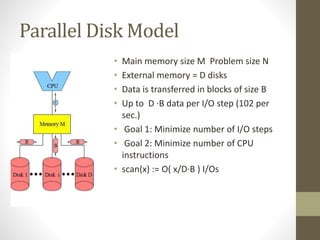
Parallel Disk Model
• Main memory size M Problem size N
• External memory = D disks
• Data is transferred in blocks of size B
• Up to D ·B data per I/O step (102 per
sec.)
• Goal 1: Minimize number of I/O steps
• Goal 2: Minimize number of CPU
instructions
• scan(x) := O( x/D·B ) I/Os
How to make algorithms I/O-
efficient?
Only a few golden rules:
• Avoid unstructured access patterns.(e.g. avoid goto
statement)
• Incorporate LOCALITY directly into the algorithm.
Tools:
• Scanning: scan(N) = O(N/DB) I/Os.
• Special I/O-efficient data structures (BTrees , B+ Trees).
• “Simulation” of parallel algorithms.
i/o efficient matrix
multiplication
Principle of locality takes two forms:
Temporal Locality: says that if any memory location is accessed
now, it is more likely to be accessed again in near future.
Spatial Locality: says that if any memory location is accessed
now, then it's neighboring memory locations are expected to
be accessed in near future.
Let's see how can we make use of the cache properties to
speed up our Matrix Multiplication program.
Assume that the 2-D array matrix is stored in a row-major order
a[0][0],a[0][1],...,a[0][n−1],a[1][0]
,a[1][1],...,a[1][n−1]...a[n−1][n−1]
The accesses into array C are
made in the following order:
• C[0][0] is accessed n times – For the first execution of k loop.
• C[0][1] is accessed n times – For the second execution of k loop.
• C[0][2] is accessed n times – For the third execution of k loop.
• ...
• C[1][0] is accessed n times – For the (n+1)th execution of k loop.
Since the same element is accessed repeatedly and accesses are
made sequentially, both temporal and spatial locality of reference is
observed.
For C, accesses are already optimized for cache!
• The accesses into array A are made in the following order:
• A[0][0],A[0][1],A[0][2],...,A[0][n] – This whole
sequence n times, for each iteration of k loop under a single
iteration of j loop.
• A[1][0],A[1][1],A[1][2],...,A[1][n] – This whole
sequence n times, for each iteration of k loop under a single
iteration of j loop.
• ...
• ...
• A[n][0],A[n][1],A[n][2],...,A[n][n] – This whole
sequence n times, for each iteration of k loop under a single
iteration of j loop.
Hence, each row of array A is accessed n times and each
element in the row is accessed sequentially. We observe good
spatial locality of reference. But the same element is not
referenced repeatedly so no temporal locality.
• The accesses into array B are made in the following order:
• B[0][0],B[1][0],B[2][0],...,B[n][0]
• B[0][1],B[1][1],B[2][1],...,B[n][1]
• ...
• B[0][n],B[1][n],B[2][n],...,B[n][n]
• Then again,
• B[0][0],B[1][0],B[2][0],...,B[n][0]
• B[0][1],B[1][1],B[2][1],...,B[n][1]
• ...
• B[0][n],B[1][n],B[2][n],...,B[n][n]
The whole array is accessed once and only then repetition
starts. So there's no spatial locality or temporal locality for B.
Each element will incur a cache miss on every access made to it.
And thus we have a cache miss on every execution of the
multiplication statement
Improving cache efficiency
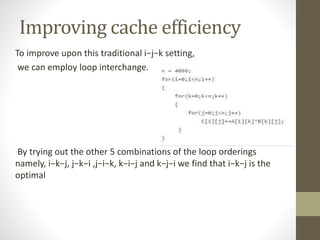
To improve upon this traditional i−j−k setting,
we can employ loop interchange.
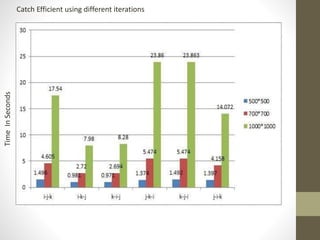
By trying out the other 5 combinations of the loop orderings
namely, i−k−j, j−k−i ,j−i−k, k−i−j and k−j−i we find that i−k−j is the
optimal
• C[0][0],C[0][1],C[0][2],...,C[0][n] – This whole sequence n times, for
each iteration of k loop……
• C[n][0],C[n][1],C[n][2],...,C[n][n] – This whole sequence n times, for
each iteration of k loop.
Now C has good spatial locality.
Similarly,
A enjoys good temporal as well as spatial locality.
B now has spatial locality.
Catch Efficient using different iterationsTimeInSeconds
Matrix Multiplication in 2D mesh
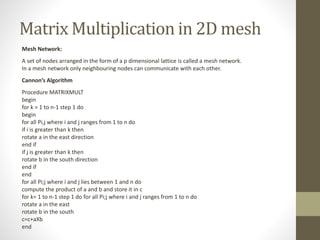
Mesh Network:
A set of nodes arranged in the form of a p dimensional lattice is called a mesh network.
In a mesh network only neighbouring nodes can communicate with each other.
Cannon’s Algorithm
Procedure MATRIXMULT
begin
for k = 1 to n-1 step 1 do
begin
for all Pi,j where i and j ranges from 1 to n do
if i is greater than k then
rotate a in the east direction
end if
if j is greater than k then
rotate b in the south direction
end if
end
for all Pi;j where i and j lies between 1 and n do
compute the product of a and b and store it in c
for k= 1 to n-1 step 1 do for all Pi;j where i and j ranges from 1 to n do
rotate a in the east
rotate b in the south
c=c+aXb
end
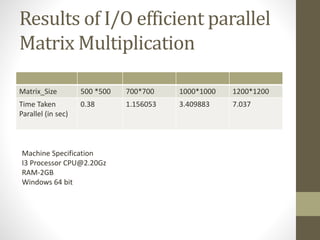
Results of I/O efficient parallel
Matrix Multiplication
Matrix_Size 500 *500 700*700 1000*1000 1200*1200
Time Taken
Parallel (in sec)
0.38 1.156053 3.409883 7.037
Machine Specification
I3 Processor CPU@2.20Gz
RAM-2GB
Windows 64 bit
References
Cache-Oblivious Algorithms – Harald Prokop
MIT June 1999
Matrix Multiplication on a Distributed Memory Machine,
www.phy.ornl.gov
Thank You

IOEfficientParalleMatrixMultiplication_present

  • 1.
    I/O Efficient Matrix Multiplication PresentedBy Shubham Joshi (2011227) Shubham Jaju (2011226)
  • 2.
    Contents • I/O efficient -Parallel Disk Model - how to make algorithm i/o efficient • Matrix Multiplication in 2D mesh - Cannon’s Algorithm • I/O efficient matrix multiplication (MPI model) • Results & Conclusion • References
  • 3.
    Parallel Disk Model •Main memory size M Problem size N • External memory = D disks • Data is transferred in blocks of size B • Up to D ·B data per I/O step (102 per sec.) • Goal 1: Minimize number of I/O steps • Goal 2: Minimize number of CPU instructions • scan(x) := O( x/D·B ) I/Os
  • 4.
    How to makealgorithms I/O- efficient? Only a few golden rules: • Avoid unstructured access patterns.(e.g. avoid goto statement) • Incorporate LOCALITY directly into the algorithm. Tools: • Scanning: scan(N) = O(N/DB) I/Os. • Special I/O-efficient data structures (BTrees , B+ Trees). • “Simulation” of parallel algorithms.
  • 5.
    i/o efficient matrix multiplication Principleof locality takes two forms: Temporal Locality: says that if any memory location is accessed now, it is more likely to be accessed again in near future. Spatial Locality: says that if any memory location is accessed now, then it's neighboring memory locations are expected to be accessed in near future. Let's see how can we make use of the cache properties to speed up our Matrix Multiplication program.
  • 6.
    Assume that the2-D array matrix is stored in a row-major order a[0][0],a[0][1],...,a[0][n−1],a[1][0] ,a[1][1],...,a[1][n−1]...a[n−1][n−1] The accesses into array C are made in the following order: • C[0][0] is accessed n times – For the first execution of k loop. • C[0][1] is accessed n times – For the second execution of k loop. • C[0][2] is accessed n times – For the third execution of k loop. • ... • C[1][0] is accessed n times – For the (n+1)th execution of k loop. Since the same element is accessed repeatedly and accesses are made sequentially, both temporal and spatial locality of reference is observed. For C, accesses are already optimized for cache!
  • 7.
    • The accessesinto array A are made in the following order: • A[0][0],A[0][1],A[0][2],...,A[0][n] – This whole sequence n times, for each iteration of k loop under a single iteration of j loop. • A[1][0],A[1][1],A[1][2],...,A[1][n] – This whole sequence n times, for each iteration of k loop under a single iteration of j loop. • ... • ... • A[n][0],A[n][1],A[n][2],...,A[n][n] – This whole sequence n times, for each iteration of k loop under a single iteration of j loop. Hence, each row of array A is accessed n times and each element in the row is accessed sequentially. We observe good spatial locality of reference. But the same element is not referenced repeatedly so no temporal locality.
  • 8.
    • The accessesinto array B are made in the following order: • B[0][0],B[1][0],B[2][0],...,B[n][0] • B[0][1],B[1][1],B[2][1],...,B[n][1] • ... • B[0][n],B[1][n],B[2][n],...,B[n][n] • Then again, • B[0][0],B[1][0],B[2][0],...,B[n][0] • B[0][1],B[1][1],B[2][1],...,B[n][1] • ... • B[0][n],B[1][n],B[2][n],...,B[n][n] The whole array is accessed once and only then repetition starts. So there's no spatial locality or temporal locality for B. Each element will incur a cache miss on every access made to it. And thus we have a cache miss on every execution of the multiplication statement
  • 9.
    Improving cache efficiency Toimprove upon this traditional i−j−k setting, we can employ loop interchange. By trying out the other 5 combinations of the loop orderings namely, i−k−j, j−k−i ,j−i−k, k−i−j and k−j−i we find that i−k−j is the optimal
  • 10.
    • C[0][0],C[0][1],C[0][2],...,C[0][n] –This whole sequence n times, for each iteration of k loop…… • C[n][0],C[n][1],C[n][2],...,C[n][n] – This whole sequence n times, for each iteration of k loop. Now C has good spatial locality. Similarly, A enjoys good temporal as well as spatial locality. B now has spatial locality.
  • 11.
    Catch Efficient usingdifferent iterationsTimeInSeconds
  • 12.
    Matrix Multiplication in2D mesh Mesh Network: A set of nodes arranged in the form of a p dimensional lattice is called a mesh network. In a mesh network only neighbouring nodes can communicate with each other. Cannon’s Algorithm Procedure MATRIXMULT begin for k = 1 to n-1 step 1 do begin for all Pi,j where i and j ranges from 1 to n do if i is greater than k then rotate a in the east direction end if if j is greater than k then rotate b in the south direction end if end for all Pi;j where i and j lies between 1 and n do compute the product of a and b and store it in c for k= 1 to n-1 step 1 do for all Pi;j where i and j ranges from 1 to n do rotate a in the east rotate b in the south c=c+aXb end
  • 13.
    Results of I/Oefficient parallel Matrix Multiplication Matrix_Size 500 *500 700*700 1000*1000 1200*1200 Time Taken Parallel (in sec) 0.38 1.156053 3.409883 7.037 Machine Specification I3 Processor CPU@2.20Gz RAM-2GB Windows 64 bit
  • 14.
    References Cache-Oblivious Algorithms –Harald Prokop MIT June 1999 Matrix Multiplication on a Distributed Memory Machine, www.phy.ornl.gov
  • 15.