Fast Distance Matrix Computation
using
Contraction Hierarchies
By
Vikas Veshishth Gargay
Geo Intelligence Team
Overview
1. Distance matrix and its use
2. Some well known problems which use distance matrix
3. Road Network Graph
4. Basic Graph algorithms
5. Algorithms for Distance Matrix
6. Challenges !
7. Contraction Hierarchies
8. Improved Distance Matrix computation
9. Results
10. References
11. Questions
Distance Matrix and its use
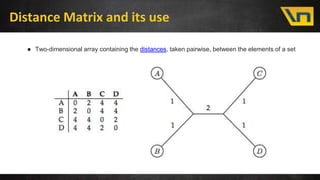
● Two-dimensional array containing the distances, taken pairwise, between the elements of a set
Distance Matrix and its use
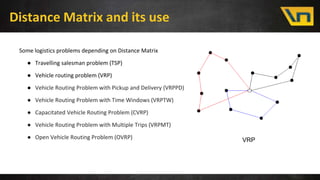
Some logistics problems depending on Distance Matrix
● Travelling salesman problem (TSP)
● Vehicle routing problem (VRP)
● Vehicle Routing Problem with Pickup and Delivery (VRPPD)
● Vehicle Routing Problem with Time Windows (VRPTW)
● Capacitated Vehicle Routing Problem (CVRP)
● Vehicle Routing Problem with Multiple Trips (VRPMT)
● Open Vehicle Routing Problem (OVRP) VRP
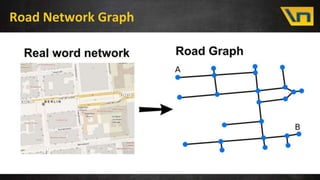
Road Network Graph
1.Basic Graph algorithms
1 function Dijkstra(Graph, source):
2 dist[source] ← 0 // Initialization of MST
3
4 create vertex set Q
5
6 for each vertex v in Graph:
7 if v ≠ source
8 dist[v] ← INFINITY // Unknown distance from source to v
9 prev[v] ← UNDEFINED // Predecessor of v
10
11 Q.add_with_priority(v, dist[v])
12
13
14 while Q is not empty: // The main loop
15 u ← Q.extract_min() // Remove and return best vertex
16 for each neighbor v of u: // only v that is still in Q
17 alt = dist[u] + length(u, v)
18 if alt < dist[v]
19 dist[v] ← alt
20 prev[v] ← u
21 Q.decrease_priority(v, alt)
22
23 return dist[], prev[]
Dijkstra
Basic Graph algorithms
● Alternate between forward and
backward dijkstra search from s and t
respectively
● Stop when settling a node that is
already settled in the other Dijkstra
● Observe : That node settled by both
searches is not necessarily on the SP
The cost of the shortest path is then :
min {dist s[u] + dist t[u] : for all u visited
in both}
Bidirectional Dijkstra
Algorithms for Distance Matrix
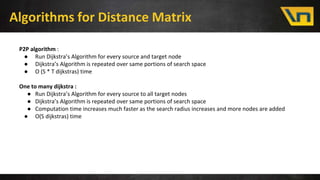
P2P algorithm :
● Run Dijkstra’s Algorithm for every source and target node
● Dijkstra’s Algorithm is repeated over same portions of search space
● O (S * T dijkstras) time
One to many dijkstra :
● Run Dijkstra’s Algorithm for every source to all target nodes
● Dijkstra’s Algorithm is repeated over same portions of search space
● Computation time increases much faster as the search radius increases and more nodes are added
● O(S dijkstras) time
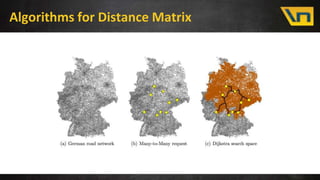
Algorithms for Distance Matrix
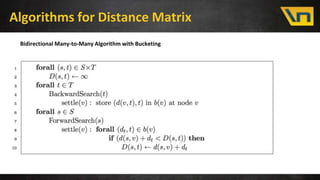
Bidirectional Many-to-Many Algorithm with Bucketing
Algorithms for Distance Matrix
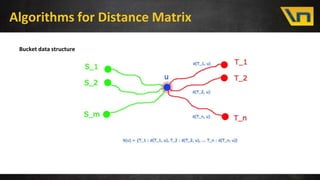
Bucket data structure
}
Algorithms for Distance Matrix
Complexity for many to many with bucketing
● Time complexity is order of | S + T | dijkstras
– Plus going through ALL nodes explored from both sides !
● Space consumed is HUGE !
– Each bucket has O(T) space
– Each node has a bucket
– There are 1,00,000 nodes searched for an average point to point search in a
20km radius
Challenges!
● P2P distance matrix algorithm takes less space but huge time
● One to many is theoretically slow
● Many to many algorithm should be fast but is slowed down by huge search space
– Search space can be reduced by tracking reached nodes in priority queue but with caveats
Runtimes on 4 Core 2G Ram machine
Size P2P
500 * 500 1.38 Hrs
1000 * 1000 5.5 Hrs
Challenges!
● How to recover ?
– Break m * n into parallel m/2 * n/2 calls
– Use a distributed framework , spark, etc to separate out the forward
searches
– Increase Heap size
– Use one to many
● Or solve the problem at root , decrease search space
but how ?
Contraction Hierarchies
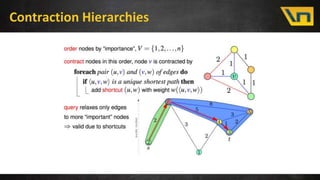
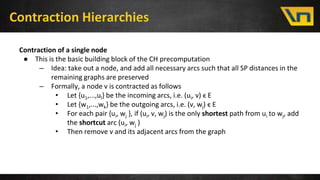
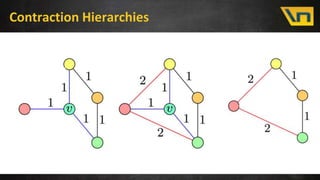
Contraction of a single node
● This is the basic building block of the CH precomputation
– Idea: take out a node, and add all necessary arcs such that all SP distances in the
remaining graphs are preserved
– Formally, a node v is contracted as follows
• Let {u1,...,ul} be the incoming arcs, i.e. (ui, v) ϵ E
• Let {w1,...,wk} be the outgoing arcs, i.e. (v, wj) ϵ E
• For each pair {ui, wj }, if (ui, v, wj) is the only shortest path from ui to wj, add
the shortcut arc (ui, wj )
• Then remove v and its adjacent arcs from the graph
Contraction Hierarchies
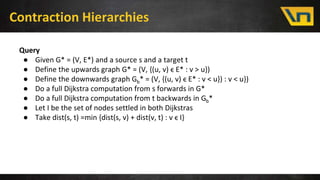
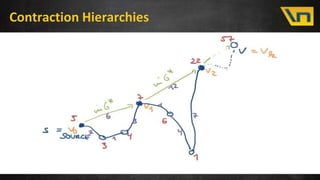
Query
● Given G* = (V, E*) and a source s and a target t
● Define the upwards graph G* = (V, {(u, v) ϵ E* : v > u})
● Define the downwards graph Gb* = (V, {(u, v) ϵ E* : v < u}) : v < u})
● Do a full Dijkstra computation from s forwards in G*
● Do a full Dijkstra computation from t backwards in Gb*
● Let I be the set of nodes settled in both Dijkstras
● Take dist(s, t) =min {dist(s, v) + dist(v, t) : v ϵ I}
Contraction Hierarchies
●Why it works ?
●How is node ordering chosen?
Contraction Hierarchies
Improved Distance Matrix computation
●Used the processed graph
●Reduced the number of explored nodes in search
space
●From 1,00,000 to 1000 nodes on average
●Reduced heavily the space and hence computation
time over nodes.
Results
Runtimes on 4 Core 2G Ram machine
Size P2P M2M with CH
500 * 500 1.38 Hrs 7s
1000 * 1000 5.5 Hrs 41s
2500 * 2500 34.7 Hrs 500s
References
Most Images/material are from :
● https://en.wikipedia.org/wiki/Distance_matrix
● http://rosalind.info/media/distance_based_phylogeny.png
● https://en.wikipedia.org/wiki/Vehicle_routing_problem
● http://2014.berlinbuzzwords.de/sites/2014.berlinbuzzwords.de/files/media/documents/peter_karich_-
_how_we_made_graphhopper_scale.pdf
● http://www.redblobgames.com/pathfinding/a-star/introduction.html
● http://www.cc.gatech.edu/~thad/6601-gradAI-fall2014/02-search-01-Astart-ALT-Reach.pdf
● http://i11www.iti.uni-karlsruhe.de/_media/teaching/theses/files/da-sknopp-06.pdf
● http://algo2.iti.kit.edu/schultes/hwy/distTableSlides.pdf
● http://algo2.iti.kit.edu/download/algeng-workshop-google-routing.pdf
● http://ad-teaching.informatik.uni-freiburg.de/route-planning-ss2012/lecture-7.pdf
● http://algo2.iti.kit.edu/schultes/hwy/contract.pdf
Questions
?
[ e-mail : vikas.v.iitr@gmail.com ]
Thank You

distance_matrix_ch

  • 1.
    Fast Distance MatrixComputation using Contraction Hierarchies By Vikas Veshishth Gargay Geo Intelligence Team
  • 2.
    Overview 1. Distance matrixand its use 2. Some well known problems which use distance matrix 3. Road Network Graph 4. Basic Graph algorithms 5. Algorithms for Distance Matrix 6. Challenges ! 7. Contraction Hierarchies 8. Improved Distance Matrix computation 9. Results 10. References 11. Questions
  • 3.
    Distance Matrix andits use ● Two-dimensional array containing the distances, taken pairwise, between the elements of a set
  • 4.
    Distance Matrix andits use Some logistics problems depending on Distance Matrix ● Travelling salesman problem (TSP) ● Vehicle routing problem (VRP) ● Vehicle Routing Problem with Pickup and Delivery (VRPPD) ● Vehicle Routing Problem with Time Windows (VRPTW) ● Capacitated Vehicle Routing Problem (CVRP) ● Vehicle Routing Problem with Multiple Trips (VRPMT) ● Open Vehicle Routing Problem (OVRP) VRP
  • 5.
  • 6.
    1.Basic Graph algorithms 1function Dijkstra(Graph, source): 2 dist[source] ← 0 // Initialization of MST 3 4 create vertex set Q 5 6 for each vertex v in Graph: 7 if v ≠ source 8 dist[v] ← INFINITY // Unknown distance from source to v 9 prev[v] ← UNDEFINED // Predecessor of v 10 11 Q.add_with_priority(v, dist[v]) 12 13 14 while Q is not empty: // The main loop 15 u ← Q.extract_min() // Remove and return best vertex 16 for each neighbor v of u: // only v that is still in Q 17 alt = dist[u] + length(u, v) 18 if alt < dist[v] 19 dist[v] ← alt 20 prev[v] ← u 21 Q.decrease_priority(v, alt) 22 23 return dist[], prev[] Dijkstra
  • 7.
    Basic Graph algorithms ●Alternate between forward and backward dijkstra search from s and t respectively ● Stop when settling a node that is already settled in the other Dijkstra ● Observe : That node settled by both searches is not necessarily on the SP The cost of the shortest path is then : min {dist s[u] + dist t[u] : for all u visited in both} Bidirectional Dijkstra
  • 8.
    Algorithms for DistanceMatrix P2P algorithm : ● Run Dijkstra’s Algorithm for every source and target node ● Dijkstra’s Algorithm is repeated over same portions of search space ● O (S * T dijkstras) time One to many dijkstra : ● Run Dijkstra’s Algorithm for every source to all target nodes ● Dijkstra’s Algorithm is repeated over same portions of search space ● Computation time increases much faster as the search radius increases and more nodes are added ● O(S dijkstras) time
  • 9.
  • 10.
    Algorithms for DistanceMatrix Bidirectional Many-to-Many Algorithm with Bucketing
  • 11.
    Algorithms for DistanceMatrix Bucket data structure }
  • 12.
    Algorithms for DistanceMatrix Complexity for many to many with bucketing ● Time complexity is order of | S + T | dijkstras – Plus going through ALL nodes explored from both sides ! ● Space consumed is HUGE ! – Each bucket has O(T) space – Each node has a bucket – There are 1,00,000 nodes searched for an average point to point search in a 20km radius
  • 13.
    Challenges! ● P2P distancematrix algorithm takes less space but huge time ● One to many is theoretically slow ● Many to many algorithm should be fast but is slowed down by huge search space – Search space can be reduced by tracking reached nodes in priority queue but with caveats Runtimes on 4 Core 2G Ram machine Size P2P 500 * 500 1.38 Hrs 1000 * 1000 5.5 Hrs
  • 14.
    Challenges! ● How torecover ? – Break m * n into parallel m/2 * n/2 calls – Use a distributed framework , spark, etc to separate out the forward searches – Increase Heap size – Use one to many ● Or solve the problem at root , decrease search space but how ?
  • 15.
  • 16.
    Contraction Hierarchies Contraction ofa single node ● This is the basic building block of the CH precomputation – Idea: take out a node, and add all necessary arcs such that all SP distances in the remaining graphs are preserved – Formally, a node v is contracted as follows • Let {u1,...,ul} be the incoming arcs, i.e. (ui, v) ϵ E • Let {w1,...,wk} be the outgoing arcs, i.e. (v, wj) ϵ E • For each pair {ui, wj }, if (ui, v, wj) is the only shortest path from ui to wj, add the shortcut arc (ui, wj ) • Then remove v and its adjacent arcs from the graph
  • 17.
  • 18.
    Contraction Hierarchies Query ● GivenG* = (V, E*) and a source s and a target t ● Define the upwards graph G* = (V, {(u, v) ϵ E* : v > u}) ● Define the downwards graph Gb* = (V, {(u, v) ϵ E* : v < u}) : v < u}) ● Do a full Dijkstra computation from s forwards in G* ● Do a full Dijkstra computation from t backwards in Gb* ● Let I be the set of nodes settled in both Dijkstras ● Take dist(s, t) =min {dist(s, v) + dist(v, t) : v ϵ I}
  • 19.
    Contraction Hierarchies ●Why itworks ? ●How is node ordering chosen?
  • 20.
  • 21.
    Improved Distance Matrixcomputation ●Used the processed graph ●Reduced the number of explored nodes in search space ●From 1,00,000 to 1000 nodes on average ●Reduced heavily the space and hence computation time over nodes.
  • 22.
    Results Runtimes on 4Core 2G Ram machine Size P2P M2M with CH 500 * 500 1.38 Hrs 7s 1000 * 1000 5.5 Hrs 41s 2500 * 2500 34.7 Hrs 500s
  • 23.
    References Most Images/material arefrom : ● https://en.wikipedia.org/wiki/Distance_matrix ● http://rosalind.info/media/distance_based_phylogeny.png ● https://en.wikipedia.org/wiki/Vehicle_routing_problem ● http://2014.berlinbuzzwords.de/sites/2014.berlinbuzzwords.de/files/media/documents/peter_karich_- _how_we_made_graphhopper_scale.pdf ● http://www.redblobgames.com/pathfinding/a-star/introduction.html ● http://www.cc.gatech.edu/~thad/6601-gradAI-fall2014/02-search-01-Astart-ALT-Reach.pdf ● http://i11www.iti.uni-karlsruhe.de/_media/teaching/theses/files/da-sknopp-06.pdf ● http://algo2.iti.kit.edu/schultes/hwy/distTableSlides.pdf ● http://algo2.iti.kit.edu/download/algeng-workshop-google-routing.pdf ● http://ad-teaching.informatik.uni-freiburg.de/route-planning-ss2012/lecture-7.pdf ● http://algo2.iti.kit.edu/schultes/hwy/contract.pdf
  • 24.
    Questions ? [ e-mail :vikas.v.iitr@gmail.com ]
  • 25.

Editor's Notes

  • #5 FE= field exec
  • #13 Node density for urban area is high
  • #16 the method of contraction hierarchies is a technique to speed up shortest-path routing by first creating precomputed "contracted" versions of the connection graph
  • #25 twitter handle