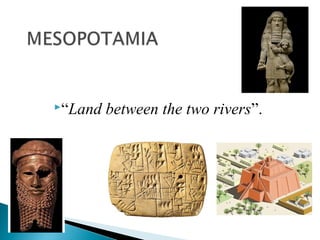
“Land between the two rivers”.

Considered the cradle of civilization.

Urban societies are known from the 6th
Millennium
BC (before Christ).

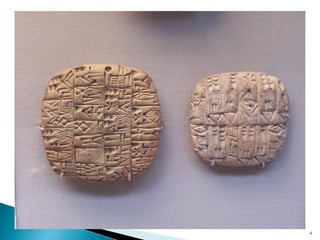
They invented writing: cuneiform script.

The Sumerians wrote
on clay tablets.

They used punches
to write on the
tablets.

Then these tablets
were baked to be
stored in an archive.

Archaeologists have
found thousands of
these tablets in the
archives.
 Around 3100 B.C. people
began to record amounts of
different crops. Barley was
one of the most important
crops in southern
Mesopotamia and when it
was first drawn it looked like
this.

5
The governor
receives 14
shekels of
silver from 5
persons and 46
shekels
remained
unpaid by 13
other persons.
The total
amount of
silver is 1
mina.
1 barley-fed ox,
6 grass-fed
oxen, the god
Shuruppak; 3
barley-fed
oxen, 6 grass-
fed oxen, the
god Gibil; 3
from the god
Ealil; 2 oxen,
6 grass-fed
oxen, Kinnir; 7
oxen from the
god Suen.2500 BC.
6
 Gilgamesh was an historical figure,
a king who reigned over the
Sumerian city-state of Uruk around
2700 b.c. Long after his death,
people worshipped Gilgamesh,
renowned as a warrior and builder
and widely celebrated for his
wisdom.
 The Epic of Gilgamesh is written
on eleven tablets. It was
discovered in the mid-nineteenth
century in the ruins of the great
library at Nineveh.
 He was an oppressive ruler,
however, which caused his
subjects to cry out to the
"gods" to create a nemesis to
cause Gilgamesh defeat.
 After one fight, this nemesis,
Enkidu, became best friends
with Gilgamesh. The two went
on many dangerous
adventures in which Enkidu is
killed.
 Gilgamesh then
determines to find
immortality since he
now fears death. It is
upon this search that he
meets Utnapishtim.
 Utnapishtim had become immortal after building a
ship to weather the Great Flood that destroyed
mankind. He brought all of his relatives and all
species of creatures aboard the vessel. Utnapishtim
released birds to find land, and the ship landed upon
a mountain after the flood. The story then ends with
tales of Enkidu's visit to the underworld.
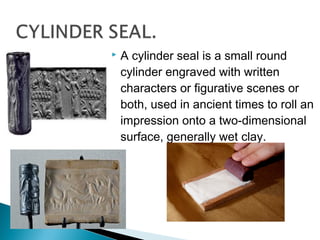
 A cylinder seal is a small round
cylinder engraved with written
characters or figurative scenes or
both, used in ancient times to roll an
impression onto a two-dimensional
surface, generally wet clay.
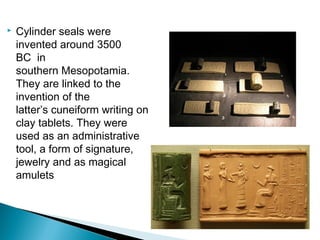
 Cylinder seals were
invented around 3500
BC  in
southern Mesopotamia.
They are linked to the
invention of the
latter’s cuneiform writing on
clay tablets. They were
used as an administrative
tool, a form of signature,
jewelry and as magical
amulets

The three main buildings were the palace, the
temple and the ziggurat.

The temple was a religious center, economic and
political. The temple had farmland and herds of
sheep, as well as warehouses and workshops.
13
The palace was
organized around an
inner courtyard and
was usually
surrounded by a wall.
 The Assyrian kings Ashurnasirpal,
Sennacherib Ashurbanipal  forced
his subjects to build him an
enormous palaces at Nimrud,
Khorsabad and Nineveh. The
rooms of the palace follow
a thispattern: a big public
courtyard, and on three sides it
has government offices and
storage. The fourth side is the
throne room, and then there's a
smaller, private courtyard. 14
 Ashurbanipal's
famous library
which held over
30,000 inscribed
clay tablets, the
books of that
time.  
15
In ancient Assyria,
lion-hunting was
considered the sport
of kings, symbolic of
the ruling monarch’s
duty to protect and
fight for his people
 Huge sculptures
of human-headed
winged bulls
(lamassu) that
weigh up to 30
tons were
intended for the
main entrances to
the palace.
16

The ziggurat is a temple-shaped
tower.

It is built on sun-dried brick
(ladrillos de adobe).

The ziggurat were considered
the houses of the gods.
Ceremonies were held outside
the building.

To access the ziggurat there
was a series of steps up to the
chapel at the top of the ziggurat.

The ziggurat may be a
symbolic representation of
the union of heaven and
earth.

In total 32 ziggurat are
known, most of whom are in
Iraq and Iran.

The best known is the
ziggurat of Ur, rebuilt in the
80s by Saddam Hussein. In
rebuilding one of 200 bricks
contains the name of the
dictator.

It is one of eight
large doors that
had the city walls
of Babylon.

This gate was
dedicated to the
goddess Ishtar.

It was built in 575
AD by king
Nabucodonosor II.

It is made of brick,
most of them blue and
includes images of
dragons, bulls, lions
and mythological
beings.

The archaeological
remains were
discovered by German
archaeologists
between 1902 and
1914.

Most of the
archaeological
remains were taken
to Germany, where
they were
reconstructed in the
Pergamo Museum.

During the time of
Saddam Hussein's
rule, the government
rebuilt a replica of
the gate at the
original site.
• One of the seven wonders
of the Ancient World.
• They were built by the king
Nabucodonosor II around
600 B.C.
• The gardens were
constructed to please
Queen Amytis who longed
for the trees and fragant
plants of her homeland.
• It created a series
of stone terraces in
which trees were
planted and various
plants for the
Queen could
remember where
she grew up.
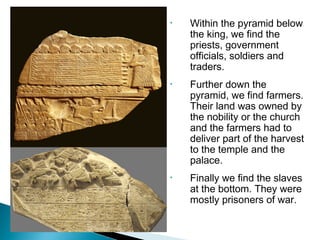
• Mesopotamian society was divided between free
men and slaves.
• The society was organized in a pyramid with the
king at the very top and slaves at the very bottom.
• The king was the
representative of the gods.
• The king was the military
commander and participated
in religious ceremonies.
• In this photo, the King Naram-
Sim of Akad.
• Within the pyramid below
the king, we find the
priests, government
officials, soldiers and
traders.
• Further down the
pyramid, we find farmers.
Their land was owned by
the nobility or the church
and the farmers had to
deliver part of the harvest
to the temple and the
palace.
• Finally we find the slaves
at the bottom. They were
mostly prisoners of war.
• It was created by the
King Hammurabi in
1760 B.C.
• It is one of the oldest
law codes known.
The articles of the
law are written in the
stone. At the top the
king is receiving the
law from the hands
of the god.
• The stone
measured 2.25
metres and contains
282 laws delivered
by the god of
justice, Shamash.
The religion was polytheistic. Every city had, as its
center, the temple of the patron. The patron god or
goddess of a city had the largest temple in the
city, but there were smaller temples and shrines to
other gods.
According to the Mesopotamian creation myth, life
began after an epic struggle between the elder
gods and the younger. In the beginning there was
only water swirling in chaos and undifferentiated
between fresh and bitter. These waters separated
into two distinct principles: the male principle,
Apsu, which was fresh water and the female
principle, Tiamat, salt water. From the union of
these two principles all the other gods came into
being.
Apsu on the advice of his Vizier, he decided to kill them. Tiamat,
however, was shocked at Apsu's plot and warned one of her sons,
Ea, the god of wisdom and intelligence. With the help of his brothers
and sisters, Ea put Apsu to sleep and then killed him. Out of the
corpse of Apsu, Ea created the earth and built his home. Tiamat,
upset now over Apsu's death, raised the forces of chaos to destroy
her children. Ea and his siblings fought against, without success
until, from among them, rose the great storm god Marduk. Marduk
swore he would defeat Tiamat if the gods would proclaim him their
king. This agreed to, he entered into battle with Tiamat, killed her
and, from her body, created the sky. He then continued on with the
act of creation to make human beings from the remains of Quingu as
help-mates to the gods.
Some of the most important deities of
ancient Mesopotamia were:
An (Anu):Sky god, as well as father of the
gods, An was the king of all the gods.
Enki (Ea): God of fresh water,
known for his wisdom. He was
depicted as a bearded man with
water flowing around him.
Nanna (Sin) – God of the moon and
the son of Enlil and Ninlil. He travels
across the sky in his small boat of
woven twigs, surrounded by the planets
and stars.
The seated figure is probably king Ur-Nammu.
Sin/Nanna himself is indicated in the form of a
crescent.
Stele of Ur-Nammu (2200 BC),
detail showing the crescent moon,
the moon god's symbol.
Inanna (Ishtar) – Goddess of love,
fertility, and war. She was the most
important of the female deities.
Ishtar Kudurru. Kudurru was a type of stone
document used as boundary stones and as records
of land grants to vassals. 
Goddess is depicted as a winged, nude,
goddess-like figure with bird's talons,
flanked by owls.
Utu (Shamash) - God of the sun and of
justice. Between the time when the sun sets
in the west and rises in the east he is in the
underworld, where he decrees the fate of the
dead..
King Melishipak I (1186–1172 B.C.)
presents his daughter to Shamash, the
sun, represented at the right, next to
Nanna and Ishtar.
Dates from the 9th century BC and shows the
sun god Shamash on the throne, in front of the
Babylonian king Nabu-apla-iddina (888-855 BC)
between two interceding deities. The text tells
how the king made a new statue for the god and
gave privileges to his temple.
 Marduk was the patron deity of the city
of Babylon. When Babylon became the
political center of Mesopotamia in the
time of Hammurabi (18th century BC),
he started to rise to the position of the
head of the Babylonian pantheon. deity. 
 He presided over justice, compassion, healing,
regeneration, magic, and fairness, although he is also
sometimes referenced as a storm god and agricultural
deity. 

Ancient mesopotamia

  • 1.
    “Land between thetwo rivers”.
  • 2.
     Considered the cradleof civilization.  Urban societies are known from the 6th Millennium BC (before Christ).  They invented writing: cuneiform script.
  • 3.
     The Sumerians wrote onclay tablets.  They used punches to write on the tablets.  Then these tablets were baked to be stored in an archive.  Archaeologists have found thousands of these tablets in the archives.
  • 4.
     Around 3100B.C. people began to record amounts of different crops. Barley was one of the most important crops in southern Mesopotamia and when it was first drawn it looked like this. 
  • 5.
    5 The governor receives 14 shekelsof silver from 5 persons and 46 shekels remained unpaid by 13 other persons. The total amount of silver is 1 mina. 1 barley-fed ox, 6 grass-fed oxen, the god Shuruppak; 3 barley-fed oxen, 6 grass- fed oxen, the god Gibil; 3 from the god Ealil; 2 oxen, 6 grass-fed oxen, Kinnir; 7 oxen from the god Suen.2500 BC.
  • 6.
  • 8.
     Gilgamesh was anhistorical figure, a king who reigned over the Sumerian city-state of Uruk around 2700 b.c. Long after his death, people worshipped Gilgamesh, renowned as a warrior and builder and widely celebrated for his wisdom.  The Epic of Gilgamesh is written on eleven tablets. It was discovered in the mid-nineteenth century in the ruins of the great library at Nineveh.
  • 9.
     He wasan oppressive ruler, however, which caused his subjects to cry out to the "gods" to create a nemesis to cause Gilgamesh defeat.  After one fight, this nemesis, Enkidu, became best friends with Gilgamesh. The two went on many dangerous adventures in which Enkidu is killed.
  • 10.
     Gilgamesh then determinesto find immortality since he now fears death. It is upon this search that he meets Utnapishtim.  Utnapishtim had become immortal after building a ship to weather the Great Flood that destroyed mankind. He brought all of his relatives and all species of creatures aboard the vessel. Utnapishtim released birds to find land, and the ship landed upon a mountain after the flood. The story then ends with tales of Enkidu's visit to the underworld.
  • 11.
     A cylinder seal isa small round cylinder engraved with written characters or figurative scenes or both, used in ancient times to roll an impression onto a two-dimensional surface, generally wet clay.
  • 12.
     Cylinder sealswere invented around 3500 BC  in southern Mesopotamia. They are linked to the invention of the latter’s cuneiform writing on clay tablets. They were used as an administrative tool, a form of signature, jewelry and as magical amulets
  • 13.
     The three mainbuildings were the palace, the temple and the ziggurat.  The temple was a religious center, economic and political. The temple had farmland and herds of sheep, as well as warehouses and workshops. 13 The palace was organized around an inner courtyard and was usually surrounded by a wall.
  • 14.
     The Assyriankings Ashurnasirpal, Sennacherib Ashurbanipal  forced his subjects to build him an enormous palaces at Nimrud, Khorsabad and Nineveh. The rooms of the palace follow a thispattern: a big public courtyard, and on three sides it has government offices and storage. The fourth side is the throne room, and then there's a smaller, private courtyard. 14
  • 15.
     Ashurbanipal's famous library whichheld over 30,000 inscribed clay tablets, the books of that time.   15 In ancient Assyria, lion-hunting was considered the sport of kings, symbolic of the ruling monarch’s duty to protect and fight for his people
  • 16.
     Huge sculptures ofhuman-headed winged bulls (lamassu) that weigh up to 30 tons were intended for the main entrances to the palace. 16
  • 17.
     The ziggurat isa temple-shaped tower.  It is built on sun-dried brick (ladrillos de adobe).  The ziggurat were considered the houses of the gods. Ceremonies were held outside the building.  To access the ziggurat there was a series of steps up to the chapel at the top of the ziggurat.
  • 18.
     The ziggurat maybe a symbolic representation of the union of heaven and earth.  In total 32 ziggurat are known, most of whom are in Iraq and Iran.
  • 19.
     The best knownis the ziggurat of Ur, rebuilt in the 80s by Saddam Hussein. In rebuilding one of 200 bricks contains the name of the dictator.
  • 20.
     It is oneof eight large doors that had the city walls of Babylon.  This gate was dedicated to the goddess Ishtar.  It was built in 575 AD by king Nabucodonosor II.
  • 22.
     It is madeof brick, most of them blue and includes images of dragons, bulls, lions and mythological beings.  The archaeological remains were discovered by German archaeologists between 1902 and 1914.
  • 23.
     Most of the archaeological remainswere taken to Germany, where they were reconstructed in the Pergamo Museum.  During the time of Saddam Hussein's rule, the government rebuilt a replica of the gate at the original site.
  • 26.
    • One ofthe seven wonders of the Ancient World. • They were built by the king Nabucodonosor II around 600 B.C. • The gardens were constructed to please Queen Amytis who longed for the trees and fragant plants of her homeland.
  • 27.
    • It createda series of stone terraces in which trees were planted and various plants for the Queen could remember where she grew up.
  • 28.
    • Mesopotamian societywas divided between free men and slaves. • The society was organized in a pyramid with the king at the very top and slaves at the very bottom.
  • 29.
    • The kingwas the representative of the gods. • The king was the military commander and participated in religious ceremonies. • In this photo, the King Naram- Sim of Akad.
  • 30.
    • Within thepyramid below the king, we find the priests, government officials, soldiers and traders. • Further down the pyramid, we find farmers. Their land was owned by the nobility or the church and the farmers had to deliver part of the harvest to the temple and the palace. • Finally we find the slaves at the bottom. They were mostly prisoners of war.
  • 31.
    • It wascreated by the King Hammurabi in 1760 B.C. • It is one of the oldest law codes known. The articles of the law are written in the stone. At the top the king is receiving the law from the hands of the god.
  • 32.
    • The stone measured2.25 metres and contains 282 laws delivered by the god of justice, Shamash.
  • 33.
    The religion waspolytheistic. Every city had, as its center, the temple of the patron. The patron god or goddess of a city had the largest temple in the city, but there were smaller temples and shrines to other gods.
  • 34.
    According to theMesopotamian creation myth, life began after an epic struggle between the elder gods and the younger. In the beginning there was only water swirling in chaos and undifferentiated between fresh and bitter. These waters separated into two distinct principles: the male principle, Apsu, which was fresh water and the female principle, Tiamat, salt water. From the union of these two principles all the other gods came into being.
  • 35.
    Apsu on theadvice of his Vizier, he decided to kill them. Tiamat, however, was shocked at Apsu's plot and warned one of her sons, Ea, the god of wisdom and intelligence. With the help of his brothers and sisters, Ea put Apsu to sleep and then killed him. Out of the corpse of Apsu, Ea created the earth and built his home. Tiamat, upset now over Apsu's death, raised the forces of chaos to destroy her children. Ea and his siblings fought against, without success until, from among them, rose the great storm god Marduk. Marduk swore he would defeat Tiamat if the gods would proclaim him their king. This agreed to, he entered into battle with Tiamat, killed her and, from her body, created the sky. He then continued on with the act of creation to make human beings from the remains of Quingu as help-mates to the gods.
  • 36.
    Some of themost important deities of ancient Mesopotamia were: An (Anu):Sky god, as well as father of the gods, An was the king of all the gods.
  • 37.
    Enki (Ea): Godof fresh water, known for his wisdom. He was depicted as a bearded man with water flowing around him.
  • 38.
    Nanna (Sin) –God of the moon and the son of Enlil and Ninlil. He travels across the sky in his small boat of woven twigs, surrounded by the planets and stars. The seated figure is probably king Ur-Nammu. Sin/Nanna himself is indicated in the form of a crescent. Stele of Ur-Nammu (2200 BC), detail showing the crescent moon, the moon god's symbol.
  • 39.
    Inanna (Ishtar) –Goddess of love, fertility, and war. She was the most important of the female deities. Ishtar Kudurru. Kudurru was a type of stone document used as boundary stones and as records of land grants to vassals.  Goddess is depicted as a winged, nude, goddess-like figure with bird's talons, flanked by owls.
  • 40.
    Utu (Shamash) -God of the sun and of justice. Between the time when the sun sets in the west and rises in the east he is in the underworld, where he decrees the fate of the dead.. King Melishipak I (1186–1172 B.C.) presents his daughter to Shamash, the sun, represented at the right, next to Nanna and Ishtar. Dates from the 9th century BC and shows the sun god Shamash on the throne, in front of the Babylonian king Nabu-apla-iddina (888-855 BC) between two interceding deities. The text tells how the king made a new statue for the god and gave privileges to his temple.
  • 41.
     Marduk was thepatron deity of the city of Babylon. When Babylon became the political center of Mesopotamia in the time of Hammurabi (18th century BC), he started to rise to the position of the head of the Babylonian pantheon. deity.   He presided over justice, compassion, healing, regeneration, magic, and fairness, although he is also sometimes referenced as a storm god and agricultural deity.