PREHISTORY
Palaeolithic/Paleolithic
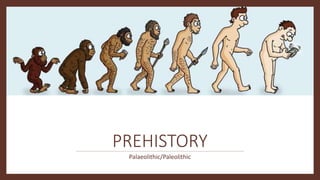
• Prehistory is the longest period in the
evolution of mankind. It covers from
the origin of the human species until
writing appeared (3.500 BC).
• As there are no written records the
main source of information is
archaeology.
• Humans are the result of gradual
evolution from the first hominids
(human-like species) to the human
species. This process lasted millions of
years.
PREHISTORY
PERIODS:
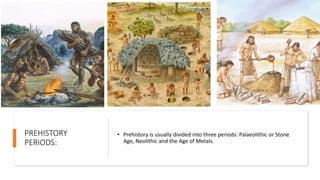
• Prehistory is usually divided into three periods: Palaeolithic or Stone
Age, Neolithic and the Age of Metals.
HUMAN
EVOLUTION
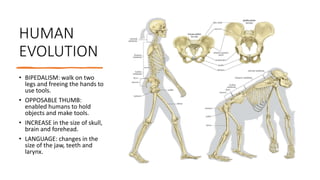
• BIPEDALISM: walk on two
legs and freeing the hands to
use tools.
• OPPOSABLE THUMB:
enabled humans to hold
objects and make tools.
• INCREASE in the size of skull,
brain and forehead.
• LANGUAGE: changes in the
size of the jaw, teeth and
larynx.
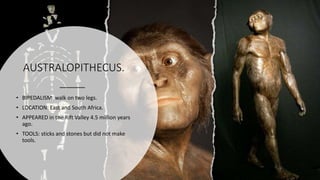
AUSTRALOPITHECUS.
• BIPEDALISM: walk on two legs.
• LOCATION: East and South Africa.
• APPEARED in the Rift Valley 4.5 million years
ago.
• TOOLS: sticks and stones but did not make
tools.
HOMO HABILIS.
• APPEARED in East Africa 2.3 million
years ago but did not leave the
continent.
• FIRST to make basic tools.
CHOPPER with a single
straight or curved cutting edge
and CHOPPING TOOL with a
bifacial cutting edge.
HOMO ERECTUS.
• APPEARED 1.9 million years ago in East Africa and was the first
human ancestor to spread to Europe and Asia.
• TOOLS: complex tools called bifaces.
• Discovery of FIRE and HUNTING in groups.
ATAPUERCA.
HOMO ANTECESSOR
• APPEARED 800.000 years ago at
Atapuerta (Burgos).
• TOOLS for specific activities.
HOMO NEANDERTHALENSIS.
HOMO
NEANDERTHALEN
SIS.
• APPEARED 300,000 years
ago only in Europe.
• They LIVED during the Ice
Age.
• Complex TOOLS made of
flint (silex).
• First BURIALS.
HOMO SAPIENS.
HOMO
SAPIENS
• APPEARED in East Africa 200,000
years ago and expanded into
Asia, Europe, Oceania and
America.
• Sophisticated TOOLS made of
stone, bone and antler.
• First works of ART.
PALAEOLITHIC ART

PREHISTORY.pptx

  • 1.
  • 2.
    • Prehistory isthe longest period in the evolution of mankind. It covers from the origin of the human species until writing appeared (3.500 BC). • As there are no written records the main source of information is archaeology. • Humans are the result of gradual evolution from the first hominids (human-like species) to the human species. This process lasted millions of years.
  • 3.
    PREHISTORY PERIODS: • Prehistory isusually divided into three periods: Palaeolithic or Stone Age, Neolithic and the Age of Metals.
  • 5.
    HUMAN EVOLUTION • BIPEDALISM: walkon two legs and freeing the hands to use tools. • OPPOSABLE THUMB: enabled humans to hold objects and make tools. • INCREASE in the size of skull, brain and forehead. • LANGUAGE: changes in the size of the jaw, teeth and larynx.
  • 7.
    AUSTRALOPITHECUS. • BIPEDALISM: walkon two legs. • LOCATION: East and South Africa. • APPEARED in the Rift Valley 4.5 million years ago. • TOOLS: sticks and stones but did not make tools.
  • 8.
    HOMO HABILIS. • APPEAREDin East Africa 2.3 million years ago but did not leave the continent. • FIRST to make basic tools.
  • 9.
    CHOPPER with asingle straight or curved cutting edge and CHOPPING TOOL with a bifacial cutting edge.
  • 10.
    HOMO ERECTUS. • APPEARED1.9 million years ago in East Africa and was the first human ancestor to spread to Europe and Asia. • TOOLS: complex tools called bifaces. • Discovery of FIRE and HUNTING in groups.
  • 12.
  • 13.
    HOMO ANTECESSOR • APPEARED800.000 years ago at Atapuerta (Burgos). • TOOLS for specific activities.
  • 14.
  • 16.
    HOMO NEANDERTHALEN SIS. • APPEARED 300,000years ago only in Europe. • They LIVED during the Ice Age. • Complex TOOLS made of flint (silex). • First BURIALS.
  • 17.
  • 18.
    HOMO SAPIENS • APPEARED inEast Africa 200,000 years ago and expanded into Asia, Europe, Oceania and America. • Sophisticated TOOLS made of stone, bone and antler. • First works of ART.
  • 20.