School of Interior
DesigningDesigning
Hi t IHistory –I
M t iMesopotamia
S t ISemester –I
Ancient History andAncient History and
CivilizationsCivilizations
In the next several units we areIn the next several units we are
going to study the history of the
first civilizations.
There are other ancient
civilizations that existed atcivilizations that existed at
different times.
Ci ili tiCivilizations
• Early man did not live in
civilizations They lived in villagescivilizations. They lived in villages
or communities.
• So what is a civilization?So what is a civilization?
Civilizations consist of:
O CitiesO Cities
O Organized governments
A tO Art
O Religiong
O Class divisions
Civilizations started aroundCivilizations started around
rivers. Why?rivers. Why?
Good farming conditions
Provided fish and
freshwater
Easy to travel
Easy to trade
( d d id(way goods and ideas
moved from place to
place)place)
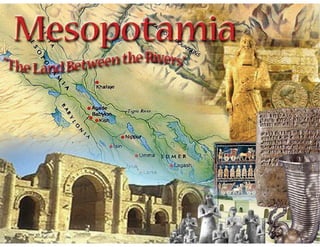
MesopotamianMesopotamian
Civilization
Focusing on the Main Ideas
• Civilization in Mesopotamia began in the
valleys of the Tigris and Euphrates Rivers.y g p
• Sumerians invented writing and made other
important contributions to later peoples.important contributions to later peoples.
• Sumerian city-states lost power when they
were conquered by outsiderswere conquered by outsiders.
Why live in Mesopotamia ?y p
• create a high and safe
flood plain
• make irrigation and
canal construction easy
• provide protection
• the surrounding swamps
were full of fish &
waterfowl
Civilizations first began as villages.
The villages gradually grew into complexThe villages gradually grew into complex
societies.
O This area called Mesopotamia (“landO This area called Mesopotamia ( land
between the rivers”)
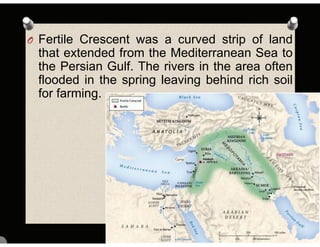
O Mesopotamia located in the FertileO Mesopotamia located in the Fertile
Crescent.
O Fertile Crescent was a curved strip of land
that extended from the Mediterranean Sea to
th P i G lf Th i i th ftthe Persian Gulf. The rivers in the area often
flooded in the spring leaving behind rich soil
for farmingfor farming.
FloodingFlooding
O Floods in Mesopotamia were frequent
d di t bl F l d tand unpredictable. Farmers learned to
control the rivers with dams and
channels. They also used the rivers to
irrigate.g
As cities formed, the people needed
plans and decisions made for the city.p y
This led to governments being formed.
O Laws - keep order
O Armies defend themselvesO Armies - defend themselves
O Building projectsg j
During this time humans worried less
about basic needsabout basic needs.
Shelter/Food/Clothing
People could do other thingsPeople could do other things.
• Develop religions
• Develop arts
Invent ways of writing• Invent ways of writing
• Create calendars
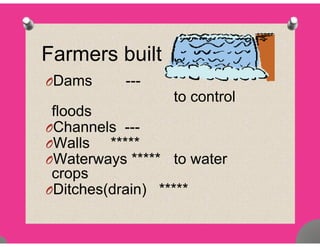
Farmers built
ODams ---
t t lto control
floods
Ch lOChannels ---
OWalls *****
W t ***** t tOWaterways ***** to water
crops
( ) *****ODitches(drain) *****
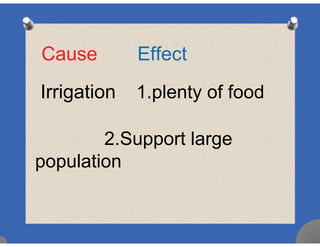
Cause Effect
Irrigation 1 plenty of foodIrrigation 1.plenty of food
2.Support large
population
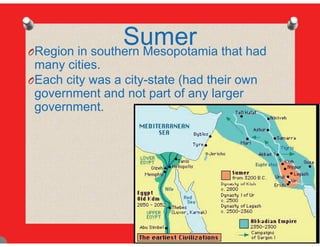
SumerSumerORegion in southern Mesopotamia that had
many citiesmany cities.
OEach city was a city-state (had their own
government and not part of any largergovernment and not part of any larger
government.
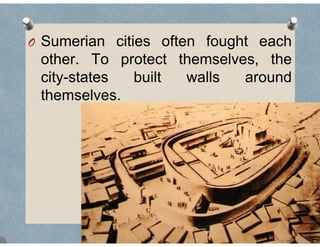
O Sumerian cities often fought each
other. To protect themselves, theother. To protect themselves, the
city-states built walls around
themselvesthemselves.
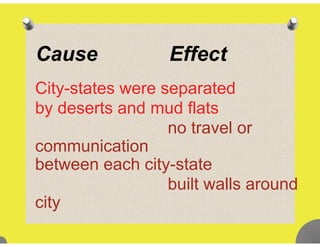
Cause Effect
City-states were separatedCity states were separated
by deserts and mud flats
t lno travel or
communication
between each city-state
built walls aroundbuilt walls around
city
ZigguratZiggurat
O Sumerians believedO Sumerians believed
in many gods and
thought their Godsg
had power over
nature and human
ti itactivity.
O They wanted to
l th G dplease the Gods.
O They built ziggurats
( d t l ) i(grand temple) in
the center of each
city for their chiefcity for their chief
god.
Large temples dedicated to the God of the city
Made of layer upon layer of mud bricks in the shape of a
pyramid in many tiers
(due to constant flooding and from
belief that gods resided on
mountaintops)
Temple on top served as the God’s
home and was beautifully decorated
Inside was a room for offerings of
Ziggurat of Ur -
2000BCE
Inside was a room for offerings of
food and goods
Temples evolved to ziggurats- a
stack of 1-7 platforms decreasing in
2000BCE
p g
size from bottom to top
Famous ziggurat was Tower of
B b lBabel
(over 100m above ground and 91m
base)
ZigguratZiggurat
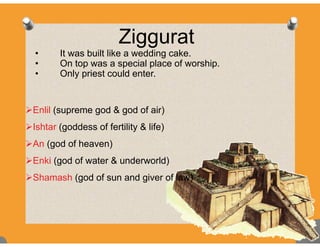
• It was built like a wedding cake.
• On top was a special place of worship• On top was a special place of worship.
• Only priest could enter.
Enlil (supreme god & god of air)
I ht ( dd f f tilit & lif )Ishtar (goddess of fertility & life)
An (god of heaven)
Enki (god of water & underworld)
Shamash (god of sun and giver of law)
Government
OPriests may have been theOPriests may have been the
first to rule.
OKings later ran the
governmentgovernment.
People in Sumerp
O Priests/KingsO Priests/Kings
O Farmers
A ti ( kill d k th tO Artisans (skilled workers that
made metal products, cloth, andp
pottery)
O Merchants and traders (traveledO Merchants and traders (traveled
to other cities and traded tools,
wheat, copper, tin, timber)
Social ClassesSocial Classes
OUpper class King priestsOUpper class- King, priests,
government officials
OMiddle class- artisans,OMiddle class artisans,
merchants, farmers,
fishers (largest group)
OLower class- slaves
(worked on farms or in
temples) Slaves may havetemples) Slaves may have
been prisoners of war or
debtor.
Roles of Societyy
OMen – head of householdOMen head of household
OWomen – had rights, could
buy and sell property and
run businessesrun businesses.
Cradle of Civilization
Sumerians’ ideas and inventionsSumerians ideas and inventions
were copied and improved upon
by other peoples.
They left a lasting mark onThey left a lasting mark on
world history.
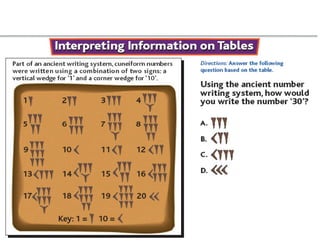
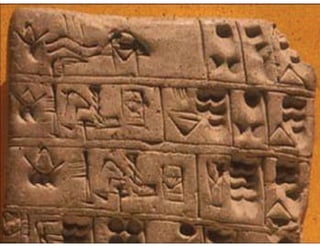
C ifCuneiform
OGreatest invention of SumeriansOGreatest invention of Sumerians
OType of writing
l d k d f b dOHelped keep records of business and
events
OOnly males could learn to write and
became scribesbecame scribes.
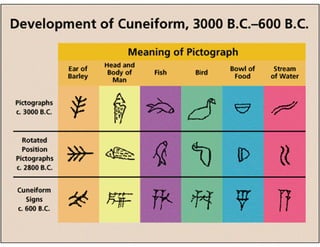
OAt first they used pictures to tell a story
( i t h)(pictograph)
OEach picture evolved into a symbol for a
word.
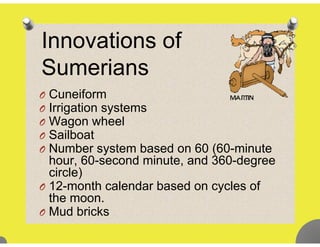
I ti fInnovations of
SumeriansSumerians
O CuneiformO Cuneiform
O Irrigation systems
O Wagon wheelO Wagon wheel
O Sailboat
O Number system based on 60 (60-minutey (
hour, 60-second minute, and 360-degree
circle)
O 12 th l d b d l fO 12-month calendar based on cycles of
the moon.
O Mud bricksO Mud bricks
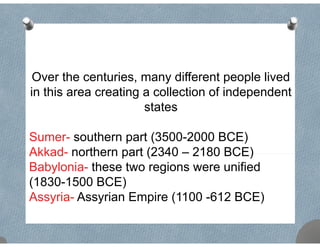
Over the centuries, many different people lived
in this area creating a collection of independentin this area creating a collection of independent
states
Sumer- southern part (3500-2000 BCE)
Akkad- northern part (2340 – 2180 BCE)Akkad northern part (2340 2180 BCE)
Babylonia- these two regions were unified
(1830-1500 BCE)(1830 1500 BCE)
Assyria- Assyrian Empire (1100 -612 BCE)
Assignmentg
O Each student will write a secret
message to trade with another
studentstudent.
O Your partner will have to decode
without helpwithout help.