CAVE PAINTINGS
1
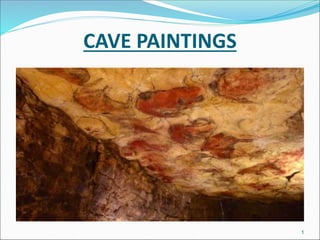
 Cave painting
involves the
application of colour
pigments on the
walls, floors or
ceilings of
prehistoric rock
shelters and caves.
Cave paintings are
monochrome, made with only
one colour (usually black) or
polychrome consisting of two
or more colours.
Chauvet Cave, France
Altamira, Cantabria, Spain.
2
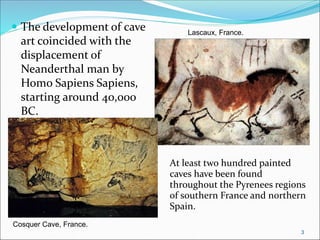
 The development of cave
art coincided with the
displacement of
Neanderthal man by
Homo Sapiens Sapiens,
starting around 40,000
BC.
At least two hundred painted
caves have been found
throughout the Pyrenees regions
of southern France and northern
Spain.
Lascaux, France.
Cosquer Cave, France.
3
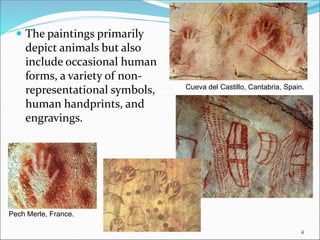
 The paintings primarily
depict animals but also
include occasional human
forms, a variety of non-
representational symbols,
human handprints, and
engravings.
Pech Merle, France.
Cueva del Castillo, Cantabria, Spain.
4
PREHISTORIC PIGMENTS
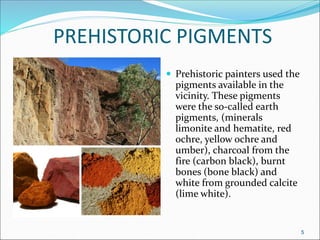
 Prehistoric painters used the
pigments available in the
vicinity. These pigments
were the so-called earth
pigments, (minerals
limonite and hematite, red
ochre, yellow ochre and
umber), charcoal from the
fire (carbon black), burnt
bones (bone black) and
white from grounded calcite
(lime white).
5
ENGRAVINGS.
 Engraved drawing is
made by cutting lines in
the rock surface with a
flint or stone tool.
Piedra Siega Verde, Salamanca, Spain. Mazouco, Portugal
6
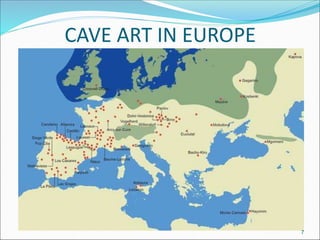
CAVE ART IN EUROPE
7
ALTAMIRA
 The cave is approximately 1000 meters
long. Around 13,000 years ago a rockfall
sealed the cave's entrance, preserving
its contents until its discovery in 1879.
 Bison, horses, deer, hands,
and mysterious signs were
painted or engraved over the
9,000 years during which the
cave of Altamira was
inhabited (22,000- 13,000
years ago). These
representations extend for a
length of more than 270
metres throughout the cave
although the best known are
the famous polychrome
paintings.
8
 They used the natural
contours of the cave
walls to give their
subjects a three-
dimensional effect.
9
LASCAUX.
 The cave contains nearly 2,000
figures, which can be grouped
into three main categories:
animals, human figures, and
abstract signs. The paintings
contain no images of the
surrounding landscape or the
vegetation of the time.
10
 Most of the major images have
been painted using red, yellow,
and black colours from mineral
pigments, including iron oxide
(ochre) and haematite for red
colour, goethite for yellow colour,
as well as manganese-containing
pigments. Charcoal may also have
been used for black colour. The
colour may have been applied
using animal fat.
11
EPIPALEOLITHIC/MESOLITHIC PAINTINGS
12
PALEOLITHIC AND EPIPALEOLITHIC/NEOLITHIC
PAINTINGS THROUGH PHOTOGRAPHS
Lascaux, France. Barranco de la Valltorta, Castellón,
Spain.
13
Recolector de miel, Ripol Perelló,
Spain.
Humans depicted not only animals, human figure is now
present in the wall paintings.
14
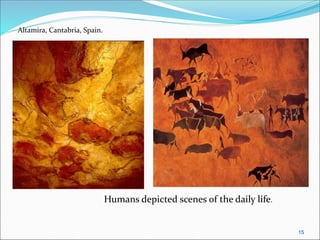
Altamira, Cantabria, Spain.
Humans depicted scenes of the daily life.
15
 Even, human figures performing rituals.
Cogul, Lérida, Spain. A group of dancers.
16

PALAEOLITHIC CAVE PAINTINGS

  • 1.
  • 2.
     Cave painting involvesthe application of colour pigments on the walls, floors or ceilings of prehistoric rock shelters and caves. Cave paintings are monochrome, made with only one colour (usually black) or polychrome consisting of two or more colours. Chauvet Cave, France Altamira, Cantabria, Spain. 2
  • 3.
     The developmentof cave art coincided with the displacement of Neanderthal man by Homo Sapiens Sapiens, starting around 40,000 BC. At least two hundred painted caves have been found throughout the Pyrenees regions of southern France and northern Spain. Lascaux, France. Cosquer Cave, France. 3
  • 4.
     The paintingsprimarily depict animals but also include occasional human forms, a variety of non- representational symbols, human handprints, and engravings. Pech Merle, France. Cueva del Castillo, Cantabria, Spain. 4
  • 5.
    PREHISTORIC PIGMENTS  Prehistoricpainters used the pigments available in the vicinity. These pigments were the so-called earth pigments, (minerals limonite and hematite, red ochre, yellow ochre and umber), charcoal from the fire (carbon black), burnt bones (bone black) and white from grounded calcite (lime white). 5
  • 6.
    ENGRAVINGS.  Engraved drawingis made by cutting lines in the rock surface with a flint or stone tool. Piedra Siega Verde, Salamanca, Spain. Mazouco, Portugal 6
  • 7.
    CAVE ART INEUROPE 7
  • 8.
    ALTAMIRA  The caveis approximately 1000 meters long. Around 13,000 years ago a rockfall sealed the cave's entrance, preserving its contents until its discovery in 1879.  Bison, horses, deer, hands, and mysterious signs were painted or engraved over the 9,000 years during which the cave of Altamira was inhabited (22,000- 13,000 years ago). These representations extend for a length of more than 270 metres throughout the cave although the best known are the famous polychrome paintings. 8
  • 9.
     They usedthe natural contours of the cave walls to give their subjects a three- dimensional effect. 9
  • 10.
    LASCAUX.  The cavecontains nearly 2,000 figures, which can be grouped into three main categories: animals, human figures, and abstract signs. The paintings contain no images of the surrounding landscape or the vegetation of the time. 10
  • 11.
     Most ofthe major images have been painted using red, yellow, and black colours from mineral pigments, including iron oxide (ochre) and haematite for red colour, goethite for yellow colour, as well as manganese-containing pigments. Charcoal may also have been used for black colour. The colour may have been applied using animal fat. 11
  • 12.
  • 13.
    PALEOLITHIC AND EPIPALEOLITHIC/NEOLITHIC PAINTINGSTHROUGH PHOTOGRAPHS Lascaux, France. Barranco de la Valltorta, Castellón, Spain. 13
  • 14.
    Recolector de miel,Ripol Perelló, Spain. Humans depicted not only animals, human figure is now present in the wall paintings. 14
  • 15.
    Altamira, Cantabria, Spain. Humansdepicted scenes of the daily life. 15
  • 16.
     Even, humanfigures performing rituals. Cogul, Lérida, Spain. A group of dancers. 16