










MEGALITHS
A megalith is a large stone that has
been used to construct a
prehistoric structure or
monument, either alone or
together with other stones. There
are over 35,000 in Europe alone,
located widely from Sweden to the
Mediterranean sea.
• The word was first used in
1849 by the British
antiquarian Algernon
Herbert in reference
to Stonehenge and derives
from the Ancient Greek words
"mega" for great and "lithos"
for stone. Most megaliths
were erected between
the Neolithic period through
the Chalcolithic period and
into the Bronze Age.
MEGALITHISM IN
THE IBERIAN
PENINSULA
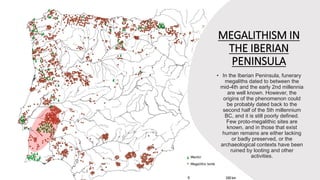
• In the Iberian Peninsula, funerary
megaliths dated to between the
mid-4th and the early 2nd millennia
are well known. However, the
origins of the phenomenon could
be probably dated back to the
second half of the 5th millennium
BC, and it is still poorly defined.
Few proto-megalithic sites are
known, and in those that exist
human remains are either lacking
or badly preserved, or the
archaeological contexts have been
ruined by looting and other
activities.
DOLMEN
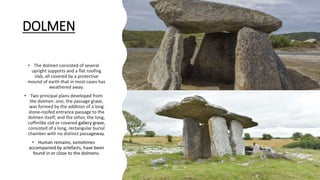
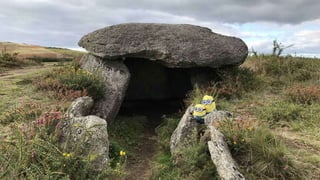
• The dolmen consisted of several
upright supports and a flat roofing
slab, all covered by a protective
mound of earth that in most cases has
weathered away.
• Two principal plans developed from
the dolmen: one, the passage grave,
was formed by the addition of a long
stone-roofed entrance passage to the
dolmen itself; and the other, the long,
coffinlike cist or covered gallery grave,
consisted of a long, rectangular burial
chamber with no distinct passageway.
• Human remains, sometimes
accompanied by artefacts, have been
found in or close to the dolmens.
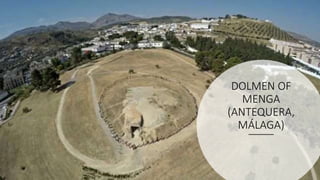
DOLMEN OF
MENGA
(ANTEQUERA,
MÁLAGA)
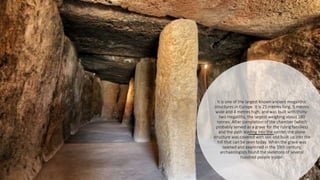
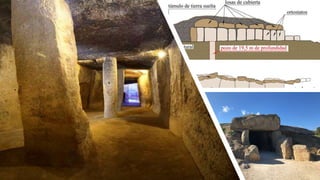
It is one of the largest known ancient megalithic
structures in Europe. It is 25 metres long, 5 metres
wide and 4 metres high, and was built with thirty-
two megaliths, the largest weighing about 180
tonnes. After completion of the chamber (which
probably served as a grave for the ruling families)
and the path leading into the center, the stone
structure was covered with soil and built up into the
hill that can be seen today. When the grave was
opened and examined in the 19th century,
archaeologists found the skeletons of several
hundred people inside.
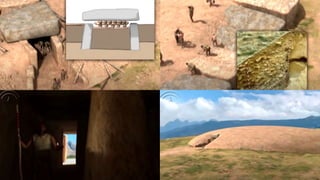
HOW DOLMENS
WERE BUILT?
MENHIR
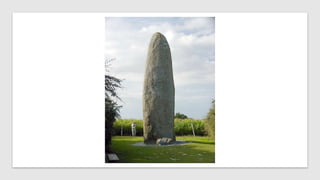
• Menhir (from
Breton men, “stone,”
and hir, “long”), which may
or may not occur in
connection with a megalithic
grave. Menhirs were simple
upright stones, sometimes
of great size, and were
erected most frequently in
western Europe, especially
Brittany.
ALIGNMENTS
• Megalithic menhirs were also
placed in several parallel rows,
called alignments. The most
famous of these are the Carnac,
France, alignments, which include
2,935 menhirs. The alignments
were probably used
for ritual processions, and often a
circle or semicircle of megaliths
stood at one end.
CARNAC
• The Carnac are an exceptionally dense
collection of megalithic sites around the
village of Carnac in Brittany
(France), consisting
of alignments, dolmens, tumuli and
single menhirs. There are more than
3,000 prehistoric standing stones. There
are three major groups of stone rows:
Ménec, Kermario and Kerlescan. Kemario
Stones consists of 1029 stones in ten
columns, about 1300 metres length.
Kerlescan alignments consists of 555
stones composed in 13 lines and about
800 metres length.
CROMLECH
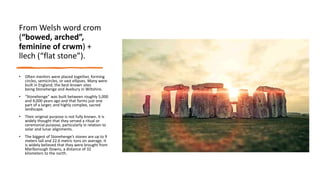
From Welsh word crom
(“bowed, arched”,
feminine of crwm) +
llech (“flat stone”).
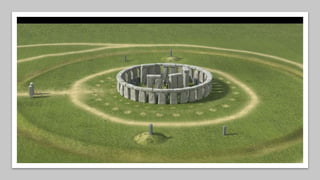
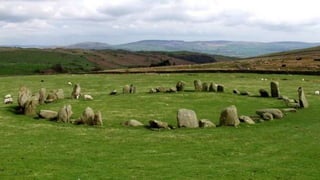
• Often menhirs were placed together, forming
circles, semicircles, or vast ellipses. Many were
built in England, the best-known sites
being Stonehenge and Avebury in Wiltshire.
• “Stonehenge” was built between roughly 5,000
and 4,000 years ago and that forms just one
part of a larger, and highly complex, sacred
landscape.
• Their original purpose is not fully known. It is
widely thought that they served a ritual or
ceremonial purpose, particularly in relation to
solar and lunar alignments.
• The biggest of Stonehenge’s stones are up to 9
meters tall and 22.6 metric tons on average. It
is widely believed that they were brought from
Marlborough Downs, a distance of 32
kilometers to the north.
MEGALITHS
MEGALITHS
MEGALITHS

MEGALITHS

  • 1.
  • 2.
    A megalith isa large stone that has been used to construct a prehistoric structure or monument, either alone or together with other stones. There are over 35,000 in Europe alone, located widely from Sweden to the Mediterranean sea. • The word was first used in 1849 by the British antiquarian Algernon Herbert in reference to Stonehenge and derives from the Ancient Greek words "mega" for great and "lithos" for stone. Most megaliths were erected between the Neolithic period through the Chalcolithic period and into the Bronze Age.
  • 3.
    MEGALITHISM IN THE IBERIAN PENINSULA •In the Iberian Peninsula, funerary megaliths dated to between the mid-4th and the early 2nd millennia are well known. However, the origins of the phenomenon could be probably dated back to the second half of the 5th millennium BC, and it is still poorly defined. Few proto-megalithic sites are known, and in those that exist human remains are either lacking or badly preserved, or the archaeological contexts have been ruined by looting and other activities.
  • 4.
    DOLMEN • The dolmenconsisted of several upright supports and a flat roofing slab, all covered by a protective mound of earth that in most cases has weathered away. • Two principal plans developed from the dolmen: one, the passage grave, was formed by the addition of a long stone-roofed entrance passage to the dolmen itself; and the other, the long, coffinlike cist or covered gallery grave, consisted of a long, rectangular burial chamber with no distinct passageway. • Human remains, sometimes accompanied by artefacts, have been found in or close to the dolmens.
  • 6.
  • 7.
    It is oneof the largest known ancient megalithic structures in Europe. It is 25 metres long, 5 metres wide and 4 metres high, and was built with thirty- two megaliths, the largest weighing about 180 tonnes. After completion of the chamber (which probably served as a grave for the ruling families) and the path leading into the center, the stone structure was covered with soil and built up into the hill that can be seen today. When the grave was opened and examined in the 19th century, archaeologists found the skeletons of several hundred people inside.
  • 9.
  • 13.
    MENHIR • Menhir (from Bretonmen, “stone,” and hir, “long”), which may or may not occur in connection with a megalithic grave. Menhirs were simple upright stones, sometimes of great size, and were erected most frequently in western Europe, especially Brittany.
  • 16.
    ALIGNMENTS • Megalithic menhirswere also placed in several parallel rows, called alignments. The most famous of these are the Carnac, France, alignments, which include 2,935 menhirs. The alignments were probably used for ritual processions, and often a circle or semicircle of megaliths stood at one end.
  • 17.
    CARNAC • The Carnacare an exceptionally dense collection of megalithic sites around the village of Carnac in Brittany (France), consisting of alignments, dolmens, tumuli and single menhirs. There are more than 3,000 prehistoric standing stones. There are three major groups of stone rows: Ménec, Kermario and Kerlescan. Kemario Stones consists of 1029 stones in ten columns, about 1300 metres length. Kerlescan alignments consists of 555 stones composed in 13 lines and about 800 metres length.
  • 18.
  • 19.
    From Welsh wordcrom (“bowed, arched”, feminine of crwm) + llech (“flat stone”). • Often menhirs were placed together, forming circles, semicircles, or vast ellipses. Many were built in England, the best-known sites being Stonehenge and Avebury in Wiltshire. • “Stonehenge” was built between roughly 5,000 and 4,000 years ago and that forms just one part of a larger, and highly complex, sacred landscape. • Their original purpose is not fully known. It is widely thought that they served a ritual or ceremonial purpose, particularly in relation to solar and lunar alignments. • The biggest of Stonehenge’s stones are up to 9 meters tall and 22.6 metric tons on average. It is widely believed that they were brought from Marlborough Downs, a distance of 32 kilometers to the north.