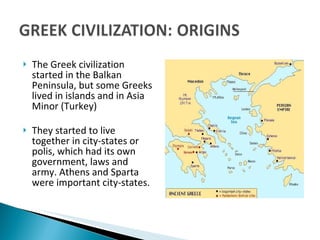
The Greek civilization started in the Balkan Peninsula, but some Greeks lived in islands and in Asia Minor (Turkey) They started to live together in city-states or polis, which had its own government, laws and army. Athens and Sparta were important city-states.
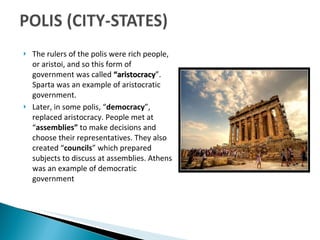
The rulers of the polis were rich people, or aristoi, and so this form of government was called  “aristocracy ”. Sparta was an example of aristocratic government. Later, in some polis, “ democracy ”, replaced aristocracy. People met at “ assemblies”  to make decisions and choose their representatives. They also created “ councils ” which prepared subjects to discuss at assemblies. Athens was an example of democratic government
Between the 8th and 6th centuries BC, Greece went through a period of crisis because the population increased and as the land wasn’t fertile, there was not enough food for everyone; so many Greeks migrated and founded colonies around the Mediterranean sea. Colonies had the same traditions and organizations as the polis they came from, but they were independent. Colonization spread Greek influence  beyond its frontiers.
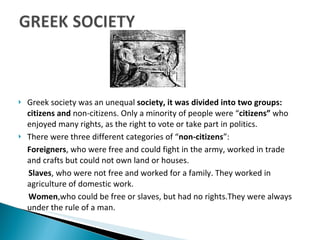
Greek society was an unequal  society, it was divided into two groups: citizens and  non-citizens. Only a minority of people were “ citizens”  who enjoyed many rights, as the right to vote or take part in politics. There were three different categories of “ non-citizens ”:  Foreigners , who were free and could fight in the army, worked in trade and crafts but could not own land or houses. Slaves , who were not free and worked for a family. They worked in agriculture of domestic work. Women ,who could be free or slaves, but had no rights.They were always under the rule of a man.
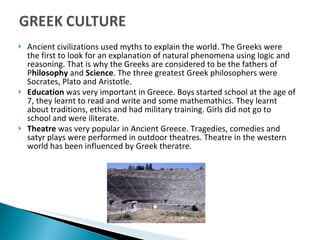
Ancient civilizations used myths to explain the world. The Greeks were the first to look for an explanation of natural phenomena using logic and reasoning. That is why the Greeks are considered to be the fathers of P hilosophy  and  Science . The three greatest Greek philosophers were Socrates, Plato and Aristotle. Education  was very important in Greece. Boys started school at the age of 7, they learnt to read and write and some mathemathics. They learnt about traditions, ethics and had military training. Girls did not go to school and were iliterate. Theatre  was very popular in Ancient Greece. Tragedies, comedies and satyr plays were performed in outdoor theatres. Theatre in the western world has been influenced by Greek theratre.
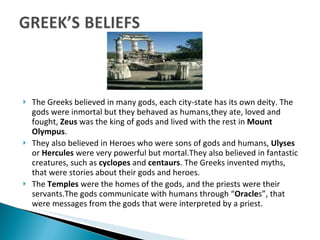
The Greeks believed in many gods, each city-state has its own deity. The gods were inmortal but they behaved as humans,they ate, loved and fought,  Zeus  was the king of gods and lived with the rest in  Mount Olympus . They also believed in Heroes who were sons of gods and humans,  Ulyses  or  Hercules  were very powerful but mortal.They also believed in fantastic creatures, such as  cyclopes  and  centaurs . The Greeks invented myths, that were stories about their gods and heroes. The  Temples  were the homes of the gods, and the priests were their servants.The gods communicate with humans through “ Oracle s”, that were messages from the gods that were interpreted by a priest.
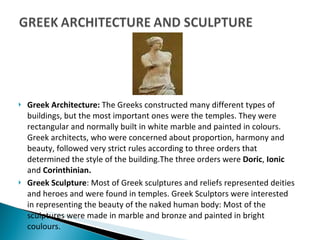
Greek Architecture:  The Greeks constructed many different types of buildings, but the most important ones were the temples. They were rectangular and normally built in white marble and painted in colours. Greek architects, who were concerned about proportion, harmony and beauty, followed very strict rules according to three orders that determined the style of the building.The three orders were  Doric ,  Ionic  and  Corinthinian. Greek Sculpture : Most of Greek sculptures and reliefs represented deities and heroes and were found in temples. Greek Sculptors were interested in representing the beauty of the naked human body: Most of the sculptures were made in marble and bronze and painted in bright coulours.

Greek civilization

  • 1.
    The Greek civilizationstarted in the Balkan Peninsula, but some Greeks lived in islands and in Asia Minor (Turkey) They started to live together in city-states or polis, which had its own government, laws and army. Athens and Sparta were important city-states.
  • 2.
    The rulers ofthe polis were rich people, or aristoi, and so this form of government was called “aristocracy ”. Sparta was an example of aristocratic government. Later, in some polis, “ democracy ”, replaced aristocracy. People met at “ assemblies” to make decisions and choose their representatives. They also created “ councils ” which prepared subjects to discuss at assemblies. Athens was an example of democratic government
  • 3.
    Between the 8thand 6th centuries BC, Greece went through a period of crisis because the population increased and as the land wasn’t fertile, there was not enough food for everyone; so many Greeks migrated and founded colonies around the Mediterranean sea. Colonies had the same traditions and organizations as the polis they came from, but they were independent. Colonization spread Greek influence beyond its frontiers.
  • 4.
    Greek society wasan unequal society, it was divided into two groups: citizens and non-citizens. Only a minority of people were “ citizens” who enjoyed many rights, as the right to vote or take part in politics. There were three different categories of “ non-citizens ”: Foreigners , who were free and could fight in the army, worked in trade and crafts but could not own land or houses. Slaves , who were not free and worked for a family. They worked in agriculture of domestic work. Women ,who could be free or slaves, but had no rights.They were always under the rule of a man.
  • 5.
    Ancient civilizations usedmyths to explain the world. The Greeks were the first to look for an explanation of natural phenomena using logic and reasoning. That is why the Greeks are considered to be the fathers of P hilosophy and Science . The three greatest Greek philosophers were Socrates, Plato and Aristotle. Education was very important in Greece. Boys started school at the age of 7, they learnt to read and write and some mathemathics. They learnt about traditions, ethics and had military training. Girls did not go to school and were iliterate. Theatre was very popular in Ancient Greece. Tragedies, comedies and satyr plays were performed in outdoor theatres. Theatre in the western world has been influenced by Greek theratre.
  • 6.
    The Greeks believedin many gods, each city-state has its own deity. The gods were inmortal but they behaved as humans,they ate, loved and fought, Zeus was the king of gods and lived with the rest in Mount Olympus . They also believed in Heroes who were sons of gods and humans, Ulyses or Hercules were very powerful but mortal.They also believed in fantastic creatures, such as cyclopes and centaurs . The Greeks invented myths, that were stories about their gods and heroes. The Temples were the homes of the gods, and the priests were their servants.The gods communicate with humans through “ Oracle s”, that were messages from the gods that were interpreted by a priest.
  • 7.
    Greek Architecture: The Greeks constructed many different types of buildings, but the most important ones were the temples. They were rectangular and normally built in white marble and painted in colours. Greek architects, who were concerned about proportion, harmony and beauty, followed very strict rules according to three orders that determined the style of the building.The three orders were Doric , Ionic and Corinthinian. Greek Sculpture : Most of Greek sculptures and reliefs represented deities and heroes and were found in temples. Greek Sculptors were interested in representing the beauty of the naked human body: Most of the sculptures were made in marble and bronze and painted in bright coulours.