MESOPOTAMIAN
CIVILIZATION
3500 B.C – 539 B.C.
• Origin
• Government
• Society
• Religion
• Language and Writing
• Technology
• Mathematics
• Astronomy
• Hammurabi Code
Origin
• ‘Mesopotamia’ from Greek words, mesos
(between) and potamol (rivers).
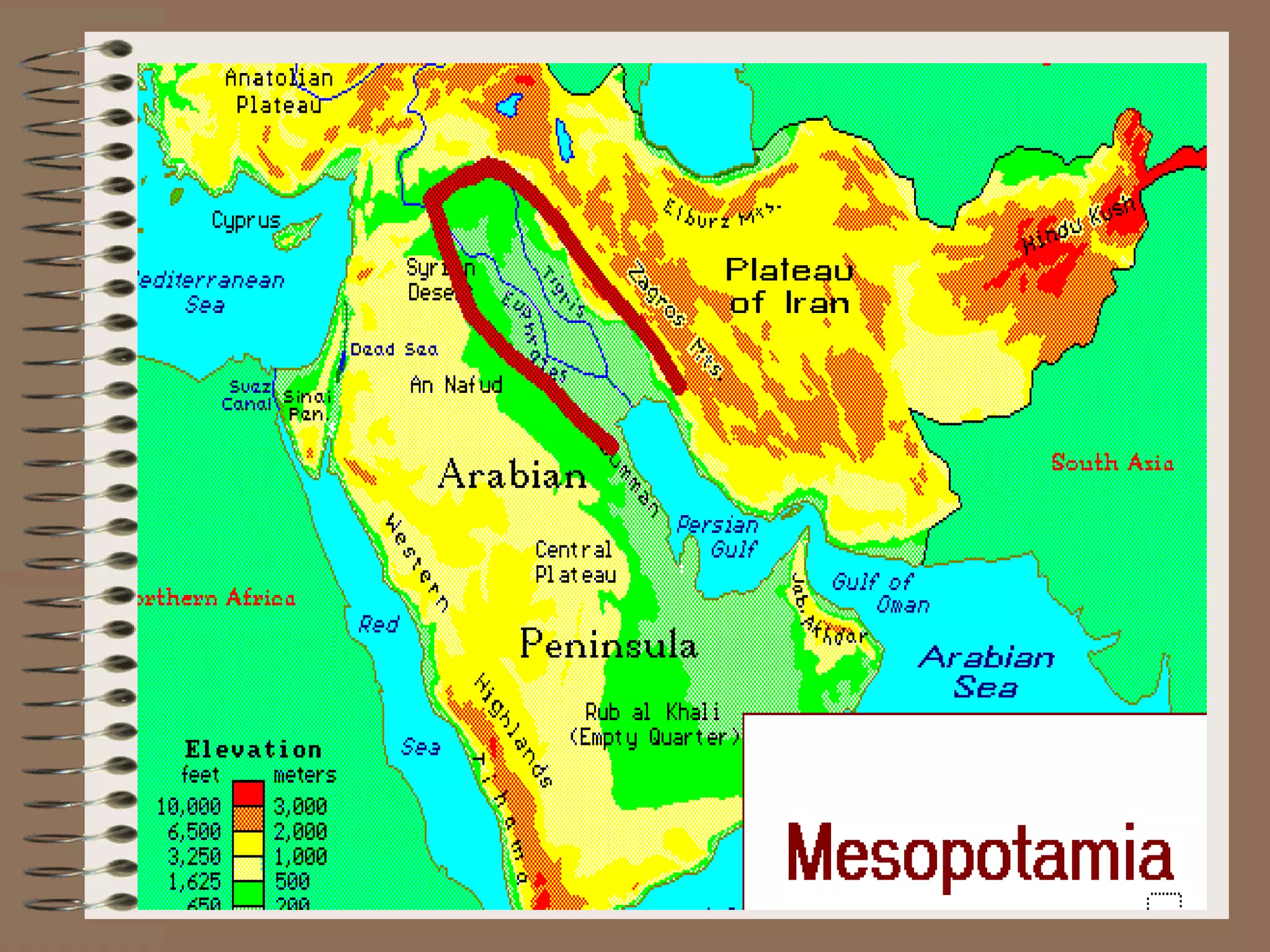
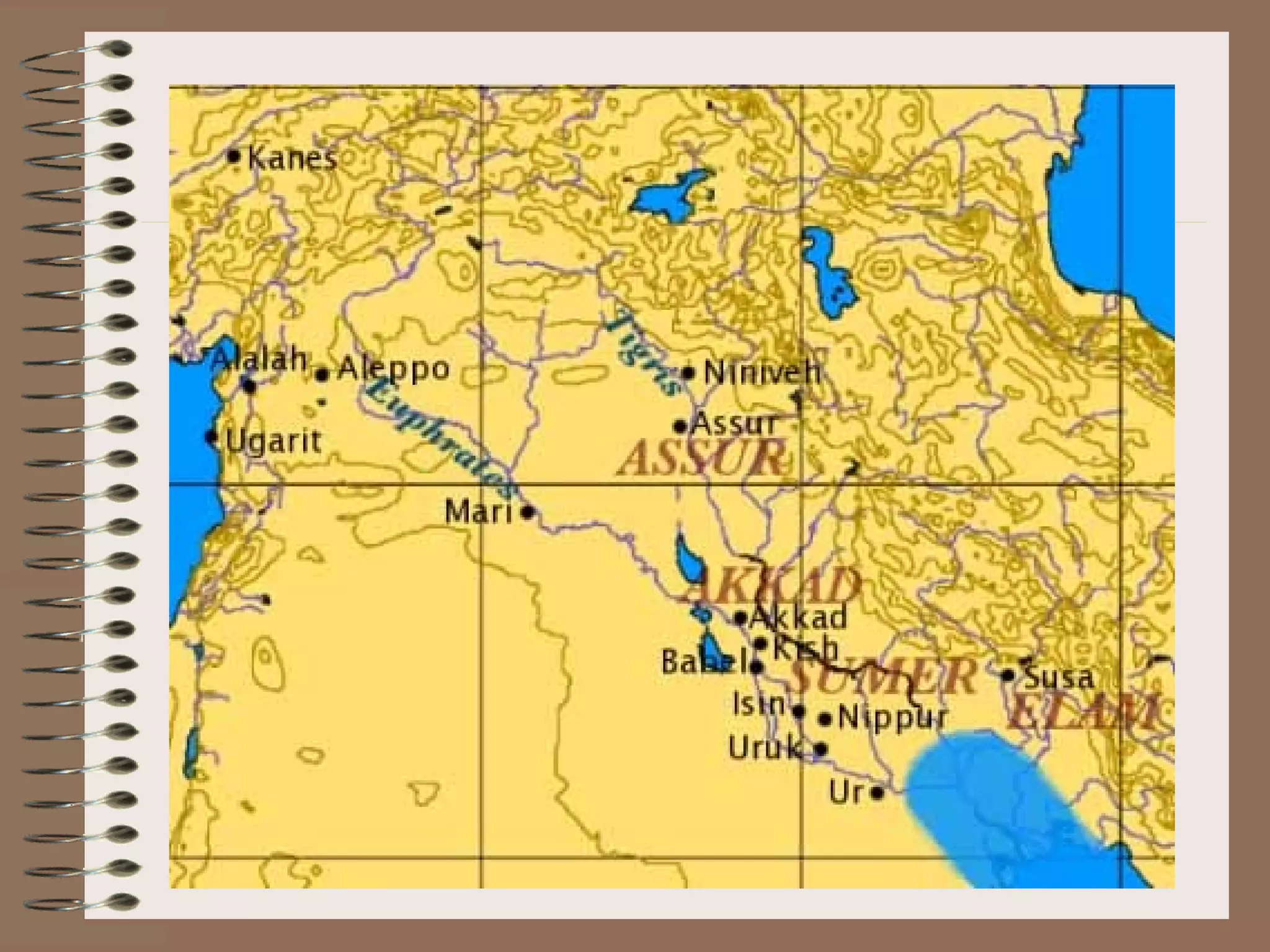
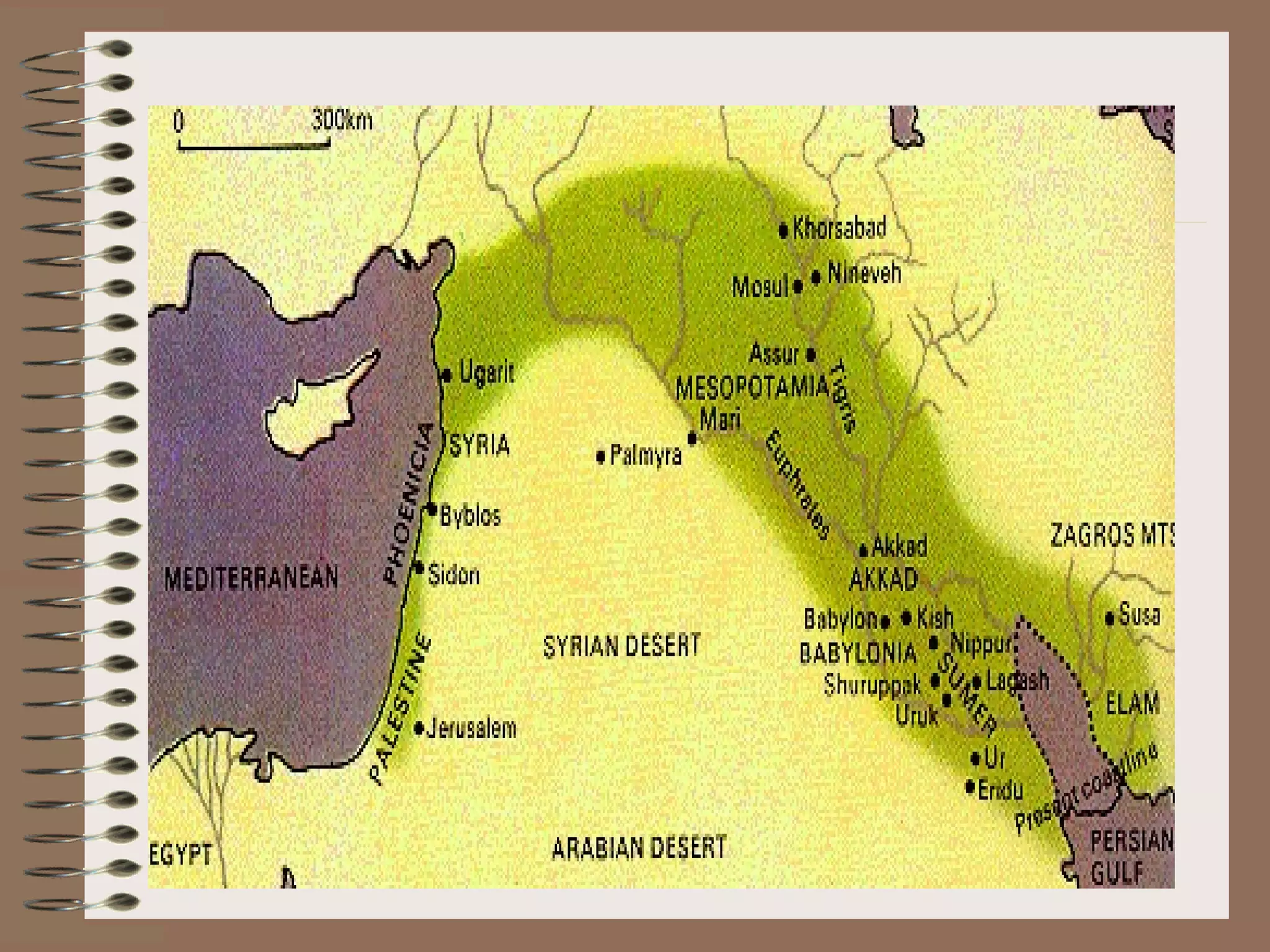
• The area between the Euphrates and Tigris -
known as the “Cradle of Civilization”.
• Now occupied by modern Iraq, eastern Syria and
southern Turkey.
• Not a political entity and no definite boundaries.
Origin
• The home of some world’s ancient civilizations;
the Sumerian, Akkadian, Babylonian and
Assyrian.
• The first literate societies were Sumerians.
• Transformed the land into agricultural land and
then city states.
• Sumerians founded the earliest cities in Sumer –
in 3500 B.C.
Origin
• Sumerians – their origin unknown.
• ‘Sumerian culture’ – the foundation of
Mesopotamian civilization – adopted by
Akkadians, Babylonians, etc.
Government
• 12 independent city states.
• E.g. Ur, Uruk, Babylon, Akad.
• Shared a common language, customs and beliefs
yet, were in constant warfare for water rights,
land and power.
• Divine kingship - most kings were thought to be
chosen by god, be a son of a god, or be a god
himself.
• Famous kings; Gilgamesh, Sargon, Hammurabi
and Nebuchadnezzar.
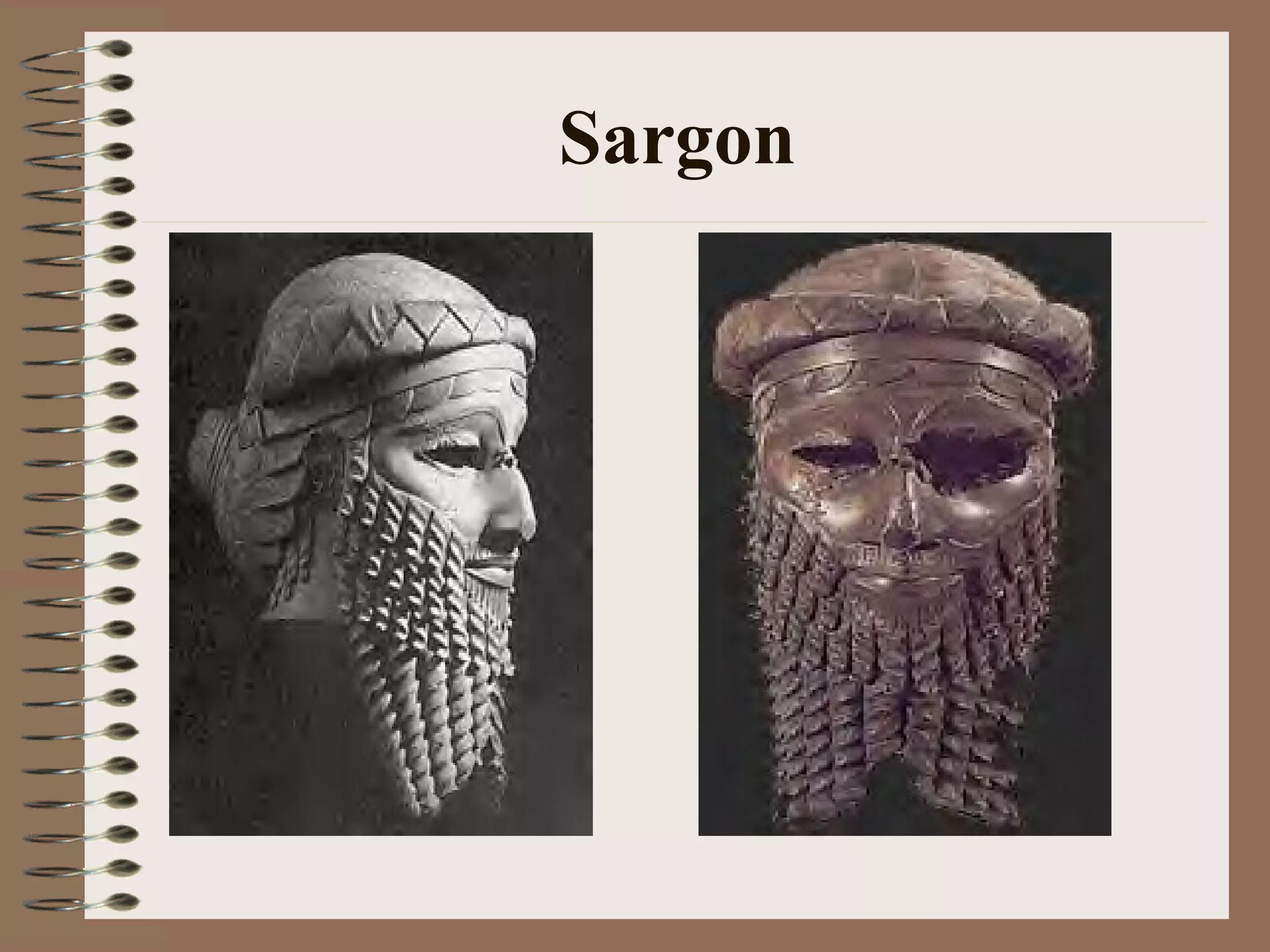
Sargon
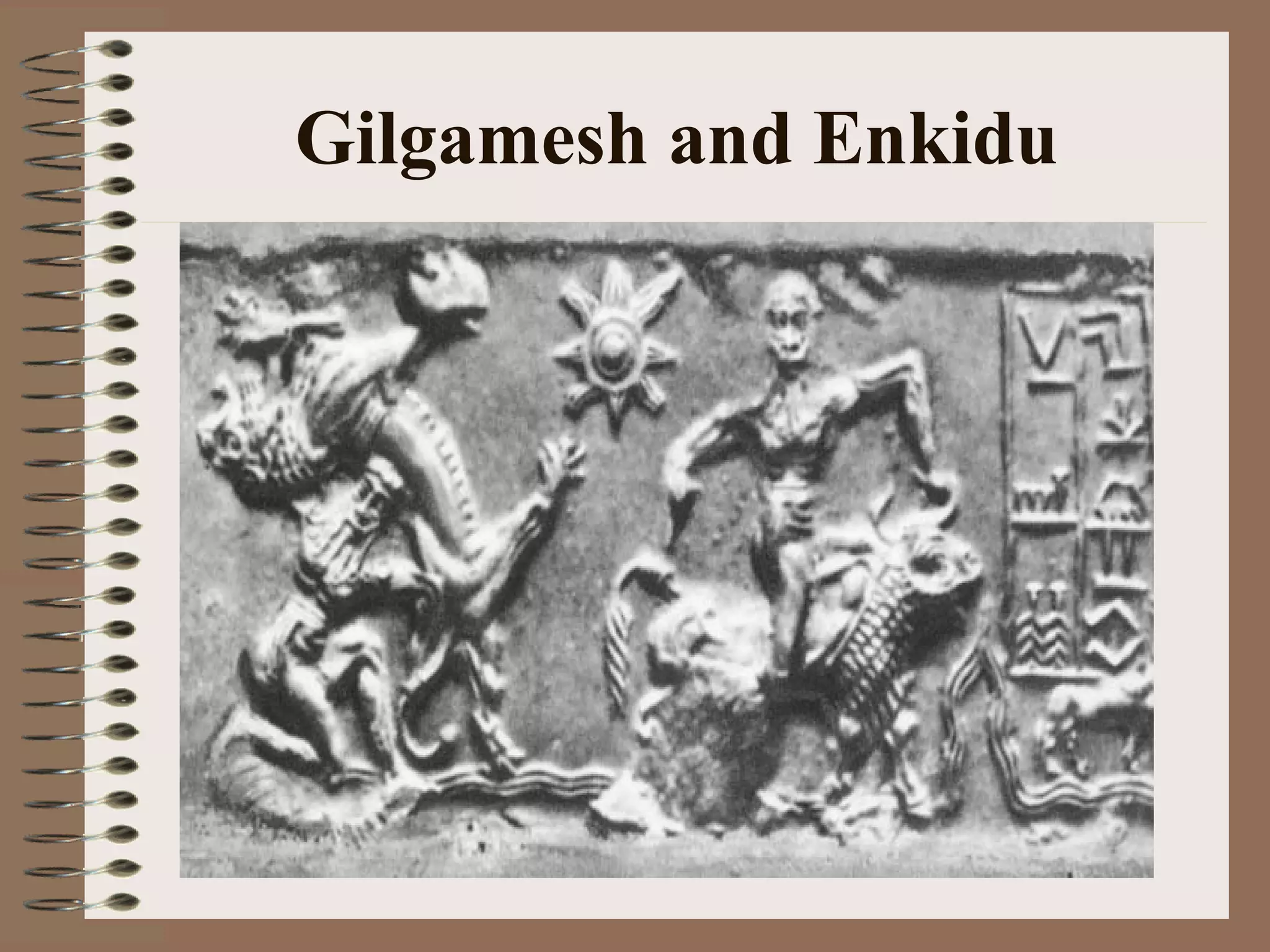
Gilgamesh and Enkidu
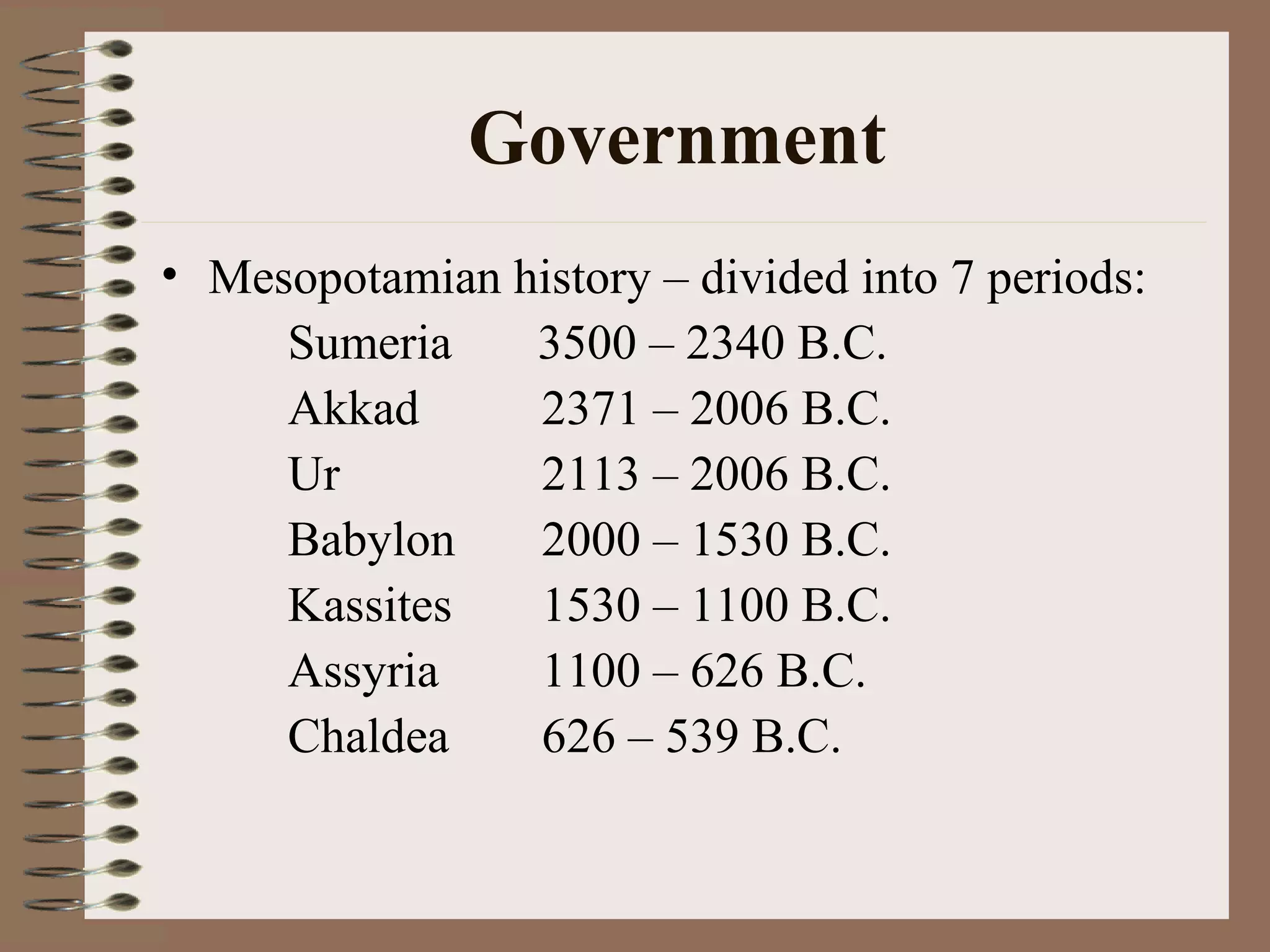
Government
• Mesopotamian history – divided into 7 periods:
Sumeria 3500 – 2340 B.C.
Akkad 2371 – 2006 B.C.
Ur 2113 – 2006 B.C.
Babylon 2000 – 1530 B.C.
Kassites 1530 – 1100 B.C.
Assyria 1100 – 626 B.C.
Chaldea 626 – 539 B.C.
Society
• Sumerian society – 4 categories:
1. Nobles - (king & family, chief priests and high
court officials)
2. Clients - (free men dependent on nobility)
3. Commoners - (free citizens)
4.Slaves - (prisoners of war, foreigners & criminals)
Society
• Women had rights – could own property and, if
they had good reason, get a divorce.
• Slavery was a common feature in Mesopotamian
society.
• Slaves possessed some privileges; able to hold
property, participate in business, marry free men
or women and purchase their freedom.
Religion
• Very important in the people’s life – sought to
please gods due to vulnerability to natural
disasters – river flooding.
• Polytheism (worship of many gods). E.g: An
(Anu), Ki, Enlil, Marduk, Nabu, etc.
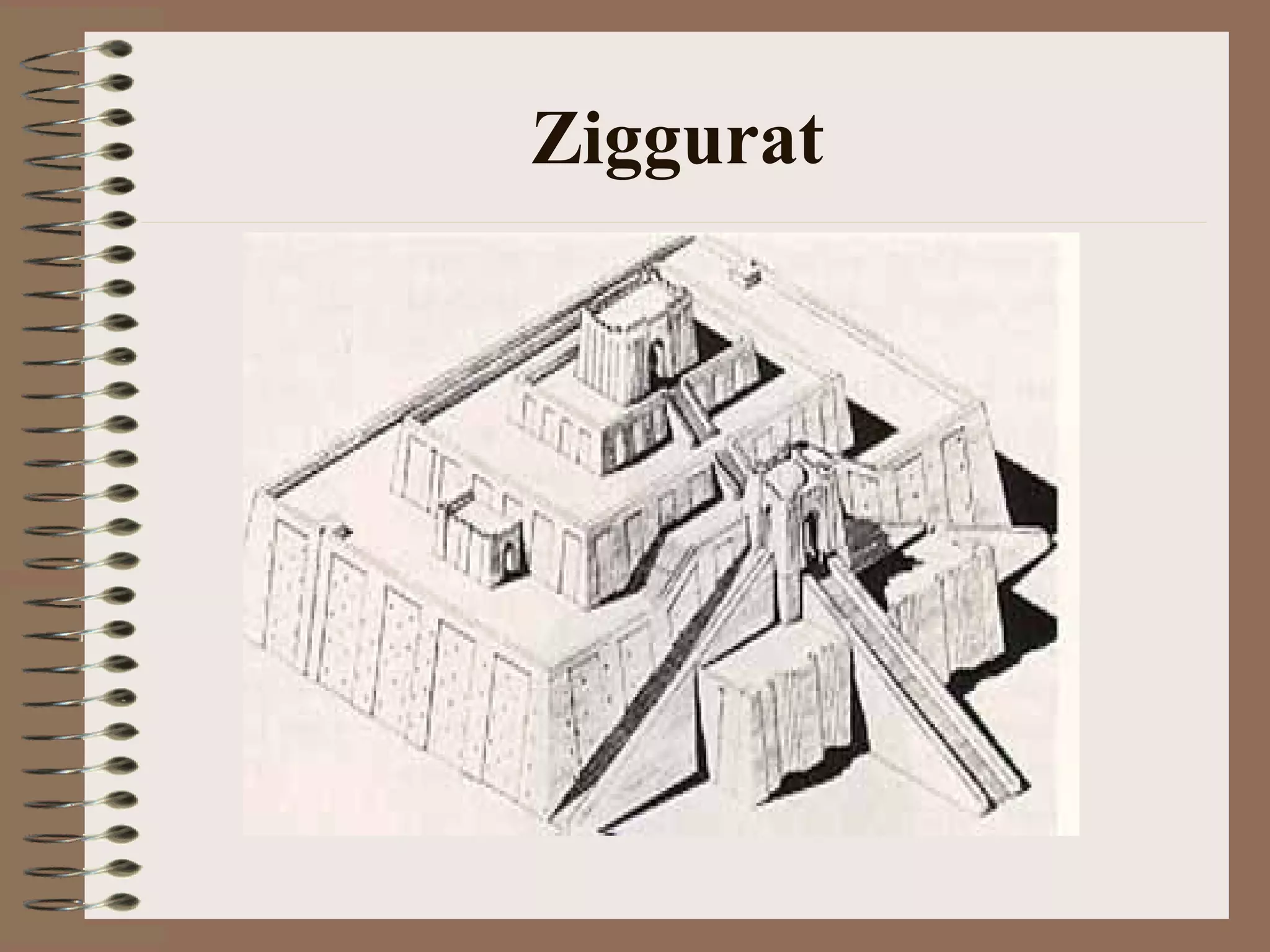
• ‘Ziggurat’- huge temples built to worship the
gods – run by traditional priesthood.
Ziggurat
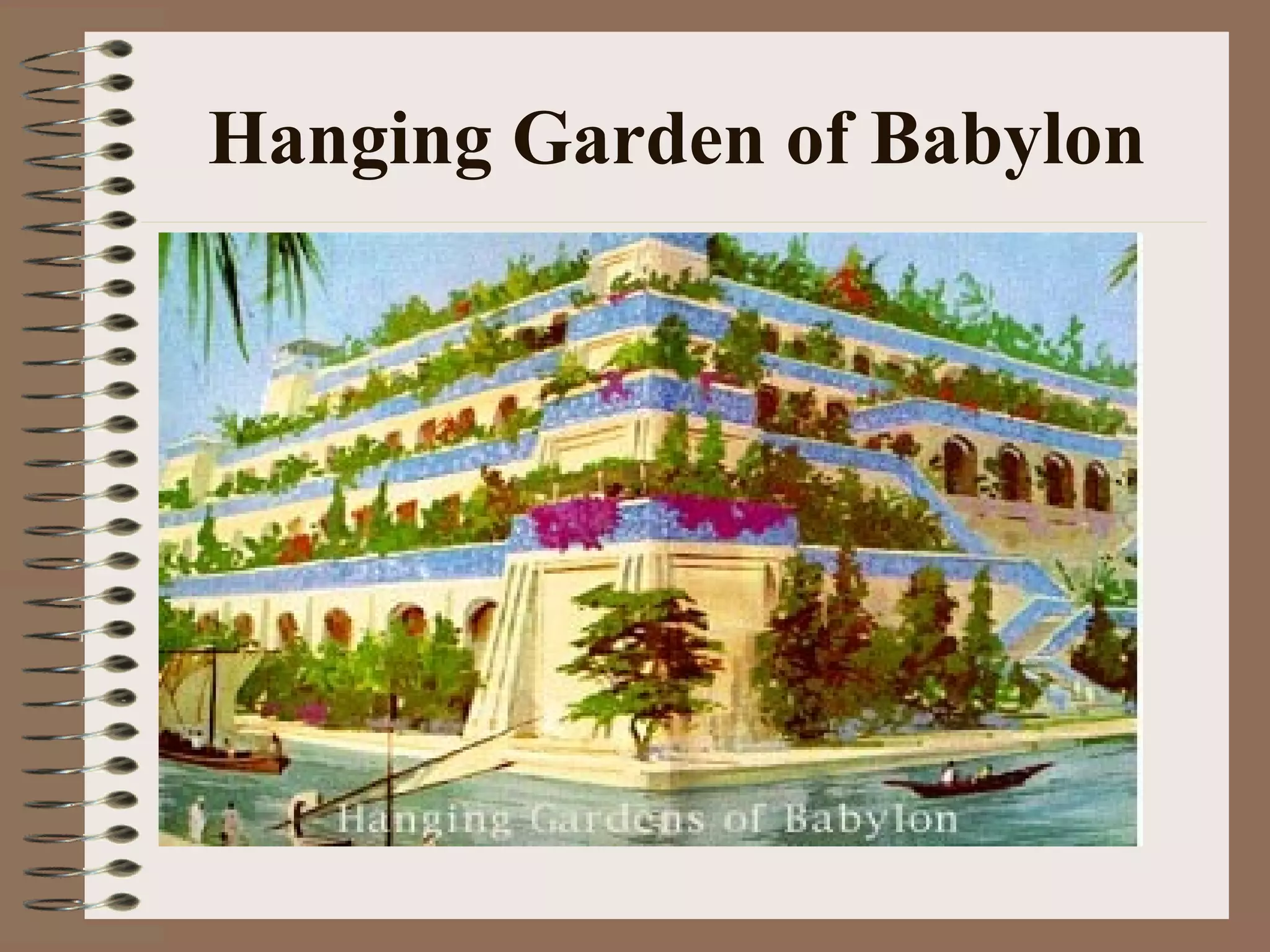
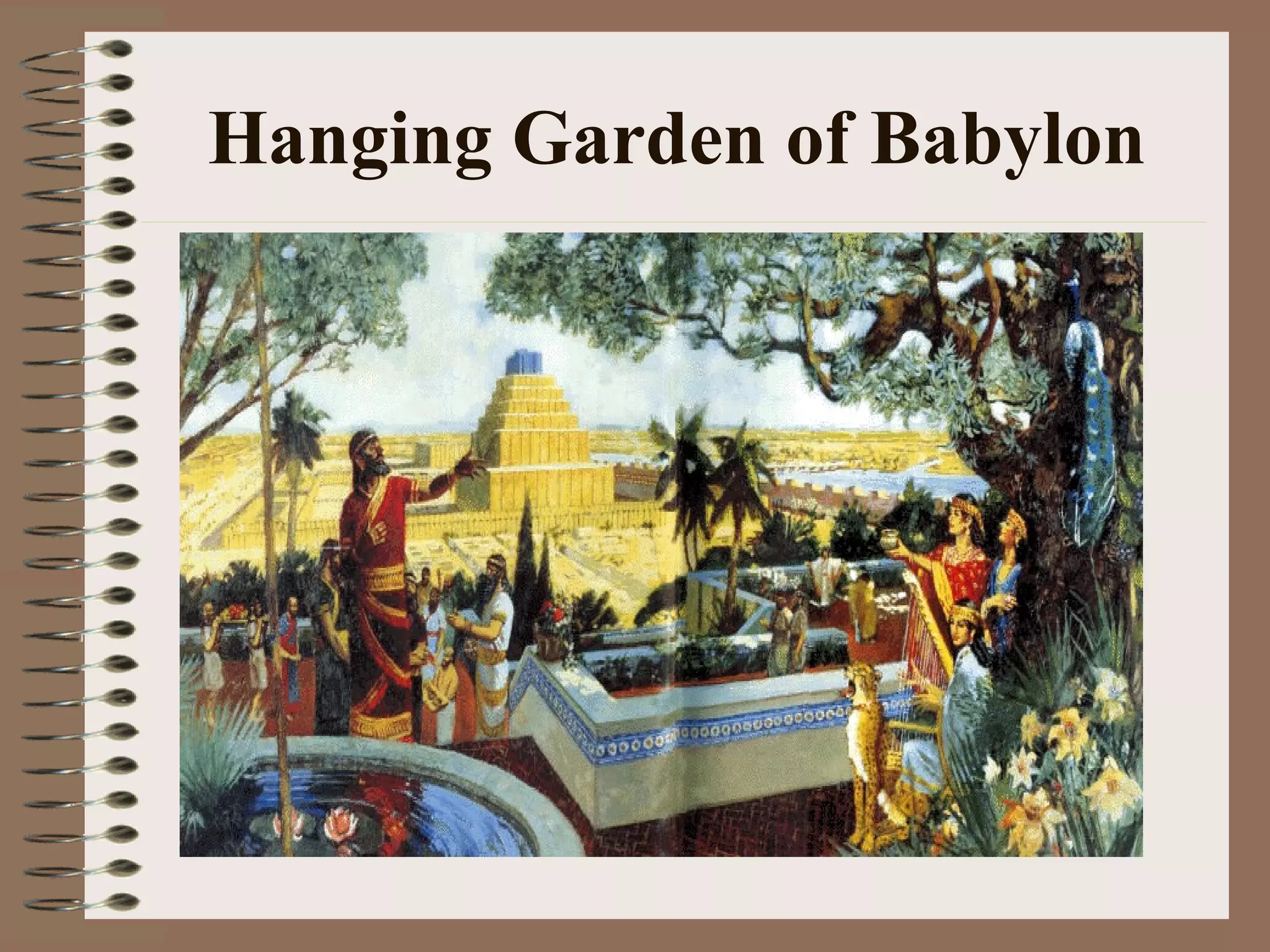
Hanging Garden of Babylon
Language and Writing
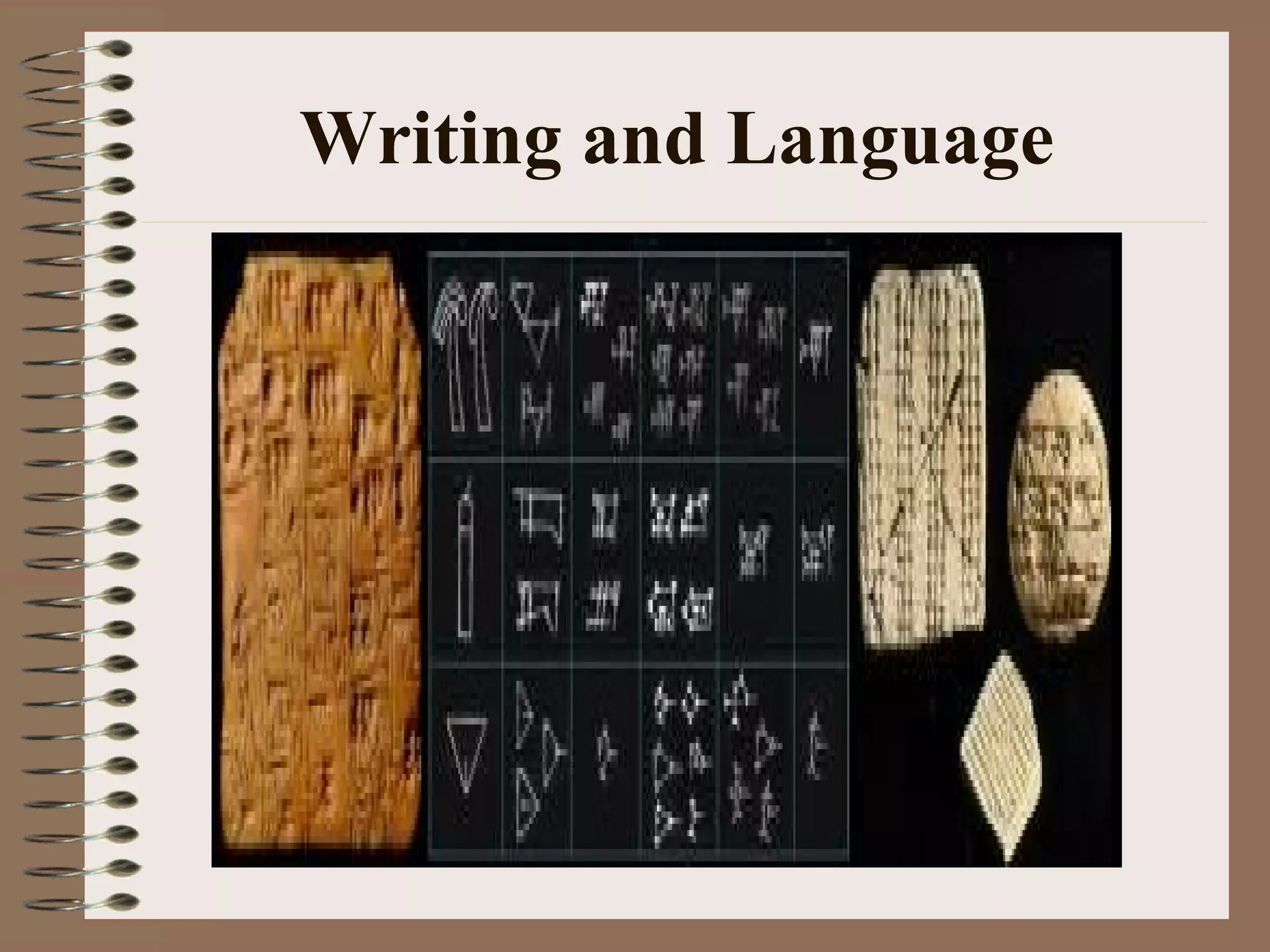
• The world’s earliest written language –
Sumerian.
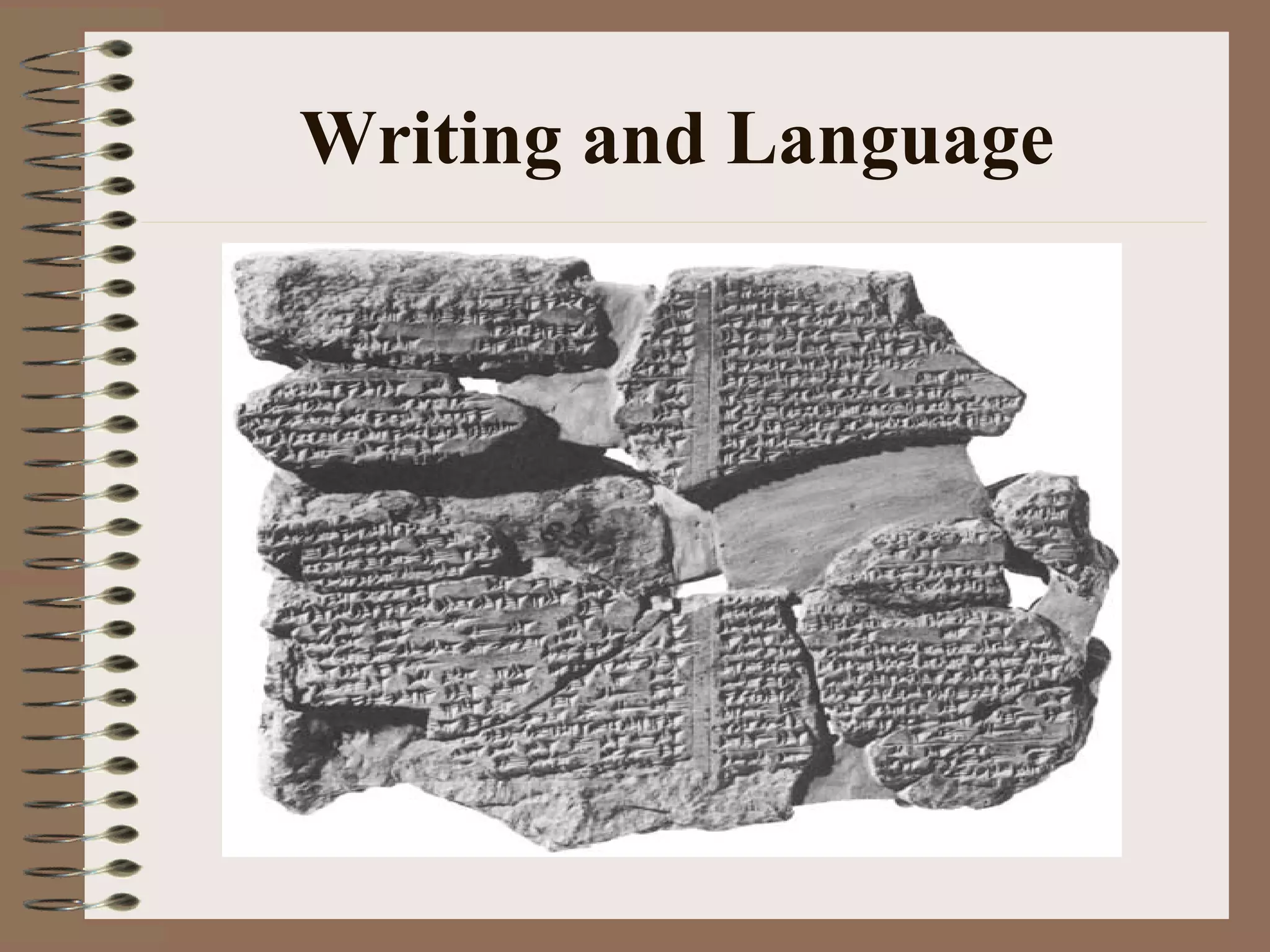
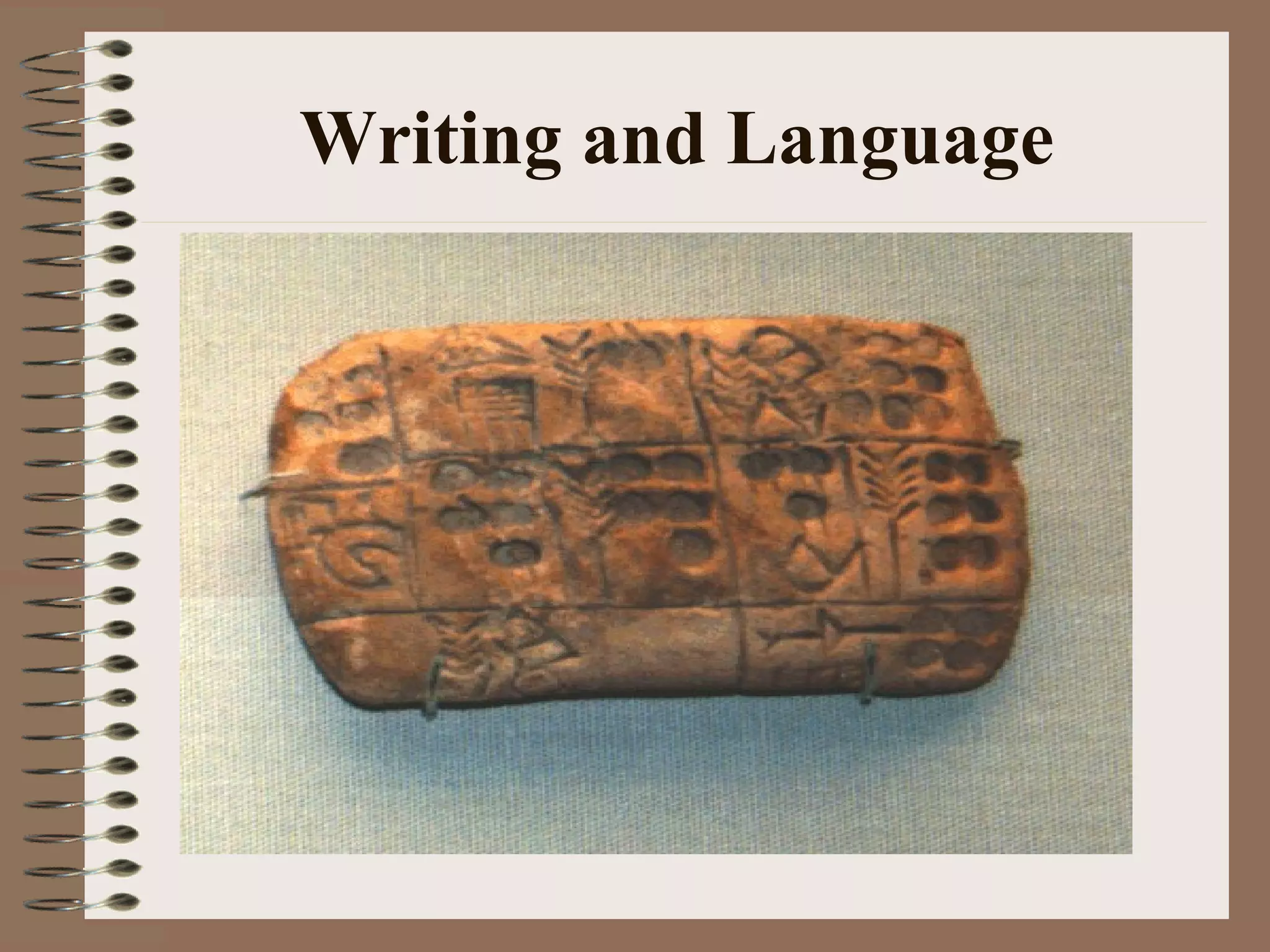
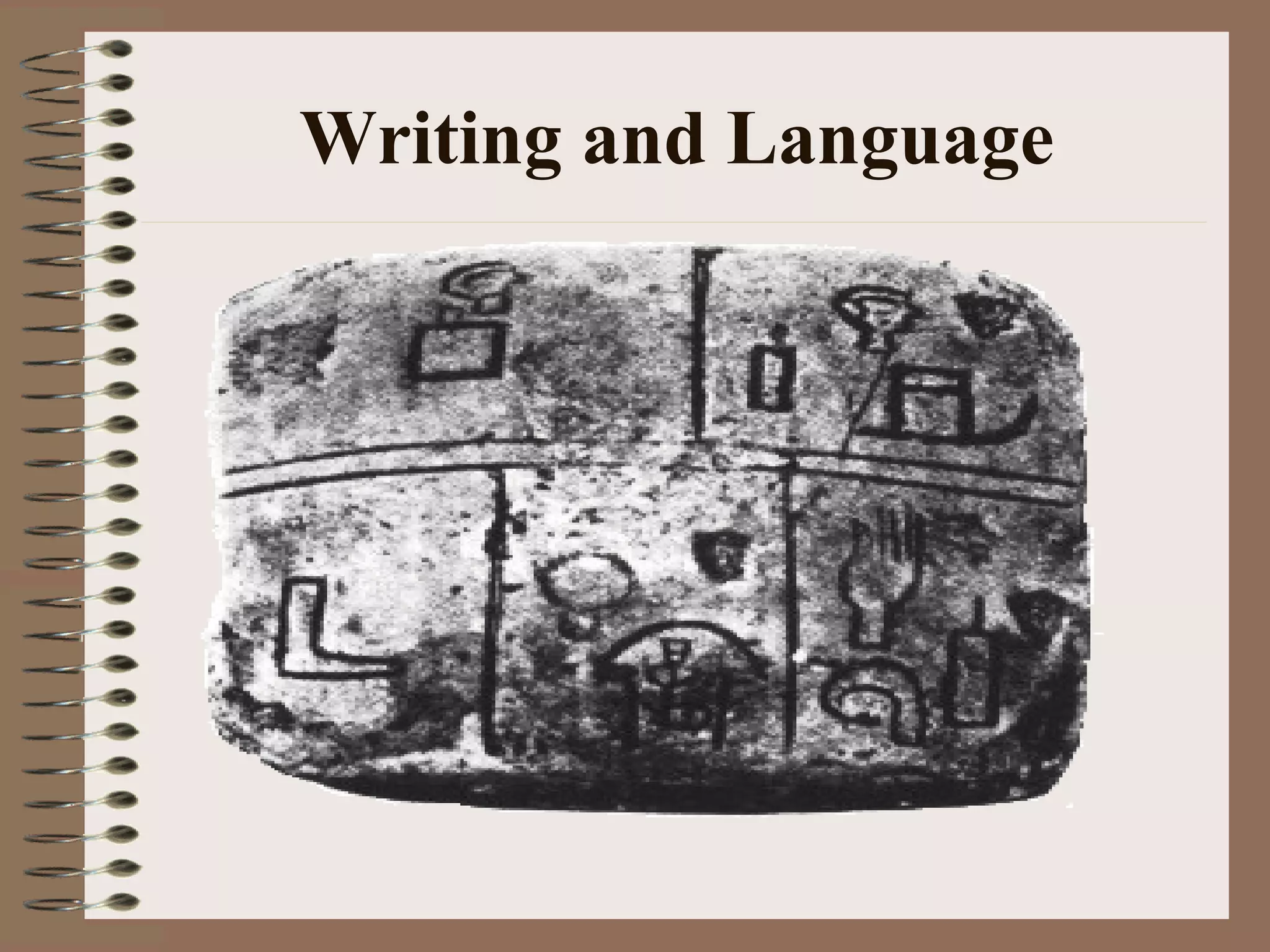
• Developed through a few stages; from
pictographic (based on pictures) ideogram
cuneiform (syllabary writing system).
• Cuneiform written on clay tablets.
Language and Writing
• Invented ‘cylinder seals’ – made of stone or ivory
carved with pictures.
• Later, Akkadian became the dominant language -
Sumerian was retained for administrative,
religious, literary and scientific purposes.
• Then, Aramaic.
Writing and Language
Technology
• Metalworking – among the first Bronze age
people in the world.
• Early on used copper, bronze and gold, and later
iron.
• Glassmaking and textile weaving.
• Water control, storage and irrigation –
construction of dams and aqueducts.
• Among the first people to make beer and wine.
• Invented wheels – wheeled chariots.
Mathematics
• Devised a sexagesimal numeral system – a
number system based on 60.
• The basis of the current 60-minute hour and 24-
hour day, also the 360 degree circle.
• Used the process of multiplication and division.
• Geometry – utilized e.g. for building projects
and mapmaking.
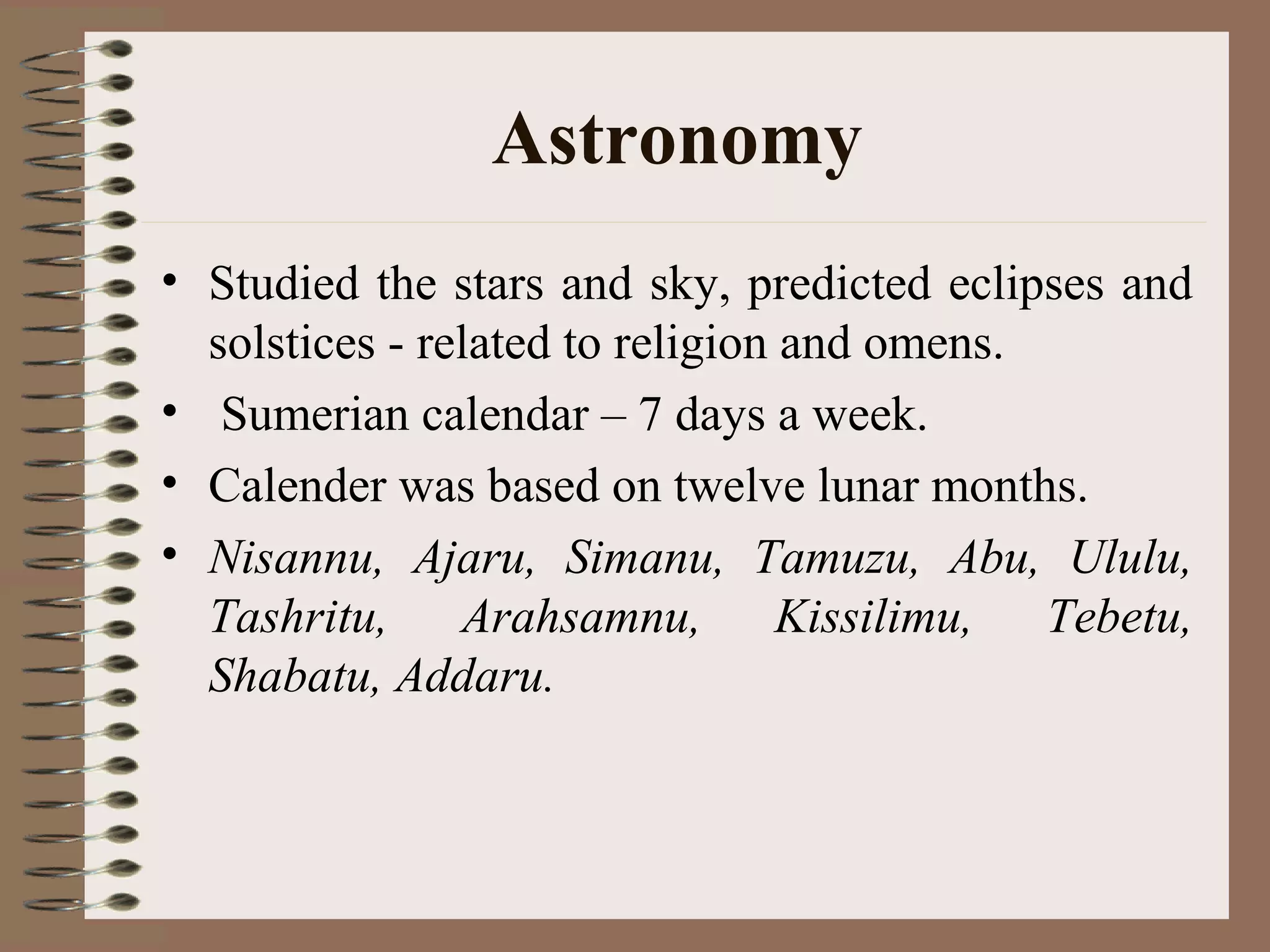
Astronomy
• Studied the stars and sky, predicted eclipses and
solstices - related to religion and omens.
• Sumerian calendar – 7 days a week.
• Calender was based on twelve lunar months.
• Nisannu, Ajaru, Simanu, Tamuzu, Abu, Ululu,
Tashritu, Arahsamnu, Kissilimu, Tebetu,
Shabatu, Addaru.
Astronomy
• Today’s constellations (Leo, Taurus, Scorpius,
Gemini, Capricornus and Sagittarius) – picked
out by Sumerian and Babylonian astronomers.
• Useful in determining the planting and harvesting
of crops.
Hammurabi Code
• Enacted by King Hammurabi “the law maker”.
• 282 laws; criminal offence, marriage and family,
slavery, land use and irrigation, commercial
activity, etc.
• The code reflects a society with a system of strict
justice.
• Penalties for criminal offenses – severe and
varied; according to the social class of the
offenders and victims.
• Written on pillars of stone – erected throughout
cities.
Hammurabi Code
• Stern punishment for burglary.
• If a robber is caught stealing, he will be killed.
• If a person stole goods belonging to the temples
or the state, he was put to death and so was the
person receiving the stolen goods.
• If couldn’t afford to compensate the loss of the
victim, he was put to death.
Hammurabi Code
• If one accuses another, but cannot prove it, the
accuser will be killed.
• If a builder builds a house and the house falls in,
killing the owner, the builder will be killed.
• If the son of the owner dies, the son of the builder
shall be killed.
• Surgeons – dangerous occupations – severe
penalties for failure.

C7 - Mesopotamian Civilization

  • 1.
  • 2.
    • Origin • Government •Society • Religion • Language and Writing • Technology • Mathematics • Astronomy • Hammurabi Code
  • 3.
    Origin • ‘Mesopotamia’ fromGreek words, mesos (between) and potamol (rivers). • The area between the Euphrates and Tigris - known as the “Cradle of Civilization”. • Now occupied by modern Iraq, eastern Syria and southern Turkey. • Not a political entity and no definite boundaries.
  • 6.
    Origin • The homeof some world’s ancient civilizations; the Sumerian, Akkadian, Babylonian and Assyrian. • The first literate societies were Sumerians. • Transformed the land into agricultural land and then city states. • Sumerians founded the earliest cities in Sumer – in 3500 B.C.
  • 7.
    Origin • Sumerians –their origin unknown. • ‘Sumerian culture’ – the foundation of Mesopotamian civilization – adopted by Akkadians, Babylonians, etc.
  • 9.
    Government • 12 independentcity states. • E.g. Ur, Uruk, Babylon, Akad. • Shared a common language, customs and beliefs yet, were in constant warfare for water rights, land and power. • Divine kingship - most kings were thought to be chosen by god, be a son of a god, or be a god himself. • Famous kings; Gilgamesh, Sargon, Hammurabi and Nebuchadnezzar.
  • 10.
  • 11.
  • 12.
    Government • Mesopotamian history– divided into 7 periods: Sumeria 3500 – 2340 B.C. Akkad 2371 – 2006 B.C. Ur 2113 – 2006 B.C. Babylon 2000 – 1530 B.C. Kassites 1530 – 1100 B.C. Assyria 1100 – 626 B.C. Chaldea 626 – 539 B.C.
  • 13.
    Society • Sumerian society– 4 categories: 1. Nobles - (king & family, chief priests and high court officials) 2. Clients - (free men dependent on nobility) 3. Commoners - (free citizens) 4.Slaves - (prisoners of war, foreigners & criminals)
  • 14.
    Society • Women hadrights – could own property and, if they had good reason, get a divorce. • Slavery was a common feature in Mesopotamian society. • Slaves possessed some privileges; able to hold property, participate in business, marry free men or women and purchase their freedom.
  • 15.
    Religion • Very importantin the people’s life – sought to please gods due to vulnerability to natural disasters – river flooding. • Polytheism (worship of many gods). E.g: An (Anu), Ki, Enlil, Marduk, Nabu, etc. • ‘Ziggurat’- huge temples built to worship the gods – run by traditional priesthood.
  • 16.
  • 17.
  • 18.
  • 19.
    Language and Writing •The world’s earliest written language – Sumerian. • Developed through a few stages; from pictographic (based on pictures) ideogram cuneiform (syllabary writing system). • Cuneiform written on clay tablets.
  • 20.
    Language and Writing •Invented ‘cylinder seals’ – made of stone or ivory carved with pictures. • Later, Akkadian became the dominant language - Sumerian was retained for administrative, religious, literary and scientific purposes. • Then, Aramaic.
  • 21.
  • 22.
  • 23.
  • 24.
  • 25.
    Technology • Metalworking –among the first Bronze age people in the world. • Early on used copper, bronze and gold, and later iron. • Glassmaking and textile weaving. • Water control, storage and irrigation – construction of dams and aqueducts. • Among the first people to make beer and wine. • Invented wheels – wheeled chariots.
  • 26.
    Mathematics • Devised asexagesimal numeral system – a number system based on 60. • The basis of the current 60-minute hour and 24- hour day, also the 360 degree circle. • Used the process of multiplication and division. • Geometry – utilized e.g. for building projects and mapmaking.
  • 27.
    Astronomy • Studied thestars and sky, predicted eclipses and solstices - related to religion and omens. • Sumerian calendar – 7 days a week. • Calender was based on twelve lunar months. • Nisannu, Ajaru, Simanu, Tamuzu, Abu, Ululu, Tashritu, Arahsamnu, Kissilimu, Tebetu, Shabatu, Addaru.
  • 28.
    Astronomy • Today’s constellations(Leo, Taurus, Scorpius, Gemini, Capricornus and Sagittarius) – picked out by Sumerian and Babylonian astronomers. • Useful in determining the planting and harvesting of crops.
  • 29.
    Hammurabi Code • Enactedby King Hammurabi “the law maker”. • 282 laws; criminal offence, marriage and family, slavery, land use and irrigation, commercial activity, etc. • The code reflects a society with a system of strict justice. • Penalties for criminal offenses – severe and varied; according to the social class of the offenders and victims. • Written on pillars of stone – erected throughout cities.
  • 30.
    Hammurabi Code • Sternpunishment for burglary. • If a robber is caught stealing, he will be killed. • If a person stole goods belonging to the temples or the state, he was put to death and so was the person receiving the stolen goods. • If couldn’t afford to compensate the loss of the victim, he was put to death.
  • 31.
    Hammurabi Code • Ifone accuses another, but cannot prove it, the accuser will be killed. • If a builder builds a house and the house falls in, killing the owner, the builder will be killed. • If the son of the owner dies, the son of the builder shall be killed. • Surgeons – dangerous occupations – severe penalties for failure.