NEOLITHIC AGE
From the Era of the beginning of the farming to
the Metals Age.
1
Neolithic Revolution was the
transition of many human cultures
from a lifestyle of hunting and
gathering to one of agriculture and
settlement.
2
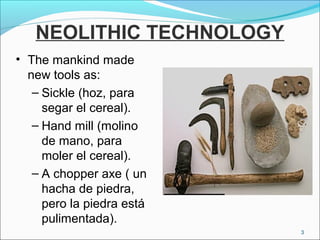
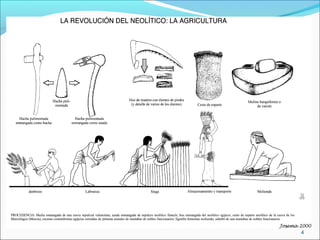
NEOLITHIC TECHNOLOGY
• The mankind made
new tools as:
– Sickle (hoz, para
segar el cereal).
– Hand mill (molino
de mano, para
moler el cereal).
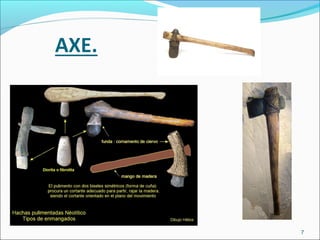
– A chopper axe ( un
hacha de piedra,
pero la piedra está
pulimentada).
3
4
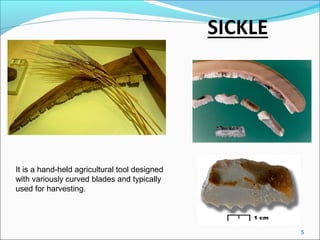
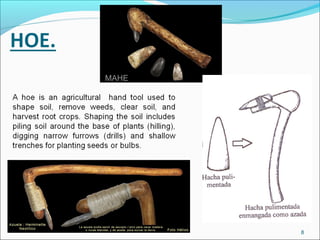
It is a hand-held agricultural tool designed
with variously curved blades and typically
used for harvesting.
5
HAND
MILL
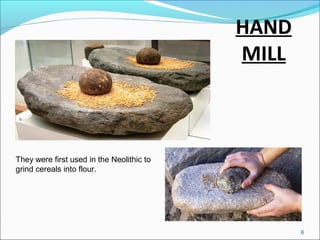
They were first used in the Neolithic to
grind cereals into flour.
6
7
8
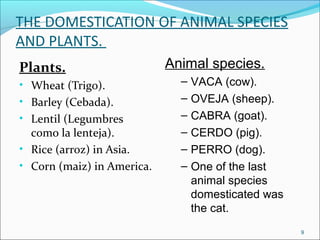
THE DOMESTICATION OF ANIMAL SPECIES
AND PLANTS.
Plants.
• Wheat (Trigo).
• Barley (Cebada).
• Lentil (Legumbres
como la lenteja).
• Rice (arroz) in Asia.
• Corn (maiz) in America.
Animal species.
– VACA (cow).
– OVEJA (sheep).
– CABRA (goat).
– CERDO (pig).
– PERRO (dog).
– One of the last
animal species
domesticated was
the cat.
9
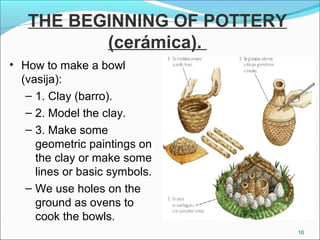
THE BEGINNING OF POTTERY
(cerámica).
• How to make a bowl
(vasija):
– 1. Clay (barro).
– 2. Model the clay.
– 3. Make some
geometric paintings on
the clay or make some
lines or basic symbols.
– We use holes on the
ground as ovens to
cook the bowls.
10
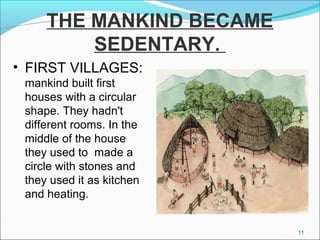
THE MANKIND BECAME
SEDENTARY.
• FIRST VILLAGES:
mankind built first
houses with a circular
shape. They hadn't
different rooms. In the
middle of the house
they used to made a
circle with stones and
they used it as kitchen
and heating.
11
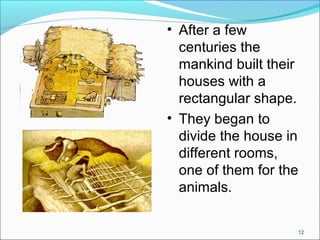
• After a few
centuries the
mankind built their
houses with a
rectangular shape.
• They began to
divide the house in
different rooms,
one of them for the
animals.
12
NEOLITHIC
ARCHAELOGICAL SITES.
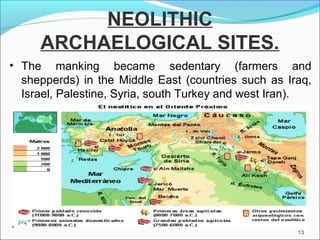
• The manking became sedentary (farmers and
shepperds) in the Middle East (countries such as Iraq,
Israel, Palestine, Syria, south Turkey and west Iran).
13
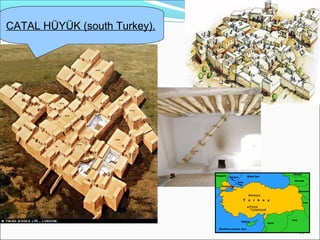
CATAL HÜYÜK (south Turkey).
14
Approximately
between 7500 BC
and 5700 BC.
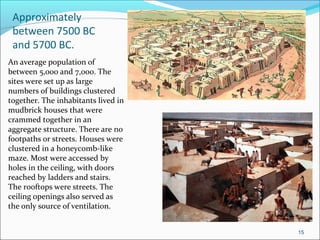
An average population of
between 5,000 and 7,000. The
sites were set up as large
numbers of buildings clustered
together. The inhabitants lived in
mudbrick houses that were
crammed together in an
aggregate structure. There are no
footpaths or streets. Houses were
clustered in a honeycomb-like
maze. Most were accessed by
holes in the ceiling, with doors
reached by ladders and stairs.
The rooftops were streets. The
ceiling openings also served as
the only source of ventilation.
15
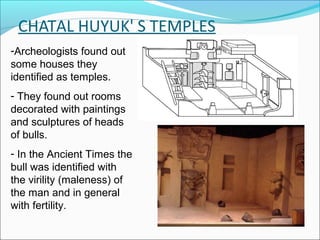
CHATAL HUYUK' S TEMPLES
-Archeologists found out
some houses they
identified as temples.
- They found out rooms
decorated with paintings
and sculptures of heads
of bulls.
- In the Ancient Times the
bull was identified with
the virility (maleness) of
the man and in general
with fertility.
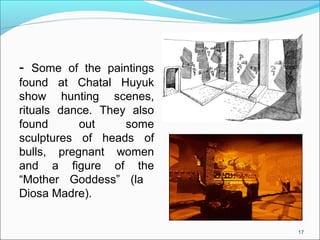
- Some of the paintings
found at Chatal Huyuk
show hunting scenes,
rituals dance. They also
found out some
sculptures of heads of
bulls, pregnant women
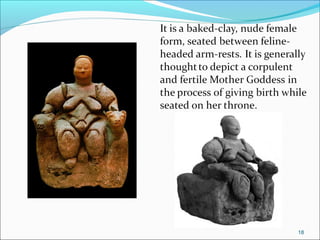
and a figure of the
“Mother Goddess” (la
Diosa Madre).
17
18
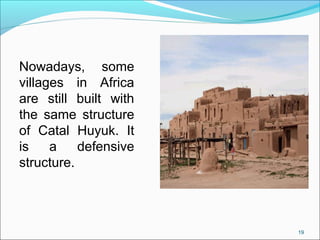
Nowadays, some
villages in Africa
are still built with
the same structure
of Catal Huyuk. It
is a defensive
structure.
19
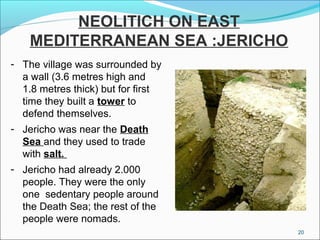
NEOLITICH ON EAST
MEDITERRANEAN SEA :JERICHO
- The village was surrounded by
a wall (3.6 metres high and
1.8 metres thick) but for first
time they built a tower to
defend themselves.
- Jericho was near the Death
Sea and they used to trade
with salt.
- Jericho had already 2.000
people. They were the only
one sedentary people around
the Death Sea; the rest of the
people were nomads.
20
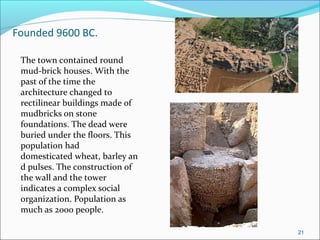
Founded 9600 BC.
The town contained round
mud-brick houses. With the
past of the time the
architecture changed to
rectilinear buildings made of
mudbricks on stone
foundations. The dead were
buried under the floors. This
population had
domesticated wheat, barley an
d pulses. The construction of
the wall and the tower
indicates a complex social
organization. Population as
much as 2000 people.
21
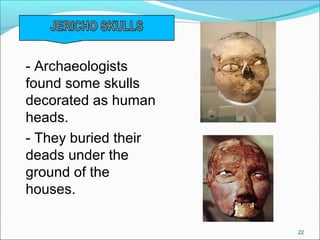
- Archaeologists
found some skulls
decorated as human
heads.
- They buried their
deads under the
ground of the
houses.
22
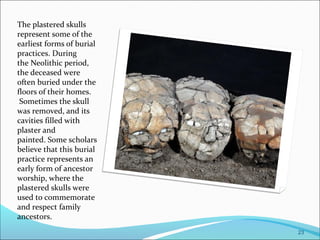
The plastered skulls
represent some of the
earliest forms of burial
practices. During
the Neolithic period,
the deceased were
often buried under the
floors of their homes.
Sometimes the skull
was removed, and its
cavities filled with
plaster and
painted. Some scholars
believe that this burial
practice represents an
early form of ancestor
worship, where the
plastered skulls were
used to commemorate
and respect family
ancestors.
23

Neolithic age

  • 1.
    NEOLITHIC AGE From theEra of the beginning of the farming to the Metals Age. 1
  • 2.
    Neolithic Revolution wasthe transition of many human cultures from a lifestyle of hunting and gathering to one of agriculture and settlement. 2
  • 3.
    NEOLITHIC TECHNOLOGY • Themankind made new tools as: – Sickle (hoz, para segar el cereal). – Hand mill (molino de mano, para moler el cereal). – A chopper axe ( un hacha de piedra, pero la piedra está pulimentada). 3
  • 4.
  • 5.
    It is ahand-held agricultural tool designed with variously curved blades and typically used for harvesting. 5
  • 6.
    HAND MILL They were firstused in the Neolithic to grind cereals into flour. 6
  • 7.
  • 8.
  • 9.
    THE DOMESTICATION OFANIMAL SPECIES AND PLANTS. Plants. • Wheat (Trigo). • Barley (Cebada). • Lentil (Legumbres como la lenteja). • Rice (arroz) in Asia. • Corn (maiz) in America. Animal species. – VACA (cow). – OVEJA (sheep). – CABRA (goat). – CERDO (pig). – PERRO (dog). – One of the last animal species domesticated was the cat. 9
  • 10.
    THE BEGINNING OFPOTTERY (cerámica). • How to make a bowl (vasija): – 1. Clay (barro). – 2. Model the clay. – 3. Make some geometric paintings on the clay or make some lines or basic symbols. – We use holes on the ground as ovens to cook the bowls. 10
  • 11.
    THE MANKIND BECAME SEDENTARY. •FIRST VILLAGES: mankind built first houses with a circular shape. They hadn't different rooms. In the middle of the house they used to made a circle with stones and they used it as kitchen and heating. 11
  • 12.
    • After afew centuries the mankind built their houses with a rectangular shape. • They began to divide the house in different rooms, one of them for the animals. 12
  • 13.
    NEOLITHIC ARCHAELOGICAL SITES. • Themanking became sedentary (farmers and shepperds) in the Middle East (countries such as Iraq, Israel, Palestine, Syria, south Turkey and west Iran). 13
  • 14.
  • 15.
    Approximately between 7500 BC and5700 BC. An average population of between 5,000 and 7,000. The sites were set up as large numbers of buildings clustered together. The inhabitants lived in mudbrick houses that were crammed together in an aggregate structure. There are no footpaths or streets. Houses were clustered in a honeycomb-like maze. Most were accessed by holes in the ceiling, with doors reached by ladders and stairs. The rooftops were streets. The ceiling openings also served as the only source of ventilation. 15
  • 16.
    CHATAL HUYUK' STEMPLES -Archeologists found out some houses they identified as temples. - They found out rooms decorated with paintings and sculptures of heads of bulls. - In the Ancient Times the bull was identified with the virility (maleness) of the man and in general with fertility.
  • 17.
    - Some ofthe paintings found at Chatal Huyuk show hunting scenes, rituals dance. They also found out some sculptures of heads of bulls, pregnant women and a figure of the “Mother Goddess” (la Diosa Madre). 17
  • 18.
  • 19.
    Nowadays, some villages inAfrica are still built with the same structure of Catal Huyuk. It is a defensive structure. 19
  • 20.
    NEOLITICH ON EAST MEDITERRANEANSEA :JERICHO - The village was surrounded by a wall (3.6 metres high and 1.8 metres thick) but for first time they built a tower to defend themselves. - Jericho was near the Death Sea and they used to trade with salt. - Jericho had already 2.000 people. They were the only one sedentary people around the Death Sea; the rest of the people were nomads. 20
  • 21.
    Founded 9600 BC. Thetown contained round mud-brick houses. With the past of the time the architecture changed to rectilinear buildings made of mudbricks on stone foundations. The dead were buried under the floors. This population had domesticated wheat, barley an d pulses. The construction of the wall and the tower indicates a complex social organization. Population as much as 2000 people. 21
  • 22.
    - Archaeologists found someskulls decorated as human heads. - They buried their deads under the ground of the houses. 22
  • 23.
    The plastered skulls representsome of the earliest forms of burial practices. During the Neolithic period, the deceased were often buried under the floors of their homes. Sometimes the skull was removed, and its cavities filled with plaster and painted. Some scholars believe that this burial practice represents an early form of ancestor worship, where the plastered skulls were used to commemorate and respect family ancestors. 23