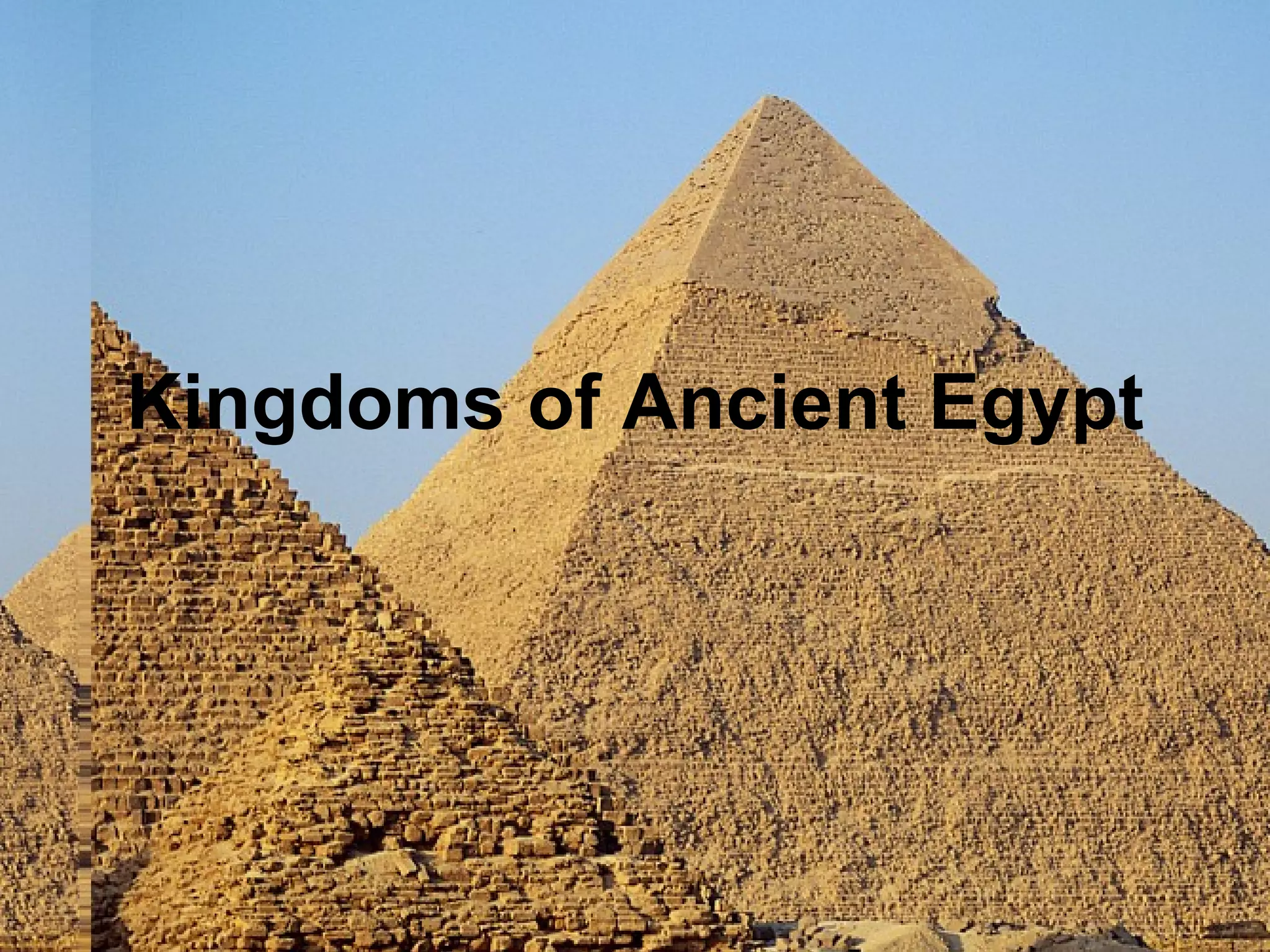
Kingdoms of Ancient Egypt
Early Egyptian Life ~8,000 BC 1 st  human life in the area Quest for food brought the stone age man to the Nile River Valley Hunters roamed until the found the river valley Climatic changes caused northern Africa to become drier ~7,000 BC Probable start of agriculture in the Nile region Barley, wheat and vegetables grown ~3,000 BC Many small villages established along the Nile Area called Kemet  Fertile, black soil
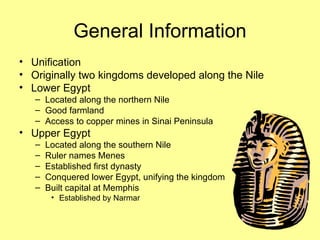
General Information Unification Originally two kingdoms developed along the Nile Lower Egypt Located along the northern Nile Good farmland Access to copper mines in Sinai Peninsula Upper Egypt Located along the southern Nile Ruler names Menes Established first dynasty Conquered lower Egypt, unifying the kingdom Built capital at Memphis Established by Narmar
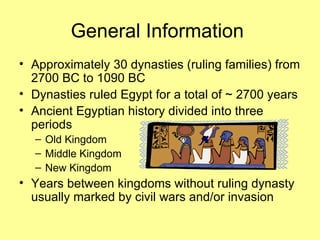
General Information  Approximately 30 dynasties (ruling families) from 2700 BC to 1090 BC Dynasties ruled Egypt for a total of ~ 2700 years Ancient Egyptian history divided into three periods Old Kingdom Middle Kingdom New Kingdom Years between kingdoms without ruling dynasty usually marked by civil wars and/or invasion
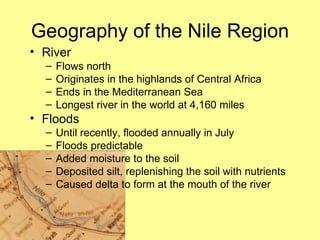
River Flows north Originates in the highlands of Central Africa Ends in the Mediterranean Sea Longest river in the world at 4,160 miles Floods Until recently, flooded annually in July Floods predictable Added moisture to the soil Deposited silt, replenishing the soil with nutrients Caused delta to form at the mouth of the river Geography of the Nile Region
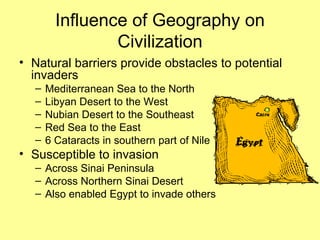
Influence of Geography on Civilization Natural barriers provide obstacles to potential invaders Mediterranean Sea to the North Libyan Desert to the West Nubian Desert to the Southeast Red Sea to the East 6 Cataracts in southern part of Nile Susceptible to invasion Across Sinai Peninsula Across Northern Sinai Desert Also enabled Egypt to invade others
Effect of Barriers Limited invasions from many angles Limited farming to a narrow region on either side of the river Caused river villages to be crowded As population grew, villages needed to expand Forced Egyptians to develop irrigation systems to create more fertile land Drained marshy swamps of the delta region in order  to farm the land
Benefits The river served as a highway United villages along the river Travel was relatively easy on the river Currents carried barges downstream to the delta Sails used to catch winds to return upstream  Additional benefits River attracted wildlife and provided fish for hunting & sport Papyrus grew along river Used to make paper
Religion in Ancient Egypt Beliefs Nature important Polytheistic Gods control forces of nature Gods controlled all life and death Gods frequently identified with certain animals Egyptian Gods Aman Re Most important god Sun god East represented birth (sunrise) West represented death (sunset) Burial temples built on the West bank of the Nile
Religion  Osiris God of the underworld  Judges the dead Rise & fall of the Nile believed to be the death & rebirth of Osiris Set God of evil who killed Osiris  Believed to cause failed harvest Isis Wife of Osiris Brought him back to life Nile floods and brings renewed life
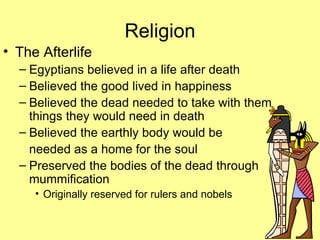
Religion The Afterlife Egyptians believed in a life after death Believed the good lived in happiness Believed the dead needed to take with them things they would need in death Believed the earthly body would be  needed as a home for the soul Preserved the bodies of the dead through mummification Originally reserved for rulers and nobels
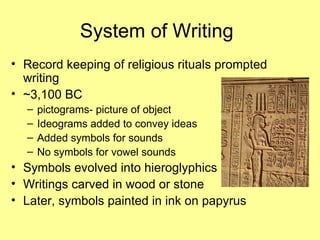
System of Writing Record keeping of religious rituals prompted writing ~3,100 BC  pictograms- picture of object Ideograms added to convey ideas Added symbols for sounds No symbols for vowel sounds Symbols evolved into hieroglyphics Writings carved in wood or stone Later, symbols painted in ink on papyrus
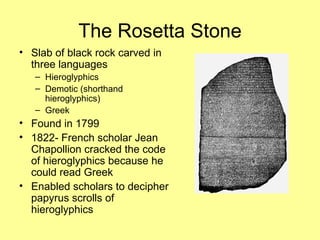
The Rosetta Stone Slab of black rock carved in three languages Hieroglyphics Demotic (shorthand hieroglyphics) Greek Found in 1799 1822- French scholar Jean Chapollion cracked the code of hieroglyphics because he could read Greek Enabled scholars to decipher papyrus scrolls of hieroglyphics
What Characterized Civilization in Ancient Egypt? Civilizations developed when people could stay put and not have to wander after their food supply. When people began to grow food, they became more organized  Divisions in labor developed to decide who did what Farmers, herders, artisans, government Cities grew with this organization Civilization & cities often thought to go hand in hand
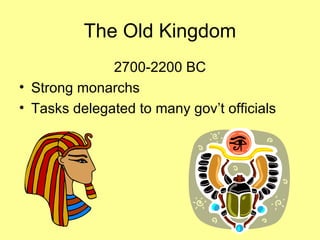
The Old Kingdom 2700-2200 BC Strong monarchs Tasks delegated to many gov’t officials
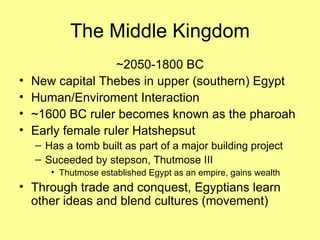
The Middle Kingdom ~2050-1800 BC New capital Thebes in upper (southern) Egypt Human/Enviroment Interaction ~1600 BC ruler becomes known as the pharoah Early female ruler Hatshepsut Has a tomb built as part of a major building project Suceeded by stepson, Thutmose III Thutmose established Egypt as an empire, gains wealth Through trade and conquest, Egyptians learn other ideas and blend cultures (movement)
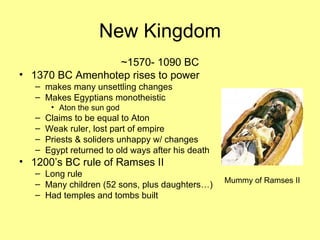
New Kingdom ~1570- 1090 BC 1370 BC Amenhotep rises to power makes many unsettling changes Makes Egyptians monotheistic Aton the sun god Claims to be equal to Aton Weak ruler, lost part of empire Priests & soliders unhappy w/ changes Egypt returned to old ways after his death 1200’s BC rule of Ramses II Long rule Many children (52 sons, plus daughters…) Had temples and tombs built Mummy of Ramses II
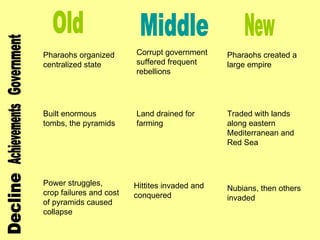
Old Middle New Government Achievements Decline Pharaohs organized centralized state  Built enormous tombs, the pyramids Power struggles, crop failures and cost of pyramids caused collapse  Corrupt government suffered frequent rebellions Land drained for farming Hittites invaded and conquered  Pharaohs created a large empire Traded with lands along eastern Mediterranean and Red Sea  Nubians, then others invaded
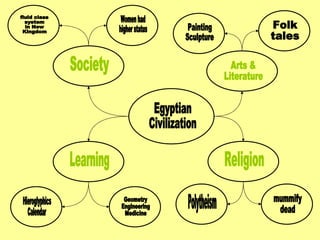
Egyptian  Civilization Learning Religion Society Arts &  Literature Hieroglyphics Calendar Geometry Engineering Medicine Polytheism mummify dead Women had  higher status fluid class  system in New  Kingdom Painting Sculpture Folk  tales
Egyptian Society Social Class A persons social position and occupation determined at birth Parents taught their children their own trade Social Structure Top = Pharaoh Ruling class of priests & nobles Middle class of merchants, artisans, doctors Bottom = Slaves
Egyptian Society Ruling Class Egyptian life revolved around religion Priests had highest status after pharaoh Only priests knew how to please gods Gods controlled nature Priests preformed rituals to obtain fertile land etc People paid tax to the temples Grain, gold, linen, etc Under priests were nobles who mainly held gov’t positions
Egyptian Society Middle Class Small group Settled in cities Cities (Memphis, Thebes) grew around temples & palaces Provided goods & services to the ruling class
Egyptian Society Peasants & Slaves Majority of Egyptians Lifestyle unchanged for thousands of years Pharaoh owned all the land Over half of the crops had to be paid as taxes Usually had to work on palace or gov’t project Brought to Egypt as POW’s or were descendents of POW’s Some slaves lived comfortable lives Some became trusted officials (Joseph) Some earned their freedom Life was tough for most
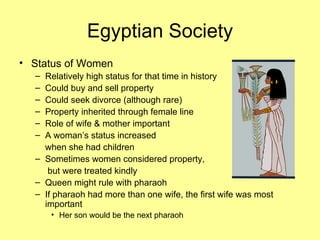
Egyptian Society Status of Women Relatively high status for that time in history Could buy and sell property Could seek divorce (although rare) Property inherited through female line Role of wife & mother important A woman’s status increased  when she had children Sometimes women considered property,   but were treated kindly Queen might rule with pharaoh If pharaoh had more than one wife, the first wife was most important Her son would be the next pharaoh
Education Original purpose of schools was to train priests Subjects taught Reading & writing Math Religious ceremonies & rituals Eventually temple schools provided more general education Usually schools attended only by the wealthy Girls did not attend school Taught domestic skills at home Students took notes on scraps of pottery  Papyrus was expensive & only used by advanced students Strict discipline
Scribes Scribes were very important Kept records, recorded history Could possibly become rich About the only social mobility of the era
Scientific Accomplishments In areas of math and science Developed system of surveying land Important due to annual floods Surveying land led to Geometry Area & volume Development of astronomy To predict floods, eclipses Led to development of calendar 365 days, 12 months 3 seasons, 30 days for 11 months, 35 for the 12 th No leap year Development of building techniques engineering
Scientific Accomplishments Medical discoveries Magic heavily used Developed surgery Greeks & Romans based much of their medical knowledge on that of the Egyptians
Other Ancient African Civilzations ~3000 BC Nubia Located southern part of Nile Valley Military skills May have had close links to Egypt 2000 BC Nubia developed into Kingdom of Kush Had pyramids too 750 BC invaded Egypt & added to Nubia, ruled like pharaohs respecting Egyptian traditions 671 BC pushed back out of Egypt by invading Assyrians ~480 BC conquered by Axuin from the Red Sea Area

Egynotes

  • 1.
  • 2.
    Early Egyptian Life~8,000 BC 1 st human life in the area Quest for food brought the stone age man to the Nile River Valley Hunters roamed until the found the river valley Climatic changes caused northern Africa to become drier ~7,000 BC Probable start of agriculture in the Nile region Barley, wheat and vegetables grown ~3,000 BC Many small villages established along the Nile Area called Kemet Fertile, black soil
  • 3.
    General Information UnificationOriginally two kingdoms developed along the Nile Lower Egypt Located along the northern Nile Good farmland Access to copper mines in Sinai Peninsula Upper Egypt Located along the southern Nile Ruler names Menes Established first dynasty Conquered lower Egypt, unifying the kingdom Built capital at Memphis Established by Narmar
  • 4.
    General Information Approximately 30 dynasties (ruling families) from 2700 BC to 1090 BC Dynasties ruled Egypt for a total of ~ 2700 years Ancient Egyptian history divided into three periods Old Kingdom Middle Kingdom New Kingdom Years between kingdoms without ruling dynasty usually marked by civil wars and/or invasion
  • 5.
    River Flows northOriginates in the highlands of Central Africa Ends in the Mediterranean Sea Longest river in the world at 4,160 miles Floods Until recently, flooded annually in July Floods predictable Added moisture to the soil Deposited silt, replenishing the soil with nutrients Caused delta to form at the mouth of the river Geography of the Nile Region
  • 6.
    Influence of Geographyon Civilization Natural barriers provide obstacles to potential invaders Mediterranean Sea to the North Libyan Desert to the West Nubian Desert to the Southeast Red Sea to the East 6 Cataracts in southern part of Nile Susceptible to invasion Across Sinai Peninsula Across Northern Sinai Desert Also enabled Egypt to invade others
  • 7.
    Effect of BarriersLimited invasions from many angles Limited farming to a narrow region on either side of the river Caused river villages to be crowded As population grew, villages needed to expand Forced Egyptians to develop irrigation systems to create more fertile land Drained marshy swamps of the delta region in order to farm the land
  • 8.
    Benefits The riverserved as a highway United villages along the river Travel was relatively easy on the river Currents carried barges downstream to the delta Sails used to catch winds to return upstream Additional benefits River attracted wildlife and provided fish for hunting & sport Papyrus grew along river Used to make paper
  • 9.
    Religion in AncientEgypt Beliefs Nature important Polytheistic Gods control forces of nature Gods controlled all life and death Gods frequently identified with certain animals Egyptian Gods Aman Re Most important god Sun god East represented birth (sunrise) West represented death (sunset) Burial temples built on the West bank of the Nile
  • 10.
    Religion OsirisGod of the underworld Judges the dead Rise & fall of the Nile believed to be the death & rebirth of Osiris Set God of evil who killed Osiris Believed to cause failed harvest Isis Wife of Osiris Brought him back to life Nile floods and brings renewed life
  • 11.
    Religion The AfterlifeEgyptians believed in a life after death Believed the good lived in happiness Believed the dead needed to take with them things they would need in death Believed the earthly body would be needed as a home for the soul Preserved the bodies of the dead through mummification Originally reserved for rulers and nobels
  • 12.
    System of WritingRecord keeping of religious rituals prompted writing ~3,100 BC pictograms- picture of object Ideograms added to convey ideas Added symbols for sounds No symbols for vowel sounds Symbols evolved into hieroglyphics Writings carved in wood or stone Later, symbols painted in ink on papyrus
  • 13.
    The Rosetta StoneSlab of black rock carved in three languages Hieroglyphics Demotic (shorthand hieroglyphics) Greek Found in 1799 1822- French scholar Jean Chapollion cracked the code of hieroglyphics because he could read Greek Enabled scholars to decipher papyrus scrolls of hieroglyphics
  • 14.
    What Characterized Civilizationin Ancient Egypt? Civilizations developed when people could stay put and not have to wander after their food supply. When people began to grow food, they became more organized Divisions in labor developed to decide who did what Farmers, herders, artisans, government Cities grew with this organization Civilization & cities often thought to go hand in hand
  • 15.
    The Old Kingdom2700-2200 BC Strong monarchs Tasks delegated to many gov’t officials
  • 16.
    The Middle Kingdom~2050-1800 BC New capital Thebes in upper (southern) Egypt Human/Enviroment Interaction ~1600 BC ruler becomes known as the pharoah Early female ruler Hatshepsut Has a tomb built as part of a major building project Suceeded by stepson, Thutmose III Thutmose established Egypt as an empire, gains wealth Through trade and conquest, Egyptians learn other ideas and blend cultures (movement)
  • 17.
    New Kingdom ~1570-1090 BC 1370 BC Amenhotep rises to power makes many unsettling changes Makes Egyptians monotheistic Aton the sun god Claims to be equal to Aton Weak ruler, lost part of empire Priests & soliders unhappy w/ changes Egypt returned to old ways after his death 1200’s BC rule of Ramses II Long rule Many children (52 sons, plus daughters…) Had temples and tombs built Mummy of Ramses II
  • 18.
    Old Middle NewGovernment Achievements Decline Pharaohs organized centralized state Built enormous tombs, the pyramids Power struggles, crop failures and cost of pyramids caused collapse Corrupt government suffered frequent rebellions Land drained for farming Hittites invaded and conquered Pharaohs created a large empire Traded with lands along eastern Mediterranean and Red Sea Nubians, then others invaded
  • 19.
    Egyptian CivilizationLearning Religion Society Arts & Literature Hieroglyphics Calendar Geometry Engineering Medicine Polytheism mummify dead Women had higher status fluid class system in New Kingdom Painting Sculpture Folk tales
  • 20.
    Egyptian Society SocialClass A persons social position and occupation determined at birth Parents taught their children their own trade Social Structure Top = Pharaoh Ruling class of priests & nobles Middle class of merchants, artisans, doctors Bottom = Slaves
  • 21.
    Egyptian Society RulingClass Egyptian life revolved around religion Priests had highest status after pharaoh Only priests knew how to please gods Gods controlled nature Priests preformed rituals to obtain fertile land etc People paid tax to the temples Grain, gold, linen, etc Under priests were nobles who mainly held gov’t positions
  • 22.
    Egyptian Society MiddleClass Small group Settled in cities Cities (Memphis, Thebes) grew around temples & palaces Provided goods & services to the ruling class
  • 23.
    Egyptian Society Peasants& Slaves Majority of Egyptians Lifestyle unchanged for thousands of years Pharaoh owned all the land Over half of the crops had to be paid as taxes Usually had to work on palace or gov’t project Brought to Egypt as POW’s or were descendents of POW’s Some slaves lived comfortable lives Some became trusted officials (Joseph) Some earned their freedom Life was tough for most
  • 24.
    Egyptian Society Statusof Women Relatively high status for that time in history Could buy and sell property Could seek divorce (although rare) Property inherited through female line Role of wife & mother important A woman’s status increased when she had children Sometimes women considered property, but were treated kindly Queen might rule with pharaoh If pharaoh had more than one wife, the first wife was most important Her son would be the next pharaoh
  • 25.
    Education Original purposeof schools was to train priests Subjects taught Reading & writing Math Religious ceremonies & rituals Eventually temple schools provided more general education Usually schools attended only by the wealthy Girls did not attend school Taught domestic skills at home Students took notes on scraps of pottery Papyrus was expensive & only used by advanced students Strict discipline
  • 26.
    Scribes Scribes werevery important Kept records, recorded history Could possibly become rich About the only social mobility of the era
  • 27.
    Scientific Accomplishments Inareas of math and science Developed system of surveying land Important due to annual floods Surveying land led to Geometry Area & volume Development of astronomy To predict floods, eclipses Led to development of calendar 365 days, 12 months 3 seasons, 30 days for 11 months, 35 for the 12 th No leap year Development of building techniques engineering
  • 28.
    Scientific Accomplishments Medicaldiscoveries Magic heavily used Developed surgery Greeks & Romans based much of their medical knowledge on that of the Egyptians
  • 29.
    Other Ancient AfricanCivilzations ~3000 BC Nubia Located southern part of Nile Valley Military skills May have had close links to Egypt 2000 BC Nubia developed into Kingdom of Kush Had pyramids too 750 BC invaded Egypt & added to Nubia, ruled like pharaohs respecting Egyptian traditions 671 BC pushed back out of Egypt by invading Assyrians ~480 BC conquered by Axuin from the Red Sea Area