Ancient Egypt is the first country
(nation state) in history..
• It was the first country to be united by a
single government.
• It was the first country with a national
culture.
• a nation-state—a political territory whose
population shares a common identity—
was the invention of the ancient Egyptians.
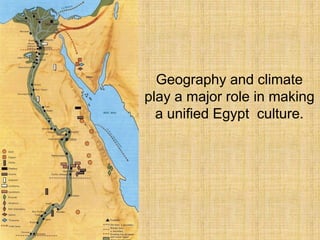
Geography and climate
play a major role in making
a unified Egypt culture.
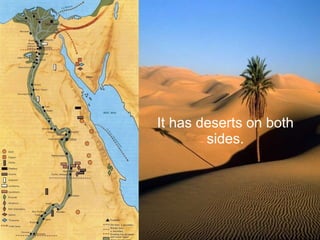
It has deserts on both
sides.
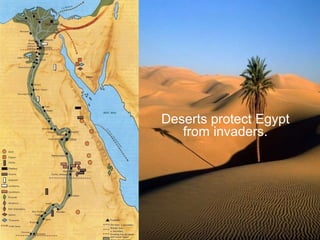
Deserts protect Egypt
from invaders.
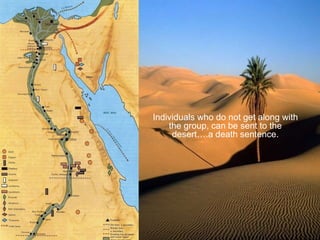
Individuals who do not get along with
the group, can be sent to the
desert….a death sentence.
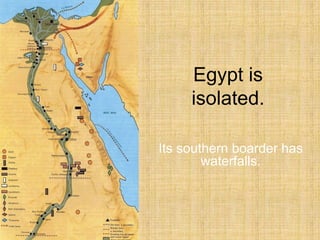
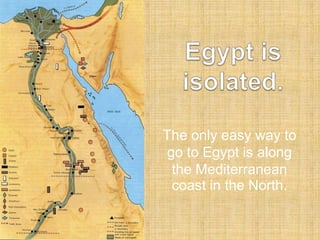
Egypt is
isolated.
Its southern boarder has
waterfalls.
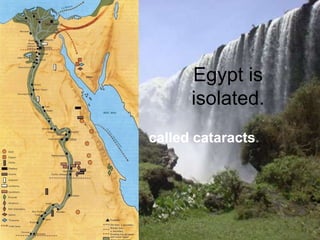
Egypt is
isolated.
called cataracts.
The only easy way to
go to Egypt is along
the Mediterranean
coast in the North.
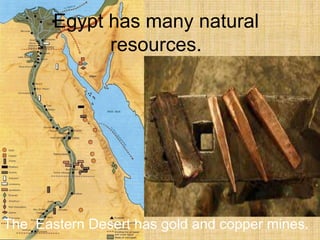
Egypt has many natural
resources.
The Eastern Desert has gold and copper mines.
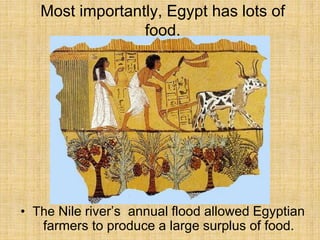
Most importantly, Egypt has lots of
food.
• The Nile river’s annual flood allowed Egyptian
farmers to produce a large surplus of food.
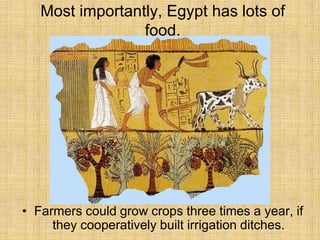
Most importantly, Egypt has lots of
food.
• Farmers could grow crops three times a year, if
they cooperatively built irrigation ditches.
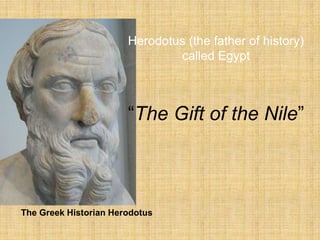
Herodotus (the father of history)
called Egypt
“The Gift of the Nile”
The Greek Historian Herodotus
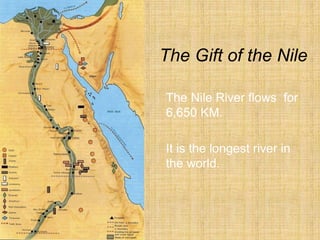
The Gift of the Nile
The Nile River flows for
6,650 KM.
It is the longest river in
the world.
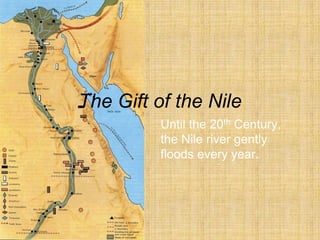
The Gift of the Nile
Until the 20th Century,
the Nile river gently
floods every year.
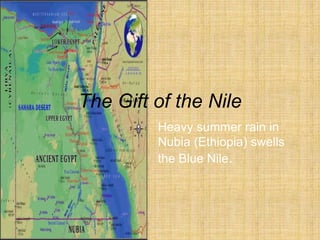
The Gift of the Nile
Heavy summer rain in
Nubia (Ethiopia) swells
the Blue Nile.
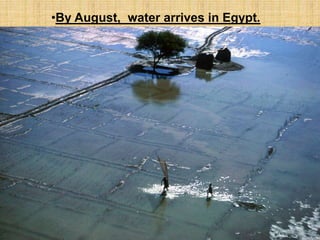
•By August, water arrives in Egypt.
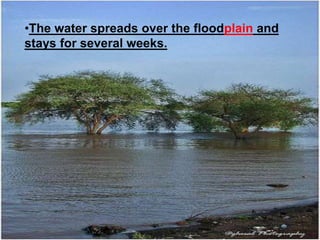
•The water spreads over the floodplain and
stays for several weeks.
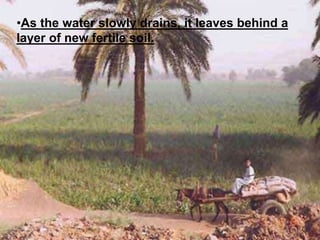
•As the water slowly drains, it leaves behind a
layer of new fertile soil.
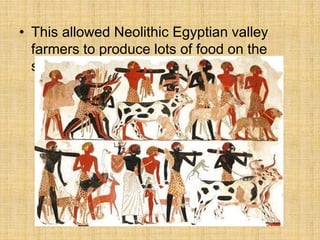
• This allowed Neolithic Egyptian valley
farmers to produce lots of food on the
same land year after year.
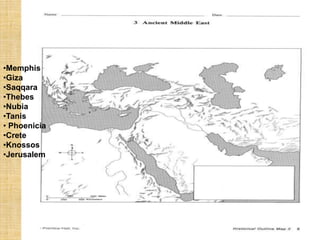
•Memphis
•Giza
•Saqqara
•Thebes
•Nubia
•Tanis
• Phoenicia
•Crete
•Knossos
•Jerusalem
SAT Vocabulary
• acquiesce apathy
• amenable assimilate
bucolic
• eclectic conducive
• omnipotent deference
• megalomaniac devout
• pedagogical dichotomy
• pious fortuitous
• supercilious narcissism
• viable
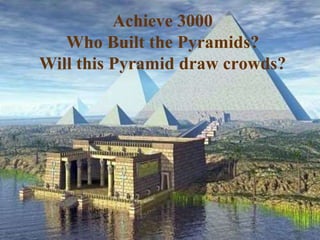
Achieve 3000
Who Built the Pyramids?
Will this Pyramid draw crowds?
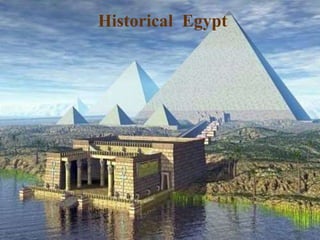
Historical Egypt
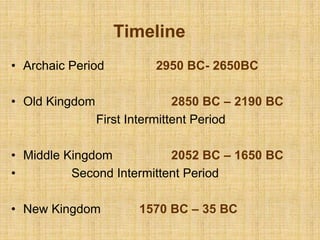
Timeline
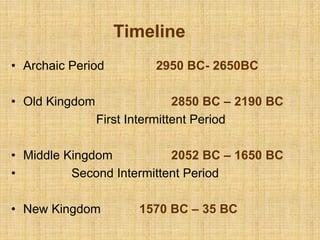
• Archaic Period 2950 BC- 2650BC
• Old Kingdom 2850 BC – 2190 BC
First Intermittent Period
• Middle Kingdom 2052 BC – 1650 BC
• Second Intermittent Period
• New Kingdom 1570 BC – 35 BC
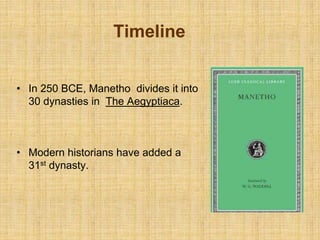
• In 250 BCE, Manetho divides it into
30 dynasties in The Aegyptiaca.
• Modern historians have added a
31st dynasty.
Timeline
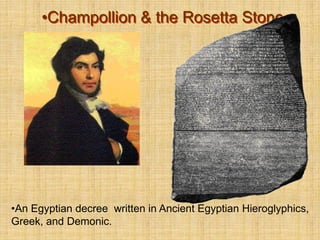
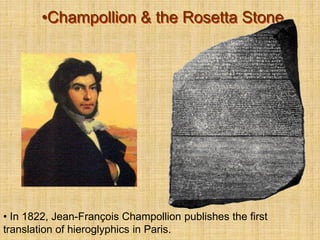
•Champollion & the Rosetta Stone
•An Egyptian decree written in Ancient Egyptian Hieroglyphics,
Greek, and Demonic.
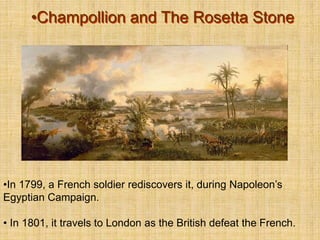
•Champollion and The Rosetta Stone
•In 1799, a French soldier rediscovers it, during Napoleon’s
Egyptian Campaign.
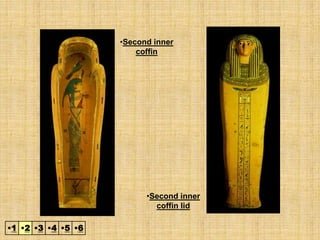
• In 1801, it travels to London as the British defeat the French.
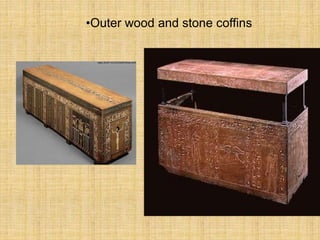
•Champollion & the Rosetta Stone
• In 1822, Jean-François Champollion publishes the first
translation of hieroglyphics in Paris.
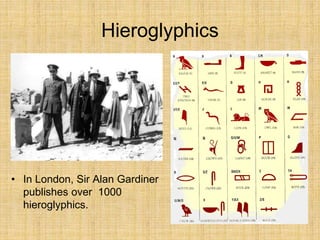
Hieroglyphics
• In London, Sir Alan Gardiner
publishes over 1000
hieroglyphics.
Timeline
• Archaic Period 2950 BC- 2650BC
• Old Kingdom 2850 BC – 2190 BC
First Intermittent Period
• Middle Kingdom 2052 BC – 1650 BC
• Second Intermittent Period
• New Kingdom 1570 BC – 35 BC
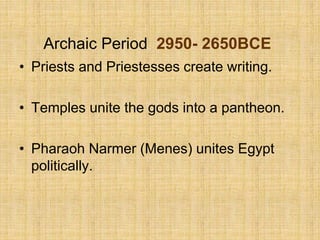
Archaic Period 2950- 2650BCE
• Priests and Priestesses create writing.
• Temples unite the gods into a pantheon.
• Pharaoh Narmer (Menes) unites Egypt
politically.
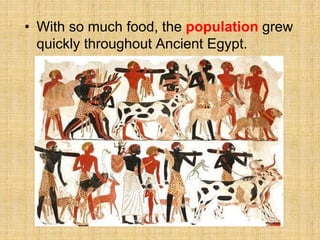
• With so much food, the population grew
quickly throughout Ancient Egypt.
• A population is a total of all the people
that live in the same geographical region
Population growth rate
• How much a population goes up or down
in a region.
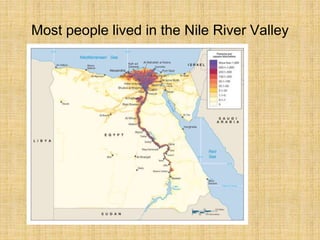
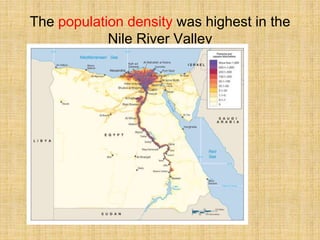
Most people lived in the Nile River Valley
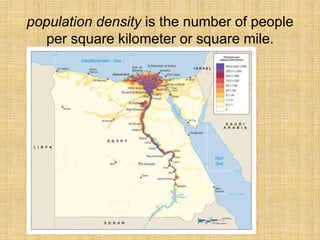
The population density was highest in the
Nile River Valley
population density is the number of people
per square kilometer or square mile.
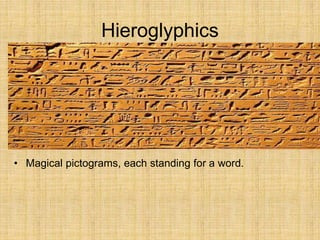
Hieroglyphics
• Magical pictograms, each standing for a word.
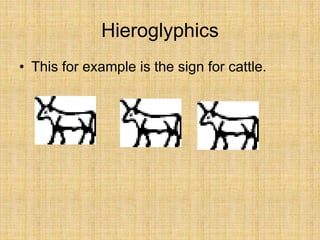
Hieroglyphics
• This for example is the sign for cattle.
Hieroglyphics
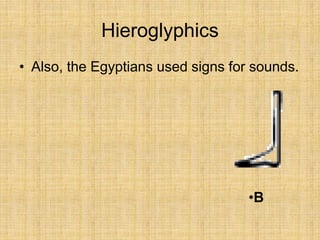
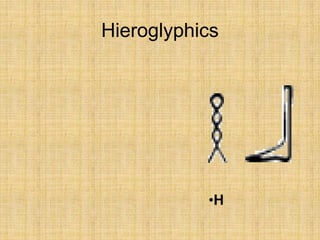
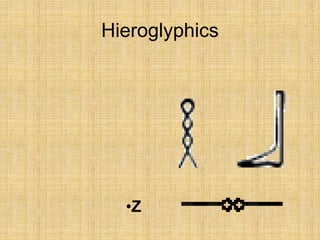
• Also, the Egyptians used signs for sounds.
•B
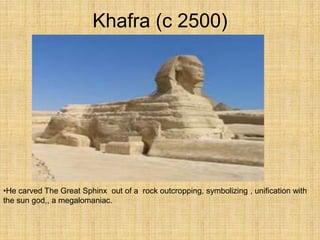
Hieroglyphics
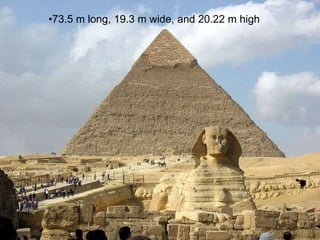
•H
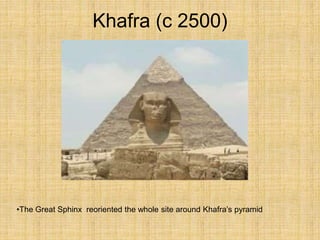
Hieroglyphics
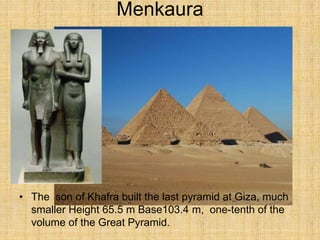
•Z
Hieroglyphics
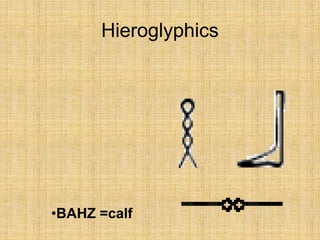
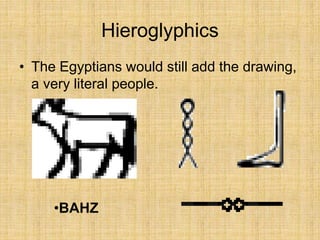
•BAHZ =calf
Hieroglyphics
• The Egyptians would still add the drawing,
a very literal people.
•BAHZ
Hieroglyphics
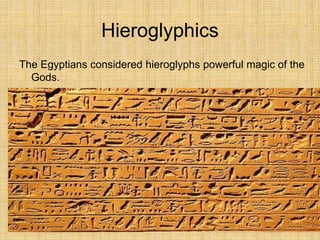
The Egyptians considered hieroglyphs powerful magic of the
Gods.
Hieroglyphics
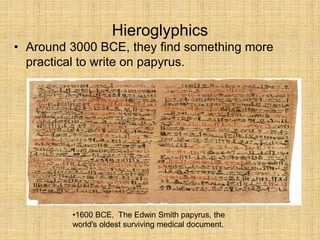
• Around 3000 BCE, they find something more
practical to write on papyrus.
•1600 BCE, The Edwin Smith papyrus, the
world's oldest surviving medical document.
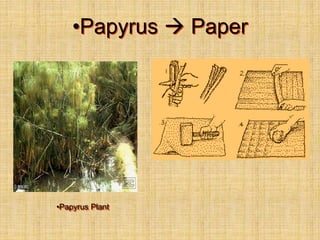
•Papyrus  Paper
•Papyrus Plant
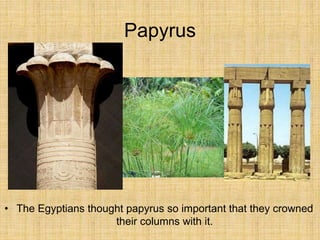
Papyrus
• The Egyptians thought papyrus so important that they crowned
their columns with it.
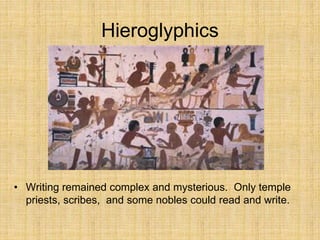
Hieroglyphics
• Writing remained complex and mysterious. Only temple
priests, scribes, and some nobles could read and write.
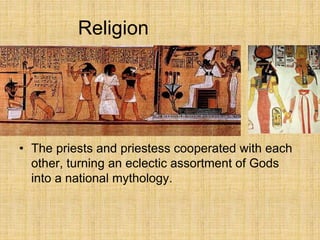
Religion
• The priests and priestess cooperated with each
other, turning an eclectic assortment of Gods
into a national mythology.
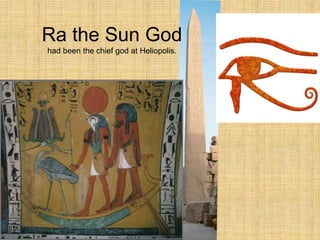
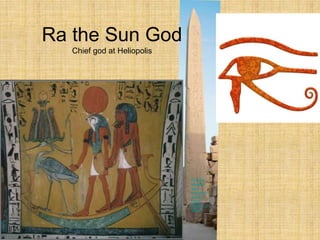
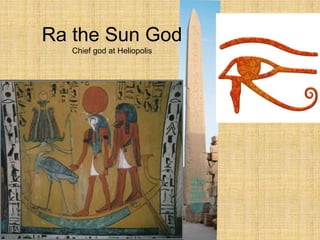
Ra the Sun God
had been the chief god at Heliopolis.
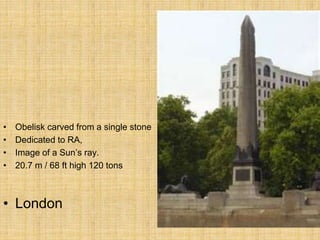
• Obelisk carved from a single stone
• Dedicated to RA,
• Image of a Sun’s ray.
• 20.7 m / 68 ft high 120 tons
• London
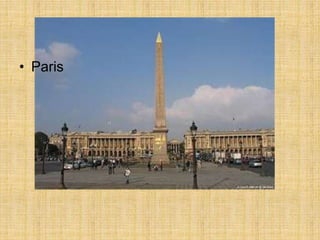
• Paris
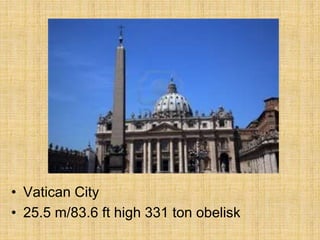
• Vatican City
• 25.5 m/83.6 ft high 331 ton obelisk
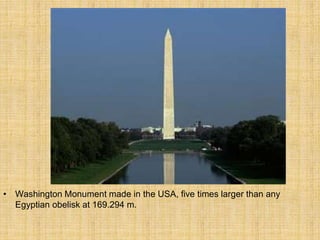
• Washington Monument made in the USA, five times larger than any
Egyptian obelisk at 169.294 m.
Ra the Sun God
Chief god at Heliopolis
• How the
obelisks
were
erected in
Ancient
Egypt
(theory)_(3
60p).flv
Ra the Sun God
Chief god at Heliopolis
• How the
obelisks
were
erected in
Ancient
Egypt
(theory)_(3
60p).flv
Ra the Sun God
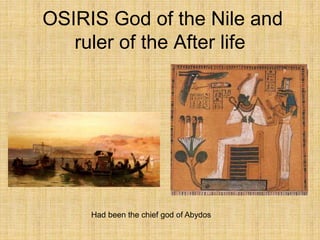
OSIRIS God of the Nile and
ruler of the After life
Had been the chief god of Abydos
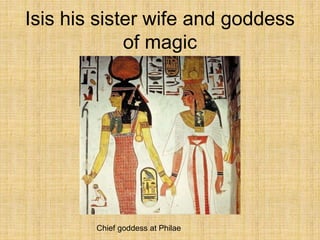
Isis his sister wife and goddess
of magic
Chief goddess at Philae
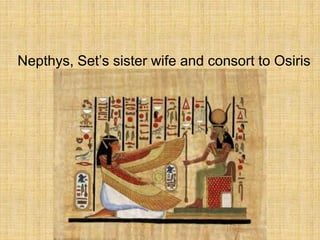
Nepthys, Set’s sister wife and consort to Osiris
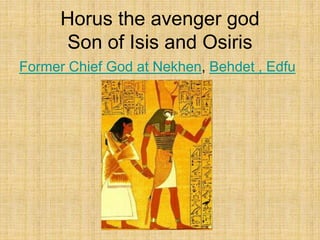
Horus the avenger god
Son of Isis and Osiris
Former Chief God at Nekhen, Behdet , Edfu
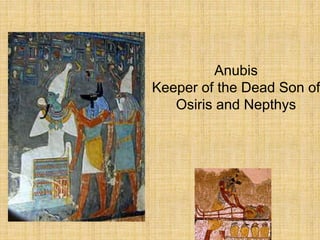
Anubis
Keeper of the Dead Son of
Osiris and Nepthys
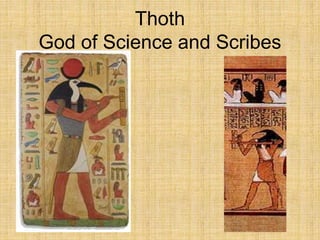
Thoth
God of Science and Scribes
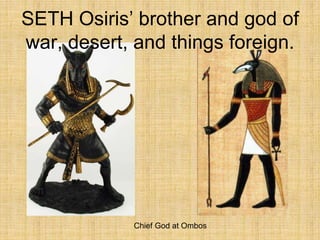
SETH Osiris’ brother and god of
war, desert, and things foreign.
Chief God at Ombos
NS=????????
• Egyptians treated outsiders without mercy.
• Egypt did not welcome foreigners.
•.
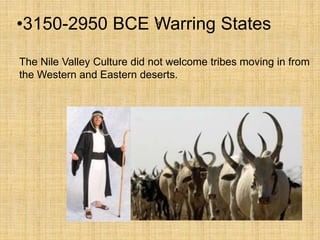
The Nile Valley Culture did not welcome tribes moving in from
the Western and Eastern deserts.
•3150-2950 BCE Warring States
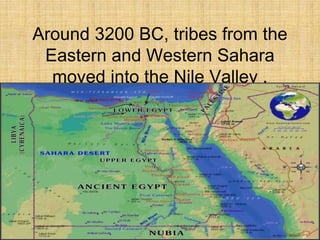
Around 3200 BC, tribes from the
Eastern and Western Sahara
moved into the Nile Valley .
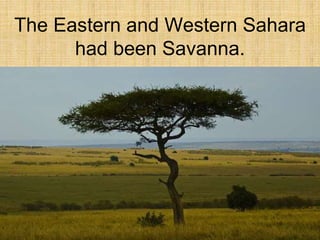
The Eastern and Western Sahara
had been Savanna.
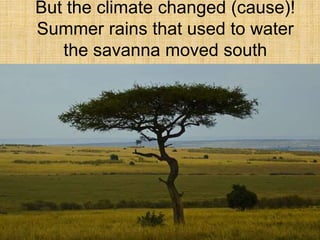
But the climate changed (cause)!
Summer rains that used to water
the savanna moved south
eastward.
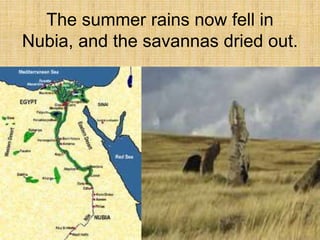
The summer rains now fell in
Nubia, and the savannas dried out.
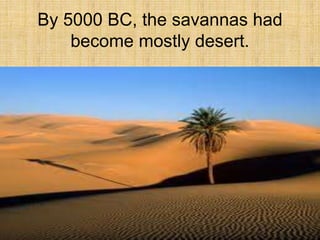
By 5000 BC, the savannas had
become mostly desert.
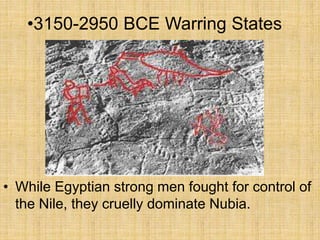
• While Egyptian strong men fought for control of
the Nile, they cruelly dominate Nubia.
•3150-2950 BCE Warring States
• While Egyptian strong men fought for control of
the Nile, they cruelly dominate Nubia.
3150-2950 BCE Warring States
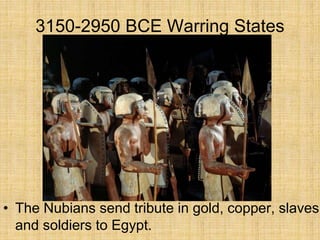
• The Nubians send tribute in gold, copper, slaves
and soldiers to Egypt.
3150-2950 BCE Warring States
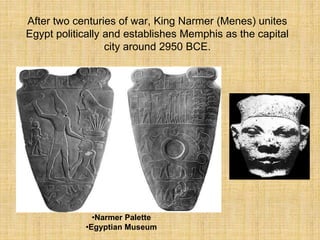
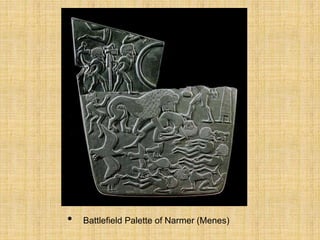
After two centuries of war, King Narmer (Menes) unites
Egypt politically and establishes Memphis as the capital
city around 2950 BCE.
•Narmer Palette
•Egyptian Museum
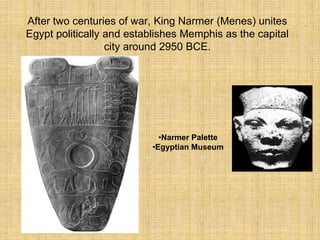
After two centuries of war, King Narmer (Menes) unites
Egypt politically and establishes Memphis as the capital
city around 2950 BCE.
•Narmer Palette
•Egyptian Museum
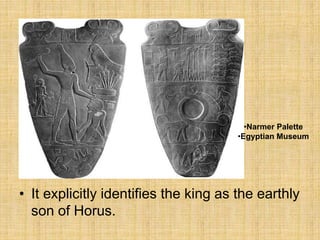
• It explicitly identifies the king as the earthly
son of Horus.
•Narmer Palette
•Egyptian Museum
• Battlefield Palette of Narmer (Menes)
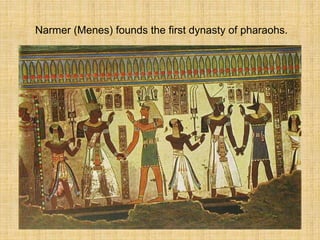
Narmer (Menes) founds the first dynasty of pharaohs.
Pharaoh (Great House)
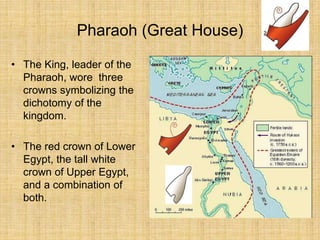
• The King, leader of the
Pharaoh, wore three
crowns symbolizing the
dichotomy of the
kingdom.
• The red crown of Lower
Egypt, the tall white
crown of Upper Egypt,
and a combination of
both.
Pharaoh (Great House)
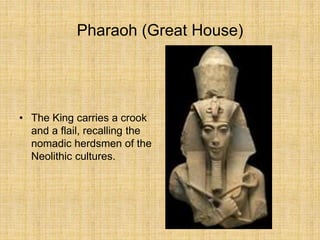
• The King carries a crook
and a flail, recalling the
nomadic herdsmen of the
Neolithic cultures.
Pharaoh (Great House)
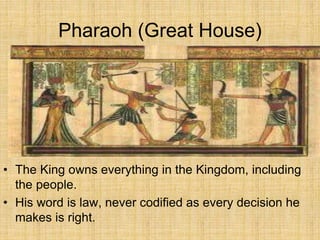
• The King owns everything in the Kingdom, including
the people.
• His word is law, never codified as every decision he
makes is right.
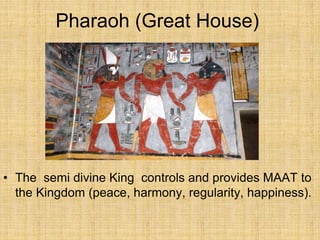
Pharaoh (Great House)
• The semi divine King controls and provides MAAT to
the Kingdom (peace, harmony, regularity, happiness).
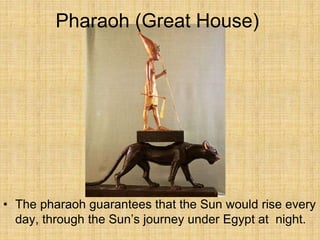
Pharaoh (Great House)
• The pharaoh guarantees that the Sun would rise every
day, through the Sun’s journey under Egypt at night.
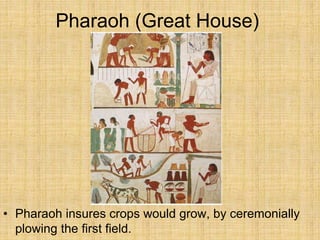
Pharaoh (Great House)
• Pharaoh insures crops would grow, by ceremonially
plowing the first field.
Pharaoh (Great House)
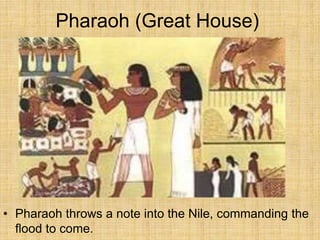
• Pharaoh throws a note into the Nile, commanding the
flood to come.
Pharaoh (Great House)
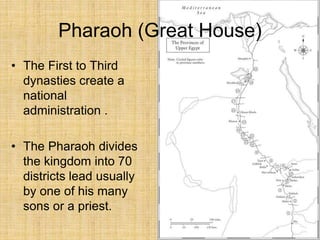
• The First to Third
dynasties create a
national
administration .
• The Pharaoh divides
the kingdom into 70
districts lead usually
by one of his many
sons or a priest.
Pharaoh (Great House)
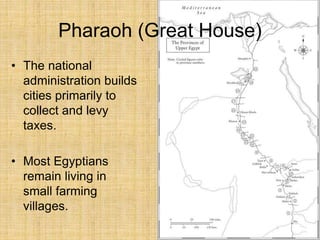
• The national
administration builds
cities primarily to
collect and levy
taxes.
• Most Egyptians
remain living in
small farming
villages.
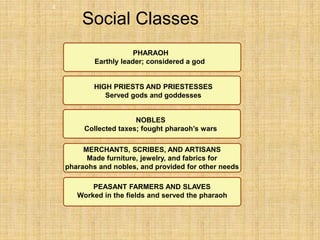
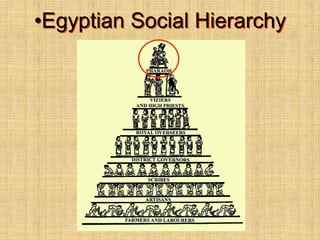
HIGH PRIESTS AND PRIESTESSES
Served gods and goddesses
PHARAOH
Earthly leader; considered a god
NOBLES
Collected taxes; fought pharaoh’s wars
MERCHANTS, SCRIBES, AND ARTISANS
Made furniture, jewelry, and fabrics for
pharaohs and nobles, and provided for other needs
PEASANT FARMERS AND SLAVES
Worked in the fields and served the pharaoh
Social Classes
2
•Egyptian Social Hierarchy
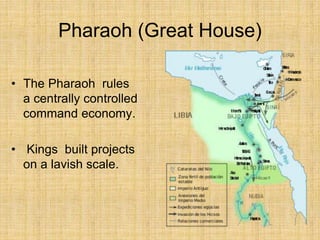
Pharaoh (Great House)
• The Pharaoh rules
a centrally controlled
command economy.
• Kings built projects
on a lavish scale.
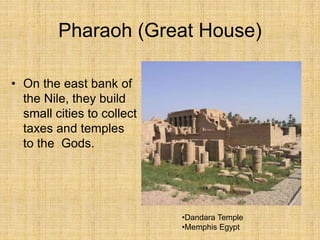
Pharaoh (Great House)
• On the east bank of
the Nile, they build
small cities to collect
taxes and temples
to the Gods.
•Dandara Temple
•Memphis Egypt
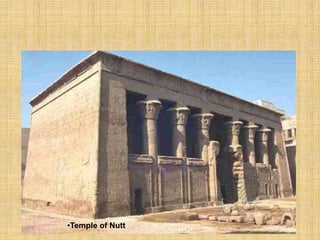
•Temple of Nutt
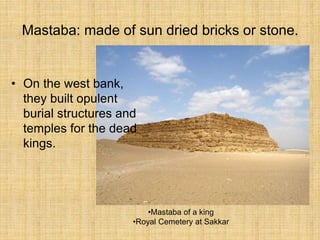
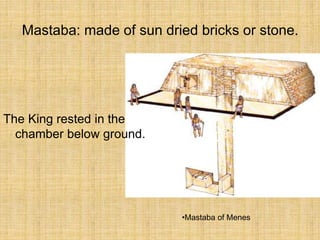
Mastaba: made of sun dried bricks or stone.
• On the west bank,
they built opulent
burial structures and
temples for the dead
kings.
•Mastaba of a king
•Royal Cemetery at Sakkar
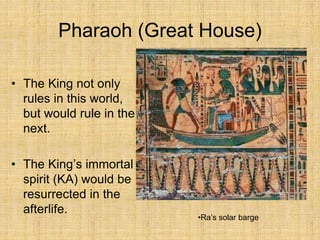
Pharaoh (Great House)
• The King not only
rules in this world,
but would rule in the
next.
• The King’s immortal
spirit (KA) would be
resurrected in the
afterlife.
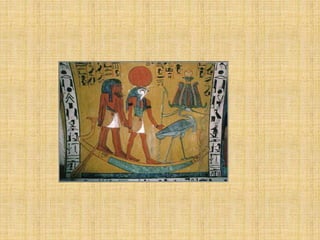
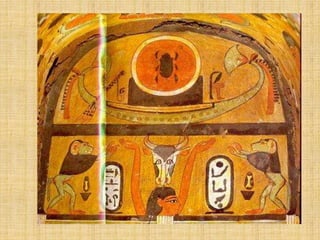
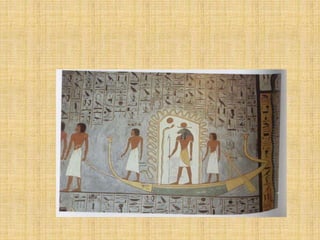
•Ra’s solar barge
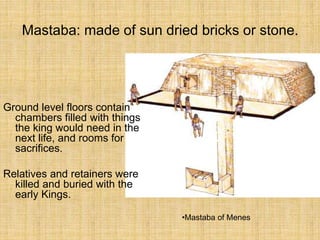
Ground level floors contain
chambers filled with things
the king would need in the
next life, and rooms for
sacrifices.
Relatives and retainers were
killed and buried with the
early Kings.
•Mastaba of Menes
Mastaba: made of sun dried bricks or stone.
The King rested in the
chamber below ground.
•Mastaba of Menes
Mastaba: made of sun dried bricks or stone.
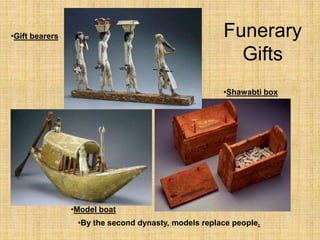
•Shawabti box
•Gift bearers
•Model boat
Funerary
Gifts
•By the second dynasty, models replace people.
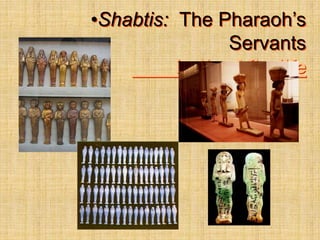
•Shabtis: The Pharaoh’s
Servants
in the Afterlife
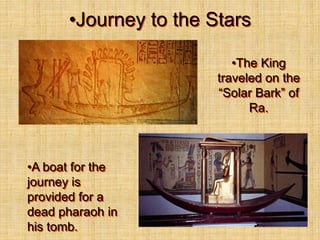
•Journey to the Stars
•A boat for the
journey is
provided for a
dead pharaoh in
his tomb.
•The King
traveled on the
“Solar Bark” of
Ra.
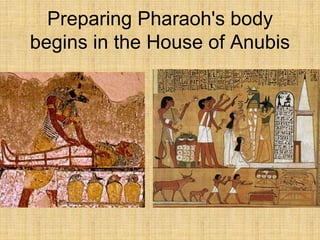
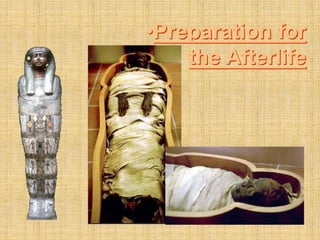
Preparing Pharaoh's body
begins in the House of Anubis
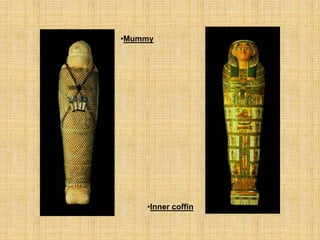
•Inner coffin
•Mummy
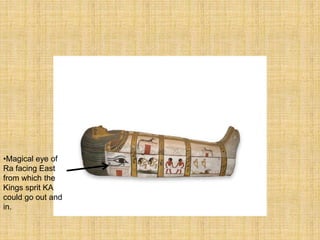
•Magical eye of
Ra facing East
from which the
Kings sprit KA
could go out and
in.
•Second inner
coffin lid
•Second inner
coffin
•2 •3 •4 •5•1 •6
•Outer wood and stone coffins
•Preparation for
the Afterlife
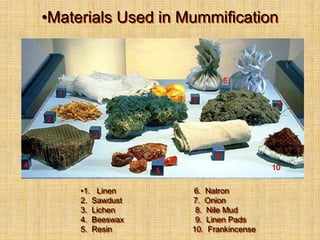
•Materials Used in Mummification
•1. Linen 6. Natron
2. Sawdust 7. Onion
3. Lichen 8. Nile Mud
4. Beeswax 9. Linen Pads
5. Resin 10. Frankincense
Mummies
• 70 steps to make a mummy.
– 1) Removal of the brain through the nostrils
– 2) Removal of the intestines through an incision in the side
3) Sterilization of the body and intestines
– 4) Treating, cleaning, dehydrating the intestines
– 5) Packing the body with natron (a natural dehydrating
agent) and leaving for 40 days
– 6) Removal of the natron agent
– 7) Packing the limbs with clay or sand
– 8) Packing the body with linen (soaked in resin), myrrh and
cinnamon
– 9) Treating the body with ointments and finally wrapping
with a fine linen gauze, not less than 1000 square meters .
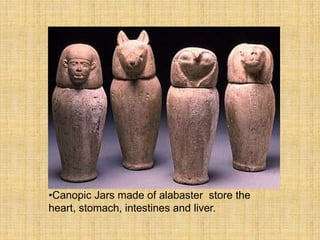
•Canopic Jars made of alabaster store the
heart, stomach, intestines and liver.
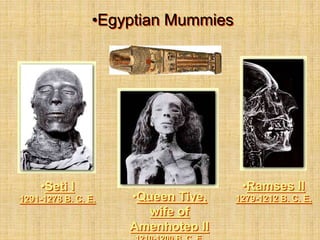
•Egyptian Mummies
•Seti I
1291-1278 B. C. E. •Queen Tiye,
wife of
Amenhotep II
•Ramses II
1279-1212 B. C. E.
Old Kingdom 2650 BC – 2134 BC
Dynasties 3-6
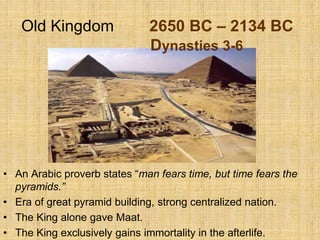
• An Arabic proverb states “man fears time, but time fears the
pyramids.”
• Era of great pyramid building, strong centralized nation.
• The King alone gave Maat.
• The King exclusively gains immortality in the afterlife.
Old Kingdom 2650 BC – 2134 BC
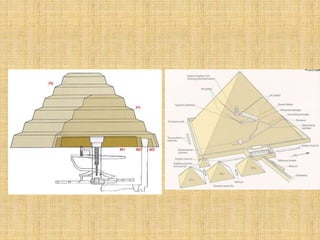
• Around 2650 BC, King Zoser (Djoser) and the architect
Imhotep construct the Step Pyramid at Sakkara.
Step Pyramid at Sakkara. C 2650 BC
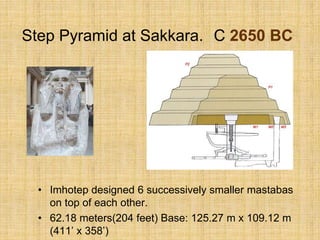
• Imhotep designed 6 successively smaller mastabas
on top of each other.
• 62.18 meters(204 feet) Base: 125.27 m x 109.12 m
(411’ x 358’)
Step Pyramid at Sakkara 2650 BC
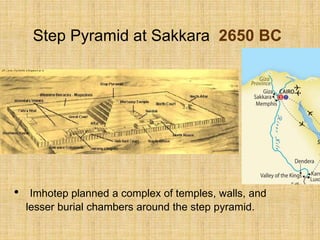
• Imhotep planned a complex of temples, walls, and
lesser burial chambers around the step pyramid.
Step Pyramid at Sakkara 2650 BC
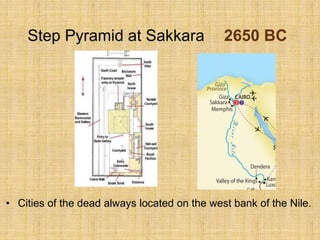
• Cities of the dead always located on the west bank of the Nile.
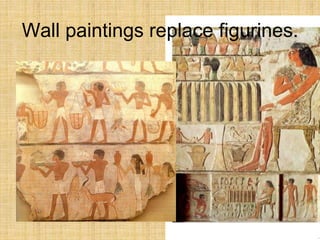
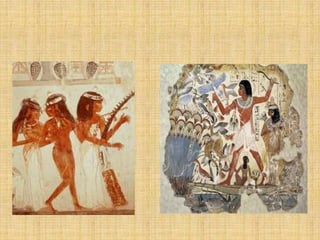
Wall paintings replace figurines.
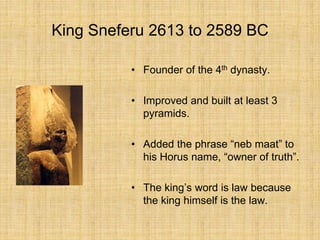
King Sneferu 2613 to 2589 BC
• Founder of the 4th dynasty.
• Improved and built at least 3
pyramids.
• Added the phrase “neb maat” to
his Horus name, “owner of truth”.
• The king’s word is law because
the king himself is the law.
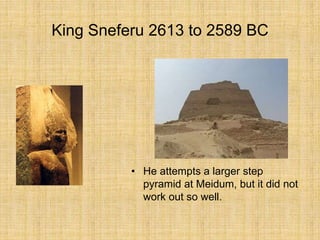
King Sneferu 2613 to 2589 BC
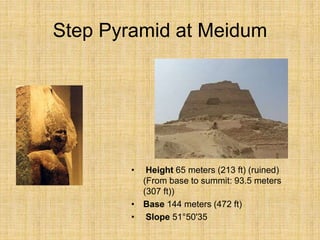
• He attempts a larger step
pyramid at Meidum, but it did not
work out so well.
Step Pyramid at Meidum
• Height 65 meters (213 ft) (ruined)
(From base to summit: 93.5 meters
(307 ft))
• Base 144 meters (472 ft)
• Slope 51°50'35
King Snefru 2613 BC to 2589 BC
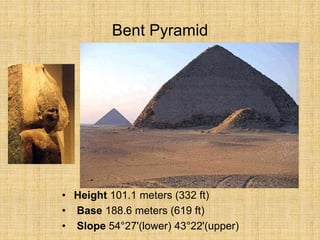
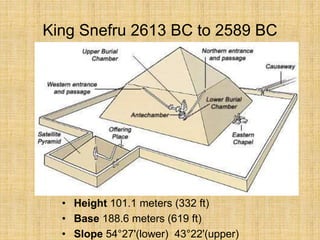
• His next attempt results in the bent pyramid at
Dahshur.
• The lower part of the pyramid rises at 54-degrees,
yet the top section changes to 43 degrees.
Bent Pyramid
• Height 101.1 meters (332 ft)
• Base 188.6 meters (619 ft)
• Slope 54°27'(lower) 43°22'(upper)
King Snefru 2613 BC to 2589 BC
• Height 101.1 meters (332 ft)
• Base 188.6 meters (619 ft)
• Slope 54°27'(lower) 43°22'(upper)
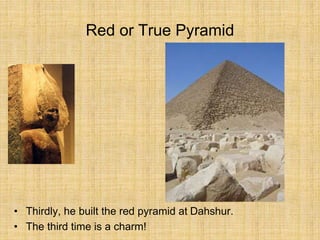
Red or True Pyramid
• Thirdly, he built the red pyramid at Dahshur.
• The third time is a charm!
King Snefru 2613 to 2589 BC
• Height 104 meters (341 ft)
• Base 220 meters (722 ft)
King Snefru 2613 BC to 2589 BC
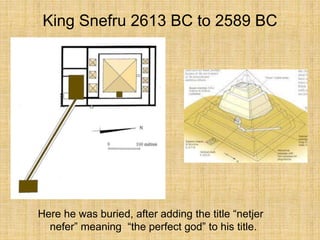
Here he was buried, after adding the title “netjer
nefer” meaning “the perfect god” to his title.
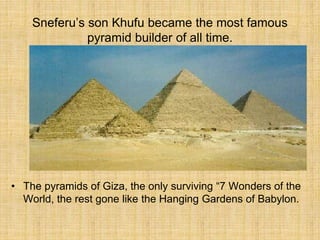
Sneferu’s son Khufu became the most famous
pyramid builder of all time.
• The pyramids of Giza, the only surviving “7 Wonders of the
World, the rest gone like the Hanging Gardens of Babylon.
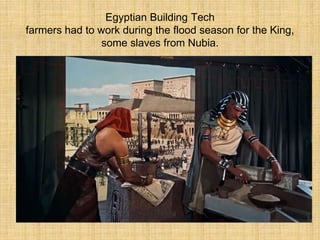
Egyptian Building Tech
farmers had to work during the flood season for the King,
some slaves from Nubia.
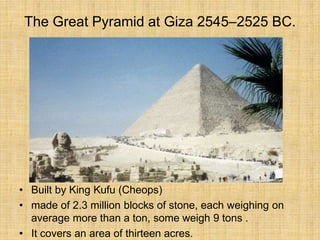
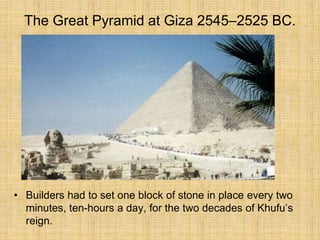
The Great Pyramid at Giza 2545–2525 BC.
• Built by King Kufu (Cheops)
• made of 2.3 million blocks of stone, each weighing on
average more than a ton, some weigh 9 tons .
• It covers an area of thirteen acres.
The Great Pyramid at Giza 2545–2525 BC.
• Builders had to set one block of stone in place every two
minutes, ten-hours a day, for the two decades of Khufu’s
reign.
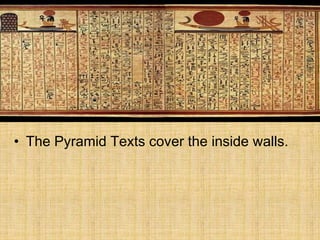
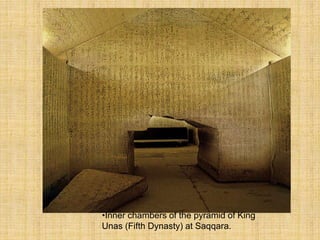
• The Pyramid Texts cover the inside walls.
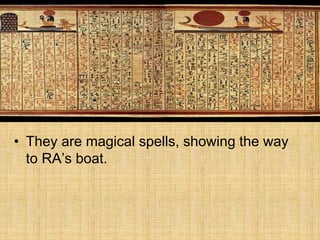
• They are magical spells, showing the way
to RA’s boat.
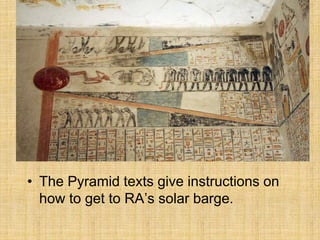
• The Pyramid texts give instructions on
how to get to RA’s solar barge.
•Inner chambers of the pyramid of King
Unas (Fifth Dynasty) at Saqqara.
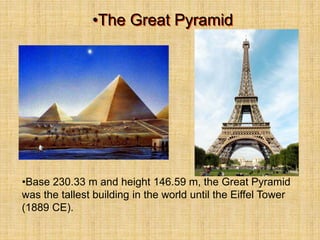
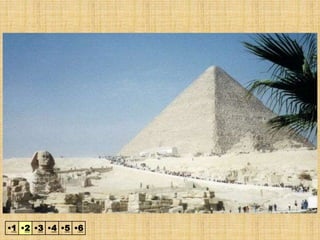
•The Great Pyramid
•Base 230.33 m and height 146.59 m, the Great Pyramid
was the tallest building in the world until the Eiffel Tower
(1889 CE).
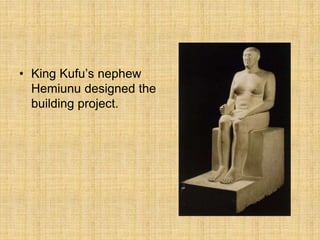
• King Kufu’s nephew
Hemiunu designed the
building project.
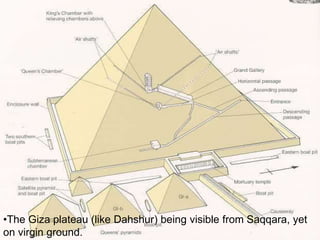
•The Giza plateau (like Dahshur) being visible from Saqqara, yet
on virgin ground.
•2 •3 •4 •5•1 •6
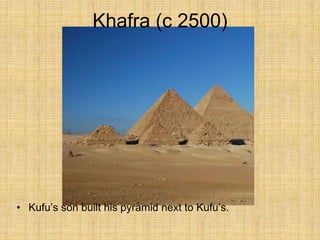
Khafra (c 2500)
• Kufu’s son built his pyramid next to Kufu’s.
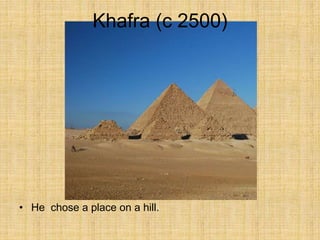
Khafra (c 2500)
• He chose a place on a hill.
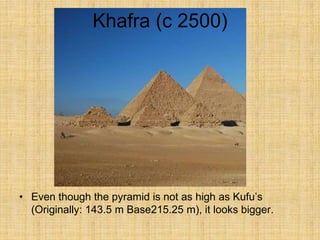
Khafra (c 2500)
• Even though the pyramid is not as high as Kufu’s
(Originally: 143.5 m Base215.25 m), it looks bigger.
Khafra (c 2500)
•He carved The Great Sphinx out of a rock outcropping, symbolizing , unification with
the sun god,, a megalomaniac.
•73.5 m long, 19.3 m wide, and 20.22 m high
Khafra (c 2500)
•The Great Sphinx reoriented the whole site around Khafra’s pyramid
Menkaura
• The son of Khafra built the last pyramid at Giza, much
smaller Height 65.5 m Base103.4 m, one-tenth of the
volume of the Great Pyramid.
Menkaura
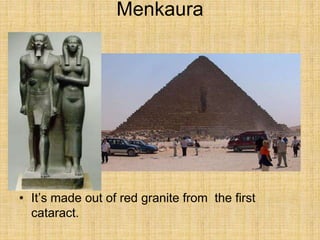
• It’s made out of red granite from the first
cataract.
Menkaura
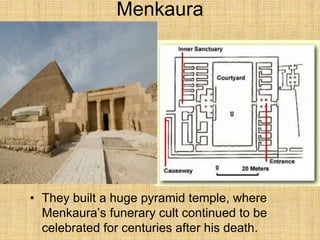
• They built a huge pyramid temple, where
Menkaura’s funerary cult continued to be
celebrated for centuries after his death.
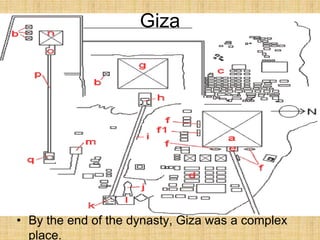
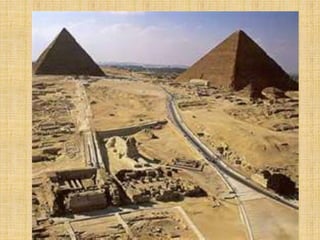
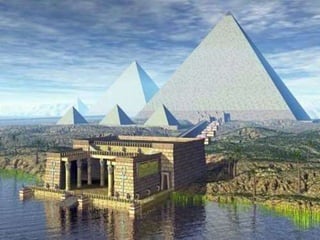
Giza
• By the end of the dynasty, Giza was a complex
place.
Giza
• By the end of the dynasty, Giza was a complex
place.
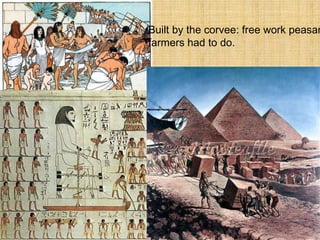
•Built by the corvee: free work peasan
•farmers had to do.
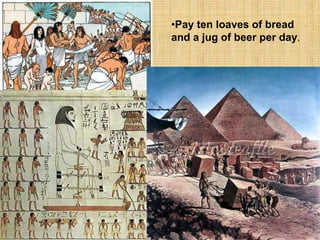
•Pay ten loaves of bread
and a jug of beer per day.
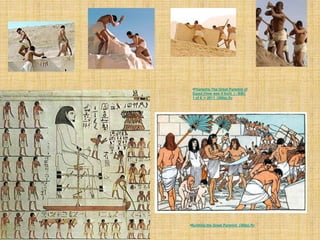
•Pharaohs-The Great Pyramid of
Egypt (How was it built_) - BBC
1 of 6 = 2011_(360p).flv
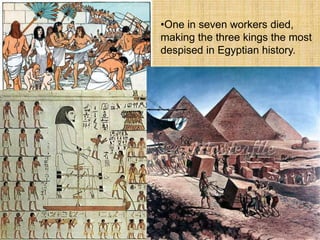
•Building the Great Pyramid_(360p).flv
•One in seven workers died,
making the three kings the most
despised in Egyptian history.
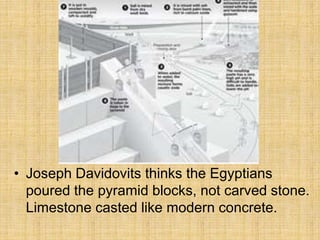
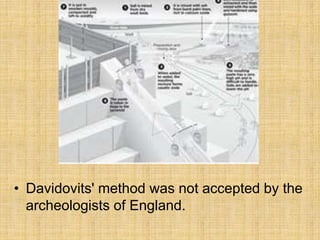
• Joseph Davidovits thinks the Egyptians
poured the pyramid blocks, not carved stone.
Limestone casted like modern concrete.
• Davidovits' method was not accepted by the
archeologists of England.
• But, Michel Barsoum discovered air
bubbles in the limestone pyramid blocks,
which do not occur in natural limestone
4th Dynasty
• King Huni last 3rd dynasty daughter
Hetepheres I married general Sneferu
• Pharaoh Sneferu, Snofru, Snefer
• Pharaoh Khufu, Khnum, Khufum, Kufu
• Pharaoh Khafra, Khafre, Khefren,
Chephren
• Pharaoh Menkaure, Menkaura
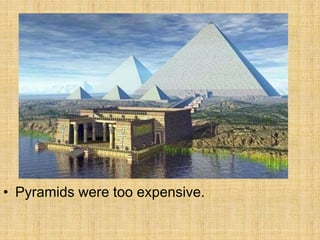
• Pyramids were too expensive.
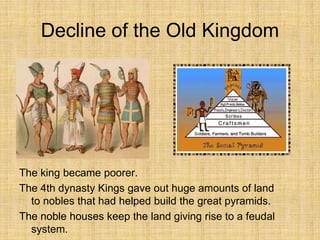
Decline of the Old Kingdom
The king became poorer.
The 4th dynasty Kings gave out huge amounts of land
to nobles that had helped build the great pyramids.
The noble houses keep the land giving rise to a feudal
system.
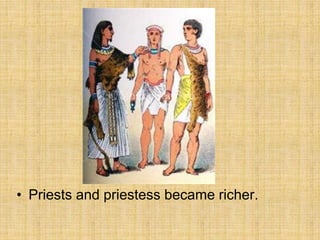
• Priests and priestess became richer.
Decline of the Old Kingdom
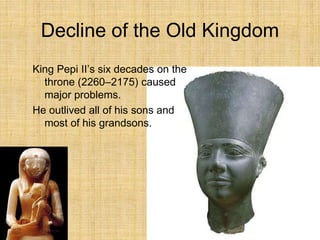
King Pepi II’s six decades on the
throne (2260–2175) caused
major problems.
He outlived all of his sons and
most of his grandsons.
Decline of the Old Kingdom
Upon his death dozens of people clamed to be the true
pharaoh.
In 20 years, 19 pharaohs claimed the throne, and divide up
Egypt’s wealth among their families.
Worst still, a series of low floods of the Nile brought famine
to Egypt.
Nubia revolted and killed the Egyptian official sent to re-
conquer them.
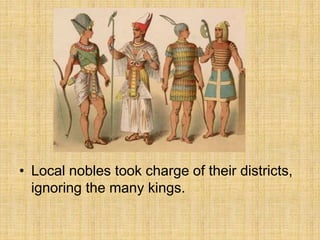
• Local nobles took charge of their districts,
ignoring the many kings.
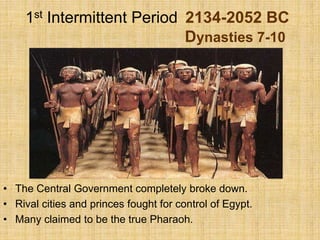
1st Intermittent Period 2134-2052 BC
Dynasties 7-10
• The Central Government completely broke down.
• Rival cities and princes fought for control of Egypt.
• Many claimed to be the true Pharaoh.
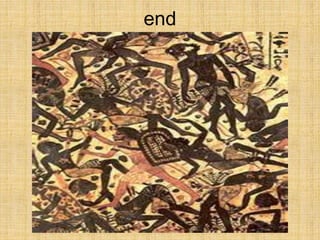
end
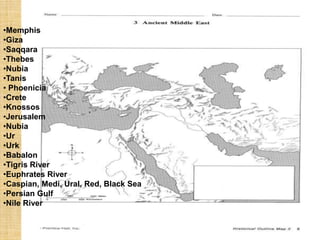
•Memphis
•Giza
•Saqqara
•Thebes
•Nubia
•Tanis
• Phoenicia
•Crete
•Knossos
•Jerusalem
•Nubia
•Ur
•Urk
•Babalon
•Tigris River
•Euphrates River
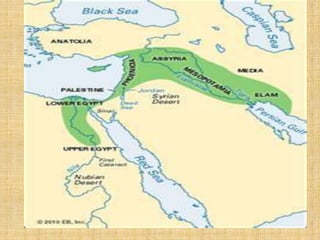
•Caspian, Medi, Ural, Red, Black Sea
•Persian Gulf
•Nile River
Loss of Nubian gold
• One of Pepi’s senior officials, the
chancellor Mehu, was killed by hostile
locals in Nubia.
• Although the Egyptian presence remained
strong in the Dakhla Oasis, Egypt had
effectively lost control of Nubia.
First Intermittent Period
• The devolution of political power to
provincial officials, instigated in the late
Fifth Dynasty, had proved both unwise and
unstoppable. Local bigwigs—some now
calling themselves “great overlord” of their
province—were amassing ever more
authority, arrogating to themselves a
combination of civil and religious offices.
• Suddenly, Egypt was no longer the only
serious power in the Nile Valley. Under its
very nose, upstart Nubian chiefs had taken
control, threatening Egypt’s centuries-old
domination.
• Merenra died, leaving the throne to a boy
of six. The infant king, Neferkara Pepi II,
was not in a position to offer any kind of
guidance to his beleaguered country. At
An Afterlife for all
• following the collapse of the Old Kingdom marked a
watershed in the long-term development of ancient
Egyptian funerary religio
• For the vast majority of the population—the illiterate
peasantry—the presence or absence of strong
government changed little in the pattern of their lives.
Long days of toil in the fields, sowing, hoeing, tending,
and reaping, were as predictable as the rising sun.
• Yet without a central govement local officals repressed
them more and irrgation systems broke down causing
famine and trade routes closed causing economic
destitute.
•.
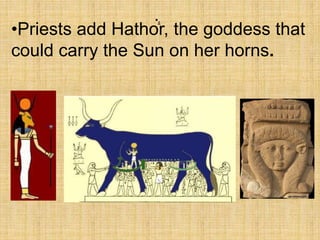
•Priests add Hathor, the goddess that
could carry the Sun on her horns.

2. Egyptian Old Kingdom

  • 2.
    Ancient Egypt isthe first country (nation state) in history.. • It was the first country to be united by a single government. • It was the first country with a national culture. • a nation-state—a political territory whose population shares a common identity— was the invention of the ancient Egyptians.
  • 3.
    Geography and climate playa major role in making a unified Egypt culture.
  • 4.
    It has desertson both sides.
  • 5.
  • 6.
    Individuals who donot get along with the group, can be sent to the desert….a death sentence.
  • 7.
    Egypt is isolated. Its southernboarder has waterfalls.
  • 8.
  • 9.
    The only easyway to go to Egypt is along the Mediterranean coast in the North.
  • 10.
    Egypt has manynatural resources. The Eastern Desert has gold and copper mines.
  • 11.
    Most importantly, Egypthas lots of food. • The Nile river’s annual flood allowed Egyptian farmers to produce a large surplus of food.
  • 12.
    Most importantly, Egypthas lots of food. • Farmers could grow crops three times a year, if they cooperatively built irrigation ditches.
  • 13.
    Herodotus (the fatherof history) called Egypt “The Gift of the Nile” The Greek Historian Herodotus
  • 14.
    The Gift ofthe Nile The Nile River flows for 6,650 KM. It is the longest river in the world.
  • 15.
    The Gift ofthe Nile Until the 20th Century, the Nile river gently floods every year.
  • 16.
    The Gift ofthe Nile Heavy summer rain in Nubia (Ethiopia) swells the Blue Nile.
  • 17.
    •By August, waterarrives in Egypt.
  • 18.
    •The water spreadsover the floodplain and stays for several weeks.
  • 19.
    •As the waterslowly drains, it leaves behind a layer of new fertile soil.
  • 20.
    • This allowedNeolithic Egyptian valley farmers to produce lots of food on the same land year after year.
  • 21.
  • 22.
    SAT Vocabulary • acquiesceapathy • amenable assimilate bucolic • eclectic conducive • omnipotent deference • megalomaniac devout • pedagogical dichotomy • pious fortuitous • supercilious narcissism • viable
  • 23.
    Achieve 3000 Who Builtthe Pyramids? Will this Pyramid draw crowds?
  • 24.
  • 25.
    Timeline • Archaic Period2950 BC- 2650BC • Old Kingdom 2850 BC – 2190 BC First Intermittent Period • Middle Kingdom 2052 BC – 1650 BC • Second Intermittent Period • New Kingdom 1570 BC – 35 BC
  • 26.
    • In 250BCE, Manetho divides it into 30 dynasties in The Aegyptiaca. • Modern historians have added a 31st dynasty. Timeline
  • 27.
    •Champollion & theRosetta Stone •An Egyptian decree written in Ancient Egyptian Hieroglyphics, Greek, and Demonic.
  • 28.
    •Champollion and TheRosetta Stone •In 1799, a French soldier rediscovers it, during Napoleon’s Egyptian Campaign. • In 1801, it travels to London as the British defeat the French.
  • 29.
    •Champollion & theRosetta Stone • In 1822, Jean-François Champollion publishes the first translation of hieroglyphics in Paris.
  • 30.
    Hieroglyphics • In London,Sir Alan Gardiner publishes over 1000 hieroglyphics.
  • 31.
    Timeline • Archaic Period2950 BC- 2650BC • Old Kingdom 2850 BC – 2190 BC First Intermittent Period • Middle Kingdom 2052 BC – 1650 BC • Second Intermittent Period • New Kingdom 1570 BC – 35 BC
  • 32.
    Archaic Period 2950-2650BCE • Priests and Priestesses create writing. • Temples unite the gods into a pantheon. • Pharaoh Narmer (Menes) unites Egypt politically.
  • 33.
    • With somuch food, the population grew quickly throughout Ancient Egypt.
  • 34.
    • A populationis a total of all the people that live in the same geographical region
  • 35.
    Population growth rate •How much a population goes up or down in a region.
  • 36.
    Most people livedin the Nile River Valley
  • 37.
    The population densitywas highest in the Nile River Valley
  • 38.
    population density isthe number of people per square kilometer or square mile.
  • 39.
    Hieroglyphics • Magical pictograms,each standing for a word.
  • 40.
    Hieroglyphics • This forexample is the sign for cattle.
  • 41.
    Hieroglyphics • Also, theEgyptians used signs for sounds. •B
  • 42.
  • 43.
  • 44.
  • 45.
    Hieroglyphics • The Egyptianswould still add the drawing, a very literal people. •BAHZ
  • 46.
    Hieroglyphics The Egyptians consideredhieroglyphs powerful magic of the Gods.
  • 47.
    Hieroglyphics • Around 3000BCE, they find something more practical to write on papyrus. •1600 BCE, The Edwin Smith papyrus, the world's oldest surviving medical document.
  • 48.
  • 49.
    Papyrus • The Egyptiansthought papyrus so important that they crowned their columns with it.
  • 50.
    Hieroglyphics • Writing remainedcomplex and mysterious. Only temple priests, scribes, and some nobles could read and write.
  • 51.
    Religion • The priestsand priestess cooperated with each other, turning an eclectic assortment of Gods into a national mythology.
  • 52.
    Ra the SunGod had been the chief god at Heliopolis.
  • 53.
    • Obelisk carvedfrom a single stone • Dedicated to RA, • Image of a Sun’s ray. • 20.7 m / 68 ft high 120 tons • London
  • 54.
  • 56.
    • Vatican City •25.5 m/83.6 ft high 331 ton obelisk
  • 57.
    • Washington Monumentmade in the USA, five times larger than any Egyptian obelisk at 169.294 m.
  • 58.
    Ra the SunGod Chief god at Heliopolis • How the obelisks were erected in Ancient Egypt (theory)_(3 60p).flv
  • 59.
    Ra the SunGod Chief god at Heliopolis • How the obelisks were erected in Ancient Egypt (theory)_(3 60p).flv
  • 60.
  • 61.
    OSIRIS God ofthe Nile and ruler of the After life Had been the chief god of Abydos
  • 62.
    Isis his sisterwife and goddess of magic Chief goddess at Philae
  • 63.
    Nepthys, Set’s sisterwife and consort to Osiris
  • 64.
    Horus the avengergod Son of Isis and Osiris Former Chief God at Nekhen, Behdet , Edfu
  • 65.
    Anubis Keeper of theDead Son of Osiris and Nepthys
  • 66.
  • 67.
    SETH Osiris’ brotherand god of war, desert, and things foreign. Chief God at Ombos
  • 68.
    NS=???????? • Egyptians treatedoutsiders without mercy. • Egypt did not welcome foreigners.
  • 69.
    •. The Nile ValleyCulture did not welcome tribes moving in from the Western and Eastern deserts. •3150-2950 BCE Warring States
  • 70.
    Around 3200 BC,tribes from the Eastern and Western Sahara moved into the Nile Valley .
  • 71.
    The Eastern andWestern Sahara had been Savanna.
  • 72.
    But the climatechanged (cause)! Summer rains that used to water the savanna moved south eastward.
  • 73.
    The summer rainsnow fell in Nubia, and the savannas dried out.
  • 74.
    By 5000 BC,the savannas had become mostly desert.
  • 75.
    • While Egyptianstrong men fought for control of the Nile, they cruelly dominate Nubia. •3150-2950 BCE Warring States
  • 76.
    • While Egyptianstrong men fought for control of the Nile, they cruelly dominate Nubia. 3150-2950 BCE Warring States
  • 77.
    • The Nubianssend tribute in gold, copper, slaves and soldiers to Egypt. 3150-2950 BCE Warring States
  • 78.
    After two centuriesof war, King Narmer (Menes) unites Egypt politically and establishes Memphis as the capital city around 2950 BCE. •Narmer Palette •Egyptian Museum
  • 79.
    After two centuriesof war, King Narmer (Menes) unites Egypt politically and establishes Memphis as the capital city around 2950 BCE. •Narmer Palette •Egyptian Museum
  • 80.
    • It explicitlyidentifies the king as the earthly son of Horus. •Narmer Palette •Egyptian Museum
  • 81.
    • Battlefield Paletteof Narmer (Menes)
  • 82.
    Narmer (Menes) foundsthe first dynasty of pharaohs.
  • 83.
    Pharaoh (Great House) •The King, leader of the Pharaoh, wore three crowns symbolizing the dichotomy of the kingdom. • The red crown of Lower Egypt, the tall white crown of Upper Egypt, and a combination of both.
  • 84.
    Pharaoh (Great House) •The King carries a crook and a flail, recalling the nomadic herdsmen of the Neolithic cultures.
  • 85.
    Pharaoh (Great House) •The King owns everything in the Kingdom, including the people. • His word is law, never codified as every decision he makes is right.
  • 86.
    Pharaoh (Great House) •The semi divine King controls and provides MAAT to the Kingdom (peace, harmony, regularity, happiness).
  • 87.
    Pharaoh (Great House) •The pharaoh guarantees that the Sun would rise every day, through the Sun’s journey under Egypt at night.
  • 88.
    Pharaoh (Great House) •Pharaoh insures crops would grow, by ceremonially plowing the first field.
  • 89.
    Pharaoh (Great House) •Pharaoh throws a note into the Nile, commanding the flood to come.
  • 90.
    Pharaoh (Great House) •The First to Third dynasties create a national administration . • The Pharaoh divides the kingdom into 70 districts lead usually by one of his many sons or a priest.
  • 91.
    Pharaoh (Great House) •The national administration builds cities primarily to collect and levy taxes. • Most Egyptians remain living in small farming villages.
  • 92.
    HIGH PRIESTS ANDPRIESTESSES Served gods and goddesses PHARAOH Earthly leader; considered a god NOBLES Collected taxes; fought pharaoh’s wars MERCHANTS, SCRIBES, AND ARTISANS Made furniture, jewelry, and fabrics for pharaohs and nobles, and provided for other needs PEASANT FARMERS AND SLAVES Worked in the fields and served the pharaoh Social Classes 2
  • 93.
  • 94.
    Pharaoh (Great House) •The Pharaoh rules a centrally controlled command economy. • Kings built projects on a lavish scale.
  • 95.
    Pharaoh (Great House) •On the east bank of the Nile, they build small cities to collect taxes and temples to the Gods. •Dandara Temple •Memphis Egypt
  • 96.
  • 98.
    Mastaba: made ofsun dried bricks or stone. • On the west bank, they built opulent burial structures and temples for the dead kings. •Mastaba of a king •Royal Cemetery at Sakkar
  • 99.
    Pharaoh (Great House) •The King not only rules in this world, but would rule in the next. • The King’s immortal spirit (KA) would be resurrected in the afterlife. •Ra’s solar barge
  • 100.
    Ground level floorscontain chambers filled with things the king would need in the next life, and rooms for sacrifices. Relatives and retainers were killed and buried with the early Kings. •Mastaba of Menes Mastaba: made of sun dried bricks or stone.
  • 101.
    The King restedin the chamber below ground. •Mastaba of Menes Mastaba: made of sun dried bricks or stone.
  • 102.
    •Shawabti box •Gift bearers •Modelboat Funerary Gifts •By the second dynasty, models replace people.
  • 103.
  • 104.
    •Journey to theStars •A boat for the journey is provided for a dead pharaoh in his tomb. •The King traveled on the “Solar Bark” of Ra.
  • 106.
    Preparing Pharaoh's body beginsin the House of Anubis
  • 107.
  • 108.
    •Magical eye of Rafacing East from which the Kings sprit KA could go out and in.
  • 109.
    •Second inner coffin lid •Secondinner coffin •2 •3 •4 •5•1 •6
  • 110.
    •Outer wood andstone coffins
  • 111.
  • 112.
    •Materials Used inMummification •1. Linen 6. Natron 2. Sawdust 7. Onion 3. Lichen 8. Nile Mud 4. Beeswax 9. Linen Pads 5. Resin 10. Frankincense
  • 113.
    Mummies • 70 stepsto make a mummy. – 1) Removal of the brain through the nostrils – 2) Removal of the intestines through an incision in the side 3) Sterilization of the body and intestines – 4) Treating, cleaning, dehydrating the intestines – 5) Packing the body with natron (a natural dehydrating agent) and leaving for 40 days – 6) Removal of the natron agent – 7) Packing the limbs with clay or sand – 8) Packing the body with linen (soaked in resin), myrrh and cinnamon – 9) Treating the body with ointments and finally wrapping with a fine linen gauze, not less than 1000 square meters .
  • 114.
    •Canopic Jars madeof alabaster store the heart, stomach, intestines and liver.
  • 116.
    •Egyptian Mummies •Seti I 1291-1278B. C. E. •Queen Tiye, wife of Amenhotep II •Ramses II 1279-1212 B. C. E.
  • 117.
    Old Kingdom 2650BC – 2134 BC Dynasties 3-6 • An Arabic proverb states “man fears time, but time fears the pyramids.” • Era of great pyramid building, strong centralized nation. • The King alone gave Maat. • The King exclusively gains immortality in the afterlife.
  • 118.
    Old Kingdom 2650BC – 2134 BC • Around 2650 BC, King Zoser (Djoser) and the architect Imhotep construct the Step Pyramid at Sakkara.
  • 119.
    Step Pyramid atSakkara. C 2650 BC • Imhotep designed 6 successively smaller mastabas on top of each other. • 62.18 meters(204 feet) Base: 125.27 m x 109.12 m (411’ x 358’)
  • 120.
    Step Pyramid atSakkara 2650 BC • Imhotep planned a complex of temples, walls, and lesser burial chambers around the step pyramid.
  • 121.
    Step Pyramid atSakkara 2650 BC • Cities of the dead always located on the west bank of the Nile.
  • 122.
  • 124.
    King Sneferu 2613to 2589 BC • Founder of the 4th dynasty. • Improved and built at least 3 pyramids. • Added the phrase “neb maat” to his Horus name, “owner of truth”. • The king’s word is law because the king himself is the law.
  • 125.
    King Sneferu 2613to 2589 BC • He attempts a larger step pyramid at Meidum, but it did not work out so well.
  • 126.
    Step Pyramid atMeidum • Height 65 meters (213 ft) (ruined) (From base to summit: 93.5 meters (307 ft)) • Base 144 meters (472 ft) • Slope 51°50'35
  • 127.
    King Snefru 2613BC to 2589 BC • His next attempt results in the bent pyramid at Dahshur. • The lower part of the pyramid rises at 54-degrees, yet the top section changes to 43 degrees.
  • 128.
    Bent Pyramid • Height101.1 meters (332 ft) • Base 188.6 meters (619 ft) • Slope 54°27'(lower) 43°22'(upper)
  • 129.
    King Snefru 2613BC to 2589 BC • Height 101.1 meters (332 ft) • Base 188.6 meters (619 ft) • Slope 54°27'(lower) 43°22'(upper)
  • 130.
    Red or TruePyramid • Thirdly, he built the red pyramid at Dahshur. • The third time is a charm!
  • 131.
    King Snefru 2613to 2589 BC • Height 104 meters (341 ft) • Base 220 meters (722 ft)
  • 132.
    King Snefru 2613BC to 2589 BC Here he was buried, after adding the title “netjer nefer” meaning “the perfect god” to his title.
  • 133.
    Sneferu’s son Khufubecame the most famous pyramid builder of all time. • The pyramids of Giza, the only surviving “7 Wonders of the World, the rest gone like the Hanging Gardens of Babylon.
  • 134.
    Egyptian Building Tech farmershad to work during the flood season for the King, some slaves from Nubia.
  • 135.
    The Great Pyramidat Giza 2545–2525 BC. • Built by King Kufu (Cheops) • made of 2.3 million blocks of stone, each weighing on average more than a ton, some weigh 9 tons . • It covers an area of thirteen acres.
  • 136.
    The Great Pyramidat Giza 2545–2525 BC. • Builders had to set one block of stone in place every two minutes, ten-hours a day, for the two decades of Khufu’s reign.
  • 137.
    • The PyramidTexts cover the inside walls.
  • 138.
    • They aremagical spells, showing the way to RA’s boat.
  • 139.
    • The Pyramidtexts give instructions on how to get to RA’s solar barge.
  • 140.
    •Inner chambers ofthe pyramid of King Unas (Fifth Dynasty) at Saqqara.
  • 141.
    •The Great Pyramid •Base230.33 m and height 146.59 m, the Great Pyramid was the tallest building in the world until the Eiffel Tower (1889 CE).
  • 142.
    • King Kufu’snephew Hemiunu designed the building project.
  • 143.
    •The Giza plateau(like Dahshur) being visible from Saqqara, yet on virgin ground.
  • 144.
    •2 •3 •4•5•1 •6
  • 145.
    Khafra (c 2500) •Kufu’s son built his pyramid next to Kufu’s.
  • 146.
    Khafra (c 2500) •He chose a place on a hill.
  • 147.
    Khafra (c 2500) •Even though the pyramid is not as high as Kufu’s (Originally: 143.5 m Base215.25 m), it looks bigger.
  • 148.
    Khafra (c 2500) •Hecarved The Great Sphinx out of a rock outcropping, symbolizing , unification with the sun god,, a megalomaniac.
  • 149.
    •73.5 m long,19.3 m wide, and 20.22 m high
  • 150.
    Khafra (c 2500) •TheGreat Sphinx reoriented the whole site around Khafra’s pyramid
  • 151.
    Menkaura • The sonof Khafra built the last pyramid at Giza, much smaller Height 65.5 m Base103.4 m, one-tenth of the volume of the Great Pyramid.
  • 152.
    Menkaura • It’s madeout of red granite from the first cataract.
  • 153.
    Menkaura • They builta huge pyramid temple, where Menkaura’s funerary cult continued to be celebrated for centuries after his death.
  • 155.
    Giza • By theend of the dynasty, Giza was a complex place.
  • 157.
    Giza • By theend of the dynasty, Giza was a complex place.
  • 158.
    •Built by thecorvee: free work peasan •farmers had to do.
  • 159.
    •Pay ten loavesof bread and a jug of beer per day.
  • 160.
    •Pharaohs-The Great Pyramidof Egypt (How was it built_) - BBC 1 of 6 = 2011_(360p).flv •Building the Great Pyramid_(360p).flv
  • 161.
    •One in sevenworkers died, making the three kings the most despised in Egyptian history.
  • 162.
    • Joseph Davidovitsthinks the Egyptians poured the pyramid blocks, not carved stone. Limestone casted like modern concrete.
  • 163.
    • Davidovits' methodwas not accepted by the archeologists of England.
  • 164.
    • But, MichelBarsoum discovered air bubbles in the limestone pyramid blocks, which do not occur in natural limestone
  • 166.
    4th Dynasty • KingHuni last 3rd dynasty daughter Hetepheres I married general Sneferu • Pharaoh Sneferu, Snofru, Snefer • Pharaoh Khufu, Khnum, Khufum, Kufu • Pharaoh Khafra, Khafre, Khefren, Chephren • Pharaoh Menkaure, Menkaura
  • 167.
    • Pyramids weretoo expensive.
  • 168.
    Decline of theOld Kingdom The king became poorer. The 4th dynasty Kings gave out huge amounts of land to nobles that had helped build the great pyramids. The noble houses keep the land giving rise to a feudal system.
  • 169.
    • Priests andpriestess became richer.
  • 170.
    Decline of theOld Kingdom King Pepi II’s six decades on the throne (2260–2175) caused major problems. He outlived all of his sons and most of his grandsons.
  • 171.
    Decline of theOld Kingdom Upon his death dozens of people clamed to be the true pharaoh. In 20 years, 19 pharaohs claimed the throne, and divide up Egypt’s wealth among their families. Worst still, a series of low floods of the Nile brought famine to Egypt. Nubia revolted and killed the Egyptian official sent to re- conquer them.
  • 172.
    • Local noblestook charge of their districts, ignoring the many kings.
  • 173.
    1st Intermittent Period2134-2052 BC Dynasties 7-10 • The Central Government completely broke down. • Rival cities and princes fought for control of Egypt. • Many claimed to be the true Pharaoh.
  • 174.
  • 175.
  • 176.
    Loss of Nubiangold • One of Pepi’s senior officials, the chancellor Mehu, was killed by hostile locals in Nubia. • Although the Egyptian presence remained strong in the Dakhla Oasis, Egypt had effectively lost control of Nubia.
  • 177.
    First Intermittent Period •The devolution of political power to provincial officials, instigated in the late Fifth Dynasty, had proved both unwise and unstoppable. Local bigwigs—some now calling themselves “great overlord” of their province—were amassing ever more authority, arrogating to themselves a combination of civil and religious offices.
  • 178.
    • Suddenly, Egyptwas no longer the only serious power in the Nile Valley. Under its very nose, upstart Nubian chiefs had taken control, threatening Egypt’s centuries-old domination. • Merenra died, leaving the throne to a boy of six. The infant king, Neferkara Pepi II, was not in a position to offer any kind of guidance to his beleaguered country. At
  • 179.
    An Afterlife forall • following the collapse of the Old Kingdom marked a watershed in the long-term development of ancient Egyptian funerary religio • For the vast majority of the population—the illiterate peasantry—the presence or absence of strong government changed little in the pattern of their lives. Long days of toil in the fields, sowing, hoeing, tending, and reaping, were as predictable as the rising sun. • Yet without a central govement local officals repressed them more and irrgation systems broke down causing famine and trade routes closed causing economic destitute.
  • 181.
    •. •Priests add Hathor,the goddess that could carry the Sun on her horns.