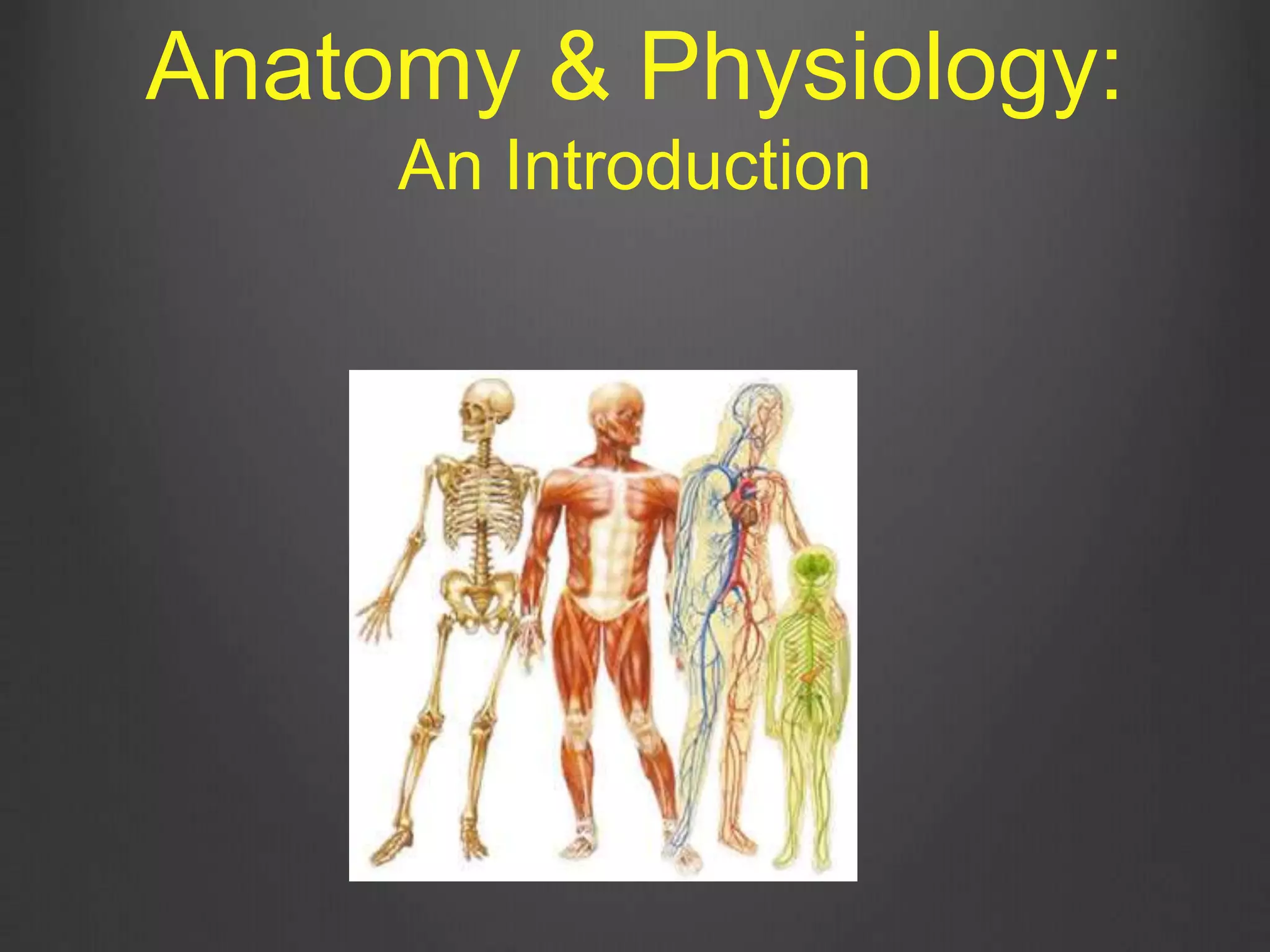
Anatomy & Physiology:
An Introduction
Anatomy - The study of
the structure of the human
body
Physiology - The study of
the functions of the human
body
An Overview of Anatomy
Branches of Anatomy
o Surface anatomy
(outside)
o Gross anatomy (inside)
o Microscopic anatomy
(histology) -tissues
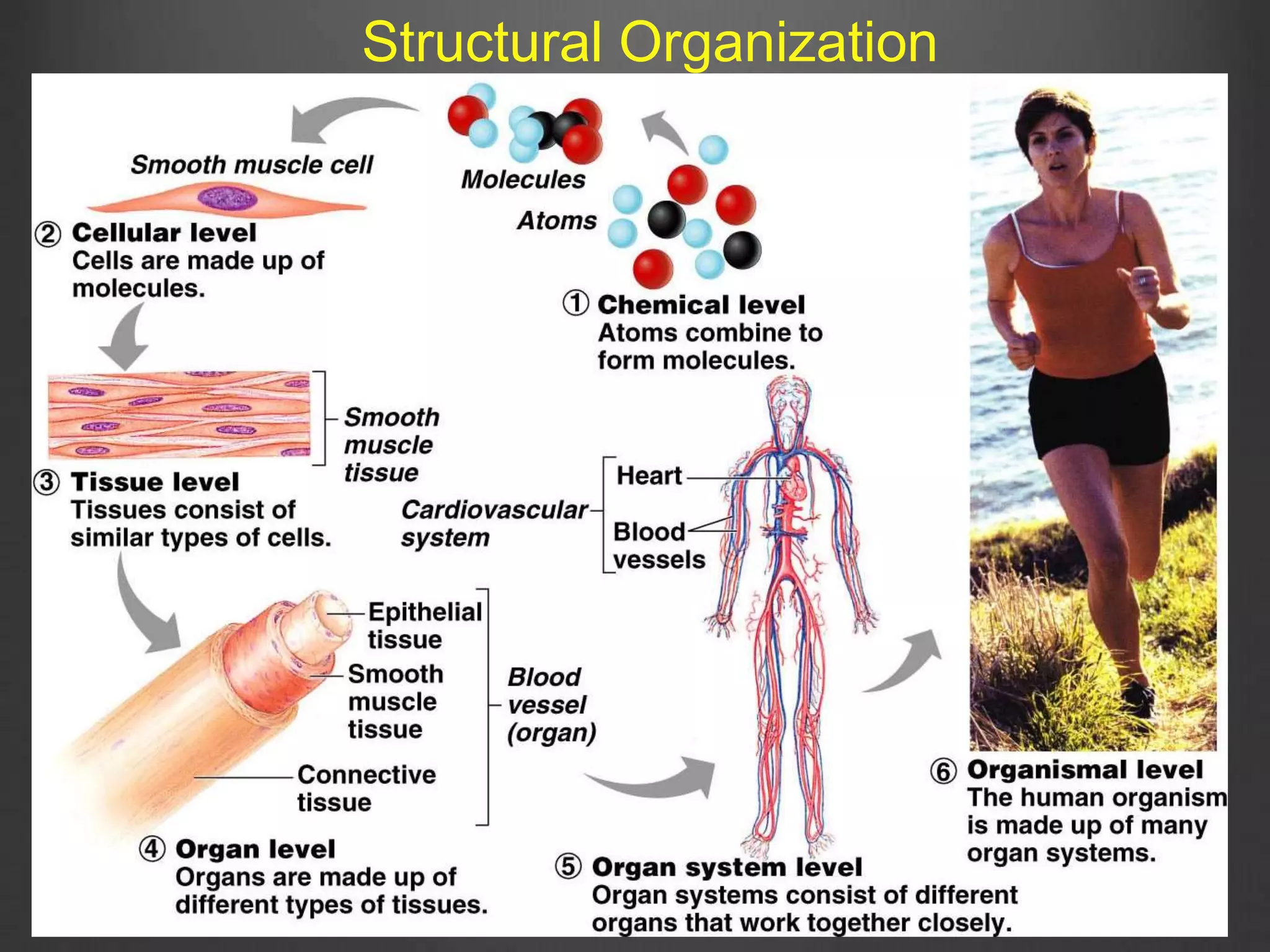
Structural Organization
 Chemical level – atoms & molecules
 Cellular level – cells
 Tissue level – a group of cells
performing a common function
 Organ level – a structure made up of
more than one type of tissue
 Organ system – organs working
together for a common purpose
 Organism – the result of all simpler
levels working together
Structural Organization
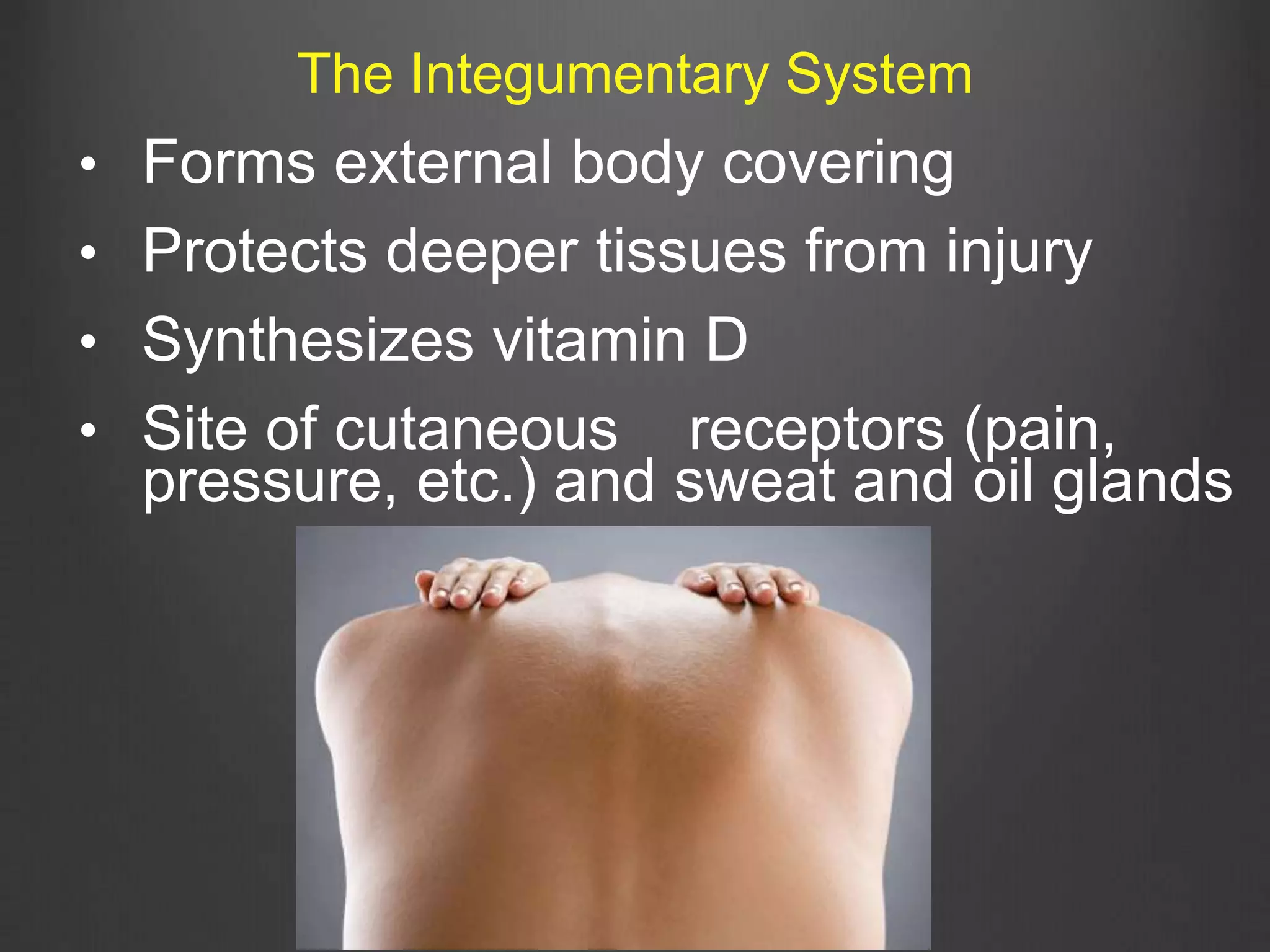
• Forms external body covering
• Protects deeper tissues from injury
• Synthesizes vitamin D
• Site of cutaneous receptors (pain,
pressure, etc.) and sweat and oil glands
The Integumentary System
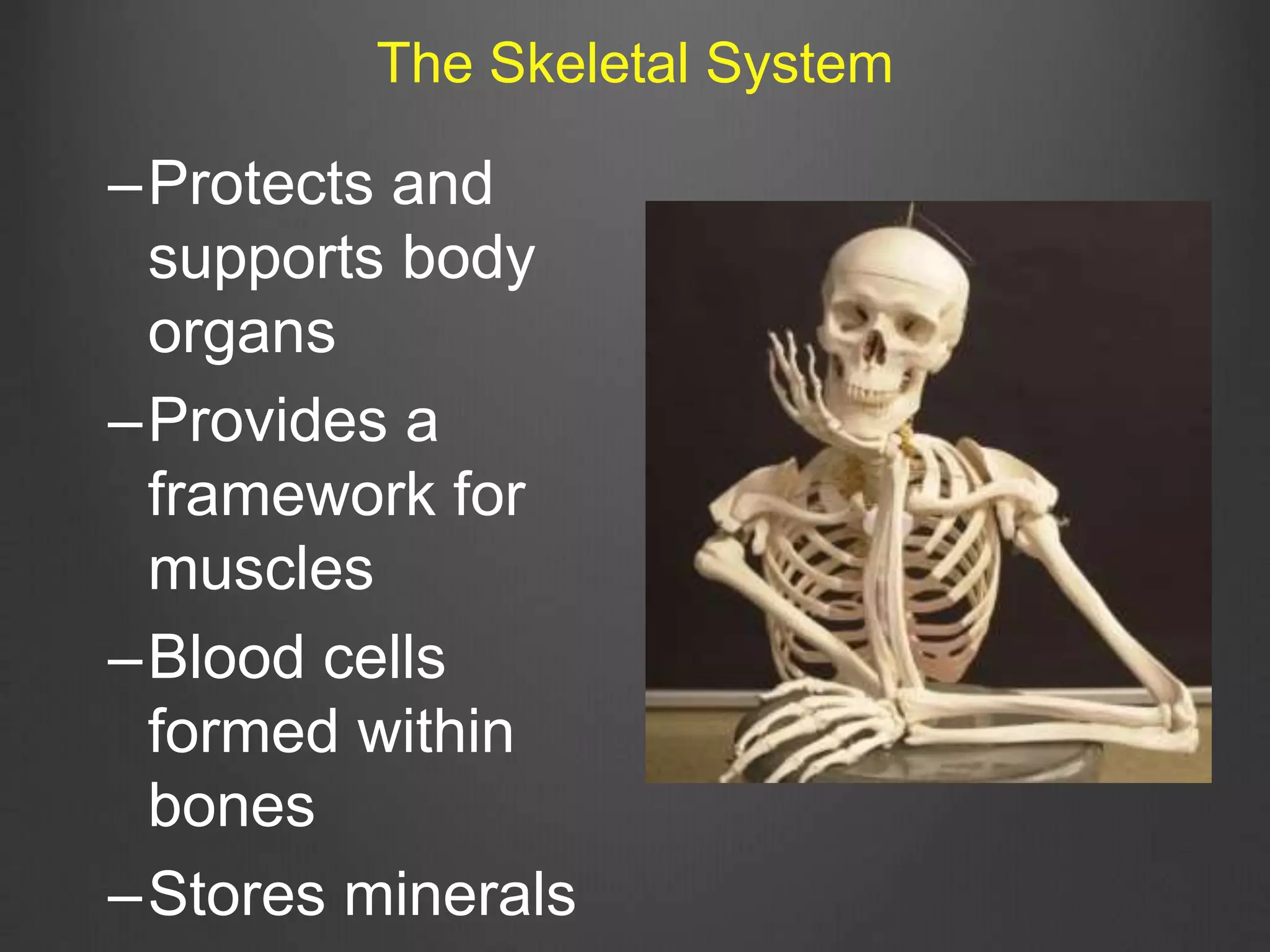
–Protects and
supports body
organs
–Provides a
framework for
muscles
–Blood cells
formed within
bones
–Stores minerals
The Skeletal System
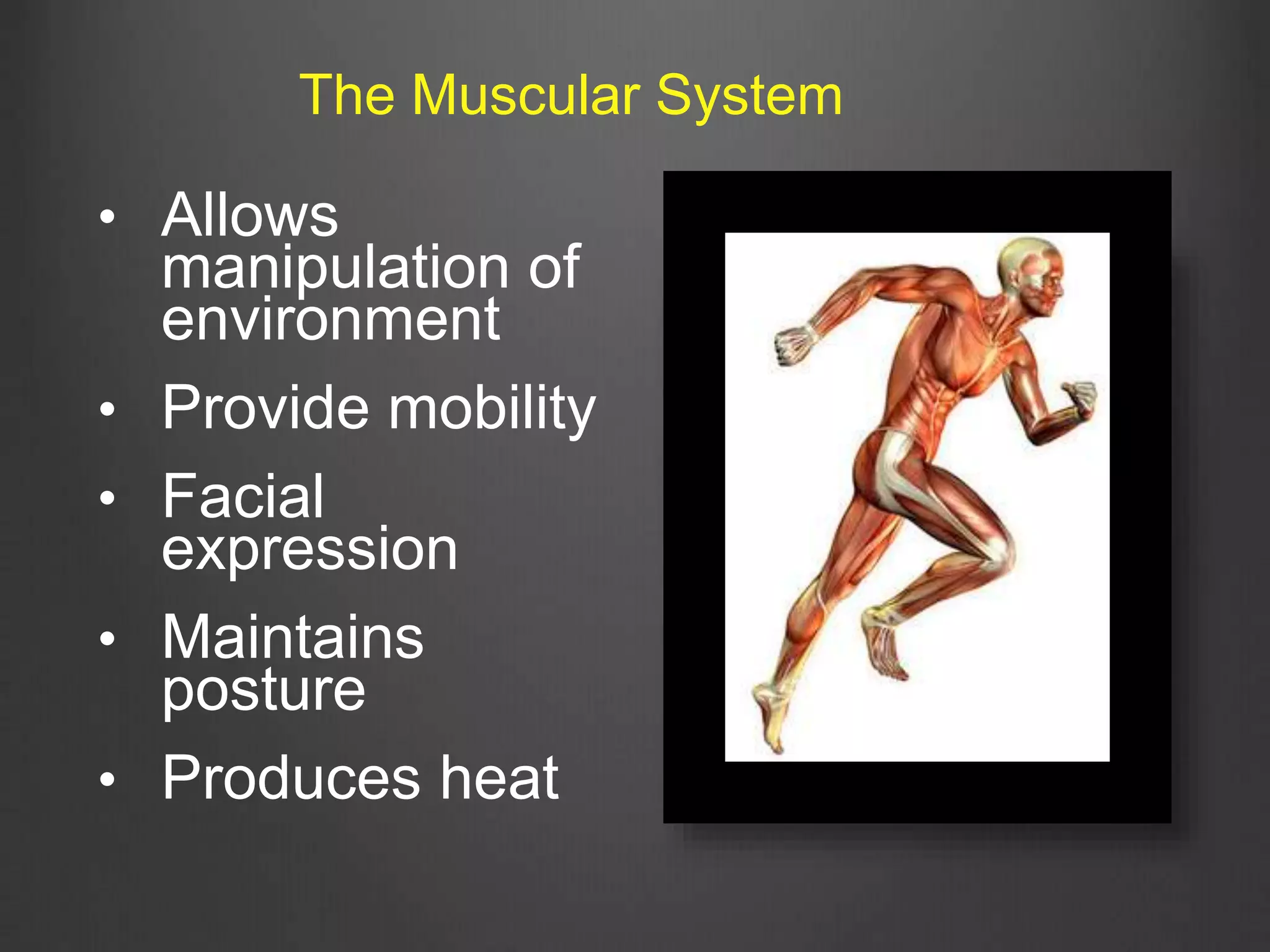
• Allows
manipulation of
environment
• Provide mobility
• Facial
expression
• Maintains
posture
• Produces heat
The Muscular System
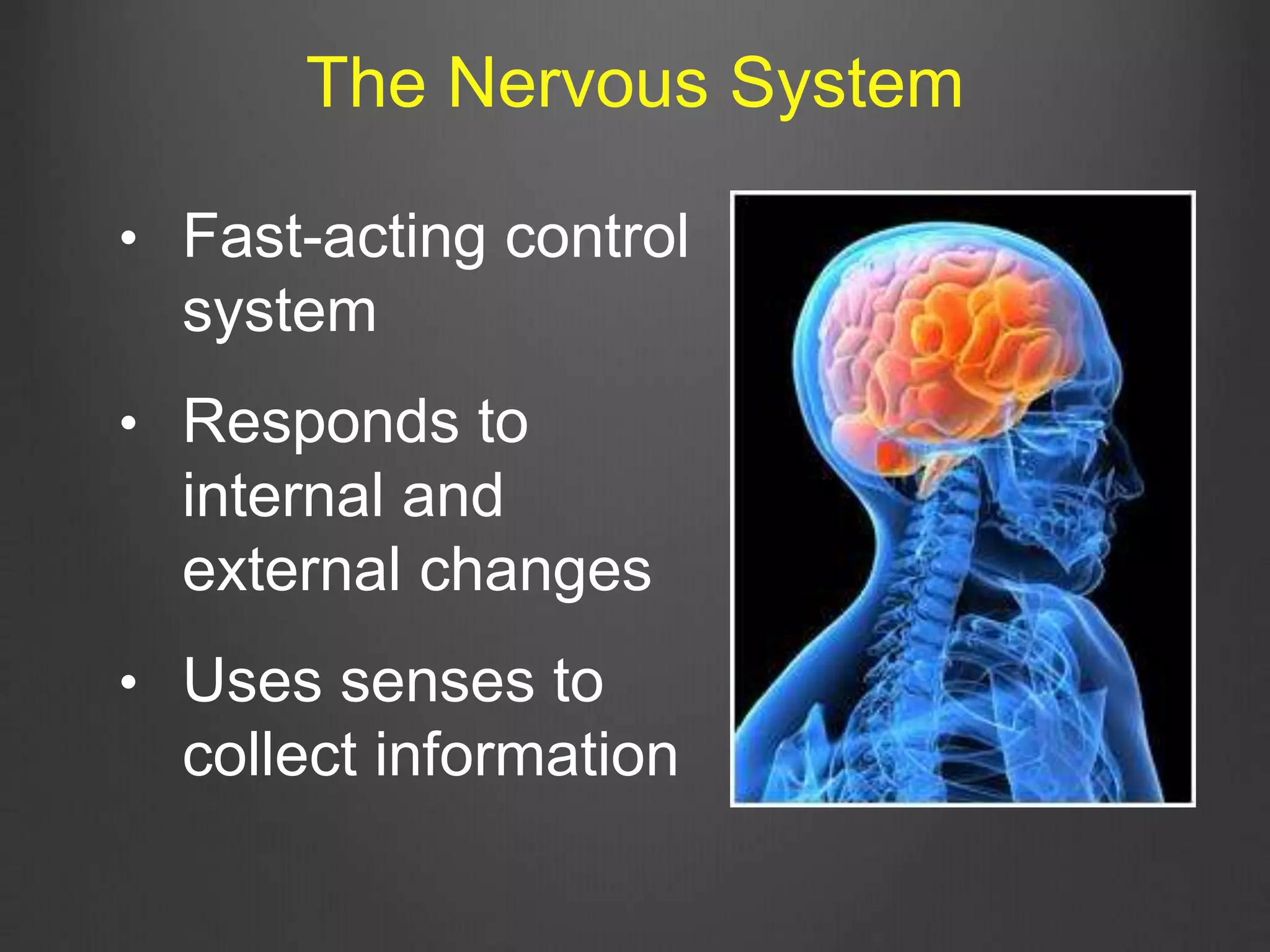
• Fast-acting control
system
• Responds to
internal and
external changes
• Uses senses to
collect information
The Nervous System
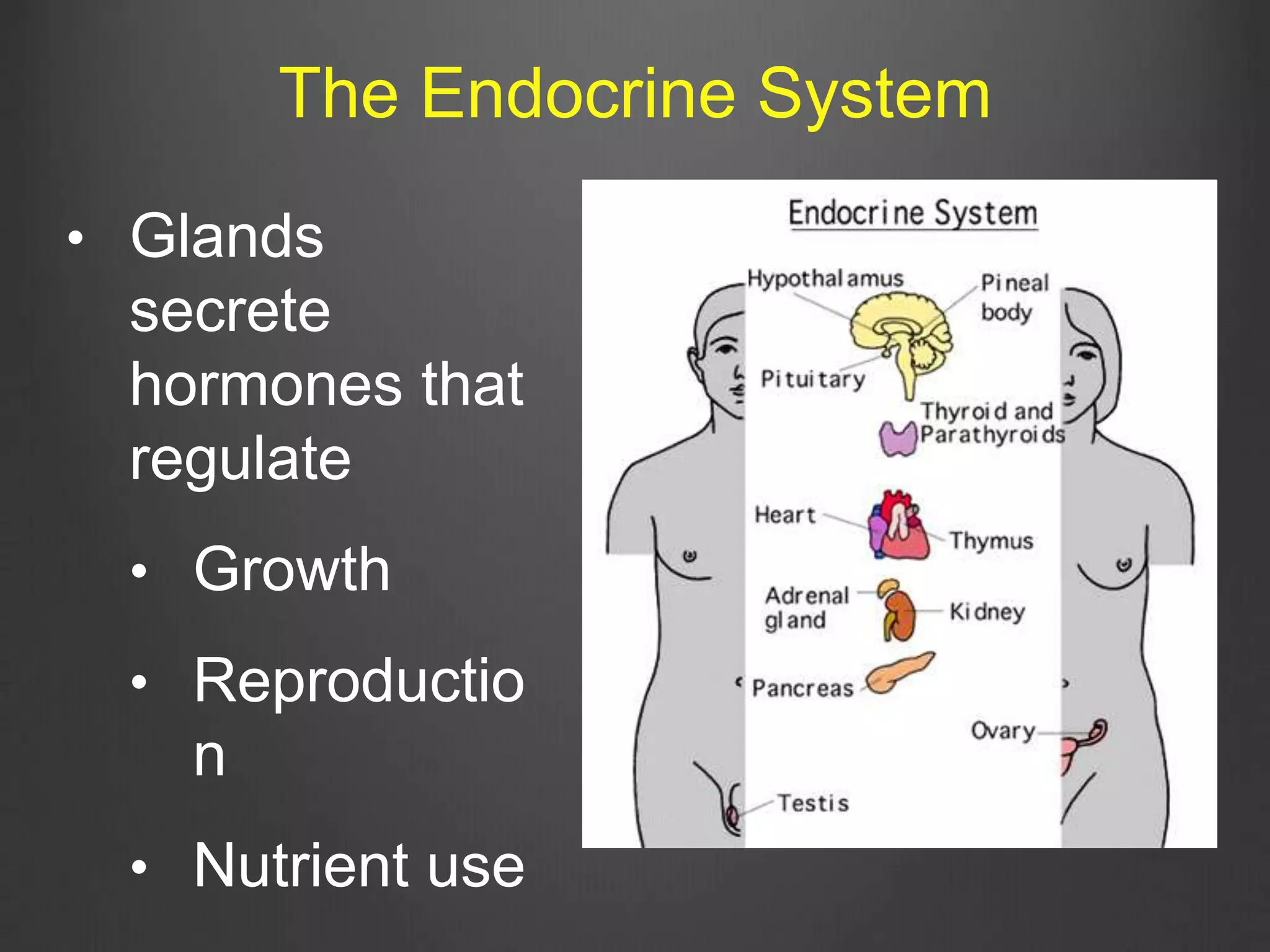
• Glands
secrete
hormones that
regulate
• Growth
• Reproductio
n
• Nutrient use
The Endocrine System
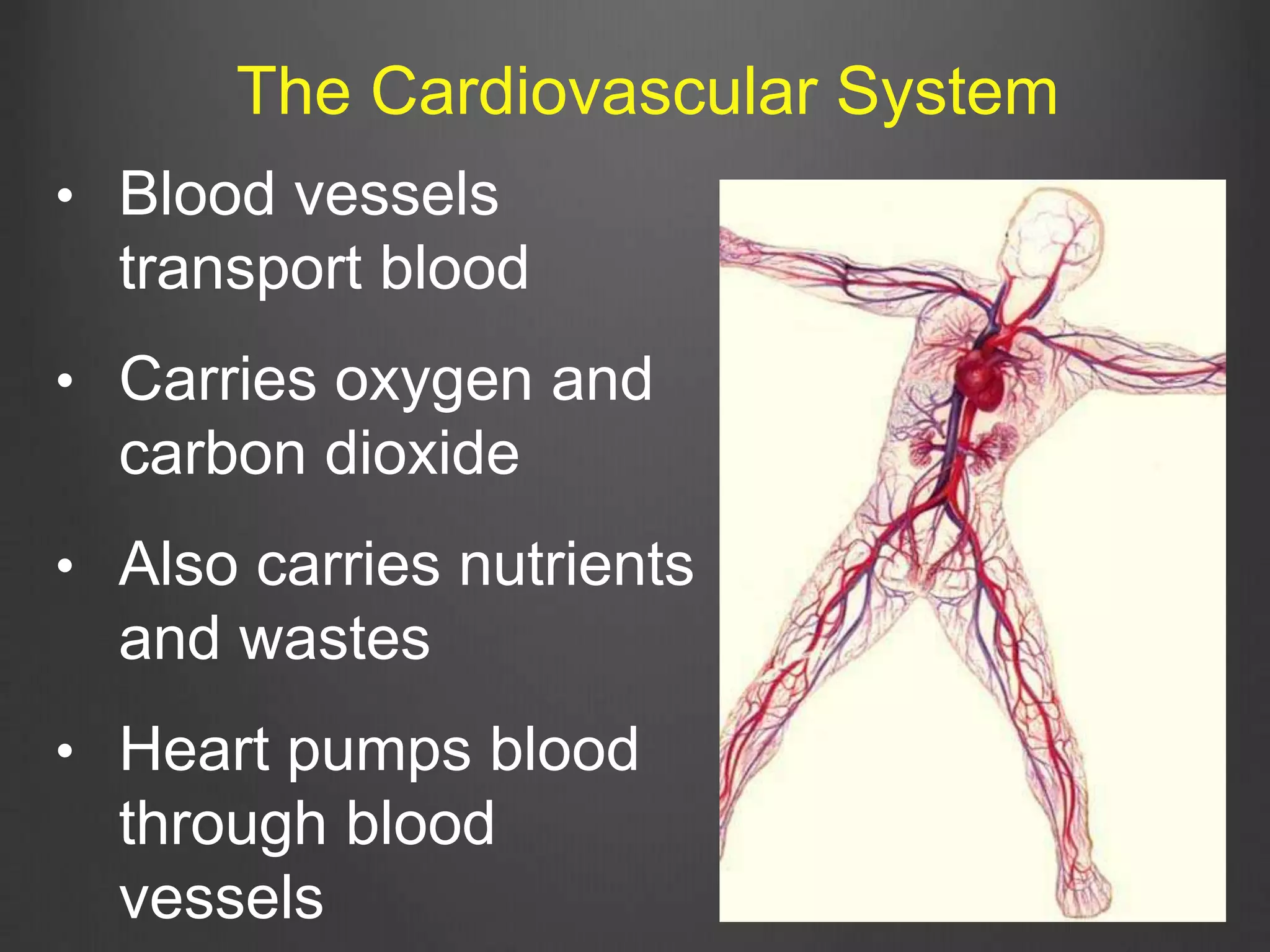
The Cardiovascular System
• Blood vessels
transport blood
• Carries oxygen and
carbon dioxide
• Also carries nutrients
and wastes
• Heart pumps blood
through blood
vessels
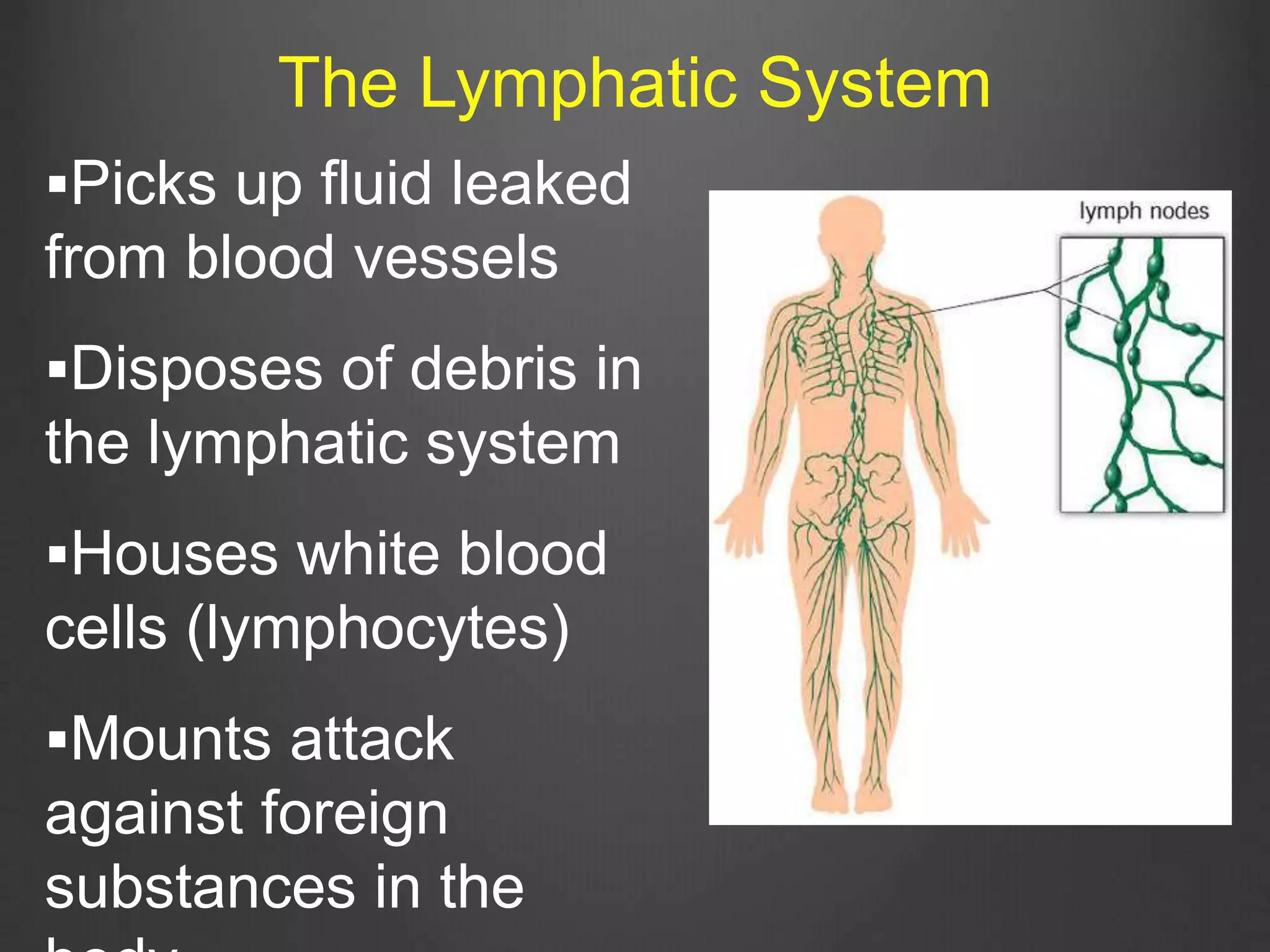
Picks up fluid leaked
from blood vessels
Disposes of debris in
the lymphatic system
Houses white blood
cells (lymphocytes)
Mounts attack
against foreign
substances in the
The Lymphatic System
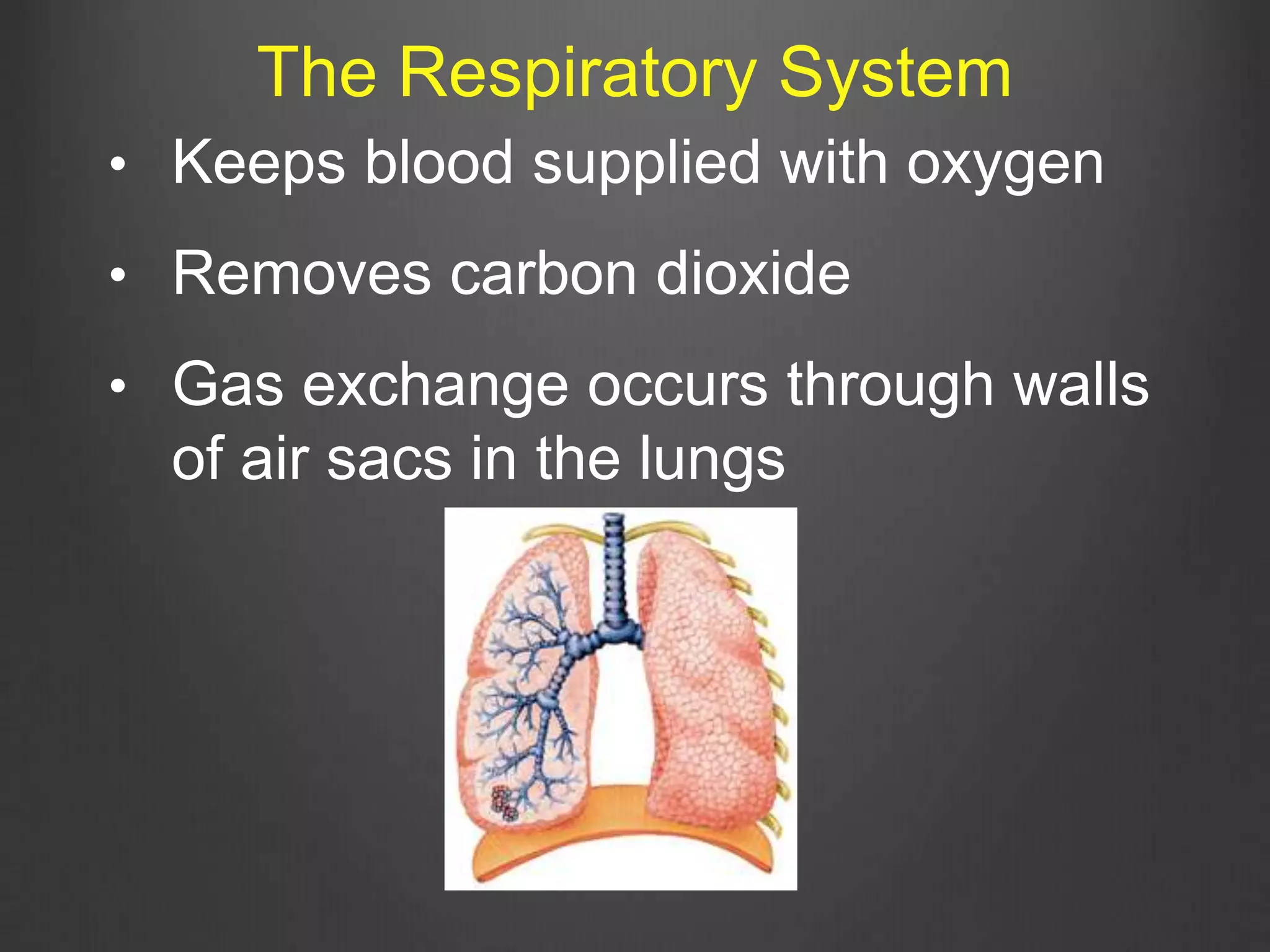
• Keeps blood supplied with oxygen
• Removes carbon dioxide
• Gas exchange occurs through walls
of air sacs in the lungs
The Respiratory System
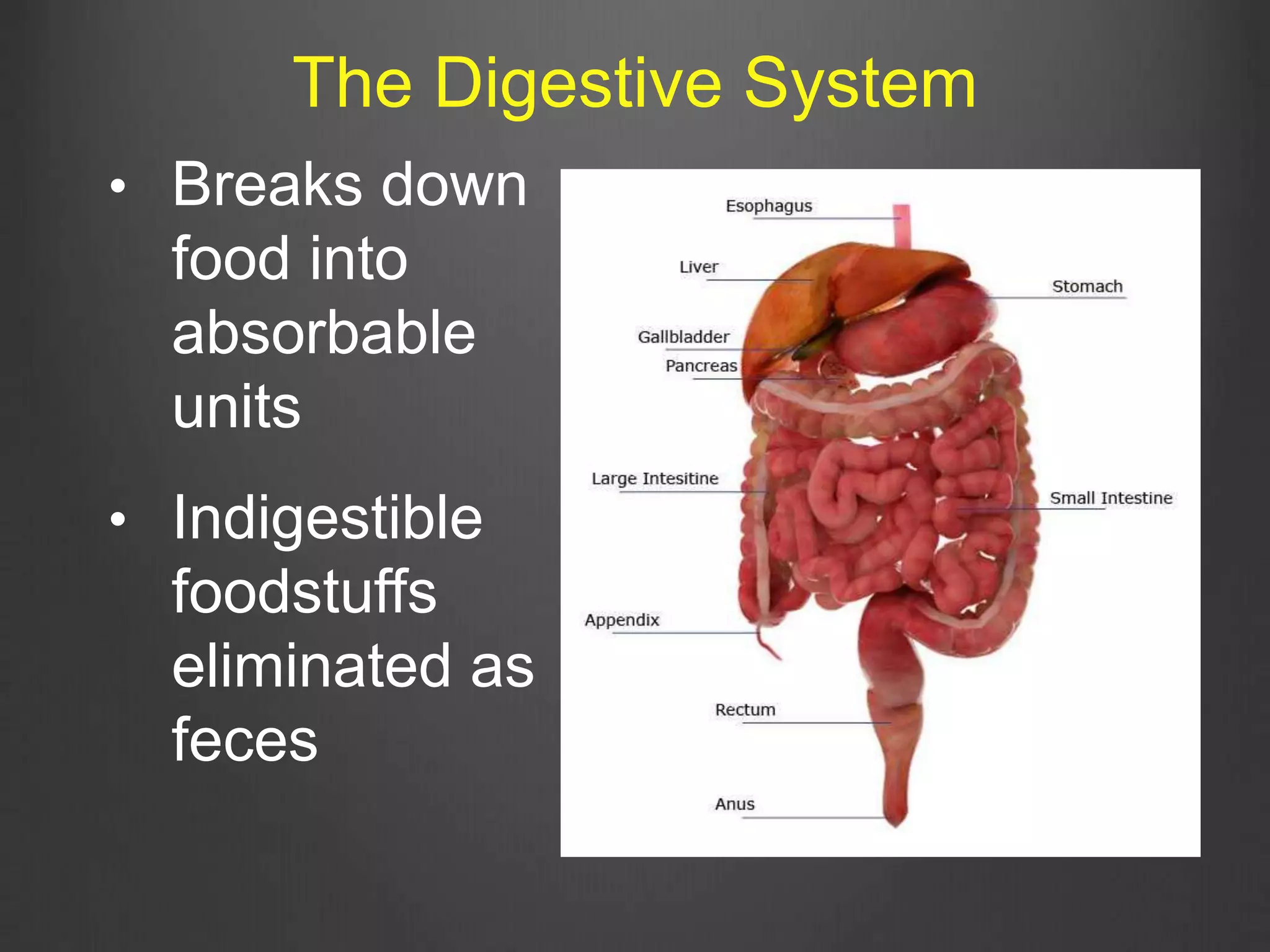
• Breaks down
food into
absorbable
units
• Indigestible
foodstuffs
eliminated as
feces
The Digestive System
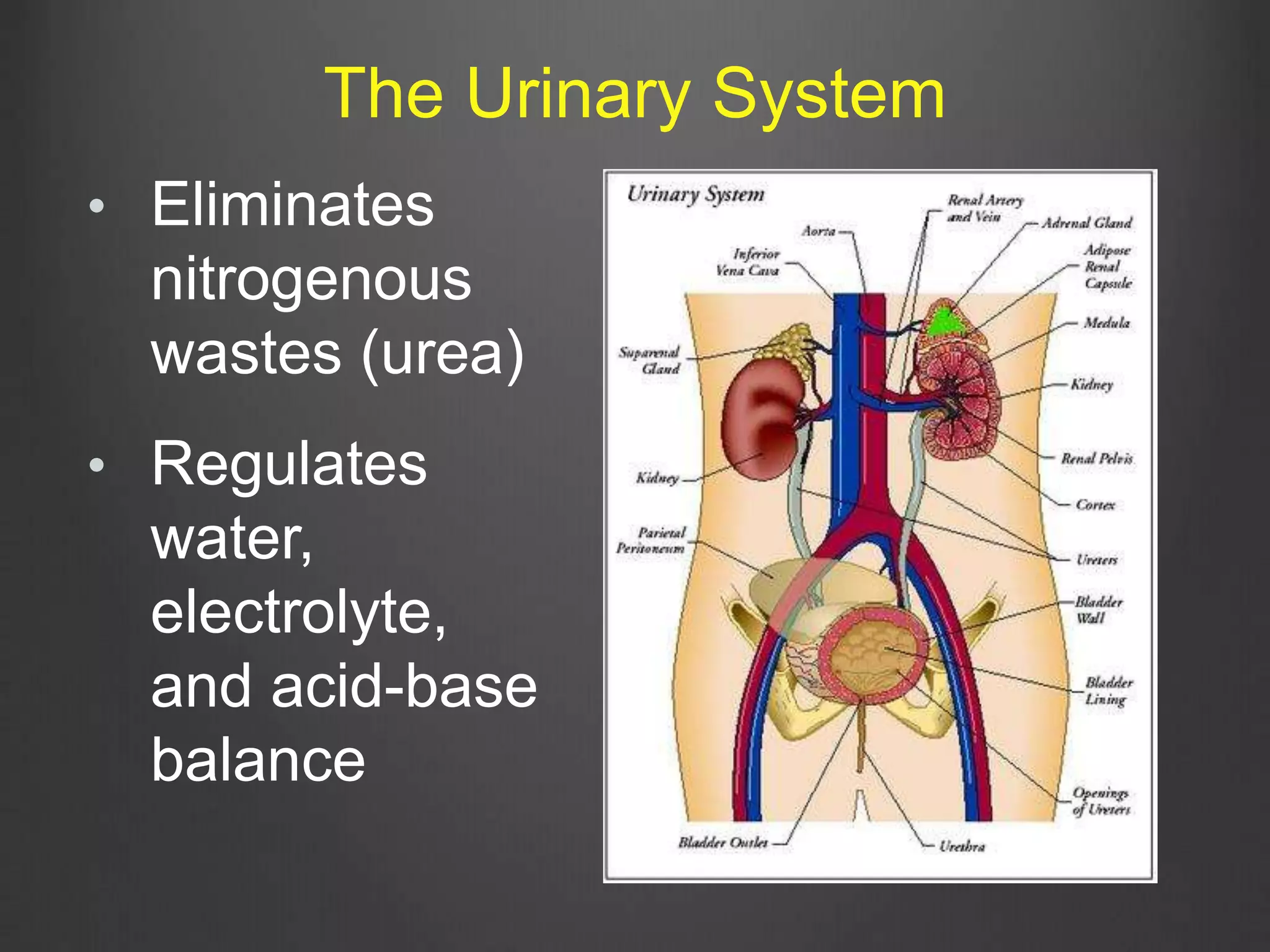
• Eliminates
nitrogenous
wastes (urea)
• Regulates
water,
electrolyte,
and acid-base
balance
The Urinary System
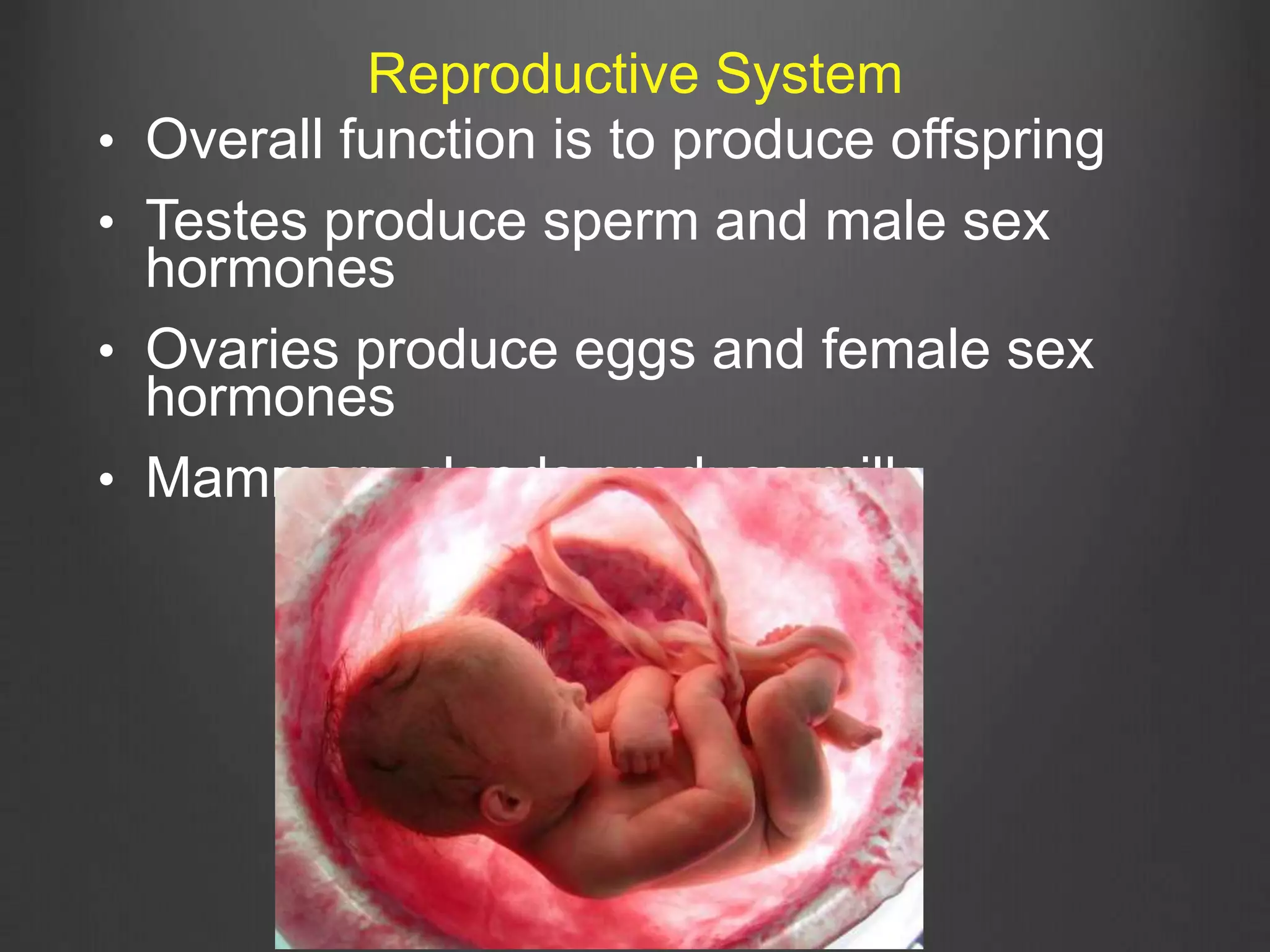
• Overall function is to produce offspring
• Testes produce sperm and male sex
hormones
• Ovaries produce eggs and female sex
hormones
• Mammary glands produce milk
Reproductive System
Necessary Life Functions:
• List eight functions that humans
must perform to maintain life.
Compare your answers with
your partner’s answers.
• List five survival needs of the
human body. Which do you
think is the most important and
why?
Maintaining Life
God has put all parts of our body
together in the way that he decided is
best. A body isn’t really a body, unless
there is more than one part. It takes
many parts to make a single body.
That’s why the eyes cannot say they
don’t need the hands. That’s also why
the head cannot say it doesn’t need
the feet. In fact, we cannot get along
without the parts of the body that seem
to be the weakest.
1
Corinthians 12:18-22
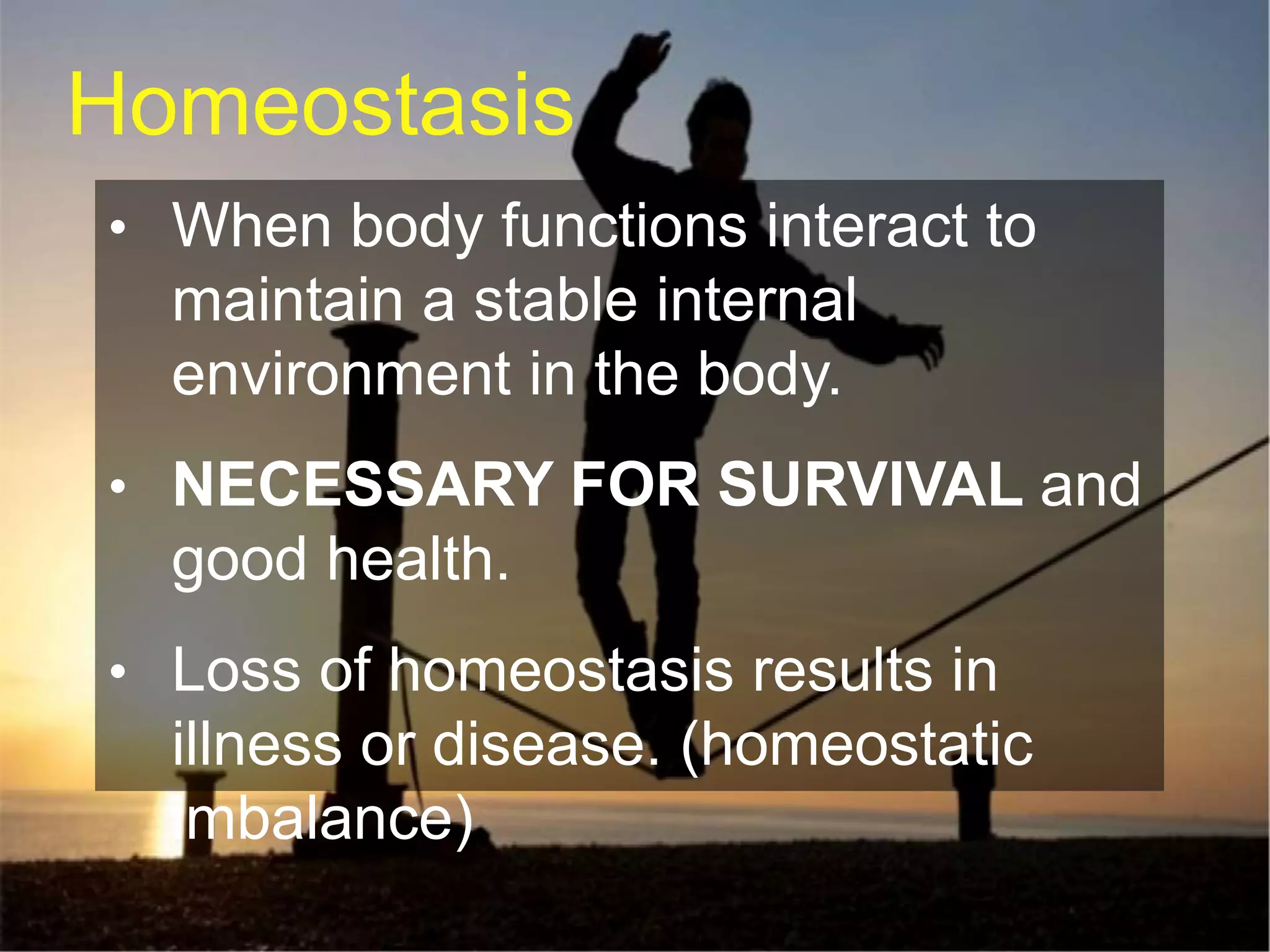
• When body functions interact to
maintain a stable internal
environment in the body.
• NECESSARY FOR SURVIVAL and
good health.
• Loss of homeostasis results in
illness or disease. (homeostatic
imbalance)
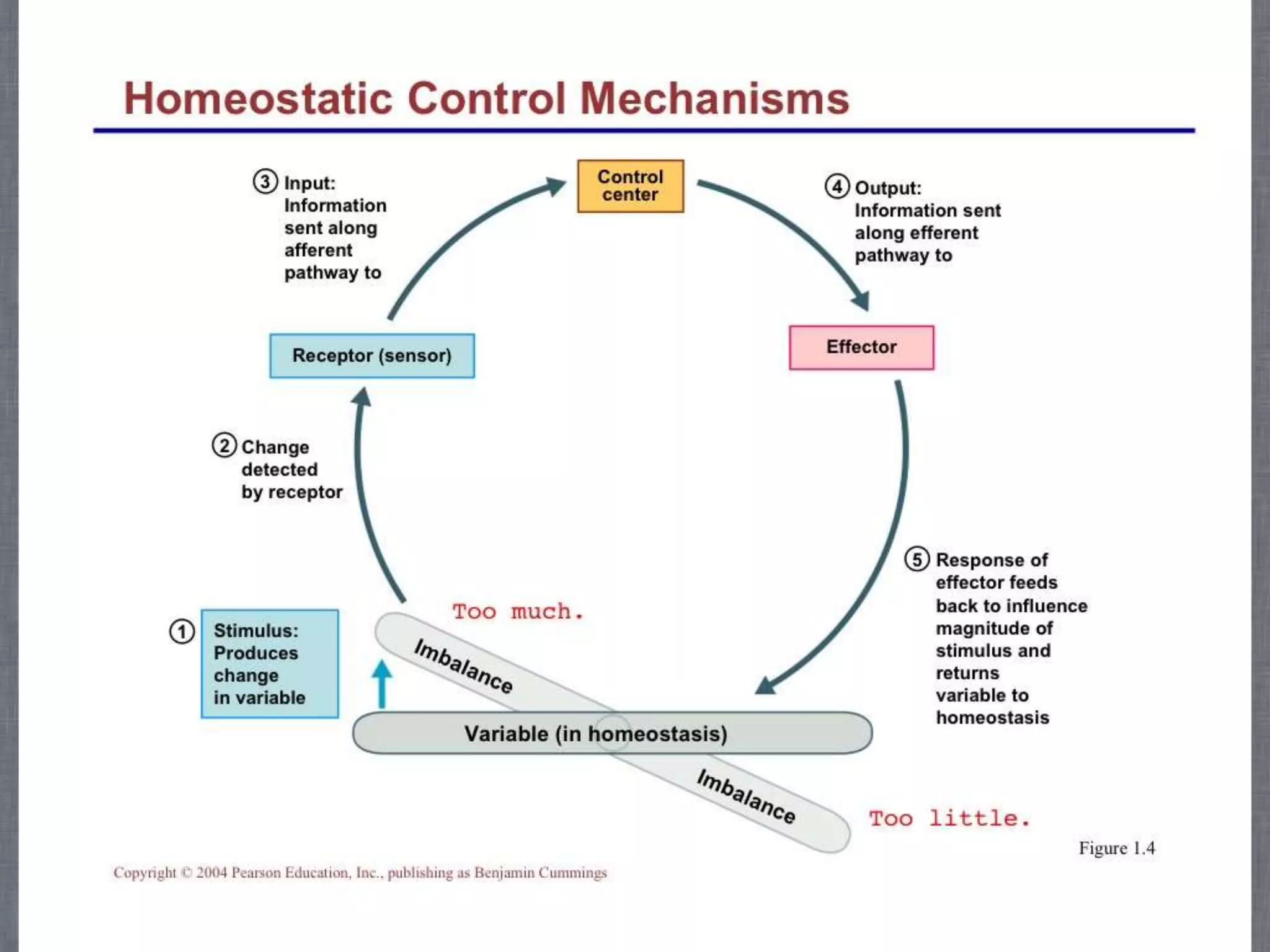
Homeostasis
Homeostasis
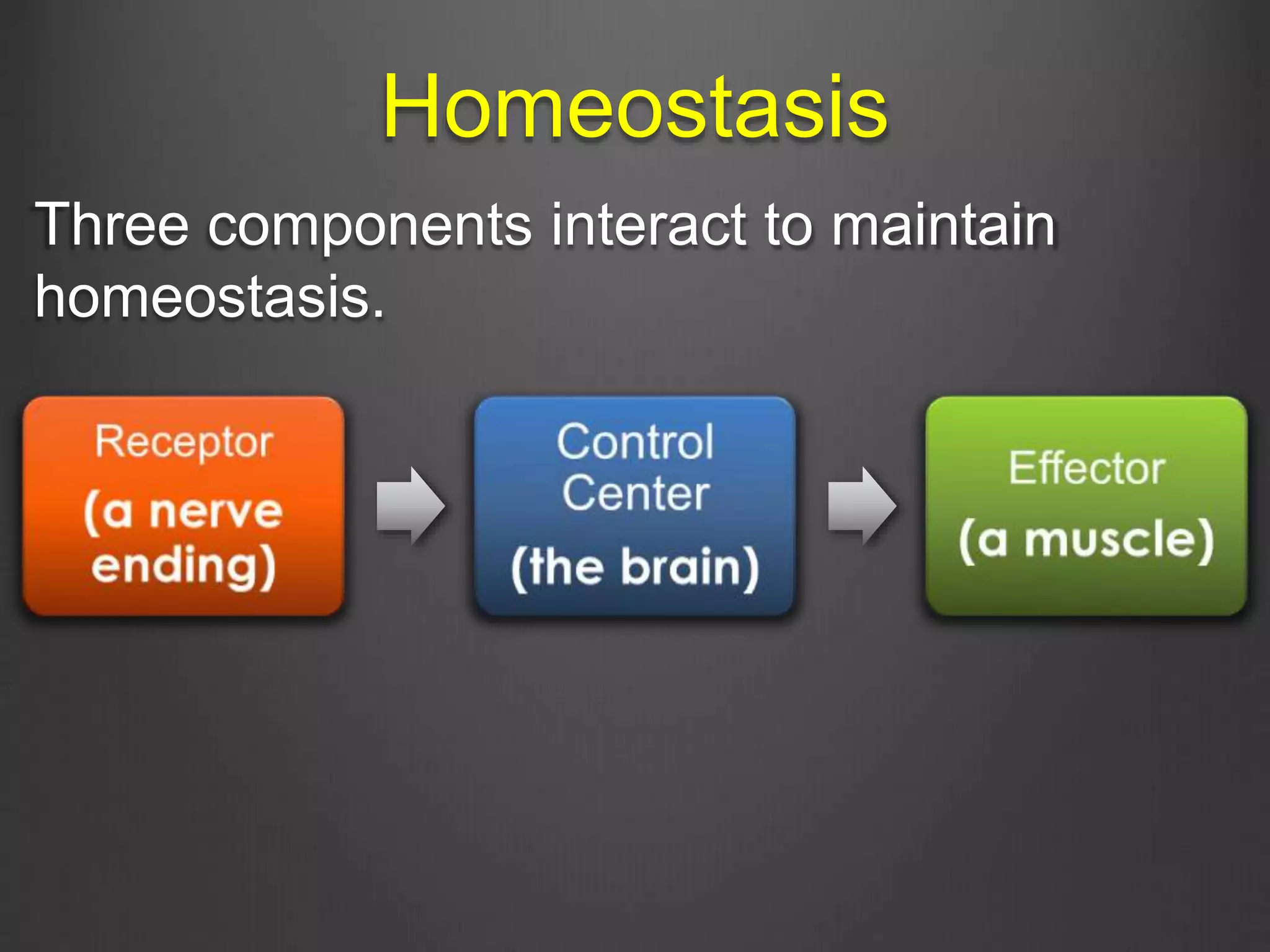
Three components interact to maintain
homeostasis.
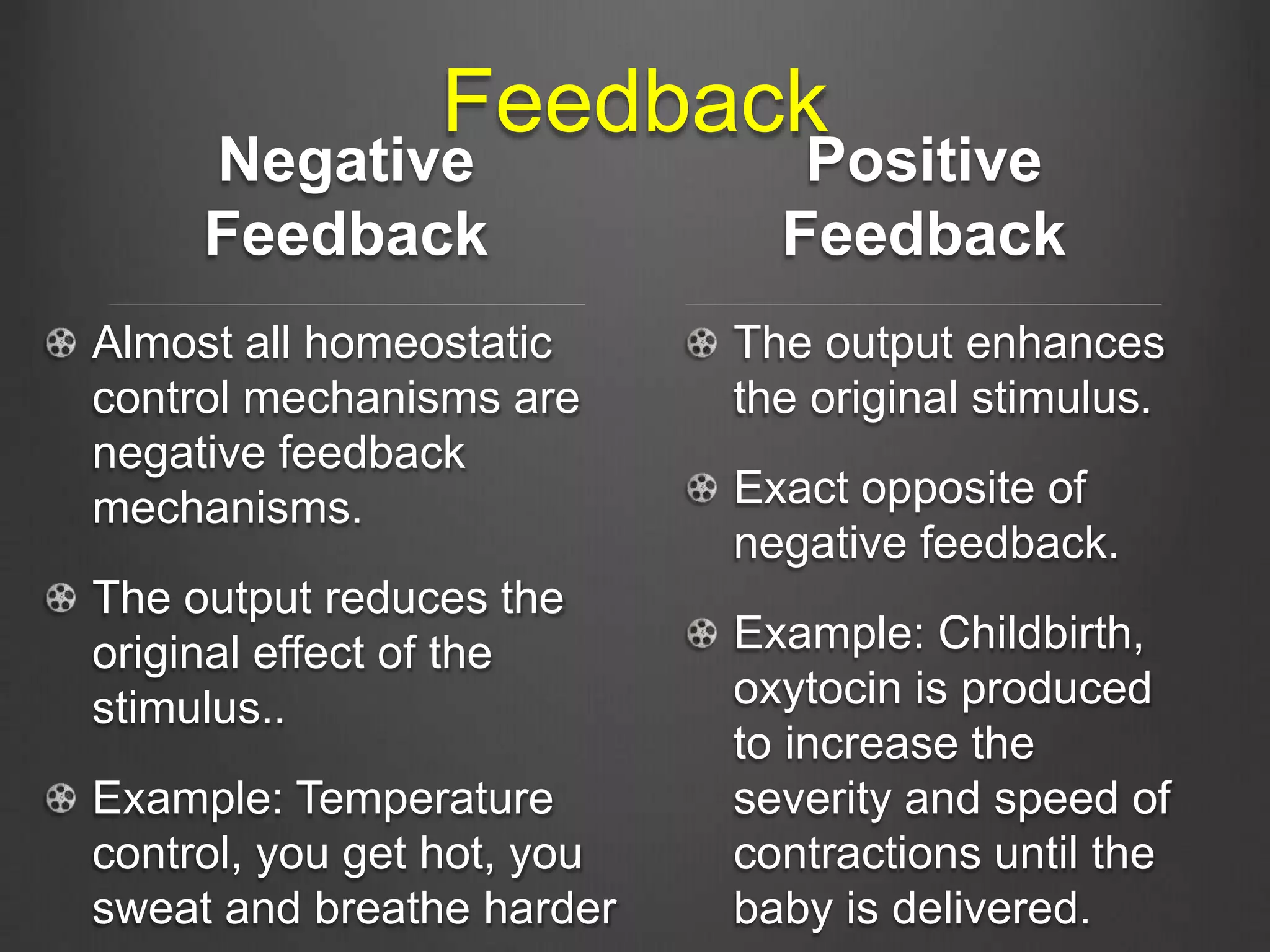
Feedback
Negative
Feedback
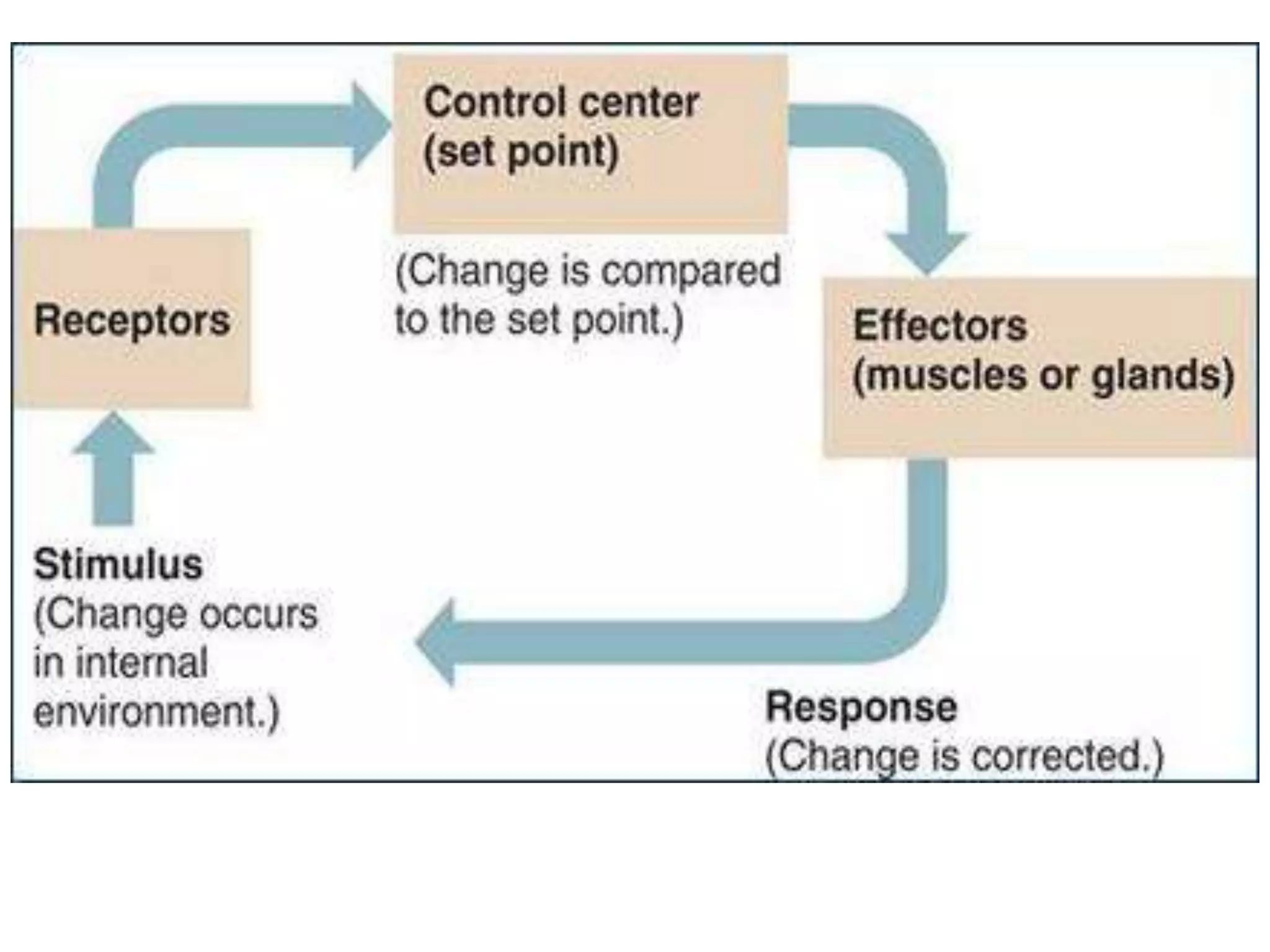
Almost all homeostatic
control mechanisms are
negative feedback
mechanisms.
The output reduces the
original effect of the
stimulus..
Example: Temperature
control, you get hot, you
sweat and breathe harder
Positive
Feedback
The output enhances
the original stimulus.
Exact opposite of
negative feedback.
Example: Childbirth,
oxytocin is produced
to increase the
severity and speed of
contractions until the
baby is delivered.
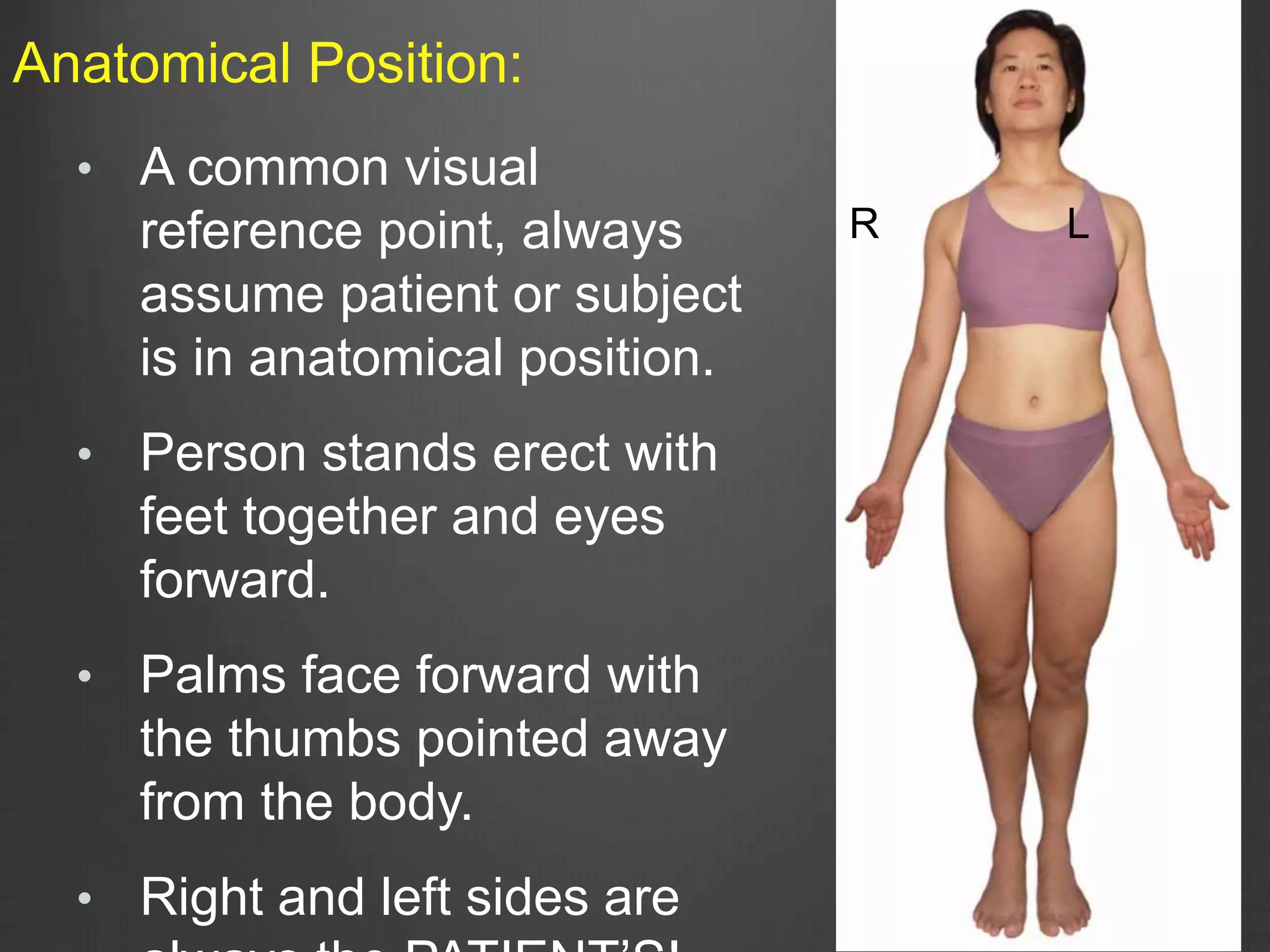
• A common visual
reference point, always
assume patient or subject
is in anatomical position.
• Person stands erect with
feet together and eyes
forward.
• Palms face forward with
the thumbs pointed away
from the body.
• Right and left sides are
Anatomical Position:
R L
Directional terminology
 Refers to the body
in anatomical
position
 Standardized terms
of directions are
paired.
Superior: toward
the head (above)
Ex: The forehead is
superior to the nose.
Inferior:
away from the head
(below)
Ex.: The naval is inferior
to the breastbone.
Anterior: toward
the front (in front of)
Ex: The breastbone is
anterior to the spine.
Posterior:
Toward the backside
(behind)
Ex.: The heart is
posterior to the
breastbone.
posterior
anterior
anterior
posterior
Medial: toward the
midline (middle)
Ex: The heart is medial
to the shoulder.
Lateral:
away from the
midline (outside)
Ex.: The arms are
lateral to the chest.
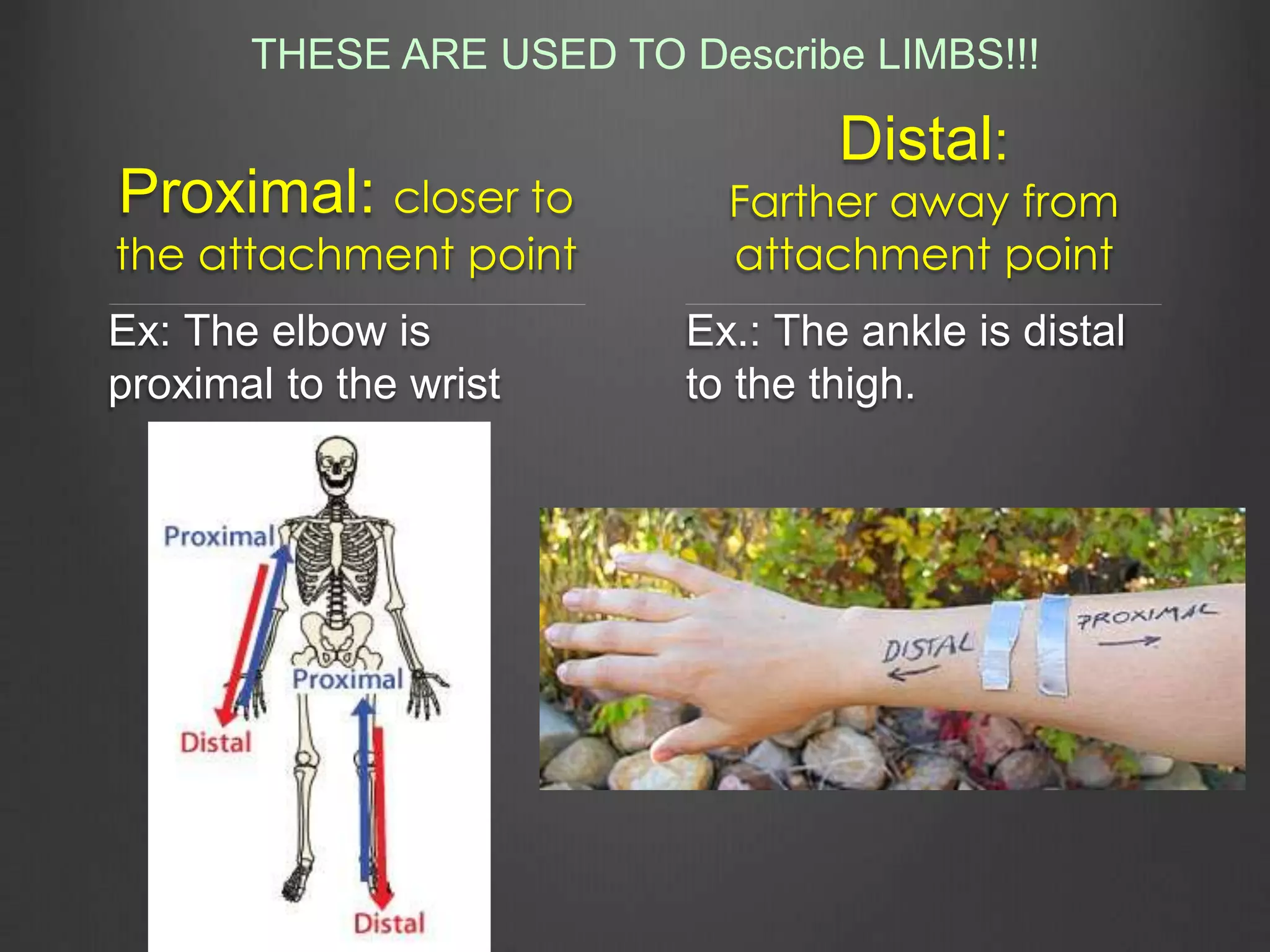
Proximal: closer to
the attachment point
Ex: The elbow is
proximal to the wrist
Distal:
Farther away from
attachment point
Ex.: The ankle is distal
to the thigh.
THESE ARE USED TO Describe LIMBS!!!
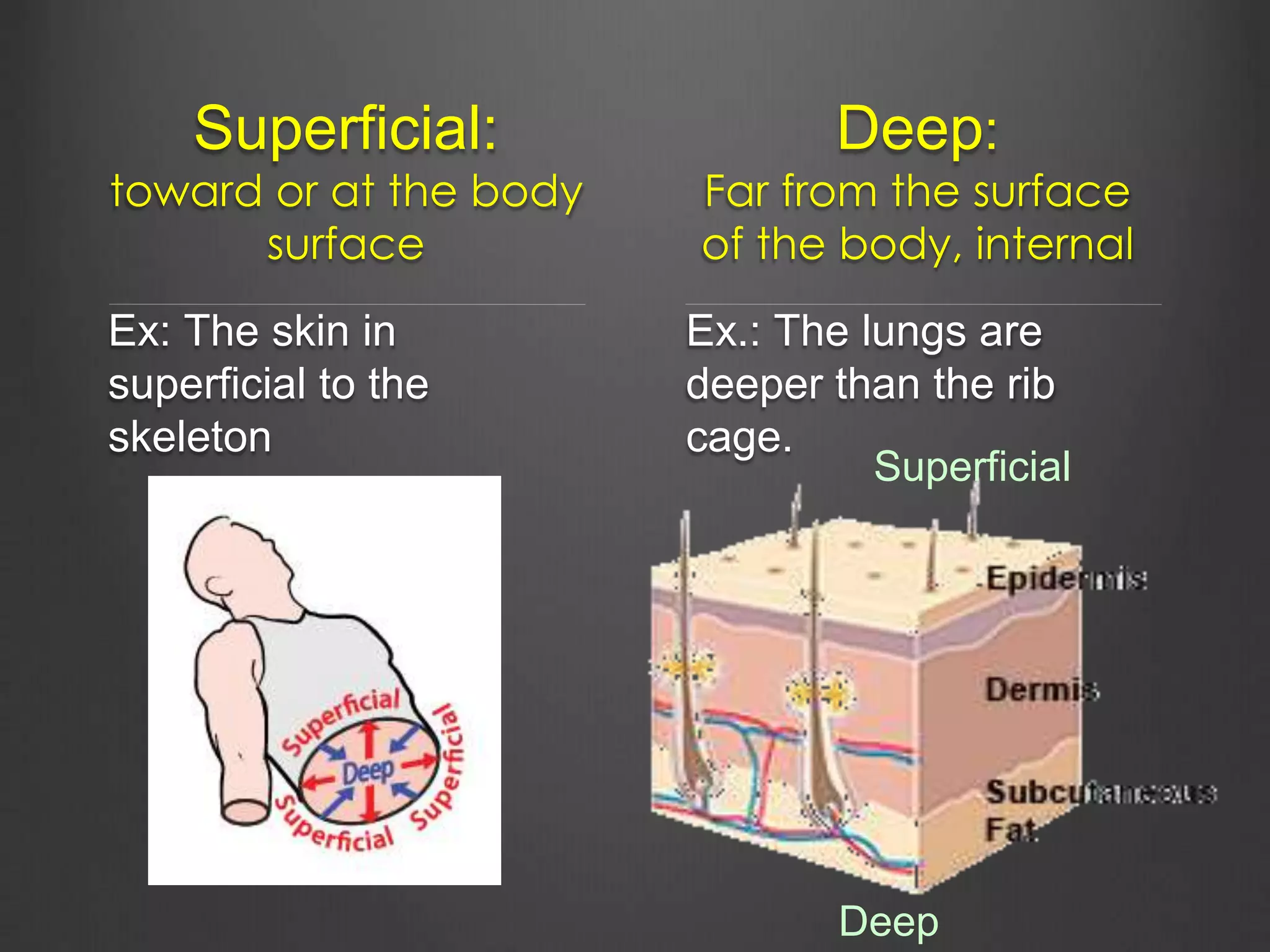
Superficial:
toward or at the body
surface
Ex: The skin in
superficial to the
skeleton
Deep:
Far from the surface
of the body, internal
Ex.: The lungs are
deeper than the rib
cage.
Superficial
Deep
Regional Terms
You will need to study and memorize
ALL the following terms!
These are landmarks we will use for
the rest of the year to identify areas
of the body.
Regional TermsBuccal
Deltoid
Picasso Anatomy Lab
1. Create an anatomically correct mosaic portrait.
2. Find and cut out pictures of all of the new anatomical
terminology.
3. Assemble and glue your mosaic portrait to a piece of
cardstock. (anterior and posterior views)
4. LABEL all of the pieces you have cut out. NUMBER
each of your labels so you can be sure that you have
gotten them all.
5. If it is a body region that is not normally visible, please
draw an arrow near the spot that the region should be.
6. You may use your diagrams from class or the diagrams
in your textbook as a reference.
Body Planes and Sections
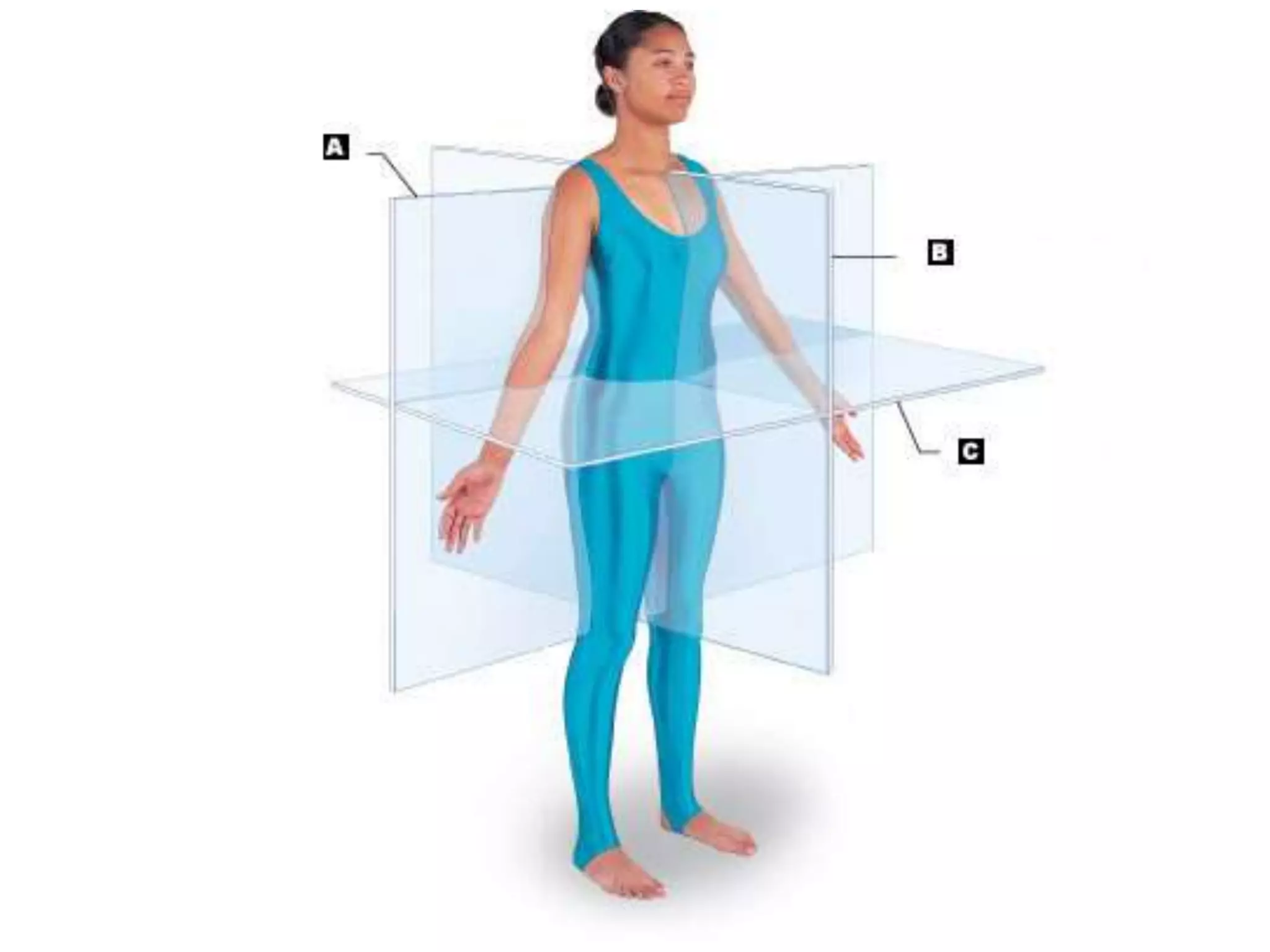
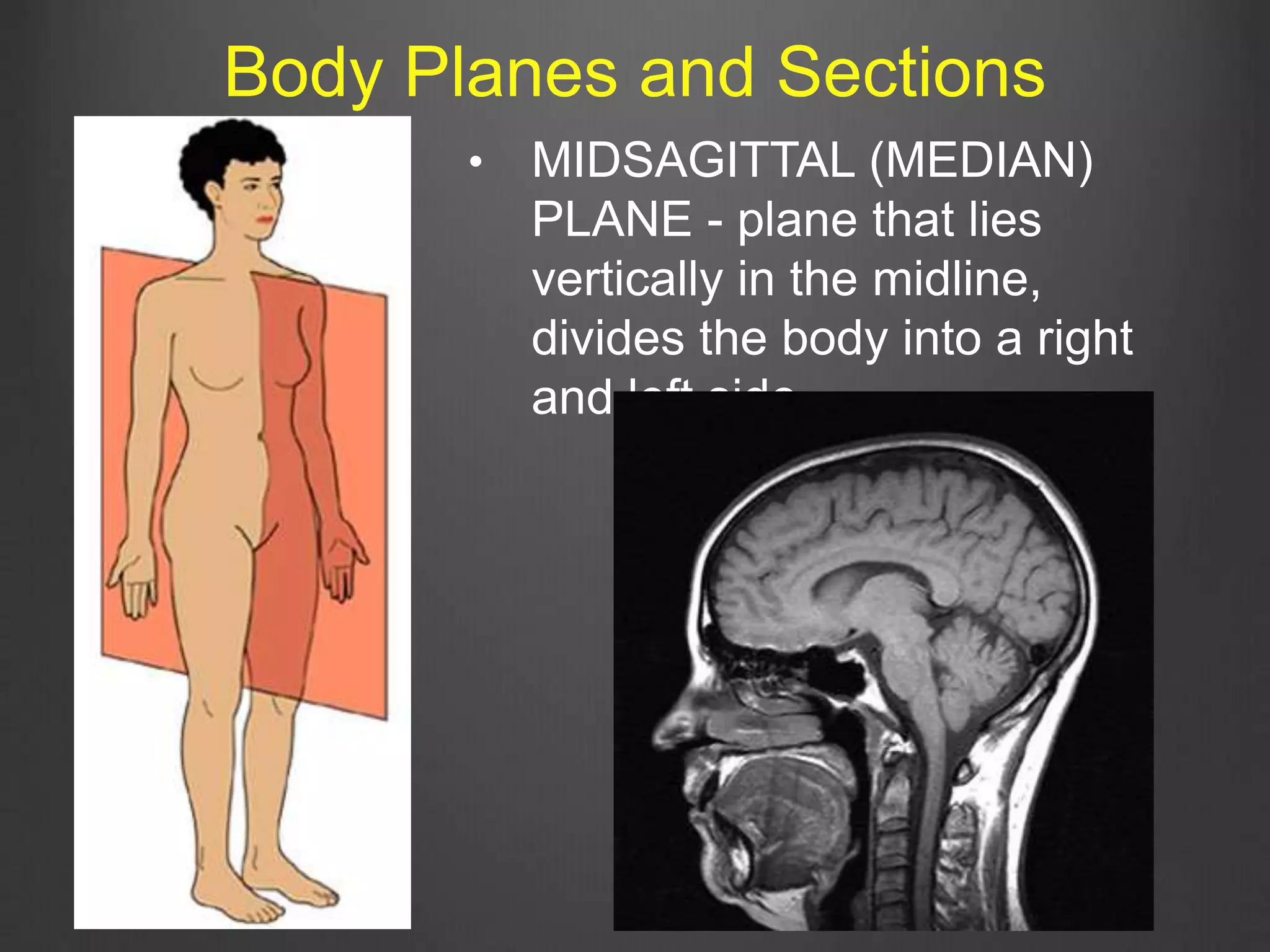
• MIDSAGITTAL (MEDIAN)
PLANE - plane that lies
vertically in the midline,
divides the body into a right
and left side.
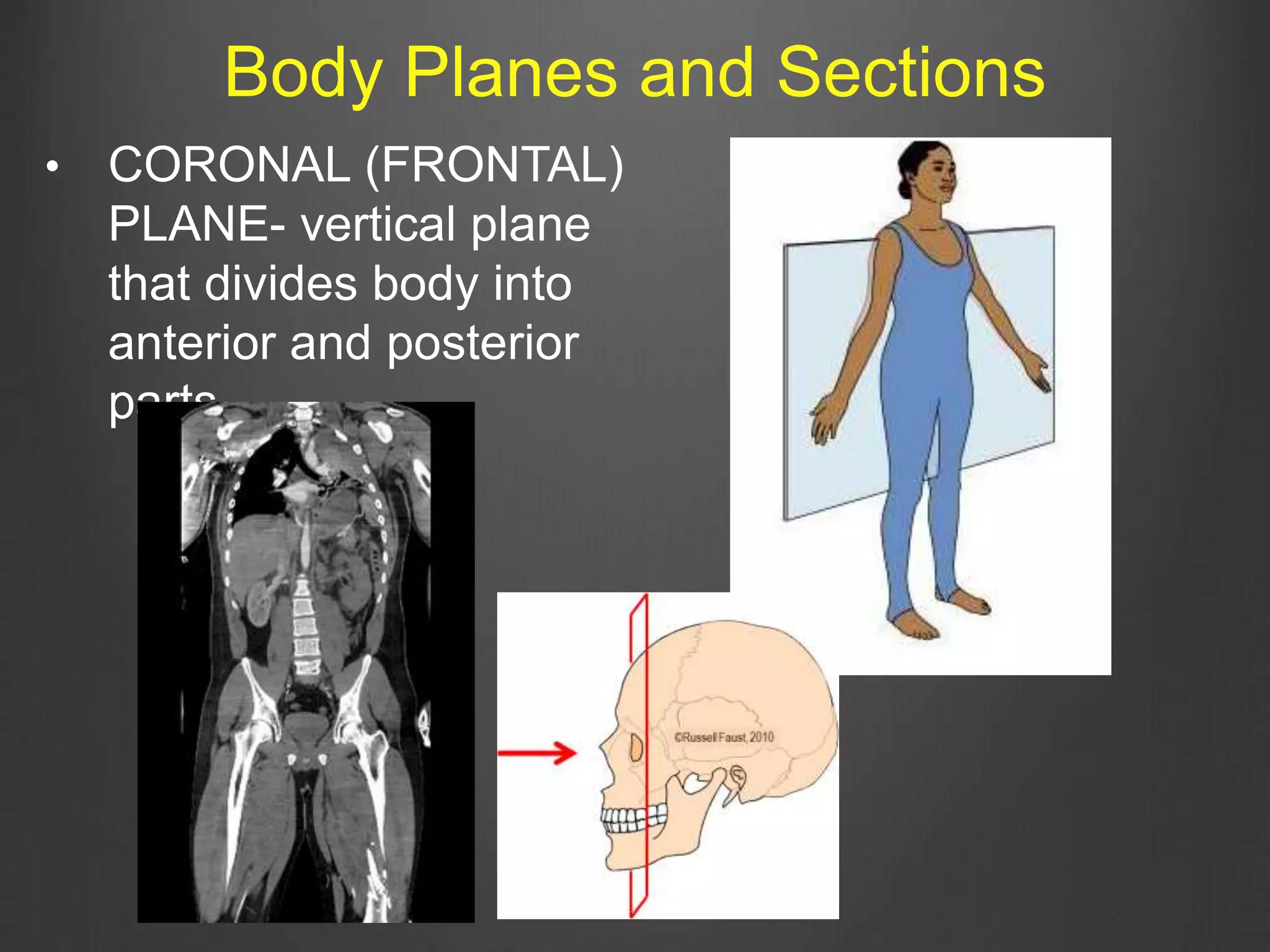
• CORONAL (FRONTAL)
PLANE- vertical plane
that divides body into
anterior and posterior
parts
Body Planes and Sections
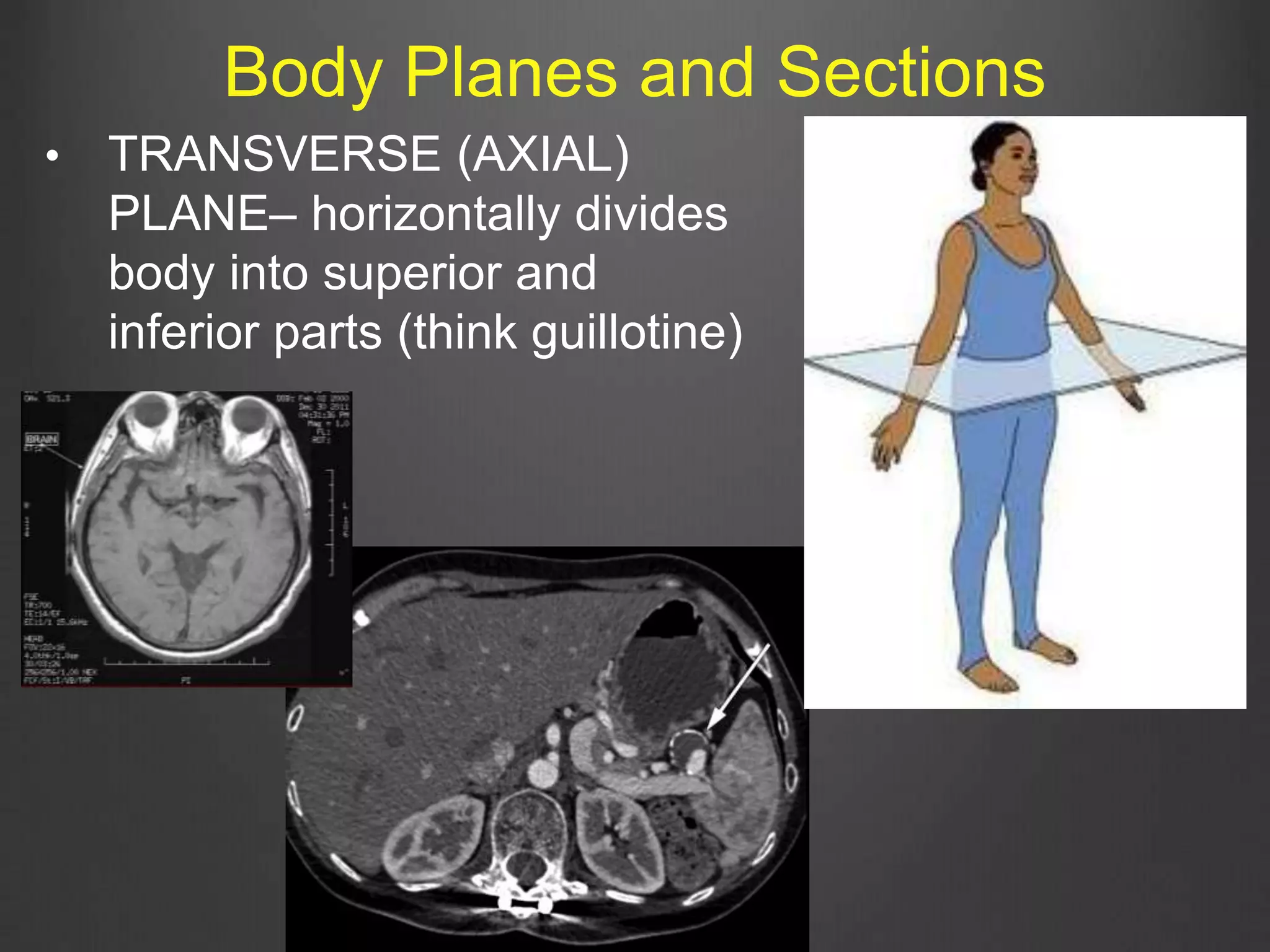
• TRANSVERSE (AXIAL)
PLANE– horizontally divides
body into superior and
inferior parts (think guillotine)
Body Planes and Sections
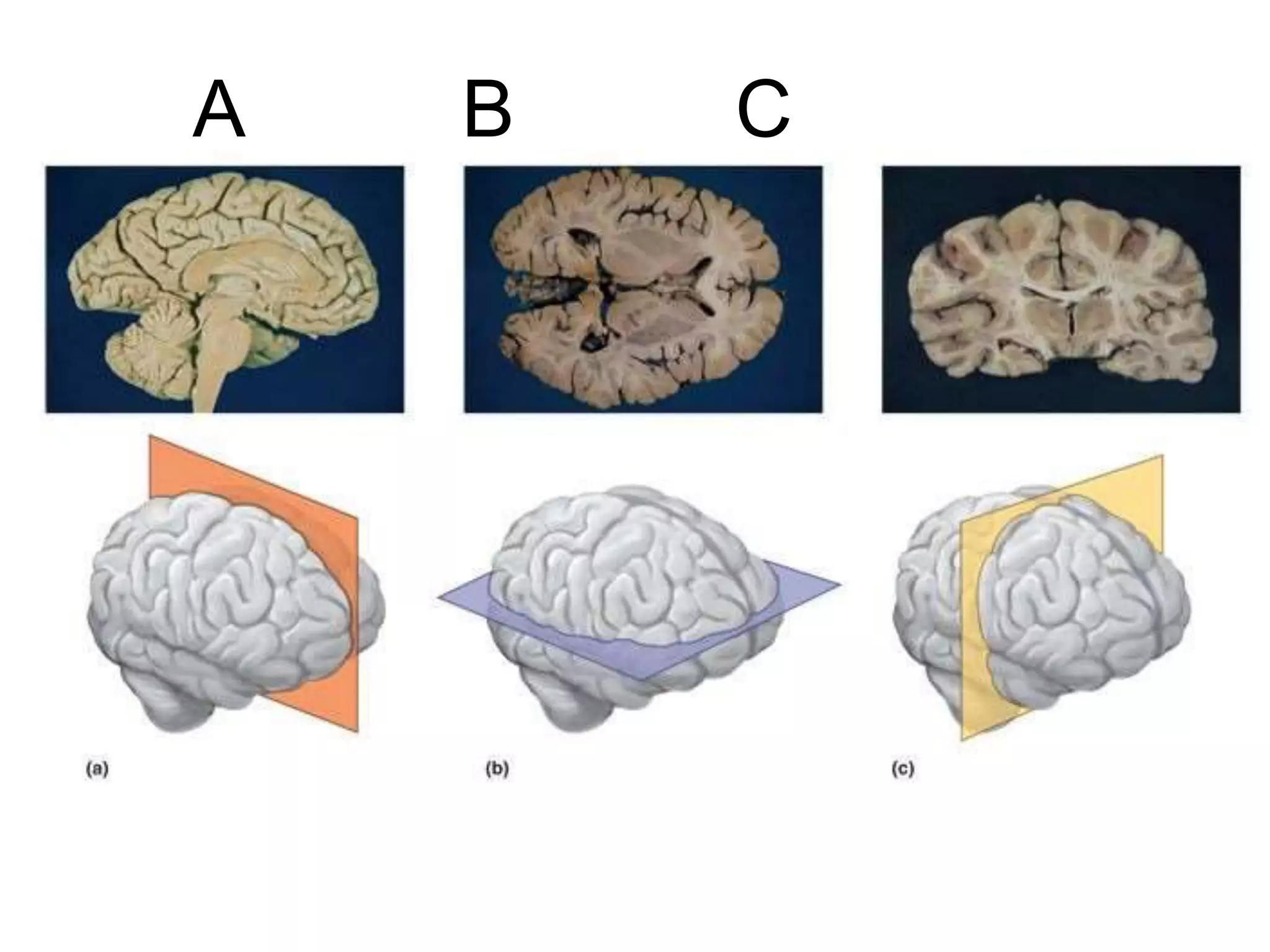
A B C
Body Cavities and Membranes
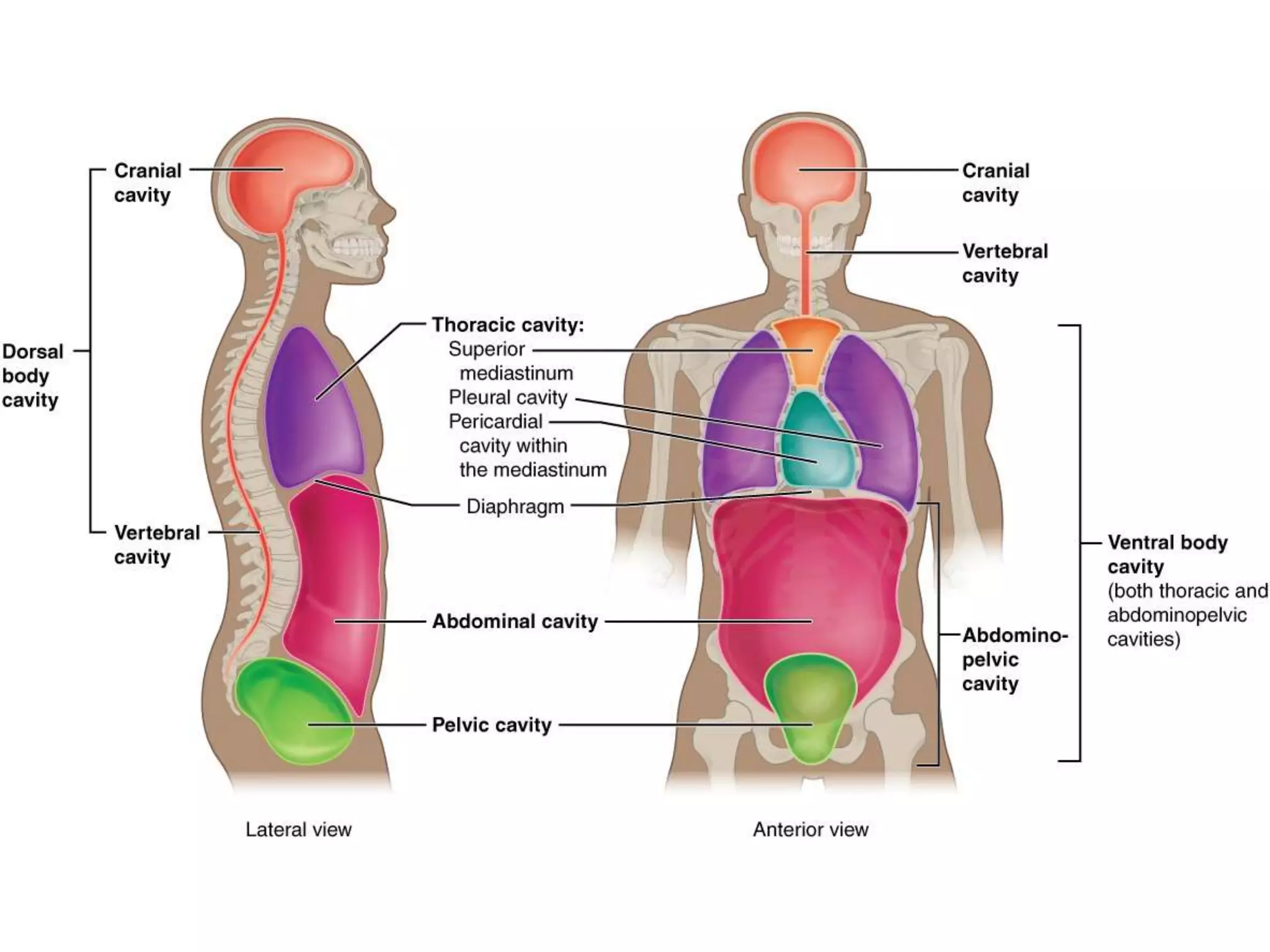
DORSAL BODY
CAVITIES:
• Cavity subdivided into
the cranial cavity and
the vertebral cavity.
• Cranial cavity houses
the brain. (A)
• Vertebral cavity runs
through the vertebral
column and encloses
the spinal cord (B)
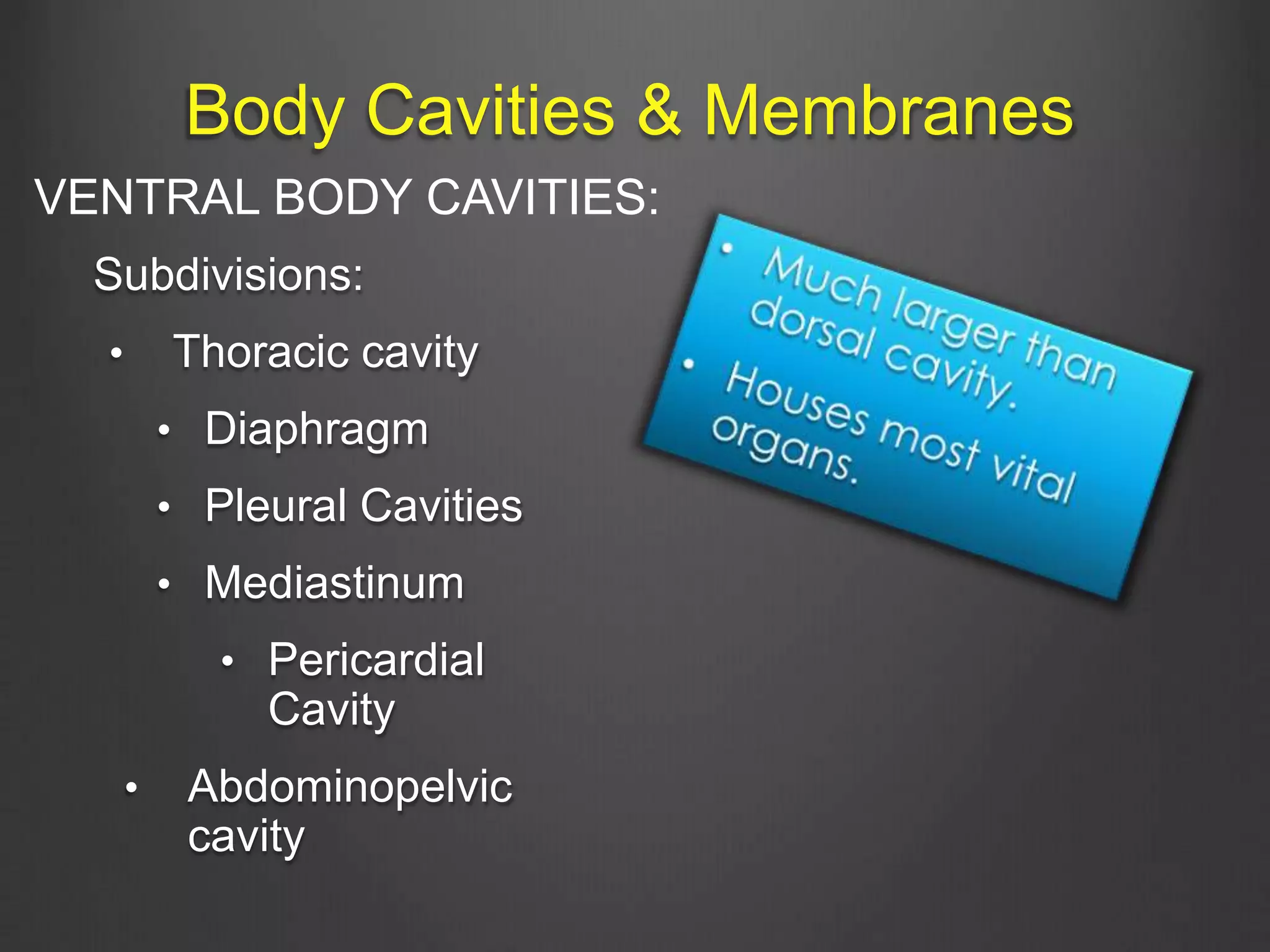
Body Cavities & Membranes
Subdivisions:
• Thoracic cavity
• Diaphragm
• Pleural Cavities
• Mediastinum
• Pericardial
Cavity
• Abdominopelvic
cavity
VENTRAL BODY CAVITIES:
Other body Cavities
ORAL CAVITY – Mouth
DIGESTIVE CAVITY – Contains
digestive organs & opens to the exterior
of the body
NASAL CAVITY – nose and area
posterior to the nose, part of respiratory
system
ORBITAL CAVITIES – house the eyes
MIDDLE EAR CAVITIES – house the
bones that transmit sound to receptors
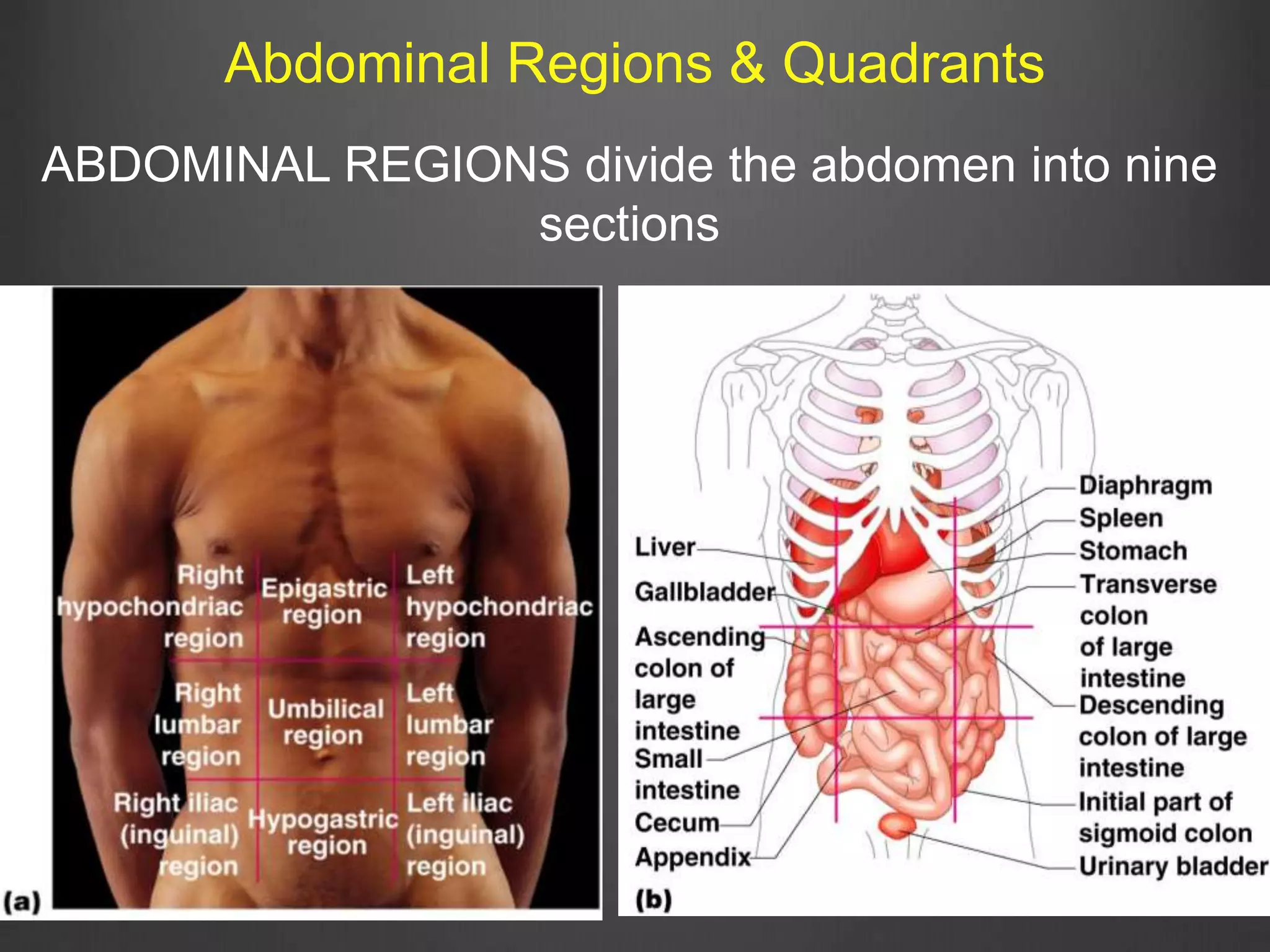
Abdominal Regions & Quadrants
ABDOMINAL REGIONS divide the abdomen into nine
sections
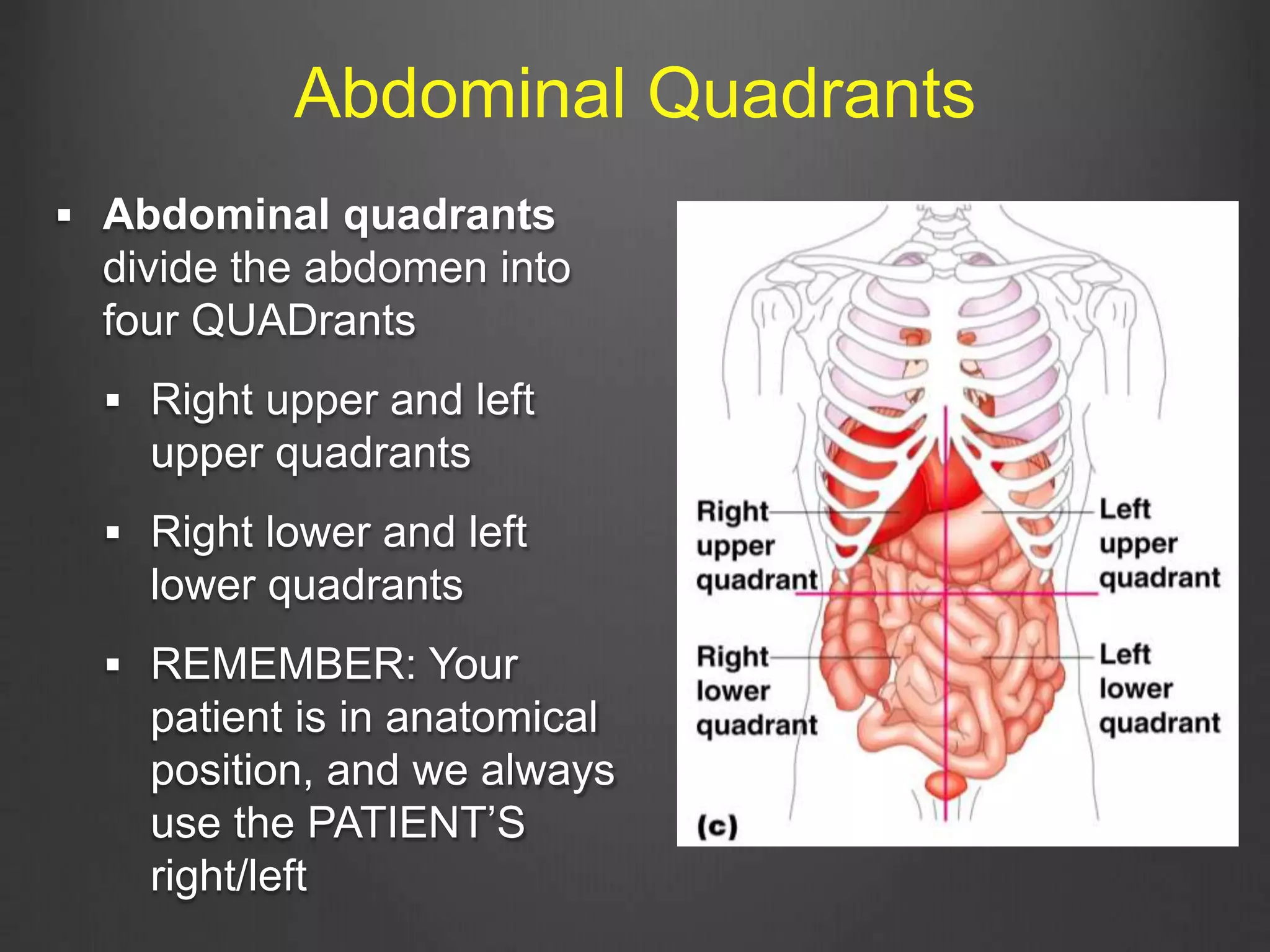
Abdominal Quadrants
 Abdominal quadrants
divide the abdomen into
four QUADrants
 Right upper and left
upper quadrants
 Right lower and left
lower quadrants
 REMEMBER: Your
patient is in anatomical
position, and we always
use the PATIENT’S
right/left

A&P Chapter1

  • 1.
  • 3.
    Anatomy - Thestudy of the structure of the human body Physiology - The study of the functions of the human body An Overview of Anatomy
  • 4.
    Branches of Anatomy oSurface anatomy (outside) o Gross anatomy (inside) o Microscopic anatomy (histology) -tissues
  • 5.
    Structural Organization  Chemicallevel – atoms & molecules  Cellular level – cells  Tissue level – a group of cells performing a common function  Organ level – a structure made up of more than one type of tissue  Organ system – organs working together for a common purpose  Organism – the result of all simpler levels working together
  • 6.
  • 7.
    • Forms externalbody covering • Protects deeper tissues from injury • Synthesizes vitamin D • Site of cutaneous receptors (pain, pressure, etc.) and sweat and oil glands The Integumentary System
  • 8.
    –Protects and supports body organs –Providesa framework for muscles –Blood cells formed within bones –Stores minerals The Skeletal System
  • 9.
    • Allows manipulation of environment •Provide mobility • Facial expression • Maintains posture • Produces heat The Muscular System
  • 10.
    • Fast-acting control system •Responds to internal and external changes • Uses senses to collect information The Nervous System
  • 11.
    • Glands secrete hormones that regulate •Growth • Reproductio n • Nutrient use The Endocrine System
  • 12.
    The Cardiovascular System •Blood vessels transport blood • Carries oxygen and carbon dioxide • Also carries nutrients and wastes • Heart pumps blood through blood vessels
  • 13.
    Picks up fluidleaked from blood vessels Disposes of debris in the lymphatic system Houses white blood cells (lymphocytes) Mounts attack against foreign substances in the The Lymphatic System
  • 14.
    • Keeps bloodsupplied with oxygen • Removes carbon dioxide • Gas exchange occurs through walls of air sacs in the lungs The Respiratory System
  • 15.
    • Breaks down foodinto absorbable units • Indigestible foodstuffs eliminated as feces The Digestive System
  • 16.
    • Eliminates nitrogenous wastes (urea) •Regulates water, electrolyte, and acid-base balance The Urinary System
  • 17.
    • Overall functionis to produce offspring • Testes produce sperm and male sex hormones • Ovaries produce eggs and female sex hormones • Mammary glands produce milk Reproductive System
  • 18.
    Necessary Life Functions: •List eight functions that humans must perform to maintain life. Compare your answers with your partner’s answers. • List five survival needs of the human body. Which do you think is the most important and why?
  • 19.
    Maintaining Life God hasput all parts of our body together in the way that he decided is best. A body isn’t really a body, unless there is more than one part. It takes many parts to make a single body. That’s why the eyes cannot say they don’t need the hands. That’s also why the head cannot say it doesn’t need the feet. In fact, we cannot get along without the parts of the body that seem to be the weakest. 1 Corinthians 12:18-22
  • 20.
    • When bodyfunctions interact to maintain a stable internal environment in the body. • NECESSARY FOR SURVIVAL and good health. • Loss of homeostasis results in illness or disease. (homeostatic imbalance) Homeostasis
  • 21.
    Homeostasis Three components interactto maintain homeostasis.
  • 25.
    Feedback Negative Feedback Almost all homeostatic controlmechanisms are negative feedback mechanisms. The output reduces the original effect of the stimulus.. Example: Temperature control, you get hot, you sweat and breathe harder Positive Feedback The output enhances the original stimulus. Exact opposite of negative feedback. Example: Childbirth, oxytocin is produced to increase the severity and speed of contractions until the baby is delivered.
  • 27.
    • A commonvisual reference point, always assume patient or subject is in anatomical position. • Person stands erect with feet together and eyes forward. • Palms face forward with the thumbs pointed away from the body. • Right and left sides are Anatomical Position: R L
  • 28.
    Directional terminology  Refersto the body in anatomical position  Standardized terms of directions are paired.
  • 29.
    Superior: toward the head(above) Ex: The forehead is superior to the nose. Inferior: away from the head (below) Ex.: The naval is inferior to the breastbone.
  • 30.
    Anterior: toward the front(in front of) Ex: The breastbone is anterior to the spine. Posterior: Toward the backside (behind) Ex.: The heart is posterior to the breastbone. posterior anterior anterior posterior
  • 31.
    Medial: toward the midline(middle) Ex: The heart is medial to the shoulder. Lateral: away from the midline (outside) Ex.: The arms are lateral to the chest.
  • 32.
    Proximal: closer to theattachment point Ex: The elbow is proximal to the wrist Distal: Farther away from attachment point Ex.: The ankle is distal to the thigh. THESE ARE USED TO Describe LIMBS!!!
  • 33.
    Superficial: toward or atthe body surface Ex: The skin in superficial to the skeleton Deep: Far from the surface of the body, internal Ex.: The lungs are deeper than the rib cage. Superficial Deep
  • 35.
    Regional Terms You willneed to study and memorize ALL the following terms! These are landmarks we will use for the rest of the year to identify areas of the body.
  • 36.
  • 37.
    Picasso Anatomy Lab 1.Create an anatomically correct mosaic portrait. 2. Find and cut out pictures of all of the new anatomical terminology. 3. Assemble and glue your mosaic portrait to a piece of cardstock. (anterior and posterior views) 4. LABEL all of the pieces you have cut out. NUMBER each of your labels so you can be sure that you have gotten them all. 5. If it is a body region that is not normally visible, please draw an arrow near the spot that the region should be. 6. You may use your diagrams from class or the diagrams in your textbook as a reference.
  • 38.
    Body Planes andSections • MIDSAGITTAL (MEDIAN) PLANE - plane that lies vertically in the midline, divides the body into a right and left side.
  • 39.
    • CORONAL (FRONTAL) PLANE-vertical plane that divides body into anterior and posterior parts Body Planes and Sections
  • 40.
    • TRANSVERSE (AXIAL) PLANE–horizontally divides body into superior and inferior parts (think guillotine) Body Planes and Sections
  • 42.
  • 43.
    Body Cavities andMembranes DORSAL BODY CAVITIES: • Cavity subdivided into the cranial cavity and the vertebral cavity. • Cranial cavity houses the brain. (A) • Vertebral cavity runs through the vertebral column and encloses the spinal cord (B)
  • 44.
    Body Cavities &Membranes Subdivisions: • Thoracic cavity • Diaphragm • Pleural Cavities • Mediastinum • Pericardial Cavity • Abdominopelvic cavity VENTRAL BODY CAVITIES:
  • 46.
    Other body Cavities ORALCAVITY – Mouth DIGESTIVE CAVITY – Contains digestive organs & opens to the exterior of the body NASAL CAVITY – nose and area posterior to the nose, part of respiratory system ORBITAL CAVITIES – house the eyes MIDDLE EAR CAVITIES – house the bones that transmit sound to receptors
  • 47.
    Abdominal Regions &Quadrants ABDOMINAL REGIONS divide the abdomen into nine sections
  • 48.
    Abdominal Quadrants  Abdominalquadrants divide the abdomen into four QUADrants  Right upper and left upper quadrants  Right lower and left lower quadrants  REMEMBER: Your patient is in anatomical position, and we always use the PATIENT’S right/left