3. S E Q U E N C E S A N D
S E R I E S
1. SEQUENCE
1.1 Introduction
A sequence can be defined as an ordered collection of things (usually numbers) or a set of numbers arranged one
after another. Sometimes, sequence is also referred as progression. The numbers a1
, 2 3
a ,a .....an
are known as terms
or elements of the sequence. The subscript is the set of positive integers 1, 2, 3..... that indicates the position of the
term in the sequence. Tn
is used to denote the nth
term.
Some examples of a sequence are as follows:
0, 7, 26......................., 1, 4, 7, 10......................., 2, 4, 6, 8…………………..
Note: The minimum number terms in a sequence should be 3.
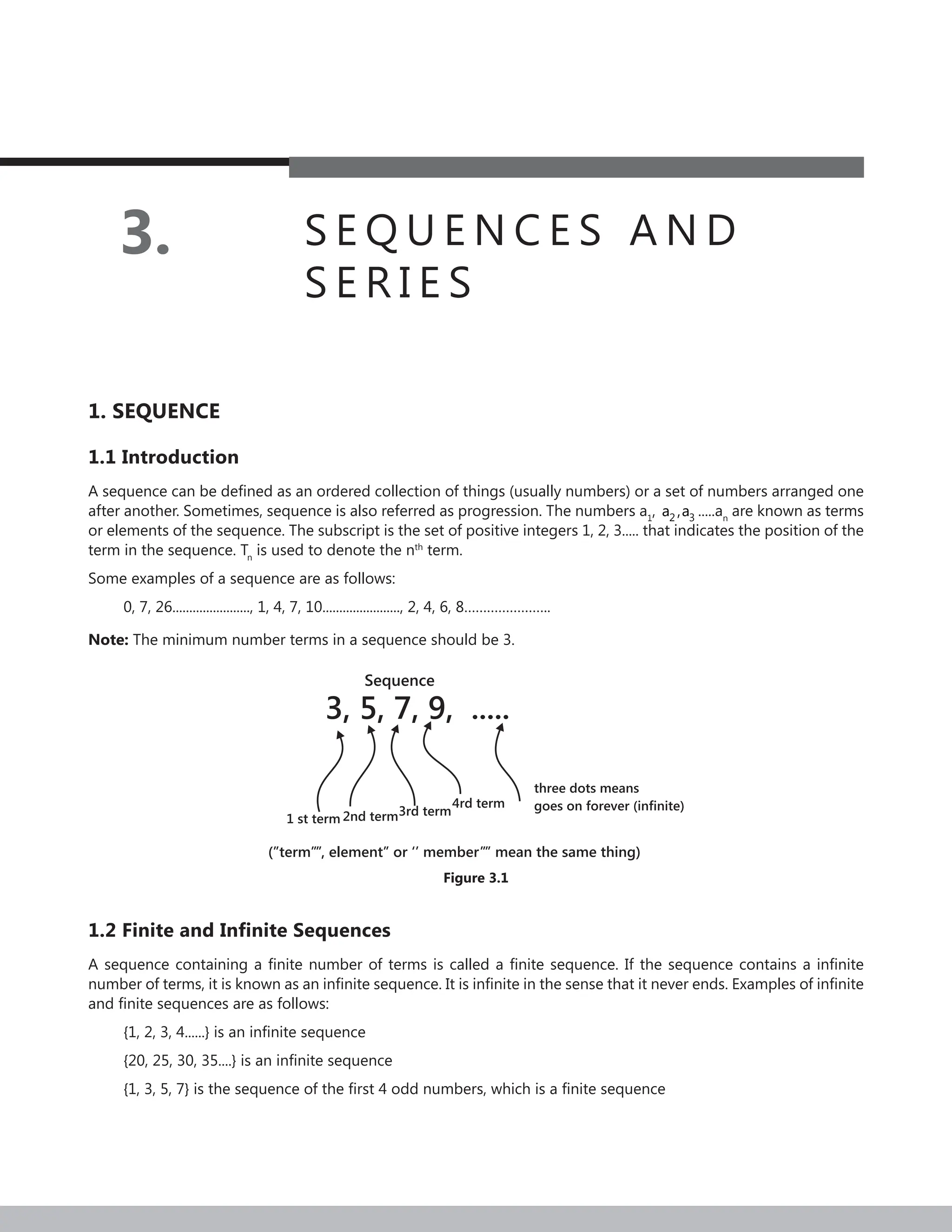
Sequence
3, 5, 7, 9, .....
1 st term 2nd term3rd term
4rd term
three dots means
goes on forever (infinite)
(”term’’’’, element’’ or ‘’ member’’’’ mean the same thing)
Figure 3.1
1.2 Finite and Infinite Sequences
A sequence containing a finite number of terms is called a finite sequence. If the sequence contains a infinite
number of terms, it is known as an infinite sequence. It is infinite in the sense that it never ends. Examples of infinite
and finite sequences are as follows:
{1, 2, 3, 4......} is an infinite sequence
{20, 25, 30, 35....} is an infinite sequence
{1, 3, 5, 7} is the sequence of the first 4 odd numbers, which is a finite sequence
3.2 | Sequences and Series
1.3 Rule
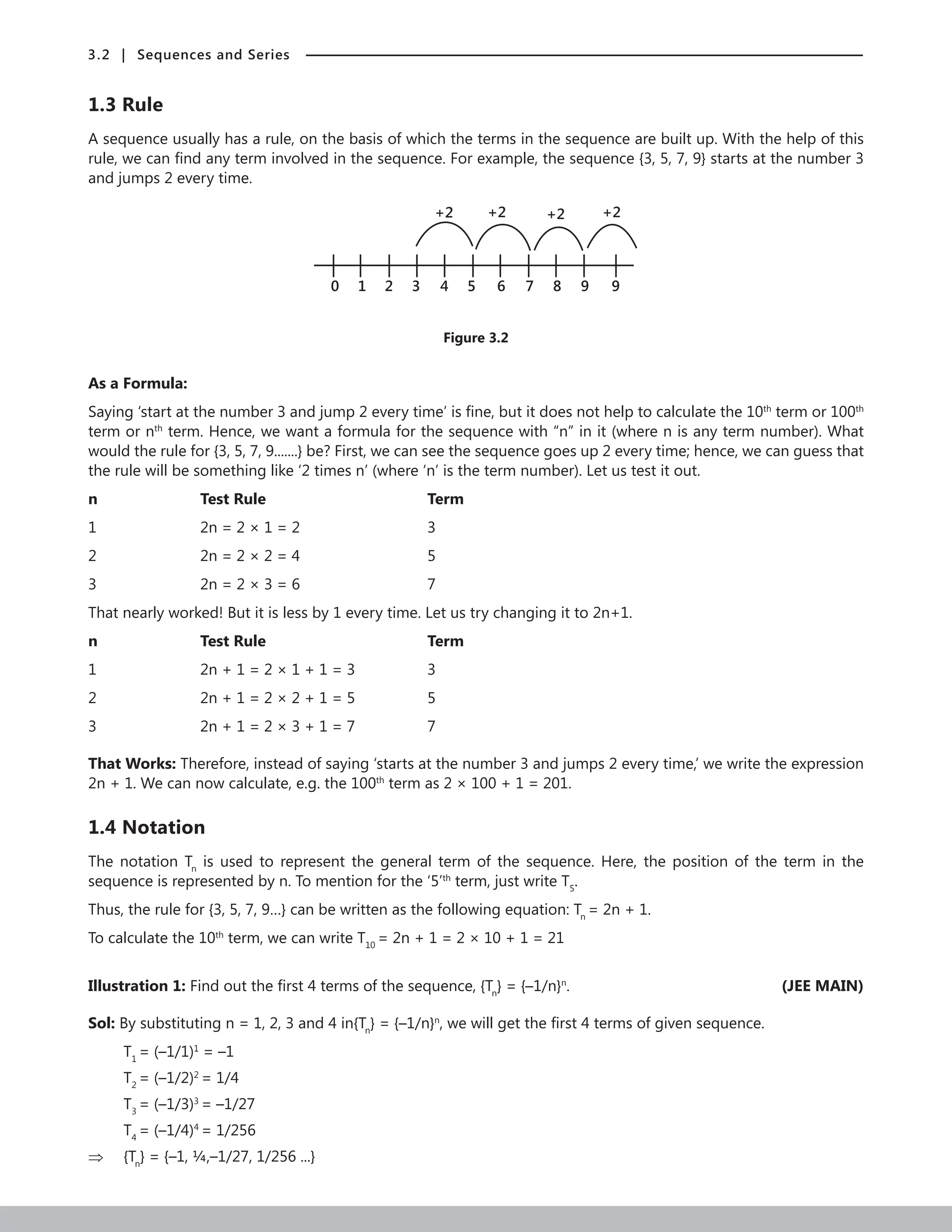
A sequence usually has a rule, on the basis of which the terms in the sequence are built up. With the help of this
rule, we can find any term involved in the sequence. For example, the sequence {3, 5, 7, 9} starts at the number 3
and jumps 2 every time.
+2 +2 +2 +2
0 1 2 3 4 5 6 7 8 9 9
Figure 3.2
As a Formula:
Saying ‘start at the number 3 and jump 2 every time’ is fine, but it does not help to calculate the 10th
term or 100th
term or nth
term. Hence, we want a formula for the sequence with “n” in it (where n is any term number). What
would the rule for {3, 5, 7, 9.......} be? First, we can see the sequence goes up 2 every time; hence, we can guess that
the rule will be something like ‘2 times n’ (where ‘n’ is the term number). Let us test it out.
n Test Rule Term
1 2n = 2 × 1 = 2 3
2 2n = 2 × 2 = 4 5
3 2n = 2 × 3 = 6 7
That nearly worked! But it is less by 1 every time. Let us try changing it to 2n+1.
n Test Rule Term
1 2n + 1 = 2 × 1 + 1 = 3 3
2 2n + 1 = 2 × 2 + 1 = 5 5
3 2n + 1 = 2 × 3 + 1 = 7 7
That Works: Therefore, instead of saying ‘starts at the number 3 and jumps 2 every time,’ we write the expression
2n + 1. We can now calculate, e.g. the 100th
term as 2 × 100 + 1 = 201.
1.4 Notation
The notation Tn
is used to represent the general term of the sequence. Here, the position of the term in the
sequence is represented by n. To mention for the ‘5’th
term, just write T5
.
Thus, the rule for {3, 5, 7, 9…} can be written as the following equation: Tn
= 2n + 1.
To calculate the 10th
term, we can write T10
= 2n + 1 = 2 × 10 + 1 = 21
Illustration 1: Find out the first 4 terms of the sequence, {Tn
} = {–1/n}n
.  (JEE MAIN)
Sol: By substituting n = 1, 2, 3 and 4 in{Tn
} = {–1/n}n
, we will get the first 4 terms of given sequence.
T1
= (–1/1)1
= –1
T2
= (–1/2)2
= 1/4
T3
= (–1/3)3
= –1/27
T4
= (–1/4)4
= 1/256
⇒ {Tn
} = {–1, ¼,–1/27, 1/256 ...}
Mathematics | 3.3
Illustration 2: Write the sequence whose nth
term is (i) 2n
and (ii) log(nx). (JEE MAIN)
Sol: By substituting n = 1, 2, 3…….., we will get the sequence.
(i) nth
term = 2n		
(ii) nth
term = an
= log(nx)
a1
= 21
, a2
= 22
.......			 a1
=log(x)
						a2
= log(2x), an
= log(nx)
Sequence ⇒ 21
, 22
,.........2n		
Sequence ⇒ log(x), log(2x),................log(nx)
2. SERIES
Series is something that we get from a given sequence by adding all the terms. If we have a sequence as
T1
, T2
, …. ,Tn
, then the series that we get from this sequence is T1
+ T2
+….+Tn
. Sn
is used to represent the sum of n
terms. Hence, Sn
= T1
+ T2
+…. +Tn
3. SIGMA AND PI NOTATIONS
3.1 Sigma Notation
The meaning of the symbol Σ (sigma) is summation. To find the sum of any sequence, the symbol Σ (sigma) is used
before its nth
term. For example:
(i)
9
n=1
n
∑ =1+2+3+.........+9		 (ii)
n
a a
r 1
r or n
=
∑ ∑ =1a
+2a
+3a
+........+ na
(iii)
5
i l
i 1 1 1 2 1 3 1 4 1 5 1
2i 4 2 1 4 2 2 4 2 3 4 2 4 4 2 5 4
=
+ + + + + +
= + + + +
+ × + × + × + × + × +
∑
Properties of Σ (Sigma)
(i)
k
i l
a
=
∑ = a + a + a… (k times) = ka, where a is a constant.		 (ii)
k k
i l i l
ai a i
= =
=
∑ ∑ , where a is a constant.
(iii)
n n n
r r r r
r l r l r l
(a b ) a b
= = =
± = ±
∑ ∑ ∑
								
(iv)
i j j i
n n n n
i j i j
i i j j j j i i
0 0 0 0
aa aa
= = = =
=
∑ ∑ ∑ ∑
3.2 Pi Notation
The symbol ∏ denotes the product of similar terms. For example:
(i)
6
n 1
n
=
∏ = 1 × 2 × 3 × 4 × 5 × 6			 (ii)
k
m
n 1
n
=
∏ = 1m
× 2m
× 3m
× 4m
× ............. × km
(iii)
k
n 1
n
=
∏ = 1 × 2 × 3 × ........ × k = k!
4. ARITHMETIC PROGRESSION
The sequence in which the successive terms maintain a constant difference is known as an arithmetic progression
(AP). Consider the following sequences:
		 a, a + d, a + 2d, a + 3d
		 T1
,    T2
, T3
, T4
3.4 | Sequences and Series
 T2
– T1
= T3
– T2
= T4
– T3
= constant (common difference)
The given sequence is an example of AP. The set of natural numbers is also an example of AP.
4.1 General Term
General term (nth
term) of an AP is given by Tn
= a + (n – 1) d, where a is the first term of the sequence and d is the
common difference of the sequence.
Note:
(i) General term is also denoted by  (last term).
(ii) n (number of terms) always belongs to the set of natural numbers.
(iii) Common difference can be zero, + ve or – ve.
		 If d  0 ⇒ increasing AP and the sequence tends to +∞
		 If d  0 ⇒ decreasing AP and the sequence tends to −∞
		 If d = 0 ⇒ constant AP (all the terms remain same)
(iv) The nth
term from end is (m – n + 1) term from the beginning, where m is the total number of terms and is given
by the following expression:
Tm-n+1
=Tm
− (n–1) d
• If the mth
term is n and the nth
term is m, then the (m + n)th
term is 0.
• If m times the mth
term is equal to n times the nth
term, then the (m + n)th
term is 0.
Vaibhav Krishnan (JEE 2009, AIR 54)
Illustration 3: If the 5th
term of an AP is 17 and its 7th term is 15, then find the 22th
term. (JEE MAIN)
Sol: Using the formula Tn
= a + (n – 1) d, we can solve above problem.
Given a + 4d = 17 and a + 6d = 15
⇒ 2d = −2 ⇒ d = −1, a = 21
∴ T22
= 21 − 21 = 0
Illustration 4: If 11 times the 11th
term of an AP is equal to 9 times the 9th
term, then find the 20th
term.(JEE MAIN)
Sol: By solving 11 (a + 10d) = 9 (a + 8d), we will get the value of a and d.
∴ 2a = –38 d ⇒ a = –19d
∴ 20th
term = a + 19d = 0
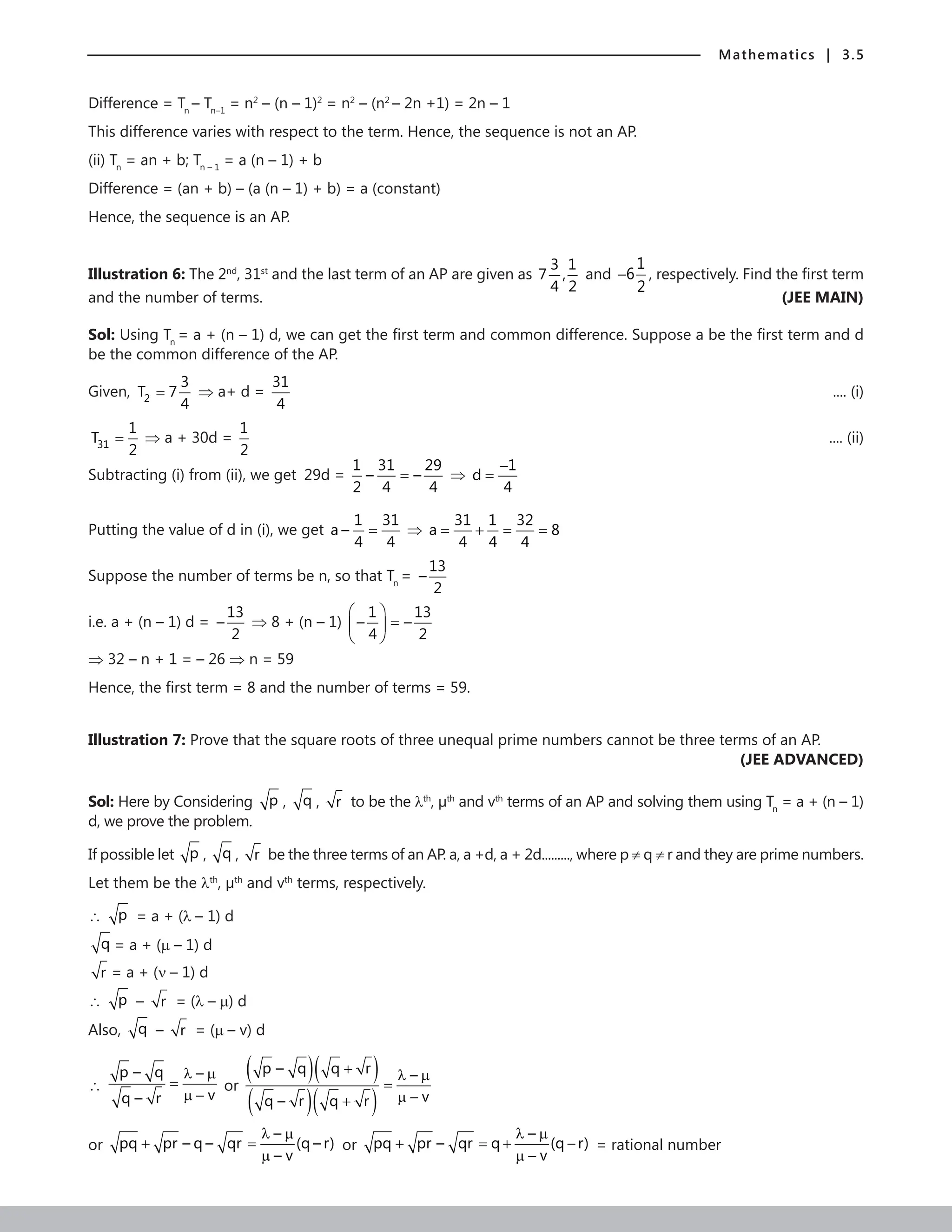
Illustration 5: Check whether the sequences given below are AP or not.	 (JEE MAIN)
(i) Tn
= n2		
(ii) Tn
= an + b
Sol: By taking the difference of two consecutive terms, we can check whether the sequences are in AP or not.
(i) Tn
= n2
; Tn–1
= (n – 1)2
MASTERJEE CONCEPTS
Mathematics | 3.5
Difference = Tn
– Tn–1
= n2
– (n – 1)2
= n2
– (n2
– 2n +1) = 2n – 1
This difference varies with respect to the term. Hence, the sequence is not an AP.
(ii) Tn
= an + b; Tn – 1
= a (n – 1) + b
Difference = (an + b) – (a (n – 1) + b) = a (constant)
Hence, the sequence is an AP.
Illustration 6: The 2nd
, 31st
and the last term of an AP are given as
3 1
7 ,
4 2
and
1
6
2
− , respectively. Find the first term
and the number of terms. (JEE MAIN)
Sol: Using Tn
= a + (n – 1) d, we can get the first term and common difference. Suppose a be the first term and d
be the common difference of the AP.
Given, 2
3
T 7
4
= ⇒ a+ d =
31
4
	 .... (i)
31
1
T
2
= ⇒ a + 30d =
1
2
 .... (ii)
Subtracting (i) from (ii), we get 29d =
1 31 29
– –
2 4 4
= ⇒
1
d
4
−
=
Putting the value of d in (i), we get
1 31
a –
4 4
= ⇒
31 1 32
a 8
4 4 4
= + = =
Suppose the number of terms be n, so that Tn
=
13
–
2
i.e. a + (n – 1) d =
13
–
2
⇒ 8 + (n – 1)
1 13
– –
4 2
 
=
 
 
⇒ 32 – n + 1 = – 26 ⇒ n = 59
Hence, the first term = 8 and the number of terms = 59.
Illustration 7: Prove that the square roots of three unequal prime numbers cannot be three terms of an AP.
 (JEE ADVANCED)
Sol: Here by Considering p , q , r to be the lth
, µth
and vth
terms of an AP and solving them using Tn
= a + (n – 1)
d, we prove the problem.
If possible let p , q , r be the three terms of an AP. a, a +d, a + 2d........., where p ≠ q ≠ r and they are prime numbers.
Let them be the lth
, µth
and vth
terms, respectively.
∴ p = a + (λ – 1) d
q = a + (µ – 1) d
r = a + (ν – 1) d
∴ p – r = (λ – µ) d
Also, q – r = (µ – v) d
∴
p – q –
v
q – r
λ µ
=
µ −
or
( )( )
( )( )
p – q q r –
v
q – r q r
+ λ µ
=
µ −
+
or
–
pq pr – q – qr (q – r)
– v
λ µ
+ =
µ
or
–
pq pr – qr q (q r)
v
λ µ
+ =
+ −
µ −
= rational number
3.6 | Sequences and Series
Since p, q, r are unequal primes, pq, pr and qr are unequal pure irrational numbers. Thus, LHS is irrational,
but irrational ≠ rational.
Hence, the problem is proved.
Illustration 8: If x, y and z are real numbers satisfying the equation 25 (9x2
+ y2
) + 9z2
– 15 (5xy + yz + 3zx) = 0, then
prove that x, y and z are in AP.	 (JEE ADVANCED)
Sol: By solving the equation 25 (9x2
+ y2
) + 9z2
– 15 (5xy + yz + 3zx) = 0, we can prove that x, y and z are in AP.
We have
(15x)2
+ (5y)2
+ (3z)2
– (15x) (5y) – (5y) (3z) – (3z) (15x) = 0
⇒ (15x – 5y)2
+ (5y – 3z)2
+ (3z – 15x)2
=0
⇒ 15x – 5y = 0, 5y – 3z = 0, 3z – 15x = 0
⇒ 15x = 5y = 3z ⇒
y y
x
1 3 5
= = (= k say)
∴ x = k, y = 3k, z = 5k
Thus, x, y and z are in AP.
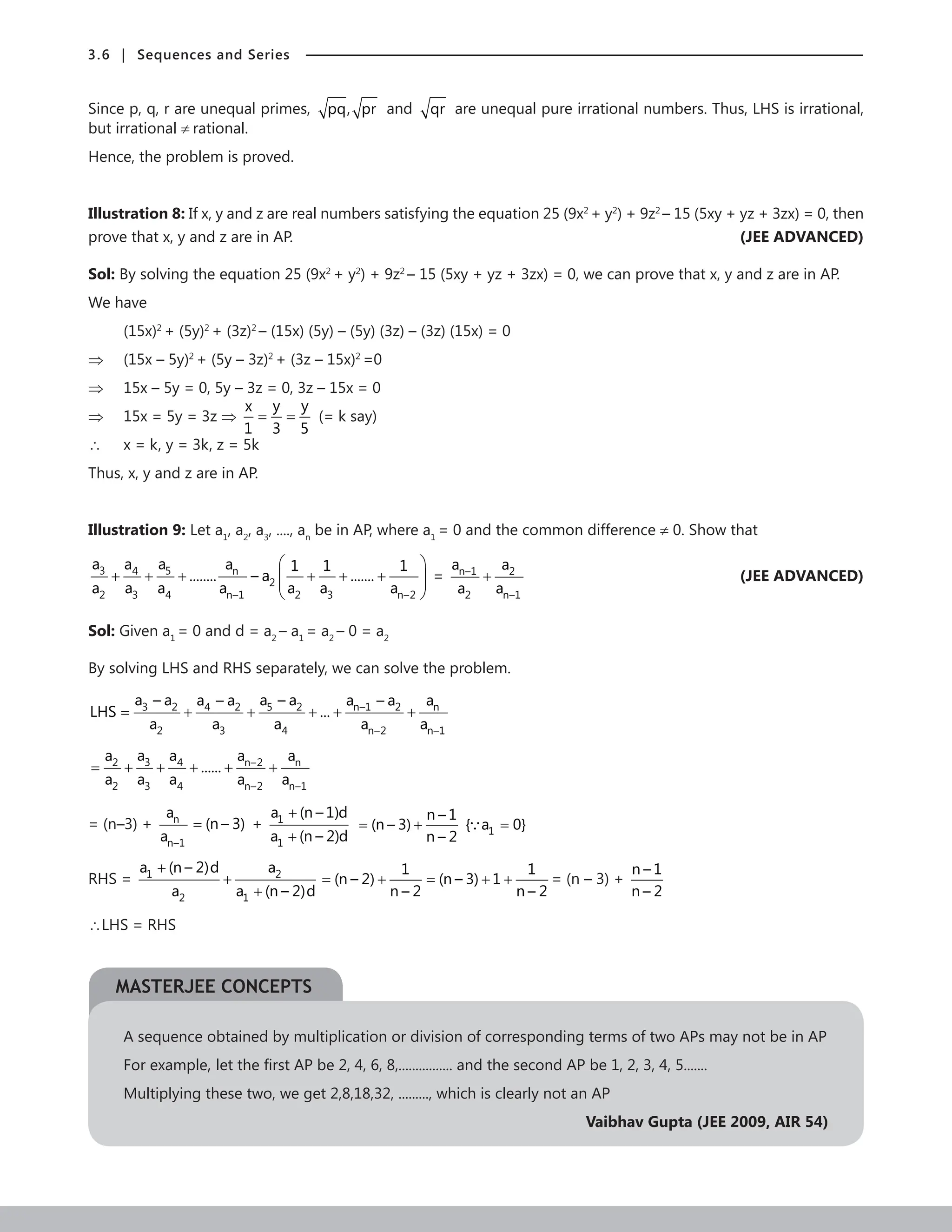
Illustration 9: Let a1
, a2
, a3
, ...., an
be in AP, where a1
= 0 and the common difference ≠ 0. Show that
3 5
4 n
2
2 3 4 n–1 2 3 n–2
a a
a a 1 1 1
........ – a .......
a a a a a a a
 
+ + + + + +
 
 
 
= n–1 2
2 n–1
a a
a a
+

(JEE ADVANCED)
Sol: Given a1
= 0 and d = a2
– a1
= a2
– 0 = a2
By solving LHS and RHS separately, we can solve the problem.
3 2 5 2
4 2 n–1 2 n
2 3 4 n–2 n–1
a – a a – a
a – a a – a a
LHS ...
a a a a a
= + + + + +
3
2 4 n–2 n
2 3 4 n–2 n–1
a
a a a a
......
a a a a a
= + + + + +
= (n–3) + n
n–1
a
a
(n – 3)
= + 1
1
a (n – 1)d
a (n – 2)d
+
+ 1
n – 1
(n – 3) { a 0}
n – 2
= + =

RHS = 1 2
2 1
a (n – 2)d a
a a (n – 2)d
+
+
+
1 1
(n – 2) (n – 3) 1
n – 2 n – 2
= + = + + = (n – 3) +
n – 1
n – 2
∴LHS = RHS
A sequence obtained by multiplication or division of corresponding terms of two APs may not be in AP
For example, let the first AP be 2, 4, 6, 8,................ and the second AP be 1, 2, 3, 4, 5.......
Multiplying these two, we get 2,8,18,32, ........., which is clearly not an AP
Vaibhav Gupta (JEE 2009, AIR 54)
MASTERJEE CONCEPTS
Mathematics | 3.7
4.2 Series of an AP
Series of an AP can be obtained as
Sn
= a + (a + d) + (a + 2d) ...... [a+(n – 1)d]
Sn
= [a + (n – 1)d] + [a+(n – 2)d] ...... + a (writing in the reverse order)
∴ 2Sn
= n(2a + (n –1) d)
∴ Sum to n terms, ( )
n 1 n
n n
S (2a (n – 1)d) T T
2 2
= + = +
Illustration 10: Find the sum of the first 19 terms of an AP when a4
+ a8
+ a12
+ a16
= 224. (JEE MAIN)
Sol: We need to find out the sum of the first 19 terms of an AP, i.e.
19
2
(2a + 18d), and we can represent the given
equation as (a + 3d) + (a + 7d) + (a + 11d) + (a + 15d) = 224.
Given (a + 3d) + (a + 7d) + (a + 11d) + (a +15d) = 224
⇒ 4a + 36d = 224 ⇒ a + 9d = 56
Sum of the first 19 terms ⇒ S =
19
2
(2a + 18d) =
19
2 56 1064
2
× × =
Illustration 11: The sum of n terms of two arithmetic progressions is in the ratio of
7n 1
4n 27
+
+
. Find ratio of the 11th
terms? (JEE MAIN)
Sol: Since we know the sum of n terms, i.e. Sn
= ( )
n
2a n – 1 d
2
 
+
  , we can write the equation as
1 1
2 2
n
(2a (n – 1)d )
7n 1 2
n
4n 27
(2a (n – 1)d )
2
+
+
=
+
+
. Hence, by putting n = 11 in this equation, we can obtain the ratio of the 11th
terms.
1 1
1 2
n 1
a d
2
7n 1
4n 27 n 1
a d
2
 
−
+  
+  
=
+  
−
+  
 
We want the ratio of 1 1
2 2
a 10d
a 10d
+
+
. Hence,
n – 1
10
2
= ⇒ n = 21
⇒ 1 2
2 2
a 10d 148
a 10d 111
+
=
+
Illustration 12: In an AP of n terms, prove that the sum of the kth
term from the beginning and the kth
term from
the end is independent of k and equal to the sum of the first and last terms. (JEE MAIN)
Sol: Using the formula k
T a (k – 1)d
= + and n k 1
T [a (n – k)d]
− + = + , we can obtain the kth
term from the beginning
and end, respectively, and after that by adding these values we can prove the given problem.
Suppose a be the first term and d be the common difference of the AP.
∴ kth
term from the beginning = k
T a (k – 1)d
= +  ... (i)
Let l be the last term of the AP and l = a + (n – 1) d
3.8 | Sequences and Series
The kth
term from the end of the given AP is the (n – k + 1)th
term from the beginning.
∴ n k 1
T [a (n – k)d]
− + = + 	 ...(ii)
Adding (i) and (ii), we get
∴ The required sum = k n k 1
T T [a (k – 1)d] a (n – k)d
− +
 
+ = + + +
  2a + (k – 1 + n – k) d
= 2a + (n – 1) d .... (iii), which is independent of k
Moreover, the sum of the first and last terms = a + l = a + [a + (n – 1) d] = 2a + (n – 1) d. ...(iv)
Thus, the sum of the first and last terms is independent of k and (3) = (4). Hence proved.
Illustration 13: If a1
, a2
, a3
,..., an
is an AP of non-zero terms , then prove that (JEE ADVANCED)
		
1 2 2 3 n–1 n 1 n
1 1 1 n – 1
.....
a a a a a a a a
+ + + =
Sol: By considering a as the first term and d as the common difference, we can write an
as a + (n – 1) d, where n =
1, 2, 3,… n.
1 2 2 3 n–1 n
1 1 1
.....
a a a a a a
+ + + =
1 1 1
......
a(a d) (a d)(a 2d) [a (n – 2)d][a (n 1)d]
+ +
+ + + + + −
=
1 1 1 1 1 1 1 1 1
– – ... –
d a a d d a d a 2d d a (n – 2)d a (n – 1)d
     
+ + +
     
+ + + + +
     
=
1 n
1 1 1 a (n 1)d – a (n 1)d n 1 n 1
d a a (n 1)d ad(a (n 1)d) ad(a (n 1)d) a(a (n 1)d) a a
  + − − − −
− = = = =
 
+ − + − + − + −
 
Facts:
• 
If each term of an AP is increased, decreased, multiplied or divided by the same non-zero number, the
resulting sequence is also an AP.
• 
The sum of the two terms of an AP equidistant from the beginning and end is constant and is equal
to the sum of the first and last terms.
a1
+ an
= a2
+ an – 1
= a3
+ an – 2
= ....
Vaibhav Krishnan (JEE 2009, AIR 54
Illustration 14: Split 69 into three parts such that they are in AP and the product of the two smaller parts is 483.
 (JEE MAIN)
Sol: By considering the three parts as a – d, a, and a + d and using the given conditions, we can solve the given
problem.
Sum of the three terms = 69 ⇒ (a – d) + a + (a + d) = 69
⇒		 3a = 69			 ⇒ a = 23 ..... (i)
MASTERJEE CONCEPTS
Mathematics | 3.9
Product of the two smaller parts = 483 ⇒ a (a – d) = 483
⇒ 23(23 – d) = 483		 ⇒ 23 – d = 21 ⇒ d = 23 – 21 = 2
Hence, the three parts are 21, 23 and 25.
Illustration 15: Divide 32 into four parts that are in AP such that the ratio of the product of extremes to the product
of mean is 7: 15. (JEE MAIN)
Sol: We can consider the four parts as (a – 3d), (a – d), (a + d) and (a + 3d).
Sum of the four parts = 32
⇒		 (a – 3d) + (a – d) + (a + d) + (a + 3d) = 32 ⇒ 4a = 32 ⇒ a = 8
And
(a – 3d)(a 3d) 7
(a – d)(a d) 15
+
=
+
⇒
2 2 2
2 2 2
a – 9d 7 64 – 9d 7
15 15
a – d 64 – d
=
⇒ =
⇒ 128 d2
= 512 ⇒ d2
= 4 ⇒ d = ± 2
Thus, the required parts are 2, 6, 10 and 14.
Illustration 16: If a + b + c ≠ 0 and
b c c a a b
, ,
a b c
+ + +
are in AP, then prove that
1 1 1
, ,
a b c
are also in AP.
 (JEE ADVANCED)
Sol: Here
b c c a a b
, ,
a b c
+ + +
are in AP; therefore, by adding 1 to each term and then by dividing each term by
a + b +c, we will get the required result
b c c a a b
, ,
a b c
+ + +
are in AP
Adding 1 to each term, find that
b c c a a b
1 , 1 , 1
a b c
     
+ + +
+ + +
     
     
are in AP
i.e.
a b c c a b a b c
, ,
a b c
+ + + + + +
are in AP
Dividing each term by a + b + c, we find that
1 1 1
, ,
a b c
are in AP
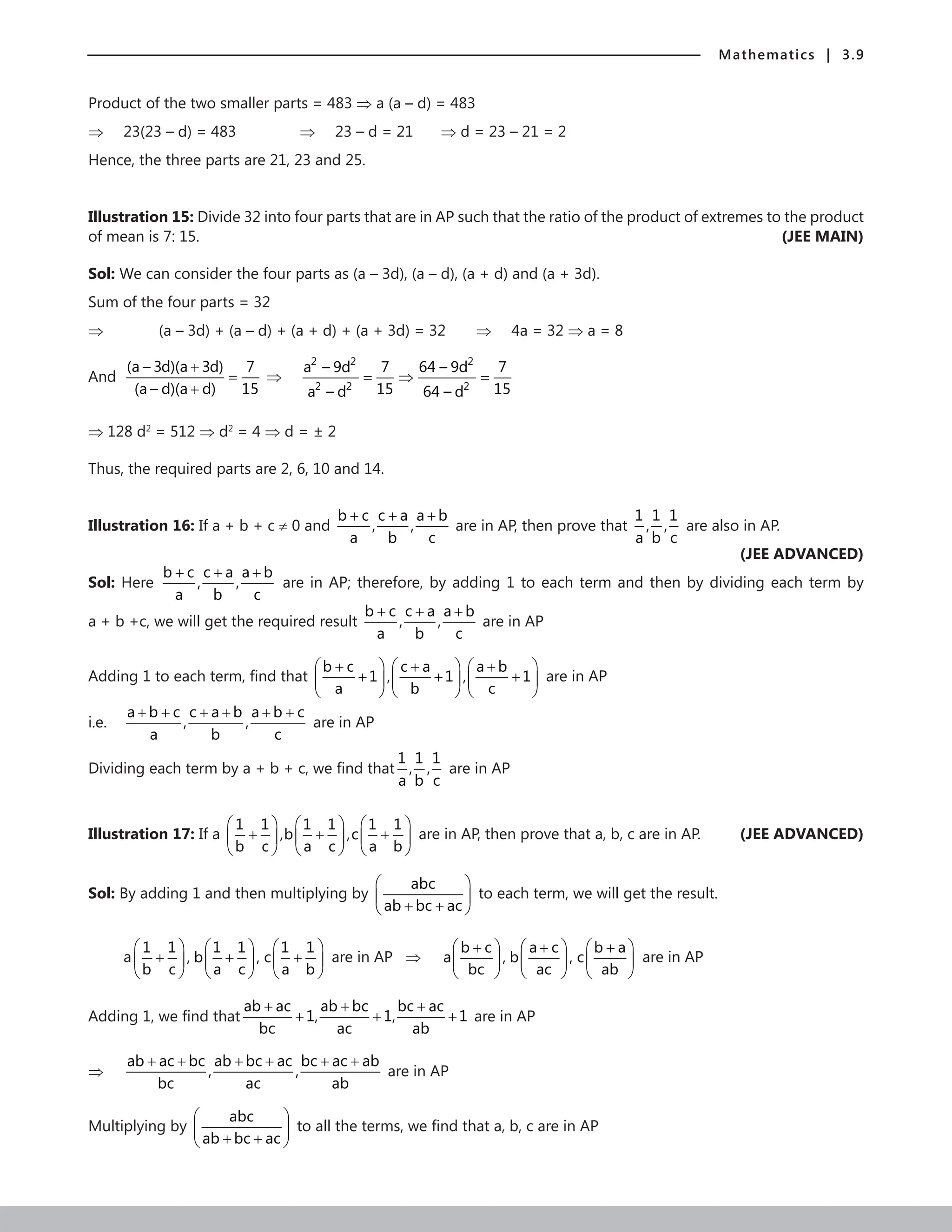
Illustration 17: If a
1 1 1 1 1 1
,b ,c
b c a c a b
     
+ + +
     
     
are in AP, then prove that a, b, c are in AP. (JEE ADVANCED)
Sol: By adding 1 and then multiplying by
abc
ab bc ac
 
 
+ +
 
to each term, we will get the result.
a
1 1 1 1 1 1
, b , c
b c a c a b
     
+ + +
     
     
are in AP ⇒
b c a c b a
a , b , c
bc ac ab
     
+ + +
     
     
are in AP
Adding 1, we find that
ab ac ab bc bc ac
1, 1, 1
bc ac ab
+ + +
+ + + are in AP
⇒
ab ac bc ab bc ac bc ac ab
, ,
bc ac ab
+ + + + + +
are in AP
Multiplying by
abc
ab bc ac
 
 
+ +
 
to all the terms, we find that a, b, c are in AP
3.10 | Sequences and Series
4.3 Arithmetic Mean
The arithmetic mean (AM) A of any two numbers a and b is given by the equation (a + b)/2. Please note that the
sequence a, A, b is in AP. If a1
, a2
, ...., an
are n numbers, the (AM) A, of these numbers is given by:
A = 1 2 n
1
(a a ..... a )
n
+ + +
Inserting ‘n’ AMs between ‘a’ and ‘b’
Suppose A1
, A2
, A3,
......., An
be the n means between a and b. Thus, a, A1
, A2
,...., An
, b is an AP and b is the (n + 2)th
term.
Thus, b = a + (n + 1 )d ⇒ d =
b – a
n 1
+
Now,
1
2
n
A a d
A a 2d
:
A a nd
= +
= +
= +
n
i
i 1
A na (1 2 3 ..... n)d
=
= + + + + +
∑ = na +
n(n 1) n(n 1) b a
d na
2 2 n 1
    
+ + −
= +
    
+
    
=
n
[2a b – a] nA
2
+ =
where, Α =
a b
2
+
Note: The sum of the n AMs inserted between a and b is equal to n times A.M. between them.
Illustration 18: Insert 20 AMs between the numbers 4 and 67. (JEE MAIN)
Sol: Given, a = 4 and b = 67; therefore by using the formula d=
b – a
n 1
+
, we can solve it.
67 – 4
d
20 1
=
+
= 3
A1
= a + d		 ⇒ A1
= 7
A2
= a + 2d ⇒ A2
= 10
A3
= a + 3d ⇒ A3
= 13
A20
= a + 20 d ⇒ A20
= 63
Thus, between 4 and 67, 20 AMs are 7, 10, 13, 16, ...., 63.
Illustration 19: If
n n
n–1 n–1
a b
a b
+
+
is the A.M. between a and b, find the value of n.  (JEE ADVANCED)
Sol: Since the A.M. between a and b =
a b
2
+
, we can obtain the value of n by equating this to
n n
n–1 n–1
a b
a b
+
+
.
⇒
n n
n–1 n–1
a b
a b
+
+
=
a b
2
+
[Given] ⇒ 2an
+ 2bn
= an
+ abn–1
+ an–1
b + bn
⇒ an
– an–1
b = abn–1
–bn
		⇒ an–1
(a – b) = bn–1
(a – b)
⇒ an–1
= bn–1
[ a ≠ b]			 ⇒
n–1 0
a a
1
b b
   
= =
   
   
0
a
1
b
 
 
 
=
 
 
 
 

⇒ n – 1 = 0					 ⇒ n = 1
Mathematics | 3.11
Illustration 20: Between 1 and 31, m arithmetic means are inserted in such a way that the ratio of the 7th
and
(m – 1)th
means is 5: 9. Calculate the value of m. (JEE MAIN)
Sol: AMs inserted between 1 and 31 are in AP. Thus, by considering d to be the common difference of AP and
obtaining the 7th
and (m – 1)th
means we can solve the problem.
Suppose A1
, A2
, A3
, A4,
...... Am
be the m AMs between 1 and 31.
Thus, 1, A1
, A2
,....Am
, 31 are in AP
The total number of terms is m + 2 and Tm+2
= 31
1 + (m + 2 – 1) d = 31 ⇒(m + 1) d = 30 ⇒ d =
30
m 1
+
A7
= T8
= a + 7d = 1 + 7 ×
30 m 1 210 m 211
m 1 m 1 m 1
+ + +
= =
+ + +
Am–1
= Tm
= 1 + (m –1) d =
30 m 1 30m – 30
1 (m – 1)
m 1 m 1
+ +
+ × =
+ +
=
31m – 29
m 1
+
7
m–1
A (m 211) / (m 1) m 211 5
A (31m 29) / (m 1) 31m – 29 9
+ + +
= = =
− +
		 [Given]
⇒
m 211 5
31m – 29 9
+
= ⇒ 9m +1899 = 155m – 145
⇒ 146m = 2044 ⇒ m =
2044
14
146
= ;Thus, m = 14
Illustration 21: Gate receipts at the show of “Baghbaan” amounted to Rs 9500 on the first night and showed a
drop of Rs 250 every succeeding night. If the operational expenses of the show are Rs 2000 a day, find out on which
night the show ceases to be profitable? (JEE MAIN)
Sol: Here, a = 9500 and d = –250. The show ceases to be profitable on the night when the receipts are just Rs 2000.
Thus, by considering that it will happen at nth
night and using Tn
= a + (n – 1) d, we can solve this problem.
We have the cost of gate receipt on the first night (a) = 9500
Common difference (d) = –250
Suppose, it happens on the nth night, then
2000 = 9500 + (n – 1) (–250) ⇒ 2000 – 9500 = – 250n + 250
⇒ –7500 – 250 = – 250n		 ⇒ –7750 = – 250n ⇒ n =
7750
31
250
=
(a) If the sum of n terms Sn
is given, then the general term Tn
= Sn
– Sn–1
, where Sn–1
is sum of (n – 1) terms of AP.
(b) In a series, if Sn
is a quadratic function of n or Tn
is a linear function of n, the series is an AP.
(i) If Tn
= an + b, the series so formed is an AP and its common difference is a.
(ii) If Sn
= an2
+ bn + c, the series so formed is an AP and its common difference is 2a.
MASTERJEE CONCEPTS
3.12 | Sequences and Series
(c) If in a finite AP, the number of terms is odd, then its middle term is the A.M. between the first term and
last term and its sum is equal to the product of the middle term and number of terms.
(d) It is found that the sum of infinite terms of an AP is ∞, if d  0 and –∞, if d  0.
(e) If for an AP, the pth term is q and the qth term is p, then the mth term is = p + q – m.
(f) If for an AP, the sum of p terms is q and sum of q terms is p, then the sum of (p + q) terms is – (p + q).
(g) If for an AP, the sum of p terms is equal to the sum of q terms, then the sum of (p +q) terms is zero.
(h) If for different APs, n n
n n
S f
S'
=
φ
, then n
n
T f(2n – 1)
T' (2n – 1)
=
φ
.
(i) If for two APs, n
n
T An B
T' Cn D
+
=
+
, then we find that n
n
n 1
A B
S 2
S' n 1
C D
2
 
+
+
 
 
=
 
+
+
 
 
.
Shrikant Nagori (JEE 2009, AIR 54)
An Important Property of AP: A sequence is said to be an AP if the sum of its n terms is of the form An2
+ Bn,
where A and B are constants. Thus, the common difference of the AP is 2A.
Proof: Suppose, a and d be the first term and common difference of AP, respectively, and Sn
be the sum of n terms.
n
n
S [2a (n – 1)d]
2
= +
⇒
2
2
n
n n d d
S an d – d n a – n
2 2 2 2
   
=
+ = +
   
   
⇒ Sn
= An2
+ Bn, where A =
d
2
and B
d
B a –
2
=
Hence, the sum of n terms of an AP is of the form An2
+ Bn.
Conversely, suppose the sum Sn
of n terms of a sequence a1
, a2
, a3
, ..........an
..... is of the form
An2
+ Bn. Then, we have to prove that the sequence is an AP.
We have Sn
= An2
– Bn
⇒		 Sn – 1
= A(n – 1)2
+ B(n – 1)		 [On replacing n by n = 1]
Now,		 An
= Sn
– Sn–1
⇒		 An
= {An2
+ Bn} – {A(n–1)2
– B(n–1)} = 2An + (B – A)
⇒		 An + 1
= 2A (n+1) + (B – A)			 [On replacing n by (n + 1)]
∴		 An + 1
– An
= {2A(n + 1) +B – A} – {2An + (B – A)} = 2A
Since An + 1
– An
= 2A for all n ∈ N, the sequence is an AP with a common difference 2A.
For example, if Sn
= 3n2
+ 2n, we can say that it is the sum of the n terms of an AP with a common difference of 6.
MASTERJEE CONCEPTS
Mathematics | 3.13
5. GEOMETRIC PROGRESSION
A sequence of non-zero numbers is called a geometric progression (GP) if the ratio of successive terms is constant.
In general, G.P. is written in the following form: a, ar, ar2
, ....., arn–1
,....
where a is the first term and r is the common ratio
5.1 General Term
If a is the first term and r is the common ratio, then Tn
= arn–1
.
Illustration 22: The 5th
, 8th
and 11th
terms of a G.P. are given as p, q and, s respectively. Prove that q2
= ps.
 (JEE MAIN)
Sol: By using Tn
= arn – 1
and solving it, we can prove the problem.
Given, T5
= p, T8
= q, T11
= s	 ....(i)
Now,		 T5
= ar5–1
= ar4
⇒ ar4
= p		 .... (ii) [Using (i)]
		 T8
= ar8–1
= ar7
⇒ ar7
=q		 ... (iii) [Using (i)]
		 T11
= ar11–1
= ar10
⇒ ar10
= s		 ..... (iv)
On squaring (iii), we get
		q2
= a2
r14
= a⋅a.r4
⋅r10
= (ar4
) (ar10
)
⇒ q2
= ps						 [Using (ii) and (iv)] proved.
5.2 Series of GP
Let us suppose Sn
= a + ar + ar2
+ ...... +arn–1
 ... (i)
Multiplying ‘r’ on both the sides of (i) and shifting the RHS terms by one place, we get
		Sn
r = 0 + ar + ar2
+ ...... +arn
 ... (ii)
By subtracting (ii) from (i), we get
		Sn
(1 – r) = a – arn
= a (1 – rn
)
		Sn
=
n
a(1 – r )
1 – r
, where r ≠ 1
Thus, the sum of the first n terms of a G.P. is given by ⇒
n
n 1
n
T – a
a(r – 1)
S
r – 1 r – 1
+
   
= =
   
 
 
 
 
And Sn
= na, when r = 1
Note: If r = 1, then the sequence is of both AP and GP, and its sum is equal to na, i.e. Sn
= na.
If |r|  1, the nth
term of G.P. converges to zero and the sum becomes finite.
The sum to infinite terms of G.P. =
n
n
n n
a(r – 1)
lim S lim
r – 1
→∞ →∞
=
As |r|  1 rn
→ 0 as n → ∞ 		 ∴
a
S
1 – r
∞ =
5.3 Geometric Mean
If a, b and c are three positive numbers in GP, then b is called the geometrical mean (GM) between a and c, and
b2
= ac. If a and b are two real numbers of the same sign and G is the G.M. between them, G2
= ab.
3.14 | Sequences and Series
Note: If a and b are two number of opposite signs, then the G.M. between them does not exist.
To Insert ‘n’ GMs Between a and b: If a and b are two positive numbers and we have to insert n GMs, G1
, G2
, ………,
Gn
, between the two numbers ‘a’ and ‘b’ then a, G1
, G2
, ……….., Gn
, b will be in GP. The series consists of (n + 2) terms
and the last term is b and the first term is a.
Thus, b = arn + 2 – 1
⇒ b = arn + 1
⇒ r =
1
n 1
b
a
+
 
 
 
⇒ G1
= ar, G2
= ar2
…….Gn
= arn
or Gn
= ayn+1 .
byn+1
= (ab)yn+1
Note: The product of n GMs inserted between ‘a’ and ‘b’ is equal to the nth
power of the single G.M. between ‘a’
and ‘b,’ i.e.
n
r
r 1
G
=
∏ = (G)n
, where G = ab (GM between a and b)
5.4 Relation between A.M. and GM
For any two non-negative number A.M. ≥ G.M.
Proof: Let two non-negative numbers be a and b .
Now, we can write ( )
2
a – b ≥ 0 ⇒ a – 2 ab + b ≥ 0 ⇒ a + b ≥ 2 ab ⇒
a b
2
+
≥ ab ⇒ A.M. ≥ GM
Note: (i) Equality for AM, G.M. (i.e. A.M. = GM) exists when a = b.
(ii) Since A.M. ≥ GM; (AM)min
= GM; (GM)max
= AM
Illustration 23: If x, y and z have the same sign, then prove that
y
x z
3
y z x
+ + ≥ . (JEE ADVANCED)
Sol: As we know that A.M. ≥ G.M., therefore by obtaining A.M. and G.M. of
x
y
,
y
z
and
z
x
we can prove the problem.
Let
x
y
= x1
;
y
z
= x2
;
z
x
= x3
∴ 1/3
1 2 3
1 2 3
x x x
(x x x )
3
+ +
≥ ⇒
y
x z
y z x
1
3
+ +
≥
Hence proved.
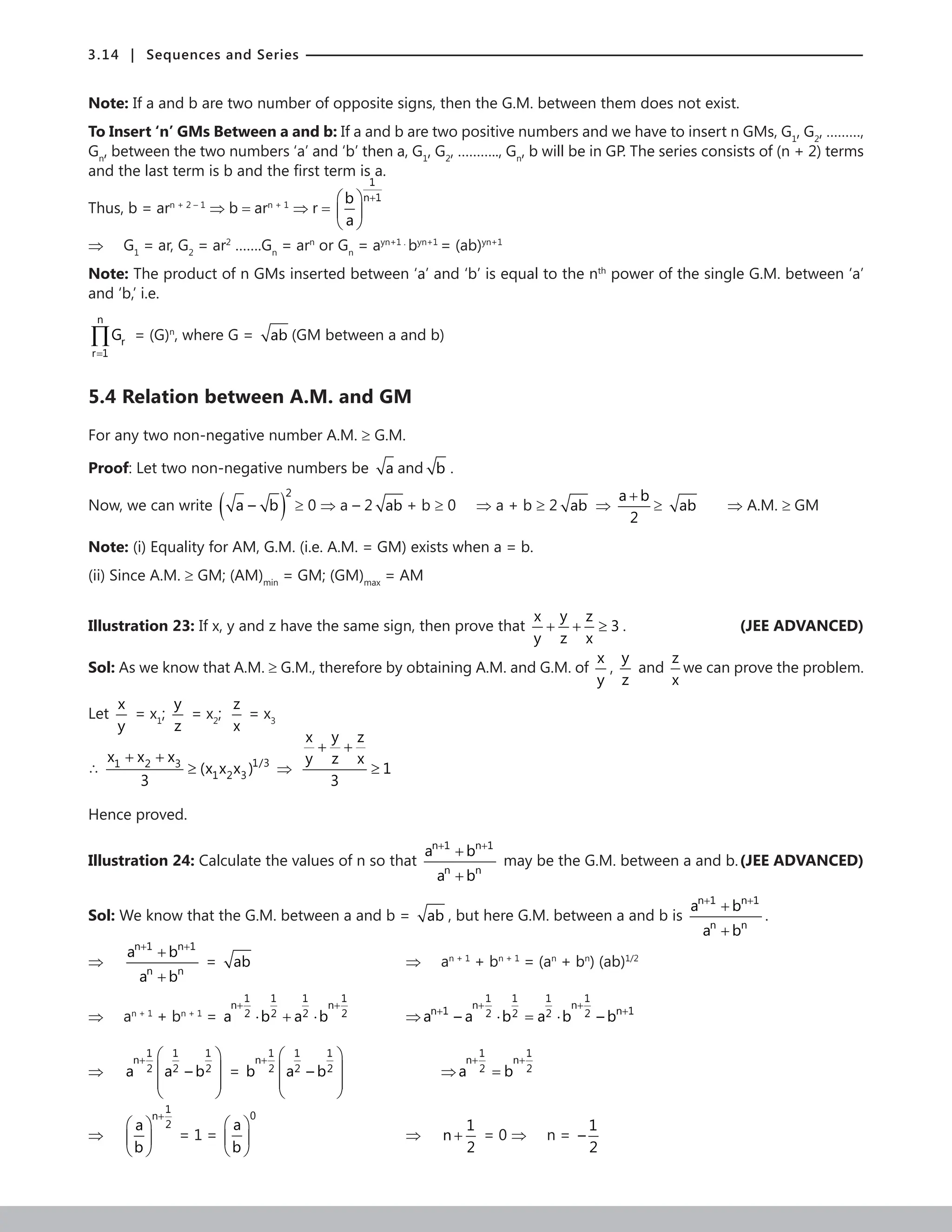
Illustration 24: Calculate the values of n so that
n 1 n 1
n n
a b
a b
+ +
+
+
may be the G.M. between a and b.(JEE ADVANCED)
Sol: We know that the G.M. between a and b = ab , but here G.M. between a and b is
n 1 n 1
n n
a b
a b
+ +
+
+
.
⇒
n 1 n 1
n n
a b
a b
+ +
+
+
= ab 					⇒ an + 1
+ bn + 1
= (an
+ bn
) (ab)1/2
⇒ an + 1
+ bn + 1
=
1 1 1 1
n n
2 2 2 2
a b a b
+ +
⋅ + ⋅ 		 ⇒
1 1 1 1
n n
n 1 n 1
2 2 2 2
a – a b a b – b
+ +
+ +
⋅ = ⋅
⇒
1 1 1
n
2 2 2
a a – b
+  
 
 
 
=
1 1 1
n
2 2 2
b a – b
+  
 
 
 
			 ⇒
1 1
n n
2 2
a b
+ +
=
⇒
1
n
2
a
b
+
 
 
 
= 1 =
0
a
b
 
 
 
					⇒
1
n
2
+ = 0 ⇒ n =
1
–
2
Mathematics | 3.15
Illustration 25: Find the sum to n terms for the series 9 + 99 + 999 …… n. (JEE ADVANCED)
Sol: The given series can be written as S = (10 – 1)+ (102
– 1) + (103
– 1) ….. +(10n
− 1).
Thus, by using Sn
=
n
a(1 – r )
1 – r
, we can find out the required sum.
∴ S = (10 + 102
+ 103
+….+ 10n
) – n; S =
n
10(1 – 10 )
– n
1 – 10
Illustration 26: If a1
, a2
and a3
are in G.P. with a common ratio r (r  0 and a  0), then values of r for which inequality
9a1
+ 5a3
 14a2
hold good are? (JEE ADVANCED)
Sol: Since a1
=
a
r
a2
= a, a3
= ar, by substituting these values to the given inequality we will get the result.
a1
=
a
r
, a2
= a, a3
= ar		 Now,
9a
5ar 14a
r
+ 
⇒ 5ar2
– 14ar + 9a  0			 ⇒ 5r2
– 14r + 9  0
⇒ 5r2
– 5r – 9r + 9  0			 ⇒ 5r(r – 1) – 9 (r – 1)  0
⇒ (5r – 9) (r – 1)  0			 ⇒ r ∈ R −
5
1,
9
 
 
 
• The product of n geometric means between a and (1/a) is 1.
• 
Let the first term of a G.P. be negative; if r  1, then it is a decreasing G.P. and if 0 r  1, then it is an
increasing GP.
• If a1
, a2
, a3
,…., an
are in AP,
a
a a a
3
1 2 n
a ,a ,a ,.....,a will be in G.P. whose common ratio is ad
.
Nitish Jhawar JEE 2009, AIR 54
Illustration 27: On a certain date, the height of a plant is 1.6 m. If the height increases by 5 cm in the following year and
if the increase in each year is half of that in the preceding years, show that the height of the plant will never be 1.7 m.
 (JEE MAIN)
Sol: Here, the sum of the increases in the height of the plant in the first, second, third, … year is equal to (1.7 – 1.6) m
= 0.1 m = 10 cm.
According to the question, increases in the height of the plant in the first, second, third, … year are 5,
5 5
,
2 4
, … cm,
respectively.
Let it reach the height of 1.7 m (i.e. increases [1.7 – 1.6] m = 0.1 m = 10 cm).
Therefore, the sum of 5,
5 5
,
2 4
, …to n terms = 10
⇒
n
1
5 1 –
2
10
1
1 –
2
 
 
  = 		 [ a = 5, r = ½, Sn
=
n
a(1 – r )
1 – r
]
⇒
n
1
10 1 – 10
2
 
=
 
 
⇒ 1 –
n
1
2
= 1 ⇒
n
1
0
2
= , which does not hold for any n. Thus, the plant will never reach the
height of 1.7 m.
MASTERJEE CONCEPTS
3.16 | Sequences and Series
Illustration 28: A manufacturer reckons that the value of a machine (price = Rs 15,625) will depreciate each year
by 20%. Calculate the estimated value at the end of 5 years.  (JEE MAIN)
Sol: Here the value of the machine after 5 years= ar5
, where a= 15,625. We will obtain the value of r using the given
condition.
The present value of the machine = Rs 15,625
The value of the machine in the next year = Rs 15,625 ×
80
100
The value of the machine after 2 years = Rs 15,625 ×
80 80
100 100
×
The values of the machine in the present year, after 1 year and after 2 years are
Rs 15,625, Rs 15,625 ×
80
100
and Rs 15,625 ×
80 80
100 100
× , respectively
These values form a GP.
Here, the first term is Rs 15,625 and the common ratio is
80
100
,i.e.
4
5
.
Thus, thee value of the machine after 5 years = ar5
= Rs 15,625
5
4 15625 1024
1024 5
5 625 5
  ×
× = = ×
 
×
 
= Rs 5120
5.5 Properties of GP
(a) If each term of a G.P. is multiplied or divided by the same non-zero quantity, then the resulting sequence is
also a GP.
(b) If in a finite GP, the number of terms is odd, then its middle term is the G.M. of the first and last terms.
(c) If a, b and c are in GP, then 2
b c
b ac
a b
= ⇒ = (which is the condition of GP).
(d) The reciprocals of the terms of a given G.P. also give a G.P. with a common ratio of
1
r
.
Proof: Let a1
, a2
, a3
, a4
,....., an
,...... be the terms of a G.P. with the common ratio r.
Then, n 1
n
a
r
a
+
= for all n ∈ N ... (i)
The sequence formed by the reciprocals of the terms of the above G.P. is given by
1 2 3 n
1 1 1 1
, , ,....., ,.....
a a a a
Now, n 1 n
n n 1
1 / a a 1
1 / a a r
+
+
= = 	 [Using (i)]
Hence, the new sequence is also a G.P. with the common ratio 1/r.
(e) If each term of a G.P. is raised to the same power (say k), then the resulting sequence also forms a G.P. with
the common ratio as rk
.
Proof: Let a1
, a2
, a3
, a4
,...., an
.... be the terms of a G.P. with the common ratio r.
Then, n 1
n
a
r
a
+
= for all n ∈ N (i)
Let k be a non-zero real number. Consider the sequence. k k k k
1 2 3 n
a ,a ,a ,.......,a ,....
Mathematics | 3.17
Here,
k
k
k
n 1 n 1
k
n
n
a a
r
a
a
+ +
 
= =
 
 
 
for all n ∈ d [Using (i)]
Thus, k k k k
1 2 3 n
a ,a ,a ,......,a ,..... is a G.P. with a common ratio rk
.
(f) In a GP, the product of the terms equidistant from the beginning and the end is always the same and it is equal
to the product of the first and last terms (only for finite GP).
Proof: Let a1
, a2
, a3
,....., an
be a finite G.P. with the common ratio r. Then,
kth
term from the beginning = ak
= a1
rk–1
kth
term from the end = (n – k + 1)th
term from the beginning
		 =
an–k +1
= a1
rn–k
∴ (kth
term from the beginning) (kth
term from the end)= ak
an–k+1
= a1
rk-1
a1
rn–k
=a1
2
rn–1
=a1
.a1
rn–1
= a1
an
for all k = 2,3,....,n –1
	
Thus, the product of the terms equidistant from the beginning and the end is always the same and is equal to
the product of the first and last terms.
(g) If the terms of a G.P. are chosen at regular intervals, the new sequence so formed also forms a G.P. with the
common ratio as rp
, where p is the size of interval.
For example:
2, 4, 8, 16, 32, 64, 128,..... (GP, where r = 2)
4, 16, 64 ..... (also a GP, where r = 4)
(h) If a1
, a2
, a3
,...., ar
..... is a G.P. of non-zero, non-negative terms, then log a1
, log a2
,...., log an
,..... is an AP and vice
versa.
(i) If T1
, T2
, T3
... and t1
, t2
, t3
are two GPs, T1
t1
, T2
t2
, T3
t3
.... is also in GP.
Proof: Let the two GPs be T1
, T2
, ...., Tn
,... with the common ratio R
⇒ n 1
n
T
R
T
+
= 			 ... (i)
and t1
, t2
,....,tn
,.... with common the ratio r
⇒ n 1
n
t
r
t
+
=  .... (ii)
Multiplying each term of the sequence (i) by the corresponding term of (ii), we get n 1 n–1
n n
T t
Rr
T t
+
  
=
  
  
  
Thus, the resulting sequence is also in G.P. with the common ratio Rr.
(j) The resulting sequence thus formed by dividing the terms of a G.P. by the corresponding terms of another
G.P. is also a GP.
Proof: Let the two GPs be T1
,T2
,....,Tn
,.... with the common ratio R
⇒ n 1
n
T
R
T
+
= 				 ... (i)
and t1
,t2
,....,tn
.... with the common ratio r
⇒ n 1
n
t
r
t
+
= 				 ...(ii)
Dividing each term of the sequence (i) by the corresponding term of (ii), we get
3.18 | Sequences and Series
n 1
n 1
n
n
T
t R
T r
t
+
+  
=  
 
				 [Using (i) and (ii)]
Thus, the resulting sequence is also in G.P. with the common ratio
R
r
 
 
 
.
Illustration 29: If sum of infinite terms of G.P. is 15 and sum of squares of infinite terms of G.P. is 45, then find GP.
 (JEE MAIN)
Sol: As the sum of infinite terms S∞
=
a
1 – r
, therefore by using this formula we can obtain the value of the common
ratio.
a
15
1 – r
=
Now, a2
, a2
r2
, a2
r4
,……;
2
2
a
45
1 – r
= ∴
225(1 – r)(1 – r)
45
(1 – r)(1 r)
=
+
225− 225r = 45 + 45r;		 180 = 270 r ∴ r = 2/3
Illustration 30: If x = 1 + a + a2
+ .... ∞, y = 1 + b + b2
+.... ∞ and |a|  1, |b|  1, then prove that
2 2 xy
1 ab a b ....
x y – 1
+ + + =
+
	 (JEE MAIN)
Sol: By using the formula S∞
=
a
1 – r
, we can solve problem.
x = 1 + a + a2
+ .... to ∞ =
1
1 – a
				 ( |a|  1)
⇒ 1 – a =
1
x
⇒
1
a 1 –
x
= ⇒
x – 1
a
x
=  ... (i)
Also, y = 1 + b + b2
+...... to ∞ =
1
1 – b
				 ( |b|  1)
⇒ 1 – b =
1
y
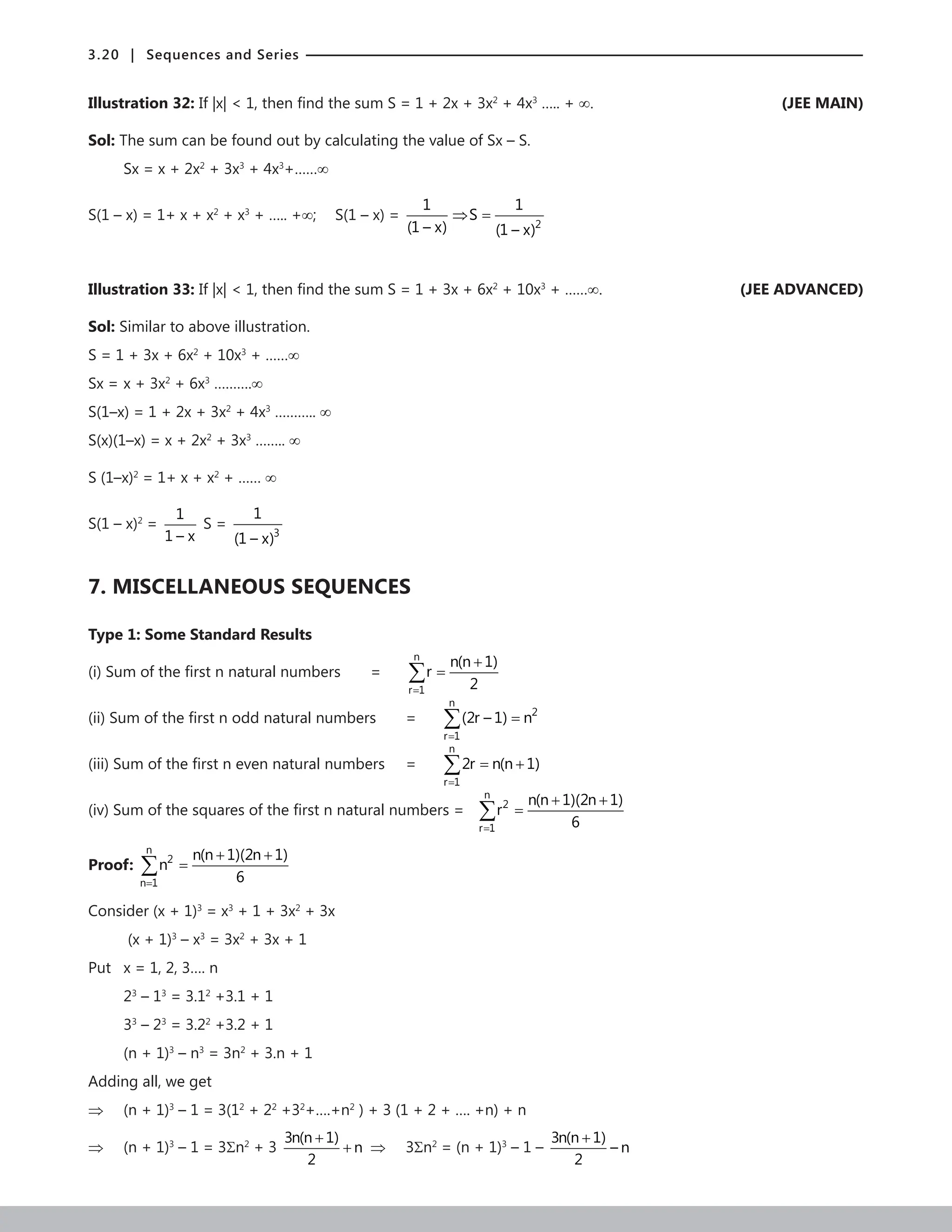
⇒
1
b 1 –
y
= ⇒
y – 1
b
y
=  ... (ii)
∴ 1 + ab + a2
b2
+ ..... to ∞ =
1
1 – ab
( |a|  1, |b|  1 ⇒ |ab|  1)
=
1
y – 1
x – 1
1 – .
x y
[Using (i) and (ii)] =
xy xy
xy – xy x y – 1 x y – 1
=
+ + +
Hence proved.
Illustration 31: If S1
, S2
, S3
, ……., SP
denote the sum of an infinite G.P. whose first terms are 1, 2, 3, …… , p, respectively
and whose common ratios are
1 1 1
, ,
2 3 4
,…….,
1
(p 1)
+
, respectively, show that S1
+ S2
+ S3
+ ……..+ Sp
=
p(p 3)
2
+
.
 (JEE ADVANCED)
Sol: By using S∞
=
a
1 – r
we can obtain S1
, S2
, S3
, ……., SP
and after that by adding them we can prove the given
equation.
Mathematics | 3.19
For S1
, we have a = 1, 			 r =
1
2
		 ∴ S1
=
1
1
1 –
2
= 2
For S2
, we have a = 2, 		 r =
1
3
		 ∴ S2
=
2
1
1 –
3
= 3
For S3
, we have a = 3, 		 r =
1
4
		 ∴ S3
=
3
1
1 –
4
= 4
For Sp
, we have a = p,		 r =
1
p 1
+
		 ∴ Sp
=
p
1
1 –
p 1
+
= p + 1
Adding all these, we get S1
+ S2
+ S3
+ ………+ Sp
= 2 + 3 + 4 + …….. + (p + 1)
				 =
p
2
[2 + (p + 1)] =
p
2
[p + 3] =
p(p 3)
2
+
				
Hence proved.
6. ARITHMETIC GEOMETRIC PROGRESSION
A series formed by multiplying the corresponding terms of AP and G.P. is called arithmetic geometric progression
(AGP).
Let a = first term of AP, b = first term of GP, d = common difference and r = common ratio of GP, then
AP: a, a + d, a + 2d, a+ 3d, ….., a + (n – 1) d
GP: b, br, br2
, br3
,….., brn–1
AGP: ab, (a + d) br, (a + 2d) br2
…. (a + (n – 1) d) brn–1
(Standard appearance of AGP)
The general term (nth
term) of an AGP is given as Tn
= [a + (n – 1)d] brn–1
.
6.1 Series of AGP
To find the sum of n terms of an AGP, we suppose that its sum as Sn
and then multiply both the sides by the
common ratio of the corresponding G.P. and then subtract as in the following way. Thus, we get a G.P. whose sum
can be easily obtained.
Sn
= ab + (a + d) br + (a + 2d) br2
+ ….. + (a + (n– 1)d) brn–1
 …(i)
rSn
= 0 + abr + (a + d) br2
+ …… + (a + (n – 1)d) brn
		 …(ii)
After subtraction, we get
Sn
(1 – r) = ab + [dbr + dbr2
+…..+ up to (n – 1) terms] – [ (a + (n – 1)d)brn
]
Sn
(1 – r) = ab +
n–1
n
dbr(1 – r )
(a (n – 1)d)br
1 – r
− +
Sn
=
n–1 n
2
ab dbr(1 – r ) (a (n – 1)d)br
1 – r 1 – r
(1 – r)
+
+ − . This is the sum of n terms of AGP
For an infinite AGP, as n → ∞, then rn
→ 0 (Q|r|  1)
⇒ S∞
=
2
ab dbr
1 – r (1 – r)
+
3.20 | Sequences and Series
Illustration 32: If |x|  1, then find the sum S = 1 + 2x + 3x2
+ 4x3
….. + ∞. (JEE MAIN)
Sol: The sum can be found out by calculating the value of Sx – S.
Sx = x + 2x2
+ 3x3
+ 4x3
+……∞
S(1 – x) = 1+ x + x2
+ x3
+ ….. +∞; S(1 – x) =
2
1 1
S
(1 – x) (1 – x)
⇒ =
Illustration 33: If |x|  1, then find the sum S = 1 + 3x + 6x2
+ 10x3
+ ……∞.  (JEE ADVANCED)
Sol: Similar to above illustration.
S = 1 + 3x + 6x2
+ 10x3
+ ……∞
Sx = x + 3x2
+ 6x3
……….∞
S(1–x) = 1 + 2x + 3x2
+ 4x3
……….. ∞
S(x)(1–x) = x + 2x2
+ 3x3
…….. ∞
S (1–x)2
= 1+ x + x2
+ …… ∞
S(1 – x)2
=
1
1 – x
S =
3
1
(1 – x)
7. MISCELLANEOUS SEQUENCES
Type 1: Some Standard Results
(i) Sum of the first n natural numbers =
n
r 1
n(n 1)
r
2
=
+
=
∑
(ii) Sum of the first n odd natural numbers =
n
2
r 1
(2r – 1) n
=
=
∑
(iii) Sum of the first n even natural numbers =
n
r 1
2r n(n 1)
=
= +
∑
(iv) Sum of the squares of the first n natural numbers =
n
2
r 1
n(n 1)(2n 1)
r
6
=
+ +
=
∑
Proof:
n
2
n 1
n(n 1)(2n 1)
n
6
=
+ +
=
∑
Consider (x + 1)3
= x3
+ 1 + 3x2
+ 3x
(x + 1)3
– x3
= 3x2
+ 3x + 1
Put x = 1, 2, 3…. n
23
– 13
= 3.12
+3.1 + 1
33
– 23
= 3.22
+3.2 + 1
(n + 1)3
– n3
= 3n2
+ 3.n + 1
Adding all, we get
⇒ (n + 1)3
– 1 = 3(12
+ 22
+32
+….+n2
) + 3 (1 + 2 + …. +n) + n
⇒ (n + 1)3
– 1 = 3Σn2
+ 3
3n(n 1)
n
2
+
+ ⇒ 3Σn2
= (n + 1)3
– 1 –
3n(n 1)
– n
2
+
Mathematics | 3.21
⇒ 3Σn2
= n3
+ 1 + 3n2
+ 3n – 1 –
3n(n 1)
– n
2
+
⇒ 3Σn2
= n3
+ 3n2
+ 2n –
3n(n 1)
2
+
⇒ 3Σn2
=
3 2 2
2n 6n 4n – 3n – 3n
2
+ +
⇒
3 2
2 2n 3n n
3 n
2
+ +
Σ =
⇒
3 2 2
2 2n 3n n n
3 n
2
+ + +
Σ = ⇒
2
2 2n (n 1) n(n 1)
3 n
2
+ + +
Σ =
⇒
+ × +
Σ =
2 n(n 1) (2n 1)
3 n
2
⇒
+ × +
Σ =
2 n(n 1) (2n 1)
n
6
(v) Sum of the cubes of first n natural numbers
2
n
3
r 1
n(n 1)
r
2
=
 
+
=  
 
∑
Proof: Consider (x + 1)4
– x4
= 4x3
+ 6x2
+ 4x + 1
Put x = 1, 2, 3…… n
24
– 14
= 4⋅13
+ 6⋅12
+ 4⋅1 + 1
34
– 24
= 4⋅23
+ 6⋅22
+ 4⋅2 + 1
44
– 34
= 4⋅32
+ 6⋅22
+ 4⋅3 + 1
		 :
(n + 1)4
– n4
= 4⋅n3
+ 6⋅n2
+ 4⋅n + 1
Adding all, we get
(n + 1)4
– 14
= 4(13
+ 23
+ ….. + n3
) + 6(12
+ 22
+ ….+ n2
) + 4(1 + 2 + 3….. +n) +n
= 3 n(n – 1)(2n 1) n 1
4 n 6 4 n n
6 2
 
   
+ +
Σ + + +
 
   
   
 
On simplification, we get
Σn3
=
2
n 1
n
2
 
 
+
 
 
 
 
(vi) Sum of the fourth powers of the first n natural numbers (Σn4
)
Σn4
= 14
+ 24
+ ….. +n4
; Σn4
=
2
n(n 1)(2n 1)(3n 3n – 1)
30
+ + +
[The result can be proved in the same manner as done for Σn3
]
Illustration 34: Find the value of
j
n i
i 1 j 1 k 1
(1)
= = =
∑∑∑ .	 (JEE MAIN)
Sol: Using the formula
n
r 1
n(n 1)
r
2
=
+
=
∑ and
n
2
r 1
n(n 1)(2n 1)
r
6
=
+ +
=
∑ , we can solve the problem.
Let S =
j
n i
i 1 j 1 k 1
(1)
= = =
∑∑∑
S =
n i n
2
i 1 j 1 i 1
i(i 1) 1
( j) [ n n]
2 2
= = =
+
= = Σ + Σ
∑∑ ∑
1 n(n 1)(2n 1) n(n 1)
2 6 2
 
+ + +
= +
 
 
n(n 1)(2n 4) n(n 1)(n 2)
12 6
+ + + +
= =
3.22 | Sequences and Series
Illustration 35: Find the sum of 1.2.3 + 2.3.4 + 3.4.5…… n terms.  (JEE MAIN)
Sol: The given series is in the form of Tn
= n(n + 1) (n + 2) = n3
+ 3n2
+ 2n.
Therefore, by using
=
 
+
=  
 
∑
2
n
3 2
r 1
n 1
r n
2
n
2
r 1
n(n 1)(2n 1)
r
6
=
+ +
=
∑ and
n
r 1
n(n 1)
r
2
=
+
=
∑ , we can solve the problem.
Tn
= n(n + 1) (n + 2) = n (n2
+ 3n + 2)
Tn
= n3
+ 3n2
+ 2n
ΣTn
= Σn3
+ 3Σn2
+ 2Σn =
( )
+ +
 
+
+ + +
 
 
2
2
3n n 1 (2n 1)
n 1
n n(n 1)
2 6
Type 2: Using Method of Difference: If T1
, T2
, T3
, T2
, T4
T5
…. is a sequence whose terms are sometimes in AP and
sometimes in GP, then for such series we first compute their nth term and then compute the sum to n terms using
sigma notation.
Illustration 36: Find Sn
= 6 + 13 + 22 ……… + Tn
. (JEE ADVANCED)
Sol: By calculating [Sn
+ (– Sn
)], we will get Tn
. After that we will obtain Σ Tn
and thus we will get the result.
Σn
= 6 + 13 + 22 ……… Tn
– Σn
= – 6 – 13 ……… – Tn–1
– Tn
⇒ 0 = 6 + (7 + 9 +11 ….. (Tn
– Tn–1
)) – Tn
⇒ Tn
= 6 + (7 + 9 + 11…. (Tn
– Tn–1
)) = 6 + (n – 1) (7 + n – 2) = 6 + (n – 1) (n + 5)
⇒ Tn
= 6 +n2
+ 4n – 5 = n2
+ 4n + 1
Σn
= Σn2
+ 4Σn + n =
n(n 1)(n 1)
6
+ +
+ 2n (n +1) + n
Illustration 37: Find S =
2
1 1 1
1 1 1 ......
3 3 3
   
+ + + + + +
   
   
n terms. (JEE ADVANCED)
Sol: Given, Tn
=
2 n 1
1 1 1
1 .....
3 3 3 −
+ + + + ; therefore by obtaining ΣTn,
we will get the result.
S =
1 1 1
1 1 1 .......
3 3 9
   
+ + + + +
   
   
Tn
=
2 n 1
1 1 1
1 .....
3 3 3 −
+ + + + =
n
1
3 1 –
3
2
 
 
 
ΣTn
=
n 2 n
3n 3 1 3n 3 1 1 1
– – ......
2 2 2 2 3
3 3 3
 
Σ
= +
 
 
=
n
3 3 1
n – 1 –
2 2 3
 
 
 
 
 
 
Type 3: Splitting the nth
term as a difference of two: Here, S is a series in which each term is composed of the
reciprocal of the product of r factors in an AP.
Mathematics | 3.23
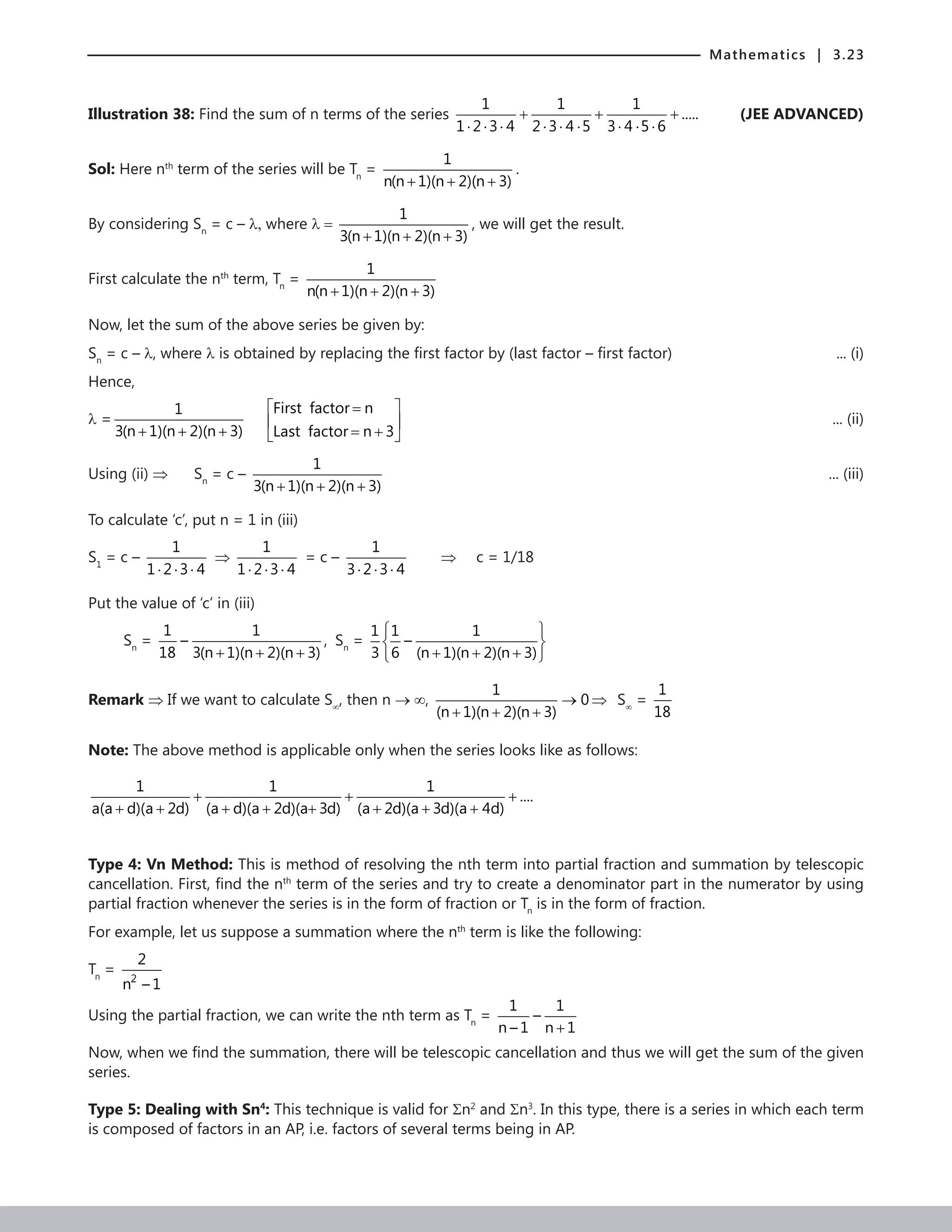
Illustration 38: Find the sum of n terms of the series
1 1 1
.....
1 2 3 4 2 3 4 5 3 4 5 6
⋅ ⋅ ⋅ ⋅ ⋅ ⋅ ⋅ ⋅ ⋅
+ + +  (JEE ADVANCED)
Sol: Here nth
term of the series will be Tn
=
1
n(n 1)(n 2)(n 3)
+ + +
.
By considering Sn
= c – λ, where λ =
1
3(n 1)(n 2)(n 3)
+ + +
, we will get the result.
First calculate the nth
term, Tn
=
1
n(n 1)(n 2)(n 3)
+ + +
		
Now, let the sum of the above series be given by:
Sn
= c – λ, where λ is obtained by replacing the first factor by (last factor – first factor)  ... (i)
Hence,
λ =
1
3(n 1)(n 2)(n 3)
+ + +
First factor n
Last factor n 3
 
=
 
= +
  
... (ii)
Using (ii) ⇒ Sn
= c –
1
3(n 1)(n 2)(n 3)
+ + + 
... (iii)
To calculate ‘c’, put n = 1 in (iii)
S1
= c –
1
1 2 3 4
⋅ ⋅ ⋅
⇒
1
1 2 3 4
⋅ ⋅ ⋅
= c –
1
3 2 3 4
⋅ ⋅ ⋅
⇒ c = 1/18
Put the value of ‘c’ in (iii)
Sn
=
1 1
–
18 3(n 1)(n 2)(n 3)
+ + +
, Sn
=
1 1 1
–
3 6 (n 1)(n 2)(n 3)
 
 
+ + +
 
Remark ⇒ If we want to calculate S∞
, then n → ∞,
1
0
(n 1)(n 2)(n 3)
→
+ + +
⇒ S∞
=
1
18
Note: The above method is applicable only when the series looks like as follows:
1 1 1
....
a(a d)(a 2d) (a d)(a 2d)(a 3d) (a 2d)(a 3d)(a 4d)
+ + +
+ + + + + + + +
Type 4: Vn Method: This is method of resolving the nth term into partial fraction and summation by telescopic
cancellation. First, find the nth
term of the series and try to create a denominator part in the numerator by using
partial fraction whenever the series is in the form of fraction or Tn
is in the form of fraction.
For example, let us suppose a summation where the nth
term is like the following:
Tn
=
2
2
n – 1
Using the partial fraction, we can write the nth term as Tn
=
1 1
–
n – 1 n 1
+
Now, when we find the summation, there will be telescopic cancellation and thus we will get the sum of the given
series.
Type 5: Dealing with Sn4
: This technique is valid for Σn2
and Σn3
. In this type, there is a series in which each term
is composed of factors in an AP, i.e. factors of several terms being in AP.
3.24 | Sequences and Series
Tn
=
1
[(n 1)(n 2)(n 3)(n 4)[n– (n – 1)]]
5
+ + + +
1
(n(n 1)(n 2)(n 3)(n 4) – (n – 1)(n 1)(n 2)(n 3)(n 4))
5
= + + + + + + + +
T1
=
1
(1 2 3 4 5 0)
5
⋅ ⋅ ⋅ ⋅ −
T2
=
1
(2 3 4 5 6 – 1 2 3 4 5)
5
⋅ ⋅ ⋅ ⋅ ⋅ ⋅ ⋅ ⋅
T3
=
1
(3 4 5 6 7 – 2 3 4 5 6)
5
⋅ ⋅ ⋅ ⋅ ⋅ ⋅ ⋅ ⋅
Tn
=
1
(n(n 1)(n 2)(n 3)(n 4) – (n – 1)(n 1)(n 2)(n 3)(n 4))
5
= + + + + + + + +
Adding all, we have
Sn
= ( )
1
n(n 1)(n 2)(n 3)(n 4)
5
+ + + +
Note: This method will be applicable only when the series looks like the following:
a(a + d) ( a+ 2d) + (a + d) (a + 2d) (a + 3d) + (a + 2d) (a + 3d) (a + 4d)+….+ up to n term, where a = first term and
d = common difference
•
1 1 1 1 n
....
1.2 2.3 3.4 n(n 1) n 1
+ + + + =
+ +
1 1 1 1 1
.... –
1.2.3 2.3.4 n(n 1)(n 2) 4 2(n 1)(n 2)
+ + + =
+ + + +
1 2 r 2 3 r 1 n n 1 n r–1 2 1 1 2 r–1 n 1 n 2 n r–1
1 1 1 1 1 1
..... –
a a ....a a a ....a a a ....a (r – 1)(a – a ) a a ....a a a ....a
+ + + + + +
 
+ + + =  
 
 
• a1
a2
….ar
+ a2
a3
….ar+1
+…..+ an
an+1
….an+r–1
=
2 1
1
(r 1)(a – a )
+
[ an
an+1
….an+r
– a0
a1
a2
….an
]
Where a1
a2
….an
are in AP and a0
= a1
– d
Shivam Agarwal JEE 2009, AIR 54
8. HARMONIC PROGRESSION
A sequence will be in harmonic progression (HP) if the reciprocals of its terms are in AP, e.g. if a1
, a2
, a3
, ……….
are in HP, then
1 2 3
1 1 1
, ,
a a a
……. are in AP. For every AP, there will be a corresponding HP, and the standard H.P. is
+ +
+ + +
1 1 1 1
, , ............
a a d a 2d a (n – 1)d
.
The terms of a harmonic series are the outcomes of an AP.
MASTERJEE CONCEPTS
Mathematics | 3.25
Note:
(i) 0 cannot be a term of H.P. because ∞ is not a term of AP, but ∞ can be a term of HP.
(ii) There is no general formula for finding the sum to n terms of HP.
(iii) If a, b and c are in HP, then
1 1 1
, ,
a b c
are in AP.
∴
2 1 1
b a c
= + 		 ⇒
2ac
b
a c
=
+
⇒ a, b and c are in HP
Moreover,
1 1 1 1
– –
b a c b
= 		 i.e.
a – b b – c
ab bc
= ;		 i.e.
a a – b
c b – c
=
Illustration 39: If the 3rd
, 6th
and last terms of a H.P. are
1 1 3
, ,
3 5 203
, then find the number of terms. 	 (JEE MAIN)
Sol: If nth
term of a H.P. is
1
a
, then the nth
term of the corresponding AP will be a. Thus, by using
Tn
= a + (n – 1) d, we will get the result.
Let a be the first term and d be the common difference of the corresponding AP.
If the 3rd
term of H.P. =
1
3
; then the 3rd
term of the corresponding AP = 3
⇒ a + 2d = 3			 ….. (i)
If the 6th
term of H.P. =
1
5
; then the 6th
term of the corresponding AP = 5
⇒ a + 5d = 5 ….. (ii)
From (i) and (ii), we get d =
2
3
⇒ a =
5
3
If the nth
term of H.P. =
3
;
203
then nth
term of AP =
203
3
a + (n – 1) d =
203
3
;
5
3
+ (n – 1)
2
3
=
203
3
5 + 2n – 2 = 203; n = 100
Illustration 40: If a1
, a2
, ……….an
are in H.P. then the expression a1
a2
+ a2
a3
+ …….+ an – 1
an
is equal to. 
 (JEE ADVANCED)
Sol: As
1 2 n
1 1 1
, ,......
a a a
are in AP, taking
2 1 3 2 n n–1
1 1 1 1 1 1
– – ... –
a a a a a a
= = = d, we can obtain the values of a1
a2
, a2
a3
and
so on.
a1
, a2
, ……. an
are in HP
1 2 n
1 1 1
, ,......
a a a
are in AP
⇒
2 1 3 2 n n–1
1 1 1 1 1 1
– – ... –
a a a a a a
= = = d (say)
⇒ a1
a2
= 1 2
1
(a – a )
d
, a2
a3
= 2 3
1
(a – a )
d
,……., an–1
an
=
1
d
(an – 1
– an
)
3.26 | Sequences and Series
Hence, a1
a2
+ a2
a3
+ ….+an – 1
an
=
1
d
[a1
– a2
+ a2
– a3
+ …..+an – 1
– an
] =
1
d
(a1
– an
)
But
n 1
1 1
a a
= + (n – 1) d ⇒ 1 n
n 1
a – a
a a
= (n – 1) d
∴ a1
a2
+ a2
a3
+ ……. + an –1
an
= (n – 1)a1
an
8.1 Harmonic Mean
If a, b and c are in HP, then the middle term is called the harmonic mean (HM) between them. If H is the HM
between a and b, then a, H, c are in H.P. and H =
2ac
a c
+
.
To Insert n HMs Between a and b
Let H1
, H2,
………., Hn
be the n HMs between a and b.
Thus, a, H1
, H2
, ……….., Hn
b are in HP.
1 2 n
1 1 1 1 1
, , .......... ,
a H H H b
are in AP.
⇒
1 1 1 1
(n 1)d; –
b a b a
= + + = (n + 1) d; d =
a – b
ab(n 1)
+
⇒
1
1 1
H a
= + d 		 ⇒
2
1 1
H a
= + 2d
⇒
3
1 1
H a
= + 3d		 ⇒
n
1 1
H a
= + nd
Adding all, we get
n
i 1 i
1 n d(n)(n 1) n n(n 1) (a – b)
H a 2 a 2 ab(n 1)
=
+ +
=
+ =
+
+
∑ = n
1 a – b n n(a b) 1
[2b a – b] n
a 2ab 2ab 2ab H
  +
+ = + = =
 
 
Note: The sum of the reciprocals of all the n HMs between a and b is equal to n times the reciprocal of the single
HM between a and b.
For example, between 1 and
1
100
if 100 HMs are inserted, then
100
i 1 i
1
H
=
∑ = 5050.
8.2 Sum of the Reciprocal of ‘n’ Harmonic Means
The sum of reciprocal of n harmonic means =
n(a b)
2ab
+
To Insert n Harmonic Means Between a and b
a, H1
, H2
, H3
…………Hn
, b → H.P.
1 2 3 n
1 1 1 1 1 1
, , , ........... ,
a H H H H b
→ A.P.
1 1
b a
= + (n + 1) d ⇒ (n + 1) d =
a – b
ab
Mathematics | 3.27
d =
a – b
(n 1)ab
+
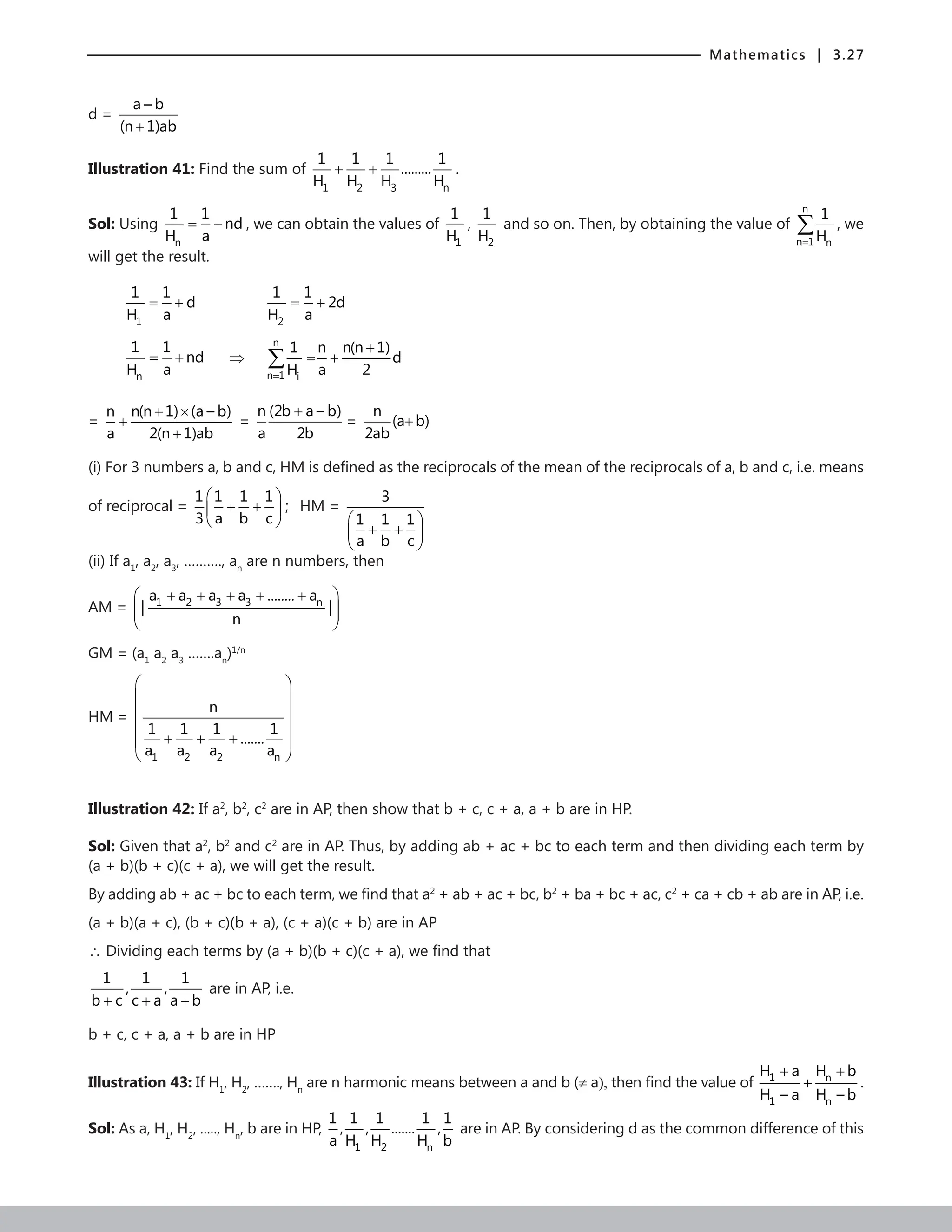
Illustration 41: Find the sum of
1 2 3 n
1 1 1 1
.........
H H H H
+ + .
Sol: Using
n
1 1
nd
H a
= + , we can obtain the values of
1
1
H
,
2
1
H
and so on. Then, by obtaining the value of
n
n 1 n
1
H
=
∑ , we
will get the result.
1
1 1
d
H a
= + 		
2
1 1
2d
H a
= +
n
1 1
nd
H a
= + ⇒
n
n 1 i
1 n n(n 1)
d
H a 2
=
+
= +
∑
=
n n(n 1) (a – b)
a 2(n 1)ab
+ ×
+
+
=
n (2b a – b)
a 2b
+
=
n
(a b)
2ab
+
(i) For 3 numbers a, b and c, HM is defined as the reciprocals of the mean of the reciprocals of a, b and c, i.e. means
of reciprocal =
1 1 1 1
3 a b c
 
+ +
 
 
; HM =
3
1 1 1
a b c
 
+ +
 
 
(ii) If a1
, a2
, a3
, ………., an
are n numbers, then
AM = 1 2 3 3 n
a a a a ........ a
| |
n
 
+ + + + +
 
 
 
GM = (a1
a2
a3
…….an
)1/n
HM =
1 2 2 n
n
1 1 1 1
.......
a a a a
 
 
 
 
+ + +
 
 
Illustration 42: If a2
, b2
, c2
are in AP, then show that b + c, c + a, a + b are in HP.
Sol: Given that a2
, b2
and c2
are in AP. Thus, by adding ab + ac + bc to each term and then dividing each term by
(a + b)(b + c)(c + a), we will get the result.
By adding ab + ac + bc to each term, we find that a2
+ ab + ac + bc, b2
+ ba + bc + ac, c2
+ ca + cb + ab are in AP, i.e.
(a + b)(a + c), (b + c)(b + a), (c + a)(c + b) are in AP
∴ Dividing each terms by (a + b)(b + c)(c + a), we find that
1 1 1
, ,
b c c a a b
+ + +
are in AP, i.e.
b + c, c + a, a + b are in HP
Illustration 43: If H1
, H2
, ……., Hn
are n harmonic means between a and b (≠ a), then find the value of 1 n
1 n
H a H b
H – a H – b
+ +
+ .
Sol: As a, H1
, H2
, ....., Hn
, b are in HP,
1 2 n
1 1 1 1 1
, , ....... ,
a H H H b
are in AP. By considering d as the common difference of this
3.28 | Sequences and Series
AP and using Tn
= a + (n – 1) d we can solve this problem.
1 1
b a
= + (n + 1)d and
n 1
1 1
–
H H
= (n – 1)d
Now, 		 1 1 1
1 1
H a 1 / a 1 / H 1 / a 1 / H
H – a 1 / a – 1 / H –d
+ + +
= =
and			
+ + +
= =
n n n
n n
H b 1 / b 1 / H 1 / b 1 / H
H – b 1 / b – 1 / H d
∴ 1 n 1 n
1 n
H a H b 1 / a 1 / H 1 / b 1 / H
H – a H – b –d d
+ + + +
+ = + =
n 1
1 1 1 1 1
– –
d b a H H
 
 
 
+
 
 
   
 
 
 
 
= 2n
9. RELATION BETWEEN AM, G.M. AND HM
If a and b are two positive numbers, then it can be shown that A ≥ G ≥ H and A, G, H are in GP, i.e. G2
= AH.
Proof: Given that, A =
a b
2
+
, G = ab and H =
2ab
a b
+
∴ A – G =
a b
2
+
– ab
⇒ A – G =
2
( a – b)
2
≥ 0
⇒ A ≥ G ……(i)
G – H =
2ab
ab –
a b
+
⇒ G – H =
a b – 2 ab
ab
a b
 
+
 
 
+
 
⇒ G – H = 2
ab
( a – b)
a b
+
≥ 0
⇒ G ≥ H ……(ii)
Using (i) and (ii), we find that
		A ≥ G ≥ H
Please note that the equality holds only when a = b.
Proof of G2
= AH		
Proof: A =
a b
2
+
, G = ab and H =
2ab
a b
+
Now, AH = ab = G2
		 ⇒ A, G  H are in G.P.
Moreover,
A
G
=
G
H
;		 ∴ A ≥ G ⇒ G ≥ H
Therefore, A ≥ G ≥ H; in fact, RMS ≥ A.M. ≥ G.M. ≥ HM (where RMS is root mean square).
Mathematics | 3.29
• If a and b are two positive quantities, then AM, G.M. and HM are always in GP, i.e. only for two numbers.
• If there are three numbers. then AM, G.M. and HM are in G.P. only when the three numbers. are in GP.
For example, 2, 4, 8 → GP
GM = 4; A.M. =
14
3
; HM =
24
7
• For two positive numbers, it has been shown that A ≥ G ≥ H, equality holding for equal numbers.
• 
For n non-zero positive numbers, it has been shown that A ≥ G ≥ H, equality holding when all the
numbers are equal.
Girish Chandani (JEE 2009, AIR 54)
Illustration 44: If a, b and c are unequal positive numbers in HP, then prove that
a b c b
4.
2a – b 2c – b
+ +
+  	 (JEE ADVANCED)
Sol: As a, b and c are in HP, therefore
2 1 1
b a c
= + . Thus, by substituting this to LHS, we can prove the given problem.
LHS =
1 1 1 1 1 1 1 1
b a b c b a b c ,
2 1 2 1 1 1
– –
b a b c c a
+ + + +
+ = + using (i)
=
c c a a a c a c
.
b a b c b c a
+
+ + + = + +
Now, A.M.  G.M. ⇒
a c
c a
2
+

a c
.
c a
		 or
a c
2.
c a
+ 
a c a c
2ac
b
a c
+ +
=
+
( ) ( )
2 2
a c a c
2
2ac 2ac
+ −
= = +
∴ LHS =
a c a c
b c a
 
+
+
 
 
 2 + 2 = 4
10. PROPERTIES OF AM, G.M. AND HM
(i) The equation with a and b as its roots is x2
– 2Ax + G2
= 0
Proof: The equation with a and b as its roots is x2
– (a + b) x + ab = 0
⇒ x2
– 2Ax + G2
= 0			 (∴ A =
a b
2
+
, G = ab )
(ii) If A, G and H are the arithmetic, geometric and harmonic means, respectively, between three given numbers a,
b and c, then the equation having a, b, c as its roots is x3
–3 Ax2
+
3
3G
H
x – G3
=0
MASTERJEE CONCEPTS
3.30 | Sequences and Series
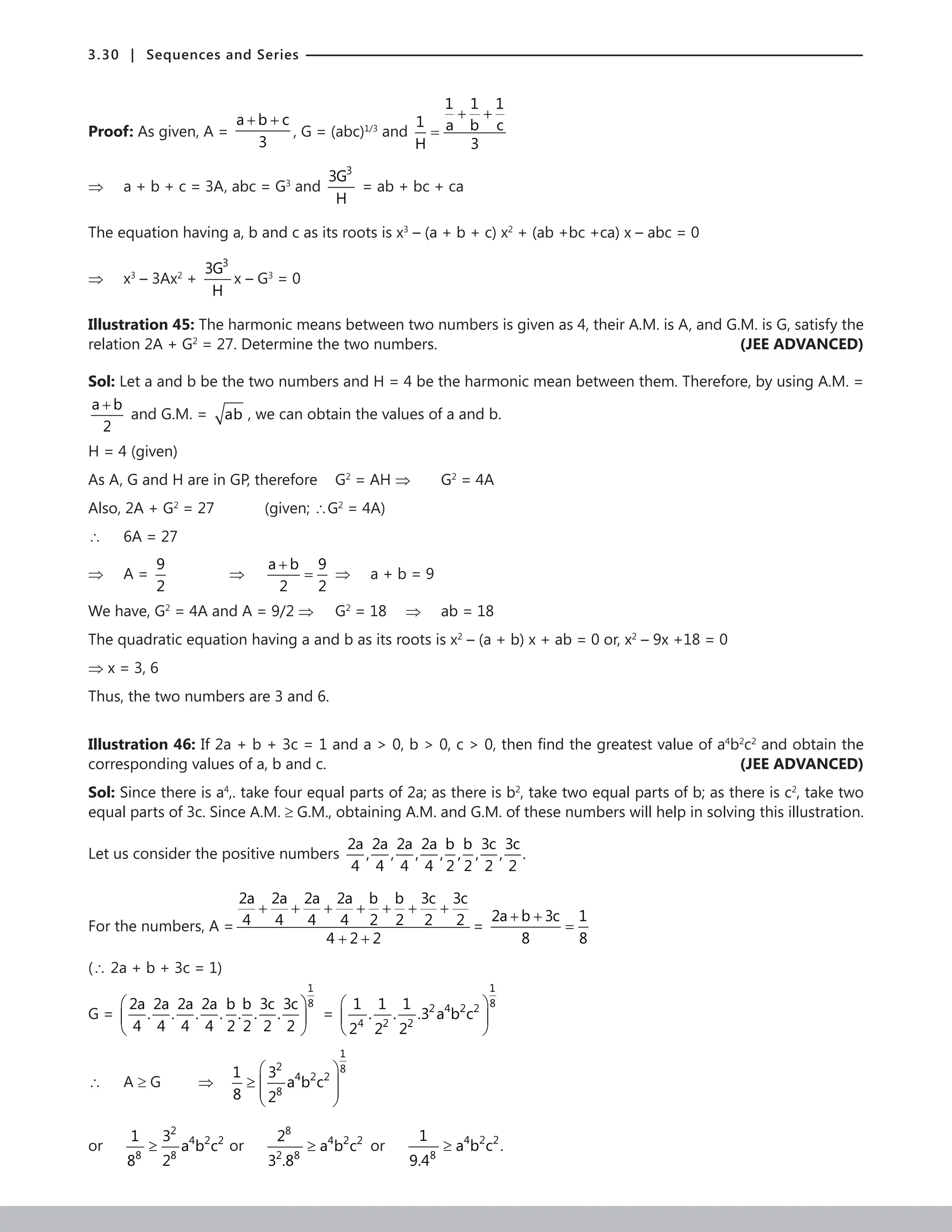
Proof: As given, A =
a b c
3
+ +
, G = (abc)1/3
and
1 1 1
1 a b c
H 3
+ +
=
⇒ a + b + c = 3A, abc = G3
and
3
3G
H
= ab + bc + ca
The equation having a, b and c as its roots is x3
– (a + b + c) x2
+ (ab +bc +ca) x – abc = 0
⇒ x3
– 3Ax2
+
3
3G
H
x – G3
= 0
Illustration 45: The harmonic means between two numbers is given as 4, their A.M. is A, and G.M. is G, satisfy the
relation 2A + G2
= 27. Determine the two numbers.  (JEE ADVANCED)
Sol: Let a and b be the two numbers and H = 4 be the harmonic mean between them. Therefore, by using A.M. =
a b
2
+
and G.M. = ab , we can obtain the values of a and b.
H = 4 (given)
As A, G and H are in GP, therefore G2
= AH ⇒ G2
= 4A		
Also, 2A + G2
= 27		 (given; ∴G2
= 4A)
∴ 6A = 27
⇒ A =
9
2
		 ⇒
a b 9
2 2
+
= ⇒ a + b = 9
We have, G2
= 4A and A = 9/2 ⇒ G2
= 18 ⇒ ab = 18
The quadratic equation having a and b as its roots is x2
– (a + b) x + ab = 0 or, x2
– 9x +18 = 0
⇒ x = 3, 6
Thus, the two numbers are 3 and 6.
Illustration 46: If 2a + b + 3c = 1 and a  0, b  0, c  0, then find the greatest value of a4
b2
c2
and obtain the
corresponding values of a, b and c.	 (JEE ADVANCED)
Sol: Since there is a4
,. take four equal parts of 2a; as there is b2
, take two equal parts of b; as there is c2
, take two
equal parts of 3c. Since A.M. ≥ G.M., obtaining A.M. and G.M. of these numbers will help in solving this illustration.
Let us consider the positive numbers
2a 2a 2a 2a b b 3c 3c
, , , , , , , .
4 4 4 4 2 2 2 2
For the numbers, A =
2a 2a 2a 2a b b 3c 3c
4 4 4 4 2 2 2 2
4 2 2
+ + + + + + +
+ +
=
2a b 3c 1
8 8
+ +
=
(∴ 2a + b + 3c = 1)
G =
1
8
2a 2a 2a 2a b b 3c 3c
. . . . . . .
4 4 4 4 2 2 2 2
 
 
 
=
1
8
2 4 2 2
4 2 2
1 1 1
. . .3 a b c
2 2 2
 
 
 
∴ A ≥ G ⇒
1
2 8
4 2 2
8
1 3
a b c
8 2
 
≥  
 
 
or
2
4 2 2
8 8
1 3
a b c
8 2
≥ or
8
4 2 2
2 8
2
a b c
3 .8
≥ or 4 2 2
8
1
a b c .
9.4
≥
Mathematics | 3.31
Hence, the greatest value of a4
b2
c2
= 8
1
9.4
It has been found that when the equality holds, the greatest value takes place.
We know that A = G when all the numbers are equal, i.e.
2a b 3c
4 2 2
= = 		 ⇒ a = b = 3c
∴
a b c
3 3 1
= = = k		 ∴ a = k
3 , b = 3k, c = k
∴ 2a + b + 3c = 1 ⇒ 6k + 3k + 3k = 1
∴ k =
1
12
		 ∴ a =
3
12
, b =
3
12
, c =
1
12
, i.e. a =
1
4
, b =
1
4
, c =
1
12
Arithmetic Mean of the mth
power
Suppose a1
, a2
, …..,an
be n positive real numbers (not all equal) and let m be a real number, then
m
m m m
1 2 n 1 2 n
a a .....a a a .....a
n n
 
+ + + +
  
 
 
, if m ∈ R –[0, 1]
If m ∈ (0, 1), then
m
m m m
1 2 n 1 2 n
a a .....a a a .....a
n n
 
+ + + +
  
 
 
Thus, if m ∈ {0, 1}, then
m
m m m
1 2 n 1 2 n
a a .....a a a .....a
n n
 
+ + + +
=  
 
 
PROBLEM-SOLVING TACTICS
(a) When looking for a pattern in a sequence or series, writing out several terms will help you see the pattern, do
not simplify directly. If you do this way, it is often easier to spot the pattern (if you leave terms as products,
sums, etc.).
(b) If each term of an AP is multiplied by (or divided by a non-zero) fixed constant C, the resulting sequence is
also an AP, with a common difference C times
1
or times
c
 
 
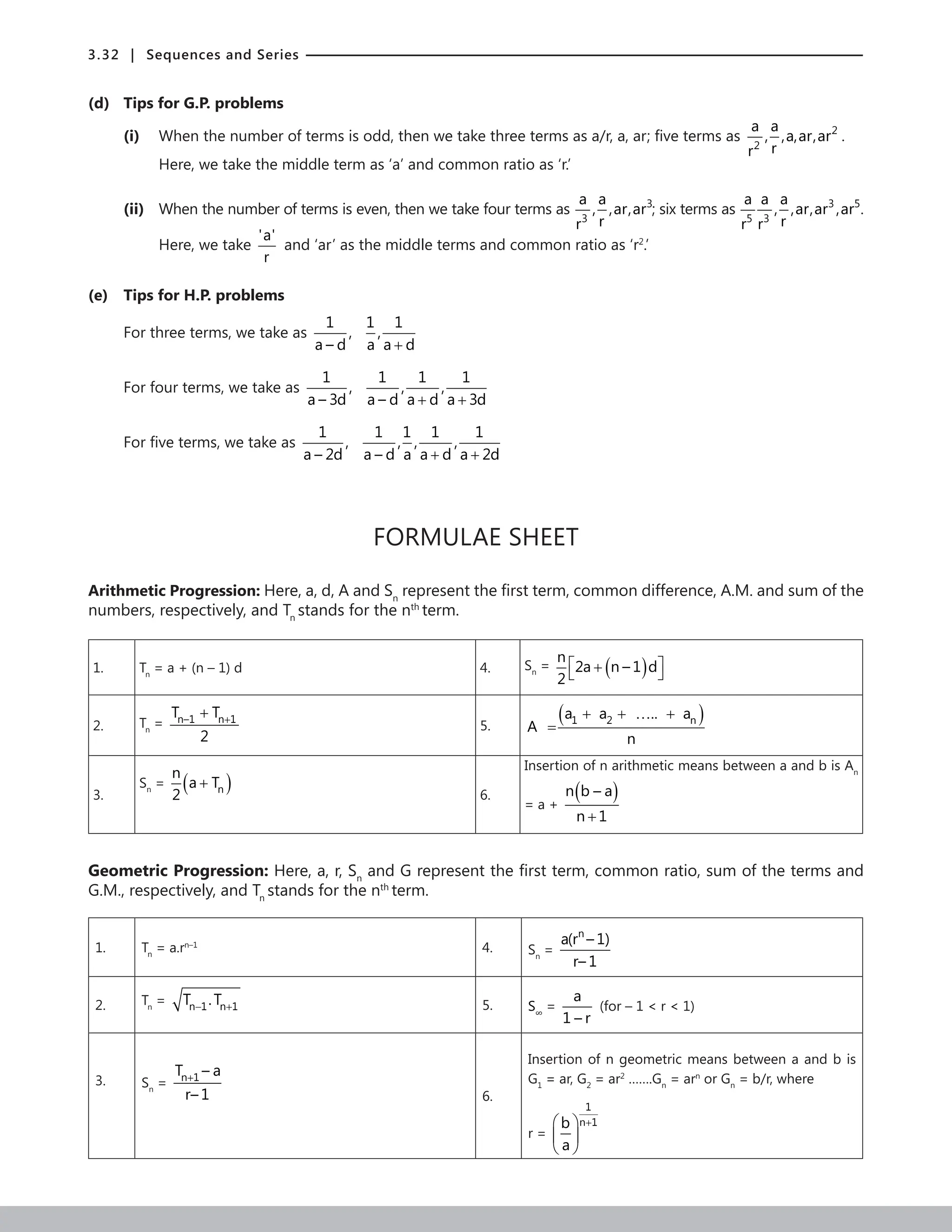
 
the previous.
(c) Tips for AP problems
(i) When the number of terms are three, then we take the terms as a – d, a, a + d;
Five terms as a - 2d, a - d, a, a + d, a + 2d
Here, we take the middle term as ‘a’ and common difference as ‘d’.
(ii) When the number of terms is even, then we take:
		 Four terms as a – 3d, a – d, a + d, a + 3d;
		 Six terms as a – 5d, a – 3d, a – d, a + d, a + 3d, a + 5d
		 Here, we take ‘a – d’ and ‘a + d’ as the middle terms and common difference as ‘2d’.
(iii) If the number of terms in an AP is even, then take the number of terms as 2n and if odd then take it as
(2n + 1).
3.32 | Sequences and Series
(d) Tips for G.P. problems
(i) When the number of terms is odd, then we take three terms as a/r, a, ar; five terms as 2
2
a a
, ,a,ar,ar
r
r
.
		 Here, we take the middle term as ‘a’ and common ratio as ‘r.’
(ii) When the number of terms is even, then we take four terms as 3
3
a a
, ,ar,ar
r
r
; six terms as 3 5
5 3
a a a
, ,ar,ar ,ar
r
r r
.
Here, we take
'a'
r
and ‘ar’ as the middle terms and common ratio as ‘r2
.’
(e) Tips for H.P. problems
For three terms, we take as
1 1 1
, ,
a – d a a d
+
For four terms, we take as
1 1 1 1
, , ,
a – 3d a – d a d a 3d
+ +
For five terms, we take as
1 1 1 1 1
, , , ,
a – 2d a – d a a d a 2d
+ +
FORMULAE SHEET
Arithmetic Progression: Here, a, d, A and Sn
represent the first term, common difference, A.M. and sum of the
numbers, respectively, and Tn
stands for the nth
term.
1. Tn
= a + (n – 1) d 4. Sn
= ( )
n
2a n – 1 d
2
 
+
 
2. Tn
= n–1 n 1
T T
2
+
+
5.
( )
1 2 n
a a .. a
A
n
+ + … +
=
3.
Sn
= ( )
n
n
a T
2
+
6.
Insertion of n arithmetic means between a and b is An
= a +
( )
n b – a
n 1
+
Geometric Progression: Here, a, r, Sn
and G represent the first term, common ratio, sum of the terms and
G.M., respectively, and Tn
stands for the nth
term.
1. Tn
= a.rn–1
4. Sn
=
n
a(r – 1)
r– 1
2. Tn
= n 1 n 1
T .T
− + 5. S∞
=
a
1 – r
(for – 1  r  1)
3. Sn
= n 1
T – a
r– 1
+
6.
Insertion of n geometric means between a and b is
G1
= ar, G2
= ar2
…….Gn
= arn
or Gn
= b/r, where
r =
1
n 1
b
a
+
 
 
 
Mathematics | 3.33
Arithmetic Geometric Progression: Here, a = the first term of AP, b = the first term of GP, d = common dif-
ference and r = common ratio of GP.
1. Sn
= ab + (a + d)br + (a + 2d)br2
+ (a + 3d)br3
+ …..
2.
Sn
=
n
n–1
2
a (n – 1)d br
dbr(1 – r )
ab
–
1 – r 1 – r
(1 – r)
 
+
 
+
3.
S∞
= 2
ab dbr
1 – r (1 – r)
+ (for – 1  r  1)
Harmonic Progression
1. n
1
a
a (n 1)d
=
+ −
, where a =
1
1
a
and d =
2 1
1 1
a a
−
2.
1 2 n
1 1 1 1 1
...
H n a a a
 
= + + +
 
 
 
3. Insertion of n harmonic means between a and b
1
1 1 a b
H a (n 1)ab
−
= +
+
2
1 1 2(a b)
H a (n 1)ab
−
= +
+
and so on ⇒
n
1 1 n(a b)
H a (n 1)ab
 
−
= +
 
+
 
 
1. The sum of n natural numbers
n
r 1
n(n 1)
r
2
=
+
=
∑
2. The sum of n odd natural numbers
n
2
r 1
(2r – 1) n
=
=
∑
3. The sum of n even natural numbers
n
r 1
2r n(n 1)
=
= +
∑
4. The sum of squares of n natural numbers
n
2
r 1
n(n 1)(2n 1)
r
6
=
+ +
=
∑
5. The sum of cubes of n natural numbers
2
n
3
r 1
n(n 1)
r
2
=
 
+
=  
 
∑

3.-SEQUENCES-AND-SERIES-THEORY.hhsssspdf

  • 1.
    3. S EQ U E N C E S A N D S E R I E S 1. SEQUENCE 1.1 Introduction A sequence can be defined as an ordered collection of things (usually numbers) or a set of numbers arranged one after another. Sometimes, sequence is also referred as progression. The numbers a1 , 2 3 a ,a .....an are known as terms or elements of the sequence. The subscript is the set of positive integers 1, 2, 3..... that indicates the position of the term in the sequence. Tn is used to denote the nth term. Some examples of a sequence are as follows: 0, 7, 26......................., 1, 4, 7, 10......................., 2, 4, 6, 8………………….. Note: The minimum number terms in a sequence should be 3. Sequence 3, 5, 7, 9, ..... 1 st term 2nd term3rd term 4rd term three dots means goes on forever (infinite) (”term’’’’, element’’ or ‘’ member’’’’ mean the same thing) Figure 3.1 1.2 Finite and Infinite Sequences A sequence containing a finite number of terms is called a finite sequence. If the sequence contains a infinite number of terms, it is known as an infinite sequence. It is infinite in the sense that it never ends. Examples of infinite and finite sequences are as follows: {1, 2, 3, 4......} is an infinite sequence {20, 25, 30, 35....} is an infinite sequence {1, 3, 5, 7} is the sequence of the first 4 odd numbers, which is a finite sequence
  • 2.
    3.2 | Sequencesand Series 1.3 Rule A sequence usually has a rule, on the basis of which the terms in the sequence are built up. With the help of this rule, we can find any term involved in the sequence. For example, the sequence {3, 5, 7, 9} starts at the number 3 and jumps 2 every time. +2 +2 +2 +2 0 1 2 3 4 5 6 7 8 9 9 Figure 3.2 As a Formula: Saying ‘start at the number 3 and jump 2 every time’ is fine, but it does not help to calculate the 10th term or 100th term or nth term. Hence, we want a formula for the sequence with “n” in it (where n is any term number). What would the rule for {3, 5, 7, 9.......} be? First, we can see the sequence goes up 2 every time; hence, we can guess that the rule will be something like ‘2 times n’ (where ‘n’ is the term number). Let us test it out. n Test Rule Term 1 2n = 2 × 1 = 2 3 2 2n = 2 × 2 = 4 5 3 2n = 2 × 3 = 6 7 That nearly worked! But it is less by 1 every time. Let us try changing it to 2n+1. n Test Rule Term 1 2n + 1 = 2 × 1 + 1 = 3 3 2 2n + 1 = 2 × 2 + 1 = 5 5 3 2n + 1 = 2 × 3 + 1 = 7 7 That Works: Therefore, instead of saying ‘starts at the number 3 and jumps 2 every time,’ we write the expression 2n + 1. We can now calculate, e.g. the 100th term as 2 × 100 + 1 = 201. 1.4 Notation The notation Tn is used to represent the general term of the sequence. Here, the position of the term in the sequence is represented by n. To mention for the ‘5’th term, just write T5 . Thus, the rule for {3, 5, 7, 9…} can be written as the following equation: Tn = 2n + 1. To calculate the 10th term, we can write T10 = 2n + 1 = 2 × 10 + 1 = 21 Illustration 1: Find out the first 4 terms of the sequence, {Tn } = {–1/n}n . (JEE MAIN) Sol: By substituting n = 1, 2, 3 and 4 in{Tn } = {–1/n}n , we will get the first 4 terms of given sequence. T1 = (–1/1)1 = –1 T2 = (–1/2)2 = 1/4 T3 = (–1/3)3 = –1/27 T4 = (–1/4)4 = 1/256 ⇒ {Tn } = {–1, ¼,–1/27, 1/256 ...}
  • 3.
    Mathematics | 3.3 Illustration2: Write the sequence whose nth term is (i) 2n and (ii) log(nx). (JEE MAIN) Sol: By substituting n = 1, 2, 3…….., we will get the sequence. (i) nth term = 2n (ii) nth term = an = log(nx) a1 = 21 , a2 = 22 ....... a1 =log(x) a2 = log(2x), an = log(nx) Sequence ⇒ 21 , 22 ,.........2n Sequence ⇒ log(x), log(2x),................log(nx) 2. SERIES Series is something that we get from a given sequence by adding all the terms. If we have a sequence as T1 , T2 , …. ,Tn , then the series that we get from this sequence is T1 + T2 +….+Tn . Sn is used to represent the sum of n terms. Hence, Sn = T1 + T2 +…. +Tn 3. SIGMA AND PI NOTATIONS 3.1 Sigma Notation The meaning of the symbol Σ (sigma) is summation. To find the sum of any sequence, the symbol Σ (sigma) is used before its nth term. For example: (i) 9 n=1 n ∑ =1+2+3+.........+9 (ii) n a a r 1 r or n = ∑ ∑ =1a +2a +3a +........+ na (iii) 5 i l i 1 1 1 2 1 3 1 4 1 5 1 2i 4 2 1 4 2 2 4 2 3 4 2 4 4 2 5 4 = + + + + + + = + + + + + × + × + × + × + × + ∑ Properties of Σ (Sigma) (i) k i l a = ∑ = a + a + a… (k times) = ka, where a is a constant. (ii) k k i l i l ai a i = = = ∑ ∑ , where a is a constant. (iii) n n n r r r r r l r l r l (a b ) a b = = = ± = ± ∑ ∑ ∑ (iv) i j j i n n n n i j i j i i j j j j i i 0 0 0 0 aa aa = = = = = ∑ ∑ ∑ ∑ 3.2 Pi Notation The symbol ∏ denotes the product of similar terms. For example: (i) 6 n 1 n = ∏ = 1 × 2 × 3 × 4 × 5 × 6 (ii) k m n 1 n = ∏ = 1m × 2m × 3m × 4m × ............. × km (iii) k n 1 n = ∏ = 1 × 2 × 3 × ........ × k = k! 4. ARITHMETIC PROGRESSION The sequence in which the successive terms maintain a constant difference is known as an arithmetic progression (AP). Consider the following sequences: a, a + d, a + 2d, a + 3d T1 ,    T2 , T3 , T4
  • 4.
    3.4 | Sequencesand Series  T2 – T1 = T3 – T2 = T4 – T3 = constant (common difference) The given sequence is an example of AP. The set of natural numbers is also an example of AP. 4.1 General Term General term (nth term) of an AP is given by Tn = a + (n – 1) d, where a is the first term of the sequence and d is the common difference of the sequence. Note: (i) General term is also denoted by  (last term). (ii) n (number of terms) always belongs to the set of natural numbers. (iii) Common difference can be zero, + ve or – ve. If d 0 ⇒ increasing AP and the sequence tends to +∞ If d 0 ⇒ decreasing AP and the sequence tends to −∞ If d = 0 ⇒ constant AP (all the terms remain same) (iv) The nth term from end is (m – n + 1) term from the beginning, where m is the total number of terms and is given by the following expression: Tm-n+1 =Tm − (n–1) d • If the mth term is n and the nth term is m, then the (m + n)th term is 0. • If m times the mth term is equal to n times the nth term, then the (m + n)th term is 0. Vaibhav Krishnan (JEE 2009, AIR 54) Illustration 3: If the 5th term of an AP is 17 and its 7th term is 15, then find the 22th term. (JEE MAIN) Sol: Using the formula Tn = a + (n – 1) d, we can solve above problem. Given a + 4d = 17 and a + 6d = 15 ⇒ 2d = −2 ⇒ d = −1, a = 21 ∴ T22 = 21 − 21 = 0 Illustration 4: If 11 times the 11th term of an AP is equal to 9 times the 9th term, then find the 20th term.(JEE MAIN) Sol: By solving 11 (a + 10d) = 9 (a + 8d), we will get the value of a and d. ∴ 2a = –38 d ⇒ a = –19d ∴ 20th term = a + 19d = 0 Illustration 5: Check whether the sequences given below are AP or not. (JEE MAIN) (i) Tn = n2 (ii) Tn = an + b Sol: By taking the difference of two consecutive terms, we can check whether the sequences are in AP or not. (i) Tn = n2 ; Tn–1 = (n – 1)2 MASTERJEE CONCEPTS
  • 5.
    Mathematics | 3.5 Difference= Tn – Tn–1 = n2 – (n – 1)2 = n2 – (n2 – 2n +1) = 2n – 1 This difference varies with respect to the term. Hence, the sequence is not an AP. (ii) Tn = an + b; Tn – 1 = a (n – 1) + b Difference = (an + b) – (a (n – 1) + b) = a (constant) Hence, the sequence is an AP. Illustration 6: The 2nd , 31st and the last term of an AP are given as 3 1 7 , 4 2 and 1 6 2 − , respectively. Find the first term and the number of terms. (JEE MAIN) Sol: Using Tn = a + (n – 1) d, we can get the first term and common difference. Suppose a be the first term and d be the common difference of the AP. Given, 2 3 T 7 4 = ⇒ a+ d = 31 4 .... (i) 31 1 T 2 = ⇒ a + 30d = 1 2 .... (ii) Subtracting (i) from (ii), we get 29d = 1 31 29 – – 2 4 4 = ⇒ 1 d 4 − = Putting the value of d in (i), we get 1 31 a – 4 4 = ⇒ 31 1 32 a 8 4 4 4 = + = = Suppose the number of terms be n, so that Tn = 13 – 2 i.e. a + (n – 1) d = 13 – 2 ⇒ 8 + (n – 1) 1 13 – – 4 2   =     ⇒ 32 – n + 1 = – 26 ⇒ n = 59 Hence, the first term = 8 and the number of terms = 59. Illustration 7: Prove that the square roots of three unequal prime numbers cannot be three terms of an AP. (JEE ADVANCED) Sol: Here by Considering p , q , r to be the lth , µth and vth terms of an AP and solving them using Tn = a + (n – 1) d, we prove the problem. If possible let p , q , r be the three terms of an AP. a, a +d, a + 2d........., where p ≠ q ≠ r and they are prime numbers. Let them be the lth , µth and vth terms, respectively. ∴ p = a + (λ – 1) d q = a + (µ – 1) d r = a + (ν – 1) d ∴ p – r = (λ – µ) d Also, q – r = (µ – v) d ∴ p – q – v q – r λ µ = µ − or ( )( ) ( )( ) p – q q r – v q – r q r + λ µ = µ − + or – pq pr – q – qr (q – r) – v λ µ + = µ or – pq pr – qr q (q r) v λ µ + = + − µ − = rational number
  • 6.
    3.6 | Sequencesand Series Since p, q, r are unequal primes, pq, pr and qr are unequal pure irrational numbers. Thus, LHS is irrational, but irrational ≠ rational. Hence, the problem is proved. Illustration 8: If x, y and z are real numbers satisfying the equation 25 (9x2 + y2 ) + 9z2 – 15 (5xy + yz + 3zx) = 0, then prove that x, y and z are in AP. (JEE ADVANCED) Sol: By solving the equation 25 (9x2 + y2 ) + 9z2 – 15 (5xy + yz + 3zx) = 0, we can prove that x, y and z are in AP. We have (15x)2 + (5y)2 + (3z)2 – (15x) (5y) – (5y) (3z) – (3z) (15x) = 0 ⇒ (15x – 5y)2 + (5y – 3z)2 + (3z – 15x)2 =0 ⇒ 15x – 5y = 0, 5y – 3z = 0, 3z – 15x = 0 ⇒ 15x = 5y = 3z ⇒ y y x 1 3 5 = = (= k say) ∴ x = k, y = 3k, z = 5k Thus, x, y and z are in AP. Illustration 9: Let a1 , a2 , a3 , ...., an be in AP, where a1 = 0 and the common difference ≠ 0. Show that 3 5 4 n 2 2 3 4 n–1 2 3 n–2 a a a a 1 1 1 ........ – a ....... a a a a a a a   + + + + + +       = n–1 2 2 n–1 a a a a + (JEE ADVANCED) Sol: Given a1 = 0 and d = a2 – a1 = a2 – 0 = a2 By solving LHS and RHS separately, we can solve the problem. 3 2 5 2 4 2 n–1 2 n 2 3 4 n–2 n–1 a – a a – a a – a a – a a LHS ... a a a a a = + + + + + 3 2 4 n–2 n 2 3 4 n–2 n–1 a a a a a ...... a a a a a = + + + + + = (n–3) + n n–1 a a (n – 3) = + 1 1 a (n – 1)d a (n – 2)d + + 1 n – 1 (n – 3) { a 0} n – 2 = + =  RHS = 1 2 2 1 a (n – 2)d a a a (n – 2)d + + + 1 1 (n – 2) (n – 3) 1 n – 2 n – 2 = + = + + = (n – 3) + n – 1 n – 2 ∴LHS = RHS A sequence obtained by multiplication or division of corresponding terms of two APs may not be in AP For example, let the first AP be 2, 4, 6, 8,................ and the second AP be 1, 2, 3, 4, 5....... Multiplying these two, we get 2,8,18,32, ........., which is clearly not an AP Vaibhav Gupta (JEE 2009, AIR 54) MASTERJEE CONCEPTS
  • 7.
    Mathematics | 3.7 4.2Series of an AP Series of an AP can be obtained as Sn = a + (a + d) + (a + 2d) ...... [a+(n – 1)d] Sn = [a + (n – 1)d] + [a+(n – 2)d] ...... + a (writing in the reverse order) ∴ 2Sn = n(2a + (n –1) d) ∴ Sum to n terms, ( ) n 1 n n n S (2a (n – 1)d) T T 2 2 = + = + Illustration 10: Find the sum of the first 19 terms of an AP when a4 + a8 + a12 + a16 = 224. (JEE MAIN) Sol: We need to find out the sum of the first 19 terms of an AP, i.e. 19 2 (2a + 18d), and we can represent the given equation as (a + 3d) + (a + 7d) + (a + 11d) + (a + 15d) = 224. Given (a + 3d) + (a + 7d) + (a + 11d) + (a +15d) = 224 ⇒ 4a + 36d = 224 ⇒ a + 9d = 56 Sum of the first 19 terms ⇒ S = 19 2 (2a + 18d) = 19 2 56 1064 2 × × = Illustration 11: The sum of n terms of two arithmetic progressions is in the ratio of 7n 1 4n 27 + + . Find ratio of the 11th terms? (JEE MAIN) Sol: Since we know the sum of n terms, i.e. Sn = ( ) n 2a n – 1 d 2   +   , we can write the equation as 1 1 2 2 n (2a (n – 1)d ) 7n 1 2 n 4n 27 (2a (n – 1)d ) 2 + + = + + . Hence, by putting n = 11 in this equation, we can obtain the ratio of the 11th terms. 1 1 1 2 n 1 a d 2 7n 1 4n 27 n 1 a d 2   − +   +   = +   − +     We want the ratio of 1 1 2 2 a 10d a 10d + + . Hence, n – 1 10 2 = ⇒ n = 21 ⇒ 1 2 2 2 a 10d 148 a 10d 111 + = + Illustration 12: In an AP of n terms, prove that the sum of the kth term from the beginning and the kth term from the end is independent of k and equal to the sum of the first and last terms. (JEE MAIN) Sol: Using the formula k T a (k – 1)d = + and n k 1 T [a (n – k)d] − + = + , we can obtain the kth term from the beginning and end, respectively, and after that by adding these values we can prove the given problem. Suppose a be the first term and d be the common difference of the AP. ∴ kth term from the beginning = k T a (k – 1)d = + ... (i) Let l be the last term of the AP and l = a + (n – 1) d
  • 8.
    3.8 | Sequencesand Series The kth term from the end of the given AP is the (n – k + 1)th term from the beginning. ∴ n k 1 T [a (n – k)d] − + = + ...(ii) Adding (i) and (ii), we get ∴ The required sum = k n k 1 T T [a (k – 1)d] a (n – k)d − +   + = + + +   2a + (k – 1 + n – k) d = 2a + (n – 1) d .... (iii), which is independent of k Moreover, the sum of the first and last terms = a + l = a + [a + (n – 1) d] = 2a + (n – 1) d. ...(iv) Thus, the sum of the first and last terms is independent of k and (3) = (4). Hence proved. Illustration 13: If a1 , a2 , a3 ,..., an is an AP of non-zero terms , then prove that (JEE ADVANCED) 1 2 2 3 n–1 n 1 n 1 1 1 n – 1 ..... a a a a a a a a + + + = Sol: By considering a as the first term and d as the common difference, we can write an as a + (n – 1) d, where n = 1, 2, 3,… n. 1 2 2 3 n–1 n 1 1 1 ..... a a a a a a + + + = 1 1 1 ...... a(a d) (a d)(a 2d) [a (n – 2)d][a (n 1)d] + + + + + + + − = 1 1 1 1 1 1 1 1 1 – – ... – d a a d d a d a 2d d a (n – 2)d a (n – 1)d       + + +       + + + + +       = 1 n 1 1 1 a (n 1)d – a (n 1)d n 1 n 1 d a a (n 1)d ad(a (n 1)d) ad(a (n 1)d) a(a (n 1)d) a a   + − − − − − = = = =   + − + − + − + −   Facts: • If each term of an AP is increased, decreased, multiplied or divided by the same non-zero number, the resulting sequence is also an AP. • The sum of the two terms of an AP equidistant from the beginning and end is constant and is equal to the sum of the first and last terms. a1 + an = a2 + an – 1 = a3 + an – 2 = .... Vaibhav Krishnan (JEE 2009, AIR 54 Illustration 14: Split 69 into three parts such that they are in AP and the product of the two smaller parts is 483. (JEE MAIN) Sol: By considering the three parts as a – d, a, and a + d and using the given conditions, we can solve the given problem. Sum of the three terms = 69 ⇒ (a – d) + a + (a + d) = 69 ⇒ 3a = 69 ⇒ a = 23 ..... (i) MASTERJEE CONCEPTS
  • 9.
    Mathematics | 3.9 Productof the two smaller parts = 483 ⇒ a (a – d) = 483 ⇒ 23(23 – d) = 483 ⇒ 23 – d = 21 ⇒ d = 23 – 21 = 2 Hence, the three parts are 21, 23 and 25. Illustration 15: Divide 32 into four parts that are in AP such that the ratio of the product of extremes to the product of mean is 7: 15. (JEE MAIN) Sol: We can consider the four parts as (a – 3d), (a – d), (a + d) and (a + 3d). Sum of the four parts = 32 ⇒ (a – 3d) + (a – d) + (a + d) + (a + 3d) = 32 ⇒ 4a = 32 ⇒ a = 8 And (a – 3d)(a 3d) 7 (a – d)(a d) 15 + = + ⇒ 2 2 2 2 2 2 a – 9d 7 64 – 9d 7 15 15 a – d 64 – d = ⇒ = ⇒ 128 d2 = 512 ⇒ d2 = 4 ⇒ d = ± 2 Thus, the required parts are 2, 6, 10 and 14. Illustration 16: If a + b + c ≠ 0 and b c c a a b , , a b c + + + are in AP, then prove that 1 1 1 , , a b c are also in AP. (JEE ADVANCED) Sol: Here b c c a a b , , a b c + + + are in AP; therefore, by adding 1 to each term and then by dividing each term by a + b +c, we will get the required result b c c a a b , , a b c + + + are in AP Adding 1 to each term, find that b c c a a b 1 , 1 , 1 a b c       + + + + + +             are in AP i.e. a b c c a b a b c , , a b c + + + + + + are in AP Dividing each term by a + b + c, we find that 1 1 1 , , a b c are in AP Illustration 17: If a 1 1 1 1 1 1 ,b ,c b c a c a b       + + +             are in AP, then prove that a, b, c are in AP. (JEE ADVANCED) Sol: By adding 1 and then multiplying by abc ab bc ac     + +   to each term, we will get the result. a 1 1 1 1 1 1 , b , c b c a c a b       + + +             are in AP ⇒ b c a c b a a , b , c bc ac ab       + + +             are in AP Adding 1, we find that ab ac ab bc bc ac 1, 1, 1 bc ac ab + + + + + + are in AP ⇒ ab ac bc ab bc ac bc ac ab , , bc ac ab + + + + + + are in AP Multiplying by abc ab bc ac     + +   to all the terms, we find that a, b, c are in AP
  • 10.
    3.10 | Sequencesand Series 4.3 Arithmetic Mean The arithmetic mean (AM) A of any two numbers a and b is given by the equation (a + b)/2. Please note that the sequence a, A, b is in AP. If a1 , a2 , ...., an are n numbers, the (AM) A, of these numbers is given by: A = 1 2 n 1 (a a ..... a ) n + + + Inserting ‘n’ AMs between ‘a’ and ‘b’ Suppose A1 , A2 , A3, ......., An be the n means between a and b. Thus, a, A1 , A2 ,...., An , b is an AP and b is the (n + 2)th term. Thus, b = a + (n + 1 )d ⇒ d = b – a n 1 + Now, 1 2 n A a d A a 2d : A a nd = + = + = + n i i 1 A na (1 2 3 ..... n)d = = + + + + + ∑ = na + n(n 1) n(n 1) b a d na 2 2 n 1      + + − = +      +      = n [2a b – a] nA 2 + = where, Α = a b 2 + Note: The sum of the n AMs inserted between a and b is equal to n times A.M. between them. Illustration 18: Insert 20 AMs between the numbers 4 and 67. (JEE MAIN) Sol: Given, a = 4 and b = 67; therefore by using the formula d= b – a n 1 + , we can solve it. 67 – 4 d 20 1 = + = 3 A1 = a + d ⇒ A1 = 7 A2 = a + 2d ⇒ A2 = 10 A3 = a + 3d ⇒ A3 = 13 A20 = a + 20 d ⇒ A20 = 63 Thus, between 4 and 67, 20 AMs are 7, 10, 13, 16, ...., 63. Illustration 19: If n n n–1 n–1 a b a b + + is the A.M. between a and b, find the value of n. (JEE ADVANCED) Sol: Since the A.M. between a and b = a b 2 + , we can obtain the value of n by equating this to n n n–1 n–1 a b a b + + . ⇒ n n n–1 n–1 a b a b + + = a b 2 + [Given] ⇒ 2an + 2bn = an + abn–1 + an–1 b + bn ⇒ an – an–1 b = abn–1 –bn ⇒ an–1 (a – b) = bn–1 (a – b) ⇒ an–1 = bn–1 [ a ≠ b] ⇒ n–1 0 a a 1 b b     = =         0 a 1 b       =          ⇒ n – 1 = 0 ⇒ n = 1
  • 11.
    Mathematics | 3.11 Illustration20: Between 1 and 31, m arithmetic means are inserted in such a way that the ratio of the 7th and (m – 1)th means is 5: 9. Calculate the value of m. (JEE MAIN) Sol: AMs inserted between 1 and 31 are in AP. Thus, by considering d to be the common difference of AP and obtaining the 7th and (m – 1)th means we can solve the problem. Suppose A1 , A2 , A3 , A4, ...... Am be the m AMs between 1 and 31. Thus, 1, A1 , A2 ,....Am , 31 are in AP The total number of terms is m + 2 and Tm+2 = 31 1 + (m + 2 – 1) d = 31 ⇒(m + 1) d = 30 ⇒ d = 30 m 1 + A7 = T8 = a + 7d = 1 + 7 × 30 m 1 210 m 211 m 1 m 1 m 1 + + + = = + + + Am–1 = Tm = 1 + (m –1) d = 30 m 1 30m – 30 1 (m – 1) m 1 m 1 + + + × = + + = 31m – 29 m 1 + 7 m–1 A (m 211) / (m 1) m 211 5 A (31m 29) / (m 1) 31m – 29 9 + + + = = = − + [Given] ⇒ m 211 5 31m – 29 9 + = ⇒ 9m +1899 = 155m – 145 ⇒ 146m = 2044 ⇒ m = 2044 14 146 = ;Thus, m = 14 Illustration 21: Gate receipts at the show of “Baghbaan” amounted to Rs 9500 on the first night and showed a drop of Rs 250 every succeeding night. If the operational expenses of the show are Rs 2000 a day, find out on which night the show ceases to be profitable? (JEE MAIN) Sol: Here, a = 9500 and d = –250. The show ceases to be profitable on the night when the receipts are just Rs 2000. Thus, by considering that it will happen at nth night and using Tn = a + (n – 1) d, we can solve this problem. We have the cost of gate receipt on the first night (a) = 9500 Common difference (d) = –250 Suppose, it happens on the nth night, then 2000 = 9500 + (n – 1) (–250) ⇒ 2000 – 9500 = – 250n + 250 ⇒ –7500 – 250 = – 250n ⇒ –7750 = – 250n ⇒ n = 7750 31 250 = (a) If the sum of n terms Sn is given, then the general term Tn = Sn – Sn–1 , where Sn–1 is sum of (n – 1) terms of AP. (b) In a series, if Sn is a quadratic function of n or Tn is a linear function of n, the series is an AP. (i) If Tn = an + b, the series so formed is an AP and its common difference is a. (ii) If Sn = an2 + bn + c, the series so formed is an AP and its common difference is 2a. MASTERJEE CONCEPTS
  • 12.
    3.12 | Sequencesand Series (c) If in a finite AP, the number of terms is odd, then its middle term is the A.M. between the first term and last term and its sum is equal to the product of the middle term and number of terms. (d) It is found that the sum of infinite terms of an AP is ∞, if d 0 and –∞, if d 0. (e) If for an AP, the pth term is q and the qth term is p, then the mth term is = p + q – m. (f) If for an AP, the sum of p terms is q and sum of q terms is p, then the sum of (p + q) terms is – (p + q). (g) If for an AP, the sum of p terms is equal to the sum of q terms, then the sum of (p +q) terms is zero. (h) If for different APs, n n n n S f S' = φ , then n n T f(2n – 1) T' (2n – 1) = φ . (i) If for two APs, n n T An B T' Cn D + = + , then we find that n n n 1 A B S 2 S' n 1 C D 2   + +     =   + +     . Shrikant Nagori (JEE 2009, AIR 54) An Important Property of AP: A sequence is said to be an AP if the sum of its n terms is of the form An2 + Bn, where A and B are constants. Thus, the common difference of the AP is 2A. Proof: Suppose, a and d be the first term and common difference of AP, respectively, and Sn be the sum of n terms. n n S [2a (n – 1)d] 2 = + ⇒ 2 2 n n n d d S an d – d n a – n 2 2 2 2     = + = +         ⇒ Sn = An2 + Bn, where A = d 2 and B d B a – 2 = Hence, the sum of n terms of an AP is of the form An2 + Bn. Conversely, suppose the sum Sn of n terms of a sequence a1 , a2 , a3 , ..........an ..... is of the form An2 + Bn. Then, we have to prove that the sequence is an AP. We have Sn = An2 – Bn ⇒ Sn – 1 = A(n – 1)2 + B(n – 1) [On replacing n by n = 1] Now, An = Sn – Sn–1 ⇒ An = {An2 + Bn} – {A(n–1)2 – B(n–1)} = 2An + (B – A) ⇒ An + 1 = 2A (n+1) + (B – A) [On replacing n by (n + 1)] ∴ An + 1 – An = {2A(n + 1) +B – A} – {2An + (B – A)} = 2A Since An + 1 – An = 2A for all n ∈ N, the sequence is an AP with a common difference 2A. For example, if Sn = 3n2 + 2n, we can say that it is the sum of the n terms of an AP with a common difference of 6. MASTERJEE CONCEPTS
  • 13.
    Mathematics | 3.13 5.GEOMETRIC PROGRESSION A sequence of non-zero numbers is called a geometric progression (GP) if the ratio of successive terms is constant. In general, G.P. is written in the following form: a, ar, ar2 , ....., arn–1 ,.... where a is the first term and r is the common ratio 5.1 General Term If a is the first term and r is the common ratio, then Tn = arn–1 . Illustration 22: The 5th , 8th and 11th terms of a G.P. are given as p, q and, s respectively. Prove that q2 = ps. (JEE MAIN) Sol: By using Tn = arn – 1 and solving it, we can prove the problem. Given, T5 = p, T8 = q, T11 = s ....(i) Now, T5 = ar5–1 = ar4 ⇒ ar4 = p .... (ii) [Using (i)] T8 = ar8–1 = ar7 ⇒ ar7 =q ... (iii) [Using (i)] T11 = ar11–1 = ar10 ⇒ ar10 = s ..... (iv) On squaring (iii), we get q2 = a2 r14 = a⋅a.r4 ⋅r10 = (ar4 ) (ar10 ) ⇒ q2 = ps [Using (ii) and (iv)] proved. 5.2 Series of GP Let us suppose Sn = a + ar + ar2 + ...... +arn–1 ... (i) Multiplying ‘r’ on both the sides of (i) and shifting the RHS terms by one place, we get Sn r = 0 + ar + ar2 + ...... +arn ... (ii) By subtracting (ii) from (i), we get Sn (1 – r) = a – arn = a (1 – rn ) Sn = n a(1 – r ) 1 – r , where r ≠ 1 Thus, the sum of the first n terms of a G.P. is given by ⇒ n n 1 n T – a a(r – 1) S r – 1 r – 1 +     = =             And Sn = na, when r = 1 Note: If r = 1, then the sequence is of both AP and GP, and its sum is equal to na, i.e. Sn = na. If |r| 1, the nth term of G.P. converges to zero and the sum becomes finite. The sum to infinite terms of G.P. = n n n n a(r – 1) lim S lim r – 1 →∞ →∞ = As |r| 1 rn → 0 as n → ∞ ∴ a S 1 – r ∞ = 5.3 Geometric Mean If a, b and c are three positive numbers in GP, then b is called the geometrical mean (GM) between a and c, and b2 = ac. If a and b are two real numbers of the same sign and G is the G.M. between them, G2 = ab.
  • 14.
    3.14 | Sequencesand Series Note: If a and b are two number of opposite signs, then the G.M. between them does not exist. To Insert ‘n’ GMs Between a and b: If a and b are two positive numbers and we have to insert n GMs, G1 , G2 , ………, Gn , between the two numbers ‘a’ and ‘b’ then a, G1 , G2 , ……….., Gn , b will be in GP. The series consists of (n + 2) terms and the last term is b and the first term is a. Thus, b = arn + 2 – 1 ⇒ b = arn + 1 ⇒ r = 1 n 1 b a +       ⇒ G1 = ar, G2 = ar2 …….Gn = arn or Gn = ayn+1 . byn+1 = (ab)yn+1 Note: The product of n GMs inserted between ‘a’ and ‘b’ is equal to the nth power of the single G.M. between ‘a’ and ‘b,’ i.e. n r r 1 G = ∏ = (G)n , where G = ab (GM between a and b) 5.4 Relation between A.M. and GM For any two non-negative number A.M. ≥ G.M. Proof: Let two non-negative numbers be a and b . Now, we can write ( ) 2 a – b ≥ 0 ⇒ a – 2 ab + b ≥ 0 ⇒ a + b ≥ 2 ab ⇒ a b 2 + ≥ ab ⇒ A.M. ≥ GM Note: (i) Equality for AM, G.M. (i.e. A.M. = GM) exists when a = b. (ii) Since A.M. ≥ GM; (AM)min = GM; (GM)max = AM Illustration 23: If x, y and z have the same sign, then prove that y x z 3 y z x + + ≥ . (JEE ADVANCED) Sol: As we know that A.M. ≥ G.M., therefore by obtaining A.M. and G.M. of x y , y z and z x we can prove the problem. Let x y = x1 ; y z = x2 ; z x = x3 ∴ 1/3 1 2 3 1 2 3 x x x (x x x ) 3 + + ≥ ⇒ y x z y z x 1 3 + + ≥ Hence proved. Illustration 24: Calculate the values of n so that n 1 n 1 n n a b a b + + + + may be the G.M. between a and b.(JEE ADVANCED) Sol: We know that the G.M. between a and b = ab , but here G.M. between a and b is n 1 n 1 n n a b a b + + + + . ⇒ n 1 n 1 n n a b a b + + + + = ab ⇒ an + 1 + bn + 1 = (an + bn ) (ab)1/2 ⇒ an + 1 + bn + 1 = 1 1 1 1 n n 2 2 2 2 a b a b + + ⋅ + ⋅ ⇒ 1 1 1 1 n n n 1 n 1 2 2 2 2 a – a b a b – b + + + + ⋅ = ⋅ ⇒ 1 1 1 n 2 2 2 a a – b +         = 1 1 1 n 2 2 2 b a – b +         ⇒ 1 1 n n 2 2 a b + + = ⇒ 1 n 2 a b +       = 1 = 0 a b       ⇒ 1 n 2 + = 0 ⇒ n = 1 – 2
  • 15.
    Mathematics | 3.15 Illustration25: Find the sum to n terms for the series 9 + 99 + 999 …… n. (JEE ADVANCED) Sol: The given series can be written as S = (10 – 1)+ (102 – 1) + (103 – 1) ….. +(10n − 1). Thus, by using Sn = n a(1 – r ) 1 – r , we can find out the required sum. ∴ S = (10 + 102 + 103 +….+ 10n ) – n; S = n 10(1 – 10 ) – n 1 – 10 Illustration 26: If a1 , a2 and a3 are in G.P. with a common ratio r (r 0 and a 0), then values of r for which inequality 9a1 + 5a3 14a2 hold good are? (JEE ADVANCED) Sol: Since a1 = a r a2 = a, a3 = ar, by substituting these values to the given inequality we will get the result. a1 = a r , a2 = a, a3 = ar Now, 9a 5ar 14a r + ⇒ 5ar2 – 14ar + 9a 0 ⇒ 5r2 – 14r + 9 0 ⇒ 5r2 – 5r – 9r + 9 0 ⇒ 5r(r – 1) – 9 (r – 1) 0 ⇒ (5r – 9) (r – 1) 0 ⇒ r ∈ R − 5 1, 9       • The product of n geometric means between a and (1/a) is 1. • Let the first term of a G.P. be negative; if r 1, then it is a decreasing G.P. and if 0 r 1, then it is an increasing GP. • If a1 , a2 , a3 ,…., an are in AP, a a a a 3 1 2 n a ,a ,a ,.....,a will be in G.P. whose common ratio is ad . Nitish Jhawar JEE 2009, AIR 54 Illustration 27: On a certain date, the height of a plant is 1.6 m. If the height increases by 5 cm in the following year and if the increase in each year is half of that in the preceding years, show that the height of the plant will never be 1.7 m. (JEE MAIN) Sol: Here, the sum of the increases in the height of the plant in the first, second, third, … year is equal to (1.7 – 1.6) m = 0.1 m = 10 cm. According to the question, increases in the height of the plant in the first, second, third, … year are 5, 5 5 , 2 4 , … cm, respectively. Let it reach the height of 1.7 m (i.e. increases [1.7 – 1.6] m = 0.1 m = 10 cm). Therefore, the sum of 5, 5 5 , 2 4 , …to n terms = 10 ⇒ n 1 5 1 – 2 10 1 1 – 2       = [ a = 5, r = ½, Sn = n a(1 – r ) 1 – r ] ⇒ n 1 10 1 – 10 2   =     ⇒ 1 – n 1 2 = 1 ⇒ n 1 0 2 = , which does not hold for any n. Thus, the plant will never reach the height of 1.7 m. MASTERJEE CONCEPTS
  • 16.
    3.16 | Sequencesand Series Illustration 28: A manufacturer reckons that the value of a machine (price = Rs 15,625) will depreciate each year by 20%. Calculate the estimated value at the end of 5 years. (JEE MAIN) Sol: Here the value of the machine after 5 years= ar5 , where a= 15,625. We will obtain the value of r using the given condition. The present value of the machine = Rs 15,625 The value of the machine in the next year = Rs 15,625 × 80 100 The value of the machine after 2 years = Rs 15,625 × 80 80 100 100 × The values of the machine in the present year, after 1 year and after 2 years are Rs 15,625, Rs 15,625 × 80 100 and Rs 15,625 × 80 80 100 100 × , respectively These values form a GP. Here, the first term is Rs 15,625 and the common ratio is 80 100 ,i.e. 4 5 . Thus, thee value of the machine after 5 years = ar5 = Rs 15,625 5 4 15625 1024 1024 5 5 625 5   × × = = ×   ×   = Rs 5120 5.5 Properties of GP (a) If each term of a G.P. is multiplied or divided by the same non-zero quantity, then the resulting sequence is also a GP. (b) If in a finite GP, the number of terms is odd, then its middle term is the G.M. of the first and last terms. (c) If a, b and c are in GP, then 2 b c b ac a b = ⇒ = (which is the condition of GP). (d) The reciprocals of the terms of a given G.P. also give a G.P. with a common ratio of 1 r . Proof: Let a1 , a2 , a3 , a4 ,....., an ,...... be the terms of a G.P. with the common ratio r. Then, n 1 n a r a + = for all n ∈ N ... (i) The sequence formed by the reciprocals of the terms of the above G.P. is given by 1 2 3 n 1 1 1 1 , , ,....., ,..... a a a a Now, n 1 n n n 1 1 / a a 1 1 / a a r + + = = [Using (i)] Hence, the new sequence is also a G.P. with the common ratio 1/r. (e) If each term of a G.P. is raised to the same power (say k), then the resulting sequence also forms a G.P. with the common ratio as rk . Proof: Let a1 , a2 , a3 , a4 ,...., an .... be the terms of a G.P. with the common ratio r. Then, n 1 n a r a + = for all n ∈ N (i) Let k be a non-zero real number. Consider the sequence. k k k k 1 2 3 n a ,a ,a ,.......,a ,....
  • 17.
    Mathematics | 3.17 Here, k k k n1 n 1 k n n a a r a a + +   = =       for all n ∈ d [Using (i)] Thus, k k k k 1 2 3 n a ,a ,a ,......,a ,..... is a G.P. with a common ratio rk . (f) In a GP, the product of the terms equidistant from the beginning and the end is always the same and it is equal to the product of the first and last terms (only for finite GP). Proof: Let a1 , a2 , a3 ,....., an be a finite G.P. with the common ratio r. Then, kth term from the beginning = ak = a1 rk–1 kth term from the end = (n – k + 1)th term from the beginning = an–k +1 = a1 rn–k ∴ (kth term from the beginning) (kth term from the end)= ak an–k+1 = a1 rk-1 a1 rn–k =a1 2 rn–1 =a1 .a1 rn–1 = a1 an for all k = 2,3,....,n –1 Thus, the product of the terms equidistant from the beginning and the end is always the same and is equal to the product of the first and last terms. (g) If the terms of a G.P. are chosen at regular intervals, the new sequence so formed also forms a G.P. with the common ratio as rp , where p is the size of interval. For example: 2, 4, 8, 16, 32, 64, 128,..... (GP, where r = 2) 4, 16, 64 ..... (also a GP, where r = 4) (h) If a1 , a2 , a3 ,...., ar ..... is a G.P. of non-zero, non-negative terms, then log a1 , log a2 ,...., log an ,..... is an AP and vice versa. (i) If T1 , T2 , T3 ... and t1 , t2 , t3 are two GPs, T1 t1 , T2 t2 , T3 t3 .... is also in GP. Proof: Let the two GPs be T1 , T2 , ...., Tn ,... with the common ratio R ⇒ n 1 n T R T + = ... (i) and t1 , t2 ,....,tn ,.... with common the ratio r ⇒ n 1 n t r t + = .... (ii) Multiplying each term of the sequence (i) by the corresponding term of (ii), we get n 1 n–1 n n T t Rr T t +    =          Thus, the resulting sequence is also in G.P. with the common ratio Rr. (j) The resulting sequence thus formed by dividing the terms of a G.P. by the corresponding terms of another G.P. is also a GP. Proof: Let the two GPs be T1 ,T2 ,....,Tn ,.... with the common ratio R ⇒ n 1 n T R T + = ... (i) and t1 ,t2 ,....,tn .... with the common ratio r ⇒ n 1 n t r t + = ...(ii) Dividing each term of the sequence (i) by the corresponding term of (ii), we get
  • 18.
    3.18 | Sequencesand Series n 1 n 1 n n T t R T r t + +   =     [Using (i) and (ii)] Thus, the resulting sequence is also in G.P. with the common ratio R r       . Illustration 29: If sum of infinite terms of G.P. is 15 and sum of squares of infinite terms of G.P. is 45, then find GP. (JEE MAIN) Sol: As the sum of infinite terms S∞ = a 1 – r , therefore by using this formula we can obtain the value of the common ratio. a 15 1 – r = Now, a2 , a2 r2 , a2 r4 ,……; 2 2 a 45 1 – r = ∴ 225(1 – r)(1 – r) 45 (1 – r)(1 r) = + 225− 225r = 45 + 45r; 180 = 270 r ∴ r = 2/3 Illustration 30: If x = 1 + a + a2 + .... ∞, y = 1 + b + b2 +.... ∞ and |a| 1, |b| 1, then prove that 2 2 xy 1 ab a b .... x y – 1 + + + = + (JEE MAIN) Sol: By using the formula S∞ = a 1 – r , we can solve problem. x = 1 + a + a2 + .... to ∞ = 1 1 – a ( |a| 1) ⇒ 1 – a = 1 x ⇒ 1 a 1 – x = ⇒ x – 1 a x = ... (i) Also, y = 1 + b + b2 +...... to ∞ = 1 1 – b ( |b| 1) ⇒ 1 – b = 1 y ⇒ 1 b 1 – y = ⇒ y – 1 b y = ... (ii) ∴ 1 + ab + a2 b2 + ..... to ∞ = 1 1 – ab ( |a| 1, |b| 1 ⇒ |ab| 1) = 1 y – 1 x – 1 1 – . x y [Using (i) and (ii)] = xy xy xy – xy x y – 1 x y – 1 = + + + Hence proved. Illustration 31: If S1 , S2 , S3 , ……., SP denote the sum of an infinite G.P. whose first terms are 1, 2, 3, …… , p, respectively and whose common ratios are 1 1 1 , , 2 3 4 ,……., 1 (p 1) + , respectively, show that S1 + S2 + S3 + ……..+ Sp = p(p 3) 2 + . (JEE ADVANCED) Sol: By using S∞ = a 1 – r we can obtain S1 , S2 , S3 , ……., SP and after that by adding them we can prove the given equation.
  • 19.
    Mathematics | 3.19 ForS1 , we have a = 1, r = 1 2 ∴ S1 = 1 1 1 – 2 = 2 For S2 , we have a = 2, r = 1 3 ∴ S2 = 2 1 1 – 3 = 3 For S3 , we have a = 3, r = 1 4 ∴ S3 = 3 1 1 – 4 = 4 For Sp , we have a = p, r = 1 p 1 + ∴ Sp = p 1 1 – p 1 + = p + 1 Adding all these, we get S1 + S2 + S3 + ………+ Sp = 2 + 3 + 4 + …….. + (p + 1) = p 2 [2 + (p + 1)] = p 2 [p + 3] = p(p 3) 2 + Hence proved. 6. ARITHMETIC GEOMETRIC PROGRESSION A series formed by multiplying the corresponding terms of AP and G.P. is called arithmetic geometric progression (AGP). Let a = first term of AP, b = first term of GP, d = common difference and r = common ratio of GP, then AP: a, a + d, a + 2d, a+ 3d, ….., a + (n – 1) d GP: b, br, br2 , br3 ,….., brn–1 AGP: ab, (a + d) br, (a + 2d) br2 …. (a + (n – 1) d) brn–1 (Standard appearance of AGP) The general term (nth term) of an AGP is given as Tn = [a + (n – 1)d] brn–1 . 6.1 Series of AGP To find the sum of n terms of an AGP, we suppose that its sum as Sn and then multiply both the sides by the common ratio of the corresponding G.P. and then subtract as in the following way. Thus, we get a G.P. whose sum can be easily obtained. Sn = ab + (a + d) br + (a + 2d) br2 + ….. + (a + (n– 1)d) brn–1 …(i) rSn = 0 + abr + (a + d) br2 + …… + (a + (n – 1)d) brn …(ii) After subtraction, we get Sn (1 – r) = ab + [dbr + dbr2 +…..+ up to (n – 1) terms] – [ (a + (n – 1)d)brn ] Sn (1 – r) = ab + n–1 n dbr(1 – r ) (a (n – 1)d)br 1 – r − + Sn = n–1 n 2 ab dbr(1 – r ) (a (n – 1)d)br 1 – r 1 – r (1 – r) + + − . This is the sum of n terms of AGP For an infinite AGP, as n → ∞, then rn → 0 (Q|r| 1) ⇒ S∞ = 2 ab dbr 1 – r (1 – r) +
  • 20.
    3.20 | Sequencesand Series Illustration 32: If |x| 1, then find the sum S = 1 + 2x + 3x2 + 4x3 ….. + ∞. (JEE MAIN) Sol: The sum can be found out by calculating the value of Sx – S. Sx = x + 2x2 + 3x3 + 4x3 +……∞ S(1 – x) = 1+ x + x2 + x3 + ….. +∞; S(1 – x) = 2 1 1 S (1 – x) (1 – x) ⇒ = Illustration 33: If |x| 1, then find the sum S = 1 + 3x + 6x2 + 10x3 + ……∞. (JEE ADVANCED) Sol: Similar to above illustration. S = 1 + 3x + 6x2 + 10x3 + ……∞ Sx = x + 3x2 + 6x3 ……….∞ S(1–x) = 1 + 2x + 3x2 + 4x3 ……….. ∞ S(x)(1–x) = x + 2x2 + 3x3 …….. ∞ S (1–x)2 = 1+ x + x2 + …… ∞ S(1 – x)2 = 1 1 – x S = 3 1 (1 – x) 7. MISCELLANEOUS SEQUENCES Type 1: Some Standard Results (i) Sum of the first n natural numbers = n r 1 n(n 1) r 2 = + = ∑ (ii) Sum of the first n odd natural numbers = n 2 r 1 (2r – 1) n = = ∑ (iii) Sum of the first n even natural numbers = n r 1 2r n(n 1) = = + ∑ (iv) Sum of the squares of the first n natural numbers = n 2 r 1 n(n 1)(2n 1) r 6 = + + = ∑ Proof: n 2 n 1 n(n 1)(2n 1) n 6 = + + = ∑ Consider (x + 1)3 = x3 + 1 + 3x2 + 3x (x + 1)3 – x3 = 3x2 + 3x + 1 Put x = 1, 2, 3…. n 23 – 13 = 3.12 +3.1 + 1 33 – 23 = 3.22 +3.2 + 1 (n + 1)3 – n3 = 3n2 + 3.n + 1 Adding all, we get ⇒ (n + 1)3 – 1 = 3(12 + 22 +32 +….+n2 ) + 3 (1 + 2 + …. +n) + n ⇒ (n + 1)3 – 1 = 3Σn2 + 3 3n(n 1) n 2 + + ⇒ 3Σn2 = (n + 1)3 – 1 – 3n(n 1) – n 2 +
  • 21.
    Mathematics | 3.21 ⇒3Σn2 = n3 + 1 + 3n2 + 3n – 1 – 3n(n 1) – n 2 + ⇒ 3Σn2 = n3 + 3n2 + 2n – 3n(n 1) 2 + ⇒ 3Σn2 = 3 2 2 2n 6n 4n – 3n – 3n 2 + + ⇒ 3 2 2 2n 3n n 3 n 2 + + Σ = ⇒ 3 2 2 2 2n 3n n n 3 n 2 + + + Σ = ⇒ 2 2 2n (n 1) n(n 1) 3 n 2 + + + Σ = ⇒ + × + Σ = 2 n(n 1) (2n 1) 3 n 2 ⇒ + × + Σ = 2 n(n 1) (2n 1) n 6 (v) Sum of the cubes of first n natural numbers 2 n 3 r 1 n(n 1) r 2 =   + =     ∑ Proof: Consider (x + 1)4 – x4 = 4x3 + 6x2 + 4x + 1 Put x = 1, 2, 3…… n 24 – 14 = 4⋅13 + 6⋅12 + 4⋅1 + 1 34 – 24 = 4⋅23 + 6⋅22 + 4⋅2 + 1 44 – 34 = 4⋅32 + 6⋅22 + 4⋅3 + 1 : (n + 1)4 – n4 = 4⋅n3 + 6⋅n2 + 4⋅n + 1 Adding all, we get (n + 1)4 – 14 = 4(13 + 23 + ….. + n3 ) + 6(12 + 22 + ….+ n2 ) + 4(1 + 2 + 3….. +n) +n = 3 n(n – 1)(2n 1) n 1 4 n 6 4 n n 6 2       + + Σ + + +             On simplification, we get Σn3 = 2 n 1 n 2     +         (vi) Sum of the fourth powers of the first n natural numbers (Σn4 ) Σn4 = 14 + 24 + ….. +n4 ; Σn4 = 2 n(n 1)(2n 1)(3n 3n – 1) 30 + + + [The result can be proved in the same manner as done for Σn3 ] Illustration 34: Find the value of j n i i 1 j 1 k 1 (1) = = = ∑∑∑ . (JEE MAIN) Sol: Using the formula n r 1 n(n 1) r 2 = + = ∑ and n 2 r 1 n(n 1)(2n 1) r 6 = + + = ∑ , we can solve the problem. Let S = j n i i 1 j 1 k 1 (1) = = = ∑∑∑ S = n i n 2 i 1 j 1 i 1 i(i 1) 1 ( j) [ n n] 2 2 = = = + = = Σ + Σ ∑∑ ∑ 1 n(n 1)(2n 1) n(n 1) 2 6 2   + + + = +     n(n 1)(2n 4) n(n 1)(n 2) 12 6 + + + + = =
  • 22.
    3.22 | Sequencesand Series Illustration 35: Find the sum of 1.2.3 + 2.3.4 + 3.4.5…… n terms. (JEE MAIN) Sol: The given series is in the form of Tn = n(n + 1) (n + 2) = n3 + 3n2 + 2n. Therefore, by using =   + =     ∑ 2 n 3 2 r 1 n 1 r n 2 n 2 r 1 n(n 1)(2n 1) r 6 = + + = ∑ and n r 1 n(n 1) r 2 = + = ∑ , we can solve the problem. Tn = n(n + 1) (n + 2) = n (n2 + 3n + 2) Tn = n3 + 3n2 + 2n ΣTn = Σn3 + 3Σn2 + 2Σn = ( ) + +   + + + +     2 2 3n n 1 (2n 1) n 1 n n(n 1) 2 6 Type 2: Using Method of Difference: If T1 , T2 , T3 , T2 , T4 T5 …. is a sequence whose terms are sometimes in AP and sometimes in GP, then for such series we first compute their nth term and then compute the sum to n terms using sigma notation. Illustration 36: Find Sn = 6 + 13 + 22 ……… + Tn . (JEE ADVANCED) Sol: By calculating [Sn + (– Sn )], we will get Tn . After that we will obtain Σ Tn and thus we will get the result. Σn = 6 + 13 + 22 ……… Tn – Σn = – 6 – 13 ……… – Tn–1 – Tn ⇒ 0 = 6 + (7 + 9 +11 ….. (Tn – Tn–1 )) – Tn ⇒ Tn = 6 + (7 + 9 + 11…. (Tn – Tn–1 )) = 6 + (n – 1) (7 + n – 2) = 6 + (n – 1) (n + 5) ⇒ Tn = 6 +n2 + 4n – 5 = n2 + 4n + 1 Σn = Σn2 + 4Σn + n = n(n 1)(n 1) 6 + + + 2n (n +1) + n Illustration 37: Find S = 2 1 1 1 1 1 1 ...... 3 3 3     + + + + + +         n terms. (JEE ADVANCED) Sol: Given, Tn = 2 n 1 1 1 1 1 ..... 3 3 3 − + + + + ; therefore by obtaining ΣTn, we will get the result. S = 1 1 1 1 1 1 ....... 3 3 9     + + + + +         Tn = 2 n 1 1 1 1 1 ..... 3 3 3 − + + + + = n 1 3 1 – 3 2       ΣTn = n 2 n 3n 3 1 3n 3 1 1 1 – – ...... 2 2 2 2 3 3 3 3   Σ = +     = n 3 3 1 n – 1 – 2 2 3             Type 3: Splitting the nth term as a difference of two: Here, S is a series in which each term is composed of the reciprocal of the product of r factors in an AP.
  • 23.
    Mathematics | 3.23 Illustration38: Find the sum of n terms of the series 1 1 1 ..... 1 2 3 4 2 3 4 5 3 4 5 6 ⋅ ⋅ ⋅ ⋅ ⋅ ⋅ ⋅ ⋅ ⋅ + + + (JEE ADVANCED) Sol: Here nth term of the series will be Tn = 1 n(n 1)(n 2)(n 3) + + + . By considering Sn = c – λ, where λ = 1 3(n 1)(n 2)(n 3) + + + , we will get the result. First calculate the nth term, Tn = 1 n(n 1)(n 2)(n 3) + + + Now, let the sum of the above series be given by: Sn = c – λ, where λ is obtained by replacing the first factor by (last factor – first factor) ... (i) Hence, λ = 1 3(n 1)(n 2)(n 3) + + + First factor n Last factor n 3   =   = +   ... (ii) Using (ii) ⇒ Sn = c – 1 3(n 1)(n 2)(n 3) + + + ... (iii) To calculate ‘c’, put n = 1 in (iii) S1 = c – 1 1 2 3 4 ⋅ ⋅ ⋅ ⇒ 1 1 2 3 4 ⋅ ⋅ ⋅ = c – 1 3 2 3 4 ⋅ ⋅ ⋅ ⇒ c = 1/18 Put the value of ‘c’ in (iii) Sn = 1 1 – 18 3(n 1)(n 2)(n 3) + + + , Sn = 1 1 1 – 3 6 (n 1)(n 2)(n 3)     + + +   Remark ⇒ If we want to calculate S∞ , then n → ∞, 1 0 (n 1)(n 2)(n 3) → + + + ⇒ S∞ = 1 18 Note: The above method is applicable only when the series looks like as follows: 1 1 1 .... a(a d)(a 2d) (a d)(a 2d)(a 3d) (a 2d)(a 3d)(a 4d) + + + + + + + + + + + Type 4: Vn Method: This is method of resolving the nth term into partial fraction and summation by telescopic cancellation. First, find the nth term of the series and try to create a denominator part in the numerator by using partial fraction whenever the series is in the form of fraction or Tn is in the form of fraction. For example, let us suppose a summation where the nth term is like the following: Tn = 2 2 n – 1 Using the partial fraction, we can write the nth term as Tn = 1 1 – n – 1 n 1 + Now, when we find the summation, there will be telescopic cancellation and thus we will get the sum of the given series. Type 5: Dealing with Sn4 : This technique is valid for Σn2 and Σn3 . In this type, there is a series in which each term is composed of factors in an AP, i.e. factors of several terms being in AP.
  • 24.
    3.24 | Sequencesand Series Tn = 1 [(n 1)(n 2)(n 3)(n 4)[n– (n – 1)]] 5 + + + + 1 (n(n 1)(n 2)(n 3)(n 4) – (n – 1)(n 1)(n 2)(n 3)(n 4)) 5 = + + + + + + + + T1 = 1 (1 2 3 4 5 0) 5 ⋅ ⋅ ⋅ ⋅ − T2 = 1 (2 3 4 5 6 – 1 2 3 4 5) 5 ⋅ ⋅ ⋅ ⋅ ⋅ ⋅ ⋅ ⋅ T3 = 1 (3 4 5 6 7 – 2 3 4 5 6) 5 ⋅ ⋅ ⋅ ⋅ ⋅ ⋅ ⋅ ⋅ Tn = 1 (n(n 1)(n 2)(n 3)(n 4) – (n – 1)(n 1)(n 2)(n 3)(n 4)) 5 = + + + + + + + + Adding all, we have Sn = ( ) 1 n(n 1)(n 2)(n 3)(n 4) 5 + + + + Note: This method will be applicable only when the series looks like the following: a(a + d) ( a+ 2d) + (a + d) (a + 2d) (a + 3d) + (a + 2d) (a + 3d) (a + 4d)+….+ up to n term, where a = first term and d = common difference • 1 1 1 1 n .... 1.2 2.3 3.4 n(n 1) n 1 + + + + = + + 1 1 1 1 1 .... – 1.2.3 2.3.4 n(n 1)(n 2) 4 2(n 1)(n 2) + + + = + + + + 1 2 r 2 3 r 1 n n 1 n r–1 2 1 1 2 r–1 n 1 n 2 n r–1 1 1 1 1 1 1 ..... – a a ....a a a ....a a a ....a (r – 1)(a – a ) a a ....a a a ....a + + + + + +   + + + =       • a1 a2 ….ar + a2 a3 ….ar+1 +…..+ an an+1 ….an+r–1 = 2 1 1 (r 1)(a – a ) + [ an an+1 ….an+r – a0 a1 a2 ….an ] Where a1 a2 ….an are in AP and a0 = a1 – d Shivam Agarwal JEE 2009, AIR 54 8. HARMONIC PROGRESSION A sequence will be in harmonic progression (HP) if the reciprocals of its terms are in AP, e.g. if a1 , a2 , a3 , ………. are in HP, then 1 2 3 1 1 1 , , a a a ……. are in AP. For every AP, there will be a corresponding HP, and the standard H.P. is + + + + + 1 1 1 1 , , ............ a a d a 2d a (n – 1)d . The terms of a harmonic series are the outcomes of an AP. MASTERJEE CONCEPTS
  • 25.
    Mathematics | 3.25 Note: (i)0 cannot be a term of H.P. because ∞ is not a term of AP, but ∞ can be a term of HP. (ii) There is no general formula for finding the sum to n terms of HP. (iii) If a, b and c are in HP, then 1 1 1 , , a b c are in AP. ∴ 2 1 1 b a c = + ⇒ 2ac b a c = + ⇒ a, b and c are in HP Moreover, 1 1 1 1 – – b a c b = i.e. a – b b – c ab bc = ; i.e. a a – b c b – c = Illustration 39: If the 3rd , 6th and last terms of a H.P. are 1 1 3 , , 3 5 203 , then find the number of terms. (JEE MAIN) Sol: If nth term of a H.P. is 1 a , then the nth term of the corresponding AP will be a. Thus, by using Tn = a + (n – 1) d, we will get the result. Let a be the first term and d be the common difference of the corresponding AP. If the 3rd term of H.P. = 1 3 ; then the 3rd term of the corresponding AP = 3 ⇒ a + 2d = 3 ….. (i) If the 6th term of H.P. = 1 5 ; then the 6th term of the corresponding AP = 5 ⇒ a + 5d = 5 ….. (ii) From (i) and (ii), we get d = 2 3 ⇒ a = 5 3 If the nth term of H.P. = 3 ; 203 then nth term of AP = 203 3 a + (n – 1) d = 203 3 ; 5 3 + (n – 1) 2 3 = 203 3 5 + 2n – 2 = 203; n = 100 Illustration 40: If a1 , a2 , ……….an are in H.P. then the expression a1 a2 + a2 a3 + …….+ an – 1 an is equal to. (JEE ADVANCED) Sol: As 1 2 n 1 1 1 , ,...... a a a are in AP, taking 2 1 3 2 n n–1 1 1 1 1 1 1 – – ... – a a a a a a = = = d, we can obtain the values of a1 a2 , a2 a3 and so on. a1 , a2 , ……. an are in HP 1 2 n 1 1 1 , ,...... a a a are in AP ⇒ 2 1 3 2 n n–1 1 1 1 1 1 1 – – ... – a a a a a a = = = d (say) ⇒ a1 a2 = 1 2 1 (a – a ) d , a2 a3 = 2 3 1 (a – a ) d ,……., an–1 an = 1 d (an – 1 – an )
  • 26.
    3.26 | Sequencesand Series Hence, a1 a2 + a2 a3 + ….+an – 1 an = 1 d [a1 – a2 + a2 – a3 + …..+an – 1 – an ] = 1 d (a1 – an ) But n 1 1 1 a a = + (n – 1) d ⇒ 1 n n 1 a – a a a = (n – 1) d ∴ a1 a2 + a2 a3 + ……. + an –1 an = (n – 1)a1 an 8.1 Harmonic Mean If a, b and c are in HP, then the middle term is called the harmonic mean (HM) between them. If H is the HM between a and b, then a, H, c are in H.P. and H = 2ac a c + . To Insert n HMs Between a and b Let H1 , H2, ………., Hn be the n HMs between a and b. Thus, a, H1 , H2 , ……….., Hn b are in HP. 1 2 n 1 1 1 1 1 , , .......... , a H H H b are in AP. ⇒ 1 1 1 1 (n 1)d; – b a b a = + + = (n + 1) d; d = a – b ab(n 1) + ⇒ 1 1 1 H a = + d ⇒ 2 1 1 H a = + 2d ⇒ 3 1 1 H a = + 3d ⇒ n 1 1 H a = + nd Adding all, we get n i 1 i 1 n d(n)(n 1) n n(n 1) (a – b) H a 2 a 2 ab(n 1) = + + = + = + + ∑ = n 1 a – b n n(a b) 1 [2b a – b] n a 2ab 2ab 2ab H   + + = + = =     Note: The sum of the reciprocals of all the n HMs between a and b is equal to n times the reciprocal of the single HM between a and b. For example, between 1 and 1 100 if 100 HMs are inserted, then 100 i 1 i 1 H = ∑ = 5050. 8.2 Sum of the Reciprocal of ‘n’ Harmonic Means The sum of reciprocal of n harmonic means = n(a b) 2ab + To Insert n Harmonic Means Between a and b a, H1 , H2 , H3 …………Hn , b → H.P. 1 2 3 n 1 1 1 1 1 1 , , , ........... , a H H H H b → A.P. 1 1 b a = + (n + 1) d ⇒ (n + 1) d = a – b ab
  • 27.
    Mathematics | 3.27 d= a – b (n 1)ab + Illustration 41: Find the sum of 1 2 3 n 1 1 1 1 ......... H H H H + + . Sol: Using n 1 1 nd H a = + , we can obtain the values of 1 1 H , 2 1 H and so on. Then, by obtaining the value of n n 1 n 1 H = ∑ , we will get the result. 1 1 1 d H a = + 2 1 1 2d H a = + n 1 1 nd H a = + ⇒ n n 1 i 1 n n(n 1) d H a 2 = + = + ∑ = n n(n 1) (a – b) a 2(n 1)ab + × + + = n (2b a – b) a 2b + = n (a b) 2ab + (i) For 3 numbers a, b and c, HM is defined as the reciprocals of the mean of the reciprocals of a, b and c, i.e. means of reciprocal = 1 1 1 1 3 a b c   + +     ; HM = 3 1 1 1 a b c   + +     (ii) If a1 , a2 , a3 , ………., an are n numbers, then AM = 1 2 3 3 n a a a a ........ a | | n   + + + + +       GM = (a1 a2 a3 …….an )1/n HM = 1 2 2 n n 1 1 1 1 ....... a a a a         + + +     Illustration 42: If a2 , b2 , c2 are in AP, then show that b + c, c + a, a + b are in HP. Sol: Given that a2 , b2 and c2 are in AP. Thus, by adding ab + ac + bc to each term and then dividing each term by (a + b)(b + c)(c + a), we will get the result. By adding ab + ac + bc to each term, we find that a2 + ab + ac + bc, b2 + ba + bc + ac, c2 + ca + cb + ab are in AP, i.e. (a + b)(a + c), (b + c)(b + a), (c + a)(c + b) are in AP ∴ Dividing each terms by (a + b)(b + c)(c + a), we find that 1 1 1 , , b c c a a b + + + are in AP, i.e. b + c, c + a, a + b are in HP Illustration 43: If H1 , H2 , ……., Hn are n harmonic means between a and b (≠ a), then find the value of 1 n 1 n H a H b H – a H – b + + + . Sol: As a, H1 , H2 , ....., Hn , b are in HP, 1 2 n 1 1 1 1 1 , , ....... , a H H H b are in AP. By considering d as the common difference of this
  • 28.
    3.28 | Sequencesand Series AP and using Tn = a + (n – 1) d we can solve this problem. 1 1 b a = + (n + 1)d and n 1 1 1 – H H = (n – 1)d Now, 1 1 1 1 1 H a 1 / a 1 / H 1 / a 1 / H H – a 1 / a – 1 / H –d + + + = = and + + + = = n n n n n H b 1 / b 1 / H 1 / b 1 / H H – b 1 / b – 1 / H d ∴ 1 n 1 n 1 n H a H b 1 / a 1 / H 1 / b 1 / H H – a H – b –d d + + + + + = + = n 1 1 1 1 1 1 – – d b a H H       +                 = 2n 9. RELATION BETWEEN AM, G.M. AND HM If a and b are two positive numbers, then it can be shown that A ≥ G ≥ H and A, G, H are in GP, i.e. G2 = AH. Proof: Given that, A = a b 2 + , G = ab and H = 2ab a b + ∴ A – G = a b 2 + – ab ⇒ A – G = 2 ( a – b) 2 ≥ 0 ⇒ A ≥ G ……(i) G – H = 2ab ab – a b + ⇒ G – H = a b – 2 ab ab a b   +     +   ⇒ G – H = 2 ab ( a – b) a b + ≥ 0 ⇒ G ≥ H ……(ii) Using (i) and (ii), we find that A ≥ G ≥ H Please note that the equality holds only when a = b. Proof of G2 = AH Proof: A = a b 2 + , G = ab and H = 2ab a b + Now, AH = ab = G2 ⇒ A, G H are in G.P. Moreover, A G = G H ; ∴ A ≥ G ⇒ G ≥ H Therefore, A ≥ G ≥ H; in fact, RMS ≥ A.M. ≥ G.M. ≥ HM (where RMS is root mean square).
  • 29.
    Mathematics | 3.29 •If a and b are two positive quantities, then AM, G.M. and HM are always in GP, i.e. only for two numbers. • If there are three numbers. then AM, G.M. and HM are in G.P. only when the three numbers. are in GP. For example, 2, 4, 8 → GP GM = 4; A.M. = 14 3 ; HM = 24 7 • For two positive numbers, it has been shown that A ≥ G ≥ H, equality holding for equal numbers. • For n non-zero positive numbers, it has been shown that A ≥ G ≥ H, equality holding when all the numbers are equal. Girish Chandani (JEE 2009, AIR 54) Illustration 44: If a, b and c are unequal positive numbers in HP, then prove that a b c b 4. 2a – b 2c – b + + + (JEE ADVANCED) Sol: As a, b and c are in HP, therefore 2 1 1 b a c = + . Thus, by substituting this to LHS, we can prove the given problem. LHS = 1 1 1 1 1 1 1 1 b a b c b a b c , 2 1 2 1 1 1 – – b a b c c a + + + + + = + using (i) = c c a a a c a c . b a b c b c a + + + + = + + Now, A.M. G.M. ⇒ a c c a 2 + a c . c a or a c 2. c a + a c a c 2ac b a c + + = + ( ) ( ) 2 2 a c a c 2 2ac 2ac + − = = + ∴ LHS = a c a c b c a   + +     2 + 2 = 4 10. PROPERTIES OF AM, G.M. AND HM (i) The equation with a and b as its roots is x2 – 2Ax + G2 = 0 Proof: The equation with a and b as its roots is x2 – (a + b) x + ab = 0 ⇒ x2 – 2Ax + G2 = 0 (∴ A = a b 2 + , G = ab ) (ii) If A, G and H are the arithmetic, geometric and harmonic means, respectively, between three given numbers a, b and c, then the equation having a, b, c as its roots is x3 –3 Ax2 + 3 3G H x – G3 =0 MASTERJEE CONCEPTS
  • 30.
    3.30 | Sequencesand Series Proof: As given, A = a b c 3 + + , G = (abc)1/3 and 1 1 1 1 a b c H 3 + + = ⇒ a + b + c = 3A, abc = G3 and 3 3G H = ab + bc + ca The equation having a, b and c as its roots is x3 – (a + b + c) x2 + (ab +bc +ca) x – abc = 0 ⇒ x3 – 3Ax2 + 3 3G H x – G3 = 0 Illustration 45: The harmonic means between two numbers is given as 4, their A.M. is A, and G.M. is G, satisfy the relation 2A + G2 = 27. Determine the two numbers. (JEE ADVANCED) Sol: Let a and b be the two numbers and H = 4 be the harmonic mean between them. Therefore, by using A.M. = a b 2 + and G.M. = ab , we can obtain the values of a and b. H = 4 (given) As A, G and H are in GP, therefore G2 = AH ⇒ G2 = 4A Also, 2A + G2 = 27 (given; ∴G2 = 4A) ∴ 6A = 27 ⇒ A = 9 2 ⇒ a b 9 2 2 + = ⇒ a + b = 9 We have, G2 = 4A and A = 9/2 ⇒ G2 = 18 ⇒ ab = 18 The quadratic equation having a and b as its roots is x2 – (a + b) x + ab = 0 or, x2 – 9x +18 = 0 ⇒ x = 3, 6 Thus, the two numbers are 3 and 6. Illustration 46: If 2a + b + 3c = 1 and a 0, b 0, c 0, then find the greatest value of a4 b2 c2 and obtain the corresponding values of a, b and c. (JEE ADVANCED) Sol: Since there is a4 ,. take four equal parts of 2a; as there is b2 , take two equal parts of b; as there is c2 , take two equal parts of 3c. Since A.M. ≥ G.M., obtaining A.M. and G.M. of these numbers will help in solving this illustration. Let us consider the positive numbers 2a 2a 2a 2a b b 3c 3c , , , , , , , . 4 4 4 4 2 2 2 2 For the numbers, A = 2a 2a 2a 2a b b 3c 3c 4 4 4 4 2 2 2 2 4 2 2 + + + + + + + + + = 2a b 3c 1 8 8 + + = (∴ 2a + b + 3c = 1) G = 1 8 2a 2a 2a 2a b b 3c 3c . . . . . . . 4 4 4 4 2 2 2 2       = 1 8 2 4 2 2 4 2 2 1 1 1 . . .3 a b c 2 2 2       ∴ A ≥ G ⇒ 1 2 8 4 2 2 8 1 3 a b c 8 2   ≥       or 2 4 2 2 8 8 1 3 a b c 8 2 ≥ or 8 4 2 2 2 8 2 a b c 3 .8 ≥ or 4 2 2 8 1 a b c . 9.4 ≥
  • 31.
    Mathematics | 3.31 Hence,the greatest value of a4 b2 c2 = 8 1 9.4 It has been found that when the equality holds, the greatest value takes place. We know that A = G when all the numbers are equal, i.e. 2a b 3c 4 2 2 = = ⇒ a = b = 3c ∴ a b c 3 3 1 = = = k ∴ a = k 3 , b = 3k, c = k ∴ 2a + b + 3c = 1 ⇒ 6k + 3k + 3k = 1 ∴ k = 1 12 ∴ a = 3 12 , b = 3 12 , c = 1 12 , i.e. a = 1 4 , b = 1 4 , c = 1 12 Arithmetic Mean of the mth power Suppose a1 , a2 , …..,an be n positive real numbers (not all equal) and let m be a real number, then m m m m 1 2 n 1 2 n a a .....a a a .....a n n   + + + +       , if m ∈ R –[0, 1] If m ∈ (0, 1), then m m m m 1 2 n 1 2 n a a .....a a a .....a n n   + + + +       Thus, if m ∈ {0, 1}, then m m m m 1 2 n 1 2 n a a .....a a a .....a n n   + + + + =       PROBLEM-SOLVING TACTICS (a) When looking for a pattern in a sequence or series, writing out several terms will help you see the pattern, do not simplify directly. If you do this way, it is often easier to spot the pattern (if you leave terms as products, sums, etc.). (b) If each term of an AP is multiplied by (or divided by a non-zero) fixed constant C, the resulting sequence is also an AP, with a common difference C times 1 or times c       the previous. (c) Tips for AP problems (i) When the number of terms are three, then we take the terms as a – d, a, a + d; Five terms as a - 2d, a - d, a, a + d, a + 2d Here, we take the middle term as ‘a’ and common difference as ‘d’. (ii) When the number of terms is even, then we take: Four terms as a – 3d, a – d, a + d, a + 3d; Six terms as a – 5d, a – 3d, a – d, a + d, a + 3d, a + 5d Here, we take ‘a – d’ and ‘a + d’ as the middle terms and common difference as ‘2d’. (iii) If the number of terms in an AP is even, then take the number of terms as 2n and if odd then take it as (2n + 1).
  • 32.
    3.32 | Sequencesand Series (d) Tips for G.P. problems (i) When the number of terms is odd, then we take three terms as a/r, a, ar; five terms as 2 2 a a , ,a,ar,ar r r . Here, we take the middle term as ‘a’ and common ratio as ‘r.’ (ii) When the number of terms is even, then we take four terms as 3 3 a a , ,ar,ar r r ; six terms as 3 5 5 3 a a a , ,ar,ar ,ar r r r . Here, we take 'a' r and ‘ar’ as the middle terms and common ratio as ‘r2 .’ (e) Tips for H.P. problems For three terms, we take as 1 1 1 , , a – d a a d + For four terms, we take as 1 1 1 1 , , , a – 3d a – d a d a 3d + + For five terms, we take as 1 1 1 1 1 , , , , a – 2d a – d a a d a 2d + + FORMULAE SHEET Arithmetic Progression: Here, a, d, A and Sn represent the first term, common difference, A.M. and sum of the numbers, respectively, and Tn stands for the nth term. 1. Tn = a + (n – 1) d 4. Sn = ( ) n 2a n – 1 d 2   +   2. Tn = n–1 n 1 T T 2 + + 5. ( ) 1 2 n a a .. a A n + + … + = 3. Sn = ( ) n n a T 2 + 6. Insertion of n arithmetic means between a and b is An = a + ( ) n b – a n 1 + Geometric Progression: Here, a, r, Sn and G represent the first term, common ratio, sum of the terms and G.M., respectively, and Tn stands for the nth term. 1. Tn = a.rn–1 4. Sn = n a(r – 1) r– 1 2. Tn = n 1 n 1 T .T − + 5. S∞ = a 1 – r (for – 1 r 1) 3. Sn = n 1 T – a r– 1 + 6. Insertion of n geometric means between a and b is G1 = ar, G2 = ar2 …….Gn = arn or Gn = b/r, where r = 1 n 1 b a +      
  • 33.
    Mathematics | 3.33 ArithmeticGeometric Progression: Here, a = the first term of AP, b = the first term of GP, d = common dif- ference and r = common ratio of GP. 1. Sn = ab + (a + d)br + (a + 2d)br2 + (a + 3d)br3 + ….. 2. Sn = n n–1 2 a (n – 1)d br dbr(1 – r ) ab – 1 – r 1 – r (1 – r)   +   + 3. S∞ = 2 ab dbr 1 – r (1 – r) + (for – 1 r 1) Harmonic Progression 1. n 1 a a (n 1)d = + − , where a = 1 1 a and d = 2 1 1 1 a a − 2. 1 2 n 1 1 1 1 1 ... H n a a a   = + + +       3. Insertion of n harmonic means between a and b 1 1 1 a b H a (n 1)ab − = + + 2 1 1 2(a b) H a (n 1)ab − = + + and so on ⇒ n 1 1 n(a b) H a (n 1)ab   − = +   +     1. The sum of n natural numbers n r 1 n(n 1) r 2 = + = ∑ 2. The sum of n odd natural numbers n 2 r 1 (2r – 1) n = = ∑ 3. The sum of n even natural numbers n r 1 2r n(n 1) = = + ∑ 4. The sum of squares of n natural numbers n 2 r 1 n(n 1)(2n 1) r 6 = + + = ∑ 5. The sum of cubes of n natural numbers 2 n 3 r 1 n(n 1) r 2 =   + =     ∑